
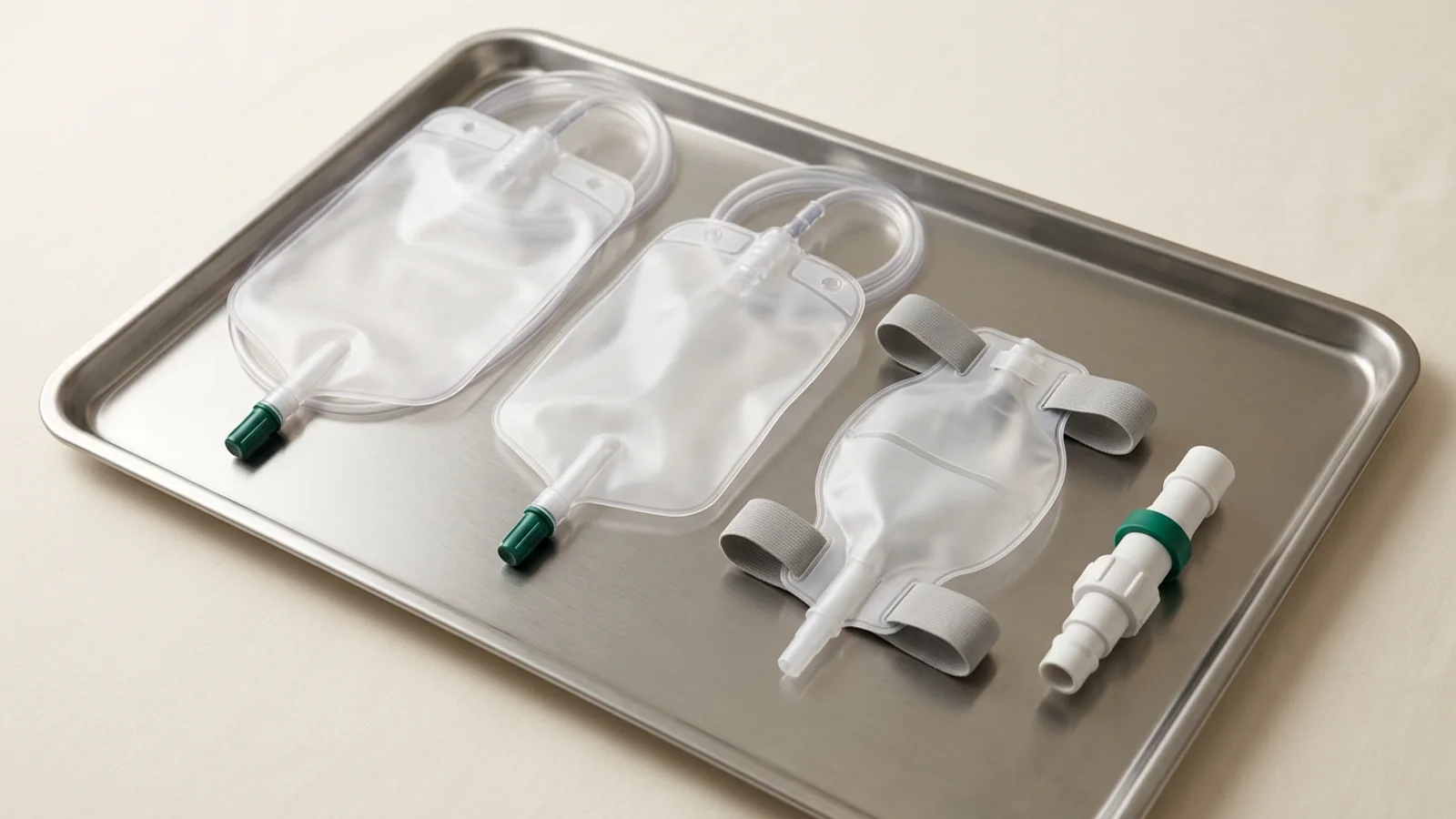
When sourcing medical urine collection bags, hospital procurement teams, distributor category managers, and value-analysis committees must specify products under their explicit regulatory generic type—21 CFR 876.5250 (urine collector and accessories)—rather than treating them as catalog accessories to urological catheters. A urine drainage bag is not a catheter, and generic catalog phrases like “2000 mL bedside bag” or billing categories like HCPCS A4357 fail to capture essential safety controls, inlet geometry, or infection-prevention mechanisms. Under U.S. FDA regulations, collectors intended to connect to an indwelling catheter are classified as Class II (special controls) under product code KNX for standalone bedside bags or FCN for a urinary drainage collection kit intended for an indwelling catheter. Collectors not intended for an indwelling catheter—ambulatory leg bags and external urinary sheaths—are classified as Class I (general controls) under product codes FAQ (sterile leg bag), NNW (non-sterile leg bag), or EXJ (urosheath; not a drainage bag).
Write four labeled port fields as separate rows: the inlet connector to the catheter funnel (a universal or stepped connector as labeled—not an ISO 80369-3 ENFit enteral tip and not an IV Luer set), the sampling site, the non-return feature if fitted, and the outlet drainage tap. For adult body-worn or hanging bags, ask for a supplier declaration against ISO 8669-2:1996 covering public headings such as rated volume, leakage, and non-return valve if fitted. Do not reprint paywalled numeric limits. ISO 8669-2 excludes urimeters, paediatric bags, and urostomy pouches from its public scope, and a 20 September 2026 search of FDA's Recognized Consensus Standards database did not return a Rec# for it. 510(k) exemption under 21 CFR 876.9 is not FDA approval under 21 CFR 807.97, and it is not proof that two bags are interchangeable.
Specify an 876.5250 collector, not a Foley French size
A frequent source of hospital purchasing error is attempting to procure urinary drainage bags using Foley catheter sizing data. Under U.S. medical device regulations, catheters and collection bags belong to fundamentally distinct generic device classifications. As detailed in our Foley catheter sizing guide, an indwelling retention catheter is classified under 21 CFR 876.5130 (urological catheter and accessories) and evaluated against ASTM F623 for French outer diameter, balloon inflation symmetry, and true inner lumen cross-sectional drainage capacity. Similarly, intermittent catheters are governed under 21 CFR 876.5130 and ISO 20696 (reviewed in our intermittent catheter specifications reference). Neither regulation dictates drainage bag capacity, inlet tubing geometry, suspension hangers, or drain tap design.
By contrast, 21 CFR 876.5250 specifically defines a urine collector and accessories as a device intended to collect urine, consisting of tubing, a suitable receptacle, connectors, mechanical supports, and optional means to prevent the backflow of urine or the ascent of infection. The regulation establishes a strict statutory dividing line based on intended clinical connection:
Indwelling Connection (21 CFR 876.5250(b)(1)): Devices intended to be connected to an indwelling catheter are classified as Class II (special controls). Typical commercial configurations include standalone bedside drainage bags (product code
KNX) and urinary drainage collection kits for an indwelling catheter (product codeFCN).Non-Indwelling / External Connection (21 CFR 876.5250(b)(2)): Devices not intended to connect to an indwelling catheter are classified as Class I (general controls). This includes sterile ambulatory leg bags (product code
FAQ), non-sterile leg bags (product codeNNW), male external incontinence sheaths (product codeEXJ), closed systems for non-indwelling catheters (product codeEYZ). Adjacent Class II codesFOC(newborn urine-collection bag) andFFH(pediatric collector for an indwelling catheter) are different SKUs, not this Class I bucket, and ISO 8669-2 does not cover paediatric bags.
Both Class I and Class II devices under 21 CFR 876.5250 are currently exempt from 510(k) premarket notification requirements, subject to the generic exemption limitations established in 21 CFR 876.9. Under § 876.9, exemption applies only to the extent the device has existing or reasonably foreseeable characteristics of commercially distributed devices within that generic type. A 510(k) is still required when intended use differs (including a different medical purpose, or lay use where the former use was by health-care professionals only) or when fundamental scientific technology differs. Buyers should also remember 21 CFR 807.97: a substantial-equivalence determination does not denote official FDA approval, and any representation that creates an impression of official approval because of complying with premarket notification regulations is misleading misbranding. 510(k) exemption is a different status and is also not approval. Neither status proves two bags are interchangeable.
The 4 December 2025 QMSR technical amendments (90 FR 55978; 876.5250 amendment note 90 FR 55985; effective 2 February 2026) retargeted remaining records and complaint-file obligations for otherwise QMSR-exempt non-sterile Class I collectors from former §§ 820.180 and 820.198 to 21 CFR 820.35. That citation change did not reclassify urine collectors. Non-sterile Class I collectors remain exempt from the rest of part 820. Class II KNX and FCN records list GMP Exempt? No.
graph TD
    A["21 CFR 876.5250 Urine Collector & Accessories"] --> B{"Intended for Indwelling Catheter Connection?"}
    B -->|Yes| C["Class II Special Controls — 510(k) Exempt § 876.9"]
    C --> C1["KNX: Standalone Drainage Bag & Accessories"]
    C --> C2["FCN: Urinary Drainage Collection Kit / Tray"]
    B -->|No| D["Class I General Controls — 510(k) Exempt § 876.9"]
    D --> D1["FAQ: Sterile External Leg Bag"]
    D --> D2["NNW: Non-Sterile External Leg Bag"]
    D --> D3["EXJ: External Incontinence Sheath"]
D --> D4["EYZ: Closed Non-Indwelling Drainage System"]FDA's June 1994 guidance document, “Guidance for the Content of Premarket Notifications for Urine Drainage Bags,” remains officially listed as final (docket FDA-2020-D-0957). While written prior to FDA's Good Guidance Practices and not legally binding, this guidance reinforces the regulatory boundary separating indwelling Class II bags from external Class I devices. In modern procurement tenders, buyers should use the 1994 text to verify intended-use classifications, but should not expect routine 510(k) clearance letters for standard exempt KNX bags.
| Device Category | FDA Product Code | Regulatory Class | 510(k) Premarket Status | QMSR / Part 820 Scope | Clinical Interface & Use |
|---|---|---|---|---|---|
| Standalone Urine Drainage Bag | KNX | Class II (Special Controls) | Exempt subject to 21 CFR 876.9 | Full QMSR Part 820 compliance required | Intended to connect to an indwelling catheter; standalone hanging bag |
| Urinary Drainage Collection Kit | FCN | Class II (Special Controls) | Exempt subject to 21 CFR 876.9 | Full QMSR Part 820 compliance required | Collection kit for an indwelling catheter; not a standalone replacement bag |
| External Leg Bag (Sterile) | FAQ | Class I (General Controls) | Exempt subject to 21 CFR 876.9 | Full QMSR Part 820 compliance required | Ambulatory external-use leg bag; not a KNX bedside bag and not a urostomy pouch |
| External Leg Bag (Non-Sterile) | NNW | Class I (General Controls) | Exempt subject to 21 CFR 876.9 | Exempt from Part 820 except records under § 820.35 | Ambulatory collection; external condom catheter or sheath |
| External Incontinence Sheath | EXJ | Class I (General Controls) | Exempt subject to 21 CFR 876.9 | Full QMSR Part 820 compliance required | Urosheath / condom catheter; external male incontinence |
| Closed Non-Indwelling System | EYZ | Class I (General Controls) | Exempt subject to 21 CFR 876.9 | Full QMSR Part 820 compliance required | Non-indwelling urinary collection with closed fluid path |
Capacity is rated volume, not a universal 2000 mL SKU
Distributor catalogs often treat a “2000 mL bedside drainage bag” as an interchangeable commodity. Capacity is a labeled field, not a universal SKU. According to ISO 8669-2:1996, bag capacity is specified as rated volume—the manufacturer-stated capacity in millilitres. ISO 8669-2:1996 remains current (confirmed 10 May 2023, stage 90.93) and lists rated volume among its public requirement headings. Do not reprint paywalled numeric acceptance values from that standard.
Labeled examples are not a size law. BD’s public page for catalog 154002 is a 2000 ml bag (GTIN-each 00801741029509); the same family page states drainage bags are also offered in 4000 ml configurations. Medline’s urological catalog table lists 2000 mL bags (DYND15205, DYND25205) beside 4000 mL DYND15405, whose catalog text is for continuous bladder irrigation (CBI). A 4000 mL irrigation bag is not specified by copying a 2000 mL overnight-bag row. Do not infer clinical interchangeability from a shared millilitre family, and do not turn that distinction into a treatment protocol.
Furthermore, ISO 8669-2 separates collection bags into two distinct physical design architectures:
Non-Body-Worn (Hanging) Bags: Designed to be used with a hanger or floor stand. Write the labeled rated volume, inlet-tubing length, and hanger. Public hanging-bag examples include 2000 mL and 4000 mL configurations with 48-inch or 50-inch inlet tubing; those inches are labeled examples, not an ISO minimum.
Body-Worn Bags: Intended to be worn on the body with a labeled fastening (leg strap, waist strap, or pocket support in ISO 8669-1 vocabulary). Write the manufacturer-stated rated volume; do not invent a 500–1000 mL size law.
Open-Ended vs. Closed-Ended Construction: Under ISO 8669-2 public definitions, an open-ended bag has an opening for drainage of the contents; a closed-ended bag has no such opening. Write which architecture is on the label. Emptying and discard schedules are out of scope for this page.
Procurement teams must also respect the strict scope exclusions of ISO 8669-2. The standard explicitly states that it does not apply to:
Urostomy pouches and ostomy appliances (which interface with abdominal stomas, not urethral catheters);
Urimeters and precision hourly drainage meters (rigid plastic measurement chambers designed for intensive care urine output monitoring); and
Urine collection bags intended specifically for pediatric or neonatal use.
Citing ISO 8669-2 on a paediatric bag or a urimeter tender is a scope mismatch. FOC (newborn bag) and FFH (pediatric collector for an indwelling catheter) are separate Class II product codes under 21 CFR 876.5250, not adult KNX hanging bags, and ISO 8669-2 does not cover paediatric bags, urimeters, or urostomy pouches.
Finally, procurement specialists should be alert to data omissions within regulatory databases. In an audit of the FDA AccessGUDID database for primary DI 00801741029509 (representing the widely used Bard Urinary Drainage Bag with Anti-Reflux Chamber, catalog 154002), the public record shows that the “Clinically Relevant Size” field is completely blank. The 2000 mL rated volume appears only on the commercial packaging and physical labeling, not in the structured GUDID attributes. Furthermore, the GMDN code assigned to this record is 61355 (“Urethral catheterization support kit, urinary drainage”), which technically defines a complete catheter insertion kit rather than an individual drainage bag. Hospital systems that auto-populate enterprise resource planning (ERP) systems from raw GUDID data will inherit an unstated capacity and a misclassified device description unless manual procurement verification rules are enforced.
Ports are four labeled parts: inlet, sample site, non-return, outlet
Commercial catalog listings, e-commerce storefronts, and third-party DME vendor tables frequently collapse the distinct ports of a drainage bag into ambiguous phrases such as “Luer adapter” or “anti-reflux valve.” In accordance with ISO 8669-1:1988, which defines vocabulary for urine collection bags and does not recommend a design, style, or size. Connector, sampling site, drip chamber, non-return valve, and drainage tap are different terms. Write them as separate labeled parts; “anti-reflux valve” is a deprecated synonym for non-return valve.
1. Inlet Tubing and Catheter Funnel Connector
The inlet tube conducts urine from the catheter funnel into the collection receptacle. Public labeled examples include 48-inch tubing on Bard 154002 (McKesson specification row) and 50-inch (127 cm) star tubing on Medline’s drain-bag table; write the labeled length and lumen style rather than a 48–50 inch minimum. The inlet connector is a catheter-funnel connector as labeled (often described as a universal or stepped connector). It is never a threaded ISO 80369-7 vascular Luer lock (governed by our IV administration set guide) and never an ISO 80369-3 ENFit enteral connector (addressed in our ENFit syringe procurement reference). A protective cap is a labeled accessory if present; mark it unknown when the catalog is silent.
2. Dedicated Needleless Sampling Site
The sampling site is a separate labeled part from the inlet connector and the drainage tap. McKesson specification fields for Bard 154002 list Sample Port Type as Luer Lock and Drain Tube Type as Twist Valve; other reseller tables for the same catalog number print Drain Tube Type as Luer-Lock Adapter. Bard EZ-LOK language applies Luer lock or slip-tip syringes to the sampling port, not to the Foley inlet. Medline catalog rows such as DYND15205 and DYND15405 list a blunt-cannula sample port, which is not the same interface as a needleless Luer. Write the sampling-site type as labeled and mark unreported geometry unknown.
3. Non-Return Feature (Anti-Reflux Mechanism)
Non-return features, if fitted, are a labeled specification row—not a proof that every catalog “anti-reflux” string is the same part. ISO 8669-1 defines the term “non-return valve” and explicitly designates “anti-reflux valve” as a deprecated synonym, although “anti-reflux” remains ubiquitous in commercial marketing. Public labeled types include (a) mechanical valves, as labeled; (b) urine drip chambers, as labeled; and (c) anti-reflux towers (Medline catalog language: reflux protection without mechanical parts to hinder flow). ISO 8669-2 tests a non-return valve only if fitted; a general ISO 8669-2 declaration does not prove that heading was in scope.
4. Outlet Drainage Tap
The outlet drainage tap is the opening used to drain an open-ended bag. Write the labeled tap type rather than a generic “drain valve.” Public catalog examples include:
Twist Valves: McKesson lists Drain Tube Type as Twist Valve for Bard 154002.
Slide Taps / Push-Pull Valves: Medline DYND15205 is listed as a 2000 mL slide-tap bag.
Metal Pinch Clamps: Medline DYND15203 (2000 mL) and DYND15405 (4000 mL) are listed with metal-clamp outlets.
T-Tap / Flip Valves: A T-tap or flip valve, if that is the labeled outlet.
CDC Category IB emptying language (use a separate clean container; prevent contact of the drainage spigot with the nonsterile container) is a care recommendation, not a holster SKU law. Write the outlet type as labeled.
| Port Interface | ISO 8669-1 Defined Term | Physical Function | Commercial Design Types | Common Procurement Collision |
|---|---|---|---|---|
| Catheter Junction | Inlet tubing & connector | Mates with indwelling Foley catheter funnel to conduct drainage | Universal stepped taper; star-lumen kink-resistant vinyl tubing | Mistaking stepped taper for an IV Luer taper or ENFit enteral tip |
| Diagnostic Port | Sampling site | Permits needle-free syringe aspiration of urine specimens | Luer-slip/Luer-lock (Bard EZ-LOK); blunt cannula port (Medline) | Transcribing sample port Luer as a drainage tap or inlet specification |
| Reflux Barrier | Non-return valve | Prevents retrograde migration of pooled urine into catheter | Mechanical valve; drip chamber; anti-reflux tower | Assuming every “anti-reflux” catalog string meets ISO 8669-2’s non-return heading |
| Emptying Port | Drainage tap | Drains an open-ended bag; emptying technique is out of scope here | Twist valve; slide tap; metal pinch clamp; pivoting T-tap | Specifying a generic drain valve without the labeled tap type |
Compatibility is intended use plus the labeled pair, not HCPCS or ENFit
A frequent assumption in consumable purchasing is that any bedside drainage bag can be paired arbitrarily with any indwelling catheter simply because they share common healthcare reimbursement codes. In U.S. institutional procurement, hospital supply systems heavily rely on Healthcare Common Procedure Coding System (HCPCS) alphanumeric codes. Under CMS Medicare Coverage Database Policy Article A52521 (Urological Supplies):
HCPCS A4357 is defined as “Bedside drainage bag, day or night, with or without anti-reflux device, with or without tube, each.”
HCPCS A4358 is defined as “Urinary drainage bag, leg or abdomen, vinyl, with or without tube, with straps, each.”
CMS Policy Article A52521 is a payor reimbursement rule, not an FDA identity or a device standard. A4357’s long descriptor itself says “with or without anti-reflux device, with or without tube,” so a billing code does not prove a non-return feature or a sealed closed system. A52521 states that extension tubing (A4331) is included in the allowance for A4357 and A4358 and should not be separately billed with those codes, and that Foley insertion trays such as A4314 include A4357 among bundled items. HCPCS A4357 on a McKesson or Medline row does not prove KNX, ISO 8669-2, or a preconnected junction.
The disconnect between commercial catalog naming and regulatory classification is illustrated by historical 510(k) precedent. Premarket notification K953767 was cleared by FDA under the proprietary trade name “PROSYS BEDSIDE DRAINAGE BAG.” However, an examination of the official FDA decision record reveals that the product code assigned was FAQ—defined as “bag, urine collection, leg, for external use, sterile,” a Class I external device! An automated inventory search filtering on catalog trade names would present a legally classified external leg bag as a bedside indwelling collector. Sourcing decisions must prioritize 21 CFR 876.5250 product codes over commercial trade names.
Clinical compatibility also depends on whether the hospital operates an open or closed urinary drainage model. According to the CDC / HICPAC Guideline for Prevention of Catheter-Associated Urinary Tract Infections (CAUTI, updated June 2019):
CDC Category IB Recommendation: CDC III.A (Category IB) recommends maintaining a closed drainage system after aseptic insertion and replacing the catheter and collecting system using aseptic technique and sterile equipment if disconnection or leakage occurs. That is a specification and infection-prevention field, not a catheterization SOP.
CDC Category II Recommendation: Healthcare institutions should consider urinary catheter systems with preconnected, sealed catheter-tubing junctions (CDC III.A.2). FCN is the collection-kit product code; it is not automatically a sealed junction. Write the junction as labeled rather than inventing shrink-bands or welds.
A standalone KNX bag plus a separately issued Foley is not the same specification as a preconnected sealed system. Write the junction as labeled. Do not convert that distinction into a treatment protocol.
Finally, procurement agents must avoid cross-referencing irrelevant device clearances. For example, 510(k) K222059 (Coloplast SpeediCath Flex Set) cleared a single-use hydrophilic intermittent catheter with an integrated drainage bag. While the manufacturer's performance testing cited ISO 8669-2:1996 for the collection bag component alongside ISO 20696 for catheter friction, K222059 is classified as a urological catheter under 21 CFR 876.5130. A supplier citing K222059 is presenting an intermittent catheter clearance, not a valid predicate or compliance record for a bedside indwelling urine collection bag.
Closed-system and sterility fields are labeled, not infection-control branding
Infection prevention is the central clinical objective in urinary drainage procurement. However, hospital value-analysis teams must distinguish between verifiable labeling claims and marketing terminology. Sourcing criteria should align with established CDC/HICPAC evidence categories rather than speculative vendor claims:
Routine Sealed Circuit vs. Antiseptic Cartridges: Vendors may market “infection-control” or microbicidal-outlet bags as if they were required. However, CDC CAUTI Guideline Category II states that complex urinary drainage systems utilizing mechanisms for reducing bacterial entry such as antiseptic-release cartridges in the drain port are not necessary for routine use. A microbicidal-outlet bag is a labeled optional feature, not a CDC mandate, and not brand equivalence.
Unobstructed Drainage Architecture: CDC III.B (Category IB) recommends keeping the catheter and collecting tube free from kinking, keeping the collecting bag below the bladder, and not resting it on the floor. Write tubing lumen style and hanger as labeled so those care recommendations can be met; CDC does not name star-lumen or dual-hook SKUs.
Diagnostic Specimen Acquisition: CDC III.U.1 (Category IB) directs small-volume urinalysis or culture specimens to the needleless sampling port after disinfectant cleansing; III.U.2 directs large volumes for special analyses (not culture) to the drainage bag. That is a specification field for the sampling site, not a sampling SOP. A bag without a labeled sampling site is a different SKU from one with a needleless port.
Sterility is a labeled field. Public catalog rows use different words; copy the printed claim rather than treating them as synonyms:
1. Sterile (Ethylene Oxide / Gamma / E-beam): The device is labeled sterile. Do not infer a sterility-assurance level that the label does not state. AccessGUDID 00801741029509 (Bard 154002) is packaged as sterile; that is an example row, not a category SAL.
2. Sterile Fluid Pathway: A labeled claim on some bedside bags (Medline catalog examples DYND15203 and DYND15205). It is not the same row as “OR sterile.”
3. Operating Room (OR) Sterile: A labeled claim (Medline catalog examples DYND25205 and DYND15405). Copy the printed sterility field; do not infer wrapping details the catalog does not state.
4. Non-Sterile: Typical for external ambulatory leg bags (product code NNW) connecting to external condom sheaths. As established under the 2026 QMSR amendments, non-sterile Class I collectors remain obligated to maintain distribution records and complaint files under 21 CFR 820.35.
Write single-use and latex statements as labeled. AccessGUDID 00801741029509 is single-use, Rx, and labeled not made with natural rubber latex; that is an example, not a category law. Storage, transit, and symbol evidence belong on the labeled storage and transport evidence guide.
Receiving worksheet: identity, volume, ports, and what not to copy
To protect healthcare facilities from misclassified consumables, port mismatch, and unverified vendor equivalence claims, procurement teams and receiving departments should implement the following standardized value-analysis checklist before awarding tenders or logging incoming inventory into enterprise hospital systems:
| Specification Domain | Mandatory Sourcing Parameter | Regulatory / Standard Reference | Verification & Audit Method | Sourcing Pitfall & Red Flag |
|---|---|---|---|---|
| Regulatory Identity | 21 CFR 876.5250 identity and product code: KNX standalone bag or FCN kit if intended for an indwelling catheter; FAQ/NNW if an external-use leg bag; not EXJ sheath and not 876.5130 Foley | FDA 21 CFR 876.5250; 21 CFR 876.9; 21 CFR 807.97 | Inspect FDA Establishment Registration & Device Listing; AccessGUDID device identifier | Tendering external leg bags (FAQ) under 'bedside' trade names; claiming FDA approval |
| Rated Volume | Manufacturer-stated rated volume in mL; do not rely on GUDID size (often empty) | ISO 8669-2:1996 rated-volume heading; manufacturer-stated millilitres | Review primary package labeling; do not rely on GUDID (frequently unpopulated) | Assuming every bag is 2000 mL, or copying a 2000 mL overnight row onto a 4000 mL irrigation SKU |
| Inlet Connector | Inlet connector as labeled (universal/stepped catheter funnel, not sample-port Luer); tubing length and lumen style as labeled | ISO 8669-1:1988 connector / inlet-tubing vocabulary; manufacturer sheet as labeled | Compare the labeled inlet connector and tubing style to the catalog row; mark unreported geometry unknown | Misidentifying catheter connector as an ISO 80369-7 Luer or ISO 80369-3 ENFit enteral tip |
| Sampling Site | Dedicated needle-free aspirating port (Luer-slip/Luer-lock or blunt cannula) | CDC III.U needleless sampling-port field; ISO 8669-1 sampling-site vocabulary | Match the labeled sampling-site type (needleless Luer, blunt cannula, or needle) to the SKU; do not copy it as the Foley inlet | Reseller listings describing sampling Luer as 'Drain Tube Type: Luer-Lock Adapter' |
| Non-Return Mechanism | Non-return feature as labeled, if fitted (drip chamber, mechanical valve, or anti-reflux tower) | ISO 8669-2:1996 non-return valve heading (if fitted) | Ask whether the ISO 8669-2 declaration actually covers the non-return heading | Assuming a general ISO 8669-2 declaration proves a non-return feature |
| Drainage Tap | Outlet drainage tap as labeled (twist, slide-tap, clamp, or T-tap) | ISO 8669-1 drainage-tap vocabulary; CDC IB emptying language is not a holster SKU law | Confirm the labeled tap type; do not invent a holster requirement | Treating any drain tap as equivalent, or converting CDC emptying language into a bedside SOP |
| Suspension Hardware | Hanger/fastening as labeled (hook, string, sheet clamp, or leg straps) | ISO 8669-2 attachment-system strength heading; hanger type as labeled | Confirm the labeled hanger; CDC IB keep-below-bladder / off-the-floor language is a care recommendation, not a tensile-test number | Assuming any hanger on a 2000 mL row will serve an unlabeled 4000 mL irrigation bag |
| Sterility & Packaging | Sterile, sterile fluid pathway, OR sterile, or non-sterile as labeled; single-use and latex statements as printed | Labeled sterility claim; 21 CFR 876.5250(b)(2) remaining 820.35 records for non-sterile Class I | Inspect pouch barrier integrity, lot number, expiration date, and UDI barcode | Treating sterile, sterile-fluid-pathway, OR sterile, and non-sterile as interchangeable |
Sources
Cornell LII — 21 CFR 876.9 Limitations of exemptions from section 510(k)
Cornell LII — 21 CFR 876.5130 Urological catheter and accessories
Cornell LII — 21 CFR 807.97 Misbranding by reference to premarket notification
U.S. FDA Product Classification — KNX Collector, urine, (and accessories) for indwelling catheter
U.S. FDA Product Classification — FCN Urinary drainage collection kit, for indwelling catheter
U.S. FDA Product Classification — FAQ Bag, urine collection, leg, for external use, sterile
U.S. FDA Product Classification — NNW Bag, urine collection, leg, for external use, non-sterile
U.S. FDA Product Classification — EXJ Device, incontinence, urosheath type, sterile
U.S. FDA Guidance — Content of Premarket Notifications for Urine Drainage Bags (June 1994)
ISO — ISO 8669-2:1996 Urine collection bags — Part 2: Requirements and test methods
ISO — ISO 8669-1:1988 Urine collection bags — Part 1: Vocabulary
U.S. CDC / HICPAC — Guideline for Prevention of CAUTI (2009) Summary of Recommendations
U.S. NLM AccessGUDID — Bard Urinary Drainage Bag with Anti-Reflux Chamber (DI 00801741029509)
McKesson SupplyManager — Bard 154002 Urinary Drain Bag Product Specifications
Medline Industries — Urologicals Catalog: Drain-Bag Specification Table (LIT184)
Centers for Medicare & Medicaid Services — DME MAC Policy Article A52521: Urological Supplies
U.S. FDA 510(k) Premarket Notification — K953767 ProSys Bedside Drainage Bag (FAQ)
U.S. FDA 510(k) Premarket Notification — K222059 Coloplast SpeediCath Flex Set Summary
ASTM International — ASTM F623 Standard Performance Specification for Foley Catheters
U.S. FDA — Enteral Feeding Connector Safety Communication (Out of scope for urinary drainage)