
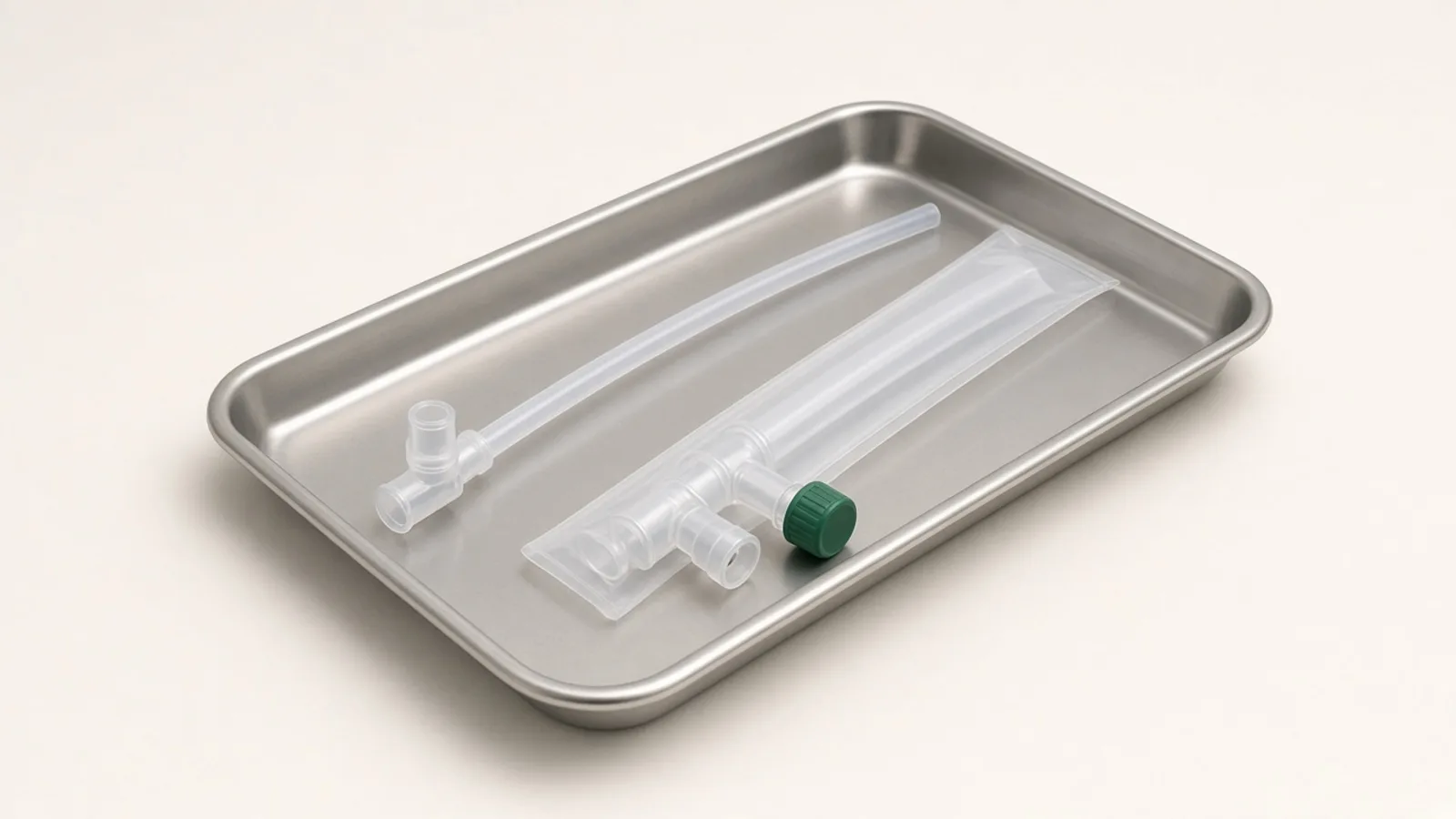
Direct Answer: Specify an airway suction catheter as a 21 CFR 868.6810 Class I tracheobronchial suction catheter under FDA product code BSY, declaring compliance with ISO 8836:2019 (recognized in full under FDA Rec# 1-150). Do not specify airway suction catheters using general-hospital suction codes (product code JOL under 21 CFR 880.6740), oral cavity evacuator codes (product code EHZ under 21 CFR 872.6640), bronchoalveolar lavage codes (product code OYI), or artificial airway conduit codes (product code BTR under 21 CFR 868.5730). Class I 510(k) exemption, subject to 21 CFR 868.9, applies only to devices that have existing or reasonably foreseeable characteristics of commercially distributed devices in that generic type; exemption is not a waiver of ISO 8836, establishment registration, device listing, quality-system obligations (BSY is not GMP-exempt), or a labeled sterile claim. Purchasing worksheets must capture open versus closed in-line configuration, labeled French (Charrière) size with any printed millimetre outer diameter, labeled length (including endotracheal versus tracheostomy length on closed systems), tip geometry as labeled, control vent (open chimney or directional vent versus closed thumb-valve), and machine-end connector sex (male, female, or both, consistent with the 2019 reinstatement of the female connector). For closed systems add the circuit adapter (T-piece, elbow, Y-adapter, or double-swivel elbow), protective sleeve, and the labeled in-use replacement interval. Closed-system residual-vacuum evidence is an ISO 8836 Annex C field for the supplier file; do not convert it into a clinical suction-pressure setting. Specify the vacuum source separately under ISO 10079. Do not copy Foley French charts, IV cannula gauge or colour conventions, or suction-pressure, insertion-depth, or patient-specific sizing instructions onto this line.
Specify a BSY tracheobronchial catheter, not a Foley, IV, ETT, Yankauer, or JOL tip
A recurrent error in respiratory and surgical consumable procurement occurs when distributor catalogs or hospital requisitions group all suction products under generic "catheter" or "suction tip" headings. Airway suction consumables intended for respiratory clearance must be classified under 21 CFR 868.6810 as a tracheobronchial suction catheter, bearing FDA product code BSY. The federal regulation defines a tracheobronchial suction catheter as a device used to aspirate liquids or semisolids from a patient's upper airway. Governed by the Division of Anesthesia, Respiratory, and Sleep Devices (DHT1C), BSY devices are Class I medical devices subject to general controls. While 21 CFR 868.6810 specifies 510(k) premarket notification exemption subject to 21 CFR 868.9, the device is not GMP-exempt. Manufacturers must still register their establishment. BSY is not GMP-exempt.
Procurement teams must carefully distinguish product code BSY from adjacent hospital suction codes that carry distinct regulatory scopes, performance benchmarks, and hazard profiles:
General-Hospital Suction Accessories (21 CFR 880.6740, Product Code JOL): Classified as a Class II vacuum-powered body fluid suction apparatus accessory under DHT3C, product code JOL covers general hospital suction catheters, aspirating tubing, rigid suction tips, and collection canisters. JOL consensus standards recognize USP sodium chloride and sterile water irrigation monographs, but do not encompass ISO 8836 respiratory performance. Illustrating the risk of code confusion, FDA Class 1 recall Z-1043-2024 listed Cardinal Health Argyle suction catheter trays with chimney valves under product code JOL across sizes 6 Fr through 18 Fr. Requisitioning a JOL item does not legally or technically guarantee compliance with respiratory-tract suction standards.
Oral Cavity Evacuators and Yankauer Tips (21 CFR 872.6640, Product Code EHZ): Rigid or flexible Yankauer oral suction tips are a different family from ISO 8836 flexible respiratory-tract catheters. FDA product code EHZ is evacuator, oral cavity, under 21 CFR 872.6640 (dental operative unit and accessories), Class I, 510(k) exempt. ISO 10079-1:2015's public scope excludes end-pieces such as suction catheters, drains, curettes, Yankauer suckers, and suction tips. Some Yankauer listings may instead use JOL; specify by the labeled product code. An EHZ or JOL oral tip is not a BSY/ISO 8836 airway-catheter specification.
Non-Bronchoscopic Bronchoalveolar Lavage Catheters (21 CFR 868.6810, Product Code OYI): OYI shares 21 CFR 868.6810 and Rec# 1-150 mapping, but FDA defines it to perform non-bronchoscopic bronchoalveolar lavage in adult patients undergoing mechanical ventilation by inserting a catheter to collect lavage specimens. That is a specimen-collection intended use, not an open or closed airway-suction SKU.
Furthermore, buyers must prevent cross-specialty confusion with catheter families published elsewhere across this guide. Tracheal tubes governed by 21 CFR 868.5730 and product code BTR (detailed in our endotracheal tube specifications guide) represent the artificial airway conduit, evaluated under ISO 5361 and fitted with 15 mm conical connectors; they are not the suction catheter itself. Similarly, urinary Foley catheters governed by ASTM F623 and ISO 20696 (analyzed in our Foley catheter procurement guide and intermittent urethral catheter reference) incorporate balloon inflation channels and drainage lumen geometry engineered for urinary bladder drainage, possessing zero relevance to airway aspiration. Vascular catheters and peripheral cannulas governed by ISO 10555 and ISO 6009 (reviewed in our intravascular catheter guide and IV cannula size and colour reference) adhere to vascular needle gauge and hub colour-coding standards that must never be transposed onto respiratory consumables.
| Regulation & Code | Official Device Name | Device Class & 510(k) Status | Intended Scope & Airway Application | Key Distinctions & Sourcing Risks |
|---|---|---|---|---|
| 21 CFR 868.6810 / BSY | Catheters, suction, tracheobronchial | Class I (General Controls), 510(k) Exempt (subject to § 868.9) | Upper airway, endotracheal, and tracheostomy aspiration (open and closed in-line) | Core generic type for respiratory suction catheters; requires registration, listing, and GMP/QSR compliance; exemption is not a sterility waiver. |
| 21 CFR 880.6740 / JOL | Catheter and tip, suction | Class II (Special Controls), 510(k) Exempt (subject to § 880.9) | General-hospital body fluid evacuation powered by external vacuum source | General hospital accessory under DHT3C; recognizes USP irrigation water monographs, not ISO 8836; listed in recall Z-1043-2024 for Argyle trays. |
| 21 CFR 872.6640 / EHZ | Evacuator, oral cavity | Class I, 510(k) Exempt | Oral cavity macroscopic fluid and debris aspiration | Dental and rigid/flexible Yankauer oral suction handles under DHT1B; excluded from ISO 10079-1 scope; cannot replace respiratory-tract catheters. |
| 21 CFR 868.6810 / OYI | Non-bronchoscopic bronchoalveolar lavage catheter | Class I, 510(k) Exempt | Diagnostic lavage specimen collection from lower respiratory tract in ventilated adults | Specimen-collection identity, not an open or closed airway-suction SKU; mapped to Rec# 1-150 for construction but a different intended use. |
| 21 CFR 868.5730 / BTR | Tube, tracheal (w/wo connector) | Class II, 510(k) required | Patient airway conduit providing artificial ventilation pathway | The artificial airway through which a suction catheter passes; governed by ISO 5361 and 15 mm conical connectors, not ISO 8836. |
ISO 8836:2019 is the particular standard; 2014 and the DIS are not
The benchmark technical consensus standard for respiratory suction catheters in the United States and international commerce is ISO 8836:2019 (Fifth edition, published December 2019), titled Suction catheters for use in the respiratory tract. In the United States, FDA recognizes ISO 8836:2019 in full under Recognition Number 1-150 (Federal Register recognition list 055, date of entry 21 December 2020). FDA Rec# 1-150 explicitly maps to 21 CFR 868.6810 product codes BSY, OFO, OFR, OFS, and OYI. Premarket submissions, supplier declarations of conformity (DoC), and tender technical dossiers should be prepared in alignment with FDA's recognized standards program and the guidance Appropriate Use of Voluntary Consensus Standards in Premarket Submissions (September 2018).
The public scope of ISO 8836:2019 specifies dimensional requirements and performance verification for suction catheters made of flexible materials, encompassing both open single-use catheters and closed (in-line) suction systems intended for respiratory tract clearance. The standard explicitly excludes:
Suction catheters intended for use with flammable anaesthetic gases or agents;
Catheters intended for use with surgical lasers (directing users to ISO/TR 11991 for laser surgery of the upper airway);
Catheters intended for use with electrosurgical equipment.
Understanding the evolution of ISO 8836 is essential for evaluating supplier quality packages. ISO 8836:2019 canceled and replaced the fourth edition (ISO 8836:2014). The public foreword of the fifth edition details three critical technical modifications that directly affect product specifications:
Reinstatement of the Female-Type Connector: ISO 8836:2014 required a male-type suction catheter connector. ISO 8836:2019 ended the male-only requirement and reinstated the female-type suction catheter connector. Specify the machine-end connector as labeled: male, female, or both. Do not treat a female connector as a nonconformity against the 2019 edition.
Revision of Terms and Definitions: The public foreword states that terms and definitions were revised. Do not import paywalled definition tables into the tender; capture the labeled size, length, adapter, and vent fields instead.
Revised Residual Vacuum Measurement for Closed Catheters: The public foreword states that the conditions for measuring residual vacuum in closed suction catheters were revised. Ask for Annex C evidence in the supplier file; do not quote paywalled numeric residual-vacuum limits as a clinical pressure setting.
Buyers must be vigilant regarding superseded certificates and unapproved drafts. A supplier declaration citing ISO 8836:2014 reflects a withdrawn standard whose transition period has expired. Furthermore, the 2014 edition included historical abstract language mentioning angled-tip (Coude) catheters and aspirator collectors that was revised in 2019; buyers must not cite 2014 text as current requirements. Conversely, ISO/DIS 8836 (sixth edition, project standard 92128) is currently under active development, having completed its Draft International Standard ballot closure on 27 May 2026 (stage 40.60, close of voting). While ISO/DIS 8836 signals future revisions, it remains an unadopted draft that has not been published as an International Standard and is not recognized under FDA Rec# 1-150. Hospital contracts must cite ISO 8836:2019 as the active specification baseline.
| Standard Edition & Status | FDA Recognition Status | Public Scope & Exclusions | Machine-End Connector Interface | Closed-System Residual Vacuum Evidence |
|---|---|---|---|---|
| ISO 8836:2014 (Superseded) | Superseded; historical transition expired | Open and closed flexible respiratory suction catheters; historical text noted Coude tips and aspirators | Restricted machine-end connection to male-only connector geometry | Established Annex C residual vacuum test under earlier measurement conditions. |
| ISO 8836:2019 (Fifth Edition) | Complete Recognition: FDA Rec# 1-150 (FR List 055, Entry 21 Dec 2020) | Open and closed flexible catheters for respiratory tract; excludes flammable gases, lasers (ISO/TR 11991), electrosurgery | Reinstates female connector; eliminates male-only mandate; allows male, female, or universal fittings | Revised test conditions in Annex C for measuring residual vacuum in closed suction catheter assemblies. |
| ISO/DIS 8836 (Sixth Edition) | Not Recognized (Under Development; project standard 92128) | Proposed revisions to open and closed respiratory suction catheters; retains laser/electrosurgical exclusions | Not a current specification baseline; do not specify SKUs to the DIS | Draft only; public abstract still covers open and closed flexible respiratory-tract catheters with the same laser, electrosurgical, and flammable-agent exclusion. Do not treat DIS clauses as Rec# 1-150. |
Open versus closed: circuit adapter, sleeve, and labeled in-use interval
Under ISO 8836:2019, open suction and closed (in-line) suction represent distinct device configurations rather than proprietary brand categories. Specify the labeled open or closed configuration rather than treating those words as brand names:
Open suction catheters are an ISO 8836 configuration: a flexible catheter with an open control vent (chimney or directional port) at the machine end, without a protective sleeve that stays in the ventilator circuit. They are specified as labeled single-use items. Do not treat an open catheter as "the same SKU without a sleeve," and do not write disconnection technique, suction pressure, or dwell instructions into the purchase specification.
Closed (in-line) suction systems are the other ISO 8836 configuration. Public 510(k) summary K031997 describes an in-line closed suction system that connects to the patient's endotracheal or tracheostomy tube and allows suction of tracheobronchial secretions without disconnecting the ventilator. FDA's 16 April 2025 Ballard communication states those systems are used to remove secretions from the airway in patients receiving mechanical ventilation, minimizing the risks associated with disconnecting the ventilator circuit. Specify the labeled sleeve, patient-connection adapter, and in-use interval; do not rewrite that intended-use sentence as a clinical protocol or a brand ranking.
Public regulatory filings establish clear specification baselines for closed suction systems. Premarket notification summary 510(k) K031997 (Mallinckrodt DAR Ty-Care and Ty-Care exel Closed Suction Systems) classifies Ty-Care / Ty-Care exel as Class I BSY devices indicated for endotracheal and tracheostomy suction of adult and pediatric intubated patients including neonates, single use only. Current BSY listings may be 510(k) exempt subject to 21 CFR 868.9; use K031997 for labeled fields, not as a rule that every closed system still files a 510(k). That file's labeled in-use replacement intervals are:
Ty-Care Standard (Fixed Assembly): Ty-Care (fixed version) is described as remaining in place up to 48 hours;
Ty-Care exel (Modular Assembly): Ty-Care exel is detachable, with the suction catheter to be replaced after 24 hours and the angled connector (elbow) after 72 hours, plus a rotating patient-access valve.
Those 24-, 48-, or 72-hour figures are that labeled system's statements, not a universal clinical dwell protocol. Specify the in-use interval only as printed on the named SKU; do not invent a hospital-wide replacement clock.
The critical importance of sterile barrier integrity in closed systems was underscored by FDA's Class I recall communication on 16 April 2025 regarding Avanos Medical Ballard Closed Suction Systems. Categorized under product code BSY, the recall was initiated due to a lack of sterility assurance (risk of non-sterility). Beyond safety oversight, the public recall records provide a comprehensive specification matrix of labeled closed-system attributes:
Patient Population Segregation: Neonate/pediatric versus adult lines, with labeled French size (the public table names 8 F, 10 F, and 14 F);
Airway Adapter Geometry: Adapter style as labeled: Y-adapter, elbow, T-piece, and DSE (double swivel elbow);
Catheter Cleaning Technology: Turbo-Cleaning named as a labeled variant on some adult 14 F DSE rows;
Medication Delivery Ports: Optional MDI port as a labeled SKU field, with REF and UDI-DI on the public table.
Specification worksheets must capture these mechanical rows. However, procurement contracts must never specify clinical technique. Vacuum suction pressures (mmHg or kPa), insertion depths, suctioning dwell times, and pre-oxygenation protocols belong exclusively to hospital clinical policies and physician orders.
flowchart TD
    A["Airway suction catheter requisition"] --> B{"Labeled identity is 21 CFR 868.6810 product code BSY?"}
    B -- "No" --> C["Do not copy JOL 880.6740, EHZ 872.6640, OYI BAL, or BTR tracheal-tube identity"]
    B -- "Yes" --> D{"Labeled ISO 8836 configuration: open or closed?"}
    D -- "Open" --> E["Capture French size, length, tip, chimney or directional vent, connector sex"]
    D -- "Closed" --> F["Capture adapter, sleeve, ET versus tracheostomy length, labeled in-use interval"]
    E --> G["ISO 8836:2019 / Rec 1-150, sterility as labeled, lot, UDI"]
    F --> G
G --> H["Specify vacuum source separately under ISO 10079"]| Specification Field | Open Suction Catheter Systems | Closed (In-Line) Suction Catheter Systems | Procurement & Regulatory Rationale |
|---|---|---|---|
| Ventilator Circuit Integrity | No in-line sleeve; suctioning an intubated ventilated patient is a circuit-disconnect configuration, not a separate identity | Connects to the endotracheal or tracheostomy tube and remains in the circuit for the labeled interval | FDA's Ballard communication frames closed systems as minimizing risks associated with disconnecting the ventilator circuit; that is intended-use language, not a procurement outcome guarantee. |
| Catheter Barrier Protection | Flexible catheter without a circuit sleeve; labeled single-use | Sealed inside flexible, translucent polymer protective sleeve | Protective sleeve is a closed-system specification row. Sterility remains a labeled claim and a lot-release field even for Class I 510(k)-exempt devices. |
| Airway Connection Interface | No integrated circuit adapter; specify French size, length, tip, and vent from the label | Integrated circuit adapter: T-piece, fixed elbow, Y-adapter, or double-swivel elbow (DSE) | Closed-system patient connection ports mate with the airway/ventilator circuit, not with a Luer, ENFit, or Foley funnel. Match the labeled adapter to the circuit; ISO 5356-1 is the conical-connector family named in the ISO 8836 public preview. |
| Suction Control Mechanism | Open chimney vent or directional thumb port requiring manual occlusion | Push-button thumb valve / suction-control device with locking mechanism | Ask for ISO 8836 Annex C residual-vacuum evidence for closed systems. Do not quote paywalled numeric limits or rewrite them as a clinical suction-pressure protocol. |
| Irrigation & Auxiliary Ports | None on catheter body; external saline bottle/ampoule required | Integrated irrigation/flush port and optional MDI medication port | Capture labeled irrigation/flush port and optional MDI port as SKU fields. Do not write lavage technique into the specification. |
| Labeled In-Use Duration | Single-use, single-procedure disposal immediately after aspiration | Labeled replacement interval (e.g., 24-hour, 48-hour, or 72-hour system per 510(k)/IFU) | Quote only the labeled interval from a named public file (for example K031997). Do not invent a universal in-use duration. |
French size, length, tip, and vent are labeled fields—not Foley or IV charts
French (Charrière) size is a labeled outer-diameter field on this family, not a Foley balloon chart and not an IV gauge. Cardinal Health's Argyle suction catheter trays with chimney valve print Fr/Ch with a millimetre equivalent on the catalog page. Quote those millimetre figures as that manufacturer's labeled size, not as a reprint of the paywalled ISO 8836 designated-size table. Cardinal's published graduated trays include:
5 Fr/Ch (1.67 mm OD)
6 Fr/Ch (2.0 mm OD)
8 Fr/Ch (2.67 mm OD)
10 Fr/Ch (3.33 mm OD)
12 Fr/Ch (4.0 mm OD)
14 Fr/Ch (4.67 mm OD)
16 Fr/Ch (5.33 mm OD)
18 Fr/Ch (6.0 mm OD)
The public introduction to ISO 8836:2019 states that size designation is important because of its relationship to the ease with which the catheter can be passed through a tracheal or tracheostomy tube. Point the airway identity to the published ISO 5361 endotracheal-tube page; ISO 5366 covers tracheostomy tubes and connectors. Buyers must never convert this physical principle into a rigid clinical formula (including any "half the airway ID" suctioning rule). Procurement captures the labeled French size and any printed millimetre OD so clinicians can match the SKU to the labeled airway; it does not write a patient-specific sizing protocol.
Catheter length is another critical labeled attribute:
Standard Endotracheal Length: Closed-system catalogs distinguish endotracheal length from tracheostomy length. Specify the labeled length printed for that SKU; do not invent a centimetre range or an insertion-depth protocol.
Dedicated Tracheostomy Length: Where a closed system is labeled for tracheostomy rather than endotracheal use, capture that length designation as a specification row. Do not copy a Foley, IV, or ETT length table onto this SKU, and do not write insertion-depth or trauma instructions.
Tip geometry is a labeled field, not a clinical trauma claim. Specify the tip as printed. Public examples include:
Whistle Tip: A labeled whistle-tip style where that term appears on the SKU;
DeLee Pediatric Tip: Cardinal names a DeLee pediatric tip on the Argyle chimney-valve family; treat that as a labeled tip style, not a trauma-reduction protocol;
Coude (Angled) Tip: A directional or Coude tip only when that geometry is labeled. Do not treat ISO 8836:2014's Coude/aspirator-collector abstract sentence as 2019 scope.
Control vents are specification rows. Open catheters are labeled with a chimney-style valve or a directional vent. Closed systems are labeled with a thumb-valve or suction-control device. For closed systems, residual-vacuum evidence belongs in the ISO 8836 Annex C supplier file. Do not write occlusion technique, suction pressure, or a clinical shutoff protocol into the purchase specification.
ISO 10079 is the vacuum source; kits are OFO, OFR, and OFS
A frequent area of confusion in supply chain management involves the regulatory boundary between the suction catheter and the vacuum power supply. The FDA product classification record for product code BSY lists consensus standards ISO 10079-2:2022 (manually powered medical suction equipment, Rec# 1-155), ISO 10079-3:2022 (suction equipment powered from vacuum or positive-pressure gas, Rec# 1-156), and ISO 4135:2022 (anaesthetic and respiratory equipment vocabulary, Rec# 1-189). Buyers frequently assume this makes ISO 10079 the governing standard for the suction catheter itself.
This is a technical misconception. ISO 10079 specifies medical suction equipment—the vacuum source (electric pumps, pipeline suction regulators, canisters, and manual aspirators). The public scope of ISO 10079-1:2015 states that the standard does not apply to end-pieces such as suction catheters, drains, curettes, Yankauer suckers, and suction tips. The current electrically powered equipment edition is ISO 10079-1:2022; its public catalogue abstract is sparse, so do not assume the 2015 exclusion sentence is reprinted there. ISO 10079-2 and ISO 10079-3 appear on the BSY record because the catheter is used with suction equipment; they do not make ISO 10079 the particular standard for the catheter. Specify the catheter to ISO 8836:2019 / Rec# 1-150 and the vacuum source separately to the applicable ISO 10079 part.
Additionally, buyers must navigate pre-packaged kit codes under 21 CFR 868.6810. FDA classifies multi-component suction kits under three dedicated product codes:
Product Code OFO: Airway suction kit;
Product Code OFR: Tracheobronchial suction catheter kit;
Product Code OFS: Tracheal suction set.
All three convenience kit codes carry Class I status under submission type Enforcement Discretion, governed by FDA's 20 May 1997 Convenience Kits Interim Regulatory Guidance. Under this guidance, convenience kits assembled from legally marketed devices and non-medical supplies do not require a separate 510(k) if they meet the guidance. Cardinal Health Argyle chimney-valve trays publish labeled open-system French sizes and kit contents (nitrile powder-free gloves; some trays add a 100 mL bottle of sterile saline), but FDA recall Z-1043-2024 lists those Argyle trays under product code JOL, not as OFO, OFR, or OFS. Do not treat a JOL tray listing as a 868.6810 convenience-kit identity.
OFO, OFR, and OFS describe convenience-kit configurations, not substitutes for ISO 8836 catheter fields. Use those codes only when the SKU is actually a 868.6810 convenience kit. Still capture the catheter's open versus closed configuration, French size, length, vent, connector, and—when closed—adapter from the labeled contents.
| Identifier / Standard | Regulatory / Technical Designation | Regulatory Mechanism & Guidance | Clinical Scope & Sourcing Boundary |
|---|---|---|---|
| Product Code OFO | Airway suction kit (21 CFR 868.6810) | Enforcement Discretion under FDA Convenience Kits Guidance (20 May 1997) | Pre-packaged kit containing airway suction catheter plus procedure accessories (e.g., gloves, drape, basin). |
| Product Code OFR | Tracheobronchial suction catheter kit (21 CFR 868.6810) | Enforcement Discretion under FDA Convenience Kits Guidance (20 May 1997) | Packaged procedure kit tailored for endotracheal or tracheobronchial suctioning. |
| Product Code OFS | Tracheal suction set (21 CFR 868.6810) | Enforcement Discretion under FDA Convenience Kits Guidance (20 May 1997) | Multi-component set configured for open tracheal aspiration; not an ISO 5361 tracheal tube. |
| ISO 10079-1:2022 | Electrically powered medical suction equipment | Electrically powered suction-equipment particular standard; not listed on the BSY catheter record | ISO 10079-1:2015 public scope excludes end-pieces such as suction catheters and Yankauer suckers. Do not use ISO 10079-1 as the catheter particular standard. The current equipment edition is ISO 10079-1:2022. |
| ISO 10079-2:2022 | Manually powered medical suction equipment | Listed on BSY classification record (Rec# 1-155) | Specifies manual foot-operated or hand-operated suction pumps used with catheters in field or transport settings. |
| ISO 10079-3:2022 | Suction equipment powered from vacuum or pressure gas | Listed on BSY classification record (Rec# 1-156) | Specifies pipeline vacuum regulators and Venturi suction units driving aspiration through the catheter. |
Receiving worksheet: identity, configuration, sterility, and what not to copy
To translate regulatory and engineering standards into practical hospital receiving and value-analysis routines, procurement teams should deploy a structured inspection worksheet. Goods receipt verification must confirm physical labeling, packaging integrity, and conformity documentation before batches are released into clinical circulation.
Receiving docks must verify Unique Device Identification (UDI) compliance under 21 CFR 801.20. Capture lot, expiry, and UDI from the label into the receiving record, and verify GUDID identity against the labeled product code, following UDI and GUDID consumable receiving guide. Storage and transit follow labeled limits, detailed in our medical consumables storage and transport guide, ensuring that sterile barrier pouches have not been compromised by environmental exposure or shipping crush.
| Specification Attribute | Target Standard / Benchmark | Verification Evidence / Field Check | Rejection Criteria / Boundary Warning |
|---|---|---|---|
| FDA Classification & Identity | 21 CFR 868.6810, Product Code BSY | GUDID device listing, establishment registration, 510(k) if non-exempt under § 868.9 | Reject JOL (880.6740) or EHZ (872.6640) substitutions; reject claims of "FDA-approved". |
| Particular Standard Conformity | ISO 8836:2019 (FDA Rec# 1-150) | Manufacturer Declaration of Conformity (DoC), test summary citing ISO 8836:2019 | Reject superseded ISO 8836:2014 certificates; reject unadopted ISO/DIS 8836 specifications. |
| Product Configuration | Open catheter vs Closed in-line system | Packaging label, visual inspection of protective sleeve and circuit adapter | Reject unverified open catheter substitution for mechanical ventilation lines requiring closed circuits. |
| Dimensional Sizing (Fr/Ch & mm) | Labeled French size (6 to 18 Fr) and OD in mm | Packaging label, IFU print (e.g., 14 Fr / 4.67 mm OD), catheter body markings | Reject unlabeled OD; reject reuse of IV cannula or Foley catheter sizing charts. |
| Catheter Insertion Length | Labeled length (cm/mm), ET vs Tracheostomy | Catheter graduation markings, specification sheet length designation | Reject adult-length catheters for dedicated tracheostomy requisitions where shorter tubes are required. |
| Airway Interface (Closed Systems) | ISO 5356-1 compatible conical connectors | Labeled adapter geometry: T-piece, fixed elbow, Y-adapter, or DSE | Reject mismatch between adapter and hospital circuit wye; reject non-standard connector tapers. |
| Vacuum Control Mechanism | Open chimney/directional vent vs Closed thumb valve | Visual inspection of vent port, Annex C residual vacuum test summary | Do not perform residual-vacuum testing at the dock; request ISO 8836 Annex C evidence from the supplier file for closed systems. |
| Sterility Assurance & Lot Release | Sterile or non-sterile as labeled | Labeled sterile claim, sterile-barrier integrity, lot number | Reject damaged packaging; 510(k) exemption is never a sterility waiver (e.g., 2025 Ballard recall). |
| Traceability & UDI Capture | 21 CFR 801.20 UDI capture (see the published UDI guide) | Human-readable UDI and AIDC as required on the published UDI receiving guide | Reject missing UDI on box or primary pack; verify GUDID listing matches BSY product code. |
| Storage & Environmental Controls | Labeled storage limits (see the published storage-and-transport guide) | Secondary-carton storage symbols as printed, not an invented temperature band | Reject water-damaged cartons; inspect for compromised blister seals or breached sterile barriers. |