
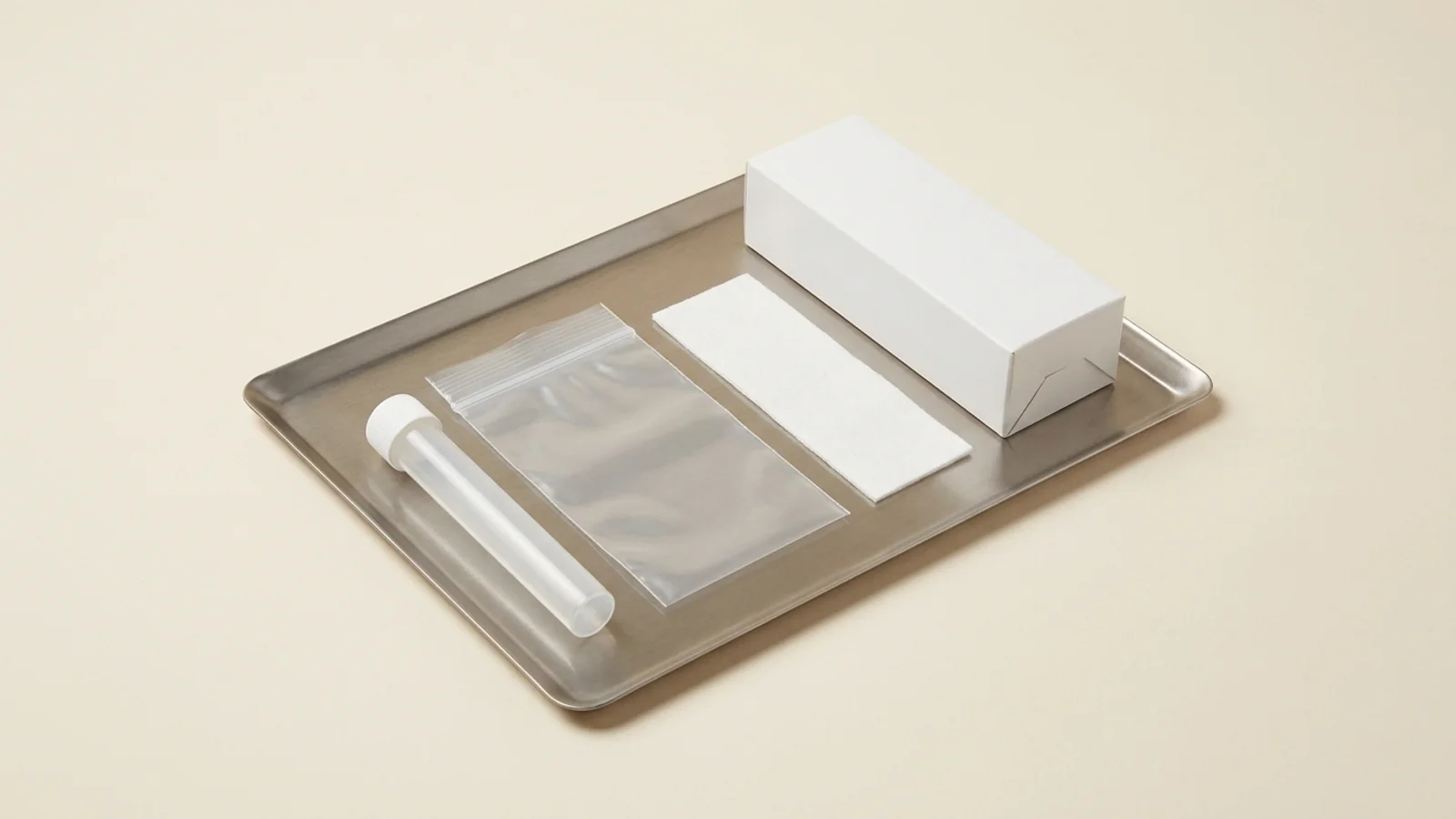
Category B is a transport class, not a tube catalog
Hospital purchasing teams, clinical diagnostic networks, and medical supply distributors frequently confront a persistent point of confusion during catalog rationalization: the conflation of primary specimen collection containers with hazardous materials transport packaging systems. A standard evacuated venous blood collection tube manufactured to ISO 6710:2017 and classified under 21 CFR 862.1675 as a Class II in vitro diagnostic specimen collection device is an individual primary container. Regardless of its closure color, draw volume tolerance, or chemical additive formulation (such as EDTA, sodium citrate, or heparin), an ISO 6710 tube is not a certified transport packaging system on its own.
In United States commercial freight and postal logistics, infectious substances are governed by the Department of Transportation (DOT) Pipeline and Hazardous Materials Safety Administration (PHMSA) under the Hazardous Materials Regulations (HMR). Within 49 CFR 173.134, Class 6, Division 6.2 infectious substances are split into two distinct tiers: Category A and Category B. A Category B biological substance is formally defined as an infectious substance that is not in a form generally capable of causing permanent disability or life-threatening or fatal disease in otherwise healthy humans or animals when exposure occurs. These materials include human and animal patient specimens collected for diagnostic, research, or investigational purposes where a high-consequence Category A pathogen is not suspected.
All Category B infectious substances must be assigned the international identification code UN3373 and described on outer packages and transport manifests by the authorized proper shipping name “Biological substance, Category B” (or “Biological substances, Category B”). This transport designation carries strict legal boundaries. It does not encompass regulated medical waste, which is defined in 49 CFR 173.134(a)(5), assigned UN3291 under 173.134(a)(1)(ii), and packaged under 49 CFR 173.197 (with the private- or contract-carrier exceptions in 173.134(c)). Nor does it apply to high-hazard Category A pathogens (assigned UN2814 for human diseases, UN2900 for animal diseases, or UN3549 for Category A solid medical waste), which require UN-specification packaging certified under 49 CFR 173.196.
Classification is always a legal shipper responsibility based on known patient medical history, local endemic conditions, clinical symptoms, and sound professional judgment. A crucial distinction codified in 49 CFR 173.134(a)(3) is the fundamental difference between a patient specimen and a culture. A culture is an infectious substance containing a pathogen that is intentionally propagated in a growth medium, whereas a patient specimen consists of biological material collected directly from humans or animals. Under no circumstances may an intentionally propagated culture of a Category A pathogen (such as Bacillus anthracis or Ebola virus) be placed into a UN3373 kit. Sourcing managers must ensure that laboratory personnel never treat a Category B box as a universal container for laboratory isolates.
| Classification & UN Number | Regulatory Reference | Material Scope | Required Packaging Standard | UN Certification Mark? |
|---|---|---|---|---|
| Category B (UN3373) | 49 CFR 173.134 & 173.199 | Diagnostic patient specimens and non-Category A biological materials | Triple packaging; 1.2 m drop test; leakproof/siftproof; absorbent media | No (UN specification mark not required; UN3373 diamond only) |
| Category A (UN2814 / UN2900) | 49 CFR 173.134 & 173.196 | Pathogens capable of permanent disability or fatal disease, plus all Category A cultures | UN-specification triple packaging; 9.0 m drop test; puncture resistance test | Yes (Full UN packaging mark required, e.g. 4G/CLASS 6.2/...) |
| Regulated Medical Waste (UN3291) | 49 CFR 173.134(a)(5) & 173.197 | Waste from medical treatment, diagnosis, immunization, or biomedical research; Category A waste is UN2814, UN2900, or UN3549 | Rigid puncture-resistant sharps boxes, drums, or wheeled carts per 173.197 | Yes for non-bulk UN standard packs under 173.197; 173.134(c) has private-carrier exceptions |
| Excepted Routine Patient Specimens | 49 CFR 173.134(b)(11) | Routine diagnostic testing with low probability of infection (cholesterol, glucose) | Excepted from Division 6.2; not a UN3373 kit specification | No (Fully excepted from Division 6.2 HMR requirements) |
| Dedicated Courier Patient Samples | 49 CFR 173.134(b)(10) | Non-Category A patient specimens moved by exclusive-use motor vehicle | Excepted from Division 6.2 packaging; OSHA leakproof labeled or color-coded containers may still apply for blood/OPIM leaving a facility | No (Excepted from Division 6.2 packaging and marking) |
What 49 CFR 173.199 actually requires in the pack
The legal framework for Category B packaging is established in 49 CFR 173.199. When a Category B biological substance is packaged, marked, and offered in complete conformance with this section, it is formally excepted from all other requirements of the Hazardous Materials Regulations. However, procurement teams and logistics managers must note two statutory exceptions that remain binding: mandatory incident reporting under 49 CFR 171.15 and 171.16 in the event of package breach or material release, and commercial aircraft cargo-location rules under 49 CFR 175.75(b).
To meet the threshold for this regulatory exception, the consumable packaging system must be engineered as a cohesive triple packaging system consisting of three distinct functional layers: a primary receptacle, a secondary packaging, and a rigid outer packaging.
Primary Receptacle: The inner container holding the biological specimen. For liquid materials, the primary receptacle must be verified as leakproof under normal transport conditions. For solid specimens, it must be siftproof. When multiple fragile primary receptacles (such as glass vials or delicate plastic culture ampoules) are consolidated in a single secondary packaging, each primary receptacle must be individually wrapped or separated by partitions to prevent contact and catastrophic breakage during transit.
Secondary Packaging: The intermediate protective barrier enclosing the primary receptacles. Like the primary layer, the secondary packaging must be leakproof for liquids and siftproof for solids. For liquid shipments, compliant systems require absorbent material positioned between the primary receptacles and the secondary packaging. The absorbency capacity must be verified to absorb 100% of the liquid contents of all enclosed primary receptacles, ensuring that fluid release will not saturate cushioning or degrade the outer carton.
Rigid Outer Packaging: A rigid exterior shipping container of adequate strength for its capacity, mass, and intended use. 49 CFR 173.199 does not name a fiberboard grade. At least one surface of the outer packaging must measure not less than 100 mm by 100 mm (3.9 inches). If residual liquid may be present in a solid shipment, or a solid may become liquid during transport, pack the material as a liquid under 173.199(b) (173.199(c)(4)).
Physical Performance and Drop Testing: Under 49 CFR 173.199(a)(4), the complete assembled packaging system must be capable of successfully passing the drop-test methodology prescribed in 49 CFR 178.609(d) from a free-fall drop height of at least 1.2 meters (3.9 feet) onto a rigid, non-resilient, flat horizontal surface. Sourcing officers must take note of a critical legal nuance: while 49 CFR 178.609(d) specifies a 9.0-meter (30-foot) drop for Category A UN-specification boxes, 49 CFR 173.199 explicitly substitutes the 1.2-meter height for Category B. Following the five-orientation drop sequence (impacting flat on base, top, long side, short side, and corner), there must be zero leakage from the primary receptacles, and all primary containers must remain cushioned and protected by the absorbent media.
Marking and Communications Specifications: The exterior of the rigid outer packaging must display the square-on-point diamond UN3373 mark on a background of contrasting color. The diamond's border line must be at least 2 mm wide, each side of the diamond must measure at least 50 mm (1.97 inches) as measured from the outside of the lines forming the border, and the letters and numbers “UN3373” inside the diamond must be at least 6 mm (0.24 inches) high. For transportation by aircraft, the entire mark must appear on one side of the package. Directly adjacent to the diamond mark, the proper shipping name “Biological substances, Category B” must appear in lettering at least 6 mm high (49 CFR 173.134 uses the description “Biological substance, Category B”). Legacy names such as “Clinical Specimen” and “Diagnostic Specimen” have not been authorized since January 1, 2007. When packages are placed in an overpack, the markings required by 173.199 must remain clearly visible or be reproduced on the overpack (173.199(a)(6)). A Category B packaging may not contain other hazardous materials except refrigerants authorized under 173.199(d), anticoagulants used to stabilize blood or plasma, or small stabilizer quantities not exceeding 30 mL or 30 g in each inner packaging (173.199(a)(9)).
Under 49 CFR 173.199(a)(7), the name and telephone number of a person who is knowledgeable about the material being shipped and has comprehensive emergency-response and incident-mitigation information for the material, or who has immediate access to a person with that knowledge, must appear on a written document (such as an air waybill or bill of lading) or on the outer packaging. The telephone number must be monitored during the company’s administrative hours.
graph TD
  A[Category B Specimen] --> B[Primary Receptacle]
  B -->|Liquid: Leakproof / Solid: Siftproof| C[Secondary Packaging]
  B -.->|Multiple Primaries| B1[Individually Wrapped or Separated]
  C -.->|Liquid Shipments| C1[Absorbent Media: 100% Fluid Capacity]
  C -->|Liquid: Leakproof / Solid: Siftproof| D[Rigid Outer Packaging]
  D --> E1[Minimum Dimension: 100 mm x 100 mm]
  D --> E2[Drop Test Passed: 1.2 m per 178.609d]
  D --> E3[Mark: UN3373 Diamond 50x50 mm, 2 mm line, 6 mm text]
  D --> E4[Proper Shipping Name: Biological substances, Category B >= 6 mm]
  D --> E5[Responsible Person Phone Monitored in Admin Hours]
D --> E6[Manufacturer/Distributor Closing Instructions Retained 1 Year]Aircraft fields that should not be copied onto every ground bag
A frequent inefficiency in hospital supply chains is the blanket application of commercial aviation packaging rules across regional ground courier networks. Many commercial packaging vendors market universal “all-in-one” UN3373 kits that incorporate expensive 95 kPa pressure-tested pouches and rigid volumetric caps. While this single-SKU strategy simplifies distribution for centralized reference laboratories that move samples on mixed air-ground itineraries, it creates unnecessary expense when applied indiscriminately to routine local ground courier transport.
The 95 kPa Internal Pressure Differential Rule: Codified under 49 CFR 173.199(b)(4), shipments of liquid Category B substances transported by aircraft require that either the primary receptacle OR the secondary packaging be capable of withstanding, without leakage, an internal pressure differential of not less than 95 kPa (0.95 bar, 14 psi). 49 CFR 173.199(b)(4) does not assign that pressure test to a temperature range. The −40 °C to +55 °C integrity test in 49 CFR 173.196(a)(7) is a Category A packaging field, not a Category B 173.199 aircraft field. If a primary tube has no 95 kPa rating, put the aircraft evidence on the secondary packaging instead of importing Category A temperature-integrity language onto a UN3373 RFQ.
Critically, 49 CFR 173.199 does NOT impose this 95 kPa pressure requirement on domestic ground shipments. For surface transportation by motor vehicle, a standard leakproof secondary pouch without 95 kPa certification is fully compliant with federal law, provided it is enclosed in a rigid outer container that meets the 1.2-meter drop standard.
Aircraft Quantity Limitations: Under 49 CFR 173.199(b)(5) and (c)(5), Category B materials moved by aircraft are subject to quantity caps. For liquids, each primary receptacle, including stabilizer, may not exceed 1 L (34 ounces), and each outer packaging, including stabilizer, may not exceed 4 L (1 gallon). For solids, except packages containing body parts, organs, or whole bodies, the outer packaging may not contain more than 4 kg (8.8 pounds), including stabilizer. Ice, dry ice, or liquid nitrogen used to maintain integrity do not count against those outer limits. 49 CFR 173.199 does not impose those quantity figures on every ground shipment.
Ground Transport Exceptions under 49 CFR 173.134(b): Healthcare logistics managers should also leverage key statutory exceptions that exempt routine local ground movements from UN3373 packaging entirely:
Exclusive-use motor vehicle exception (49 CFR 173.134(b)(10)): A Division 6.2 material other than Category A, contained in a patient sample or a biological product, is not subject to the HMR as a Division 6.2 material when transported by a private or contract carrier in a motor vehicle used exclusively to transport such materials. Medical or clinical equipment and laboratory products may ride on the same vehicle if properly packaged and secured against exposure or contamination. Category A never qualifies. If the material meets the definition of regulated medical waste, it must still follow the regulated-medical-waste rules.
Routine Clinical Testing Exception (49 CFR 173.134(b)(11)): Specimens collected for routine diagnostic testing unrelated to infectious disease diagnosis—such as cholesterol screening, blood glucose panels, kidney function tests, and pregnancy assays—where there is a low probability of pathogen presence are entirely excepted from Division 6.2 HMR requirements.
Materials of Trade (MOT) Exception (49 CFR 173.6(a)(4)): Materials of trade under 49 CFR 173.6(a)(4) are a quantity-limited motor-vehicle exception for Division 6.2 material other than Category A, not a UN3373 air-kit specification. For liquids, the inner packaging must be leakproof and the outer packaging must contain enough absorbent to take the entire contents. For other than regulated medical waste, inner packagings are limited to 0.5 kg or 0.5 L each with an outer packaging not more than 4 kg or 4 L, or a single inner packaging not more than 16 kg or 16 L in a single outer packaging.
International Modal Alignment: For U.S. air and ground HMR shipments, 49 CFR 173.199 remains the binding text. International alignment is described in the World Health Organization’s Guidance on regulations for the transport of infectious substances 2025–2026 (applicable from 1 October 2025). UN packing instruction P650, reproduced in the WHO 2023–2024 P650 annex, is the Category B triple-pack instruction that does not require Category A UN-specification testing. IATA Dangerous Goods Regulations Packing Instruction 650 is the air-operator counterpart; do not treat paywalled IATA tables as 173.199. 49 CFR 173.199 already requires a rigid outer packaging on every Category B pack, ground or air. An itemized contents list between secondary and outer packaging, and some orientation-arrow practices, appear in WHO/IATA P650 and public-health job aids—they are not 173.199 mandates. After an aircraft movement, 173.199(a)(8) also requires each package, overpack, pallet, or unit load device containing a Category B infectious substance to be inspected for leakage when unloaded.
| Packaging & Regulatory Attribute | Dedicated Ground Courier (Exclusive-Use) | Commercial Ground Freight (LTL / Parcel) | Domestic & International Air Express |
|---|---|---|---|
| Primary & Secondary Barrier | Excepted from Division 6.2 packaging under 173.134(b)(10); OSHA leakproof rules may still apply for blood/OPIM | 49 CFR 173.199 triple packaging (leakproof primary/secondary) | 49 CFR 173.199 triple packaging; IATA PI 650 extras if the air operator requires them |
| 95 kPa Pressure Differential | Not required | Not required | Mandatory on primary receptacle or secondary pouch |
| Liquid Quantity Limitations | No 173.199 quantity cap; exception is exclusive-use motor vehicle, not UN3373 | No statutory 1 L / 4 L limit under 173.199(a) | Max 1 L per primary receptacle; max 4 L per outer packaging |
| Absorbent Media Requirement | Not a 173.199 field; OSHA 1910.1030 still requires leakproof containers for blood/OPIM leaving a facility | 100% liquid volume capacity between primary and secondary | 100% liquid volume capacity between primary and secondary |
| Drop Test Evidence | Not required under 173.134(b)(10) | 1.2 m free-fall drop test per 49 CFR 178.609(d) | 1.2 m free-fall drop test per 49 CFR 178.609(d) / IATA PI 650 |
| UN3373 Diamond & Proper Shipping Name | Excepted under 49 CFR 173.134(b)(10) | Mandatory 50 mm diamond + 6 mm proper shipping name | Mandatory 50 mm diamond + 6 mm proper shipping name on single face |
| Itemized Contents List | Not a 173.199 field | Not required by 173.199; name and telephone may appear on a written document or the outer pack (173.199(a)(7)) | WHO/IATA P650 and some operator job aids; not a 173.199 field |
Refrigerants, OSHA marks, and the primary-container SKU
Some Category B lanes use ice or dry ice because a receiving laboratory specifies a temperature for the assay. Do not copy a vaccine 2–8 °C SOP onto every specimen pack. 49 CFR 173.199(d) sets refrigerant placement, outer-pack integrity, and dry-ice communication fields; it does not assign a default storage temperature.
Refrigerant placement: Under 49 CFR 173.199(d) and (d)(1), ice or dry ice must be placed outside the secondary packaging or in an overpack. Interior supports must keep the secondary packaging in its original position. If ice is used, the outside packaging must be leakproof or have a leakproof liner. If dry ice is used, the outside packaging must permit release of carbon dioxide gas and otherwise meet 49 CFR 173.217.
Wet Ice Compliance: When ice is used, the outside packaging must be leakproof or have a leakproof liner. 173.199(d)(1) also requires enough absorbent to absorb all liquid, including melted ice, and requires the primary receptacle and secondary packaging to keep their integrity at the refrigerant temperature and at the aircraft temperatures and pressures they could see if refrigeration is lost. Liquid nitrogen is not a Category B kit detail; 173.199(d) requires dry ice and liquid nitrogen to be offered under the applicable HMR provisions of this subchapter.
Dry Ice Compliance: Carbon dioxide, solid (dry ice, assigned UN1845, Class 9) is governed by 49 CFR 173.217. Because dry ice continuously releases carbon dioxide gas as it sublimates, the outer packaging must permit the release of carbon dioxide gas to prevent a dangerous pressure build-up. For Category B packs, 49 CFR 173.199(d)(2) requires the package to be marked “Carbon dioxide, solid” or “Dry ice” and to indicate that the refrigerated material is used for diagnostic or treatment purposes. Net quantity, Class 9, and UN1845 documentation fields come from 49 CFR 173.217, including the 2.5 kg small-quantity exception; they are additional HMR layers, not a substitute for 173.199 triple packaging. For unused-SKU warehouse temperatures and distribution simulation, see labeled storage and transport for medical consumables.
Regulatory Boundary: OSHA 29 CFR 1910.1030 vs DOT UN3373: A common operational mistake is conflating workplace biohazard markings with Department of Transportation transport marks. Under OSHA’s Bloodborne Pathogens standard (29 CFR 1910.1030(d)(2)(xiii)), specimens of blood or other potentially infectious materials (OPIM) that leave a healthcare facility must be placed in a leakproof container that is closed and labeled or color-coded. The required OSHA label must be fluorescent orange or orange-red and display the biohazard legend.
29 CFR 1910.1030(g)(1)(i)(G) exempts individual containers of blood or other potentially infectious materials that are placed in a labeled container during storage, transport, shipment, or disposal from the inner labeling requirement. OSHA’s workplace biohazard label is not the DOT UN3373 transport diamond. 49 CFR 173.199 does not independently require a biohazard symbol, and an OSHA biohazard mark cannot substitute for the UN3373 square-on-point diamond and proper shipping name.
Primary Container SKUs: ISO 6710 vs Transport Packaging: Evacuated venous blood collection tubes manufactured to ISO 6710:2017 are regulated by the FDA under 21 CFR 862.1675 as Class II in vitro diagnostic collection devices. The ISO 6710:2017 public abstract specifies requirements and test methods for evacuated and non-evacuated single-use venous blood specimen containers. It does not specify requirements for blood-collection needles, needle holders, blood-culture receptacles, or arterial blood-gas collection devices. It is not a UN3373 transport-packaging standard: it does not set 1.2 m drop evidence, 95 kPa secondary performance, absorbency, or the Category B mark. Buyers still need a documented 173.199 triple pack around whatever primary receptacle they purchase.
RFQ fields, closing instructions, and training evidence
To prevent non-compliant purchases, convert 49 CFR 173.199 into RFQ fields. A carton printed with a UN3373 diamond without closing instructions, 1.2 m drop evidence, and the rest of the section is an incomplete specification and can be refused by a carrier.
Essential RFQ Specification Fields for Category B Packaging:
Packaging Architecture: Require a complete triple packaging system comprising leakproof primary compatibility, a leakproof secondary pouch, and a rigid outer carton measuring at least 100 mm × 100 mm on one external face.
Absorbent capacity: For liquids, require evidence that absorbent between the primary receptacle and the secondary packaging can absorb the entire contents of the primary receptacles without compromising cushioning or the outer packaging (49 CFR 173.199(b)(2)).
Drop Test Report: Demand a manufacturer or accredited laboratory test report certifying that the complete packaging assembly passed the 49 CFR 178.609(d) free-fall drop test from 1.2 meters without primary receptacle leakage.
Pressure differential (air lanes): For aircraft liquids, require evidence that the primary receptacle or the secondary packaging withstands, without leakage, an internal pressure producing a pressure differential of not less than 95 kPa (14 psi) under 49 CFR 173.199(b)(4). Do not copy 49 CFR 173.196(a)(7)’s −40 °C to +55 °C Category A temperature-integrity test onto this field.
Outer-package marking: Verify that the outer packaging displays the UN3373 square-on-point mark (sides at least 50 mm, border at least 2 mm, characters at least 6 mm) and the proper shipping name “Biological substances, Category B” in letters at least 6 mm high. For aircraft, the entire mark must appear on one side.
Closing instructions: Require current filling and closing instructions, and manufacturer or subsequent-distributor certification that a copy or electronic image is retained for at least one year from issuance under 49 CFR 173.199(a)(10).
Under 49 CFR 173.199(e), each person who offers or transports a Category B infectious substance under that section must know its requirements. PHMSA’s training aid (Transporting Infectious Substances Safely) states that it should not be used to determine compliance with 49 CFR Parts 100–185. Packaging and transport employees who are hazmat employees remain subject to 49 CFR 172.704: general awareness/familiarization, function-specific, safety, and security-awareness training, plus in-depth security training when a security plan applies.
Recurrent Training Cycles: Under DOT 49 CFR 172.704(c)(2), hazmat employee training must be completed at least once every three years. Employers must maintain training records covering the preceding three years, including employee identity, training date, course description, and testing certification. Procurement and quality teams must distinguish this statutory three-year DOT interval from the two-year recurrent certification cycle frequently enforced by commercial airlines under IATA DGR and public health agency guidelines. Finally, health systems must maintain documented standard operating procedures for incident reporting under 49 CFR 171.15 and 171.16 in the event of any packaging failure or hazardous material release.
| Procurement Specification Field | Regulatory Standard / Benchmark | Required Supplier Audit Evidence | Pass / Fail Verification Criteria |
|---|---|---|---|
| Triple Packaging Architecture | 49 CFR 173.199(a)(1)–(3) | Engineering drawing & packaging specification sheet | Primary and secondary leakproof (liquids) or siftproof (solids); rigid outer carton >= 100 mm x 100 mm on one face. |
| Absorbent Material Capacity | 49 CFR 173.199(b)(2) (liquids) | Absorbency laboratory test report (mL capacity) | Absorbency rating >= 100% of maximum loaded primary fluid volume; zero liquid migration past secondary barrier. |
| 1.2-Meter Drop Test Integrity | 49 CFR 173.199(a)(4) via 178.609(d) | Certified drop test report (5-orientation drop sequence) | Zero leakage from primary receptacles post-drop; primary containers remain cushioned and protected by absorbent media. |
| 95 kPa Pressure Differential | 49 CFR 173.199(b)(4) (aircraft liquids) | Supplier statement or test report that primary or secondary withstands 95 kPa without leakage | Zero leakage at not less than 95 kPa (14 psi) on the claimed layer; this field applies to aircraft, not every ground bag. |
| Outer Package Marking | 49 CFR 173.199(a)(5) | Carton die-line proof and dimensional inspection sheet | Diamond sides >= 50 mm; border line >= 2 mm; 'UN3373' >= 6 mm; proper shipping name >= 6 mm; knowledgeable contact phone field. |
| Manufacturer Closing Instructions | 49 CFR 173.199(a)(10) | Illustrated closing instruction sheet and 1-year retention record | Step-by-step instructions provided with each kit batch; documented proof of 1-year record retention by supplier. |
| Hazmat Personnel Training | 49 CFR 173.199(e) & 49 CFR 172.704 | Employer training records, syllabus, and testing certificate | DOT recurrent training at least once every three years under 172.704; IATA operator courses often recertify every two years and do not replace the DOT interval. |