
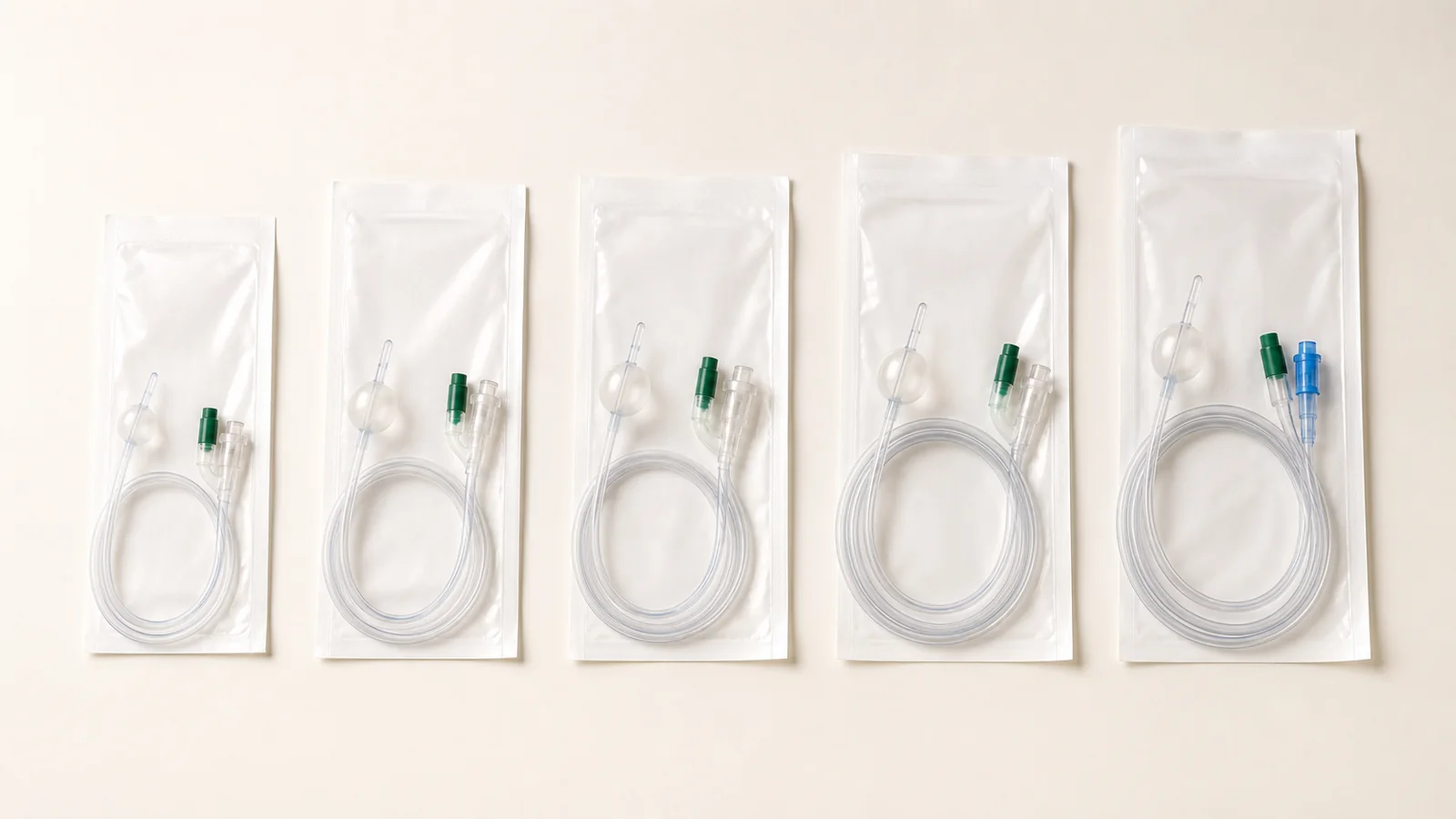
Standardizing urological consumables across a hospital network or regional distribution supply chain requires moving beyond brand names and vague catalog descriptions. Foley indwelling catheters are precision fluid-management devices where physical dimensions, shaft polymers, lumen configurations, and balloon mechanics directly influence clinical drainage efficiency, urethral trauma rates, and catheter-associated urinary tract infection (CAUTI) risks.
Understanding the French (Charrière) Sizing Scale and Dimensions
The outer diameter of indwelling urethral catheters is specified using the French (Fr) or Charrière (Ch) scale. One French unit equals 1/3 millimetre of outer diameter (0.333 mm; about 0.013 in):
Outer Diameter (mm) = French Size (Fr) ÷ 3 = French Size (Fr) × 0.3333 mm
Catalog sizes commonly span 6 Fr (2.0 mm OD) through 26 Fr (8.7 mm OD). ASTM F623's performance specification covers French 12–26 for short-term urethral balloon catheters and excludes pediatric sizes, so 6–10 Fr SKUs need their own labeled evidence. Funnel or valve colors are manufacturer warehouse conventions, not a single ISO Foley color standard. Packaging text remains the binding identifier.
| French Size (Fr) | Outer Diameter (mm) | Outer Diameter (in) | Valve Color Code | Typical stocking context (not a treatment protocol) |
|---|---|---|---|---|
| 6 Fr | 2.0 mm | 0.079 in | Light Green / Pale Green | Pediatric / neonatal specialty carts (confirm labeled size range) |
| 8 Fr | 2.7 mm | 0.105 in | Light Blue | Pediatric carts (confirm labeled size range) |
| 10 Fr | 3.3 mm | 0.131 in | Black | Older pediatric / adolescent carts (confirm labeled size range) |
| 12 Fr | 4.0 mm | 0.157 in | White | Common adult medical/surgical par-level size |
| 14 Fr | 4.7 mm | 0.184 in | Green | Common adult first-line par-level size |
| 16 Fr | 5.3 mm | 0.210 in | Orange | Heavier-drainage adult par-level size (clinical selection required) |
| 18 Fr | 6.0 mm | 0.236 in | Red | Larger-bore adult backup size (clinical selection required) |
| 20 Fr | 6.7 mm | 0.262 in | Yellow | Urology / PACU specialty size (often 3-way SKUs) |
| 22 Fr | 7.3 mm | 0.289 in | Purple / Violet | CBI / hematuria specialty size |
| 24 Fr | 8.0 mm | 0.315 in | Dark Blue | High-volume irrigation specialty size |
| 26 Fr | 8.7 mm | 0.341 in | Black / Brown | Major urology specialty size; confirm 3-way vs 2-way SKU |
Hospital formularies often concentrate routine floor stock on 12 Fr, 14 Fr, and 16 Fr for general medical and surgical floors, keeping 18 Fr to 24 Fr in urology, PACU, and intensive-care carts. Actual size mix belongs in the clinical-stakeholder specification, not in a catalog rule of thumb.
What ASTM F623 and the FDA Foley pathway actually measure
Buyers often cite ASTM F623 and ISO 20696 as if they were interchangeable clinical sizing rules. They are bench-performance specifications with explicit scopes. ASTM F623-19—the edition cited in FDA's August 2020 Safety and Performance Based Pathway guidance—covers short-term utilization of a single-use balloon-retention catheter, French sizes 12 through 26, for urethral bladder drainage. The standard's exclusions include long-term indwelling use over 30 days, non-urethral routes, three-lumen catheters, 30 cm3 balloons, and pediatric catheters. A later edition (ASTM F623-25) is now the active ASTM publication; tenders should name the edition in the supplier's declaration of conformity rather than assuming 2019 remains current for every market.
For conventional Foley catheters using the FDA pathway, the guidance maps labeled French size to outside diameter and sets flow-rate performance criteria drawn from ASTM F623: a minimum average flow rate of 100 cm3/min for French sizes 14–26 and 70 cm3/min for French size 12. Inflated-balloon traction for labeled sizes 14–26 is judged by whether the entire balloon passes into or through a 28 Fr funnel barrel. Those figures are premarket performance criteria for conventional even French sizes, not bedside dosing instructions and not a substitute for inner-lumen data on silicone versus latex shafts.
ISO 20696:2018 is the broader sterile single-use urethral catheter standard (with or without a balloon) and is only partially recognized by FDA. Balloon volume maintenance, deflation reliability, flow rate, and balloon integrity clauses are among the parts FDA does not currently recognize. A purchasing specification can still ask for ISO 20696 reports, but it should not present unpublished or secondary-source recovery percentages as if they were U.S. clearance criteria.
Material Comparison: 100% Silicone vs. Elastomer-Coated Latex
One of the most consequential technical determinations in catheter procurement is shaft biomaterial selection. While both latex-substrate and 100% all-silicone catheters are widely available, their structural cross-sections and clinical risk profiles differ fundamentally.
The Outer vs. Inner Diameter Hydraulic Paradox
Because the French gauge governs only the outer diameter of the shaft, two catheters with identical French ratings (e.g., 16 Fr) can possess significantly different inner drainage lumen (ID) cross-sectional areas. Natural rubber latex possesses high elasticity but lower structural stiffness, requiring manufacturers to extrude thicker walls to prevent catheter collapse under aspiration. In contrast, medical-grade silicone possesses higher durometer tensile rigidity, permitting thinner walls.
Because flow scales steeply with inner radius, small lumen differences matter—but they are product-specific. Buyers should require inner-lumen or flow-rate data for the exact SKU, measured to the test method cited in the dossier. FDA's Safety and Performance Based Pathway cites ASTM F623 flow-rate criteria for conventional even French sizes; do not treat a 14 Fr all-silicone catalog as equivalent to a 16 Fr latex catalog without those data.
| Material Specification | Wall Structure & Inner Lumen | Labeled / cleared dwell (product-specific) | Encrustation & Biocompatibility | Sourcing notes (not list prices) |
|---|---|---|---|---|
| 100% All-Silicone | Thin extruded wall; largest inner drainage lumen for equivalent French OD; transparent shaft for fluid inspection | Follow the manufacturer's labeled/cleared indwelling duration. ASTM F623 addresses short-term urethral use and excludes long-term (>30 day) and non-urethral (including suprapubic) applications. | Latex-free shaft when truly 100% silicone; still require ISO 10993 biological evaluation and latex-status labeling for the finished device, including any coatings or packaging. | Usually higher unit cost than latex-core SKUs; compare total cost using restart, allergy, and dwell evidence from the supplier—not assumed unit prices. |
| Silicone-Elastomer Coated Latex | Latex core with outer bonded silicone layer; thicker wall reduces inner lumen area | Follow labeled/cleared duration. Do not treat “silicone-coated” as equivalent to all-silicone or as a universal 14–28 day device. | Outer silicone layer cushions insertion; however, pinholes or delamination can expose underlying latex proteins | Usually lower unit cost than all-silicone; latex-core status must remain visible in the specification and storage plan. |
| Hydrogel-Coated Latex | Latex shaft with hydrophilic hydrogel polymer coating; absorbs moisture to create slippery surface | Follow labeled/cleared duration; coating does not convert a latex core into a latex-free device. | Low initial insertion friction coefficient; hydrogel layer cushions urethral contact but does not prevent latex diffusion | Price varies by coating system; specify the coating chemistry and latex-core disclosure rather than a comfort slogan. |
| Uncoated Plain Latex | Standard vulcanized natural rubber; thickest wall profile; opaque amber appearance | Follow labeled/cleared duration. Uncoated latex is generally limited to short-term labeled use and is a poor default for latex-safe formularies. | High mucosal friction; significant risk of Type I latex hypersensitivity; rapid mineral encrustation | Usually the lowest unit cost; many latex-safe formularies exclude uncoated latex regardless of price. |
Balloon Capacity, Inflation Mechanics, and Channel Configurations
Retention balloon performance is a critical factor in patient comfort and catheter reliability. Balloons must expand symmetrically without occluding the drainage eyelets and must deflate smoothly without forming persistent ridges or 'cuffing' that can lacerate the urethral mucosa upon removal.
Balloon Capacity and Inflation Media Standards
Indwelling catheter balloons are manufactured in two primary volume classes:
5–10 mL Standard Retention Balloon: This is the common adult retention balloon class on 2-way SKUs. Nominal markings such as 5 mL, 10 mL, or 5–10 mL are not interchangeable. Inflate only with the volume and medium printed on that device's labeling and IFU. Do not convert a 5 mL marking into a 10 mL fill, or a sterile-water IFU into a saline IFU, unless the labeling says so. Balloon geometry and seating are design-specific.
30 mL Hemostatic Balloon: Larger hemostatic balloons are a distinct SKU class and are outside ASTM F623's stated exclusions for 30 cm3 balloons. Fill volume, medium, and traction use belong in the labeled IFU and the clinical protocol—not in a generic 30–50 mL purchasing rule.
2-Way Drainage vs. 3-Way Continuous Bladder Irrigation (CBI)
Catheter channel configuration determines whether the device is restricted to simple evacuation or capable of simultaneous therapeutic irrigation:
| Lumen Configuration | Number of Ports | Channel Architecture | Clinical Application & Flow Dynamics |
|---|---|---|---|
| 2-Way Foley Catheter | 2 ports | Main large drainage channel + secondary narrow balloon inflation channel | Routine indwelling drainage SKUs for floor, ICU, and peri-operative carts |
| 3-Way Foley Catheter | 3 ports | Main drainage channel + inflation channel + dedicated continuous fluid inflow channel | Continuous irrigation SKUs; specify independent inflow and drainage bores rather than assuming any 3-way design is equivalent |
When procuring 3-way catheters (typically 18 Fr to 24 Fr), the technical specification must ensure the inflow irrigation channel does not excessively compromise the main drainage channel. If the drainage bore is too narrow, irrigation inflow will outpace evacuation, resulting in acute bladder distension.
Tip Configurations: Nelaton Straight vs. Coudé/Tiemann Curved
The catheter tip design dictates ease of passage through anatomical obstructions:
Nelaton Tip (Straight, Round Tip): Standard configuration with a soft, closed rounded tip and two staggered opposing drainage eyelets (Murphy eyes). Used for unobstructed male and female catheterization.
Coudé / Tiemann Tip (Curved, Angled Tip): Features a 30-to-45 degree upward taper and a firmer, slightly rigid tip. The curve allows the catheter to navigate over the elevated median lobe of an enlarged prostate (BPH) or through tortuous urethral strictures. A tactile alignment stripe or notch on the drainage funnel indicates the orientation of the tip during insertion.
Procurement and Quality Audit Checklist for Hospital Tenders
To ensure patient safety, regulatory compliance, and consistent batch quality, hospital procurement committees and distributor quality assurance teams should mandate the following verification criteria in supplier bidding dossiers:
Regulatory Clearance & Classification: For the U.S. market, verify Class II identification under 21 CFR 876.5130 (product code EZL) and a current 510(k) where required. Do not copy U.S. 510(k) language into non-U.S. tenders. EU MDR classification follows Annex VIII rules for intended duration and invasiveness (commonly Rule 5 for urethral catheters) and must match the manufacturer's declared class. Require an active ISO 13485 certificate for the manufacturing sites.
ASTM F623 & ISO 20696 Benchtop Test Compliance: Require accredited test reports against the current editions that actually cover the submitted design. ASTM F623 is scoped to short-term single-use balloon-retention urethral catheters, French sizes 12 through 26; it excludes long-term (>30 day) use, non-urethral routes, three-lumen catheters, 30 cm3 balloons, and pediatric catheters. ISO 20696 covers sterile single-use urethral catheters with or without a balloon, but FDA currently does not recognize its balloon-volume, deflation-reliability, flow-rate, and balloon-integrity clauses. Critical dossier checks include:
Balloon Volume Recovery: If ISO 20696 is cited, require the current published balloon volume-recovery table and test method for the labeled nominal volume. Secondary summaries often quote 55% (5 mL), 75% (10 mL), and 80% (20 mL); do not extend those figures to 30 mL balloons, invent immersion durations, or treat them as FDA-recognized 510(k) criteria.
Traction Resistance: Do not write a 15 N axial-pull number into the tender unless it appears in the cited edition. FDA's Foley Safety and Performance Based Pathway instead points to ASTM F623 inflated-balloon traction: for labeled French sizes 14 through 26, the entire balloon should not pass into or through a 28 Fr funnel barrel.
Balloon Burst Resistance: Require ASTM F623 balloon integrity / burst results to the current edition and the acceptance criteria in that edition or in the FDA pathway table—not a generic “twice rated capacity” rule.
ISO 10993 Biocompatibility Validation: Require a biological evaluation per ISO 10993-1 that matches contact type and duration. Typical mucosal-contact endpoints include cytotoxicity (ISO 10993-5), sensitization, and irritation; additional systemic endpoints are duration- and contact-dependent, not a fixed shopping list.
Packaging Barrier & Sterility Assurance: Confirm terminal sterilization validation (ethylene oxide per ISO 11135 or radiation per ISO 11137) to the SAL stated for the sterile claim, commonly 10^-6 for terminally sterilized devices. Packaging should comply with ISO 11607-1/2. Shelf life is the labeled expiry supported by aging evidence—not a universal 3-to-5-year purchasing rule.
Color-Coding & Dimensional Labeling: Validate that primary packs and shelf cartons display French size, labeled balloon fill volume and medium, material composition (all-silicone versus silicone-coated latex), lumen configuration, sterile status, lot number, and expiry. Color dots are secondary to that text.