
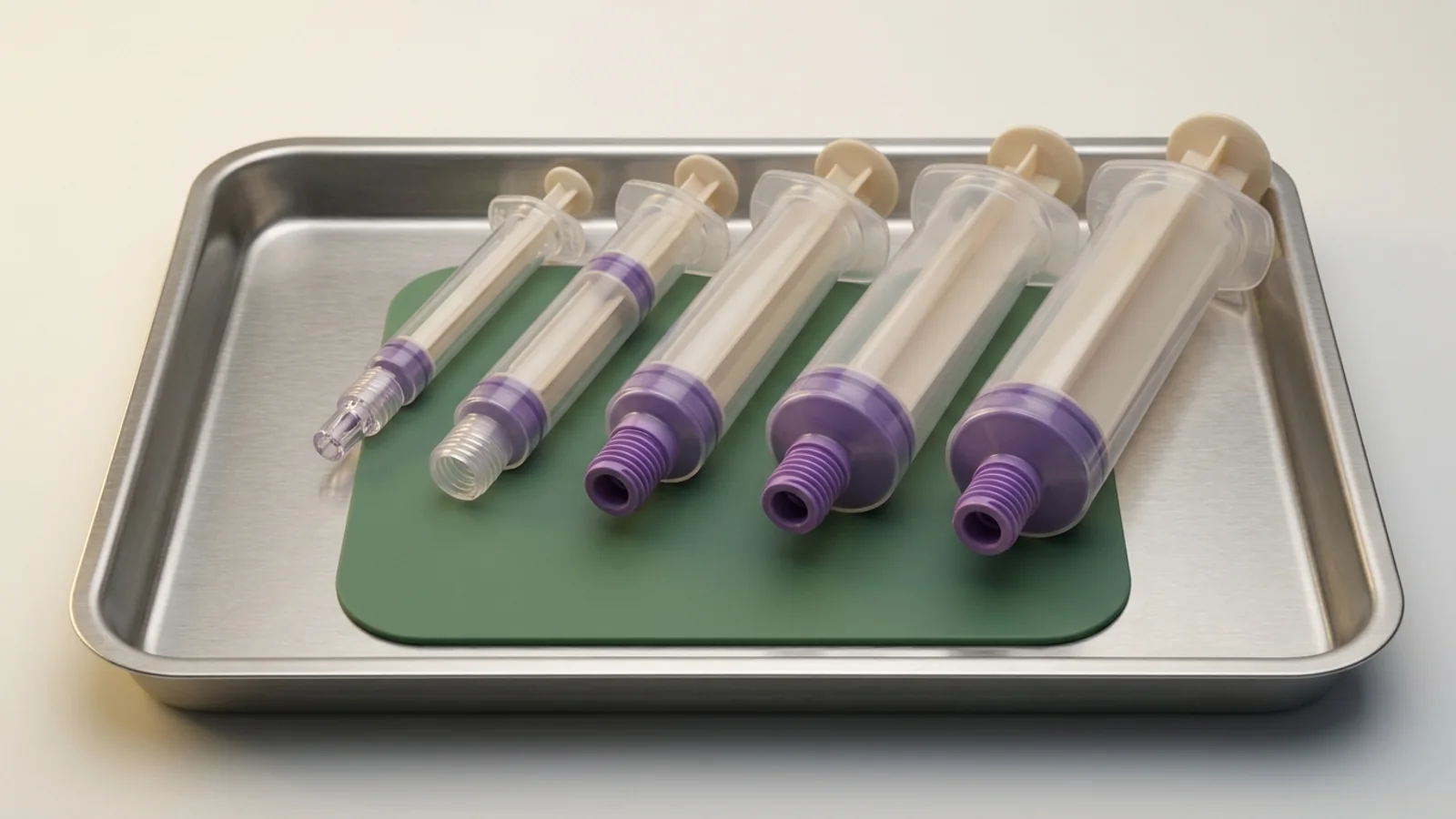
When hospital supply-chain teams, medical distributors, and value-analysis committees procure enteral feeding syringes, they frequently encounter tenders that compress distinct regulatory classifications into generic phrases such as "oral/enteral syringes" or specify purchasing lines based solely on visual barrel accents like purple plunger rods. In commercial distribution, generic catalogs routinely group enteral dispensers next to intravascular Luer syringes or traditional catheter-tip irrigation barrels. Under U.S. device classification, an ENFit syringe is an enteral piston syringe with an enteral-specific connector: 21 CFR 876.5980 product code PNR, ISO 80369-3 patient-end geometry, and 510(k) clearance—not a Luer hypodermic, an insulin unit syringe, or an oral-only tip.
Specify a PNR ENFit Syringe, Not a Luer Hypodermic or an Oral-Only Tip
The fundamental purchasing error in enteral syringe acquisition is treating all calibrated manual piston dispensers as generic plastic commodities. In the United States, a conventional piston syringe intended for intravascular injection or hypodermic single-lumen needles is regulated under 21 CFR 880.5860 (product code FMF; MEG is the antistick code under the same regulation), reviewed by DHT3C (General Hospital). As detailed in the specification guide for sterile hypodermic syringes, those devices use male Luer nozzles evaluated against ISO 7886-1 and ISO 80369-7 (FDA Rec# 5-133). An ISO 8537 insulin syringe occupies unit scale under 880.5860 and is not an ENFit device. An IV administration set is 21 CFR 880.5440 / FPA and ends in ISO 80369-7 Luer, not an enteral female tip. A respiratory suction catheter is 21 CFR 868.6810 / BSY under ISO 8836; copying ENFit onto that SKU does not specify a PNR syringe. An enteral syringe intended to introduce liquid nutrition, hydration, or medication into the gastrointestinal tract is classified under 21 CFR 876.5980 (Gastrointestinal tube and accessories, Class II), reviewed by DHT3A (Gastroenterology/Urology).
FDA created product code PNR specifically for "enteral syringes with enteral specific connectors." The classification definition restricts this code to plastic devices comprising a barrel, movable plunger, and enteral-specific connector that deliver nutrition, medication, or hydration orally or directly into a gastrointestinal tube or extension set, still citing AAMI/CN3(PS):2014 in that definition. Current recognized connector standards on the same PNR record are Rec# 5-123 (ISO 80369-3:2016 including Amendment 1) and Rec# 5-139 (ISO 18250-3:2018). PNR devices are not 510(k) exempt and are not eligible for third-party accredited review. A 510(k) clearance is not FDA approval, not a sterility waiver, and not proof that two PNR SKUs are interchangeable.
An ENFit syringe must also not be confused with an oral-only dispenser. The public scope of ISO 80369-3:2016 excludes oral-only medical devices—explicitly, an oral tip syringe that is not intended to connect to another medical device and is intended to administer directly to the patient's mouth. ISO 20695:2020, the particular standard for enteral feeding systems, is likewise not applicable to oral syringes. Cardinal Health's Monoject pharmacy sheet prints a separate "Oral Syringes — Standard Tip" purple line beside "Enteral Syringes — ENFit Connection." Copying purple color or an oral-tip catalog number does not specify PNR. Do not assign oral-only tips the antistick code MEG.
| Classification & specification field | PNR enteral syringe (ENFit pair) | FMF hypodermic piston syringe | Oral-only tip dispenser |
|---|---|---|---|
| 21 CFR classification | 21 CFR 876.5980 (Class II) | 21 CFR 880.5860 (Class II) | Not PNR; record the labeled regulation—do not assume 880.5860 |
| FDA product code | PNR (enteral syringes with enteral specific connectors) | FMF (syringe, piston); MEG is antistick, not oral-tip | Not PNR; MEG is not an oral-dispenser code |
| FDA review panel / office | DHT3A (Gastroenterology/Urology) | DHT3C (General Hospital) | As labeled on the SKU file |
| Patient-end connector standard | ISO 80369-3:2016 including Amendment 1:2019 | ISO 80369-7:2021 (Luer) | Excluded from ISO 80369-3 (oral tip not intended to connect to another device) |
| FDA consensus recognition on that identity | Rec# 5-123 (and Rec# 5-139 for reservoir connectors, not the syringe tip) | Rec# 5-133 / Rec# 6-404 on the FMF record | ISO 80369-3 recognition does not cover the oral-only exclusion example |
| Labeled mating pair | Female syringe tip to male ENFit tube or extension, as labeled | Male nozzle to female hypodermic hub or IV Luer | Not specified as an ENFit locking pair |
| Misconnection design intent | ISO 80369-3 is intended to reduce non-enteral misconnections; not a 100% lockout claim | Compatible with hypodermic/IV Luer fittings as designed | Lacks the ISO 80369-3 connector pair; still not a PNR syringe |
ISO 80369-3 Is the Patient-End Pair; ENFit Is the Trademarked Implementation
The global engineering initiative to eliminate catastrophic enteral-to-intravenous misconnections culminated in the ISO 80369 series of standards for small-bore connectors. For enteral applications, ISO 80369-3:2016 (First Edition, published July 2016) specifies the dimensions, geometry, and mechanical performance criteria for connectors deployed across enteral medical devices and accessories. In the United States, the Food and Drug Administration established complete recognition of this standard under FDA Rec# 5-123 (Federal Register recognition list 052, entered July 15, 2019), which specifically encompasses ISO 80369-3:2016 including Amendment 1 (2019). Tender documents should always reference Rec# 5-123 or the 2016 standard with Amendment 1, rather than citing the unamended 2016 baseline alone.
Buyers must keep the consensus engineering standard separate from the commercial trademark. ENFit is a registered trademark of the Global Enteral Device Supplier Association (GEDSA) for a widely marketed ISO 80369-3 implementation. GEDSA's public FAQs state that ISO 80369-3 defines connector geometry and that dose-accuracy performance is out of scope for that part; they also state it is possible to have an ISO 80369-3 connector that is not compatible with ENFit, while encouraging a single global orientation (female on the administration/syringe side, male on the patient-access side). Do not treat the trademark as a second geometry standard, and do not assert that every ISO 80369-3 declaration is an ENFit-branded, ENFit-mating product. Specify the labeled pair and the dated edition (2016 plus Amendment 1 / Rec# 5-123).
When drafting procurement contracts, tender specifications that demand only "ENFit syringes" create commercial ambiguity, while tenders that request generic "enteral syringes" risk receiving obsolete legacy stepped fittings. The robust specification statement requires: "Enteral piston syringes holding 510(k) clearance under 21 CFR 876.5980 product code PNR, featuring patient-end connector dimensions and functional performance compliant with ISO 80369-3:2016/Amd 1:2019 (FDA Recognized Consensus Standard Rec# 5-123)."
Standard Female Tip Versus Low-Dose Tip Is a Labeled SKU, Not a Dose
Within the PNR classification, the consequential hardware field is the labeled tip: standard female ENFit versus low-dose tip (LDT). GEDSA's 9 August 2016 position statement says standard female ISO 80369-3 ENFit syringes raised low-volume dose-accuracy concerns, that there was then no ISO/AAMI/ASTM/EN enteral-syringe dose-accuracy standard, and that LDT adds an inner male lumen so the moat between that lumen and the outer ring is not part of the fluid path and should be free of fluid. Those are manufacturer-association descriptions of a labeled feature. They are not an ISO 80369-3 requirement, not a dose, and not a reason to treat every small-volume SKU as LDT.
FDA's 7 October 2021 letter to PNR LDT manufacturers records a complaint about possible overdose if the user does not clear the moat around the LDT tip, and asks manufacturers to put moat-clearing, filling-adapter, medicine-cup, and new-syringe-to-flush warnings in labeling. Quote those as IFU rows on an LDT SKU. Do not convert them into a filling SOP, a millilitre dose, or a claim that standard female connectors are interchangeable with LDT or with legacy oral tips.
Public 510(k) files show how manufacturers split the two tip families—as examples, not as a universal cutoff. K183540 (NeoMed Oral/Enteral Syringes with ENFit connector; product code PNR; decision 30 April 2019) names standard female ENFit syringes 12 mL to 60 mL and LDT syringes 1 mL to 6 mL, supplied sterile or non-sterile, single-use or reusable. Reusable configurations in that summary are supplied non-sterile, intended for multiple use in non-clinical settings, single-patient only; that is a labeled configuration, not permission to write reprocessing instructions. Cardinal Health's Monoject ENFit Connection sheet (sterile catalog numbers 401SE–460SE, cleared as PNR under K243652 on 19 December 2024) states that 1 mL and 3 mL ENFit syringes feature low-dose tip design; the same sheet lists 6, 12, 35, and 60 mL ENFit SKUs without that LDT call-out, and a separate purple Standard Tip oral table that is not the ENFit line. A 6 mL SKU can therefore be LDT on one file and not named LDT on another. Copy the labeled tip, not a guessed millilitre rule.
Peer-reviewed laboratory comparison does not convert LDT into an interchangeable commodity. O'Mara et al. (Journal of Clinical Pharmacy and Therapeutics, 2019) compared female LDT syringes with legacy syringes. The primary outcome was how often administered volume exceeded 10% of the expected amount (576 tests). The authors reported significantly higher rates of unacceptable dosing variance with LDT versus legacy (21.2% versus 7.4%). That paper does not retract ISO 80369-3, does not rank manufacturers, and is not a dosing protocol. Use it only to keep LDT, filling method, and adapter process as labeled fields and to refuse inferred clinical interchangeability among LDT, standard female ENFit, and legacy oral-tip syringes.
For value-analysis, an LDT syringe SKU without the matching labeled filling accessory (and without the FDA-requested IFU warnings on the file) is an incomplete specification. LDT is a hardware-plus-labeling field, not proof of precision and not a substitute for writing the companion reservoir/filling interface as its own line.
| Design and sourcing parameter | Standard female ENFit syringe | Low-dose tip (LDT) ENFit syringe |
|---|---|---|
| Public labeled size examples (not an ISO size law) | K183540: 12 mL to 60 mL; other public files also show 10, 20, 35, 100 mL | K183540: 1 mL to 6 mL; Cardinal Monoject names LDT on 1 mL and 3 mL ENFit SKUs; 0.5 mL appears on some catalogs, not as a universal LDT cutoff |
| Internal tip architecture (as described, not reprinted dimensions) | Female ENFit collar as declared to ISO 80369-3 / Rec# 5-123 (early files cited AAMI/CN3:2014 Table B.2) | Female ENFit plus additional LDT feature (GEDSA: inner male lumen; moat not part of the fluid path) |
| Intended-use field | PNR: nutrition, medication, or hydration orally or to a GI tube/extension, as labeled | Same PNR intended use; LDT is a tip-design SKU, not a separate clinical dose |
| Moat / dose-accuracy labeling | ISO 80369-3 does not specify dose accuracy (GEDSA FAQs) | FDA 7 Oct 2021 PNR letter: moat overdose complaint; requested IFU warnings |
| IFU evidence to request if the SKU is LDT | Connector and intended-use labeling as declared | Confirm moat, filling-adapter, medicine-cup, and new-syringe-to-flush warnings appear |
| Companion accessory (separate SKU/code) | Male ENFit tube or extension (PIF), not a PIO adapter as the syringe | Labeled filling adapter / straw / bottle cap; reservoir connectors specified to ISO 18250-3 / Rec# 5-139, not as the syringe tip |
| Dimensional evidence to request | Dated ISO 80369-3:2016+Amd 1 / Rec# 5-123 declaration or equivalent 510(k) narrative | Same Rec# 5-123 plus labeled LDT feature; GEDSA points LDT dimensions to ISO 20695 Annex K (paywalled). PNR's classification does not list Rec# 9-138 |
Compatibility Is the ENFit Pair; Adapters and Reservoirs Are Different Codes
A specified ENFit circuit is a labeled gender pair, not a universal fitting. Foundational public summaries such as K143344 (NeoMed NeoConnect Enteral Syringes with ENFit Connector; originally product code PIF) and K183540 describe a piston syringe with an integral female ENFit tip compatible only with feeding tubes and extension sets that have ENFit male connectors. K143344 names sizes 0.5 mL to 100 mL and dimensional compliance to AAMI/CN3:2014 (PS) Part 3 Table B.2; later PNR files such as K183540 declare ISO 80369-3. Specify the dated edition on the current file. Do not treat the skin-level gastrostomy button connector—which ISO 80369-3 excludes—as the syringe tip; if an extension is used, specify the labeled male ENFit on that extension.
Procurement buyers must carefully distinguish between the syringe itself and adjacent device classifications governed by separate FDA product codes:
Product code PIF (gastrointestinal tubes with enteral specific connectors): 21 CFR 876.5980 Class II. Physical state is a plastic connector attached to an enteral tube. Specifying a PIF tube does not satisfy a PNR syringe requisition. Early ENFit syringe 510(k)s such as K143344 used PIF before PNR existed; current syringe identity is PNR.
Product code PIO (enteral specific transition connectors): 21 CFR 876.5980 Class II. Definition: facilitates connections between AAMI/CN3(PS):2014 compliant connectors and non-ISO 80369-1 compliant legacy enteral connectors. A PIO adapter is not a PNR syringe.
Product code FPD (tube, feeding): An older 876.5980 feeding-tube code that also appears on some pre-PNR oral/enteral syringe 510(k)s. Specifying FPD does not specify a current PNR syringe SKU.
ISO 18250-3:2018 reservoir connectors: Recognized on the PNR record as Rec# 5-139. Public scope: connectors intended to be used on enteral reservoirs, not the medical devices that use those connectors, and not ordinary food/beverage screw caps. Specify filling adapters, bottle caps, and reservoir connectors separately from the syringe's ENFit tip. Do not specify current SKUs to ISO/WD 18250-3.
Buyers should also evaluate references to ISO 20695:2020 (Enteral feeding systems — Design and testing). Recognized by the FDA under Rec# 9-138, ISO 20695 addresses overall feeding systems including giving sets, extension lines, and accessories. Notably, the FDA Rec# 9-138 recognition list maps tube codes like PIF and transition codes like PIO, but does not formally map PNR. While ISO 20695 contains valuable guidance (such as Annex K regarding LDT dimensions), buyers should not reject a PNR syringe 510(k) simply because it cites ISO 80369-3 rather than declaring ISO 20695 conformity.
flowchart TD
    subgraph Identity["Regulatory identity"]
        PNR["21 CFR 876.5980 product code PNR"]
        NOT["Not FMF/MEG 880.5860, not FPA 880.5440, not oral-only tip"]
        PNR --> NOT
    end
    subgraph Pair["Patient-end pair"]
        ISO["ISO 80369-3:2016 plus Amendment 1 / Rec# 5-123"]
        TIP["Labeled tip: standard female vs LDT"]
        ISO --> TIP
    end
    subgraph Adjacent["Different codes / interfaces"]
        TUBE["PIF feeding tube or extension with male ENFit"]
        RES["ISO 18250-3 reservoir / filling accessory Rec# 5-139"]
        PIO["PIO transition adapter: minimize; not the syringe"]
    end
    PNR --> ISO
    TIP -->|"labeled female syringe to male tube"| TUBE
    TIP --> RES
TIP -.->|"not a PNR syringe SKU"| PIOCapacity, Sterility, Pump, and Color Are Labeled Fields—Not ISO 80369-3
Because ISO 80369-3 standardizes only the physical connector interface, procurement officers must verify several critical device performance parameters on the manufacturer's product label and regulatory filings. These parameters are labeled fields for capacity, sterility, use-life, and pump compatibility.
Labeled Nominal Capacity and Graduation Scales
Public PNR files and catalogs show labeled nominal capacities such as 0.5, 1, 3, 6, 10, 12, 20, 35, 60, and 100 mL. Those are catalog examples, not an ISO 80369-3 size law. Some PNR 510(k) summaries cite ISO 7886 capacity, scale, piston-fit, or leakage tests as barrel-performance evidence. That citation does not reclassify the SKU as a 21 CFR 880.5860 FMF hypodermic syringe and does not replace ISO 80369-3 on the tip. Verify volume, graduation marks, and usable capacity against the manufacturer's specification sheet.
Sterility, Packaging, and Single-Patient Reuse
Tender documents must explicitly state whether syringes must be supplied sterile or non-sterile:
Sterile single-use configurations: K143344 documents ethylene oxide sterilization to a labeled SAL of 10^-6 for that file; do not copy that number onto other SKUs. If the tender requires sterile units, match the labeled sterile claim and package. Incoming receipt of sterile pouches is a packaging-integrity record, as in recording sterile-pouch damage at goods receipt, not a sterility assay.
Non-sterile packaging: Cardinal's Monoject ENFit Connection table lists non-sterile 88811-series sizes beside sterile 401SE–460SE. Record sterile versus non-sterile from the label. Do not infer that non-sterile bulk is acceptable for every clinical unit.
Reusable single-patient configurations: K183540 describes reusable standard and LDT ENFit syringes supplied non-sterile, intended for multiple use in non-clinical settings, single-patient only. Treat that as a labeled configuration. Do not purchase a home-use reusable SKU for an acute sterile-field requirement, and do not write reprocessing instructions here.
Enteral Infusion Pump Compatibility
Administering continuous enteral nutrition via an automated syringe pump requires precise dimensional alignment between the syringe barrel flange, plunger end-disk, and the pump's mechanical drive grippers. In 510(k) clearance K161141 (Pentaferte PENTA ENFit and NUTRIFIT), the manufacturer cleared 10 mL, 20 mL, and 60 mL enteral syringes specifically labeled for automated enteral pump delivery across neonatal, pediatric, and adult populations.
Notably, the bench performance testing in K161141 cited ISO 7886-1 and ISO 7886-2 (piston syringes for manual and power-driven pumps). Sourcing specialists must understand that citing ISO 7886-2 for mechanical barrel testing on a PNR submission does not reclassify the device as a 21 CFR 880.5860 hypodermic syringe. The SKU remains a Class II PNR enteral device. If syringes will be loaded into syringe drivers, buyers must verify that the specific syringe brand and sizes are listed on the infusion pump manufacturer's validated syringe library.
The Color Coding Fallacy: Purple Is Not a Standard
Throughout healthcare distribution, purple and orange plastic tints are widely associated with enteral feeding lines. Neither ISO 80369-3 nor 21 CFR 876.5980 mandates barrel color, plunger tint, or packaging color. Color is an internal visual convention, not a connector standard. Cardinal Health produces purple standard-tip oral syringes completely outside its ENFit Connection line. A clear syringe with a labeled ISO 80369-3 / ENFit pair is still that pair; a purple oral-tip syringe is not. Buyers must not rely on color as a substitute for the dated connector declaration.
Connector Mechanical Test Methods: ISO 80369-20
Manufacturers demonstrate connector mechanical durability through standardized test protocols. Under FDA Rec# 5-144, the FDA recognizes ISO 80369-20:2024 (Second edition, entered May 26, 2025) as a complete recognized standard for common small-bore connector test methods, covering fluid leakage, subatmospheric pressure air leakage, stress cracking, axial separation force, unscrewing torque, and thread overriding. Premarket declarations referencing the previous 2015 edition (FDA Rec# 5-97) remain acceptable until July 2, 2028.
Receiving Worksheet: Identity, Tip, Connector Evidence, and What Not to Copy
To streamline value-analysis reviews, incoming quality control, and tender contract audits, hospital receiving teams and distributors should execute a structured verification protocol. This protocol validates critical device attributes while eliminating reliance on informal catalog descriptions.
In addition to connector conformity, receiving personnel must capture statutory identification data on all incoming shipments. In accordance with 21 CFR Part 801 and hospital traceability procedures outlined in our guide to UDI and GUDID receiving requirements, receiving teams must log the Unique Device Identifier Device Identifier (UDI-DI) and verify batch Production Identifiers (UDI-PI), including manufacturing lot number and expiration date. Furthermore, warehouse storage conditions must conform with labeled temperature and humidity ranges, as established in the technical guide for labeled storage and transport of medical supplies.
| Verification domain | Procurement requirement | Verifiable document / label evidence | Common purchasing error to avoid |
|---|---|---|---|
| Regulatory generic identity | 21 CFR 876.5980 Class II, product code PNR | FDA 510(k) clearance letter / device listing | Accepting 21 CFR 880.5860 FMF/MEG Luer pistons, 880.5440 IV sets, PIF tubes, PIO adapters, or FPD as the syringe |
| Connector conformity | ISO 80369-3:2016 including Amendment 1:2019 (FDA Rec# 5-123), or an ENFit-trademarked implementation of that pair as labeled | Manufacturer declaration of conformity and 510(k) narrative naming the dated edition | Relying on undated 'ENFit' marketing, AAMI/CN3 without a date, or assuming every ISO 80369-3 declaration is ENFit-compatible |
| Tip architecture | Explicitly labeled standard female versus LDT | Product specification sheet and catalog number | Treating every small-volume SKU as LDT, or treating a 6 mL Cardinal ENFit SKU as LDT because NeoMed's 6 mL band is LDT |
| LDT labeling if the SKU is LDT | IFU includes the 7 October 2021 requested moat, filling-adapter, medicine-cup, and new-syringe-to-flush warnings | Package insert / IFU | Omitting the labeled filling adapter from the order, or converting those warnings into a facility dosing SOP |
| Sterility and use-life | Labeled sterile versus non-sterile; single-use versus reusable single-patient | Primary package label | Copying K143344's 10^-6 SAL onto other files, or buying a non-clinical reusable SKU for an acute sterile requirement |
| Mechanical pump use | Pump use only when labeled; named pump library if the syringe will be loaded in a driver | 510(k) indications (e.g. K161141 10/20/60 mL pump ENFit still PNR) and pump manufacturer's syringe library | Treating an ISO 7886-1/-2 barrel/pump test as FMF identity, or assuming any PNR barrel fits a pump clamp |
| Closed-circuit mating | Integral female ENFit tip mating to male tube/extension ports as labeled | 510(k) summary device description | Procuring PIO transition adapters as permanent syringe substitutes |
| Color | Secondary aesthetic attribute only | Visual appearance is not connector evidence | Treating purple or orange as proof of ISO 80369-3 / ENFit geometry |
| Traceability and UDI | Human-readable and barcode UDI on the packaging level in hand | AccessGUDID record and packaging label | Accepting bulk cartons that lack the required package-level UDI for that device class |