
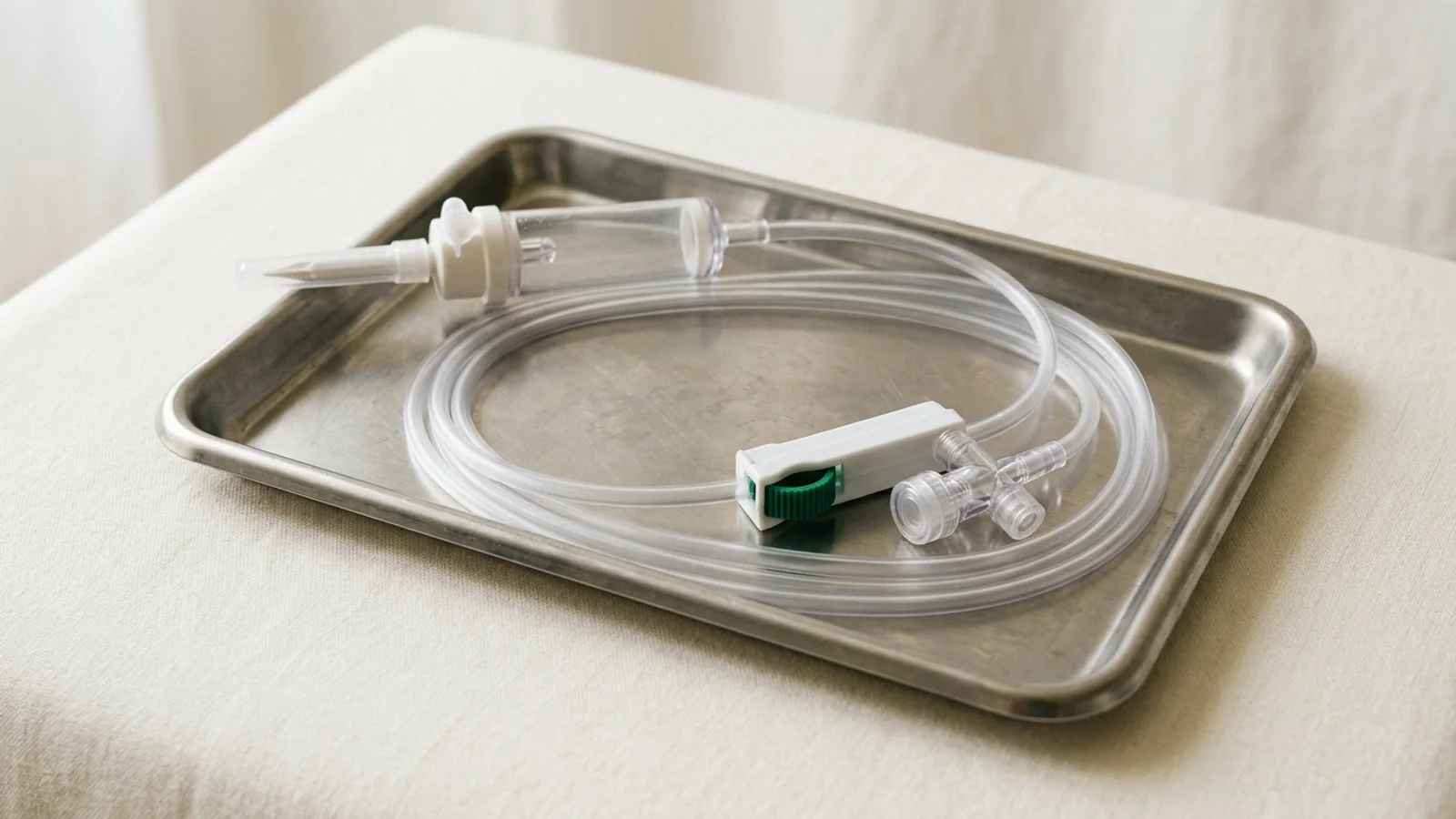
In healthcare material management and pharmacy procurement, intravenous administration sets represent one of the highest-volume consumable categories. However, tender documents and hospital purchase orders frequently suffer from specification ambiguity: confusing administration sets with peripheral IV catheters, treating gravity infusion lines as interchangeable with dedicated pump sets, or failing to specify plasticizer formulations and needle-free port mechanisms.
An intravascular administration set is a labeled fluid-path system. Buyers must specify each component along the pathway—from container spike to vascular-access connection—using the device identification, FDA product code, recognized gravity-feed standard where it applies, and explicit material and accessory claims.
The set is the fluid path, not the cannula
In the United States, intravenous administration sets are regulated by the FDA under Title 21 of the Code of Federal Regulations, 21 CFR 880.5440 (Intravascular administration set). The regulation defines the device as a Class II (special controls) system intended to administer fluids from a container to a patient's vascular system through a needle or catheter inserted into a vein.
The statutory identification covers a broad assembly of fluid-path components and accessories, which may include:
Piercing Spike: Hollow spike designed to enter the container port. Specify vented versus non-vented as labeled; do not infer venting from a generic 510(k) number.
Drip Chamber: Drip chamber as a named 21 CFR 880.5440 component. Drop factor is a labeled drops/mL field, not a legal default.
Fluid Delivery Tubing: Fluid-delivery tubing as labeled. Polymer and plasticizer (including DEHP in a PVC fluid path) are specification fields, not brand-equivalent materials.
Flow Regulators: Flow regulator as a named component. Manual clamps on a gravity set are not evidence of pump-set anti-free-flow features.
Infusion-Line Filters: Infusion-line filter if the labeled configuration includes one. Pore size is a labeled rating for that SKU, not a universal micron chart.
Stopcocks and Manifolds: Multi-way valves (1-way, 3-way, 4-way) allowing multi-line access and diversion of fluid streams.
Access Sites & Connectors: Needle-free injection ports, Y-sites, and standardized male/female Luer lock connectors.
Procurement teams must clearly distinguish the administration set from the vascular access device itself. The administration set conducts fluid to the vascular access point; the catheter or cannula resides inside the patient's vein (see our dedicated reference on IV cannula sizes and color codes).
graph LR
  A["IV Solution Container"] --> B["Piercing Spike<br/>(Vented vs Non-Vented)"]
  B --> C["Drip Chamber<br/>(labeled drops/mL)"]
  C --> D["In-Line Filter<br/>(if labeled)"]
  D --> E["Fluid Delivery Tubing<br/>(DEHP status labeled)"]
  E --> F["Flow Control<br/>(Roller Clamp / Pump Segment)"]
  F --> G["Access Ports<br/>(Needle-Free Y-Site)"]
  G --> H["ISO 80369-7 connector"]
H --> I["Vascular Access Device"]Put product code and configuration on the same line
FDA's Intravascular Administration Sets 510(k) Guidance Manual establishes clear product code mappings under 21 CFR 880.5440. Tender documents should pair the specific set configuration with its corresponding product code:
| Product Code | Device Classification Name | Typical Clinical Architecture & Components |
|---|---|---|
| FPA | Set, Administration, Intravascular | Standard primary IV sets, secondary piggyback sets, extension sets, and sets with needleless access ports. |
| BRZ | Set, Blood Transfusion | Blood administration sets as identified in FDA's 2008 510(k) guidance. Filter rating, if present, is a labeled specification for that set—not a universal mesh size. |
| FPB | Filter, Infusion Line | Stand-alone or integral infusion-line filters. Pore size is a labeled rating, not a cross-brand equivalent. |
| CAK | Filter, Blood Transfusion, Microfilter | Specialized microaggregate filtration sets for cellular blood components. |
| FMG | Stopcock, I.V. Set | Single or ganged multi-port stopcocks and manifold manifolds for multiple infusion lines. |
| FPK | Tubing, Fluid Delivery | Extension lines, connecting tubing, and pressure-rated infusion tubing. |
| LHI | Set, Transfer, I.V. Fluid | Fluid transfer sets used for compounding and fluid reconstitution. |
Note that under 21 CFR 880.5440, pharmacy compounding systems (Product Code NEP) are exempt from 510(k) premarket notification subject to general limitations of exemptions in 21 CFR 880.9, whereas all clinical patient-connected intravascular sets (FPA, BRZ, FPB) require 510(k) clearance.
Gravity-feed evidence is ISO 8536-4; pump fit is labeled compatibility
A widespread source of clinical risk and procurement error is treating gravity infusion sets and volumetric infusion pump sets as interchangeable. The engineering requirements and testing standards for these two modalities differ significantly.
For single-use gravity infusion sets, the FDA recognizes ISO 8536-4:2019 (Infusion equipment for medical use — Part 4: Infusion sets for single use, gravity feed) (FDA Recognition Number 6-447). ISO 8536-4 specifies physical requirements for particulate contamination, tensile strength of connections, leakage under positive and negative pressure, flow rate under hydrostatic head, drip chamber dimensions, and air inlet filter efficiency.
In FDA's intravascular guidance, submitters of pump-compatible sets must provide comprehensive mechanical compatibility data with specific, named infusion pump models. Furthermore, the guidance requires clear warning labels regarding unrestricted flow hazards when sets are used with infusion pumps that lack integrated anti-free-flow safeguards.
| Functional Parameter | Gravity Administration Set | Infusion Pump Administration Set |
|---|---|---|
| Governing Standard | ISO 8536-4:2019 | Manufacturer-validated pump system protocol |
| Flow Mechanism | Hydrostatic head pressure (gravity height) | Active peristaltic or volumetric piston pumping |
| Tubing Specification | Labeled tubing polymer and plasticizer | Labeled pump-segment and named pump-model compatibility |
| Free-Flow Protection | Manual roller clamp only | Integrated active or passive anti-free-flow clamp mechanism |
| Tender Requirement | ISO 8536-4 compliance test reports | Named pump model compatibility matrix & validation reports |
Specify DEHP, latex, filter, and needle-free as labeled claims
When drafting purchasing specifications, buyers must establish unambiguous criteria for material formulations and functional accessories:
DEHP Plasticizer Disclosure: FDA's 2008 intravascular-administration-set 510(k) guidance recommends labeling DEHP in the PVC fluid pathway because the plasticizer can leach on contact with lipids. DEHP versus non-DEHP is a labeled fluid-path claim. It is not proof that two SKUs are interchangeable and it is not a patient-selection instruction.
Natural Rubber Latex Labeling: Latex status is a labeling field on the set and its accessories. Specify whether natural rubber latex is present in the fluid path or ports; do not assume a needle-free valve is latex-free because another SKU is.
In-Line Filtration Ratings: If a filter is part of the labeled configuration, specify the labeled pore-size rating and whether the filter is integral or a separate accessory (FDA product codes such as FPB or CAK). Do not treat common catalog micron numbers as a regulatory default or as brand-to-brand equivalence.
Needle-Free Access Technology: Needleless access may be an integral Y-site or a separate accessory. FDA's 2008 guidance recommends microbial-ingress testing for needleless devices that facilitate bidirectional flow, using a simulated-use challenge that approximates expected clinical accesses. That recommendation is evidence for the labeled valve, not a hang-time or administration instruction.
Small-Bore Connector Standards: To prevent dangerous misconnections between IV lines, enteral feeding tubes, and neuraxial systems, all intravascular set terminations must conform to ISO 80369-7 for Luer connectors.
Tender checklist without clinical administration steps
Use a checklist that can be verified against the labeled device and the public FDA/ISO identity—not against clinical administration steps:
| Tender Specification Field | Required Buyer Verification | Primary Standard / Regulatory Basis |
|---|---|---|
| 510(k) Clearance & Code | Verify valid 510(k) clearance under product code FPA, BRZ, FPB, or FMG | 21 CFR 880.5440 |
| Delivery Modality | State Gravity Feed vs Dedicated Pump Set (list specific pump models) | ISO 8536-4:2019 / Pump OEM Validation |
| Spike Configuration | Specify Vented (with bacterial air filter) or Non-Vented | ISO 8536-4:2019 / labeled spike configuration |
| Drip Factor Rating | State the labeled drops/mL. Nursing texts often list 10, 15, 20, or 60 as conventions; those are labeled drop factors, not a legal default | Labeled drops/mL (not a legal default) |
| Tubing Material & Length | Specify labeled length in inches and millimeters, and DEHP status in the PVC fluid path if claimed | FDA 510(k) guidance (length, DEHP if PVC fluid path) |
| Access Port Type | State number and location of needle-free Y-sites (split septum / swabable) | FDA Microbial Ingress Recommendations |
| In-Line Filter (if included) | State the labeled pore-size rating if a filter is included; do not treat catalog micron numbers as a regulatory default | Labeled filter rating / FDA 510(k) guidance |
| Connector Standard | Mandate male/female locking Luer connectors per ISO 80369-7 | ISO 80369-7:2021 |
| Sterility Assurance | Mandate the labeled sterile, non-pyrogenic fluid-path claim; do not invent a numeric sterility-assurance value | Labeled sterile, non-pyrogenic fluid path as claimed |
To review related vascular access and injection device standards, explore our guides on IV cannula sizes and color codes and hypodermic needle gauge and length specifications.