
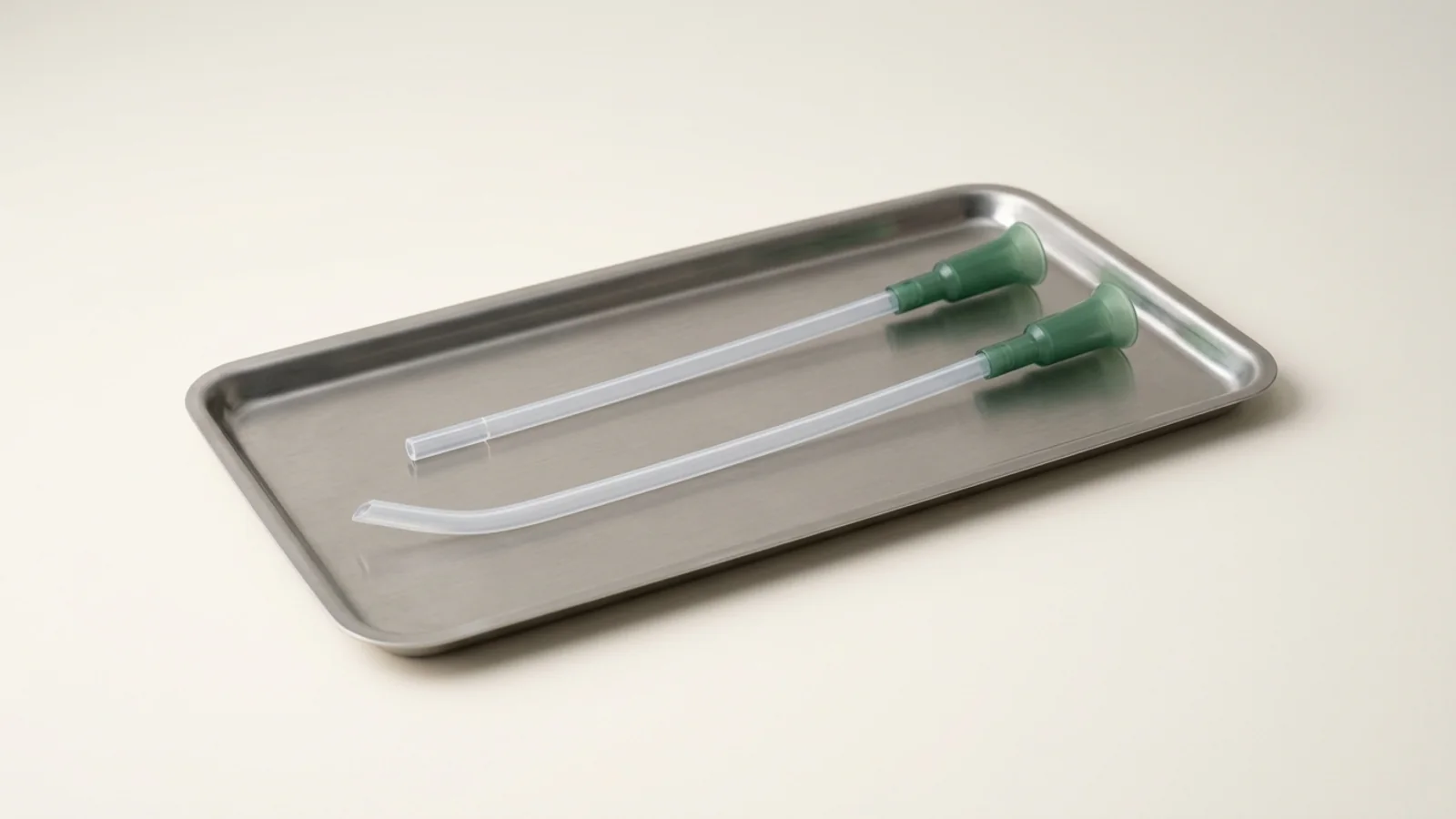
Intermittent urethral catheters are not a Foley size chart
When hospital purchasing teams, supply distributors, and central procurement committees draft tender specifications for urinary catheters, they frequently commit an expensive category error: they paste a conventional Foley retention catheter sizing chart into an intermittent catheter request for quotation (RFQ). This practice introduces contractual ambiguities, generates irrelevant supplier clarifications, and fails to establish the technical criteria necessary to evaluate single-use intermittent devices.
The fundamental scenario question confronting hospital buyers is: How should a healthcare facility or distributor specify a sterile single-use intermittent urethral catheter under ISO 20696 without reusing a Foley French-size and balloon chart?
The direct answer is straightforward. An intermittent urethral catheter must be specified as an ISO 20696:2018 device under 21 CFR 876.5130 with product code EZD (catheter, straight), or alternatively GBM or KOD. Buyers must verify labeled French outer diameter, ISO 20696 effective shaft length, anatomical tip geometry (Nelaton straight, Tiemann/coudé, or olive), drainage zone configuration, proximal funnel or bag connector, shaft material, latex statement, sterility modality, and specific hydrophilic coating chemistry. ASTM F623-19 remains a balloon-retention standard for French sizes 12 through 26 and is the wrong technical foundation for a no-balloon intermittent device.
Both intermittent and indwelling catheters are regulated under the same overarching classification rule, 21 CFR 876.5130 (Urological catheter and accessories), which defines a urological catheter as a flexible tubular device inserted through the urethra to pass fluids to or from the urinary tract. However, sharing a federal regulation does not make them interchangeable consumable lines. Indwelling Foley catheters are Class II retention devices intended for continuous, days-long or weeks-long bladder drainage, where retention balloon integrity, inflation lumen cross-section, and drainage channel throughput govern patient safety. Our companion guide, Foley Catheter Sizes: A Procurement and Specification Guide, covers ASTM F623 French sizing, true inner drainage lumen cross-sections, balloon capacity, and retention tender standards. That published framework belongs strictly to retention catheters.
In contrast, intermittent urethral catheters are single-use devices intended for transient insertion to completely empty the bladder, followed by immediate withdrawal. They possess no retention balloon, require no inflation lumen, feature specialized tip geometries and localized micro-hole or polished eyelet drainage zones, and depend critically on surface lubricity to minimize urethral friction during transit. This article provides technical specification and sourcing guidance for procurement officers; it does not provide clinical catheterization instructions, insertion techniques, dwell-time rules, or patient-specific size selection.
ISO 20696 is the particular urethral-catheter standard—and FDA recognizes it only in part
The definitive international consensus standard governing single-use urethral catheters is ISO 20696:2018 (Sterile urethral catheters for single use, First edition 2018-06, including corrected versions 2019-12). ISO systematically reviewed and confirmed this standard in 2023, establishing its ongoing international currency. The explicit scope of ISO 20696 covers sterile urethral catheters for single use, with or without a balloon. It specifically excludes drainage catheters covered by ISO 20697 (such as suprapubic, nephrostomy, and ureteral catheters) as well as ureteral stents governed by ASTM F1828.
While ISO 20696 encompasses both ballooned and non-ballooned urethral catheters in international trade, the U.S. FDA recognizes ISO 20696 only in part. On 29 May 2023, under Federal Register Recognition List 060, the FDA published Recognized Consensus Standard Rec# 9-143, granting partial recognition to ISO 20696:2018 (corrected 2019-12). Sourcing professionals must understand which clauses FDA recognized and which clauses it explicitly withheld from recognition.
FDA's Standards Information Sheet for Rec# 9-143 explicitly excludes four major clauses and five associated annexes from recognition:
Clause 6.3 and Annex C (Balloon volume maintenance): Not recognized. FDA determined that ISO 20696's balloon volume retention test conflicts with established FDA guidance and ASTM F623-19.
Clause 6.4 and Annexes D and I (Deflation reliability / failure to deflate): Not recognized. FDA relies on the deflation reliability protocols set forth in the 1994 Foley 510(k) guidance and ASTM F623-19.
Clause 6.5 and Annex E (Flow rate): Not recognized. FDA determined that Annex E's gravity flow methodology conflicts with the flow-through drainage lumen requirements for French sizes 12 and 14 specified in ASTM F623-19 and the August 2020 Conventional Foley Catheters Safety and Performance Based Pathway.
Clause 6.6 and Annex F (Balloon integrity / resistance to rupture): Not recognized. FDA requires balloon burst and rupture resistance to be evaluated according to ASTM F623-19 criteria.
The regulatory rationale behind FDA's partial recognition reveals why the standard is split. Rec# 9-143 states that ISO 20696 Clause 6.3 / Annex C conflicts with ASTM F623-19 Clause 4.4 (balloon volume maintenance); Clause 6.4 / Annexes D and I conflict with F623 Clause 4.6; Clause 6.5 / Annex E conflicts with F623 Clause 4.1 flow criteria for French sizes 12 and 14; and Clause 6.6 / Annex F conflicts with F623 Clause 4.2 balloon integrity. Those mappings are Foley balloon and Fr 12/14 flow tools. For a no-balloon intermittent SKU they are the wrong RFQ backbone. A Declaration of Conformity to ISO 20696 should name the clauses actually applied and must not be treated as a substitute for ASTM F623 balloon or Fr 12/14 flow evidence on a retention catheter. Do not reproduce paywalled ISO 20696 Table 1 lengths or annex numeric limits.
| ISO 20696 Clause / Annex | Subject Matter | FDA Rec# 9-143 Status | Intermittent Procurement Applicability |
|---|---|---|---|
| Remainder of ISO 20696 (not listed as unrecognized) | Clauses other than 6.3–6.6 and Annexes C, D, E, F, I | Not listed as unrecognized on Rec# 9-143 | Request DoC naming applied clauses; ISO 10993/11137 are separate 510(k) citations, not copied ISO 20696 tables |
| Labeled French size and effective shaft length | SKU-labeled Fr and ISO 20696 effective length (examples in 510(k)s) | Rec# 9-143 remainder; use labeled 510(k) fields | As labeled; do not copy ASTM F623 Fr 12–26 or paywalled Table 1 |
| Drainage openings as labeled | Polished eyelets (K213575, K192468) or micro-hole zone (K241028, K251116) | Rec# 9-143 remainder; use labeled 510(k) fields | Specify the labeled opening design; do not copy opening dimensions |
| Clause 6.3 & Annex C | Balloon volume maintenance | NOT recognized (conflicts with F623) | Not applicable: intermittent catheters have no balloon |
| Clause 6.4 & Annexes D, I | Deflation reliability and failure to deflate | NOT recognized (conflicts with F623) | Not applicable: intermittent catheters have no balloon |
| Clause 6.5 & Annex E | Flow rate through drainage lumen | NOT recognized (conflicts with F623 Fr 12/14) | Optional bench data: K192468 cited Annex E method |
| Clause 6.6 & Annex F | Balloon integrity and resistance to rupture | NOT recognized (conflicts with F623) | Not applicable: intermittent catheters have no balloon |
| Annex A & Annex H | Tensile strength and peak tensile force | Not listed as unrecognized on Rec# 9-143 | Cited in K192468 (Annex A strength, Annex H peak tensile force) |
| Annex B | Security of connector to drainage funnel | Not listed as unrecognized on Rec# 9-143 | Cited in K192468 Annex B connector security |
| Annex G | Kink stability and resistance to lumen collapse | Not listed as unrecognized on Rec# 9-143 | Cited in K192468 Annex G kink stability |
flowchart TD
  A["21 CFR 876.5130: Urological Catheters (Class II)"] --> B{"Labeled intended use"}
  B -->|"Single-use intermittent, no balloon"| C["Intermittent urethral catheter"]
  B -->|"Balloon retention / Foley"| D["Foley retention catheter"]
  C --> E["Product codes: EZD / GBM / KOD (tip is labeled, not automatic EZC)"]
  D --> F["Product codes: EZL / MJC"]
  E --> G["Particular standard: ISO 20696:2018/2019 (Rec# 9-143, partial)"]
  F --> H["Particular standard: ASTM F623-19 (Rec# 9-132)"]
  G --> I["Buyer fields from labels and 510(k)s:\n- Labeled Fr and ISO 20696 effective length\n- Tip: Nelaton, Tiemann/coudé, olive\n- Drainage: polished eyelets or micro-holes\n- Coating and wetting as labeled\n- Annex A/B/G/H if declared; Annex E is unrecognized"]
H --> J["Foley balloon RFQ stays on the other article:\n- Balloon volume (F623 4.4) and integrity (4.2)\n- Deflation reliability (F623 4.6)\n- Fr 12-26 drainage flow (F623 4.1); three-lumen excluded\n- 1994 Foley guidance and 2020 SPB pathway"]Product codes: EZD, GBM, and KOD versus EZL Foley
Under the FDA classification framework, 21 CFR 876.5130 contains several three-letter product codes that segregate device types by physical design, indications, and consensus standard mappings. When requesting regulatory clearance records or reviewing supplier 510(k) documentation, procurement officers must match the quoted SKU to the correct product code.
The primary product code for modern sterile intermittent catheters is EZD (Catheter, straight). The live FDA classification database record for EZD confirms that it is a Class II device requiring 510(k) premarket notification and is not exempt from Good Manufacturing Practice (GMP) regulations. Crucially, the EZD record lists three recognized consensus standards: ASTM F623-19 (Rec# 9-132), ASTM D1894-14 (Rec# 9-142, coefficient of friction of plastic film and sheeting), and ISO 20696:2018 (Rec# 9-143). EZD is also eligible for the FDA 510(k) Third Party Review Program. Modern intermittent catheter clearances consistently use EZD, including Coloplast Luja Female (K241028), Coloplast Luja Coudé (K251116), and Hollister Female IC (K213575).
Two additional codes appear in historical or broad urological listings:
KOD (Catheter, urological): A generic Class II product code under 21 CFR 876.5130. The live KOD record lists ASTM F623-19 and ISO 20696. In FDA's Standards Information System, KOD is mapped as an example code alongside EZD and EZL for ISO 20696. While KOD is an acceptable regulatory filing code, it is broader than EZD.
GBM (Catheter, urethral): An older Class II classification under 21 CFR 876.5130. The live GBM classification page lists ASTM F623-19 as recognized consensus standard, but does not list ISO 20696. Historical 510(k) clearances, such as Hangzhou Bever's Ready-to-Use Hydrophilic Catheters (K192468), cited GBM in the summary body while the formal clearance letter referenced both GBM and EZD. Sourcing teams should require current SKUs to provide their active device listing code rather than assuming GBM and EZD are identical.
Crucially, buyers must distinguish intermittent codes from retention and specialty codes:
EZL (Catheter, retention type, balloon): This is the exclusive product code for conventional Foley balloon catheters under 21 CFR 876.5130. The live EZL record lists ASTM F623-19, ASTM D1894-14, and ISO 20696, and uniquely lists the two official Foley guidance documents: the September 1994 Foley 510(k) guidance and the August 2020 Conventional Foley Catheters Safety and Performance Based Pathway. An EZL code indicates an indwelling balloon catheter, not an intermittent catheter.
EZC (Catheter, coude): While EZC exists for curved-tip urological catheters, modern regulatory practice does not automatically assign coudé intermittent catheters to EZC. A prime example is K251116 (Coloplast Luja Coudé, cleared 27 June 2025): despite having a pronounced flexible curved tip, the device was formally classified under product code EZD (Catheter, straight). Tip curvature is a labeled configuration option, not an automatic product code trigger.
MJC (Urological catheter, antimicrobial): Live classification name: catheter, urological (antimicrobial) and accessories. Class II, 510(k) required, 21 CFR 876.5130. The MJC page lists ASTM F623-19 and the 1994 Foley 510(k) guidance. It is not an intermittent default code.
| Product Code | Device Classification Name | Regulation | Recognized Standards on File | Cleared Precedent / Role |
|---|---|---|---|---|
| EZD | Catheter, straight | 21 CFR 876.5130 | ASTM F623-19, ASTM D1894-14, ISO 20696:2018 | Primary code: K241028 (Luja female), K251116 (Luja Coudé), K213575 (Hollister) |
| GBM | Catheter, urethral | 21 CFR 876.5130 | ASTM F623-19 (ISO 20696 not listed on live page) | Older code: K192468 (Hangzhou Bever cleared under GBM and EZD) |
| KOD | Catheter, urological | 21 CFR 876.5130 | ASTM F623-19, ISO 20696:2018 | Broad urological category; eligible for third-party review |
| EZC | Catheter, coude | 21 CFR 876.5130 | ASTM F623-19 (live EZC page; ISO 20696 not listed) | Dedicated coudé code; modern intermittent coudés often clear under EZD |
| EZL | Catheter, retention type, balloon | 21 CFR 876.5130 | ASTM F623-19, ASTM D1894-14, ISO 20696:2018, Foley Guidances | Retention Foley only; not valid for intermittent catheter tenders |
| MJC | Urological catheter, antimicrobial | 21 CFR 876.5130 | ASTM F623-19; 1994 Foley 510(k) guidance listed on MJC | Antimicrobial retention catheters; distinct drug-device evaluation |
Why ASTM F623 and the Foley pathway stay on the other article
A frequent question from purchasing officers is why FDA product classification records for intermittent codes like EZD cite ASTM F623-19, and why manufacturers of intermittent catheters frequently list ASTM F623 in their 510(k) performance testing summaries. Understanding this relationship prevents buyers from mistakenly demanding Foley test compliance.
ASTM F623-19 (Standard Performance Specification for Foley Catheter, recognized in full as FDA Rec# 9-132) is scoped exclusively for indwelling balloon-retention devices. Section 1.1 states that the standard covers short-term utilization of a single-use, balloon-retention catheter, French sizes 12 through 26 inclusive, for bladder drainage through the urethra. Furthermore, Section 1.7 of ASTM F623-19 explicitly lists the following public exclusions:
Long-term indwelling usage over 30 days.
Nonurethral catheterization (nephrostomy, suprapubic cystostomy, ureterostomy, gastrostomy, and enemas).
Three-lumen catheters (excluded from ASTM F623-19; do not import them from a Foley irrigation SKU).
Large retention balloons equal to or exceeding 30 cm³.
Pediatric catheters (F623-19 section 1.1 includes only French sizes 12 through 26; section 1.7 excludes pediatric catheters).
Catheters whose surface has been enhanced for lubricity using liquids or gels.
These exclusions demonstrate why ASTM F623 cannot govern an intermittent RFQ. Cited 510(k)s include Fr 8 and Fr 10 (K213575, K251116, K241028), which sit outside F623’s included Fr 12–26 table; they include no-balloon designs and liquid wetting media that section 1.7 excludes. A 9 cm or 5.5-inch labeled effective length is an ISO 20696 field on those files, not an F623 shaft-length specification. Section 1.2 still allows some coated surfaces to be tested to F623; a 510(k) citation of F623 does not waive the public exclusions or authorize copying a Foley balloon chart.
Why then do 510(k) summaries for intermittent catheters—such as Coloplast Luja Female (K241028)—cite ASTM F623-19 alongside ISO 20696? In premarket notifications, device manufacturers frequently leverage individual mechanical test apparatus or tensile testing fixtures described in F623 to demonstrate baseline material robustness (under F623 Section 1.2, which allows chemically treated surfaces with coatings to be tested to the specification). Citing F623 for baseline mechanical properties does not transform the intermittent SKU into a balloon catheter, does not waive F623's explicit exclusions, and does not authorize a buyer to transfer Foley balloon-capacity or Fr 12/14 drainage-flow requirements onto an intermittent RFQ.
Similarly, FDA's September 1994 Foley 510(k) guidance and the August 2020 Conventional Foley Catheters Safety and Performance Based Pathway are dedicated regulatory pathways for indwelling retention devices under product code EZL. Sourcing teams seeking retention catheter parameters, balloon burst criteria, and dual-lumen cross-sections must refer to our dedicated analysis in Foley Catheter Sizes: A Procurement and Specification Guide. For intermittent catheters, ISO 20696 remains the primary governing particular standard.
Specification fields buyers can verify: length, size, tip, connector
Rather than copying retention catheter charts, tender specifications for intermittent urethral catheters must articulate verifiable physical and mechanical parameters. Sourcing teams can extract ten concrete specification fields directly from recent FDA 510(k) clearance summaries:
French Size (Outer Diameter): Intermittent catheter outer diameters are specified in French gauge (1 Fr = 1/3 mm). Capture the labeled French size on the SKU rather than an ASTM F623 Fr 12–26 balloon-retention table. Cited examples: K241028 Fr 10, 12, 14, and 16; K251116 Fr 8, 10, 12, 14, 16, and 18; K213575 Fr 8, 10, 12, and 14; K192468 female and male Fr 6–18, Tiemann Fr 8–18, and pediatric Fr 6, 8, and 10. Do not copy paywalled ISO 20696 dimensional tolerances; verify the labeled size on the current listing.
ISO 20696 Effective Shaft Length: Effective shaft length is a labeled ISO 20696 field, not a Foley balloon-retention dimension and not a patient-selection instruction. Use the length printed on the SKU. Cited 510(k) examples:
Female Effective Length: K241028 (Luja female) states one effective length of 9 cm (3.5 in) for female patients only. K213575 (Hollister Female IC) states a 5.5-inch length versus a 5-inch predicate and treats both as conforming to BS EN ISO 20696 effective shaft length—a manufacturer declaration, not a copied ISO table.
Male Effective Length: K251116 (Luja Coudé) states one effective length according to ISO 20696:2018 of 33 cm (13 inches) for male patients only (adults and pediatric above age 1). Do not treat that length as a universal male RFQ default.
Pediatric Effective Length: Pediatric length is whatever the current SKU labels. K192468 lists pediatric Fr 6, 8, and 10 among its variants; it does not publish a single numeric pediatric length table in the summary. Do not invent a 20–30 cm pediatric family.
Tip Configuration: Intermittent catheters require distinct tip shapes to accommodate varying urethral anatomy:
Nelaton (Straight) Tip: A straight, rounded, closed distal tip. This is the standard configuration for routine voiding across female and uncomplicated male anatomy (e.g., K241028, K213575).
Tiemann / Coudé (Curved) Tip: A labeled flexible curved or tapered tip. K251116 describes a flexible curved (bended) tip under product code EZD. K192468 lists Tapered-Tip Tiemann variants. Tip shape is a configuration field; it is not automatic recoding to EZC and is not a clinical size-selection rule.
Olive Tip: K192468 lists an olive (curved and olive) tip as a labeled variant alongside Nelaton and Tiemann. Treat olive as a labeled configuration, not a clinical indication.
Tip Orientation Indicators: K192468 states that the Tiemann variant has a bent tip with a guide stripe in the shaft and/or a raised ridge on the funnel for orientation. Specify those labeled orientation marks when the SKU is a Tiemann/coudé; do not add catheterization technique.
Drainage Zone Geometry: Specify the labeled drainage design. K213575 and K192468 describe two smooth or polished drainage eyelets. K241028 and K251116 describe several small holes (micro holes) at the tip creating a drainage zone so urine can flow through the catheter. That is a labeled geometry, not a comparative mucosal-trauma or suction claim. Do not copy paywalled ISO opening dimensions.
Proximal Funnel Connector & Collection Interface: The proximal end terminates in a standard tapered funnel connector for direct voiding into a toilet or receptacle. Certain designs feature an integrated handle outlet capable of locking securely onto a standard urine collection bag (as cleared in K241028). Security of the connector joint must meet ISO 20696 Annex B.
Funnel Color Coding: K213575 lists a color-coded funnel as a manufacturer configuration. There is no universal international standard for intermittent catheter funnel colors. Buyers must never confuse catheter funnel colors with ISO 6009 hypodermic needle colors, nor assume that different catheter manufacturers share identical color palettes.
Aseptic Handling Aids: K192468 lists an optional insertion-aid sleeve as a no-touch design feature. Specify whether a sleeve or gripper is labeled on the SKU. Do not treat a sleeve as infection-prevention superiority or as catheterization technique.
Joint Strength and Tensile Resistance: The catheter shaft, tip weld, and funnel-to-tube joint must withstand physiological tensile forces without separation. Suppliers must demonstrate conformity to ISO 20696 Annex A (tensile strength) and Annex H (peak tensile force), verifying that no component separates under withdrawal tension.
Kink Resistance: The catheter tube must maintain lumen patency and resist kinking during insertion through the pelvic floor musculature. Conformity to ISO 20696 Annex G (kink stability) provides objective verification of lumen stability.
Packaging and Moisture Barrier: Pre-hydrated catheters require impermeable foil laminates or specialized blister packs that maintain liquid content and sterility throughout labeled shelf life.
| Specification Parameter | Coloplast Luja Female (K241028) | Coloplast Luja Coudé (K251116) | Hollister Female IC (K213575) | Hangzhou Bever Ready-to-Use (K192468) |
|---|---|---|---|---|
| FDA Product Code | EZD (Catheter, straight) | EZD (Catheter, straight) | EZD (Catheter, straight) | GBM / EZD |
| Target Population | Female (adults & children ≥2 yrs) | Male (adults & children ≥1 yr) | Female & female pediatric | Adult male, female, pediatric |
| French Sizes (Fr) | Fr 10, 12, 14, 16 | Fr 8, 10, 12, 14, 16, 18 | Fr 8, 10, 12, 14 | Female/male Fr 6–18; Tiemann Fr 8–18; pediatric Fr 6, 8, 10 |
| Effective Shaft Length | 9 cm (3.5 in) | 33 cm (13 in) | 5.5 in | As labeled (summary does not publish one length table) |
| Tip Configuration | Nelaton (straight rounded) | Flexible Coudé (curved) | Nelaton (straight rounded) | Nelaton, Tiemann, Olive |
| Drainage Zone | Micro-hole drainage zone | Micro-hole drainage zone | Two smooth lateral eyelets | Two polished lateral eyelets |
| Hydrophilic Coating | PVP-based, saline with PEG | Modified PVP, saline with PEG | PVP-based, direct hydration | PVP-based, packed in water |
| Sterilization & Shelf Life | E-beam, SAL 10⁻⁶, 2 years | E-beam; SAL 10⁻⁶; 2 years | E-beam (predicate gamma); SAL validated; shelf life as labeled | ISO 11137 radiation validation; ASTM F1980 aging; duration as labeled |
Hydrophilic coating is a labeled claim, not a brand equivalent
One of the most persistent procurement pitfalls in consumable purchasing is treating “hydrophilic coating” as a generic commodity specification. Sourcing officers often assume that any catheter labeled as hydrophilic offers identical lubricity, insertion comfort, and urethral protection across different brands. Regulatory filings demonstrate that hydrophilic coatings represent highly differentiated, proprietary chemical matrices requiring specific verification.
Hydrophilic coatings consist of a hydrophilic polymer—most commonly polyvinylpyrrolidone (PVP)—applied to the labeled shaft polymer (polyurethane in K241028, K251116, and K192468; TPE, phthalate-free and PVC-free, in K213575). 510(k)s describe PVP-based coatings hydrated by sterile water or saline with PEG. Treat coating identity, wetting medium, and friction method as labeled claims. Do not assume a shared chemistry or a universal coefficient of friction.
However, the engineering of hydrophilic catheter systems diverges across three critical dimensions:
Wetting Medium Chemistry: The fluid that hydrates the coating is a labeled field. K192468 is packed in water. K241028 and K251116 use saline solution with PEG and cite manufacturer pH and osmolality methods. Request the wetting medium named on the SKU. Do not infer epithelial water movement or clinical comfort from the presence of PEG.
Activation Modality: Catheters are supplied in two primary activation formats:
Ready-to-Use (Pre-hydrated): The catheter is packaged pre-immersed in wetting fluid inside an impermeable foil pouch or blister pack (e.g., Luja, Hangzhou Bever). It is ready for immediate insertion upon opening without manual soaking.
Burstable Sachet: A dry catheter packed with a sealed liquid sachet that must be activated before use. K192468’s LoFric Primo reference device required bursting of a water packet prior to use; that is a labeled activation format, not a universal wait time. Do not invent an activation interval.
Friction Testing and Lubricity Retention: FDA product code EZD lists ASTM D1894-14 (Rec# 9-142) among recognized consensus standards. K241028 cites ASTM D1894-14 plus Coloplast friction methods at T=0 and T=5 minutes. K251116 names TM6030 (friction at T=0) and TM6058 (friction after 5 minutes). K192468 cites ASTM D1894 coefficient of friction and an internal coating-adhesion method. Request the method actually declared for the SKU. Timed Coloplast methods are not a universal wet-lubricity standard, and ASTM D1894 on EZD is not proof of cross-brand coating equivalence.
FDA's historical 1994 Foley guidance established the regulatory precedent that hydrophilic coatings cannot be evaluated by generic claims; manufacturers must provide coefficient of friction data, coating adherence testing, and shelf-life stability evidence proving the coating does not degrade. Sourcing teams must require suppliers to provide documented test evidence (such as ASTM D1894 kinetic friction coefficients and coating shed/particulate data) rather than accepting unverified promotional assertions of 'high lubricity.'
Material, latex, sterility, and what to request in the quality agreement
Evaluating the physical shaft and sterile barrier system requires verifiable material and quality disclosures across four primary domains:
Catheter shaft polymers and plasticizers
The cited 510(k)s use polyurethane or thermoplastic elastomer (TPE) shafts, not a single equivalent polymer. K241028, K251116, and K192468 describe polyurethane. K213575’s subject device is TPE, labeled phthalate-free and PVC-free; the predicate in that file was phthalate-free PVC. If a current SKU is PVC, capture the labeled plasticizer statement, including whether it is not made with di(2-ethylhexyl) phthalate (DEHP). Do not treat PUR, TPE, and PVC as interchangeable, and do not infer wall thickness or lumen area from the polymer family alone.
Natural rubber latex disclosures
In accordance with FDA labeling guidance, modern intermittent catheters are labeled as “Not made with natural rubber latex” (as cleared in K213575). Sourcing teams must verify this explicit statement on primary packaging and Certificates of Conformance (CoC). As detailed in our analysis of medical gloves in Medical Exam and Surgical Gloves: A Specification Guide for Buyers, FDA discourages the phrase 'latex-free' because total absence of trace allergens cannot be scientifically guaranteed; the standardized regulatory statement is 'Not made with natural rubber latex.'
Sterilization modality and sterile barrier integrity
Intermittent urethral catheters in the cited files are supplied sterile and single-use. K241028 and K251116 state e-beam sterilization, SAL 10⁻⁶, and a two-year shelf life. K213575 uses e-beam (predicate gamma) and states that SAL was validated for both radiation methods without publishing a shelf-life duration. K192468 cites ISO 11137-1/2/3 radiation validation and ASTM F1980 aging without stating e-beam or a two-year expiry. K241028 also cites ISO 11607-1 packaging. Request the labeled modality, SAL if stated, sterile-barrier evidence, and expiry; do not impose ethylene oxide, a universal SAL 10⁻⁶, or a 2–3 year default on every SKU.
For storage and logistics criteria, procurement contracts should cross-reference our operational guidance in Labeled Storage and Transport for Medical Consumables: Temperature, Humidity, and Distribution Evidence. Pre-hydrated hydrophilic catheters follow the labeled storage and transport conditions on the SKU. Use those labeled limits, and the storage-and-transport article, rather than a numeric range invented here.
Quality agreement clauses under QMSR
Where a hospital system or distributor is specifying these SKUs under a quality agreement, use the purchasing-information and change-control fields in Quality Agreements for Consumable Suppliers: Purchasing Information, Change Control, and Outsourced Processes. Require pre-implementation written notification of coating, polymer, plasticizer, sterilization, and primary-packaging changes, with the notice interval set in the agreement. Do not invent a default number of days or a CoA/AQL rule on this page.
RFQ checklist and what this page will not decide
To streamline tender documentation and supplier audits, procurement committees should adopt the following structured specification checklist. This checklist operationalizes the technical criteria established in this guide, separating verifiable engineering facts from marketing claims.
| RFQ Parameter | Mandatory Specification Requirement | Regulatory / Consensus Baseline | Supplier Verification Document |
|---|---|---|---|
| 1. Intended Use | Single-use, transient urethral drainage (no balloon retention) | 21 CFR 876.5130; ISO 20696:2018 | Product Instructions for Use (IFU) |
| 2. FDA Classification | Class II, product code EZD (or GBM / KOD); 510(k) cleared | 21 CFR 876.5130; FDA Product Code EZD | 510(k) clearance letter and Device Listing |
| 3. Standard Conformity | Conformity to ISO 20696:2018/2019 recognized clauses | FDA Rec# 9-143 (excluding balloon/flow clauses) | Declaration of Conformity (DoC) |
| 4. Outer Diameter | Labeled French size on the SKU (cited files include Fr 6–18 depending on variant) | Labeled size; ISO 20696 DoC if declared — not F623 Fr 12–26 | Labeled dimensional data or supplier declaration |
| 5. Shaft Length | As labeled (examples: 9 cm K241028; 5.5 in K213575; 33 cm K251116) | ISO 20696 effective shaft length as labeled | Labeled technical datasheet |
| 6. Tip Geometry | Nelaton (straight), Tiemann/Coudé (curved), or Olive; orientation mark | Labeled configuration; K251116 / K192468 | Engineering drawing & packaging artwork |
| 7. Drainage Design | Polished/smooth eyelets or micro-hole zone as labeled | ISO 20696 Clause 6.2 | Microscopy inspection data / visual standard |
| 8. Lubricity & Coating | Coating polymer, wetting/activation, and friction method as labeled | ASTM D1894-14 on EZD if declared; timed methods only if the SKU cites them | Declared friction/adhesion evidence (D1894 and/or named method) |
| 9. Material & Latex | Labeled polymer (PUR, TPE, or PVC); plasticizer statement; 'Not made with natural rubber latex' if claimed | FDA Latex Labeling Guidance; ISO 10993 | Material declaration & biocompatibility summary |
| 10. Sterility & Pack | Labeled modality and expiry; SAL if stated (K241028/K251116: e-beam, SAL 10⁻⁶, 2 years) | ISO 11137 and/or ISO 11607-1 if cited for that SKU; not a default pair | Labeled sterility, SAL, and expiry evidence |
Regulatory freshness and review triggers
This specification guide is current as of 10 September 2026. Sourcing teams should re-evaluate their tender specifications upon the occurrence of any of the following regulatory triggers:
ISO Standards Confirmation: ISO confirmed ISO 20696:2018 in 2023. If ISO/TC 84 publishes a second edition or revises Table 1 effective length criteria, specifications must be updated.
FDA Recognition Modifications: If FDA updates Rec# 9-143 on the Standards Information System (page last updated 25 May 2026), particularly regarding the recognition status of Annex E flow rates or balloon clauses.
ASTM F623 Revisions: ASTM's development of F623-25. While ANSI may register successors, FDA consensus recognition remains fixed at ASTM F623-19 (Rec# 9-132) until the Federal Register recognition list is amended.
FDA Classification Updates: Any rulemaking modifying 21 CFR 876.5130 or altering the recognized consensus standards listed on product code pages EZD, GBM, KOD, or EZL.
What this guide will not decide
To maintain strict institutional boundaries, procurement teams must recognize what a technical purchasing guide cannot resolve:
Clinical Catheterization Protocols: This guide does not prescribe clinical catheterization technique, clean versus sterile intermittent catheterization procedures, or frequency of catheterization. Such determinations rest entirely with prescribing clinicians and nursing protocols.
Individual Patient Sizing: Determining whether an individual patient requires an Fr 10 female Nelaton, an Fr 14 male Coudé, or an olive tip is a clinical decision based on anatomical presentation, stricture evaluation, and urodynamic testing.
Generic Coating Equivalency: Purchasing departments must not authorize automatic substitution between different hydrophilic brands without clinical and quality review of wetting chemistry, activation requirements, and friction data.
Drainage Catheter Substitution: Intermittent urethral catheters must never be substituted for suprapubic, nephrostomy, or ureteral drainage catheters governed by ISO 20697, nor for indwelling retention catheters governed by ASTM F623.