
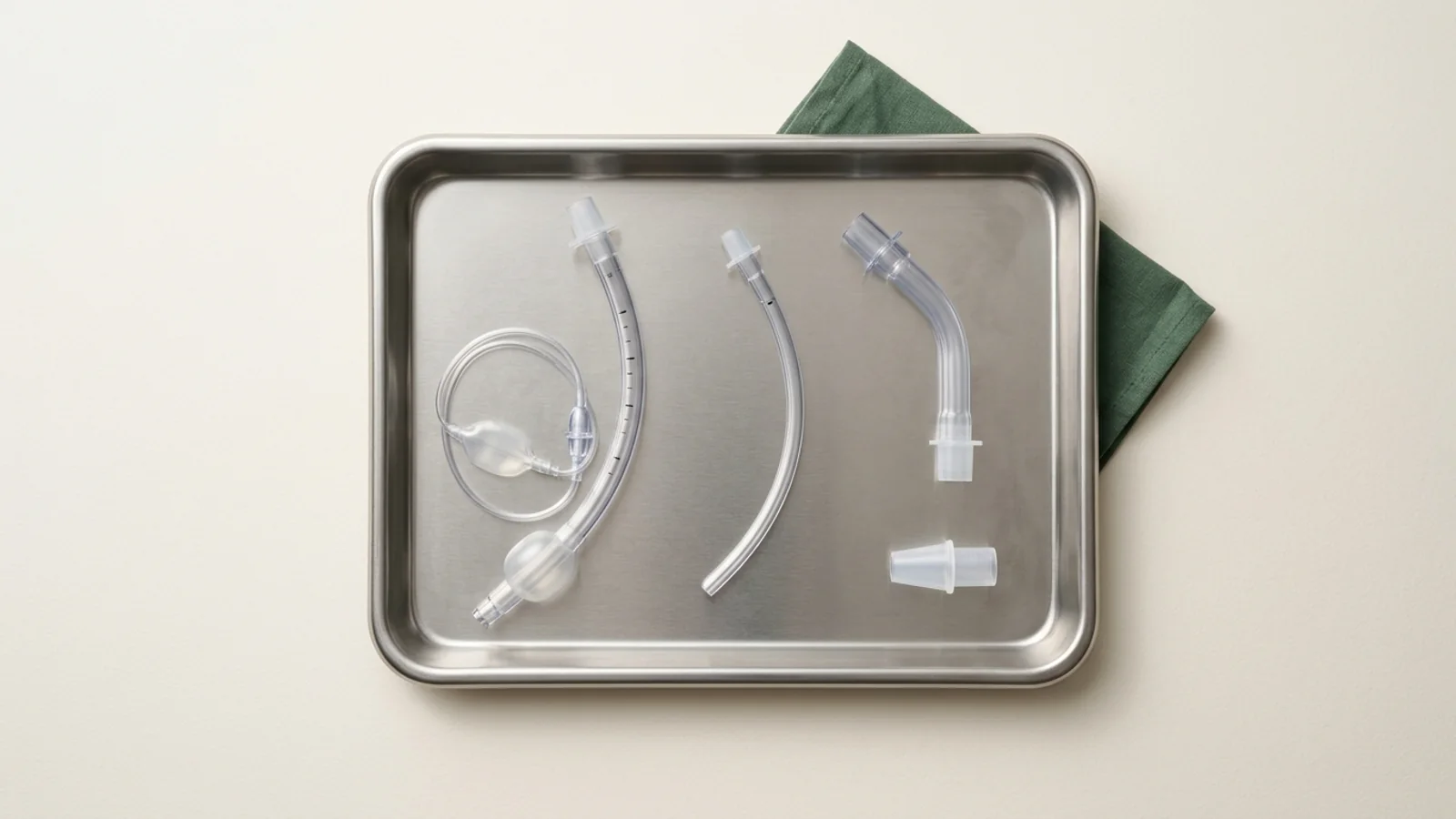
Specify the Tracheal Tube by 21 CFR 868.5730, Not Catalog Trade Names
Hospital procurement, supply distributors, and value-analysis committees often see airway tenders filled with catalog phrases such as 'ET tube,' 'cuffed endotracheal tube,' or 'reinforced airway.' Distributor portals and surplus listings commonly put oral/nasal tracheal tubes, tracheostomy tubes, bronchial or differential-ventilation sets, laser Magill-tip SKUs, and intubating stylets under one heading. Copying the catalog heading without the 21 CFR identification and ISO 5361 scope produces an ambiguous line that can be filled with the wrong generic type.
Under U.S. Food and Drug Administration (FDA) regulations codified in Title 21 of the Code of Federal Regulations, an endotracheal tube is legally classified under 21 CFR 868.5730 as a 'tracheal tube.' The regulation defines a tracheal tube as a device inserted into a patient's trachea via the nose or mouth and used to maintain an open airway. It is classified as a Class II device subject to performance standards and premarket notification (510(k)). FDA's product classification database assigns this generic device type the three-letter product code BTR ('tube, tracheal (w/wo connector)'). The BTR classification is designated as life-supporting and life-sustaining, is not exempt from Good Manufacturing Practice (GMP) quality system regulations, and is ineligible for accredited third-party 510(k) review.
Procurement teams must clearly segregate product code BTR from five adjacent regulatory categories that operate under entirely separate generic classifications and clinical indications:
Tracheostomy Tubes (21 CFR 868.5800 / Product Code BTO): A device placed into a surgical opening of the trachea to facilitate ventilation, with a cuff that, when inflated, is intended to seal the tracheal wall (21 CFR 868.5800). Insertion through a stoma is a different identification from 868.5730 nose-or-mouth placement. Tracheostomy tubes are specified under ISO 5366, not ISO 5361. A shared 15 mm ISO 5356-1 connector does not make a BTO SKU a BTR tracheal tube.
Tracheal/Bronchial Differential Ventilation Tubes (21 CFR 868.5740 / Product Code CBI): A device used to isolate the left or the right lung for anesthesia or pulmonary function testing (21 CFR 868.5740). FDA product code CBI lists ISO 16628:2022 as Rec# 1-161. That tracheobronchial family is excluded from ISO 5361 and is not a single-lumen BTR line.
Bronchial Tubes (21 CFR 868.5720 / Product Code BTS): A device used to differentially intubate a bronchus in order to isolate a portion of lung distal to the tube (21 CFR 868.5720). That generic type is not an ISO 5361 oro- or naso-tracheal tube.
Inflatable Tracheal Tube Cuffs (21 CFR 868.5750): A separate Class II generic classification applying when a cuff assembly is sold independently as an add-on device. For integral cuffed tubes under 868.5730, cuff characteristics are evaluated as part of the total tube submission.
Tracheal Tube Stylets (21 CFR 868.5790 / Product Code BSR): A device used temporarily to make a flexible tracheal tube rigid to aid insertion. Class I, 510(k)-exempt subject to 21 CFR 868.9. A stylet packaged with a tube, including the stylet-packaged variants in K243785, remains this accessory; it does not change the tube's BTR generic type. A 10 Fr 'intubating stylet' on a marketplace ETT page is this accessory family, not the tube's designated size.
Reprocessed Tracheal Tubes (21 CFR 868.5730 / Product Code NMA): Still regulation 868.5730, Class II, 510(k). The classification record states that reprocessing validation data for this device type must be included in a 510(k) submission (70 FR 56911). NMA is not a 510(k) exemption. A labeled single-use BTR tube is not specified by copying an NMA listing, and in-house reuse of a labeled single-use tube is not authorized by that code.
Sourcing teams should ensure that consumable specifications align with facility requirements for UDI and GUDID label capture, verified storage and distribution environmental controls, and facility receiving protocols, just as they do when evaluating respiratory PPE filtration standards or intravenous administration sets. This guide addresses procurement specifications, dimensional verification, and regulatory conformity; it does not provide clinical intubation training, cuff-pressure titration rules, or patient-specific size selection.
flowchart TD
  A["Airway Consumable Requisition"] --> B{"Insertion Route & Clinical Placement"}
  B -->|"Translaryngeal: Nose or Mouth into Trachea"| C["21 CFR 868.5730: Tracheal Tube (Product Code BTR)"]
  B -->|"Surgical Stoma directly into Trachea"| D["21 CFR 868.5800: Tracheostomy Tube (Product Code BTO)"]
  B -->|"Selective Mainstem Bronchial Intubation"| E["21 CFR 868.5720: Bronchial Tube (Product Code BTS)"]
  B -->|"Differential Lung Isolation: Double Lumen"| F["21 CFR 868.5740: Differential Tube (Product Code CBI)"]
  C --> G{"Wall Construction & Intended Use"}
  G -->|"Standard or Wire-Reinforced Oro/Naso Tube"| H["ISO 5361 Consensus Standard"]
  G -->|"Laser Surgery of the Airway"| I["Outside ISO 5361: Governed by ISO 14408 / 11990"]
  C --> J{"Single-Use vs Commercial Reprocessing"}
  J -->|"Original Labeled Single-Use"| K["Standard 510(k) BTR Device"]
J -->|"Commercial SUD Reprocessing"| L["Product Code NMA: Requires 510(k) Reprocessing Data"]ISO 5361 Scope: What Belongs on the Tracheal Tube Line
The particular standard for oro-tracheal and naso-tracheal tubes and tracheal tube connectors is ISO 5361, 'Anaesthetic and respiratory equipment — Tracheal tubes and connectors.' The current fourth edition, ISO 5361:2023, was published on 17 January 2023 (stage 60.60), with corrected English and French versions issued in November 2023. It cancels and replaces ISO 5361:2016. Public scope covers reinforced, shouldered, tapered, suctioning/monitoring, and other specialized tracheal tubes. Machine-end conical connectors are specified against ISO 5356-1, which ISO 5361 names among its public normative references.
Understanding the explicit scope boundaries of ISO 5361 prevents buyers from misapplying the standard to excluded product families or rejecting specialized tubes that are legitimately covered. According to its published scope, ISO 5361 applies to:
Oro-tracheal and naso-tracheal tubes: Standard flexible polymeric tubes intended for insertion via either oral or nasal approaches.
Reinforced (armored) tubes: Tubes whose walls are reinforced with an embedded metal wire or plastic spiral to maintain patent lumen geometry during flexion or neck repositioning. Embedding a stainless-steel coil does not remove a tube from ISO 5361 or product code BTR.
Preformed tracheal tubes: Tubes with an acute radius intended to direct the machine end in a specific direction. Current BTR 510(k)s use RAE as the trade-name family for that preformed geometry. Specify oral versus nasal preformed curvature as labeled; do not treat RAE as a required catalog name.
Shouldered and tapered tubes: Cole-type tubes combine a small-diameter laryngo-tracheal portion and a larger oral portion with a shoulder, as named in ISO 5361 public terms. Record whether a shouldered or tapered geometry is labeled; do not convert that geometry into a patient-age or resistance protocol.
Specialized auxiliary lumina: Tubes with means for suctioning, monitoring, or delivery of drugs or other gases, as named in ISO 5361 public scope. Specify a subglottic suction or monitoring port only when it is labeled.
Equally important are the explicit exclusions outlined in ISO 5361 clause 1. The standard explicitly excludes: (1) tracheobronchial and endobronchial tubes, which fall under ISO 16628; (2) tracheostomy tubes and connectors, which are governed by ISO 5366; (3) supralaryngeal airways, such as laryngeal mask airways, which are specified under ISO 11712; and (4) tubes intended for use with flammable anaesthetic gases, electrosurgical equipment, or medical lasers. Airway tubes designed for laser surgery must be evaluated under specialized standards, specifically ISO 14408, ISO 11990-1, and ISO 11990-2.
ISO 5361:2023/Amd 1:2026, published in July 2026 (ISO catalog 2026-07; 1 page), is titled 'Reinstatement of third edition S1 dimensions.' S1 is the inflating-tube separation dimension discussed in the 2023 public introduction; numeric S1 limits are not restated here. FDA Rec# 1-164 as of 15 September 2026 still names ISO 5361 Fourth edition 2023-01 and, in the transition note, Fourth edition 2023-11. Do not treat Amd 1:2026 as the FDA-recognized text unless and until FDA updates Rec# 1-164.
| Airway Device Category | Applicable Particular Standard | FDA 21 CFR & Product Code | Standard Scope Status |
|---|---|---|---|
| Oro-tracheal & Naso-tracheal Tubes (Standard & RAE) | ISO 5361:2023 (FDA Rec# 1-164) | 21 CFR 868.5730 / BTR | Included in full scope |
| Reinforced (Spiral Wire/Armored) Tracheal Tubes | ISO 5361:2023 (FDA Rec# 1-164) | 21 CFR 868.5730 / BTR | Included in full scope |
| Tracheostomy Tubes & Cannulas | ISO 5366:2016 | 21 CFR 868.5800 / BTO | Excluded from ISO 5361 |
| Tracheobronchial Differential Ventilation Tubes | ISO 16628:2022 (FDA Rec# 1-161) | 21 CFR 868.5740 / CBI | Excluded from ISO 5361 |
| Supralaryngeal airways (including laryngeal-mask families) | ISO 11712 (excluded from ISO 5361) | Not 21 CFR 868.5730 / BTR | Excluded from ISO 5361; specify on a separate line |
| Laser or electrosurgical airway tubes | ISO 14408 / ISO 11990 (outside ISO 5361) | Confirm the labeled product code; ISO 14408 on the BTR list is not identity | Excluded from ISO 5361; do not specify as an ISO 5361 BTR SKU |
Size Designation Is Labeled Inside Diameter in Millimetres
ISO 5361 clause 6.2 names size designation as a design requirement. For buyers, the designated size is the labeled inside diameter in millimetres marked on the tube and sterile barrier—not outside diameter, French size, or gauge. Public 510(k) comparison tables state size as millimetre ID ranges (for example K250173: RAE 3.0–9.0 mm, with Magill reference ranges 3.0–10.0 mm and 2.5–6.0 mm). Those ranges are evidence fields on those submissions, not a universal size chart and not permission to quote paywalled ISO dimension tables.
Procurement teams moving from other consumable categories must not reuse those size systems. Urinary catheters are specified on a French (Charrière) outer-diameter scale, as detailed in our guide to Foley catheter sizing and inner drainage lumen specifications, which does not designate tracheal-tube size. Hypodermic needle wire gauges and intravenous cannula ISO 6009 color codes, as described in IV cannula gauge sizes and ISO 6009 color codes, likewise do not specify tracheal tubes. Do not convert millimetre ID into French units or needle gauges on the purchase order.
Manufacturers also label outside diameter and usable length in millimetres as secondary fields. Medtronic's published ordering table for Shiley pediatric oral/nasal tubes with TaperGuard cuffs uses columns for item number, ID (mm), OD (mm), length (mm), and cuff rest diameter (mm) across labeled IDs 2.5 through 6.0 mm. Those are manufacturer field names for that family, not a formulary default table and not a clinical size-selection rule. The designated purchase-order size remains the labeled inside diameter in millimetres. Related Shiley pages that cite ISO 5361:2016 are vendor edition statements inside FDA's Rec# 1-118 window only until 20 December 2026.
ISO 5361 publicly names marking, a radiopaque marker, a glottic depth mark, and related information-supplied-by-the-manufacturer requirements. Record what is actually marked on the SKU—depth marks, glottic mark, radiopaque line—without converting those marks into intubation-depth or tip-position instructions. Do not treat a manufacturer catalog's centimetre marks as a universal ISO dimension table.
Cuff Design, Murphy Eye, and Curvature Profiles
When building a tracheal tube specification worksheet, buyers must capture three structural configuration attributes that dictate device utility: cuff presence and geometry, distal tip eye configuration, and longitudinal curvature.
1. Cuffed Versus Cuffless Geometry: Specify cuffed versus cuffless as labeled. ISO 5361 public introduction states that cuffed tubes are intended to seal and protect the trachea from aspiration and that a variety of cuff designs exist. That is a configuration field, not a protocol for which patients receive a cuff, and not a cuff-pressure target.
Public 510(k) comparison fields distinguish cuff geometry. K250173 (Covidien/Medtronic Shiley Oral/Nasal RAE family, decision 6 October 2025) lists cuffless, high-volume low-pressure cylindrical, or low-pressure taper-shaped cuffs, with Murphy eye in the trade names, non-DEHP PVC versus PVC on predicates, and a standard 15 mm connector. K223130, cited there as a reference device, is the pediatric oral/nasal TaperGuard family under the same 868.5730 / BTR code. Specify the labeled cuff shape (cylindrical, taper, other, or cuffless) and the inflation system as labeled. Do not write clinical cuff-pressure targets onto the purchase order, and do not treat a catalog adjective such as TaperGuard or HVLP as brand or clinical equivalence.
2. Murphy Eye Versus Magill Bevel: ISO 5361 defines a Murphy eye as a hole through the wall near the patient end on the side opposite the bevel, with additional Murphy-eye requirements named as their own clause group. Magill-type in the 2023 public terms is a curved tube with a particular radius and bevel; it does not, by itself, tell the buyer whether a Murphy eye is present. Specify bevel and Murphy eye as separate labeled fields: eye present or absent. Do not assume a 'Magill' catalog word means either curvature or tip geometry without the label.
3. Magill Curve Versus Preformed RAE Curvature: ISO 5361 public terms distinguish Magill-type curvature from a preformed tracheal tube with an acute radius intended to direct the machine end in a specific direction. Current BTR 510(k)s use RAE as the trade-name family for that preformed geometry: K250173 compares RAE versus Magill curvature and lists oral/nasal RAE tubes. Specify oral versus nasal versus oral/nasal route and Magill versus preformed/RAE curvature as labeled. Oral RAE and nasal RAE are not interchangeable SKUs.
4. Reinforced (Armored) Shafts: Wire-reinforced ('armored') tubes remain inside ISO 5361 public scope and product code BTR. K243785 (Covidien/Medtronic Shiley reinforced oral/nasal tracheal tubes, decision 25 September 2025) describes a stainless-steel spiral wire embedded between PVC layers, Magill curve, standard 15 mm connector, low-pressure cuff or cuffless, Murphy eye on named models, and non-DEHP PVC, with testing named to ISO 5361 and ISO 5356-1 (dimensional verification, bevel angle, cuff inflation/deflation, kink resistance, radius of curvature, connector strength). A preloaded stylet in a kit remains the 868.5790 accessory; it does not change the tube's generic type. Reinforcement does not recode the SKU as a tracheostomy tube under ISO 5366.
| Design Attribute | Standard Options | Functional Purpose | Procurement Verification Check |
|---|---|---|---|
| Cuff Configuration | Cuffless / HVLP Cylindrical / Low-Pressure Tapered | Labeled cuff presence and shape; not a pressure-target or brand-equivalence finding | Record cuffless vs labeled HVLP cylindrical vs low-pressure taper (or other labeled shape); no cmH2O on the PO |
| Distal Tip Geometry | Murphy Eye / Plain Magill Bevel | Collateral ventilation port in event of primary bevel wall contact | Confirm Murphy eye present or absent on the label/IFU; do not infer it from a Magill catalog word |
| Shaft Curvature | Continuous Magill Curve / Preformed RAE (Oral/Nasal) | Directs the machine-end connector as labeled (Magill curve vs preformed/RAE) | Distinguish Oral RAE (chin facing) from Nasal RAE (forehead facing); not interchangeable |
| Wall Construction | Standard Extruded Polymer / Spiral Wire-Reinforced | Kink resistance as a named ISO 5361 requirement group; still 868.5730 / BTR | Verify embedded stainless-steel coil; confirmed inside 868.5730 BTR and ISO 5361 |
| Subglottic Suction | Standard Shaft / Dedicated Subglottic Suction Lumen | Named ISO 5361 specialized feature only when a suction/monitoring lumen is labeled | Specify a subglottic suction port only if labeled; do not invent connector color or ICU protocols |
The 15 mm Machine Connector: ISO 5356-1 Conical Fit, Not IV Luer
The machine-end breathing connector on these tubes is specified against ISO 5356-1 conical connectors (cones and sockets), not against IV-set Luer geometry. Current BTR 510(k) summaries (K250173, K243785) state a standard 15 mm connector and cite ISO 5356-1 alongside ISO 5361. ISO 5361 public scope includes tracheal tube connectors; the 2023 public contents list size, dimensions, bevel (clause 6.4), cuffs, inflating system, curvature, radiopaque marker, and kink resistance as separate design groups—do not cite clause 6.4 as the connector clause. The 15 mm cone is intended to mate with 15 mm breathing-system sockets on circuits and related attachments. Connector match is interoperability, not device identity.
FDA Rec# 1-62 still recognizes ISO 5356-1 Third edition 2004-05-15 in full (identically adopted as ANSI/AAMI/ISO 5356-1:2004), including 15 mm and 22 mm sizes intended for general use in breathing systems, 8.5 mm paediatric sizes in that 2004 edition, and 22 mm latching sockets. ISO 5356-1:2015 public scope additionally names 8.5 mm and 11.5 mm neonatal/paediatric sizes, 15 mm and 22 mm general breathing-system sizes, 23 mm vaporizer (not breathing-system) size, and 30 mm scavenging size. A 510(k) citation of 'ISO 5356-1' is not proof of which edition was used. Do not collapse the 2004 FDA-recognized text with the 2015 ISO edition.
ISO 5361:2023's public preview lists ISO 80369-7 among normative references. That listing does not recast the 15 mm breathing connector as an IV Luer or ENFit fitting, and it is not a finding that this page is a small-bore connector map. Specify the cuff-inflation fitting separately from the machine-end cone. Tracheostomy tubes under ISO 5366 also use ISO 5356-1 connectors; a 15 mm match does not identify a 868.5730 tracheal tube. Point IV-set architecture to the published administration-set guide.
FDA Recognized Standards and the December 2026 Cutover
When evaluating supplier bids, tender qualification packets, and Certificates of Conformity, healthcare procurement managers must track FDA's scheduled transition timeline between ISO 5361 editions. The FDA Recognized Consensus Standards Database currently contains two active recognition entries for ISO 5361 under product code BTR:
FDA Recognition Number 1-118 (ISO 5361 Third Edition 2016-09-01): Originally entered on recognition list 046 on 23 December 2016. FDA's Supplemental Information Sheet (SIS) establishes that recognition of ISO 5361:2016 will be superseded by Rec# 1-164. Crucially, FDA explicitly states that it will accept declarations of conformity to Rec# 1-118 in support of premarket submissions only until 20 December 2026. After 20 December 2026, declarations of conformity to the 2016 third edition will no longer be accepted.
FDA Recognition Number 1-164 (ISO 5361 Fourth Edition 2023-01): Entered on recognition list 061 on 18 December 2023 as a complete standard. The SIS names ISO 5361 Fourth edition 2023-01 and, in the transition note, Fourth edition 2023-11 (the November 2023 corrected version), mapped to 21 CFR 868.5730 product code BTR. The 2023 public introduction states paediatric and neonatal design guidance, including a revised maximum distance from the patient end to the machine end of the inflatable cuff length, while stating that the historical maximum for general-population tubes should remain available. Do not quote those numeric limits. ISO 5361:2023/Amd 1:2026 (published July 2026; titled reinstatement of third-edition S1 dimensions) is not shown as Rec# 1-164 content as of 15 September 2026.
Many established consumable manufacturer catalogs (such as selected lines in Medtronic's Shiley airway portfolio) continue to cite ISO 5361:2016 on product specification sheets. Such citations remain legally valid and inside FDA's accepted conformity window through late 2026. However, for long-term multi-year purchasing agreements extending beyond December 2026, hospital sourcing teams should request documentation of manufacturer testing plans and declarations of conformity aligned with Rec# 1-164 (ISO 5361:2023).
Public 510(k) summaries show the bench-test names buyers can request without this article quoting pass/fail numbers. K250173 (Shiley Oral/Nasal RAE Tracheal Tube family, decision 6 October 2025) and K243785 (Shiley reinforced Oral/Nasal tracheal tubes, decision 25 September 2025) classify the devices as 21 CFR 868.5730, Class II, product code BTR. Named tests to ISO 5361 and ISO 5356-1 include visual inspection, dimensional verification, bevel angle, cuff inflation and deflation, kink resistance, radius of curvature, and connector strength. These are 510(k) evidence fields, not clinical size-selection rules and not brand-equivalence findings. K243785 also lists stylet-packaged variants; the stylet remains 868.5790.
Procurement and Receiving Verification Checklist
Materials managers and value-analysis teams can require a manufacturer-neutral worksheet. The table below lists verifiable label, listing, and 510(k) fields. It does not invent AQL sampling, prices, or clinical substitution, and it does not treat a shared 15 mm connector or a DEHP-free claim as equivalence.
| Worksheet Specification Field | Required Vendor Submission / Label Data | Audit Acceptance Criteria |
|---|---|---|
| 1. FDA Classification | 21 CFR 868.5730; FDA Product Code BTR | Must not list BTO (tracheostomy), CBI (differential ventilation), BTS (bronchial), or BSR (stylet) as the tube's code. NMA is a different 868.5730 code for reprocessed tubes. |
| 2. Premarket Notification | Valid active 510(k) clearance number (Kxxxxxx) | Cross-reference against FDA 510(k) database for cleared product codes and trade names |
| 3. Declared Standard Edition | ISO 5361:2016 (Rec# 1-118) or ISO 5361:2023 (Rec# 1-164) | Note that Rec# 1-118 declarations expire on 20 December 2026; require 2023 edition for future contracts |
| 4. Designated Tube Size | Nominal inside diameter (ID) in millimetres (mm) | Confirm marked ID on shaft and pouch; reject French size or needle gauge substitutions |
| 5. Route & Curvature | Oral, Nasal, or Oral/Nasal; Magill vs Preformed RAE | Specify exact curvature matching procedural specialty requirements (e.g. Oral RAE for dental/ENT) |
| 6. Cuff Design & Assembly | Cuffless, HVLP Cylindrical, or Low-Pressure Tapered | Record labeled cuff shape and inflation-system presence; do not write clinical pressure targets or receiving leak-test protocols |
| 7. Distal Tip & Eye | Murphy Eye present or Plain Magill Bevel | Confirm atraumatic edge polishing around bevel and Murphy eye cutout |
| 8. Wall Reinforcement | Unreinforced extruded PVC vs Spiral Wire-Reinforced | Reinforced models must feature fully encapsulated wire spiral without surface irregularities |
| 9. Machine-End Connector | 15 mm male conical connector conforming to ISO 5356-1 | Confirm a labeled 15 mm ISO 5356-1 cone; connector match is not 868.5730 identity. Note which ISO 5356-1 edition is declared. |
| 10. Radiopaque Line | Continuous longitudinal radiopaque marker to distal tip | Confirm a radiopaque marker is labeled if claimed; do not convert the mark into a tip-position protocol |
| 11. Sterility & Single-Use | Sterile, Single-Use (EO or Radiation sterilization) | Intact sterile barrier pouch with sterilization indicator; labeled single-use symbol (do not re-sterilize) |
| 12. Material Disclosures | Phthalate (DEHP) disclosure and Natural Rubber Latex status | Record DEHP and natural-rubber-latex status as labeled; do not require a single polymer recipe as brand equivalence |
| 13. Reprocessed listing (if applicable) | FDA product code NMA with 510(k) reprocessing-validation data | Do not treat a labeled single-use BTR tube as NMA; NMA is still 510(k), not an exemption |