
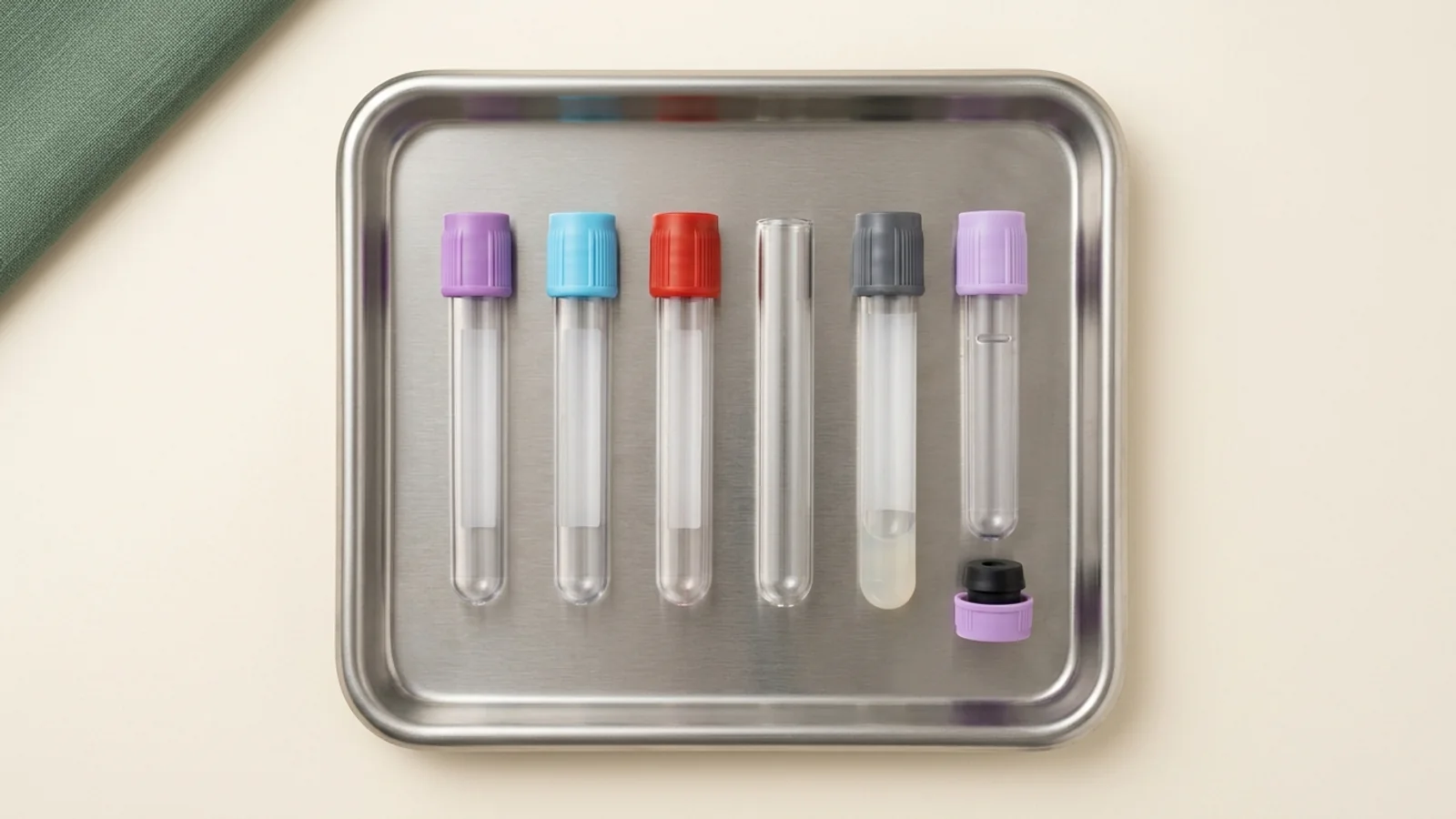
Specify the Tube by 21 CFR 862.1675, Not by Catalog Name
When procuring venous blood specimen containers, hospital purchasing agents, distributor category managers, and healthcare supply-chain quality teams frequently encounter requisition lines described only by trademarked commercial brand names such as "Vacutainer" or colloquial shorthand like "purple-top vacuum tubes." From a regulatory, clinical-laboratory, and quality-assurance standpoint, an evacuated blood collection tube is not a generic commodity, nor is it an accessory to a hypodermic needle. Under United States Food and Drug Administration (FDA) regulations, it is an in vitro diagnostic (IVD) medical device governed by 21 CFR 862.1675 and the overarching IVD statutory definitions of 21 CFR 809.3.
Under 21 CFR 862.1675, the FDA identifies a blood specimen collection device as a device intended to collect and handle blood specimens and to separate serum from nonserum (cellular) components prior to further testing. The generic type may include blood collection tubes, vials, systems, serum separators, blood collection trays, or vacuum sample tubes. Current eCFR classifies the generic type as Class II. FDA product-classification records for GIM and JKA list submission type 510(k) and GMP Exempt? No, so a U.S. line still needs a 510(k) number and a quality system under 21 CFR Part 820 / QMSR. Furthermore, under 21 CFR 809.3, IVD products include reagents, instruments, and systems intended for use in the diagnosis of disease or other conditions, specifically encompassing containers and collection devices used in the preparation and examination of specimens taken from the human body. Current FDA 510(k) clearances for blood collection tubes mandate comprehensive labeling under both 21 CFR Part 801 and 21 CFR Part 809.
Within the 21 CFR 862.1675 regulatory family, the FDA classifies tubes into distinct three-letter product codes that reflect the container's chemical mechanism, additive state, and diagnostic utility:
Product Code GIM ("Tubes, vacuum sample, with anticoagulant"): This code is designated for evacuated tubes with an anticoagulant, intended to yield whole blood or anticoagulated plasma. Worked 510(k)s include dipotassium and tripotassium EDTA hematology tubes (K213670) and buffered sodium citrate coagulation tubes (K240455). In K240455 (decision date October 31, 2024), FDA stated that GIM indicates anticoagulant use and is more appropriate than the predicate JKA code for those citrate tubes. A heparin vacuum tube is still an anticoagulant specification: read its own 510(k) product code rather than copying a citrate or EDTA letter.
Product Code JKA ("Tubes, vials, systems, serum separators, blood collection"): JKA is the broader 862.1675 family—tubes, vials, systems, serum separators, blood collection—not a synonym for “no anticoagulant.” Serum-separator and clot-activator SKUs such as K230855 (decision date December 20, 2023) sit here: evacuated PET tubes with spray-dried silica and an inert polymer gel, cleared to obtain and store serum for chemistry IVD testing and monitoring of certain therapeutic drugs. The same code also covers some anticoagulant containers that are not GIM vacuum-sample tubes, including MiniCollect K2EDTA (K182078), which is non-evacuated. A catalog family that mixes SST, EDTA, and citrate under one “Vacutainer” heading is still three specification lines.
A critical procurement error is merging adjacent generic device types onto a single 21 CFR 862.1675 tube contract line. Clinical phlebotomy kits and hospital storeroom requisitions often package tubes, needles, and culture receptacles together, but regulatory classification and performance testing follow completely independent standards:
Hypodermic Single Lumen Needles (21 CFR 880.5570, Product Code FMI): Class II general-hospital devices intended to inject or withdraw fluids from beneath the skin, consisting of a metal cannula joined to a female hub that mates with a syringe or holder. As detailed in our technical guide to hypodermic needle gauge, length, and wall specifications and our reference on IV cannula sizes and color codes, needle hubs follow ISO 7864 and ISO 6009 hub gauge color coding. Needle hubs and multi-sample blood collection needles are governed by FMI, not 862.1675.
Blood-Culturing Systems (21 CFR 866.2560, Product Code MDB): Class I devices that measure bacterial concentration in liquid medium; automated blood-culturing systems used to test blood and other normally sterile body fluids are excepted from the 510(k) exemption. FDA product code MDB (system, blood culturing) lists submission type 510(k). ISO 6710 excludes blood-culture receptacles. Do not write an MDB bottle onto a 862.1675 tube line.
Arterial Blood Sampling Kits (21 CFR 868.1100, Product Code CBT): Class I kits (510(k) exempt subject to 868.9) used to obtain arterial samples for blood-gas determinations. The identification states the kit may include a syringe, needle, cork, and heparin. Greiner’s U.S. IFU states that venous blood collected in heparinized vacuum tubes is not suitable for blood-gas analysis; do not write an 868.1100 kit onto a 862.1675 heparin-tube line. Piston-syringe generic types remain a separate specification, as examined in our hypodermic syringe specification guide.
Secondary and Specimen Transport Packaging: Once filled with venous blood, tubes transported outside the healthcare facility must comply with Department of Transportation regulations for Category B biological substances (49 CFR 173.199 / UN 3373), requiring leak-proof secondary containment and certified 95 kPa pressure differential resistance, as outlined in our Category B specimen packaging reference. ISO 6710 excludes transit packaging.
| Device Category | Regulation (21 CFR) | FDA Product Code | Device Class / Review Pathway | Primary Scope Boundary |
|---|---|---|---|---|
| Anticoagulant Vacuum Tube | 862.1675 | GIM | Class II / 510(k) (Chemistry & Toxicology) | Evacuated venous containers pre-filled with anticoagulant (EDTA, Citrate, Heparin, Fluoride). |
| Serum Separator / Broader 862.1675 Family | 862.1675 | JKA | Class II / 510(k) (Chemistry & Toxicology) | Broader JKA family: SST/clot-activator tubes (e.g. K230855) and some non-evacuated anticoagulant containers (e.g. K182078 MiniCollect K2EDTA). |
| Hypodermic Single Lumen Needle | 880.5570 | FMI | Class II / 510(k) (General Hospital) | Cannula with female hub mating to syringe or needle holder; governed by ISO 7864 / ISO 6009. |
| Blood Culturing System | 866.2560 | MDB | Class I (automated systems non-exempt) | Nutrient broth bottles for microbial growth detection; excluded from ISO 6710. |
| Arterial Blood Sampling Kit | 868.1100 | CBT | Class I / 510(k) exempt (Anesthesiology) | Kit that may include a syringe, needle, cork, and heparin for arterial blood-gas samples; excluded from ISO 6710. |
flowchart TD
    req["Requisition: Blood Specimen Collection Tube"] --> ant{"Contains Active Anticoagulant?"}
    ant -- "Yes" --> vac{"Pre-evacuated vacuum sample tube?"}
    ant -- "No" --> jka["FDA Product Code JKA: Broader 862.1675 Family<br/>(SST / clot activator; also some non-evacuated SKUs)"]
    vac -- "Yes" --> gim["FDA Product Code GIM: Anticoagulant Vacuum Tube<br/>(21 CFR 862.1675 Class II)"]
    vac -- "No" --> jka2["Still 862.1675, often JKA<br/>(e.g. MiniCollect K2EDTA K182078)"]
    gim --> chem1["Specify Labeled Additive: 9NC Citrate, K2E EDTA, LH Heparin"]
    jka --> chem2["Specify Serum Mechanism: CAT Clot Activator with or without Gel"]
    jka2 --> chem1
    chem1 --> iso["ISO 6710:2017 Venous Container Line<br/>Labeled Draw Volume + Fill Indicator"]
    chem2 --> iso
    iso --> cls["Specify Closure Type as Labeled<br/>Shielded Two-Part Assembly vs Conventional Stopper"]
cls --> rec["Receiving & Tender Audit<br/>510(k) Number, Declared Standard, Expiry, UDI"]ISO 6710 Scope: What Is in, and What Belongs on Another Line
The primary international technical standard governing blood collection containers is ISO 6710:2017 ("Single-use containers for human venous blood specimen collection", Second edition, published July 2017). ISO last reviewed and confirmed this edition in 2023, so this version remains current. Sourcing professionals must note that the predecessor standard, ISO 6710:1995, was formally withdrawn (stage 95.99) on July 25, 2017. Any vendor tender or quality dossier that cites conformity exclusively to ISO 6710:1995 must be returned for revision, as it relies on an obsolete regulatory reference.
The public scope of ISO 6710:2017 establishes precise boundaries regarding which medical consumables fall within its testing requirements and which must be procured under independent standards:
Included Products: Evacuated containers (containers where blood collection is driven by a pre-set internal vacuum induced by the manufacturer) and non-evacuated containers (where blood is collected by gravity, capillary action, or syringe transfer) specifically intended for human venous blood specimen collection.
Excluded Products: ISO 6710 explicitly excludes blood collection needles, needle holders, blood culture receptacles, and arterial blood gas collection devices that can be used for venous blood. Accessories such as luer adaptors, tube holders, and transfer devices remain separate generic devices.
The 2017 revision introduced several pivotal structural and technical changes that buyers must reflect in their procurement specifications:
Normative Annexes for Physical Verification: ISO 6710:2017 names test methods in Annex A (non-evacuated draw volume), Annex B (evacuated draw volume), Annex C (leakage), and Annex D (robustness). Public 510(k) summaries may cite those named tests. This page does not reproduce paywalled procedures or invent centrifugal g-force pass/fail numbers.
Additive Letter Codes vs Closure Colors: In the 2017 edition, Table 1 was revised to focus strictly on specified additive letter codes (e.g., 9NC, K2E, CAT, LH) rather than mandated closure colors. Recommended color codes for identifying additives were relegated to informative Annex F because international consensus across CEN and global regulatory bodies could not be reached regarding a mandatory color scheme. The standard explicitly states that container identification must be achieved through the descriptive label and chemical name, not closure color.
Clarification of Sterility States: Clause 8 was technically revised and retitled "Sterility and special microbiological states," recognizing that tubes may be offered with sterile interiors (commonly irradiated to a Sterility Assurance Level of 10^-3) or in defined non-sterile microbiological states.
A frequent sourcing error is conflating evacuated venous tubes with non-evacuated capillary containers, such as Greiner MiniCollect or BD Microtainer lines. The FDA decision summary for K182078 (MiniCollect K2E K2EDTA tubes) illustrates the critical boundary between these lines. MiniCollect tubes are classified under 21 CFR 862.1675 / product code JKA, but they are non-evacuated, non-sterile, low-volume (0.25 to 0.5 mL) plastic containers with an integrated collection feature for capillary blood (fingerstick or heelstick in that review). The same decision summary also describes syringe transfer of venous blood into the non-evacuated tube. That transfer path does not make MiniCollect an evacuated 13×75 mm GIM hematology line. While K182078 cites ISO 6710:2017 Annex A for fill-accuracy testing because CLSI GP39-A6 does not define a fill-accuracy procedure, and states that the volume of water should be within ±10% of the draw volume, the SKU remains a separate capillary/low-volume requisition. Copying an evacuated venous line from a MiniCollect or Microtainer specification—or the reverse—fails the evacuated-versus-non-evacuated field.
| Specimen Container Feature | ISO 6710:2017 Evacuated Venous Tube | CLSI GP42 Capillary Micro-Tube (e.g., K182078) | Procurement & Tender Distinction |
|---|---|---|---|
| Draw Mechanism | Pre-calibrated internal vacuum | Non-evacuated; gravity/capillary scoop/funnel | Evacuated tubes require airtight polymer walls; capillary tubes are open or vented. |
| Specimen Volume Range | 1.8 mL to 10.0 mL nominal draw | 0.25 mL to 0.50 mL (250–500 µL) | Never substitute micro-tubes for high-throughput automated analyzer lines. |
| Sterility Claim | Labeled interior sterility when claimed (often SAL 10^-3 in evacuated 510(k)s) | Non-sterile (as labeled in K182078) | Record the labeled sterility state. Do not copy MiniCollect non-sterile labeling onto an evacuated venous line, or the reverse. |
| Dimensional Profile | Standardized 13×75, 13×100, 16×100 mm | Miniature tube; optional 13×75 mm carrier outer tube | Automated decappers and centrifuge buckets require exact outer dimensional tolerances. |
| Governing Standard Set | ISO 6710:2017, CLSI GP39-A6 (Rec# 7-221) | CLSI GP42, CLSI GP39-A6, ISO 6710 Annex A | Separate line item: capillary tubes serve pediatric, geriatric, and point-of-care lines. |
Draw Volume Is Not the Same as Nominal Capacity
Procurement disputes between hospitals and consumable distributors frequently arise from confusion over volumetric terminology. ISO 6710:2017 establishes precise normative definitions that buyers must incorporate into technical requisitions:
Draw Volume: The volume of whole blood collected into the container by means of the pre-set internal vacuum when filled under standard atmospheric conditions. Draw volume represents the net biological sample collected, which determines the concentration of dissolved cellular and plasma analytes.
Nominal Liquid Capacity: The total liquid volume contained in the tube when filled to the fill indicator line, representing the draw volume plus the volume of liquid additive pre-packaged inside the tube (excluding accessories). For dry, spray-coated tubes (such as K2EDTA or clot activators), nominal liquid capacity is approximately equal to draw volume. However, for tubes with significant volumes of liquid additive (such as 3.2% sodium citrate solutions), nominal liquid capacity is substantially larger than the blood draw volume.
Fill Indicator: A permanent line or index mark printed on the tube label or molded into the tube body indicating the exact level to which the tube must be filled to achieve the calibrated blood-to-additive ratio.
Free Space (Headspace): The residual internal air volume remaining above the filled liquid level. ISO 6710 names free space as a container field. Do not treat that definition as a mixing or inversion protocol.
Draw-volume accuracy is a labeled and 510(k) evidence field, not a catalog adjective. Public reviews state numeric fill windows. In K240455 (BD Vacutainer Citrate tubes), the FDA documents labeled draw volumes of 1.8 mL ±10% (acceptable range: 1.62 mL to 1.98 mL) and 2.7 mL ±10% (acceptable range: 2.43 mL to 2.97 mL). Greiner Bio-One’s U.S. IFU and sell-sheet likewise state that fill tolerances are maintained within ±10% of stated volume in accordance with ISO 6710 and CLSI, and that an on-label fill mark indicates the proper blood-to-additive ratio. Ask for that labeled fill-tolerance field and for 510(k) or CoA evidence that it holds across the declared shelf life at the labeled storage range. Do not paste a paywalled Annex A/B procedure into the RFQ.
To maintain compatibility with standard automated laboratory analyzers, centrifuge carriers, and decapping robotics, hospitals prefer uniform tube outer dimensions—most commonly 13×75 mm. Outer millimetres are not draw volume. A standard 13×75 mm citrate SKU may still be specified at 1.8 mL or 2.7 mL because manufacturers use sandwich-wall containers. As cleared in K240455 and described on Greiner citrate lines, these tubes use an inner polypropylene tube inside an outer polyethylene terephthalate (PET) tube so the outer analyzer footprint stays 13×75 mm while the inner draw and liquid additive are retained.
Identify Additives by Letter Code and Labeled Chemistry, Not by a Colour Chart
A deeply ingrained yet hazardous practice in hospital consumables purchasing is relying on stopper color as the sole identifier for blood collection tubes (e.g., ordering "50 cases of light blue tops" or "100 cases of lavender tops"). Commercial marketing sell-sheets and third-party supply blogs frequently present "universal color charts" that map stopper colors to specific diagnostic departments.
The governing international standard explicitly rejects universal cap-color standardization. When drafting ISO 6710:2017, the international committee was forced to relegate closure color recommendations to informative Annex F because member nations across the European Committee for Standardization (CEN) could not agree a mandatory common colour code. Under ISO 6710, container identification is by description of the additive and/or product name; recommended colours are informative. Specify this manufacturer’s labeled cap colour as a matching field, not as a cross-brand default.
Manufacturer technical instructions emphasize that closure colors represent internal brand specifications, not universal clinical codes:
Manufacturer Variations: Greiner Bio-One's international instructions for use expressly state that published cap colors are examples of standard colors and that cap color may vary for specific catalog items and regional market requirements. Furthermore, manufacturers utilize color-coded inner rings to denote functional variations: a white inner ring identifies pediatric or partial draw volumes, while a yellow inner ring designates the presence of a separator gel.
Nuances Within a Single Manufacturer: K213670 states that closures in that EDTA submission are pink or lavender to indicate the presence of EDTA additive, and that the tube is available with a Hemogard shield or a conventional rubber stopper. The same review names a royal-blue K2EDTA tube as a distinct comparator SKU (without thiuram curing agent), not as a substitute hematology tube. Greiner’s U.S. IFU separately maps trace-element tubes to sodium heparin or no additive. Do not treat a royal-blue cap, a pink cap, or the word EDTA as a cross-SKU identity.
Strict Distinction from ISO 6009 Needle Colors: Buyers must never conflate blood tube closure colors with ISO 6009 hypodermic needle hub colors. ISO 6009 is an FDA-recognized standard under product code FMI that assigns colors strictly to cannula gauge sizes (e.g., 21G green, 22G black, 20G yellow). The presence of a green cap on a heparin tube has zero connection to the green hub of a 21G needle.
Hospital purchase specifications must define additives by their chemical nomenclature, concentration, physical application method, and ISO 6710 letter code:
9NC — Buffered Sodium Citrate (0.109 M / 3.2%): Used for coagulation IVD testing as labeled (K240455). Specify liquid buffered trisodium citrate at 0.109 mol/L (3.2%) with a 9:1 blood-to-additive ratio when that is the intended SKU. ISO letter code 9NC also appears on 3.8% citrate and 4:1 ESR configurations in manufacturer IFUs, so the letter code without concentration and ratio does not define the product.
K2E — Dipotassium EDTA (Spray-Dried): The standard additive family for hematology whole-blood counts in public 510(k)s. K213670 clears plastic PET K2EDTA spray-dried at 1.8 mg/mL. Do not replace that labeled concentration with an unofficial ISO table range, and do not treat a pink or lavender cap as the specification.
K3E — Tripotassium EDTA (Liquid): K213670 clears glass K3EDTA liquid fill at 1.7 mg/mL as a different additive form from spray-dried K2EDTA. Do not treat K2E and K3E as interchangeable by the EDTA family name or by cap colour.
CAT — Clot Activator: Container walls may be spray-coated with silica particles. K230855 states a 2.1 to 4.3 mg/mL silica clot-activator range for that SST family. Silica clot activator with or without separator gel remains a JKA serum mechanism, not a GIM anticoagulant.
LH / NH — Lithium Heparin / Sodium Heparin: Anticoagulants used to obtain heparinized plasma for chemistry IVD testing, at the labeled salt, form, and concentration. Greiner’s U.S. IFU states that venous blood collected in heparinized vacuum tubes is not suitable for blood-gas determinations; arterial kits remain 21 CFR 868.1100 / CBT.
FE / FX — Fluoride / EDTA or Fluoride / Oxalate: Formulated with sodium fluoride (a glycolytic enzyme inhibitor) combined with potassium oxalate or EDTA to prevent glucose degradation over time for blood glucose and lactate testing.
Thixotropic Polymer Separator Gel: Present or absent as labeled, on serum-separator (SST, JKA in K230855) or plasma-separator tubes. K230855 names an inert polymer separator gel and barrier-integrity bench tests after centrifugation and simulated transport. Do not invent a universal gel density, and do not treat gel as an ISO letter code.
| ISO Letter Code | Chemical Additive Name | Physical Form & Target Concentration | FDA Code | Primary Clinical Laboratory Use |
|---|---|---|---|---|
| 9NC | Buffered Trisodium Citrate | Aqueous liquid solution; 0.109 M (3.2%); 9:1 blood-to-additive ratio | GIM | Coagulation IVD testing as labeled (K240455); specify 3.2% and 9:1, not 9NC alone. |
| K2E | Dipotassium EDTA (K2EDTA) | Spray-dried; 1.8 mg/mL in K213670 (do not substitute an unofficial range) | GIM | Hematology / whole-blood counts as labeled (K213670). |
| K3E | Tripotassium EDTA (K3EDTA) | Liquid fill; 1.7 mg/mL in K213670 glass SKUs | GIM | Hematology testing; different labeled form from K2E, not interchangeable by colour. |
| CAT | Silica Clot Activator | Spray-dried microscopic particles; 2.1–4.3 mg/mL blood | JKA | Serum chemistry and therapeutic-drug monitoring as labeled (K230855). |
| CAT with gel accessory | Silica Activator + Polymer Gel (SST) | Spray-dried silica with inert thixotropic polyester separator gel | JKA | Serum chemistry IVD testing as labeled (K230855); gel is an accessory, not a letter code. |
| LH / NH | Lithium Heparin / Sodium Heparin | Spray-dried or liquid, at the labeled heparin salt and concentration | GIM | Heparinized plasma chemistry as labeled; not an arterial blood-gas kit. |
| FE / FX | FE: fluoride with EDTA. FX: fluoride with oxalate. Specify the labeled pair; do not collapse the codes. | Spray-dried or liquid antiglycolytic combination, as labeled | GIM | Antiglycolytic glucose or lactate SKUs as labeled. |
Which Standard FDA Will Accept on a Declaration of Conformity
When hospital value-analysis committees and regulatory compliance officers evaluate vendor tender submissions, they must verify which consensus standards are formally recognized by the FDA for 21 CFR 862.1675 devices. A common misconception among international suppliers is assuming that a Declaration of Conformity to ISO 6710 is automatically sufficient to satisfy FDA premarket review.
As of September 16, 2026, the FDA Recognized Consensus Standards database for 21 CFR 862.1675 (product codes GIM and JKA) lists the following recognized standards:
FDA Rec# 7-221 — CLSI GP39-A6 (formerly H01-A6): Titled "Tubes and Additives for Venous Blood Specimen Collection; Approved Standard—Sixth Edition" (entered July 9, 2014, Federal Register list 036, recognized in full). This is the product-side performance standard recognized by FDA for both GIM and JKA. The SIS abstract is a performance standard for manufacturers of venous and capillary blood collection tubes and additives, addressing materials, construction, and labeling of tubes and tube assemblies.
FDA Rec# 7-225 — CLSI GP34-A: Titled "Validation and Verification of Tubes for Venous and Capillary Blood Specimen Collection; Approved Guideline" (entered March 16, 2012, Federal Register list 028, recognized in full for JKA; it is not listed on the GIM classification page accessed 16 September 2026). The SIS abstract is a guideline for manufacturers and users of blood collection tubes for serum, plasma, and whole blood testing, covering validation and verification of test (examination) performance.
FDA Rec# 7-277 — CLSI GP41 7th Edition: Titled "Collection of Diagnostic Venous Blood Specimens" (entered September 17, 2018, Federal Register list 050, recognized in full). While mapped to product codes GIM and JKA, GP41 is a clinical collection procedure standard governing outpatient and inpatient phlebotomy procedures. It does not define manufacturing or dimensional criteria for the tube as a manufactured consumable.
Significantly, ISO 6710 is not listed on the FDA Recognized Consensus Standards database for product codes JKA or GIM as of 16 September 2026. Manufacturers may still cite ISO 6710 test annexes in FDA filings (K182078 cites Annex A water fill-accuracy testing) while recent BD summaries for K240455 and K230855 list other performance standards and do not list ISO 6710. A declaration of conformity to ISO 6710 is not interchangeable with a declaration to Rec# 7-221, and neither replaces the 510(k) number or the labeled additive.
The following procurement rule applies: Require the FDA 510(k) number for a U.S. GIM or JKA line. Ask which product-side standard is actually declared—CLSI GP39-A6 (Rec# 7-221), CLSI GP34-A (Rec# 7-225) where it applies, ISO 6710:2017, or both—and keep those declarations attached to the SKU. Do not accept an ISO 6710 declaration as a substitute for the 510(k) or the label.
Closure, Sterility, Expiry, and IVD Label Fields Buyers Can Verify
Beyond tube dimensions and chemical additives, receiving departments, warehouse auditors, and laboratory managers must audit mechanical closure engineering, sterility claims, expiration dating, and IVD labeling compliance.
1. Closure Engineering and Splash Protection: Specify the labeled closure: a two-piece shielded assembly (rubber stopper under a protective plastic shield, as in BD Hemogard or Greiner SAFETY Caps) or a conventional exposed stopper. K213670 clears EDTA tubes with either Hemogard or a conventional rubber stopper. Shielded closures are a specification choice, not a substitute for the additive identity.
2. Sterility Claims and Microbiological States: Sterility claims for blood collection tubes are frequently misunderstood by purchasing personnel. Blood collection tubes do not undergo the terminal full-device sterilization common to surgical implants (which achieve SAL 10^-6 for the entire packaged article). Under ISO 6710 Clause 8, sterility applies specifically to the interior fluid-contact surface of the tube and additive chamber. Cleared 510(k) summaries (K240455 citrate and K213670 EDTA) state that tube interiors are gamma-irradiated to SAL 10^-3. Certain SST configurations in K230855 are listed at SAL 10^-3 or 10^-6 by size and closure. MiniCollect K182078 is labeled non-sterile. Record the labeled sterility state and SAL if stated; do not copy an SAL 10^-6 surgical-pack claim onto these tubes, and do not treat interior sterility as automatic across every 862.1675 SKU.
3. Expiration Dating and Vacuum Decay: Evacuated blood collection tubes have relatively short labeled shelf lives—typically 6 to 12 months from manufacture in the public 510(k)s used here. For liquid citrate tubes (K240455), cleared shelf life is 9 months for 2.7 mL SKUs and 6 months for 1.8 mL SKUs. K213670 states 10 months at 4–25 °C for those EDTA tubes; K230855 states 10 to 12 months by SST configuration. Record labeled expiry and storage, and apply the facility’s own remaining-dating rule. This page does not set a universal percent-remaining threshold.
4. 21 CFR 809.10 IVD Labeling Compliance: Under 21 CFR 809.10, immediate tube labels and secondary carton packaging must present explicit, verifiable information:
Proprietary and Established Names: The brand name and generic device identification.
Quantitative Reactive Ingredients: The exact chemical salt (e.g., K2EDTA, buffered sodium citrate), concentration, and blood-to-additive ratio.
Regulatory Legends: The mandatory statement "For In Vitro Diagnostic Use" and prescription indication (Rx only).
Storage Temperature Constraints: Clearly defined storage parameters, typically 4 °C to 25 °C (protect from freezing and direct sunlight), with temperature symbols conforming to ISO 15223-1, as detailed in our labeled storage and transport guide.
Lot Number and Expiry Date: Human-readable expiration date and manufacturing control lot number.
Fill Mark and Calibrated Draw Volume: A permanent visual fill line and stated draw volume in millilitres.
Unique Device Identification (UDI): Device Identifier (DI) and Production Identifiers (PI) encoded in GS1 or HIBCC barcode symbology, verifiable via the FDA AccessGUDID database, as covered in our guide to UDI and GUDID for medical consumables.
| Procurement Specification Parameter | Normative Target / Standard Requirement | Verification Document / Audit Method |
|---|---|---|
| FDA Classification & Regulation | 21 CFR 862.1675; Class II; Product Code GIM (anticoagulant) or JKA (SST/plain) | FDA 510(k) Premarket Notification Clearance Letter |
| Consensus Standards Conformance | CLSI GP39-A6 (Rec# 7-221) and, where declared, CLSI GP34-A (Rec# 7-225) and/or ISO 6710:2017 | Manufacturer Declaration of Conformity (DoC) & Test Reports |
| Draw Volume & Fill Tolerance | Labeled draw in mL and fill indicator; ±10% only when that tolerance is labeled or shown in the 510(k) (e.g. K240455, K182078) | Label / 510(k); named Annex A or B test report if the supplier cites that method |
| Tube Dimensions & Analyzer Fit | Outer footprint 13×75 mm, 13×100 mm, or 16×100 mm; sandwich wall for low draw | Engineering drawing; dimensional verification on receiving inspection |
| Additive Chemistry & Concentration | ISO letter code + labeled chemical salt, concentration, and ratio (e.g., 9NC 0.109 M 9:1) | Product label audit; 21 CFR 809.10 compliance verification |
| Closure Safety Engineering | Labeled closure: shielded two-part assembly or conventional stopper | Visual inspection against the labeled closure type |
| Interior Sterility Assurance | Labeled interior sterility/SAL if claimed (often gamma SAL 10^-3; some SST configs 10^-6; MiniCollect K182078 non-sterile) | Labeled sterility statement; 510(k) or lot-release evidence named by the supplier |
| Shelf Life & Vacuum Retention | Labeled expiry (citrate 6–9 months in K240455; EDTA 10 months in K213670; SST 10–12 months in K230855); facility remaining-dating policy | Outer packaging label; receiving warehouse date check |
| Labeling & Traceability | 21 CFR 809.10 IVD text, Rx-only, temperature 4–25 °C, lot number, UDI barcode | FDA AccessGUDID database record; physical barcode scan test |