
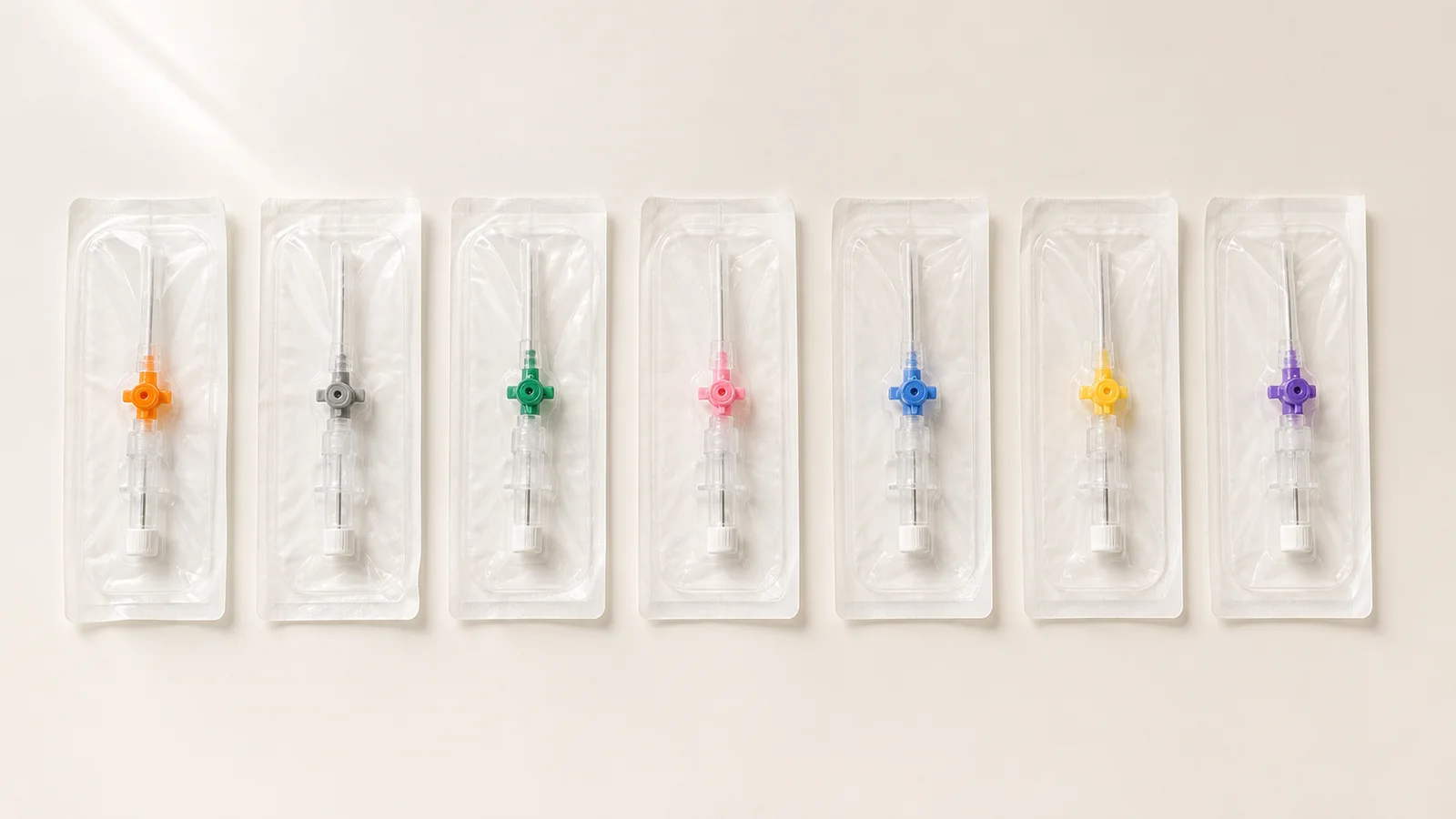
Peripheral intravenous (IV) cannulas represent the highest-volume sterile vascular access consumable in modern acute care hospitals. Selecting and procuring IV catheters involves balancing fluid delivery hydraulics, catheter biomaterial performance, healthcare worker sharps safety, and total procedural cost. Purchasing teams that standardize strictly on unit purchase price often overlook catastrophic hidden costs stemming from insertion failures, phlebitis complications, catheter restarts, and occupational needlestick injuries.
The Inverse Gauge Sizing System, Dimensions, and Flow Dynamics
Peripheral IV catheter sizing is derived from the historical Birmingham Wire Gauge (BWG) standard, where the gauge (G) number is inversely related to the outer diameter (OD) of the catheter tubing. As gauge number decreases, external diameter and internal lumen bore expand exponentially.
According to the Hagen-Poiseuille law governing laminar fluid flow through a tubular conduit:
Flow Rate (Q) = (π × ΔP × r^4) ÷ (8 × η × L)
Where ΔP is the perfusion pressure differential, r is the internal radius of the cannula, η is fluid dynamic viscosity, and L is the length of the cannula tubing. Because the flow rate varies directly with the fourth power of the internal radius (r^4) and inversely with catheter length (L), small increments in gauge diameter produce massive increases in infusion delivery capacity. For instance, an 18G cannula delivers nearly four times the gravity flow rate of a 22G cannula of equivalent length.
| Gauge (G) | ISO 6009 Color | Outer Diameter (mm) | Standard Lengths | Representative catalog water flow (not an ISO mandate) | Typical stocking context (not a treatment protocol) |
|---|---|---|---|---|---|
| 14G | Orange | 2.0 – 2.1 mm | 45 mm (1.77 in) | 240 – 300 mL/min | Large-bore trauma / theatre carts (clinical selection required) |
| 16G | Grey | 1.7 – 1.8 mm | 45 mm (1.77 in) | 180 – 220 mL/min | Rapid-infusion / high-risk theatre carts (clinical selection required) |
| 18G | Green | 1.2 – 1.3 mm | 32 – 45 mm (1.25–1.77 in) | 80 – 110 mL/min | Common adult theatre / radiology cart size |
| 20G | Pink | 1.0 – 1.1 mm | 25 – 32 mm (1.00–1.25 in) | 55 – 75 mL/min | Common adult ward cart size |
| 22G | Blue | 0.8 – 0.9 mm | 25 mm (1.00 in) | 30 – 45 mL/min | Smaller-vein / lower-flow cart size (clinical selection required) |
| 24G | Yellow | 0.65 – 0.75 mm | 19 mm (0.75 in) | 15 – 25 mL/min | Pediatric / difficult-access cart size |
| 26G | Violet / Purple | 0.55 – 0.65 mm | 19 mm (0.75 in) | 10 – 15 mL/min | Neonatal specialty size (confirm labeled length and flow) |
Published mL/min values in distributor catalogs are typically gravity-water figures for a stated length. ISO 10555-5 specifies how to test over-needle peripheral catheters; it does not publish a universal 14G–26G flow table. In use, flow falls with viscosity, extension-set resistance, needleless connectors, and pump limits. Require the supplier's test conditions next to any catalog flow claim.
How to read gauge, color, and flow without mixing standards
Three documents get conflated in tenders. ISO 10555-5:2013 is the over-needle peripheral catheter performance standard (currently under revision as ISO/DIS 10555-5). ISO 10555-1:2023 supplies general intravascular-catheter requirements, including the peak-tensile table by outside diameter. ISO 6009:2016 colours hypodermic needles. Hub color on a cannula is therefore a specification to sample, not a legal substitute for printed gauge.
FDA's 1995 guidance on 510(k) submissions for short-term and long-term intravascular catheters remains the device-specific premarket document for this generic type; product code FOZ sits under 21 CFR 880.5200. That guidance is older than FDA's Good Guidance Practices rewrite, is non-binding, and is not a flow-rate table for 14G–26G. Use it to structure the U.S. dossier request, then attach the current ISO test reports.
Safety mechanisms need the same precision. ISO 23908:2024 is the current sharps-injury-protection standard (ISO 23908:2011 remains the widely cited predecessor). OSHA 29 CFR 1910.1030 requires engineering controls for contaminated sharps; EU Council Directive 2010/32/EU addresses prevention of sharps injuries in the hospital sector. Neither instrument ranks passive clips above push-button shields by a 95% compliance statistic. Name the mechanism, require the matching ISO 23908 report, and evaluate activation in a user trial.
ISO 6009 Color Coding and Hub Architecture
ISO 6009:2016 is the colour-coding standard for single-use hypodermic needles, not a law that every IV cannula hub must obey. ISO 10555-5 includes an informative annex of opaque catheter-hub colours that industry commonly aligns with the needle code (14G orange through 26G violet). Hub wings, port caps, and flashback housings can still differ by manufacturer. Gauge printed on the pack remains the binding identifier.
Hub Styles: Ported vs. Non-Ported and Winged vs. Straight
Specify hub configuration as a logistics and closed-system choice, not as a universal clinical protocol:
Ported Cannulas (With Injection Port): Feature an integrated top-mounted medication port with a silicone one-way duckbill valve. This allows direct intermittent bolus drug administration via syringe without disconnecting the main IV infusion line. Highly prevalent in European and Asian hospital markets.
Non-Ported Straight / Winged Cannulas: Feature a streamlined, low-profile hub without a top port, connecting to an external closed extension set with needleless valves. This design minimizes mechanical pressure ulcers against the skin and reduces infection entry points. Preferred in North American and Australian infection-prevention guidelines.
Side Stabilization Wings: Flexible lateral wings facilitate secure taping and engineered dressing attachment to the patient's skin, reducing micromotion-induced phlebitis and accidental dislodgement.
Catheter Material Science: Polyurethane (PUR) vs. FEP and PTFE
The catheter tubing material represents the primary biological interface with the patient's venous endothelium. Over-the-needle IV cannulas are primarily fabricated from either Polyurethane (PUR) or Fluorinated Ethylene Propylene (FEP / PTFE).
| Performance Attribute | Polyurethane (PUR; some branded formulations) | Fluorinated Polymers (FEP / PTFE) | Clinical & Procurement Impact |
|---|---|---|---|
| Initial Insertion Stiffness | High tensile column strength; resists tip collapse during skin puncture | Stiff extruded profile; excellent pushability through tough or scarred tissue | Both materials provide good primary venipuncture tactile feedback when properly lubricated |
| In-Vivo Thermo-Softening | Some PUR formulations are promoted as softening at body temperature; quantify only with the supplier's material data, not a 50–70% rule for all PUR. | Typically remains stiffer in vivo than thermo-softening PUR grades; still SKU-specific. | Softening PUR grades are often selected where longer peripheral dwell is requested; do not treat every PUR lot as clinically equivalent to a named biomaterial. |
| Kink Resistance & Recovery | Elastomeric memory; recovers lumen shape immediately after joint bending | Plastic deformation; permanently kinks when bent across joint flexion creases | Better kink recovery is a reason some tenders prefer PUR near flexion sites; confirm with sample evaluation rather than a universal occlusion claim. |
| Mechanical Phlebitis Rate | Manufacturer literature for specific biomaterials (for example BD Vialon versus FEP) cites lower phlebitis in referenced studies; that is not a 20–40% reduction that applies to all PUR cannulas. | Stiffer fluoropolymers are often associated with more mechanical irritation in comparative literature; still product- and technique-dependent. | Dwell time is a labeled claim and a clinical protocol, not a 72–96 hour purchasing constant. Follow the IFU and facility insertion/replacement policy. |
| Acquisition cost (qualitative) | Often higher unit cost than commodity FEP; do not write invented dollar ranges into the tender. | Often lower unit cost; compare restart and safety-feature cost separately. | Any total-cost claim needs local restart and complication data, not an assumed saving from polymer family alone. |
Safety-Engineered Sharps Protection and ISO 23908 Qualification
Occupational needlestick injuries (NSIs) pose serious biological hazards (Hepatitis B, Hepatitis C, HIV) to clinical staff. Under international occupational safety mandates, including the US OSHA Bloodborne Pathogens Standard (29 CFR 1910.1030) and EU Directive 2010/32/EU, healthcare facilities must procure safety-engineered medical devices.
Passive vs. Active Safety Mechanisms
Sharps injury protection mechanisms on IV cannulas fall into two engineering categories:
Passive Automatic Shielding: The feature covers the needle during or after withdrawal without a separate user activation step. That architecture can reduce dependence on a second action, but it does not produce a universal 95% compliance rate, and it is not the same as a push-button retraction device. Specify the mechanism type and require ISO 23908 evidence for that design.
Active Manual Shielding: Requires a discrete user action after venipuncture (push-button, sliding sheath, or latch). BD Insyte Autoguard, cited as a manufacturer example in this article, is a push-button shielded catheter—an active design—not a passive clip. Active devices remain widely used; specify activation method and training rather than banning them by slogan.
Integrated Blood-Control Septum Technology
Advanced safety IV cannulas integrate an internal elastomeric blood-control septum within the hub. When the introducer needle is extracted, the multi-slit septum instantly seals the lumen, stopping blood leakage from the hub until the extension set or Luer lock is connected. This feature is intended to reduce blood leakage from the hub until a Luer connection is made. It is a SKU option to specify and sample, not a guarantee that linens, beds, and gloves will stay uncontaminated.
Procurement Audit and Quality Assurance Checklist for IV Cannulas
To ensure patient safety and avoid supplier batch failures, hospital purchasing committees and distributor quality teams should enforce the following technical requirements during tender qualification:
Regulatory Clearances: For the U.S. market, verify Class II identification under 21 CFR 880.5200 (product code FOZ) and a current 510(k) where required. Do not paste U.S. 510(k) language into non-U.S. tenders. EU MDR class follows the manufacturer's declared rule for intended invasiveness and duration—not an automatic Class IIa Rule 7 for every peripheral cannula. Require ISO 13485 for the manufacturing sites.
ISO 10555-5 Mechanical Testing Compliance: Require ISO 10555-1 peak-tensile results for the catheter test piece and ISO 10555-5 union-strength results for the needle hub and tube. ISO 10555-1:2023 Table 1 states minimum peak tensile force by outside-diameter band (3 N, 5 N, 10 N, or 15 N) and notes that those values are historical, not clinically derived. Mapping 3 N/5 N/10 N onto 26G–14G as if ISO 10555-5 published that gauge table is incorrect (20G typically falls in the 5 N band; 14G in the 15 N band).
Needle Geometry and Tip Taper Quality: Verify high-precision tri-bevel needle grind with siliconized micro-coating and smooth zero-gap transition between needle point and catheter tip taper to minimize skin penetration drag and tissue coring.
Flashback Chamber and Filter Plug Permeability: Confirm clear, high-transparency flashback chamber with hydrophobic blood-stop filter plug that allows instant air venting for rapid blood flashback visualization while preventing blood strike-through.
Pyrogenicity and Sterility Assurance: Require lot CoAs showing the sterile claim (commonly SAL 10^-6 for terminal sterilization per ISO 11135 or ISO 11137) and pyrogen/endotoxin evidence appropriate to intravascular contact under the recognized USP/ISO method used in the 510(k) or technical file. Do not copy a single 0.5 EU/mL water-for-injection limit onto every cannula SKU unless that is the declared specification.