
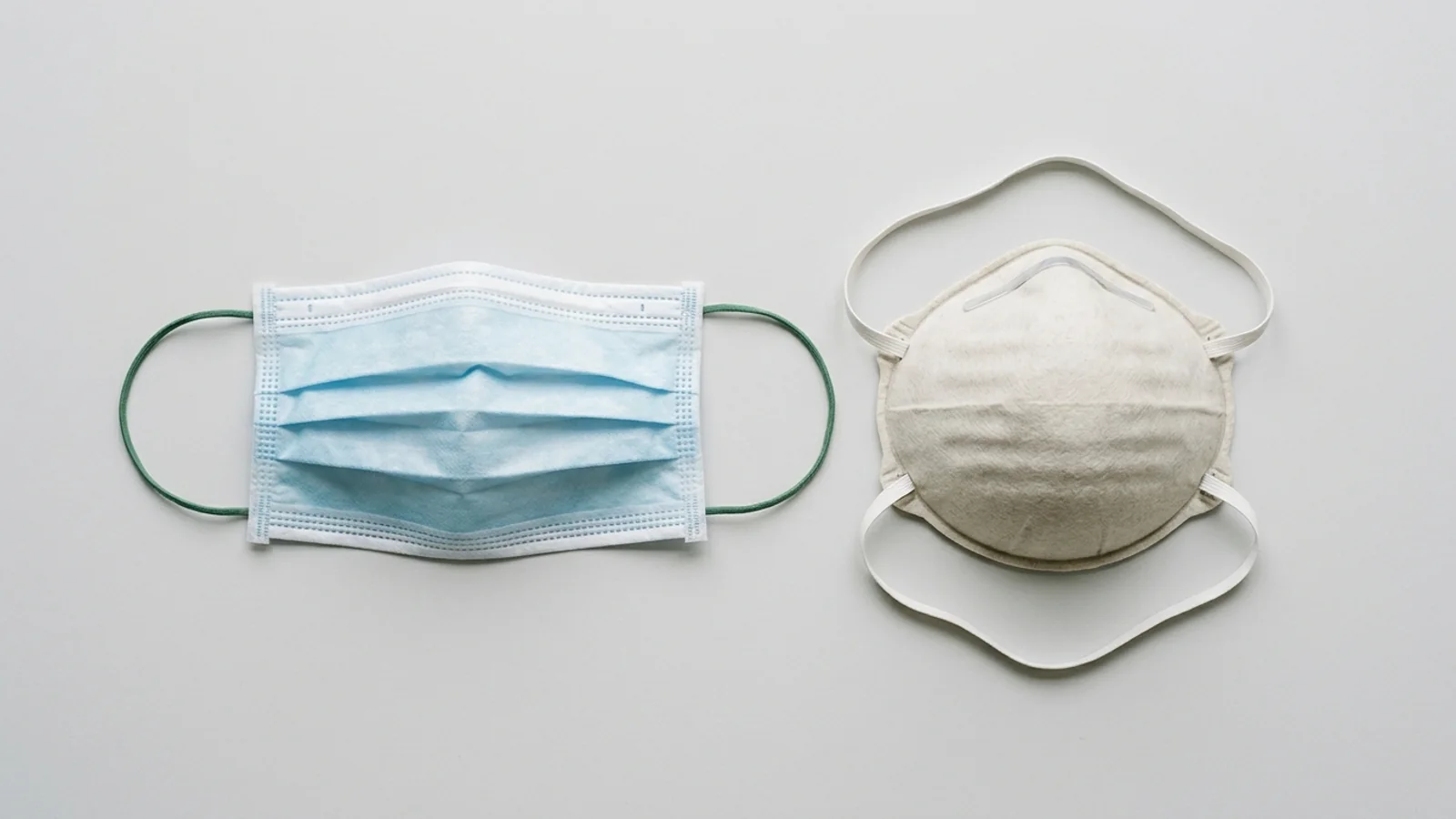
Healthcare procurement teams, infection preventionists, and materials managers routinely confront tender submissions and vendor catalogs that conflate surgical masks, procedure masks, commercial barrier face coverings, industrial N95 respirators, and surgical N95 respirators. Marketing literature frequently presents ASTM F2100 Level 1, 2, or 3 filtration percentages alongside NIOSH 95% particulate filtration ratings, implying that high-level surgical masks provide equivalent respiratory protection to N95 filtering facepieces.
In reality, surgical masks and particulate respirators serve fundamentally different clinical and occupational functions. Surgical masks are loose-fitting fluid barriers designed primarily to catch large droplets expelled by the wearer (source control) and to shield the wearer's mouth and nose from pressurized blood and bodily fluid splashes. Respirators are tight-fitting devices engineered to form a continuous peripheral facial seal, forcing all inhaled air through certified particulate filter media.
Name the product by regulator before naming a filtration number
As maintained by the FDA, healthcare face coverings and protective devices are categorized into distinct regulatory classes based on intended use, design architecture, and regulatory jurisdiction:
Face Masks (Source Control): Non-surgical, loose-fitting masks intended for source control (reducing the spread of respiratory droplets from the wearer). FDA's current page states they are not a substitute for surgical masks or N95 respirators. Do not specify them as fluid-resistant surgical masks or as NIOSH-approved respirators.
Barrier Face Coverings (ASTM F3502): Barrier face coverings described in ASTM F3502-21. FDA's current page states they are not substitutes for N95 respirators or surgical masks. They are not NIOSH 42 CFR 84 respirators and are not ASTM F2100 surgical-mask materials.
Surgical and Procedure Masks (21 CFR 878.4040, Code FXX): Class II medical devices intended to cover the nose and mouth of operating room and healthcare personnel to protect both the surgical patient and healthcare worker from transfer of microorganisms, body fluids, and particulate material. They are loose-fitting and include masks labeled as surgical, laser, isolation, dental, or medical procedure masks.
NIOSH-Approved N95 Respirators (42 CFR Part 84): Air-purifying respirators evaluated, tested, and certified by NIOSH (National Institute for Occupational Safety and Health) under 42 CFR Part 84. Designed for a tight facial fit, filtering at least 95% of airborne particles (non-resistant to oil). When used in workplace respiratory protection programs, they require OSHA 1910.134 fit testing.
Surgical N95 Respirators (Dual-Regulated, Code MSH): A healthcare subset of N95 filtering facepieces intended where both particulate respiratory protection and fluid-barrier performance are claimed. Dual-regulated by NIOSH under 42 CFR Part 84 and by FDA under 21 CFR 878.4040, product code MSH.
graph TD
  A["Face PPE Sourcing Requirement"] --> B{"Required Protection Profile"}
  B -->|"Fluid Barrier + Droplet Containment"| C["Surgical / Procedure Mask<br/>21 CFR 878.4040 (FXX)<br/>ASTM F1862 80/120/160 mm Hg if claimed"]
  B -->|"Airborne Particulate Filtration Only"| D["NIOSH N95 Respirator<br/>42 CFR Part 84<br/>NIOSH CEL TC-84A Verified"]
  B -->|"Airborne Particulates + Fluid Barrier"| E["Surgical N95 Respirator<br/>Dual FDA (MSH) and NIOSH (42 CFR 84)"]
B -->|"General Public Source Control"| F["Face Mask / ASTM F3502<br/>Not a surgical mask or N95"]ASTM F2100 is a medical-mask material classification, not a respirator approval
For medical face masks under product code FXX, the primary consensus standard recognized by the FDA is ASTM F2100-23 (Standard Specification for Performance of Materials Used in Medical Face Masks) (FDA Recognition Number 6-492).
ASTM F2100-23 establishes performance criteria for the materials used in surgical and procedure masks, evaluating five critical laboratory tests:
Bacterial Filtration Efficiency (BFE): A named ASTM F2100-23 material test. Public FDA recognition identifies the test; it does not authorize reprinting Level 1/2/3 numeric acceptance tables.
Differential Pressure (Delta-P / Breathability): A named ASTM F2100-23 material test of airflow resistance. Do not treat a breathability number as NIOSH respirator performance.
Sub-Micron Particulate Filtration Efficiency (PFE): A named ASTM F2100-23 material test. A swatch filtration percentage is not 42 CFR 84 respirator approval and is not a facial-seal rating.
Resistance to Penetration by Synthetic Blood (ASTM F1862): FDA's surgical-mask 510(k) guidance states that fluid resistance may be claimed if a mask passes ASTM F1862 at 80, 120, or 160 mm Hg, and that higher passing pressures are more fluid resistant.
Flammability (16 CFR Part 1610): A named ASTM F2100-23 material test. Specify the claimed flammability class only as labeled; do not reconstruct paywalled acceptance tables.
In FDA's surgical-mask 510(k) guidance, fluid-resistance claims are tied to ASTM F1862. A pass at 80, 120, or 160 mm Hg is a labeled barrier rating, not a patient-specific PPE-selection instruction and not NIOSH filtration.
NIOSH N95 identity is TC-84A approval plus intended use
Particulate respirators are regulated in the United States by the Centers for Disease Control and Prevention (CDC) through the National Personal Protective Technology Laboratory (NPPTL) of NIOSH, under Title 42 of the Code of Federal Regulations, Part 84.
NIOSH's public comparison states that N95 filtering facepiece respirators filter at least 95% of airborne particles and are not oil-resistant. Approval is a 42 CFR Part 84 identity verified by TC number on the Certified Equipment List, not an ASTM F2100 level.
To ensure authenticity, hospital buyers must verify the following three mandatory elements for every N95 respirator line item:
NIOSH Certified Equipment List (CEL) Listing: Every genuine NIOSH-approved respirator is assigned a unique Testing and Certification number in the format TC-84A-XXXX. Buyers should independently search the official NIOSH CEL database to verify that the manufacturer name, model number, and approval status match the tender submission.
Standardized Exterior Markings: Under NIOSH regulations, approved filtering facepieces must bear clear exterior markings, including the NIOSH name or block logo, the filter designation (N95), the model/part number, and the TC approval number.
Occupational Fit Program Compatibility: Respirators rely entirely on an airtight facial seal. In U.S. healthcare facilities, employers are mandated under OSHA 29 CFR 1910.134 to implement written respiratory protection programs, including medical clearance, initial and annual quantitative or qualitative fit testing, and user seal checks prior to each entry into hazardous atmospheres.
Surgical N95s are dual-regulated, with a conditional 510(k) exemption
A critical area of procurement complexity is the surgical N95 respirator. In operating rooms and sterile procedural suites, clinicians require simultaneous protection from airborne infectious pathogens and high-pressure liquid splashes.
Surgical N95 respirators are classified as Class II medical devices under 21 CFR 878.4040, assigned FDA Product Code MSH. To streamline oversight, the FDA and CDC/NIOSH established a joint regulatory framework governed by Memorandum of Understanding MOU 225-18-006.
Under this collaborative framework, NIOSH evaluates and approves the filtration and breathability of the respirator under 42 CFR Part 84, while evaluating synthetic blood fluid resistance (ASTM F1862), flammability, and biocompatibility on behalf of the FDA.
| Regulatory Attribute | Standard Surgical Mask (FXX) | Industrial N95 Respirator | Surgical N95 Respirator (MSH) |
|---|---|---|---|
| Governing Regulation | 21 CFR 878.4040 | 42 CFR Part 84 | 21 CFR 878.4040 & 42 CFR Part 84 |
| FDA Device Class & Code | Class II / FXX | Not an FDA surgical N95 (MSH) unless medical claims apply | Class II / Product Code MSH |
| NIOSH Approval Required | No | Yes (TC-84A-XXXX) | Yes (TC-84A-XXXX) |
| Fluid Resistance (ASTM F1862) | Yes (80, 120, or 160 mm Hg) | No (Typically not tested/claimed) | Yes, if labeled as a surgical N95 (ASTM F1862 as claimed) |
| Fit & Facial Seal | Loose-fitting; edge leakage | Tight-fitting; sealed perimeter | Tight-fitting; sealed perimeter |
| 510(k) Status | Premarket Notification [510(k)] | NIOSH approval is the identity; not a 510(k) surgical mask | 510(k)-Exempt under MOU conditions |
Under 21 CFR 878.4040(b)(1), product code MSH devices are exempt from 510(k) premarket notification when they hold NIOSH approval and meet standard fluid-barrier criteria. However, buyers should note that MSH devices lose their 510(k) exemption and require full premarket clearance if the manufacturer makes specific disease-prevention claims, antimicrobial kill claims, surgical smoke filtration claims, or incorporates novel surface coatings.
Date COVID-19 EUA and enforcement-discretion language
During the COVID-19 pandemic, the FDA issued Emergency Use Authorizations (EUAs) and temporary enforcement discretion policies permitting the emergency importation and distribution of non-NIOSH-approved respirators and un-cleared barrier masks. Procurement contracts must reflect the dated termination of these emergency policies.
PHE Expiration: The federal COVID-19 Public Health Emergency declaration officially expired on 11 May 2023.
HHS EUA Declaration Termination: On 29 June 2026, the Secretary of Health and Human Services determined that circumstances no longer justify emergency use authorization of medical devices, including personal respiratory protective devices. In the Federal Register notice published 2 July 2026, HHS announced that the EUA declarations will terminate effective 26 December 2026.
Procurement Implication: Existing COVID-19 device EUAs remain in effect only until 26 December 2026 unless revoked earlier. Buyers must not accept an emergency EUA authorization as evidence of standing FDA 510(k) clearance or permanent NIOSH TC approval.
Tender fields that keep masks and respirators from being substituted
Purchasing specifications should keep masks and respirators from being substituted by stating regulator, product code, and the evidence that belongs to each identity:
| Specification Field | Surgical / Procedure Mask Line | Surgical N95 Respirator Line |
|---|---|---|
| FDA Product Code | Must specify FXX | Must specify MSH |
| Device Regulation | 21 CFR 878.4040 | 21 CFR 878.4040 & 42 CFR Part 84 |
| NIOSH Approval Number | N/A (Not applicable) | Mandatory: TC-84A-XXXX on CEL list |
| Material Specification | ASTM F2100-23 (Level 1, 2, or 3) | 42 CFR Part 84 certified filter |
| Fluid Barrier Rating | ASTM F1862 (80, 120, or 160 mm Hg) | ASTM F1862 at the labeled 80, 120, or 160 mm Hg passing pressure |
| Facial Seal & Fit | Loose-fitting pleat or cone | Tight-fitting cup, flat-fold, or duckbill |
| Sterility Option | Typically non-sterile (sterile available for OR) | Non-sterile or sterile individually wrapped |
| Required Documentation | 510(k) Summary + ASTM F2100 test reports | NIOSH Approval Letter + CEL TC entry + F1862 report |
For comprehensive standards covering other surgical barrier PPE, consult our companion references on sterile surgical gowns and medical exam and surgical gloves.