
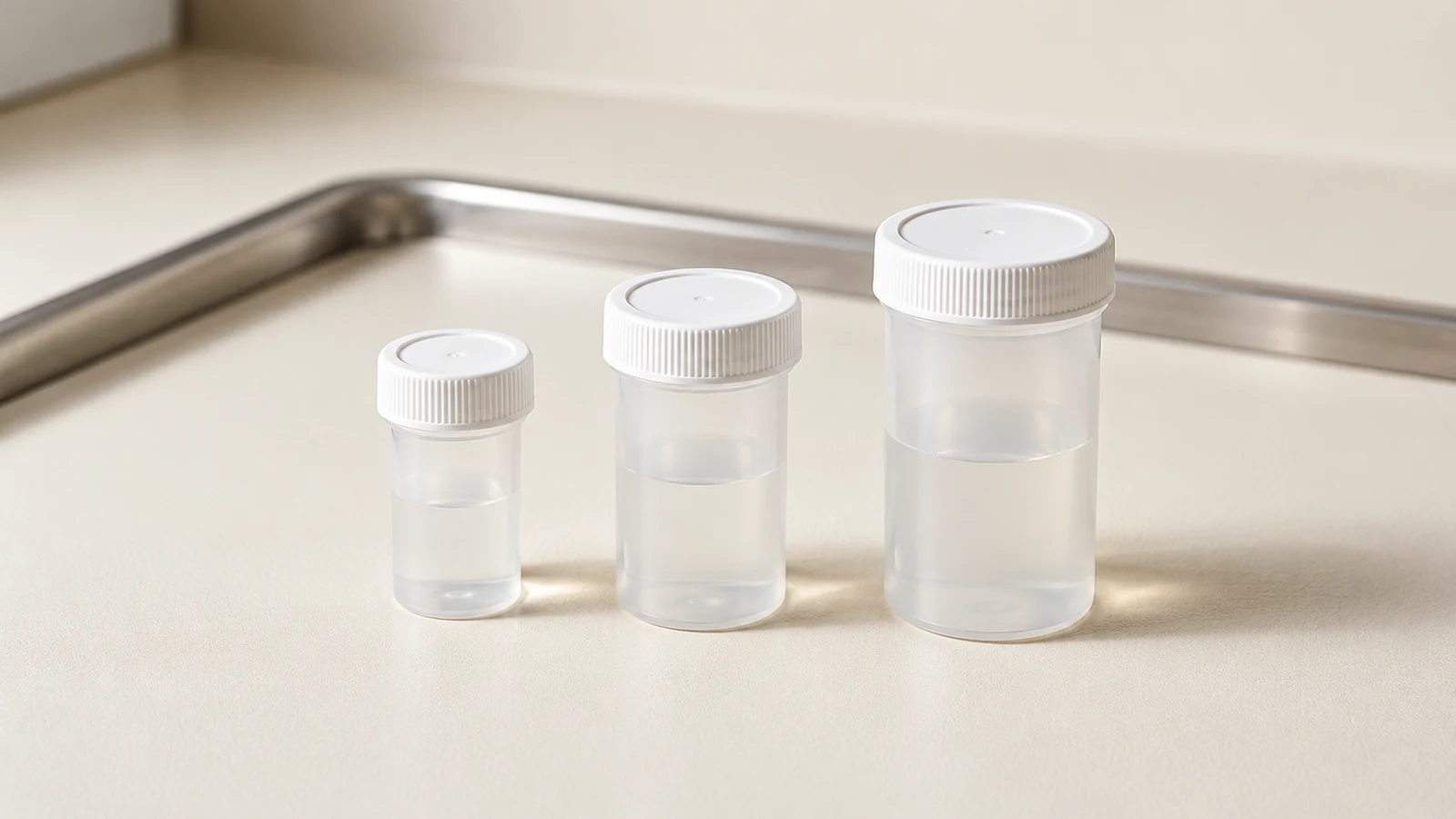
A clinic network changing prefilled biopsy-jar suppliers needs an approved purchasing record that receiving staff can actually check. Start with six fields: fixative identity, nominal capacity and labeled fill, sterility claim, applicable Safety Data Sheet (SDS), storage and expiry documentation, and transport arrangements. Assign missing information to the supplier, laboratory or shipping team before the new stock is issued. A matching jar size alone cannot settle the substitution.
What the container classification tells buyers
21 CFR 864.3250 covers specimen transport and storage containers, including those prefilled with a fixative or general-purpose reagent. Products within that identification are Class I and exempt from 510(k) premarket notification, subject to section 864.9 limitations. This describes a regulatory category; it does not establish that two products meet the same laboratory specification.
The FDA FMH entry identifies sterile specimen containers under this regulation and lists them as Class I, 510(k)-exempt and not GMP-exempt. Do not assign FMH to a prefilled SKU merely because it is a specimen jar. Ask the manufacturer to confirm the classification for the offered product. Our sputum-container guide addresses the related sterility decision for that collection family.
Verify the fixative against the laboratory’s specification
Write the full medium name into the purchase specification. The Azer SDS, revision 3 lists less than 4% formaldehyde and less than 1% methyl alcohol, with phosphate ingredients. The StatLab SDS, version 2.1 lists 3–4% formaldehyde and 1–1.5% methyl alcohol by weight. Thus, “10% neutral buffered formalin” is not a statement that the mixture contains 10% formaldehyde. Use the composition disclosure for the actual product rather than transferring percentages from another brand.
Formalin is not the universal purchasing answer. Pathology Sciences Medical Group’s submission guide distinguishes routine formalin supplies from special-study arrangements. Separately, PreAnalytiX describes PAXgene Tissue as a formalin-free system for fixation, storage and processing for histological and molecular analysis. That manufacturer description establishes an alternative product family, not interchangeability with the laboratory’s existing method.
Have the receiving laboratory identify its approved medium and exact product requirements before procurement compares quotations. Keep specialty media as separate item records when the laboratory requires them. A supplier’s claim that two jars serve the same broad tissue category is insufficient evidence for substitution. The same matching principle appears in our swab and transport-medium guide.
Separate nominal capacity from published liquid fill
Globe’s formalin-filled collection publishes liquid fills beside container capacities. Simport’s HistoTainer II page states that the family is 50% filled. Leica’s AffirmSeal overview lists sizes and fixative but does not give a per-size liquid-fill table. These are different levels of catalog evidence; the missing Leica values remain unknown here.
| Manufacturer / line | Nominal capacity | Published fill evidence | Closure / pressure evidence |
|---|---|---|---|
| Globe Scientific | 20 / 40 / 60 / 90 / 120 mL | 10 / 20 / 30 / 45 / 60 mL, respectively | Click-close and Tite-Rite variants; collection describes leak-resistant containers |
| Simport HistoTainer II | 20 / 40 / 60 / 90 / 120 mL | Family statement: 50% filled; confirm the ordered SKU’s stated liquid volume | Integrated leak-resistant seal; manufacturer lists 95 kPa as tested |
| Leica AffirmSeal | 20 / 40 / 60 / 90 / 120 mL | Not specified per size on the cited overview | Audible/tactile click closure; manufacturer claims 95 kPa pressure-test compliance |
For example, Globe’s listed 40 mL container contains 20 mL of fixative. Enter those as separate fields. A quote that says only “40 mL formalin jar” needs clarification before it becomes the receiving specification. Published half-fill descriptions are catalog characteristics, not a universal minimum fill requirement or a specimen-sizing rule. The laboratory owns specimen-specific capacity and fixation requirements.
Treat the pressure statements in the table as manufacturer claims. They do not establish that these brands have equivalent test coverage or that an assembled shipment is accepted by a carrier. During qualification, request the evidence relevant to the selected size, closure and intended transport arrangement. Leave a field marked “not verified” while that evidence is missing.
Record the sterility claim without inferring it
Section 864.3250(b) exempts a device that is not labeled or otherwise represented as sterile from Part 820 quality management system requirements, except requirements concerning records and complaint files under section 820.35. Preserve both parts of that exception in supplier records. It is not a statement that all obligations are limited to complaint handling.
No explicit sterility statement was identified for the prefilled lines on the three cited product overviews. Page silence does not establish a particular SKU’s status. Request the primary label and applicable instructions, record the manufacturer’s exact claim, and resolve any conflicting distributor description. Fixative identity does not establish container sterility or demonstrate pathogen inactivation. Supplier qualification should address the purchased product’s evidence without inventing a mandatory lot certificate or selecting a sterilization method for the manufacturer.
Keep the applicable SDS and resolve conflicting versions
Under OSHA’s formaldehyde standard, hazard-communication provisions cover mixtures containing greater than 0.1% formaldehyde. The standard sets an airborne limit of 0.75 ppm as an eight-hour time-weighted average and 2 ppm as a 15-minute short-term limit. These are workplace air limits; they are not liquid acceptance specifications. NIOSH also identifies formaldehyde as a potential occupational carcinogen. A purchasing file should route the product’s safety information to the workplace safety team.
The Hazard Communication standard requires manufacturers or importers to provide an SDS with the initial shipment and first shipment after an update, and upon request; distributors pass SDS information downstream. Employers must maintain required SDSs with ready access during each work shift. Preserve incoming hazard labels. This supports an SDS handoff and accessibility check, not an assertion that a new paper SDS must accompany every repeat delivery.
The following comparison reports the linked document versions. Their availability online does not confirm that they are the latest supplier-issued revisions. The formulations and documents must not be treated as identical, and differences in cancer-category wording are not a basis for ranking product safety.
| Supplier document inspected | Section 2 carcinogenicity entry | Section 14 transport entries | Limit for purchasing use |
|---|---|---|---|
| Azer: revision 3, 24 July 2018 | Category 1 | US DOT, TDG, IATA and IMDG: not regulated | Confirm applicable product code and latest revision with supplier |
| Avantik: January 2014, hosted by StratDx | Category 1A | Ground: not regulated; air subsection: UN 3334, Class 9, PG III; later IATA/ICAO line: not regulated | Internally inconsistent; obtain current supplier clarification before a shipping decision |
| StatLab: version 2.1, 29 January 2020 | Category 2 | ICAO/IATA/DOT/TDG section: not regulated for transport | Confirm applicable product code and latest revision with supplier |
The Avantik example is especially useful because a single page gives conflicting air-transport entries. Do not select the convenient line or turn the older UN 3334 entry into a rule for all formalin jars. Ask the supplier for an applicable, corrected SDS and have the shipping team resolve the classification against current requirements and carrier conditions. Record the clarification alongside the product code and document revision.
Make storage, expiry and returns part of the order
Azer’s cited SDS specifies room-temperature storage. StatLab’s cited SDS specifies a dry, cool, well-ventilated location with containers closed and locked storage; it also identifies sunlight and extreme temperatures as conditions to avoid and notes possible paraformaldehyde precipitation. These statements do not establish a universal numerical storage range, cold-exposure threshold or shelf life for prefilled jars.
Obtain storage and expiry information for the exact supplied product. If a supplier uses “room temperature,” ask for any numerical limits needed by your receiving and storage procedures. Keep a jar-material temperature claim separate from evidence for the filled product. Record the labeled expiry when present and agree any minimum remaining shelf life commercially, rather than adopting an unsupported universal number. See our storage and transport evidence guide for the broader documentation approach.
Azer’s Section 13 directs disposal of unused product as regulated hazardous waste and lists U122. This is a statement in that SDS, not an independent determination of every facility’s waste classification or discharge rules. PSMG’s client guide provides a concrete return model: clients return expired bottles through its courier for disposal. That is one laboratory’s service, not a universal supplier obligation. Agree a return or disposal route with the supplier or reference laboratory and the facility’s environmental team before ordering.
Assess the specimen and the chemical separately
Under 49 CFR 173.134, infectious-substance classification begins with whether material is known or reasonably expected to contain a pathogen. Category B infectious substances receive UN 3373. Diagnostic purpose alone does not make every biopsy Category B: paragraph (b)(11) includes a conditional exception for non-infectious-disease testing, including cancer biopsies, where the probability of infection is low. Paragraph (b)(4) separately addresses pathogens neutralized or inactivated so they no longer pose a health risk.
The section supplies no blanket exemption for a jar merely because it contains formalin. Have the responsible shipper document the applicable specimen classification and chemical assessment for the shipment. An SDS entry for unused fixative does not settle the biological classification of a specimen added later. If Category B requirements apply, use the separate Category B packaging guide rather than treating a jar’s pressure-test claim as shipment approval.
A receiving record for the supplier change
The table below is a proposed procurement handoff, not a universal regulatory form. Complete the approved specification before the first delivery so receiving staff compare what arrived with a documented decision. For each open field, name the person responsible for closing it. An unanswered field should stay visible instead of becoming an assumed match in the item master.
| Field to record | Evidence to obtain | Receiving or qualification action |
|---|---|---|
| Supplier, product code and pack quantity | Quote, manufacturer label and packing record | Match the ordered variant and pack level; keep the supplier’s code alongside the internal item number |
| Fixative identity and concentration | Primary label, applicable SDS and laboratory-approved specification | Compare the full medium name; refer any mismatch to the laboratory before issue |
| Nominal capacity and liquid fill | Product-specific label or manufacturer specification | Keep capacity and supplied liquid volume in separate fields; request missing fill information |
| Sterility claim | Manufacturer label and applicable instructions | Record exact wording or that the claim is unverified; resolve conflicting sales descriptions |
| SDS identity, revision and access | Supplier-confirmed SDS applicable to the product code | Store the revision with the qualification record and confirm staff can access the applicable sheet |
| Lot, labeled expiry and identifiers | Jar and case labels as supplied | Record available identifiers and packaging level; flag missing agreed traceability data |
| Condition at receipt | External inspection and supplier’s applicable acceptance information | Record visible leakage, damage or abnormal appearance; route exceptions through local safety and quality procedures |
| Storage and expiry commitments | Label, applicable instructions, SDS and supplier clarification | Compare the delivery record with agreed conditions; record uncertainty or suspected excursions |
| Transport arrangement | Shipping team’s classification record and carrier confirmation | Keep specimen and chemical assessments separate; close SDS contradictions before dispatch |
| Expired or unused stock | Agreed supplier/laboratory return terms and facility waste procedure | Name the return or disposal contact and any collection restrictions before stock is distributed |
For traceability, capture identifiers actually supplied and verify any automated scan against the visible label. Do not assume every Class I jar has the same barcode format or that a scan always contains lot and expiry. The UDI and GUDID guide covers those broader labeling distinctions. Keep missing fields explicit and ask the supplier how the agreed traceability requirement will be met.
A practical switch record can show the old SKU, proposed SKU, evidence revision, each unresolved difference and the laboratory’s acceptance of the proposed specification. Receiving then checks subsequent lots against that approved record. Reopen qualification when the supplier changes the fixative, fill, closure, labeling, SDS or storage instructions. This connects the comparison to a repeatable purchasing decision without claiming that a catalog match establishes clinical or transport equivalence.
Sources
Regulatory text and product pages were checked on 22 October 2026. Product-table entries are manufacturer statements. The SDS comparison identifies the specific older revisions inspected; obtain the applicable current revision for a purchase or shipment. PSMG’s return arrangements apply to its clients.
FDA Product Classification Database - FMH, container, specimen, sterile
Surgipath AffirmSeal Pre-Filled Specimen Jars - Leica Biosystems product page
Formalin Filled containers - Globe Scientific collection page
M961 HistoTainer II prefilled containers - Simport product page
Azer Scientific Safety Data Sheet - 10% Neutral Buffered Formalin (SDS_180724, Rev 3)
Avantik Biogroup Safety Data Sheet - Formalin, 10% Neutral Buffered
StatLab Safety Data Sheet - 10% Neutral Buffered Formalin (Version 2.1, 2020-01-29)
PreAnalytiX - Tissue fixation and stabilization (PAXgene Tissue)
Pathology Sciences Medical Group - Surgical Tissue/Biopsy Submission Guidelines