
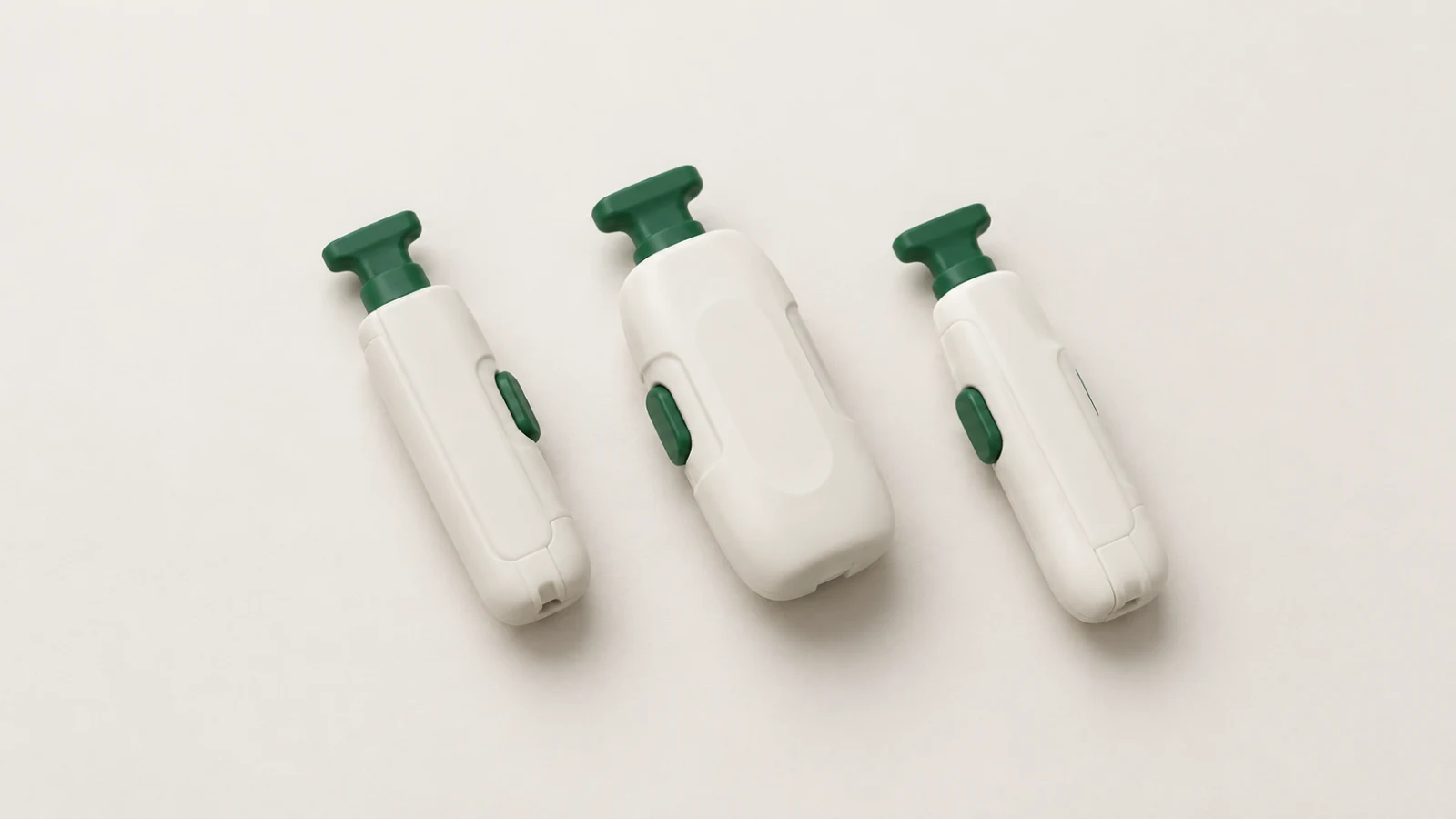
When comparing safety lancets, record the puncture element, penetration depth and firing action separately. A needle model has a gauge; a blade model has a blade width. Both have a labeled penetration depth, which may be fixed or selectable. Then check how the device prevents reuse, what its labeling permits and which regional order code the supplier is quoting. Matching a gauge or a color alone does not establish interchangeability.
For example, BD’s US listing identifies REF 366594 by a 1.5 mm blade width and 2.0 mm depth, while Roche’s Australian specifications describe a 23G needle with three depth settings. These are different specification formats. The comparison below helps buyers capture those differences without choosing a setting or puncture site for a patient.
Start with the US device category
FDA’s FMK classification record identifies disposable lancets with integral sharps-injury prevention as Class II devices submitted through 510(k). 21 CFR 878.4850 distinguishes four categories:
| Blood-lancet category | US classification / key boundary |
|---|---|
| Single-use, integral sharps-injury prevention | Class II; tested irreversible disablement after one use |
| Single-use, without integral prevention | Class II; a separate category from FMK |
| Reusable base, single patient | Class II; validated cleaning and disinfection instructions |
| Reusable base, multiple patients | Class III; premarket approval pathway |
The regulation gives May 22, 2024 as the PMA or product-development-protocol filing deadline for specified legacy multiple-patient devices. That deadline does not establish which products are currently sold or approved.
Read the three physical fields separately
Puncture element: copy the manufacturer’s needle gauge or blade width into its own field. Keep blade width separate from penetration depth, even when both are expressed in millimeters. A listing of 1.5 mm × 2.0 mm for a blade is not a 1.5 mm needle diameter. Avoid converting a blade specification into a gauge to make a spreadsheet appear complete.
Depth: record the labeled depth in millimeters and whether the quoted variant is fixed-depth or adjustable. For an adjustable model, preserve the complete list of available settings. A selectable device whose settings include 1.8 mm is not the same purchasing description as a dedicated 1.8 mm model. A dimension match is one input to supplier-change review, not its conclusion.
Firing action: distinguish contact activation from a side button or other release button. Separately record the sharps-protection claim after use. Firing the lancet and activating its protection are different events; the presence of a button does not establish an active sharps-protection mechanism. That distinction matters when comparing catalog language with standards terminology.
Compare labeled dimensions by regional source
These tables transcribe public manufacturer information checked on October 23, 2026. They compare disclosures, not measured performance or clinical suitability. The dimensions table and family-behavior table should be read together. “Not stated on the page” identifies a gap in the cited evidence; it does not mean the product lacks that feature. A regional listing is evidence of catalog content, not confirmation of stock or authorization in another market.
| Product / order identity | Element and size | Depth (mm) / mode | Regional evidence / date |
|---|---|---|---|
| BD Microtainer Contact-Activated; REF 366592 | Needle, 30G | 1.5; fixed | BD US: 366594 page / family FAQ; checked 2026-10-23 |
| BD Microtainer Contact-Activated; REF 366593 | Needle, 21G | 1.8; fixed | BD US: 366594 page / family FAQ; checked 2026-10-23 |
| BD Microtainer Contact-Activated; REF 366594 | Blade, 1.5 mm width | 2.0; fixed | BD US: 366594 page / family FAQ; checked 2026-10-23 |
| Unistik 3 Gentle; order code not stated on page | Needle, 30G | 1.5; fixed | Owen Mumford US; checked 2026-10-23 |
| Unistik 3 Comfort; order code not stated on page | Needle, 28G | 1.8; fixed | Owen Mumford US; checked 2026-10-23 |
| Unistik 3 Normal; order code not stated on page | Needle, 23G | 1.8; fixed | Owen Mumford US; checked 2026-10-23 |
| Unistik 3 Extra; order code not stated on page | Needle, 21G | 2.0; fixed | Owen Mumford US; checked 2026-10-23 |
| Unistik 3 Neonatal and Laboratory; order code not stated on page | Needle, 18G | 1.8; fixed | Owen Mumford US; checked 2026-10-23 |
| Sarstedt Mini; 85.1015 | Needle, 28G | 1.6; fixed | Sarstedt US; checked 2026-10-23 |
| Sarstedt Normal; 85.1016 | Needle, 21G | 1.8; fixed | Sarstedt US; checked 2026-10-23 |
| Sarstedt Extra; 85.1017 | Needle, 18G | 1.8; fixed | Sarstedt US; checked 2026-10-23 |
| Sarstedt Super; 85.1018 | Blade, 1.5 mm width | 1.6; fixed | Sarstedt US; checked 2026-10-23 |
| Sarstedt Neonatal; 85.1019 | Blade, 1.5 mm width | 1.2; fixed | Sarstedt US; checked 2026-10-23 |
| Accu-Chek Safe-T-Pro Plus; order code not stated on cited pages | Needle, 23G | 1.3 / 1.8 / 2.3; selectable | Roche Australia; checked 2026-10-23 |
The BD rows use the 366594 page’s family FAQ for the two sibling needle dimensions; its main specification panel describes the blade SKU. The Sarstedt page directly lists gauge for three variants and blade width for two. Product names such as “Neonatal and Laboratory” are reproduced as catalog identities, not recommendations for any patient group.
Color also needs its own brand context. Owen Mumford lists yellow for the 23G Unistik 3 Normal, while Sarstedt lists yellow for its 18G Extra. Use the variant and order identity to resolve the size rather than transferring a housing-color assumption between brands. Keep the dimensions in the item master even if local staff also use color as a visual cue.
Compare firing, reuse prevention and sterility disclosures
| Family | Firing action | Protection after use | Sterility disclosure | Regional evidence / date |
|---|---|---|---|---|
| BD Microtainer Contact-Activated | Contact-activated | Automatic retraction; manufacturer says design prevents reuse | Not stated on cited US page | BD US; checked 2026-10-23 |
| Unistik 3 | Side activation | Needle retracts after use | Not stated on cited page | Owen Mumford US; checked 2026-10-23 |
| Sarstedt Safety lancet | Not stated on cited family page | Not stated on cited family page | Not stated in retrieved family-page text | Sarstedt US; checked 2026-10-23 |
| Accu-Chek Safe-T-Pro Plus | Release button; no loading / priming in US summary | Concealed before and after use; disabled after use | Gamma irradiation; Australian page states four years after sterilization | US K232488 summary / Roche Australia; checked 2026-10-23 |
Sarstedt’s retrieved family page contains FAQ headings about reuse and sterility, but not the answers. Those headings cannot support affirmative table entries. Obtain the current regional instructions and labeling before completing these fields. Likewise, a protective cap shown in a photograph cannot establish a sterilization method or shelf life.
The US summary for K232488 provides a useful counterexample to an easy terminology mistake: Safe-T-Pro Plus fires through a release button, yet the summary describes its sharps-injury prevention as passive because protection occurs automatically after use. It also documents the needle size and selectable depths. Do not classify every button-fired lancet as having active protection.
The ISO 23908:2024 preview distinguishes user-activated protection from self-activating protection. It includes lancing devices in scope and describes safe-mode indication, including persistent visual indication. Its revision summary adds free-fall testing and a minimum 5 N challenge to access the sharp. These are qualification topics requiring the complete applicable test methods, not instructions for warehouse staff to challenge a sharp by hand.
FDA lists the 2024 edition as completely recognized under recognition 6-507, with an entry date of May 26, 2025. The record says declarations of conformity to the 2011 edition remain acceptable in support of premarket submissions until July 4, 2027. This is a standards-recognition transition, not a deadline to discard inventory. An FMK code or an older clearance alone does not demonstrate conformity to the 2024 edition.
Why equal numbers do not establish equal performance
Two products may share a gauge and depth while differing in body shape, firing action and labeled purpose. Sarstedt Extra and Unistik 3 Neonatal and Laboratory both list 18G and 1.8 mm; both are needle variants. Their different catalog identities still require separate label review. The needle-versus-blade distinction must come from the element field, not from the word “Neonatal.”
The NHS Supply Chain review from September 2018 illustrates why buyers capture more than a gauge: its criteria include identifying needle versus blade, penetration depth, gauge or incision length, product visibility on packaging and expected blood volume. The review notes that suppliers use differing droplet or flow descriptions and that patient factors affect collected volume. Its supplier-declared data is historical procurement evidence, not a current ranking or a guarantee that one device will fill a tube.
Treat “High Flow,” comfort language and expected-volume statements as attributed product claims. Ask what the claim means for the exact variant and what evidence supports it. A flow label cannot replace the required volume and additive specification of the downstream capillary collection tube. Procurement should record both products independently rather than deriving one specification from the other.
Separate mandatory controls from supplier evidence
For the integral-prevention category, section 878.4850(a)(2)(ii) requires mechanical evidence of irreversible disablement after one use; subsection (iv) addresses sterility of the skin-breaching component. Subsection (vi) requires prominent single-patient, discard-after-use and bloodborne-pathogen warnings. Review the complete labeling against those requirements. The provision does not prescribe a universal retracting design or require every statement on both the unit and shipping carton.
For qualification, request the current label and instructions, the exact device’s regulatory identity, and supporting evidence for its disablement and sterility claims. If a supplier claims ISO 23908 conformity, request the edition, applicable configuration and supporting report or declaration. These requests turn a general safety claim into a reviewable record. A used-device indicator and the type of protective cap should be recorded from product-specific evidence rather than inferred from the FMK classification.
Fixed depth or adjustable: what changes in the tender
An adjustable product changes what the tender needs to describe. Record all selectable settings and route the operating instructions to the clinical team for review. For fixed-depth products, retain a separate line for each approved variant and order code. These are purchasing-record choices; the clinical team determines whether a product and its labeled use meet the intended workflow.
The FDA clearance record for K232488 records a substantially equivalent decision on November 13, 2023. It provides a verifiable regulatory link for Safe-T-Pro Plus, while the Australian page supplies additional regional technical disclosures. Neither establishes current local stock. Its four-year sterility statement runs from sterilization and should not be copied into a contract as four years of remaining shelf life at delivery. Define the required remaining shelf life separately and check the delivered expiry date.
An adjustable model may be considered for inventory consolidation, but savings, stockout reduction and equivalence require local evidence. Compare quoted pack quantities, approved uses and training needs before changing the item master. A fixed-depth device removes a depth-selection step; it does not make every other selection or use error impossible. Avoid describing either format as universally safer, cheaper or more suitable.
Receiving and supplier-change checks
Build a proposed purchasing description from the approved label: manufacturer, model, regional REF, needle gauge or blade width, penetration depth and mode, firing action, reuse-prevention claim and pack quantity. Keep the label version and source date beside the record. This is a procurement recommendation based on the disclosure gaps above, rather than a claim that every field is a required marking on every packaging layer.
| Review point | Record or compare | Action for an unresolved difference |
|---|---|---|
| Product identity | Quoted REF, manufacturer, regional label and delivered variant | Hold the substitution for supplier-quality review; do not infer a cross-brand equivalent |
| Dimensions and operation | Element type, gauge or width, depth settings and firing action | Obtain missing fields from the supplier before approving the change |
| Reuse and protection | Single-use warnings and documented protection behavior | Request the current instructions and qualification evidence; receiving staff should not perform improvised force or sharp-access tests |
| Sterility and remaining life | Product-specific claim, stated method, lot, expiry and visible package condition | Segregate suspect goods under local procedures and ask the supplier to resolve the discrepancy |
| Quantity and traceability | Order unit versus delivered pack quantity; labeled product and lot identifiers | Reconcile the receipt with the approved purchase record before release |
Regional evidence needs the same discipline. The BD MENAT family page describes contact activation and prevention of reuse but does not provide the gauge/depth ordering detail used in the US comparison. Ask the local supplier for the offered regional REF and current label. A family name, CE-related marketing statement or US catalog entry cannot by itself complete that regional purchasing record.
Keep receiving checks focused on identity, documentation and visible condition. Route any planned performance evaluation through the responsible quality team using an approved method and the manufacturer’s instructions. For disposal and barcode detail, use the separate sharps-container guide and UDI receiving guide. A traceability record supports investigation; it does not itself prove sterility or device equivalence.
Evidence limits
This comparison uses public regulatory records, an ISO preview, regional manufacturer pages and a dated NHS procurement review. It includes no independent bench testing, price analysis or clinical comparison. Manufacturer disclosures can change and may lag the instructions supplied with the product. Preserve an unresolved field as unknown until the supplier provides usable evidence; keep clinical suitability, regional market access and purchase acceptance as distinct review decisions.