
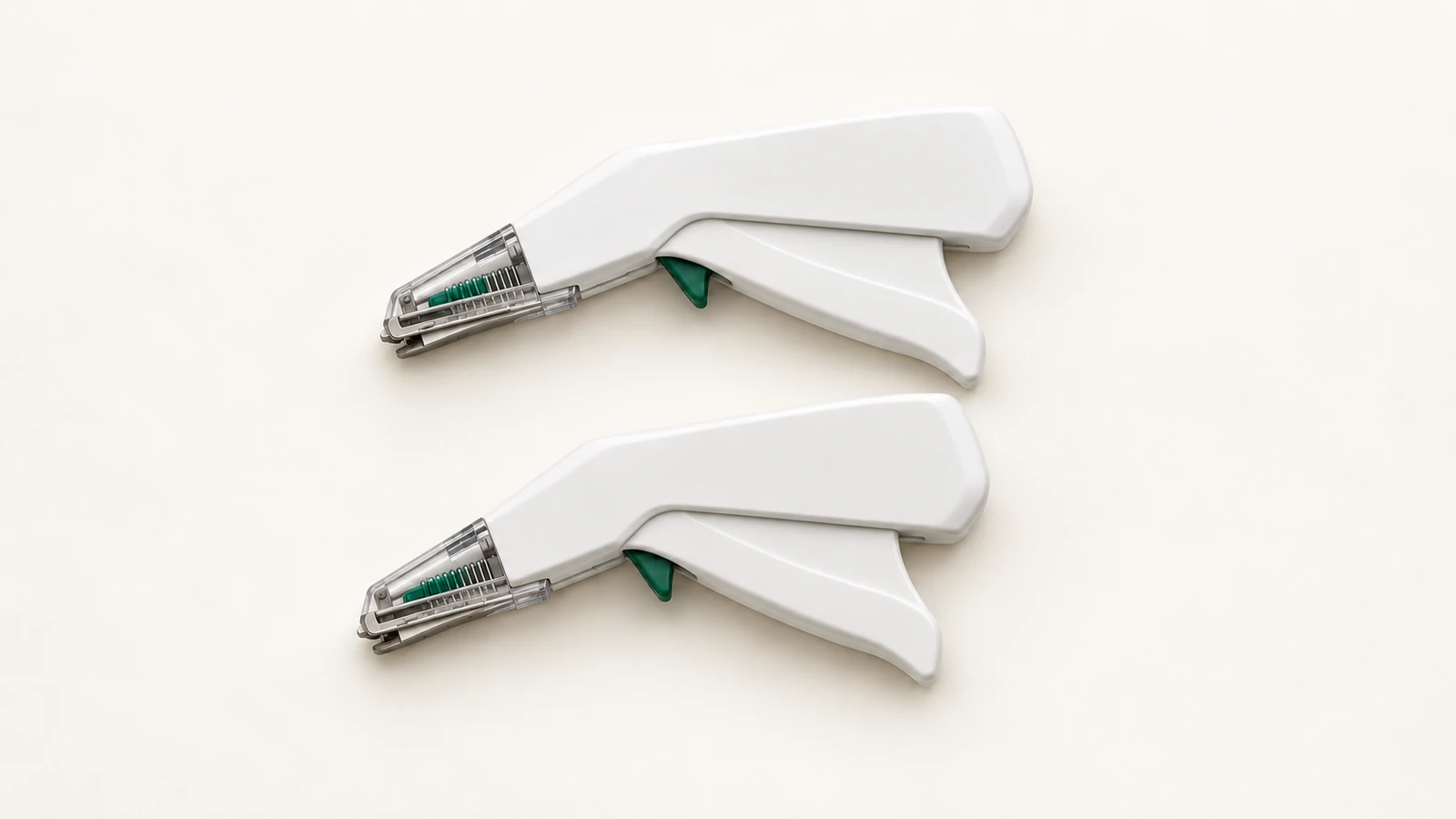
Before changing a skin stapler supplier, record the exact stapler SKU, its published staple geometry and loaded count, and the remover SKU with its written compatibility scope. A shared size word or similar handle does not establish interchangeability. Keep the document date and market beside each entry so an old brochure cannot silently become a current supply promise.
This US-focused purchasing guide compares public manufacturer declarations reviewed on October 21, 2026. It does not report independent dimensional testing or validate a stapler/remover pairing. Several documents are older manufacturer-authored copies hosted by distributors; their dates remain part of the evidence. Clinical placement, removal technique and treatment selection are outside its scope.
What you are buying: an exempt Class I prescription device
Under 21 CFR 878.4740(a), an external-use surgical stapler delivers compatible staples to skin and is a Class I prescription device, exempt from premarket notification subject to the limits in 878.9. FDA identifies the skin-stapler category as QQS. Exemption does not mean FDA has cleared each catalog pairing, and a missing clearance number alone does not show that an exempt product is unlawfully marketed. Ask for the applicable classification rationale and product labeling.
The October 8, 2021 final order created the separate stapler regulation and reclassified internal-use staplers into Class II with special controls, while external-use staplers remained Class I. Keep those populations separate when reviewing tenders. Historical clearances also exist: K800535 records a substantial-equivalence decision for the 3M disposable skin stapler on April 4, 1980, under GDT and 878.4760. That record neither establishes current stock nor validates a modern substitute.
Section 878.9 limits exemption to devices with existing or reasonably foreseeable characteristics of their generic type. It requires premarket notification for a different intended use or different fundamental scientific technology. A material or mechanism change therefore calls for a supplier regulatory assessment; the mere presence of a new feature does not let a buyer determine the pathway from its name.
The staple record: preserve units and measurement state
Use separate columns for the size descriptor, crown width, wire diameter, leg length and formed height. Copy the manufacturer’s terminology before normalizing it. In particular, a formed rectangular staple height is not an unformed leg length. If a document omits a value or its measurement state, record that gap instead of filling it from another brand. Matching numbers alone cannot demonstrate extraction performance.
Ethicon illustrates why the source matters. Its portfolio comparison sheet prints wire and leg values without units and describes PXW35 as regular in one row but Wide in another. The PXW35 ePC entry identifies it as Wide, with wire value 0.58 and leg value 3.9, again without units. The Fixed-Head page lists both PXR35 and PXW35. Use these pages to check identity, while taking dimensioned values from the dated documents below.
The 2016 Ethicon fact sheet and July 2010 Ethicon EMEA brochure supply explicit millimeter units across all six PROXIMATE codes. The latter illustrates wire diameter, leg length and crown length. Preserve those field names; do not rename the 3.9 mm leg value as closed staple height. These are manufacturer declarations in older documents, so obtain labeling applicable to the offered SKU and market before accepting a supply change.
Stapler records as of October 21, 2026: the table describes the cited documents, including their omissions. It is not an availability list or a list of approved substitutes.
| Family and named codes | Loaded count and pack | Published dimensions and material | Evidence and purchasing limit |
|---|---|---|---|
| Teleflex Weck VisiStat 528135 Regular / 528235 Wide | 35 staples; 6/box | US page: medical-grade stainless steel; no numerical crown, wire or leg dimensions. | Teleflex US page; request missing dimensions for the offered reference. |
| Ethicon PROXIMATE: PRR35/PRW35, PXR35/PXW35, PMR35/PMW35 | 35 staples; 6/box | Regular: crown 5.7 mm, wire 0.53 mm, leg 3.9 mm. Wide: crown 6.9 mm, wire 0.58 mm, leg 3.9 mm. | 2016 fact sheet and 2010 EMEA brochure; dimensioned historical documents, not a stock confirmation. |
| CONMED Reflex One 8035 Regular / 8535 Wide; Reflex TL 8635 Regular / 8735 Wide; Reflex rotating head 8935 | 35 staples; 6/box | Formed drawing: Regular 5.7 mm crown × 4.2 mm height; Wide 6.9 mm × 3.6 mm. 316L stainless steel; wire diameter unstated. | June 2022 brochure, pp. 3–4 and November 2024 discontinuation notice; notice sets a January 1, 2025 production stop, with final discontinuation tied to inventory depletion; no designated replacement or current stock confirmation. |
| 3M Precise Vista 3995, 3996, 3997, 3998; discontinued line | 3995: 35W; 3996: 15W; 3997: 35; 3998: 15. Each 6/carton. | Historical IFU: regular/wide lever-action family; no millimeter geometry in that IFU. | September 2023 notice supplies SKU counts; 2013-11 IFU supplies family description. |
| 3M Precise DS-5/DS-15/DS-25 and PGX-15W/PGX-35W; discontinued line | DS: 5/15/25 staples, 12/carton. PGX: 15/35 wide, 6/carton. | Historical IFU: arcuate DS staples; wide PGX family; no millimeter geometry in that IFU. | 2013-11 IFU and September 2023 notice; preserve the distinct staple shape. |
Teleflex’s US VisiStat page documents 35-count Regular and Wide dispensers and Rx-only status, but does not establish a numerical crown match to CONMED or Ethicon. Do not convert an omitted number into an assumed specification. For each missing field, record who will obtain the manufacturer response and whether the purchase decision can proceed without it. That makes an unknown visible to the approving team.
The 3M Precise record: discontinuation and remaining stock
The manufacturer-authored September 2023 3M discontinuation notice, hosted by Medline, sets two target-date groups: September 30, 2022 for 3997, 3998, PGX-15W, PGX-35W and SR-1; December 31, 2023 for 3995, 3995NS, 3996, DS-5, DS-15, DS-25 and SR-3. It names no suggested alternatives and permits sales while inventory remains, with actual availability potentially ending before or after the target date. Neither zero stock nor continued manufacture follows from it.
The indexed 3M US catalog lists seven references: 3995, 3995NS, 3996, DS-5, DS-15, DS-25 and SR-3. An indexed snapshot cannot confirm today’s listing or stock. Carry the discontinuation notice beside those listings. For an offered lot, obtain its actual labeling, expiry, quantity and supply commitment rather than treating a web listing as proof of replenishment. The notice lists 3995NS as bulk, 10/carton; the retained IFU does not include that reference, so its packaging or sterility status must not be borrowed from 3995.
The CONMED Reflex line: a production stop with codes to reconcile
CONMED’s November 1, 2024 notice, hosted by Medline, announces a Reflex finished-goods production stop effective January 1, 2025, with final discontinuation conditional on inventory depletion. It names no designated replacement. Teleflex, Ethicon, Medtronic/Covidien and DeRoyal appear as alternatives in the notice, without technical-equivalence claims. Record the documented production stop; the notice cannot establish whether inventory remains today or whether final discontinuation has since occurred.
The notice names 13 codes: international-only TL 3013/3013R and One 3036/3036R; One 8035/8535, TL 8635/8735 and rotating-head 8935; bulk nonsterile 803590/853590/873590; and extractor 3031. That covers all ten codes in the June 2022 brochure’s ordering table and adds three bulk variants. It does not explicitly label the other stapler references sterile. Confirm each offered pack’s labeling. A brochure still hosted by the manufacturer does not establish current production or replenishment.
The April 2009 CONMED brochure (MBR 9010 Rev. 2) lists lower-count One codes 8015/8025 and 8515/8525, lower-count TL codes 8615/8625 and 8715/8725, and Value Extractor 3034 alongside 3031. Both extractors are listed as Wide/Regular, 12/box. These eight stapler codes and 3034 are absent from the June 2022 ordering table and the November 2024 notice. Record their present lifecycle status as unknown from these documents; a third-party listing cannot establish current manufacturer supply or extend the notice to unlisted codes.
Remover identity: keep the written scope with the SKU
Remover records as of October 21, 2026: the wording below captures the reviewed documents. Each claim belongs to its named device and document. None establishes the performance of another manufacturer’s remover. A positive family-coverage statement also does not prove that every pairing outside the family is prohibited; it means those other pairings remain unsupported by that statement.
| Remover identity | Design and pack record | Written scope and dated evidence | Decision boundary |
|---|---|---|---|
| 3M Precise SR-1 / SR-3 | SR-1: stainless metal style. SR-3: plastic scissors handles, stainless arms/jaws. Notice: 10/carton. | 3M IFU, 2013-11: “universal in design” and “used to remove any brand of staple.” | Historical statement for a discontinued line; do not transfer it to another remover. |
| Ethicon PSX | Squeeze-handle; 12/box. | 2016 fact sheet: “compatible with all PROXIMATE Skin Staplers.” 2010 EMEA brochure: “for all models.” | Family coverage documented in older literature; no cross-brand performance established. |
| CONMED Reflex 3031 | Wide / Regular; 12/box. | June 2022 brochure: “Compatible with wide and regular staples.” Covered in November 2024 notice. | . Size-word coverage, not a continuous numerical interval; notice sets a January 1, 2025 production stop. Unlisted historical 3034 has no status from this notice. |
| Teleflex Weckstat 525980, US | White plastic, metal tips; sterile/disposable; 12/box. | US VisiStat page presents the extractor as its complement; US store confirms item and pack. No explicit any-brand sentence. | Catalog pairing; obtain written scope for a proposed mixed-brand use. |
The current Ethicon PSX ePC entry confirms the Squeeze-Handle Staple Extractor and quantity 12/box, but supplies no compatibility sentence. Its dimensional fields are NA. The portfolio comparison sheet describes PSX as sterile and for single-patient use. Keep those present-page facts separate from the scope statement in the dated fact sheet; a recent retrieval date does not update the underlying document.
Market-specific references also matter. The distributor-hosted Teleflex international brochure lists WK525960 stainless steel, 36/pack; WK525970 brown plastic, 6/pack; and WK525980 white plastic, 12/pack. It is older regional literature, not proof that all three are currently sold in the United States. Keep the exact prefix, pack and market in the quote and confirm which reference the supplier will deliver.
Before a substitution, list every remover already stocked at receiving and removal locations. Ask for compatibility evidence covering the proposed staple/remover pair. If that evidence is absent, hold that pairing unresolved and obtain an appropriately documented alternative. Co-purchasing a named companion can simplify the record, but brand matching by itself is not the acceptance test.
Counts, packaging and label limits that quotes leave out
Compare purchasing units at the dispenser and box levels. A 6-dispenser box and a 12-extractor box are different quantities; one box of each does not provide equal device counts. Use local placement and removal demand to set reorder quantities rather than assuming a fixed clinical consumption ratio. Similarly, compare loaded counts before comparing unit prices. The record should expose a 15-versus-35 count difference without predicting how many devices a particular procedure will consume.
Keep material, sterility, single-use limits and shelf life specific to the offered reference. The 3M IFU issued 2013-11 describes 316L non-absorbable staples, single-patient use, no reprocessing or resterilization, sterile supply and a five-year shelf life for its listed devices. Those historical facts do not cover 3995NS or establish current applicability. Preserve relevant metal-sensitivity warnings with the full IFU; an alloy name is not a substitute for biological evaluation evidence.
MRI wording needs the same care. The 2020 Ethicon PROXIMATE sheet identifies six product codes and describes their 316L staples as MR Conditional under specified conditions. Retain the complete manufacturer document rather than reducing it to a field-strength slogan or applying it to the stapler instrument. The June 2022 CONMED brochure explicitly notes that Reflex One and Reflex TL Skin Staplers have not been evaluated for safety in the MR environment and their MR safety is unknown. The historical 3M IFU states that its device was not tested for MRI. Neither an alloy match nor an unknown field permits borrowing another product’s MR classification.
At receiving, compare the lot’s label and applicable IFU with the approved item record. Capture expiry and storage conditions as supplied; a five-year statement from one historical IFU cannot become a category-wide default. Record whether a claim concerns the staple, dispenser, remover or package. If the supplier’s evidence is incomplete, preserve the unknown rather than creating a reassuring value in the item master.
Classification and recall checks need more than one code
Alongside QQS for skin staplers, FDA lists removable skin staples under GDT, 878.4760, and disposable surgical instruments under KDC, 878.4800. These generic categories are Class I and 510(k)-exempt, subject to applicable limits. KDC is a broad instrument category, not a SKU-level determination for every remover. Ask the supplier to identify the code used for its particular device rather than assigning one from appearance.
The verified WECK VisiStat recall Z-0764-2017 shows why searches should span companion and legacy codes. Teleflex initiated the action on November 18, 2016 for specified lots of sterile 35W stapler 528235 because packages were not sealed properly and sterility was not assured. FDA indexed it under GDT and recorded termination on November 24, 2017. It is one historical lot-specific action, not a category incidence estimate or evidence that current lots are affected.
Use the FDA recall database search to document relevant codes, manufacturer and product names, catalog numbers and lots. Save the search date, filters, returned records and the disposition of any match. A QQS-only search would miss the GDT indexing of this example. An empty result under one filter does not establish a recall-free history; an unavailable search remains incomplete. Visual package inspection likewise does not independently prove sterility. If the prefilled search link fails, use New Search from the linked recall record and enter the relevant product code there.
An RFQ and receiving record for the exact pair
The following is a recommended purchasing worksheet, not a regulatory form. As of October 21, 2026, it converts the document comparisons above into fields a buyer can assign, check and retain. Keep the evidence URL, document date, reviewer and unresolved question with each field so later substitutions do not inherit undocumented assumptions.
| Field | Evidence to retain | Acceptance question |
|---|---|---|
| Identity and lifecycle | Exact manufacturer, catalog code, market, offered lot and dated catalog/lifecycle documents. | Does the supplier substantiate the offered supply, including any discontinued-line status? |
| Geometry | Size word, crown, wire, leg and formed-height fields, each with unit and measurement state. | Are values actually stated for this SKU, and are missing values still marked unknown? |
| Loaded count and purchasing unit | Staples/dispenser, dispensers/box, removers/box, bulk or unit-pack configuration. | Does the quote match the units the warehouse will receive? |
| Material and safety labeling | Product-specific material declaration, applicable IFU, contraindications and complete MR document if relevant. | Do statements concern this staple or device, with no borrowed alloy or MRI claim? |
| Sterility, expiry and use limits | Actual pack label and applicable IFU; lot, expiry, storage and reuse/reprocessing wording. | Are these claims verified for the offered reference and packaging configuration? |
| Remover identity and scope | Exact remover code, market and written compatibility sentence with document date. | Does the evidence cover the proposed pair, including existing removers at other locations? |
| Regulatory pathway | Supplier’s classification and exemption rationale or applicable premarket record. | Has the supplier addressed the 878.9 boundaries for this device? |
| Recall and receiving checks | Dated searches by relevant codes/names/SKU/lot; label and visible packaging observations. | Are matches resolved, searches complete and discrepancies assigned before acceptance? |
For example, compare an existing VisiStat 528235 record with the Reflex One 8535 brochure and notice entries. Both are described as Wide, 35-count dispensers, but the reviewed Teleflex page supplies no numerical crown dimension. The CONMED drawing cannot fill that blank. Nor does either catalog establish that a stocked Weckstat 525980 is compatible with Reflex staples. The Reflex notice also sets a production stop and names no designated replacement. Its 8535 entry is a documented historical comparison with unconfirmed remaining stock. A proposed purchase still needs evidence for both the offered supply and the exact staple/remover pair.
Assign supplier change-notification responsibilities through the consumable quality agreement; agree the notice period and approval process for changes to geometry, material, packaging or compatibility. At goods receipt, use the UDI/GUDID receiving guide to capture applicable identifiers without treating a database entry as a compatibility certificate. Store a label image and the relevant document revision with the lot record so a discrepancy can be traced.
Keep adjacent product decisions linked but distinct: suture pack specifications, scalpel blade/handle fitment, wound-dressing identification and sharps-container specifications each have their own evidence. The completed stapler record should let the approving team see the exact proposed device pair, which facts are documented and which still need a supplier answer.