
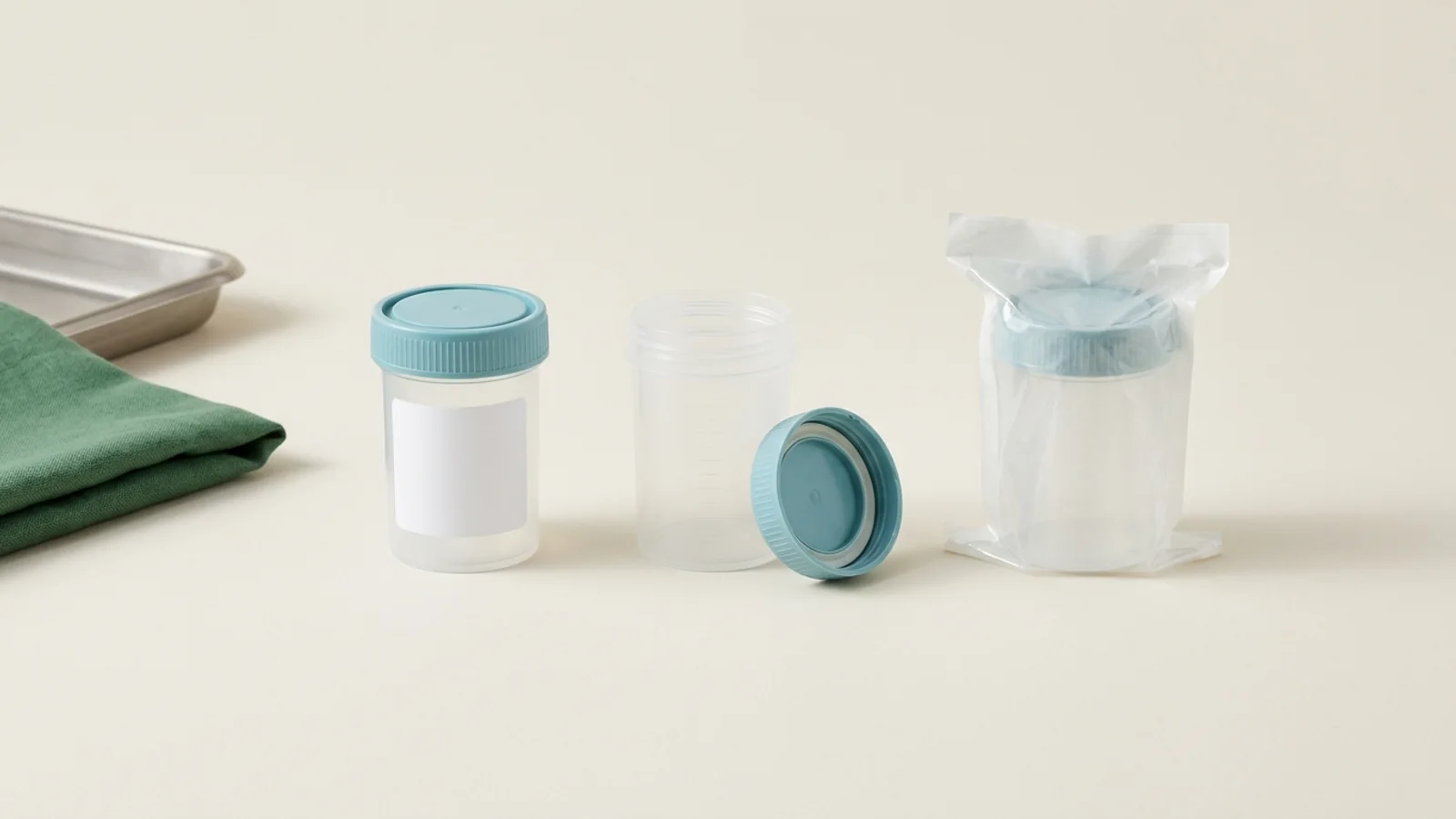
What a Specimen Container Is Under FDA Rules
Hospital buyers and laboratory distributors usually meet this product as a 60 mL specimen cup, a sputum collector, or a universal container. Those catalog names do not identify the device. Under 21 CFR 864.3250, a specimen transport and storage container is a device intended to contain biological specimens, body waste, or body exudate during storage and transport so the contents can be destroyed or used for diagnostic examination. It may be empty. If it is prefilled, the regulation describes a fixative solution or other general-purpose reagent. The section does not apply to containers intended for use as part of an over-the-counter test-sample collection system for drugs-of-abuse testing.
The classification is Class I (general controls). The device is exempt from premarket notification under subpart E of part 807, subject to 21 CFR 864.9. Exemption from 510(k) is not a finding that every cup on a web page is interchangeable. The buyer's first split is the sterility claim, because FDA keeps separate product codes for it.
FMH, container, specimen, sterile. Class I and 510(k)-exempt under 21 CFR 864.3250. The device name is the sterile specimen container. The classification record does not itself assign the cup to mycobacterial culture or any other test menu.
NNI, container, specimen, non-sterile. The same regulation and the same 510(k) exemption, with the device name limited to the non-sterile specimen container. FDA's product-code page still notes a quality-system exemption only while the device is not labeled or represented as sterile.
Mailers are not cups. KDT is the sterile specimen mailer and storage container. NNK is the non-sterile mailer. Temperature control is a different pair of names: KDW for the sterile temperature-controlled mailer and NNL for the non-sterile one. A screw-cap cup does not become a mailer because a catalog says it can be transported.
FMH and NNI share a regulation number, a device class, and 510(k)-exempt status. They do not share the quality-system boundary. Price, resin color, and a shared case pack do not close that gap.
What the Sterility Claim Actually Changes
The current text of 21 CFR 864.3250(b), amended at 90 FR 55981 on December 4, 2025, states the boundary directly. If the device is not labeled or otherwise represented as sterile, it is exempt from the current good manufacturing practice requirements of the quality management system regulation in part 820, except for requirements concerning records and complaint files under section 820.35. A sterile label, or any other representation that the container is sterile, removes that exemption.
Some FDA product-code pages have not caught up with that amendment. The NNI page, for example, still displays an older note citing the former record and complaint-file sections 820.180 and 820.198. Use the current regulation text for the citation. Use the product-code page to confirm the device name and whether FDA marks the code GMP-exempt.
Part 820, as amended by the Quality Management System Regulation, does not turn a sterile claim into a published list of test numbers for this container. The regulation does not state a sterility assurance level, name an ethylene-oxide or radiation standard, or require a particular cleanroom class for an FMH cup. What the buyer can check is narrower and more useful: whether the unit is labeled sterile, which method the supplier actually declares, how the unit is wrapped, and which lot and expiry marks arrive with it.
The three vendor documents reviewed for this comparison do not describe one shared sterilization practice.
Globe Scientific item 6523. The 60 mL (2 oz) Tite-Rite page catalogs the container as sterile polypropylene with an attached polyethylene screw cap and a patient-ID label with a tab seal. It does not state the sterilization method. It also does not state that this item is individually wrapped. Individual wrapping is described on a different Globe item, 6529, which is a 120 mL container.
Plastilab 60 mL sheet. Sterile codes are marked Sterile EO, for ethylene oxide, and the features list says sterile containers are individually wrapped in BOPP film. The sheet does not explain how that film relates to the gas cycle. Ask for that process description. Do not fill the gap with a Tyvek pouch, a residual-gas limit, or a gamma dose the sheet does not report.
Abdos 60 mL family. The page says sterile models are gamma-irradiated and individually wrapped. One description says sterile containers are packed in polyethylene pouches. The page does not cite a sterile-barrier standard, a dose, or a lot-release certificate.
For a unit that is labeled sterile, ISO 11607-1 is the packaging standard for terminally sterilized medical devices, covering materials, sterile barrier systems, and packaging systems. The public catalog page identifies the standard. It does not publish numeric seal, dye, or aging limits, and this article does not add test-method names from the paywalled text. Ask the supplier whether the wrap on the sterile cup was evaluated as a sterile barrier system, and ask for the declaration that matches the method printed on the label.
Leak Resistance: Vendor Language Versus Transport Law
Vendor pages compete on leak language. Globe describes an expanded inner liner that compresses against the wall and rim and uses leak-resistant, leak-proof, and air-tight for that seal, including for hospital pneumatic tubes. Plastilab says an integrity seal prevents leakage. Abdos says the HDPE cap is leak-proof and reports a leak-proof test at 635 mmHg, written on the page as 635 mm/Hg. None of those sentences is an FDA clearance and none is a Department of Transportation packaging certification.
When a shipper offers the specimen as a Category B infectious substance, 49 CFR 173.199 applies. CDC's archived COVID-19 specimen page tells shippers to pack suspected and confirmed SARS-CoV-2 patient specimens, cultures, or isolates as UN 3373 Category B. That instruction does not classify every sputum sample. A cup that is merely labeled leak-resistant has not made the classification decision. Where the section does apply, the cup is only the primary receptacle in triple packaging: primary receptacle, secondary packaging, and a rigid outer packaging.
The subsection numbers matter, because catalog summaries often attach the pressure test and the quantity limits to the wrong paragraph.
Triple packaging, paragraph (a)(1). The Category B substance must be packaged in a primary receptacle, a secondary packaging, and a rigid outer packaging.
Leakproof primary for liquids, paragraph (b)(1). This is the performance requirement that lands on the cup when the contents are liquid. The section does not name a screw thread, a liner, or a vacuum number.
Absorbent, paragraph (b)(2). Absorbent goes between the primary receptacle and the secondary packaging, in a quantity sufficient to absorb the entire contents of the primary receptacles. It is not a feature of the cup wall.
Leakproof secondary, paragraph (b)(3). The secondary packaging must be leakproof for liquids.
95 kPa, paragraph (b)(4), air only. For shipments by aircraft, the primary receptacle or the secondary packaging must withstand, without leakage, an internal pressure that produces a pressure differential of not less than 95 kPa (0.95 bar, 14 psi). Ground shipment under this section does not carry that sentence. The section also does not set a -40°C to +55°C test window for this pressure check.
Air quantity limits, paragraph (b)(5). For shipments by aircraft, each primary receptacle for liquids is limited to 1 L, and each outer packaging is limited to 4 L, including material used to stabilize the sample. Ice, dry ice, and liquid nitrogen used to maintain the material are excluded from the outer-packaging limit.
Completed-package drop, paragraph (a)(4). The completed package must be capable of passing the drop test in 49 CFR 178.609(d) from at least 1.2 meters. After the drop, there must be no leakage from the primary receptacle, which must remain protected by absorbent material, when required, in the secondary packaging. The drop test is a result for the finished package, not a certificate printed on the cup.
Marking and a reachable person, paragraphs (a)(5) and (a)(7). The outer packaging carries the diamond mark and the proper shipping name Biological substances, Category B. The name and telephone number of a person who knows the material, or who can reach someone who does, go on a written document such as an air waybill or on the outer packaging. The telephone must be monitored during the company's administrative hours. The section does not require a 24-hour emergency-response center, and it does not add orientation arrows.
The 95 kPa figure is about 713 mmHg. Abdos's stated 635 mmHg test is about 84.7 kPa. That arithmetic only compares two numbers. It does not show that the Abdos cup failed a test it does not claim, and it does not show that the cup satisfies paragraph (b)(4). Globe and Plastilab do not report a 95 kPa result at all. Because the aircraft rule can be met by the secondary packaging, absence of the number on the cup sheet is an unknown, not a finding that the cup is non-compliant.
Pneumatic-tube marketing should stay in the same column. Globe says the liner is suitable for hospital pneumatic tube systems. CDC's archived COVID-19 page recommends a site-specific risk assessment before those systems are used for suspected or confirmed SARS-CoV-2 specimens. A brochure line is not that assessment. The same discipline applies to the rest of the leak copy: record the vendor's words, and record a regulatory paragraph only when the supplier states the paragraph.
The outer packaging, the absorbent, and the shipping papers are a separate purchase. The site's guide to Category B specimen packaging and UN 3373 covers that system. This page stops at what the cup has to be, and at what a cup sheet usually fails to say.
| 173.199 requirement | What has to meet it | What the three cup sheets show |
|---|---|---|
| Triple packaging, (a)(1) | Primary receptacle, secondary packaging, and rigid outer packaging | Not a cup claim. The cup can only be the primary receptacle. |
| Leakproof liquid primary, (b)(1) | The primary receptacle | Vendor leak wording only. No sheet cites (b)(1). |
| Absorbent for the full liquid volume, (b)(2) | Material between primary and secondary | Not reported. Absorbent is not a cup feature. |
| 95 kPa pressure differential, (b)(4) | Primary or secondary, and only for air shipments | Not reported. Abdos's 635 mmHg figure is a different number. |
| 1 L primary and 4 L outer, (b)(5) | Aircraft quantity limits, excluding the refrigerant from the outer limit | Not reported. A 60 mL nominal size is not this limit. |
| 1.2 m drop of the completed package, (a)(4) | The finished package, by the test in 178.609(d) | Not reported on any cup sheet. |
Matching the Container to the Intended Specimen
The regulation covers biological specimens, body waste, and body exudate. It does not assign FMH to culture and NNI to urinalysis, and it does not set a mouth diameter. Match the container to the attributes named by the laboratory's specimen guidance, and stop where that guidance stops giving container attributes.
Sputum and Lower Respiratory Specimens
CDC's archived interim page on clinical specimens for COVID-19, updated July 15, 2022, names the container without writing a purchasing specification for every respiratory test.
Sputum container. For sputum, CDC names a sterile, leak-proof, screw-cap collection cup or a sterile dry container. That line does not set a sputum fill volume, and it does not say a preservative is forbidden.
The 2 to 3 mL figure. CDC attaches 2 to 3 mL to lower-respiratory specimens such as bronchoalveolar lavage, tracheal aspirate, pleural fluid, and lung biopsy, collected into the same kind of sterile, leak-proof, screw-cap sputum cup or sterile dry container. Do not copy that volume onto a sputum tender as if it were the fill specification.
Saliva, preservative, and cold storage. The saliva line on the same page specifies a sterile, leak-proof screw-cap container and states that no preservative is required. Separately, the page says to store respiratory specimens at 2-8°C for up to 72 hours after collection, and at -70°C or below if testing or shipping is delayed. None of the cup sheets reviewed here states a -70°C rating. Storage conditions for the filled specimen are covered in the site's guide to labeled storage and transport for medical consumables.
APHL's April 2018 guidelines for submitting sputum for tuberculosis testing use a short container list: sterile, clear, plastic, and leak-proof, with a 50 mL screw-cap centrifuge tube as the example. The same paragraph says sputum collection devices and wide-mouth sterile collection containers are commercially available. It does not measure those openings, and it does not identify the three vendor families below as that wide-mouth format. APHL also recommends delivery to the public health laboratory within 24 hours, and refrigeration when transport is delayed. Those are handling conditions attached to the submission guidance, not a resin specification.
Urine, Stool, and Prefilled Containers
A laboratory can specify a sterile cup for a culture sample and a non-sterile cup for a test that does not need one. That choice is the laboratory's specification. It is not a sentence in 21 CFR 864.3250, and the product-code names do not encode urinalysis, toxicology, or an evacuated-tube transfer port. If a transfer spike or an integrated cannula matters, ask for that geometry on the drawing. Do not infer it from the word urine cup.
Stool variants are easier to see on the sheets that actually list them. Plastilab's 60 mL sheet includes codes with and without a spoon. Abdos lists a 60 mL stool container with a spoon and label (P40121) and a sterile, individually wrapped spoon-and-label version (P40120). 21 CFR 864.3250 allows a container to be empty or prefilled with a fixative solution or other general-purpose reagent. The regulation does not name formalin, Cary-Blair medium, or polyvinyl alcohol. If a tender needs a named preservative, quote the laboratory's reagent and confirm the supplier's fill, rather than treating the preservative name as an FDA identification.
What the Sheets Actually Say About the Resin
Resin comparisons are useful only where a sheet makes them. Plastilab offers the 60 mL container in polypropylene or polystyrene, with a screw cap whose polymer is not stated, and says the container is inert and chemically resistant to commonly used laboratory reagents at room temperature. It does not publish a drop-test, freeze, or clarity comparison between the two resins. Globe item 6523 states a polypropylene body and a polyethylene cap. Abdos states a polypropylene body, an HDPE screw cap, and that the containers are autoclavable. Abdos does not state the autoclave temperature.
Abdos also says the resin complies with 21 CFR 177.1520 and describes the polypropylene as virgin and medical-grade. That is a vendor materials statement about an olefin polymer. It is not an FDA device listing, not a 510(k), and not proof of product code FMH. The same page's IVD Directive 98/79/EC line and ISO Class 8 cleanroom line are vendor claims as well. Record them as labeled claims. They do not move a cup from NNI to FMH.
A Specification Comparison with Unknowns Marked
The table uses three public documents only: Globe item 6523, the Plastilab 60 mL data sheet, and the Abdos PP/HDPE sample-container page. A cell says not reported when that document does not state the field. A sterile catalog word is not treated as a confirmed FDA product-code assignment.
| Field | Globe Scientific 6523, 60 mL | Plastilab 60 mL sheet | Abdos 60 mL family |
|---|---|---|---|
| FDA product code on the page | Not reported | Not reported | Not reported |
| Sterility wording | Cataloged sterile. Method not reported. This item's individual wrap is not reported. | Sterile EO, individually wrapped in BOPP film. Separate codes are marked Aseptic. | Sterile models are gamma-irradiated and individually wrapped. Non-sterile options are also listed. |
| Body polymer | Polypropylene | Polypropylene or polystyrene | Polypropylene. Page claims 21 CFR 177.1520 compliance. |
| Cap | Polyethylene screw cap with an expanded inner liner | Screw cap. Polymer not reported. Integrity seal claimed. | HDPE screw cap, described by the vendor as leak-proof |
| Nominal volume | 60 mL (2 oz). Mouth diameter not reported. | 60 mL. Mouth diameter not reported. | 60 mL, with a stated height of 55 mm. Mouth diameter not reported. |
| Graduations and label | Molded graduation marks. Patient ID label with tab seal. | Patient-information label. Graduations not reported on the features list. | Graduations. Frosted labeling area. Some codes add a label. |
| Vendor leak statement | Leak-resistant, leak-proof, and air-tight. Marketed for pneumatic tube systems. No pressure number. | Integrity seal claimed to prevent leakage. No pressure number. | Leak-proof test reported at 635 mmHg. Not a 95 kPa statement. |
| 95 kPa air-transport result | Not reported | Not reported | Not reported |
| Single-use statement | Not reported on this item page | Described as disposable single-use containers | Not reported |
| Lot, expiry, or UDI on the page | Not reported | Not reported | Not reported |
Read the empty cells as part of the specification. Globe's sterile word does not identify ethylene oxide or gamma. Plastilab's BOPP wrap does not identify a sterile-barrier evaluation. Abdos's 635 mmHg test does not identify paragraph (b)(4). None of the pages shows a US product code, so none of them can be filed as FMH or NNI from the marketing page alone.
Evidence to Request Before Ordering
Ask for documents that close the blank cells. Do not ask the supplier to certify a standard the regulation does not name, and do not treat a quality-agreement clause as a substitute for the label.
Device identity. Ask for the regulation number and the product code the supplier uses for the exact SKU: FMH or NNI for the cup, and KDT, NNK, KDW, or NNL only if the item is actually a mailer. Confirm the code on FDA's classification record rather than on a distributor category page.
The sterile representation. Quote the label. If it says sterile, the part 820 exemption does not apply. If it says aseptic, non-sterile, or nothing, ask whether the supplier also represents the unit as sterile anywhere else on the box, the sheet, or the contract.
Method, wrap, lot, and expiry. For a sterile unit, ask which method will be declared, whether each unit is wrapped, and which lot and expiry marks ship with the goods. ISO 11607-1 is the right question for the barrier system. It is not a license to demand unpublished numeric limits.
Leak and pressure, named as tests. Ask the supplier to separate a factory leak check from any statement that the primary receptacle or the secondary packaging meets 49 CFR 173.199(b)(4) for air. If the only number is 635 mmHg, file it as the vendor's number.
Resin, cap, and unstated performance. Ask for the body resin, the cap resin, and any autoclave, freeze, or chemical-resistance limit the supplier is willing to put in writing. A 21 CFR 177.1520 sentence, when offered, stays a materials claim.
Label symbols and UDI. Check the sterile symbol and the method mark only when the label carries them. Whether a UDI is required, and how receiving should capture it, depends on the device and the current exceptions. Use the site's guide to UDI and GUDID for medical consumables rather than assuming every Class I cup carries a full UDI.
Change notice in the quality agreement. Put resin, cap liner, mold, wrap, and contract sterilizer on the list of changes that require notice before the next lot. That is a purchasing control. The site's guide to quality agreements for consumable suppliers describes how to write the notice. It does not create a 510(k) duty for an exempt cup.
What Recalls Teach Receiving Teams
Two FDA Class 2 records show how a sterile representation fails after the cup has left the catalog page. They do not show a single root cause for the whole product family.
Medline urine kits, initiated October 23, 2024. Recall Z-0361-2025 is one record in event 95628. The product on that record is a urine kit, SKU DYLAB1001A, component 503581, and FDA classifies the kit as a general surgery tray under product code LRO, not as an FMH cup. Medline's stated reason is that the specimen container included in the kits was labeled sterile but was identified as non-sterile. FDA's determined cause is under investigation by the firm. The record's quantity-in-commerce line reads 626,305 total kits in the United States. The same quantity line is posted on other recall numbers in the same event, so use it as the figure FDA printed on those records, not as a count proved for one SKU. The record does not say that non-sterile NNI cups were packed into sterile kits, and it does not call the goods adulterated.
Covidien Precision specimen container, initiated October 14, 2016. Recall Z-0756-2017 covers the 4 oz (118 mL) plastic screw-top container, item 17099, described as OR packaged and sterile, under product code FMH. Covidien's reason is that sterility of the outer surface of the container was compromised because of a packaging defect. FDA's determined cause is packaging process control. The recall was terminated on August 8, 2018. The public record does not describe pinholes or name a seal-test method.
Receiving checks that follow from those records are comparisons, not a new test method.
Kit versus component. On a convenience kit, compare the cup's own sterile marking with the kit label. The Medline record is a kit recall about a component container. Quarantine and lot separation for mixed stock are covered in the site's guide to tracing mixed-lot consumables during a recall.
Wrap versus outer surface. The Covidien reason is about the outer surface of a packaged sterile container. Inspect the unit wrap that is actually on the goods received. A crushed shipper is a receiving note. It is not, by itself, the defect named in that recall.
Label versus purchase order. Match the purchase-order words sterile or non-sterile to the unit label and the packing list. Check a sterilization-method symbol only when one is printed.
Where the Container Ends and Category B Packaging Begins
A leak-resistant cup does not finish a Category B shipment. ISO 20658:2023, Requirements for the collection and transport of samples for medical laboratory examinations, superseded ISO/TS 20658:2017. Its public abstract says it specifies requirements and good-practice recommendations for collection and transport of samples intended for medical laboratory examinations, including pre-examination work by laboratories and by service providers. The catalog page does not set cup dimensions, a pressure differential, or a UN mark. Those shipping duties, when the material is Category B, remain in 49 CFR 173.199.
The diagram keeps the cup in the first tier and moves every later duty onto packaging the cup sheet does not supply.
flowchart TD
    A["Specimen cup is the primary receptacle"] --> B{"Is the cup labeled sterile?"}
    B -->|Yes| C["Sterile family code FMH; part 820 applies"]
    B -->|No| D["Non-sterile family code NNI; exemption except 820.35"]
    C --> E["Liquids: primary receptacle must be leakproof"]
    D --> E
    E --> F["Secondary packaging must be leakproof"]
    G["Absorbent for the entire liquid volume"] -.-> F
    F --> H["Air only: cup or secondary holds 95 kPa"]
    H --> I["Completed package passes a 1.2 m drop"]
    I --> J["Outer pack marked UN 3373 Category B"]
J --> K["Responsible-person phone during business hours"]Buyers who stop at the cup still have to specify the rest of the package when the shipment is Category B:
A leakproof secondary packaging. Paragraph (b)(3) is a second leakproof layer. It is the layer that can also carry the aircraft 95 kPa result under paragraph (b)(4).
Absorbent sized to the liquid. Paragraph (b)(2) asks for enough absorbent for the entire contents of the primary receptacles, placed between the cup and the secondary packaging. A 60 mL nominal cup does not tell you that volume if the laboratory fills it to a different line.
A completed outer package. Paragraph (a)(4) drop-tests the completed package from at least 1.2 meters. Paragraph (a)(5) marks the outer packaging with the UN 3373 diamond and the proper shipping name Biological substances, Category B. Paragraph (a)(7) adds a knowledgeable person's name and a telephone monitored during business hours, on the shipping document or the outer packaging.
Specify the sputum container by the sterility claim on the label, then keep every unstated method, wrap, resin limit, and pressure result marked unknown. Use 49 CFR 173.199 for the package around the cup, not as a slogan for the cup itself.