
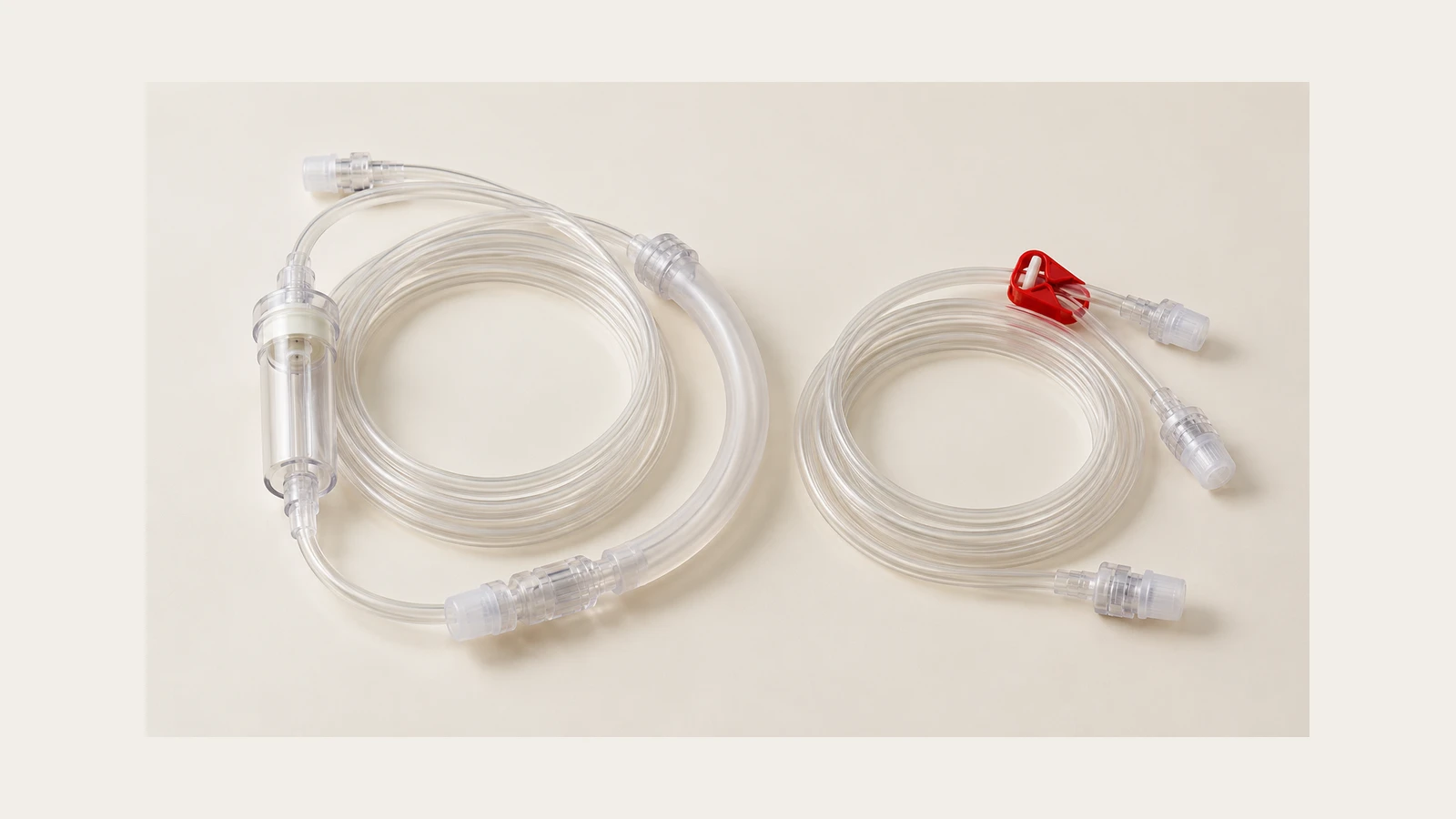
Before substituting a hemodialysis bloodline, obtain current labeling that names the installed delivery system and the proposed circuit configuration. Match the exact order code, pump-segment specification and stated pump position. A familiar brand, matching connector or broad compatibility claim is insufficient purchasing evidence. Nipro, for example, describes its blood tubing sets as machine-specific and individually labeled for equipment compatibility. NiproSet product information.
For a buyer managing a mixed fleet during a recall or supply interruption, the useful question is which documented set belongs with each console. Build the substitution request around that pairing. The tables below identify what public records actually disclose and where the supplier still needs to supply evidence. They are a starting point for specification review; they do not qualify a substitute for clinical use.
What the US regulatory evidence establishes
FDA’s final guidance was issued July 23, 2026. Its history describes biocompatibility harmonization and other minor updates, rather than announcing an entirely new machine-fit regime. The document addresses manufacturer submissions, and its recommendations are nonbinding unless a cited statute or regulation imposes a requirement. FDA guidance entry. See also the guidance introduction and history.
The guidance covers blood tubing sets and accessories under 21 CFR 876.5820, product codes FJK and KOC, excluding vascular-access and peritoneal-dialysis tubing. It recommends identifying compatible delivery systems, pump-segment outer diameter, arterial and venous lengths, priming volume, injection-port needle limits and transducer-protector pressure limits. It also recommends sterile/single-use statements and red arterial and blue venous patient and dialyzer connectors. Evaluation recommendations include four hours at 37°C with blood-analog fluid on each labeled delivery system, plus pump-segment diameter validation. FDA guidance, sections II, III.B and III.F.
For procurement, turn those disclosures into a comparison request. Ask the manufacturer to identify the exact set, machine models and supporting compatibility documentation. Keep a submission recommendation separate from a purchasing requirement agreed with your supplier. A test summary can help resolve an evidence gap; a buyer should not infer that every manufacturer must release its complete regulatory submission to a customer.
Named-machine specifications in the public records
Read each row within its stated source scope. Manufacturer pages were checked on October 24, 2026; a retrieval date does not make an older brochure a current lot label. “Not stated” means the cited record does not supply that field. Pump dimensions retain the source’s terminology: a catalog heading of “width” is not silently relabeled as measured inner diameter.
| Machine scope and order code | Pump segment and position | Length or priming volume | Interfaces and pack information | Source and limit |
|---|---|---|---|---|
| Fresenius 2008; CombiSet 03-2621-5 / 03-2622-3 | 8 mm catalog width; post-pump / pre-pump respectively | 14 in pump segment; line lengths and priming volumes not stated here | Transducer protectors and separate priming set; 24 sets/case | Portfolio, Rev C 06/2022, p. 2 |
| Fresenius 2008; CombiSet 03-2630-6 / 03-2631-4 | 6.35 mm catalog width; pre-pump / post-pump respectively | 14 in pump segment; line lengths and priming volumes not stated here | 2600-series accessories; 24 sets/case | Portfolio, Rev C 06/2022, p. 2 |
| Fresenius 2008 K/K2/T with specified Crit-Line hardware; SMARTECH 03-2722-9C / 03-2742-9C | 8.0 mm ID × 12.0 mm OD × 34.3 cm | Arterial 385 cm / 94 mL; venous 295 cm / 62 mL | Integrated Crit-Line chamber and transducer protectors; EtO, single-use; 24/case in portfolio | IFU G71-4582 Rev A; portfolio 06/2022 |
| Baxter 1000 / Arena; Nipro BL+A203/V801 / BL+A204/V801 | 8 mm; pre-pump / post-pump respectively | Segment length, line lengths and prime not stated | Machine-specific labeling; 24 sets/case | Nipro page, checked 2026-10-24 |
| Baxter SPS 550–1550; Nipro BL+A211/V804 | 8 mm; pre-pump | Lengths and prime not stated | Machine-specific labeling; 24 sets/case | Nipro page, checked 2026-10-24 |
| B. Braun Dialog; Nipro BL+A217Y/V806 | 8 mm; post-pump | Lengths and prime not stated | Page names Dialog, without extending this row to Dialog+ or Dialog DR; 24 sets/case | Nipro page, checked 2026-10-24 |
| Fresenius 2008; Nipro BL+A209Y/V803 / BL+A214/V805 | 8 mm; pre-pump / “Universal” respectively | Lengths and prime not stated | Universal wording remains within the named 2008 entry; 24 sets/case | Nipro page, checked 2026-10-24 |
| SC+ Hemodialysis System; SC+ Blood Tubeset | Pump dimensions not specified in this summary | Priming volume ≤165 mL | SC+-specific pressure component; sterile, single-use; pack count not stated | K193670, 2020-12-23; historical clearance |
| Tablo Cartridge, K140841, as predicate in the SC+ submission | Pump dimensions not supplied here | Comparator priming volume ≤200 mL | Historical comparator; current Tablo ordering and interface requirements need current labeling | K193670 comparison, pp. 6–7; 2020 |
These rows support separate item-master entries for different pump sizes and positions. They do not support a clinical preference for one bore or a conversion between them. In particular, the 94 mL arterial and 62 mL venous volumes belong to the cited SMARTECH IFU. Copying those figures into a general CombiSet entry would combine different product records and could conceal a material specification difference.
Preserve suffixes when transcribing order codes. The SMARTECH IFU identifies 03-2722-9C and 03-2742-9C; the portfolio also contains entries without that final C. Similar-looking codes are a reason to check the label, rather than merge stock records. Confirm whether the quotation is for a complete arterial/venous set, a separate line or an accessory, and compare case quantities only after that distinction is clear.
Verify physical interfaces without inventing a fit test
The SMARTECH IFU distinguishes the pump segment, pressure-monitor lines and venous chamber as machine interfaces. It also warns that excessive tightening of transducer-protector connections can crack connectors and cause pressure-reading errors or leaks. These are product-specific statements, not evidence that all sets share the same membrane, connector construction or operating limits. SMARTECH IFU, pp. 1–2.
Record inner diameter, outer diameter and length as separate fields where the manufacturer supplies them. Keep pump position alongside those dimensions. For chamber and monitor interfaces, request the named machine configuration and the applicable manufacturer compatibility evidence. A purchasing comparison should expose missing information rather than fill the gaps with customary dimensions or assumed sensor geometry.
A geometric calculation from tubing bore alone cannot predict delivered blood flow or a patient outcome. Likewise, a chamber appearing to fit a holder does not establish alarm performance. Receiving teams should not open sterile stock to measure internal bores or improvise console trials. Any engineering evaluation belongs in an authorized assessment using the relevant manufacturer instructions and designated samples, with its scope recorded separately from goods receipt.
Read broad compatibility claims in their actual scope
Asahi Kasei markets blood tubing lines for most commonly used dialysis machines, but the cited page does not provide a named-machine matrix. That wording can begin a supplier inquiry; it cannot complete one. Ask which order code and current labeling cover the exact installed machine. Asahi Kasei product page.
LIGO’s OEM page advertises broad compatibility while listing different pump-segment dimensions and chamber outer diameters. This is supplier marketing, not independent validation of the listed pairings. The useful procurement question is which documented configuration is being offered, including any required interface components. LIGO product page.
Cross-manufacturer sourcing is not inherently disqualifying: the correction records below include B. Braun lines described for Fresenius machines. Conversely, a shared manufacturer name cannot resolve differences among that manufacturer’s SKUs. Evaluate the documented pairing on its merits and preserve the proposed configuration in the approval record.
Keep ISO edition status separate from FDA recognition
| Record checked 2026-10-24 | What it establishes | Procurement consequence |
|---|---|---|
| ISO 8637-2:2024 catalogue | Published edition covering disposable extracorporeal blood and fluid circuits and accessories; dialyzers and vascular-access devices are outside its scope. | Ask for the exact edition and scope behind a conformity claim. |
| ISO 8637-2:2018 catalogue | Withdrawn edition, replaced by the 2024 publication. | ISO withdrawal and regulator recognition are separate status questions. |
| FDA recognition 9-140, record 43769 | Partial recognition of the 2018 edition, entered December 19, 2022. Exclusions: 4.4.9.1, 4.4.9.2, 5.5.6.1, 5.5.9, 5.5.10 and 5.5.11. | Do not treat a general ISO claim as covering the excluded transducer-protector, needle-port, flow-dynamics and pump-segment provisions. |
| ISO/FDIS 8637-2 catalogue | Revision under development; FDIS ballot initiated September 21, 2026. | A draft stage is not publication of a replacement International Standard. |
The FDA recognition record predates the July 2026 guidance update. Its partial recognition of the 2018 edition does not establish adoption of the 2024 ISO edition. Keep the supplier’s standard edition, claimed scope and any FDA recognition reference in separate fields. A declaration covering a standard is also different evidence from the labeling that identifies a particular machine pairing.
What the 2026 correction says about substitution
FDA’s April 22, 2026 update classified the B. Braun Streamline/B3 correction as Class I, following March communications. The action corrects affected devices rather than removing them from use or sale. The notice recommends alternate equipment and points affected users to the correction instructions. It is not a general approval of alternative bloodlines. FDA correction notice.
| Affected catalog numbers | FDA-listed description | Specification boundary |
|---|---|---|
| B3-3632M3705 / B3-4630M4705 | Low volume, no chamber; 2.6 mm / 4.8 mm pump segment respectively | Machine family and pack count not stated in these descriptions. |
| SL-2000M2095DA / SL-2000M2095L | Streamline Fresenius for DaVita / long version, FMC | Do not transfer the B3 pump dimensions to these codes. |
| SL-2010M2096 / SL-2010M2096A | Streamline for Dialog / Dialog DR | Different descriptions remain separate catalog identities. |
FDA reports preliminary manufacturer testing linking a resin change to bubbles adhering inside the arterial line, with possible treatment interruption and blood loss. B. Braun had reported no serious injuries or deaths as of March 20, 2026. The notice publishes catalog identifiers, not a lot-by-lot eligibility list. FDA reason for correction and affected-product table.
The sourcing lesson is to include material and configuration changes in the supplier agreement. Specify who notifies whom, which product and lot identifiers accompany a change, and how the buyer reviews its impact before replacing an approved stock item. Negotiate a workable notification period; this evidence does not establish a universal 90-day legal requirement. Keep current field-action instructions with the affected stock record.
For responsibilities and notification terms, use the guide to supplier quality agreements. For reconciling cartons, individual units and mixed stock during a field action, use the mixed-lot recall workflow. Preserve the correction notice alongside the stock records it affects.
Shortage-list removal does not confirm local availability
FDA’s June 16, 2026 shortage-list update removed dialysis bloodlines under product code FJK. The notice does not establish an original listing date, the causes of each supply interruption, or recovered availability for every machine configuration. FDA Medical Device Shortages List.
Verify delivery commitments for the exact proposed SKU, quantity and destination. Record which part of a quoted substitute is still unconfirmed, including pack contents or regional availability. A national category-level update should not close an unresolved machine-pairing question or substitute for a supplier’s delivery confirmation.
Build a receiving and substitution evidence record
The retained openFDA query returns two of 15 CombiSet records, including 03-2922-7 and 03-2622-3. Both descriptions include pre-pump and 8.0 mm, with FJK classification and sterile, single-use and prescription flags. This is manufacturer-listed identity information, not independent certification of compatibility. The sample is illustrative, not a complete family comparison. openFDA CombiSet UDI records.
Use the following as a suggested purchasing record, with one record per proposed line-to-machine pairing. Assign an owner to unresolved fields so that a substitute cannot become a routine replenishment item merely because an emergency order was received. A distributor’s quotation, the manufacturer’s technical document and the actual received package should be traceable to the same catalog identity.
Identify the installed equipment. Record the manufacturer, exact model and relevant configuration supplied by the facility’s equipment owner. Avoid shortening several console families to a single brand name in the request.
Identify the proposed consumable. Retain the full order code and suffix, set contents, unit of purchase and case quantity. Request current labeling and IFU, with their revision identifiers, for that specific item.
Compare the documented interfaces. Record pump dimensions and position, arterial and venous lengths, priming volume, chamber/interface information and transducer-protector limits where supplied. Mark a missing value as unresolved; do not borrow it from another family’s IFU.
Resolve compatibility and market scope. Ask the supplier to identify the named delivery systems, supporting compatibility evidence and applicable market authorization. Route the record to the facility’s designated clinical and engineering reviewers before changing the approved supply configuration.
Reconcile received identity and condition. Compare catalog code, device identifier, lot, expiry, package integrity and labeled storage conditions with the order and approved specification. Capture the actual package identifiers rather than assuming a database search contains the received lot.
Record disposition and change control. Document the purchasing decision, outstanding conditions and responsible reviewers. Link the supplier’s notification commitments and field-action contacts to the item record, and revisit the assessment when relevant labeling or configuration changes.
If a database record and package appear inconsistent, preserve both and ask the labeler to resolve the discrepancy. Do not overwrite the package evidence with an assumed database value. The site’s UDI and GUDID receiving guide covers the broader identification workflow; the dialysis-specific addition is the documented machine and circuit configuration attached to that identity.
Limits of this comparison
This is a review of public US regulatory records and manufacturer documents, not independent bench testing. It does not establish cross-brand equivalence, prescribe circuit setup, choose a patient’s extracorporeal volume, or authorize a change to machine settings. The SC+ and Tablo comparison is historical submission evidence; it is not a current catalog of either system’s consumables.
The Fresenius portfolio is dated June 2022, and the retrieved SMARTECH document is G71-4582 Rev A. Nipro cautions that registration and availability vary by country. Request the documentation applicable to the product and destination being quoted. Review this comparison when an IFU, field action, shortage notice, recognition record or ISO edition changes.
For adjacent supply decisions, the IV administration-set guide and non-PVC IV tubing guide address different device families and evidence. Their material and pump claims should not be transferred to an extracorporeal bloodline solely because both products contain tubing.
Sources
Primary records and manufacturer pages checked October 24, 2026. Publication dates and revisions are identified where available. Manufacturer marketing is used to examine claim wording, not to validate compatibility.
FDA: Hemodialysis blood tubing sets 510(k) guidance, July 23, 2026
FDA: Final guidance entry for hemodialysis blood tubing sets
FDA: Streamline/B3 bloodline correction, Class I update April 22, 2026
FDA: ISO 8637-2:2018 partial recognition 9-140, record 43769
FDA: K193670 SC+ system and blood tubeset clearance summary, December 23, 2020
openFDA: CombiSet UDI records, illustrative two-record query
Fresenius: Bloodline Portfolio, P/N 102810-01 Rev C, June 2022