
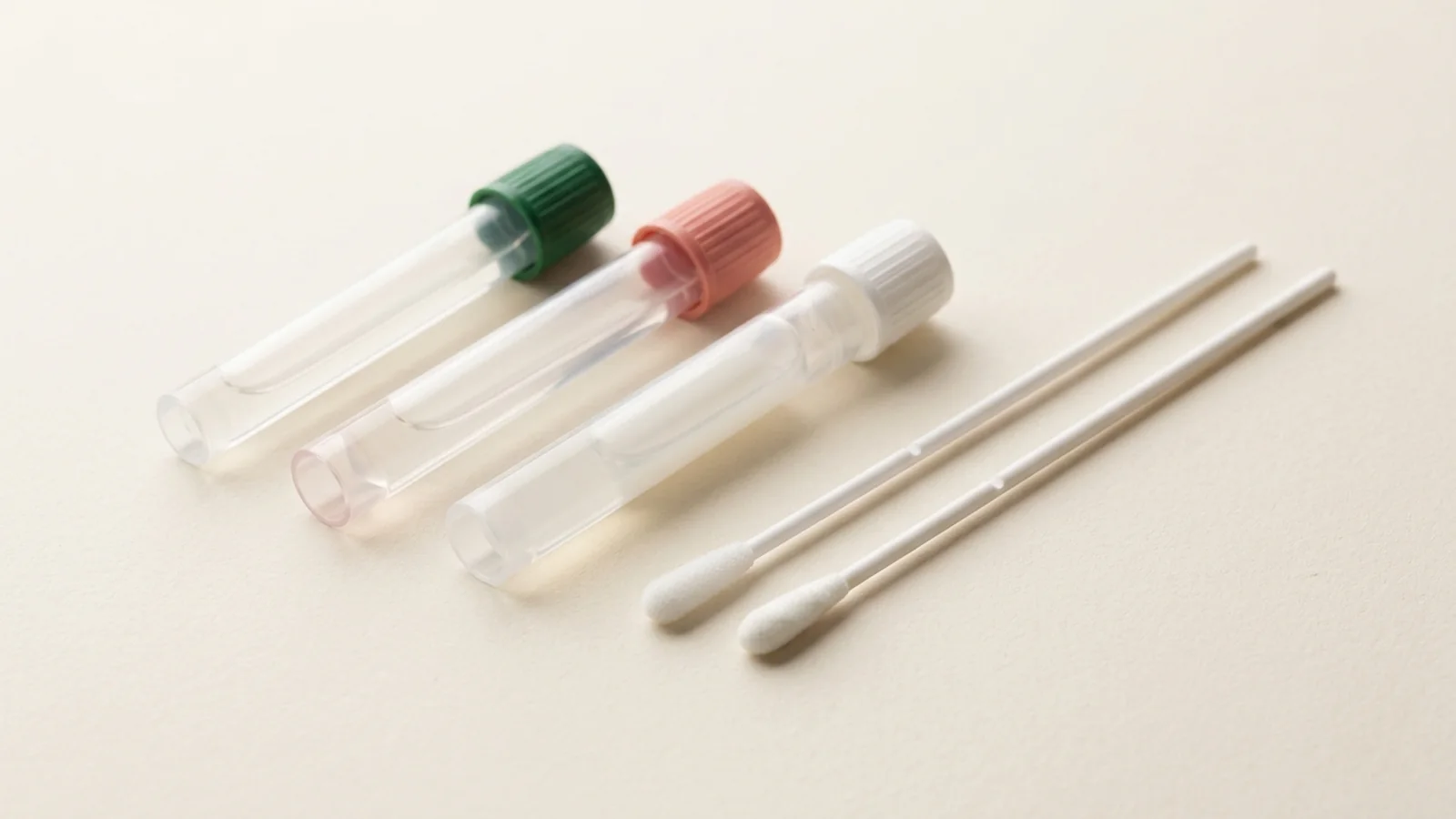
Start With the Assay: The Decision Order for Swab and Medium Selection
A clinic network restocking nasopharyngeal, throat and wound swab kits usually feeds two different laboratory workflows: bacterial culture with Gram stain, and a respiratory molecular panel. They want different things from the tube. Culture needs live organisms that have not been overgrown by contaminants. A nucleic acid amplification test (NAAT) needs intact viral RNA or DNA and nothing in the specimen that interferes with extraction or amplification. A single "universal" SKU rarely serves both unless the documents say so. That makes the decision order the most useful specification: choose the assay first, the transport medium second, and the swab tip and shaft last.
The assay comes first because the testing laboratory's accepted-specimen list, published in the assay's instructions for use, has the final word on which swab and medium it will run. CDC's specimen guidance tells collectors to contact the testing laboratory to confirm accepted specimen types and to follow the manufacturer's instructions. A medium qualifies when its labeled claim matches that assay. The swab is then picked from the swabs the medium's manufacturer has validated with it, not from whatever is cheapest in the same catalog.
The table turns that order into a first-pass specification map. The hold windows are examples of labeled claims discussed later in this guide; the package insert for the SKU you actually buy governs.
| Workflow | What the specimen must preserve | Medium families to evaluate | Swab tip and shaft fields | Example labeled hold claim | Avoid or verify first |
|---|---|---|---|---|---|
| Respiratory NAAT or PCR panel | Viral nucleic acids | Cleared viral or universal transport medium; saline, PBS or a dry swab only if the assay IFU lists it | Synthetic fiber such as nylon flocked or polyester on a thin plastic or wire shaft | UTM-RT: up to 96 h at 2–25 °C for respiratory-virus nucleic acids | Calcium alginate tips and wooden shafts (CDC); agar gel media unless the IFU accepts them |
| Bacterial culture and Gram stain | Viable aerobes, anaerobes and fastidious bacteria without overgrowth | Liquid Amies; gel Amies; liquid Stuart | Nylon flocked, polyester or rayon on a plastic shaft with a breakpoint | ESwab liquid Amies: up to 48 h at room or refrigerator temperature | Viral media containing antibiotics and antimycotics; inactivating media |
| Culture where gonococci drive the choice | Viability despite metabolic products toxic to gonococci | Gel Amies with charcoal (Remel classical formula: 10 g/L charcoal) | Rayon bud on a plastic shaft is common | Remel IFU: gonococci survive well for at least 6–12 h; by 24 h recovery may fail when few were present | Assumed molecular compatibility; Bordetella pertussis culture, where one study found charcoal Amies performed poorly |
| Molecular test added to a culture swab | Both viable organisms and amplifiable DNA | Liquid Amies only where the molecular assay's IFU lists it | As validated by the medium manufacturer | Set by the assay IFU | Reading a culture-only clearance as a molecular claim |
What FDA Regulates: 866.2390, 866.2900, and the End of COVID-Era Flexibility
Swab-and-tube kits are often bought as commodities, but FDA classifies them as in vitro diagnostic devices, and most of the relevant product codes require a 510(k). Which regulation applies depends on what the product is and what it claims, not on which department orders it.
21 CFR 866.2900 covers a microbiological specimen collection and transport device: a specimen-collecting chamber intended to preserve the viability or integrity of microorganisms during storage and transport, which may be labeled sterile. The device is Class I, but the regulation exempts from premarket notification only devices solely intended for collecting and transporting concentrated parasites. FDA's classification record for product code JTW (aerobic transport systems) lists a 510(k) submission type. Anaerobic transport systems (JTX) and specimen collection devices (LIO) sit under the same regulation.
21 CFR 866.2390 covers a transport culture medium, which the regulation defines as a semisolid, usually non-nutrient medium that keeps suspected pathogens viable in transit, classified as Class I. That wording predates liquid molecular transport media, but FDA's JSM record ("culture media, non-propagating transport") is the code that current viral and universal transport media are cleared under. The record lists Class I, 510(k) required, eligibility for third-party 510(k) review, and two FDA-recognized consensus standards: CLSI M40-A2 (reaffirmed September 2019) for quality control of microbiological transport systems, and CLSI MM13 (2nd edition) for collecting, transporting, preparing and storing specimens for molecular methods. The JTW record lists the same two standards.
FDA's FAQ on viral transport media maps the product types to codes in one place:
| Regulation | Device type (FDA wording) | Product code | Class per FDA | What generally falls here |
|---|---|---|---|---|
| 21 CFR 866.2300 | Culture media, non-selective and non-differential | JSG | I (exempt) | PBS/saline transport media |
| 21 CFR 866.2390 | Culture media, non-propagating transport | JSM | I (reserved) | Most viral transport media |
| 21 CFR 866.2390 | Culture media, anaerobic transport; propagating transport | JSL; JSN | I (reserved) | Other transport culture media |
| 21 CFR 866.2900 | Specimen collection device; aerobic and anaerobic transport systems | LIO; JTW; JTX | I (reserved) | Swab-and-medium collection systems and some viral media |
| 21 CFR 866.2950 | Microbial nucleic acid storage and stabilization device | QBD | II | Inactivating transport media |
"Reserved" means the device type is not exempt from 510(k). So the buyer's test is simple. For a JSM, JSL, JSN, JTW, JTX or LIO product, ask for the 510(k) number and check it in FDA's database. For a PBS/saline product, expect an exemption, but the same FAQ notes that exempt manufacturers must still meet registration and listing, corrections-and-removals reporting, medical device reporting and IVD labeling requirements. It also states that transport media must be manufactured under the quality system regulation in 21 CFR Part 820.
flowchart TD
  A["Supplier quotes a swab or transport-medium SKU"] --> B{"Which FDA product code applies?"}
  B -->|"JSG: PBS or saline medium"| C["Generally 510(k)-exempt: confirm registration, listing and IVD labeling"]
  B -->|"JSM, JSL, JSN, JTW, JTX or LIO"| D["510(k) required: obtain the K-number and read the cleared indications"]
  B -->|"QBD: inactivating medium"| E["Class II: obtain the FDA authorization and confirm the assay pairing"]
  B -->|"Only a COVID-19 policy or EUA is cited"| F["Treat as unverified: the enforcement policy has ended and device EUAs end December 26, 2026"]
  D --> G{"Do the cleared indications cover the intended test?"}
  E --> G
  G -->|"Yes"| H["Continue to M40-A2, IFU and labeling checks"]
G -->|"No or unclear"| I["Hold the substitution and ask the testing laboratory"]The pandemic left purchasing habits that no longer have regulatory cover. FDA's FAQ, current as of August 11, 2026, says the agency is not continuing the enforcement policy in its COVID-19 Transport Media Policy, which is no longer in effect. Under FDA's transition guidance, continued distribution was tolerated only where a required marketing submission had been submitted and accepted by November 7, 2023, and only until FDA took final action on it. The same page reports that on June 29, 2026 the HHS Secretary determined that circumstances no longer justify COVID-19 device emergency use authorizations, and that the declarations will be terminated effective December 26, 2026, after which the listed COVID-19 device EUAs will no longer be in effect. In practice, a viral transport medium offered on the strength of the old enforcement policy is not an acceptable basis for an award, and any product that relies on an EUA needs a documented plan for after that date. For the list of cleared viral transport media, FDA points readers to product code JSM in its 510(k) database.
Two Cleared Systems, Compared Field by Field
Two Copan 510(k) records show what a cleared specification looks like on paper. They appear here as worked examples of the fields to compare, not as a recommendation, and not as evidence that any other brand is equivalent.
The liquid Amies example is K061301, found substantially equivalent on June 23, 2006 under 21 CFR 866.2900 with product codes JTW and JTX. Its 510(k) summary describes a kit containing a plastic screw-cap tube with a conical bottom holding 1 mL of liquid Amies medium, and a nylon-flocked swab on a solid plastic shaft with a molded breakpoint, offered in two swab sizes. The medium is described as an inorganic phosphate buffer with calcium and magnesium salts and sodium chloride, with sodium thioglycollate providing a reduced environment, and the 2006 intended use is bacterial culture of aerobes, anaerobes and fastidious bacteria. Copan's current ESwab page adds the catalog fields: a 12 x 80 mm tube; 80 mm breakpoints on the regular and minitip swabs and a 100 mm breakpoint on the flexible minitip; capture and non-capture caps; single-, double- and triple-swab kits; multiple aliquots from one collection; and viability up to 48 hours at room or refrigerator temperature, with Neisseria gonorrhoeae assessed at 24 hours under CLSI M40-A2 criteria.
The universal transport medium example is K232357, a traditional 510(k) cleared on April 25, 2024 under 21 CFR 866.2390 with product codes JSM and LIO. Its 510(k) summary describes a tube with 3 mL of medium, supplied in bulk or as a kit with a sterile flocked swab. The indications cover transport of specimens containing viruses, chlamydiae, mycoplasma or ureaplasma for culture, and stabilization of unprocessed upper-respiratory specimens for respiratory-virus nucleic acid testing with compatible molecular assays. The summary also lists an 18-month medium shelf life, specimen transport and storage for up to 96 hours at 2–25 °C, and ingredients including Hank's balanced salt solution, bovine serum albumin, gelatin, HEPES buffer, sucrose, phenol red, vancomycin, amphotericin B and colistin. Copan's UTM page lists 16 x 100 mm and 12 x 80 mm tubes with red caps and a 15.5 x 95 mm round-bottom tube with a blue cap, flocked swabs with 80 mm or 100 mm breakpoints, and room-temperature storage before collection.
| Field | Liquid Amies example (ESwab, K061301) | Universal transport medium example (UTM-RT, K232357) | What to ask any supplier |
|---|---|---|---|
| FDA basis | 510(k) K061301; 21 CFR 866.2900; JTW and JTX | 510(k) K232357; 21 CFR 866.2390; JSM and LIO | K-number, product codes and decision date for the exact SKU |
| Medium and fill | 1 mL liquid Amies | 3 mL UTM-RT medium | Formulation name and nominal fill on the label |
| Cleared use | Aerobic, anaerobic and fastidious bacteria for culture | Viral, chlamydial, mycoplasma and ureaplasma culture; respiratory-virus nucleic acids with compatible molecular assays | The indications for use statement, word for word |
| Swab tip | Nylon flocked; regular, minitip and flexible minitip | Nylon flocked; regular, minitip and flexible minitip | Tip material and size, and which swabs are validated with the medium |
| Shaft and breakpoint | Solid plastic; molded breakpoint at 80 mm (100 mm on the flexible minitip) | Plastic shaft; breakpoint at 80 mm or 100 mm | Shaft material and breakpoint distance against tube height |
| Tube and cap | 12 x 80 mm, conical bottom; capture or non-capture cap | 16 x 100 mm or 12 x 80 mm; 15.5 x 95 mm round bottom | Tube geometry for racks and automation; cap type |
| Labeled specimen hold | Up to 48 h at room or refrigerator temperature; N. gonorrhoeae assessed at 24 h | Up to 96 h at 2–25 °C | Hold time and temperature range from the package insert |
| Shelf life | 15 months supported in the 2006 summary; not stated on the product page | 18 months in the 510(k) summary; not stated on the product page | Current labeled shelf life for the SKU, or record it as unknown |
| Sterility | Kits listed as individually packaged, sterile | Most kits listed as individually packaged, sterile; one zip-bag kit and the bulk tubes carry no sterility statement | Sterility claim for each format bought, kit and bulk |
The last two rows show why the right-hand column matters. Neither product page states a shelf life. The figures above come from the 510(k) summaries linked from FDA's records, and the ESwab figure dates from 2006. Any field a supplier will not document for the exact SKU should be recorded as unknown, not filled in from the benchmark.
Swab Tip and Shaft: The Material Fields That Change Results
Swab fields look minor next to the medium, but two of them decide whether a respiratory molecular specimen is acceptable at all: the tip fiber and the shaft material.
CDC's specimen guidance says to use only synthetic fiber swabs with thin plastic or wire shafts designed for nasopharyngeal sampling. It rules out calcium alginate swabs and swabs with wooden shafts, "as they may contain substances that inactivate some viruses and may inhibit molecular tests," and states that sterile swabs should be used for upper-respiratory specimens. For a buyer, those sentences become hard exclusions in the respiratory SKU specification.
Tip construction affects how much material reaches the laboratory. In Daley and colleagues' 2006 study, flocked swabs collected significantly more respiratory epithelial cells than rayon swabs in parallel nasopharyngeal and nasal sampling of 16 volunteers, and in nasopharyngeal sampling of 61 symptomatic patients. Among the patients, flocked swabs averaged 67.2 cells per high-power field against 29.3 for rayon (P < 0.001); among children the figures were 69.3 against 21.8, and among adults 61.0 against 29.4. The endpoint was cell yield, not test sensitivity. It supports flocked tips as a specification preference, not a claim that any flocked swab improves results on every assay.
Shaft evidence is more mixed than catalog copy suggests. Wadowsky and colleagues (1994) found that a calcium alginate-tipped swab with an aluminum shaft inhibited a PCR assay for Bordetella pertussis, while a Dacron-tipped swab on a plastic shaft did not. The alginate fiber inhibited the assay after less than a minute in suspension; the aluminum shaft needed at least 48 hours of storage to do so. A 2002 study in the same journal again found that calcium alginate swabs inhibited PCR and saw no inhibition with Dacron or rayon swabs. It reported, as an unpublished observation, no inhibition from aluminum shafts even after overnight soaking, and attributed the conflicting shaft findings to differences in manufacturers' swab components or in extraction methods. Calcium alginate is the consistent problem. For aluminum or other wire shafts, rely on the medium and assay manufacturers' validation rather than a blanket rule.
Swab fields worth writing into the tender:
Tip fiber stated per SKU (nylon flocked, polyester, rayon or foam), with calcium alginate excluded for respiratory molecular use.
Shaft material stated (plastic or wire), with wooden shafts excluded for respiratory molecular use.
Breakpoint present or absent, and its distance (for example 80 mm or 100 mm) checked against the tube height and cap design.
The medium manufacturer's named, validated swabs. Puritan, for example, states that its UniTranz-RT medium is validated with Puritan polyester or PurFlock Ultra swabs.
Packaging format: individually packaged sterile swabs versus bulk-packaged swabs, as labeled.
Medium Chemistry: Liquid Amies, Gel Formats, Stuart, and Viral Formulations
Transport media are maintenance media. Their job is to keep organisms or nucleic acids in the state they were collected in, not to grow them. Most compatibility rules follow from the differences between the families below.
Liquid Amies. The Remel instructions for use explain the lineage: Amies is a modification of Stuart's medium, in which a balanced salt solution with inorganic phosphate buffer replaced sodium glycerophosphate, an energy source that let contaminants overgrow pathogens. Liquid versions leave out the agar; the 2006 ESwab 510(k) summary, for example, describes its liquid Amies as a phosphate buffer with calcium, magnesium and sodium salts and sodium thioglycollate. Puritan's liquid Amies guide describes 1 mL vials that allow up to 10 identical inoculations from one collection and work with many automated platforms. It gives handling as delivery within two hours where possible, otherwise storage at 2–25 °C with processing within 48 hours, or 24 hours for Neisseria gonorrhoeae.
Gel Amies. Remel's classical semisolid formula lists 4.0 g of agar per liter, relies on sodium thioglycollate and agar for a reduced environment, and gives a pH of 7.3 ± 0.2 at 25 °C. Its procedure has the shaft cut off above the medium, and at the laboratory the swab itself is applied to plates, so there is no liquid to aliquot. Puritan's guide notes that gel systems typically support one test per collection and are not typically compatible with molecular testing. Remel also says specimens should be kept at room temperature until processed because refrigeration may be detrimental to some organisms, which differs from the 2–25 °C window labeled for the liquid Amies systems above. Specimen temperature is a per-product claim, not a property of the Amies name.
Gel Amies with charcoal. Remel lists charcoal as an optional 10 g per liter and states that it neutralizes metabolic products toxic to gonococci. Medical Wire & Equipment positions its charcoal gel Amies for cases where charcoal is needed to neutralize bacterial toxins and other inhibitory substances, supplies it with a rayon bud, and states that its Transwab products comply with CLSI M40-A2. Two limits matter. Remel's limitations say gonococci survive well for at least 6 to 12 hours, but by 24 hours their numbers may drop far enough to prevent recovery when only a few were present. And the 2002 pertussis study found that Amies with charcoal supported Bordetella pertussis growth poorly compared with Regan-Lowe medium. Charcoal is a targeted choice, not a general upgrade.
Liquid Stuart. Distributor catalogs still carry the parent formula. Cardinal Health's swab catalog lists liquid Stuart and liquid Amies kits with single or double rayon swabs on plastic shafts, a rayon minitip on a flexible wire shaft, and Amies gel kits. Confirm the laboratory still accepts Stuart before stocking it.
Viral and universal transport media. These are liquid buffered salt solutions with protein stabilizers and antimicrobials. Puritan's viral transport media guide describes UniTranz-RT as a modified Hank's balanced salt solution with buffer salts and HEPES, gelatin and bovine serum albumin, sucrose, and amphotericin B, vancomycin, colistin and L-cysteine to suppress bacterial and fungal contaminants. Phenol red serves as a pH indicator, and a shift from pink to yellow can flag contamination or degradation. The UTM-RT 510(k) summary lists a similar ingredient set. Because these media contain antibiotics, they are not a substitute for a bacterial culture transport medium.
PBS, saline and inactivating media. FDA's FAQ says PBS/saline transport media generally fall under 21 CFR 866.2300 (JSG) and are generally exempt from 510(k). Inactivating transport media fall under 21 CFR 866.2950 (QBD, Class II). Plain saline adds no stabilizer or antimicrobial, and an inactivating medium is not meant to keep organisms alive for culture, so both belong only in workflows whose assay IFU names them.
Assay Compatibility Evidence: What the PCR-Inhibition Studies Actually Show
The rules above rest on a small set of studies. They justify caution, but they are narrower than vendor summaries often suggest.
Agar. Gibb and Wong (1998) observed PCR inhibition in throat swabs submitted in routine bacteriological transport media. Their experiments showed that agar, extracted along with the DNA by the DNAzol reagent, was the inhibitory agent, and a transport medium without agar showed no inhibitory effect. The finding is tied to that extraction method. It is evidence of risk for gel media in molecular workflows, not proof that every extraction carries agar through.
Charcoal. The evidence cuts both ways. The 2002 Bordetella study found that rayon swabs held for 48 hours in Amies with charcoal performed similarly to dry swabs for PCR, even though the same medium supported culture poorly. The same study also found lower PCR sensitivity from those swabs than from rayon or Dacron swabs held for 48 hours in Regan-Lowe medium. That is one organism, one assay and one extraction protocol, so it neither clears nor condemns charcoal media for molecular use. The assay IFU decides.
Dry swabs. A medium is not always needed for molecular testing. In Gokulan and colleagues' 2021 study, contrived dry swabs carrying diluted SARS-CoV-2 were stable at room temperature for 24 hours. Extraction-free direct RT-PCR from them showed no variance from the standard method using RNA extracted from viral transport medium, with comparable or lower cycle-threshold values within 48 hours. Alfaro-Núñez and colleagues found SARS-CoV-2 RNA on spiked dry swabs stayed stable for up to 9 days at 20 °C. Both studies used contrived or spiked samples rather than patient cohorts, and a dry swab offers nothing for culture. Dry collection is an option only where the assay IFU or the laboratory's own validation supports it.
The common thread is the assay IFU. Puritan's viral transport media guide, citing FDA, notes that not all transport media are compatible with all SARS-CoV-2 testing platforms. It lists the common reasons specimens are rejected: the wrong swab or shaft material for the assay, the wrong medium for the platform, temperature excursions in transit, leaking caps or cracked tubes, and labeling errors. Each of those is a specification or receiving check rather than a clinical judgment.
Buyer Verification: CLSI M40-A2 Statements, 510(k) Status, and Labeled Claims
Turn the evidence into a request list that suppliers answer in writing before award, and again before any substitution is accepted.
| Check | Evidence to request | Where it comes from | Treat as a problem when |
|---|---|---|---|
| FDA marketing basis | 510(k) number and product code for the exact SKU, or the exemption basis for PBS/saline | FDA 510(k) and classification databases; FDA's viral transport media FAQ | The supplier cites the ended COVID-19 policy, relies on an EUA with no plan for after December 26, 2026, or cannot name a K-number for a reserved product code |
| Cleared indications | Indications for use statement | 510(k) summary and package insert | The intended test or organism group is outside the claim, such as a culture-only Amies claim offered for a molecular panel |
| CLSI M40-A2 performance | Compliance statement and a summary of viability and overgrowth testing at room temperature and 4 °C | Manufacturer validation; M40-A2 is FDA-recognized for JSM and JTW | A culture transport system has no M40-A2 statement, or the supplier offers only a general quality-system certificate |
| Assay pairing | The laboratory's accepted-specimen list and the medium maker's validated swabs | Assay IFU; medium package insert | The swab, shaft or medium is not on the IFU list |
| Labeled hold and storage | Specimen hold time and temperature, storage before use, and shelf life | Package insert; 510(k) summary | The labeled hold is shorter than real courier time, or shelf life is undocumented |
| Sterility | Sterility claim for kits and for bulk media | Label and package insert | Sterility is not stated for the format being bought |
| Change notification | Written commitment to notify before changing the medium formulation, swab material, breakpoint or component source | Supplier quality agreement | The supplier reserves the right to substitute components without notice |
CLSI M40-A2 needs a precise reading. CLSI describes the standard, published in June 2014 and reaffirmed in September 2019, as criteria for selecting and validating transport devices, a consistent protocol for manufacturers' initial testing, and a method by which laboratories can verify manufacturers' claims and compare devices. A 2016 evaluation of three liquid Amies swab systems summarizes the criteria it applied. Holding periods were 48 hours at room temperature or 4 °C (24 hours for N. gonorrhoeae). The roll-plate method required at least 5 CFU after the holding period from the same dilution used at time zero, and the swab-elution method allowed no more than a 3-log decrease. In overgrowth testing at 4 °C, counts could rise by no more than 1 log. The study tested flocked and foam swabs in liquid medium by both the roll-plate and swab-elution methods. These are criteria for the manufacturer's validation study, not a lot-release test to expect on every certificate. Lot quality control can be narrower: Remel, for example, states that every lot of its Amies medium is tested with named control organisms and found acceptable for recovery on subculture. Ask which of the two a supplier's document represents.
Where a supplier will not document a field, record it as unknown. An unknown shelf life, sterility basis or validated swab pairing is a reason to ask again or keep the incumbent SKU. It is not a gap to fill with the benchmark's value.
Receiving, Storage, and Shipping: Closing the Loop
Receiving checks connect the specification to what actually arrives. Cardinal Health's catalog lists the label fields a receiving clerk can check on each kit: product code, media formulation, lot number and expiration date, with color-coded caps carrying a biohazard overskirt. Compare them with the purchase specification, quarantine anything past expiry, and confirm that sterile packaging and caps are intact. The companion guide on recording sterile-pouch damage at goods receipt covers how to document damaged packaging. Where the label carries a UDI, capture it as described in UDI and GUDID for medical consumables.
Keep two time windows separate in procedures and in the inventory system. Storage before use is a product condition: Copan labels UTM as room-temperature stable before collection, so it should not need refrigerated stock. The specimen hold starts at collection and comes from the medium's labeled claim: up to 48 hours for the liquid Amies systems above (24 hours for N. gonorrhoeae) and up to 96 hours at 2–25 °C for UTM-RT's respiratory-virus nucleic acid claim. If courier time between a clinic and the laboratory can exceed the shorter window, that is a specification problem to solve before award. The wider evidence behind labeled storage conditions is covered in labeled storage and transport for medical consumables.
When specimens travel on from a clinic to a reference laboratory, the transport tube becomes the primary receptacle inside a shipping package. Whether that shipment is a Category B biological substance, and what packaging it then needs, is a separate decision covered in Category B specimen packaging and UN 3373. The swab specification only needs to make sure the tube and cap can serve as the leakproof primary receptacle that packaging assumes.
Sources
Regulatory, standards, peer-reviewed and manufacturer sources used in this guide:
21 CFR 866.2900 - Microbiological specimen collection and transport device (eCFR)
FDA Product Classification - JTW, System, Transport, Aerobic (21 CFR 866.2900)
FDA Product Classification - JSM, Culture Media, Non-Propagating Transport (21 CFR 866.2390)
FAQs on Viral Transport Media During COVID-19 (FDA, content current as of August 11, 2026)
510(k) K061301 - Copan Liquid Amies Elution Swab (ESwab) Collection and Transport System (FDA)
510(k) K232357 - Copan Universal Transport Medium (UTM-RT) System (FDA)
UTM Universal Transport Medium - product specifications (Copan Diagnostics)
ESwab Liquid Based Collection and Transport - product specifications (Copan Diagnostics)
Interim Guidelines for Collecting and Handling of Clinical Specimens for COVID-19 Testing (CDC)
What is Viral Transport Media: The Complete Guide (Puritan Medical Products)
TRANSWAB Amies Charcoal - product page (Medical Wire & Equipment)
Remel Amies Transport Medium w/ and w/o Charcoal - Instructions for Use (Thermo Fisher Scientific)
Collection & Transport Swabs with Media - ordering catalog (Cardinal Health)