
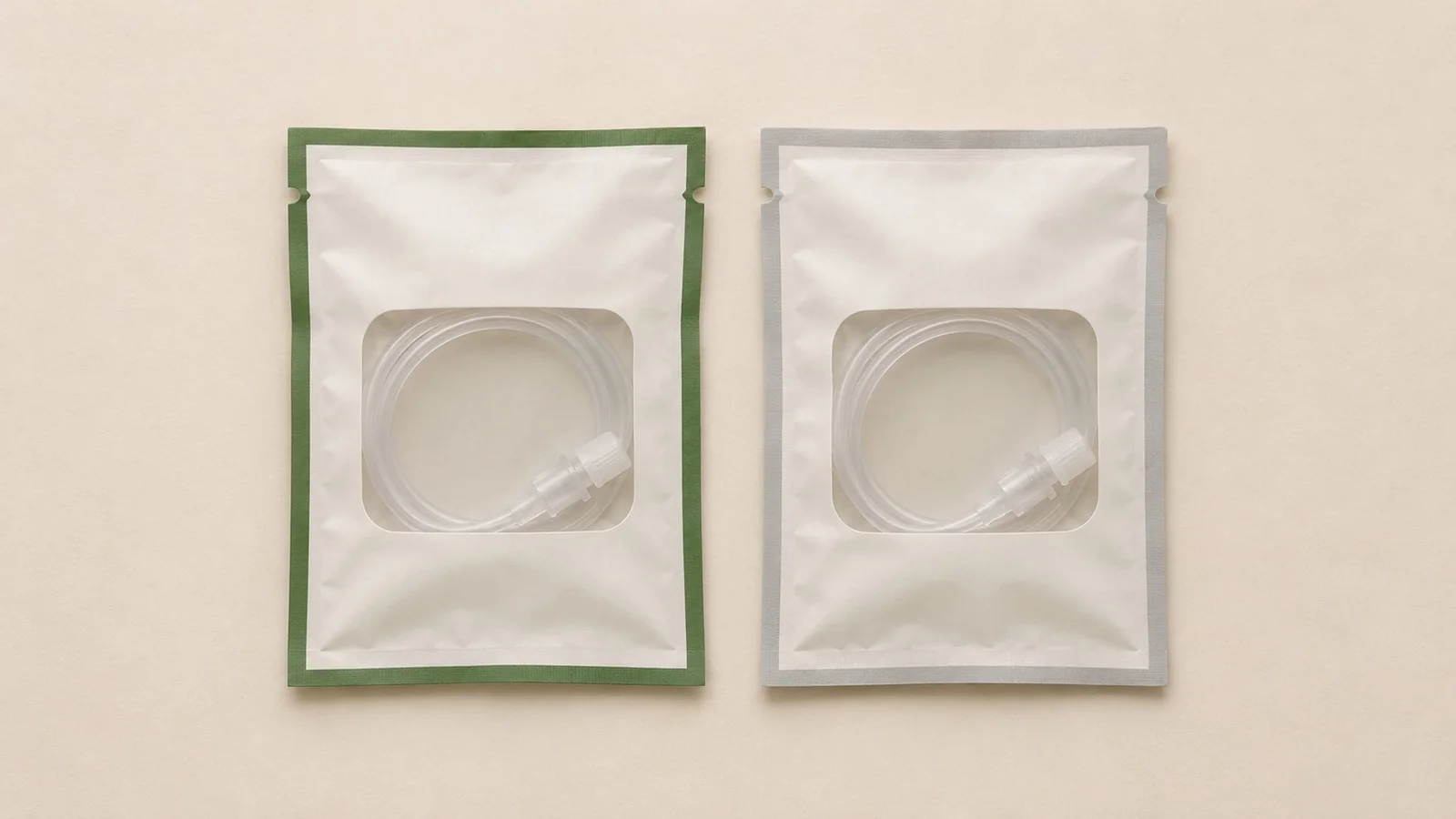
The procurement answer: one port family, two access systems
Not every implanted port takes a Huber needle. The port model and its current labeling decide the access device, and the word “port” on a requisition does not. Conventional septum ports, such as the NMI Port II described in FDA 510(k) summary K131694, are designed to be accessed with a non-coring Huber needle through a self-sealing silicone septum. The PowerFlow Implantable Apheresis IV Port from Bard Access Systems is different. Its FDA summaries (K163001 and K191143) describe an angled, funnel-shaped entrance that guides a 14 or 16 Ga introducer needle and a peripheral IV (P.I.V.) catheter, and they name a BD Insyte Autoguard Shielded IV Catheter for routine access.
For a buyer, that means a single category default—“implanted port, therefore Huber set”—can send the wrong consumable to a care unit. The safe purchasing rule is narrower and more useful: identify the exact port model, read the access device stated in its current instructions for use (IFU), and buy to that specification. This guide stays at the specification and sourcing level. How a port is accessed, flushed or de-accessed belongs to the manufacturer’s IFU and the clinical team, not to a procurement article.
What FDA cleared for PowerFlow
Both PowerFlow summaries place the device in Class II under 21 CFR 880.5965 (subcutaneous, implanted, intravascular infusion port and catheter) with product code PTD. The original clearance, K163001, is dated April 17, 2017. The later clearance, K191143, states that the port base moved to an alternative titanium formulation made by metal injection molding, while the intended use, operating principle, method of action and packaging configuration stayed the same as the 2017 device.
The summaries describe a low-profile titanium port with an angled opening: “a funnel shaped entrance designed to guide the peripheral intravenous (P.I.V.) access needle and catheter.” The implanted system has three primary components—a port body with a valved, silicone-layered septum, an attachable radiopaque 9.6 Fr ChronoFlex polyurethane catheter, and a catheter lock. The cleared indications include long-term therapeutic apheresis, blood withdrawal, and infusion of medications, IV fluids, parenteral nutrition and blood products, plus power injection of contrast media at a maximum recommended rate of 5 mL/s.
The procurement-relevant point is the access device. In both summaries it is an IV catheter carried on an introducer needle—a catheter-over-needle product—rather than a non-coring needle. Routine infusion or withdrawal is described with a BD Insyte Autoguard Shielded IV Catheter, and power injection with a power-injection-rated IV catheter. K163001 also shows that PowerFlow was not the first port of this type: its predicate, the Bard CathLink 20 Titanium Port, was likewise accessed with a peripheral IV catheter through an angled entry funnel, and the summary lists PowerFlow’s funnel target area as 2.82 in² against 2.46 in² for the predicate.
K163001 lists the components of the IV Port Access Kit. None of them is a Huber needle:
14 or 16 Gauge Insyte Autoguard Shielded IV Catheter
Extension Set, Macro, 9 inch Hex Luer Lock with valve
Sentrinex 3D Port Dressing and GuardIVa
Skin prep pad, ChloraPrep 3 mL, alcohol wipe, absorbent towel, face mask, 2” x 2” gauze and medical adhesive tape
Pre-filled saline syringe
The same summary lists a separate Intermediate Implantation Placement Kit used at implantation. That kit is not a restocking item for routine access, so it should not be confused with access supplies on a requisition.
A Bard catalog reproduced on MedicalExpo (POWERFLOW product catalog) says the valve accepts 16 and 14 gauge IV catheters and reports bench testing up to 1,000 accesses, while stating that bench testing may not reflect clinical performance. Treat that as manufacturer information, not independent evidence. The 2017 kit list is a baseline for questions, not proof of what a distributor ships today; confirm the current kit part number, component list and IFU revision with the supplier.
Why Huber is still the right default for a septum port
None of this makes Huber needles obsolete. FDA’s product classification for the non-coring (Huber) needle, product code PTI, is a Class 2 device under regulation 880.5570 (hypodermic single lumen needle). FDA defines it as the needle used “to gain access into a subcutaneous implanted intravascular infusion port” and notes that the tip is angled so the bevel provides a clean entry into the port septum without damage. The same entry says the hub may include an anti-stick safety feature, an integrated extension set or a luer-activated valve—useful attributes to specify when sourcing Huber sets.
The NMI Port II summary (K131694) is a clear conventional comparator. Navilyst Medical describes ports “designed to be accessed using a non-coring Huber needle introduced through the skin into the self-sealing silicone septum covering the reservoir.” The port is cleared under the same regulation, 21 CFR 880.5965, but with product code LJT, and it comes in plastic or titanium, valved or non-valved configurations. Its power-injection indication is tied to the needle: a maximum of 5 mL/s with a 19G or 20G non-coring power-injectable needle, or 2 mL/s with a 22G needle, and the summary describes power-injector settings up to 300 psi depending on model. In other words, even within the Huber family, needle gauge and power rating are labeled specifications, not interchangeable details.
FDA’s Guidance on 510(k) Submissions for Implanted Infusion Ports (October 1990) explains why Huber became the default. Its septum puncture test tells manufacturers to “use only the needles listed in labelling” and notes that typically non-coring needles are used, and its clearance test inserts a non-coring needle into the septum. The same guidance flags “a new profile or angle of septum access” as a design change that may need additional data. Both halves matter to buyers: non-coring needles are the common interface, but the labeling of the specific port is the reference point.
For conventional septum ports, then, the practical rule is to keep stocking non-coring Huber sets and to select gauge, length and power-injection rating from each port’s labeling rather than from a house default.
The documented PowerFlow misaccess case
A published case report shows what a category default can do. Gill, Oakley and Onwuemene (Journal of Emergency Nursing, 2021) describe a 33-year-old woman with a history of outpatient apheresis through bilateral PowerFlow ports who was evaluated in an emergency department. According to the abstract, the right PowerFlow port was mistaken for a conventional port and accessed with a Huber needle rather than the appropriate catheter-over-needle device. On infusion of IV fluids the patient experienced pain and swelling; the port malfunctioned and was eventually replaced.
A root cause analysis led the authors’ institution to require identification of the PowerFlow port by at least two of four methods, covered in the identification section below. The report frames the problem as identification and education, which is exactly where supply documentation can help or hurt.
Two cautions apply. First, this is one case, available to most readers as an abstract; it cannot establish how often misaccess happens, compare access devices, or describe the mechanism of damage beyond what the authors report. Second, the case does not show that any stocking decision caused the event. The reasonable procurement inference is narrower: when the only port access product a unit recognizes is a Huber set, the wrong default becomes easier to reach, so requisitions and shelves should make the model-specific alternative visible.
Port model, access device and IFU evidence matrix
The matrix below compares the two documented examples and the case every buyer meets in practice: a port whose model is not yet known. Each cell reflects the cited public document at the time of clearance or publication, so the last column lists what must be rechecked on the current IFU.
| Port family and model | FDA identity | Entry design in the summary | Labeled access device | Listed kit or accessory evidence | Verify on the current IFU |
|---|---|---|---|---|---|
| PowerFlow Implantable Apheresis IV Port (Bard Access Systems) | Class II, 21 CFR 880.5965, product code PTD; K163001 (2017), K191143 | Angled, funnel-shaped titanium entrance; valved silicone-layered septum | 14 or 16 Ga introducer needle with P.I.V. catheter; BD Insyte Autoguard Shielded IV Catheter for routine access; power-injection-rated IV catheter for power injection | K163001 IV Port Access Kit: 14 or 16 Ga Insyte Autoguard catheter, 9-inch extension set with valve, port dressing, prep items; no Huber needle listed. Bard catalog: valve accepts 14 and 16 gauge IV catheters | IFU revision, current kit part number and component list, power-injection-rated catheter specification |
| NMI Port II (Navilyst Medical), conventional septum comparator | Class II, 21 CFR 880.5965, product code LJT; K131694 (2013) | Self-sealing silicone septum over a single reservoir; plastic or titanium; valved or non-valved | Non-coring Huber needle; non-coring power-injectable needle for contrast injection | Summary says ports are provided with a variety of procedural accessories; no access-kit list. Needle device type: FDA PTI | Needle gauge versus power-injection limit (5 mL/s with 19G or 20G, 2 mL/s with 22G), configuration, IFU revision |
| Any port whose model is not documented | Unknown until identified | Unknown until identified | Do not assume; the identified model’s labeling decides | None until the model is confirmed | Model identity first, from chart, implant card or care-team confirmation; then the rows above |
Read the matrix as a verification aid, not a compatibility guarantee. PowerFlow and NMI Port II are documented examples, not a complete list of port models, and other models may carry their own access requirements. Standards do not settle the question either: the scope of ISO 10555-6:2015 covers requirements, performance and user-safety issues for subcutaneous implanted ports and catheters, but it does not specify requirements for non-coring needles, so the access device remains a matter of each model’s labeling.
How to identify the port before restocking
Buyers and central supply teams do not examine patients, but they can insist that a port access request carries documented identification. The protocol reported by Gill and colleagues requires at least two of the following methods, all performed or confirmed by clinical staff:
Chart record: a record in the patient’s chart of an implantable apheresis IV port.
Patient-held identification: the port identification card, bracelet or keychain issued at insertion.
Palpation finding: the rounded top and hollow concave entry point described for PowerFlow, as documented by the clinical team.
Imaging: radiopaque port markers seen on x-ray or fluoroscopy, where the care team judges imaging appropriate.
For the supply side, the translation is simple. A requisition should name the port model, not just “port access.” Where an implanting facility captured the device’s unique device identifier, that record can help confirm the model; our guide to UDI and GUDID capture for medical consumables covers what receiving teams should record. If the model cannot be confirmed, return the request to the care team for identification rather than releasing a generic Huber set or a generic IV catheter. Neither substitution is a neutral fallback.
RFQ and receiving fields for port access supplies
Most errors start with vague item descriptions. These fields make a port access RFQ, purchase order or receiving check specific enough to verify:
Port model as labeled: for example “PowerFlow Implantable Apheresis IV Port” or “NMI Port II,” never just “implanted port” or “port needle.”
Access device type from the IFU: catheter-over-needle IV catheter or non-coring (Huber) needle, quoted from the current IFU section that states it.
Gauge, length and power-injection rating: 14 or 16 Ga for the PowerFlow catheters named in the summaries, and the labeled needle gauge for septum ports where power-injection limits depend on gauge. Our references on IV cannula sizes and color codes and hypodermic needle gauges and lengths explain the underlying dimensions.
Kit part number, IFU revision and full component list: compare against the cleared component list as a starting point and record any differences. Extension-set details such as length, connector and valve can be specified using the fields in our IV administration set specification guide.
Labels and identifiers at receiving: capture the device identifier and production identifiers, and do not confuse product codes. PTD and LJT identify the ports in the examples above; PTI identifies non-coring needles. A port’s product code is not the access kit’s code.
Supplier confirmation: written confirmation of which port model or models the kit is labeled for, with the IFU reference. Reject “universal port” claims that are not backed by labeling.
Change notification: a quality-agreement clause requiring advance written notice before kit components, the catheter or needle brand, packaging or the IFU change, with the notice period set in the agreement.
Standards claims in context: ISO 10555-6 conformity speaks to the implanted port and its catheter, not to the access device; the standard’s scope expressly excludes non-coring needle requirements. For related catheter classification fields, see our guide to short-term and long-term intravascular catheters.
Limits of the evidence and what to recheck
The evidence behind this guide has clear boundaries, and buyers should keep them in view.
510(k) summaries. The FDA summaries for K163001, K191143 and K131694 are manufacturer-prepared documents that support substantial-equivalence clearance at a point in time. They describe cleared labeling and listed kit contents; they are not comparative clinical trials, and the PowerFlow kit list dates from 2017.
Manufacturer catalog. The 1,000-access figure in the Bard catalog is bench data, and the catalog itself says bench testing may not reflect clinical performance. This review read a marketplace reproduction of the catalog, not BD’s current product page or brochure.
Clinical implementation data. A single-center study in Transfusion (Gray et al., 2019) followed 18 patients treated through PowerFlow ports from July 2017 to June 2019. It reported flow rates up to 90 mL/min, limited by patient tolerance, and complications including infection, obstruction due to fibroblastic sleeve, and migration of the device, with an estimated bloodstream infection risk of 0.18 per 1,000 intravascular device days. The paper calls PowerFlow the first “FDA-approved” apheresis device, but the regulatory route on record is 510(k) clearance. These are device-context observations from one center, not population incidence and not a comparison of access supplies.
Case report and standard. The Gill et al. case report is one patient and supports an identification signal, not a frequency estimate. ISO 10555-6:2015 was reviewed at scope level only, and its scope excludes non-coring needles.
No independent bench testing, clinical observation or supplier audit was performed for this article. Recheck the access specification when any of the following occurs:
A port manufacturer issues a revised IFU, kit part number or component change.
FDA posts a new clearance, recall, safety communication or classification change affecting product codes PTD, LJT or PTI.
Incident reports or near-miss reviews flag port identification or access-supply confusion.
A supplier changes the catheter or needle brand, packaging or distributor for an access kit.
Annual contract renewal or formulary review for vascular access consumables.
The underlying discipline is the one this site applies to every consumable: turn a vague category label into a model-specific, verifiable specification. For implanted ports, that means the port model and its current IFU, not the word “port,” decide what goes on the shelf.