
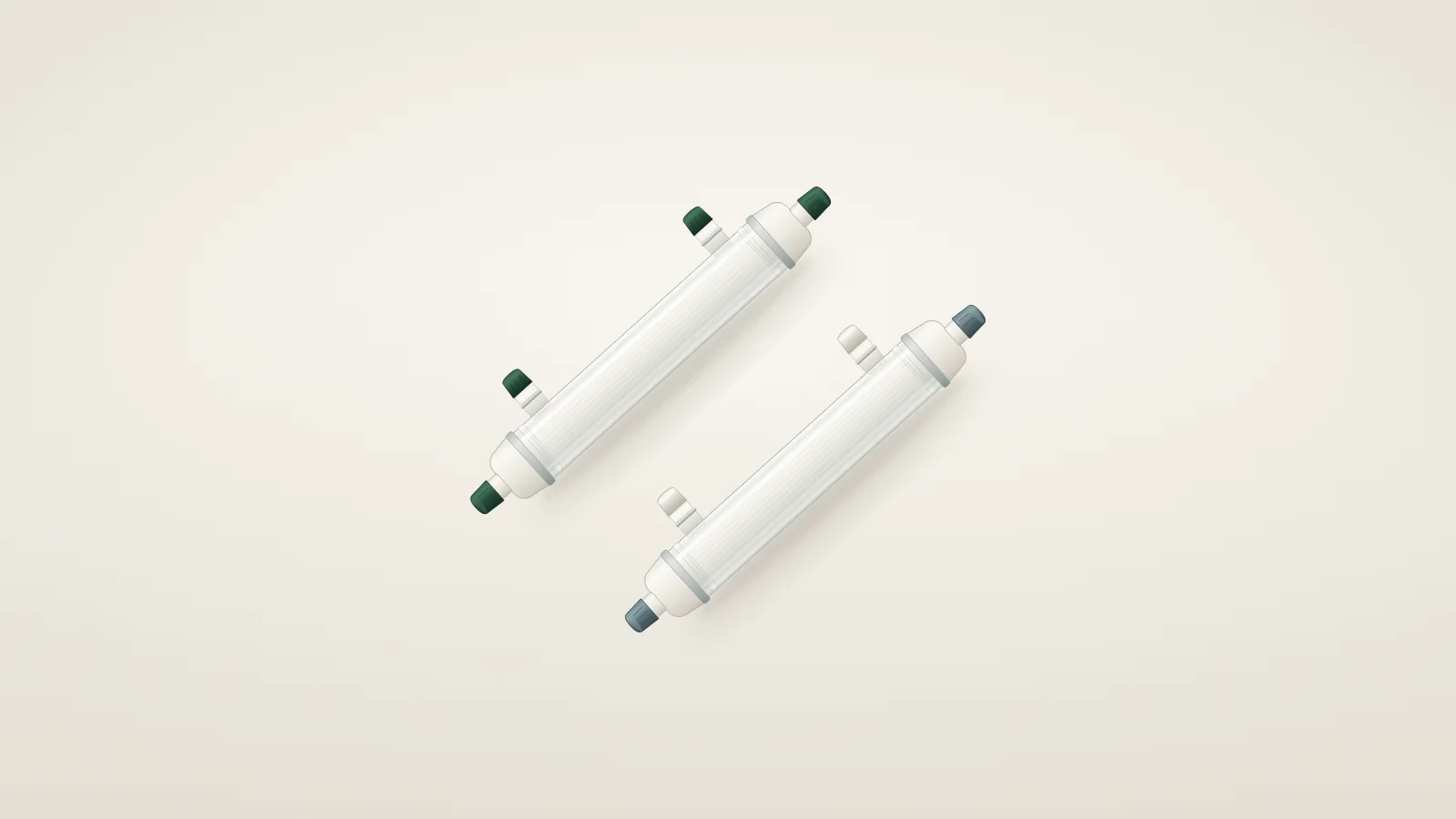
When two US hemodialyzer quotes list the same membrane area, start with the exact manufacturer order code (REF) and the package label and instructions for use (IFU) for the stock offered. Record membrane class and polymer, dialyzer blood priming volume, any separately documented saline priming volume, sterilization method, sterile scope, single-use status and labeled indications. Keep missing or disputed fields open and send any proposed substitution for local clinical review.
Theranova 400 (955691) and Optiflux F180NRe (0500318E) both list 1.7 m², with blood priming volumes of 91 mL and 102 mL, respectively. Their membrane classes and sterilization methods also differ. An area match is a starting point for a request for quotation (RFQ). Theranova 400 US catalog and Optiflux F180NRe IFU.
Start with the exact US order code
Keep one worksheet record per offered REF and pack configuration. Record the unit of purchase alongside the code so a quote for a case can be reconciled against the carton and individual unit labels. Ask the distributor to identify the US version and provide the IFU document number and revision applicable to the offered stock. A suffix can distinguish items with different documentation even when the model names are almost identical.
The two Fresenius codes show why the final letter matters. F180NRe (0500318E) is electron-beam sterilized and lists 102 mL blood priming volume. F180NR (0500318N) is ethylene-oxide sterilized and lists 97 mL. Both state 1.7 m². Retain the full code and the source revision so receiving staff can check the item that actually arrives. F180NRe IFU, p. 1 and F180NR IFU, p. 1.
For the complete extracorporeal circuit, attach the dialyzer specification and the tubing-set compatibility record to the same purchasing file. The tubing-set record covers its own machine interfaces, including the pump segment. The dialyzer worksheet below covers the filter and its labeling. Dialysis bloodline compatibility guide.
Build the dialyzer RFQ table
Use the two tables together, keyed by the exact US REF. The first covers membrane and volume fields. The second records sterilization, labeled use and what the supplier still needs to confirm. The Theranova catalogs were updated January 1, 2026. Their materials and sterilization details come from the August 2024 Theranova datasheet v4.0, PDF p. 3.
| Model and US REF | Evidence | Membrane and area | Blood priming (mL) | Saline priming (mL) |
|---|---|---|---|---|
| Theranova 400 · 955691 | US catalog and v4.0 datasheet | Medium cut-off PAES/PVP · 1.7 m² | 91 | 300 (catalog) |
| Theranova 500 · 955692 | US catalog and v4.0 datasheet | Medium cut-off PAES/PVP · 2.0 m² | 105 | 300 (catalog) |
| Optiflux F180NRe · 0500318E | F50010927 Rev 04/2025, p. 1 | High flux · Advanced Fresenius Polysulfone · 1.7 m² | 102 | Pending supplier confirmation |
| Optiflux F180NR · 0500318N | F50002270 Rev 07/2023, pp. 1 and 4 | High flux · Advanced Fresenius Polysulfone (polysulfone/PVP) · 1.7 m² | 97 | Pending supplier confirmation |
| Blank RFQ row · model, REF and market | Label and IFU number, revision, page or section | Class, polymer and area | Blood compartment volume | Separate labeled field or pending status |
| US REF | Sterilization, sterile scope and use | Labeled indications and exclusions | Supplier follow-up |
|---|---|---|---|
| 955691 | Steam · sterile fluid path · single use | Prescribed intermittent hemodialysis for chronic kidney failure. Excludes hemofiltration and hemodiafiltration. | Obtain the package label and applicable IFU. |
| 955692 | Steam · sterile fluid path · single use | Prescribed intermittent hemodialysis for chronic kidney failure. Excludes hemofiltration and hemodiafiltration. | Obtain the package label and applicable IFU. |
| 0500318E | Electron beam · sterile fluid path · single use | Acute or chronic renal failure when conservative therapy is judged inadequate. The IFU excludes patients under 30 kg. | Confirm the IFU revision and the separate saline field. |
| 0500318N | Ethylene oxide · sterile fluid path · single use | Acute kidney injury or chronic kidney disease when conservative therapy is judged inadequate. The IFU excludes patients with known hypersensitivity to device materials. | Confirm the IFU revision and reconcile any priming-volume discrepancy. |
| Blank RFQ row · REF | Method, scope and single-use status | Indication, population and modality limits | Evidence needed, owner and status |
PAES is polyarylethersulfone and PVP is polyvinylpyrrolidone. Record the scope of the sterility claim exactly as labeled. A sterile fluid path describes the path through the device. If an outer surface or packaging claim matters to the tender, request specific documentation for that claim. Keep a copy of the accepted label and IFU with the RFQ and use the supplier agreement to define which changes in the REF, membrane, sterilization or labeling trigger notice. Supplier quality agreement guide.
At receipt, compare the carton and unit identifiers with the approved line item. Match the labeled storage and handling conditions to the approved record, and escalate any REF or IFU change before routine release. Labeled storage and transport guide.
Resolve conflicting priming-volume figures
Start with the exact model and document revision when a quote lists a different priming volume. The October 2023 Theranova commercial comparison gives two blood priming figures for each Optiflux model. The table identifies both entries so the supplier can respond to a specific discrepancy.
PDF page 4 of the October 2023 comparison lists 105 mL for F180NR and 102 mL for F180NRe. On PDF pages 6 and 7 the figures are reversed. Both sets of entries use model names without Optiflux order codes. The August 2024 comparison repeats those entries, so the newer datasheet date alone leaves the discrepancy open. Theranova commercial comparison v3.0 and Theranova datasheet v4.0, PDF pp. 4 and 6–7.
| Model and US REF | v3.0 PDF p. 4 | v3.0 PDF pp. 6–7 | Fresenius IFU | Buyer action |
|---|---|---|---|---|
| Optiflux F180NR · 0500318N | 105 mL | 102 mL | 97 mL · F50002270 Rev 07/2023, p. 1 | Record the IFU value and keep any differing quote open. |
| Optiflux F180NRe · 0500318E | 102 mL | 105 mL | 102 mL · F50010927 Rev 04/2025, p. 1 | Confirm the offered REF and applicable IFU. |
The Theranova datasheet places a separate 300 mL entry near the two models’ blood compartment volumes. The exact-model US catalogs name the fields explicitly: 91 mL blood and 300 mL saline for 955691, and 105 mL blood and 300 mL saline for 955692. Use those field names in the RFQ. Keep a saline preparation amount and any combined dialyzer-and-set limit in their own fields. For the two Optiflux rows, leave the comparable saline field pending until the supplier documents the same field definition. Theranova 400 US catalog and Theranova 500 US catalog.
For example, if a vendor quotes 0500318N at 102 mL, enter 97 mL as the figure in IFU F50002270 Rev 07/2023 and 102 mL as the supplier’s quoted figure. Mark the line unresolved. Ask the vendor to confirm the full REF, identify which priming field the figure describes and show the page in the labeling supplied for that stock. Record the corrected value, source revision and date when a written response resolves the discrepancy.
Check the indication for the quoted model
Use the regulatory record to identify the device type and its special controls. Use the exact US product label to record the indication, patient population and excluded modalities for the offered model.
FDA granted De Novo request DEN190042 for Theranova 400 and 500 on August 28, 2020, under product code QAX. FDA’s September 2024 final order codified the class II device type at 21 CFR 876.5862. Its labeling controls include model-level membrane area and blood priming volume, a table of in vitro performance data and a clinical performance summary. Record the pathway as a De Novo classification grant. openFDA decision record and FDA final order, 89 FR 72715–72717.
The device-type definition names hemodialysis, hemofiltration and hemodiafiltration. The two US Theranova catalogs specify prescribed intermittent hemodialysis for chronic kidney failure and exclude hemofiltration and hemodiafiltration. The catalogs also describe an extracorporeal blood volume limit for the dialyzer and set together, expressed relative to the patient’s blood volume. Preserve the scope of that limit and the model’s use statement in the purchasing record. 21 CFR 876.5862 in the FDA final order, Theranova 400 US catalog and Theranova 500 US catalog.
Carry across exclusions from the applicable IFU when preparing the file for clinical review. F50010927 Rev 04/2025 gives an under-30 kg exclusion for F180NRe. F50002270 Rev 07/2023 describes the F180NR exclusion for known hypersensitivity to device materials. Keep each exclusion with its own REF and attach the full IFU so the clinical team can review the complete labeling. F180NRe general information, p. 1 and F180NR general information, p. 1.
Record how clearance was measured
Record the blood-side and dialysate-side flows, ultrafiltration rate, test medium, solute or marker, and method footnote with each bench rate. Record clinical findings in a separate row with the comparator, patient population, endpoint and time point. A rate in mL/min describes clearance under specified test conditions. A clinical reduction ratio describes the change in concentration as a percentage.
In the Theranova 400 aqueous bench table, the reported urea clearance differs by 36 mL/min between two test cells with the same blood-side flow and zero ultrafiltration. The cells differ in dialysate-side flow. The Optiflux F180NRe IFU illustrates a second comparison issue: its urea row uses sodium as a marker. Ask for the method footnote even when a quote already shows the same solute name and units. Theranova v4.0 aqueous clearance table, PDF p. 3 and Optiflux F180NRe IFU, p. 1, footnotes 2 and 3.
| Evidence | Model and reported figure | Test conditions or study design |
|---|---|---|
| In vitro bench test | Theranova 400 · urea clearance 246 mL/min | Aqueous solution. Blood-side flow 300 mL/min, dialysate-side flow 300 mL/min and ultrafiltration 0 mL/min. |
| In vitro bench test | Theranova 400 · urea clearance 282 mL/min | Aqueous solution. Blood-side flow 300 mL/min, dialysate-side flow 500 mL/min and ultrafiltration 0 mL/min. |
| IFU method footnote | Optiflux F180NRe · sodium marker for the urea row | Keep this method footnote with any quoted rate. |
| Randomized trial | Theranova 400 vs Elisio-17H · free lambda light-chain reduction ratio of 33% vs 17% at week 24 | 172 clinically stable participants on maintenance hemodialysis, randomized. The trial also assessed predialysis serum albumin at week 24. |
The 24-week trial reported a higher free lambda light-chain reduction ratio for Theranova 400 versus Elisio-17H and met its noninferiority criterion for predialysis serum albumin. Its comparison applies to those two models and those biochemical endpoints. The authors say the trial was too short and too small to assess cardiovascular events or mortality. Several authors disclosed Baxter employment. One site investigator disclosed Baxter trial support paid to his institution. Weiner et al., Clinical Journal of the American Society of Nephrology, 2020.
Send unresolved fields back to the supplier
If the file still has an open field, send a request tied to the exact line item. Ask the supplier to return four pieces of information for the stock offered.
Exact US REF and pack configuration. Include the full code with any suffix and identify the unit or case being quoted.
Applicable package label and dated IFU. Identify the document number and revision for the offered stock and the sections covering membrane, sterilization, sterile scope, single use and labeled use.
Written resolution of any volume discrepancy. State which priming field the quote uses and point to the applicable page. Record combined circuit limits separately when listed.
Source and method for any performance figure. Provide the bench table, conditions, marker and footnotes. For a clinical result, provide the trial, comparator, population, endpoint and follow-up.
Once purchasing has the label, IFU and written answers, attach them to the reviewed line item so the receiving team can verify the shipment. Send proposed substitutions with the exact product and circuit details to the facility’s clinical reviewers for a decision.