
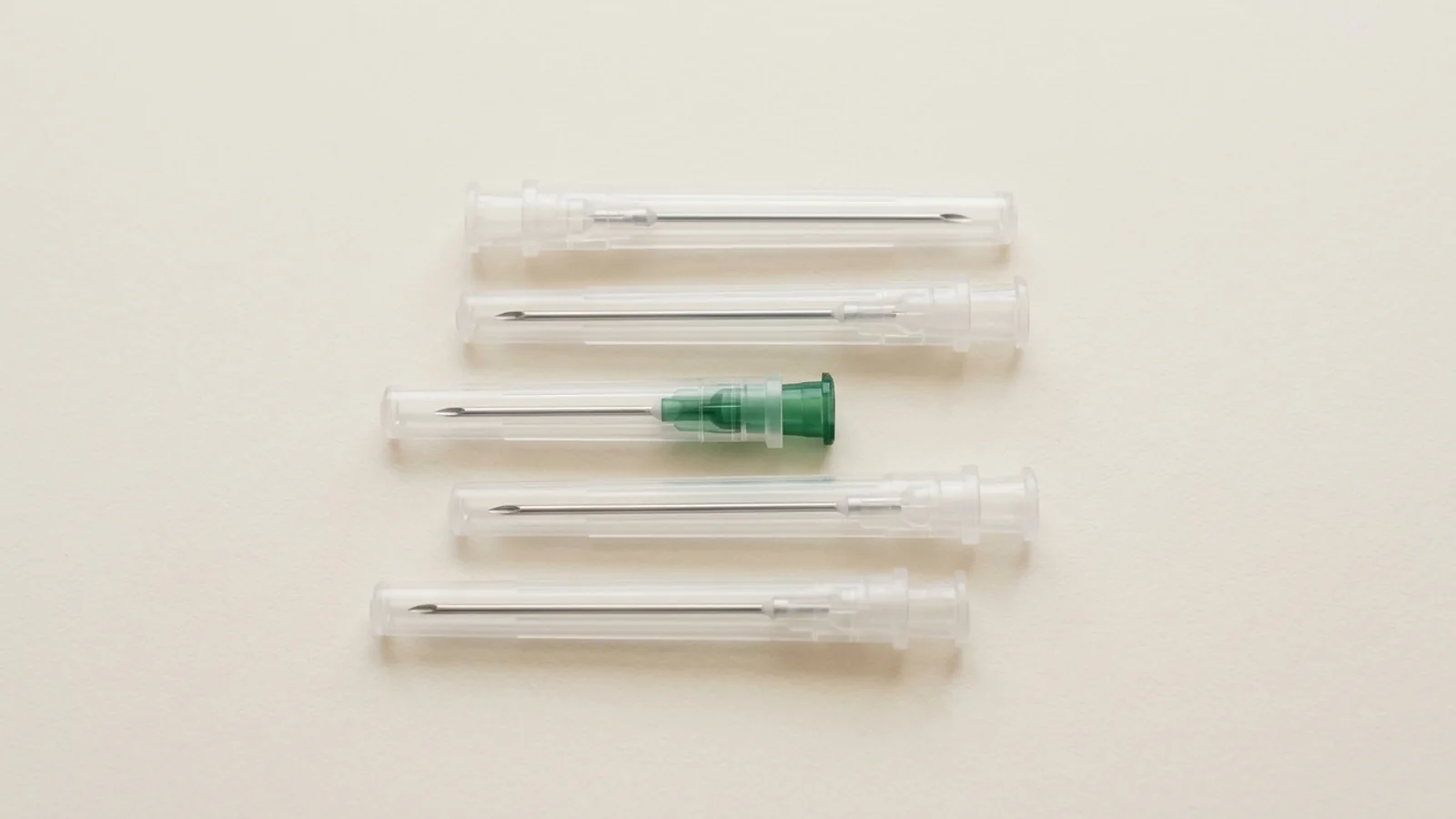
In healthcare consumable sourcing, sterile hypodermic needles are frequently ordered through fragmented trade descriptions that combine gauge numbers, fractional inch lengths, and brand-specific color names without technical precision. Buyers and quality managers often encounter tender specifications that confuse hypodermic needles with peripheral vascular catheters, overlook wall thickness differences, or fail to define connector and sharps-injury protection standards.
Hospital procurement teams must specify sterile hypodermic needles by device identity, metric size, gauge, length, wall type, labeled hub colour under ISO 6009, connector, and optional ISO 23908 shield—without reusing the published IV cannula colour table and without recommending a gauge for a patient or procedure.
Identify a hypodermic needle, not a peripheral IV cannula
In the United States, single-use hypodermic needles are regulated by the FDA under Title 21 of the Code of Federal Regulations, 21 CFR 880.5570 (Hypodermic single lumen needle). The regulation classifies the device as a Class II (performance standards) instrument intended to inject fluids into, or withdraw fluids from, anatomical structures below the surface of the skin.
The statutory identification describes a rigid metal tube sharpened at one end and joined at the proximal end to a female hub designed to mate with the male nozzle of a piston syringe (21 CFR 880.5860) or an intravascular administration set (21 CFR 880.5440). Hypodermic needles are assigned FDA Product Code FMI.
A vital boundary in medical consumable procurement is separating hypodermic injection needles from peripheral IV cannulas (catheters):
Hypodermic Needle (21 CFR 880.5570, Code FMI): A rigid metal tube sharpened at one end and joined to a female hub that mates a piston-syringe nozzle or an intravascular administration set. It is not an indwelling polymer catheter.
Peripheral IV Cannula (21 CFR 880.5200, Code FOZ): A flexible polymer over-the-needle catheter (polyurethane or FEP) mounted over an internal steel introducer needle. The steel needle is discarded after venipuncture, leaving the flexible plastic catheter indwelling in the vein (see our dedicated reference on IV cannula sizes and color codes).
graph TD
  A["Needle Consumable Requirement"] --> B{"Device Architecture"}
  B -->|"Rigid Steel Tube + Female Hub"| C["Hypodermic Single-Lumen Needle<br/>21 CFR 880.5570 (FMI)<br/>ISO 7864 / ISO 9626 / ISO 6009"]
  B -->|"Polymer Tube + Introducer Needle"| D["Peripheral IV Cannula / Catheter<br/>21 CFR 880.5200 (FOZ)<br/>Indwelling Vascular Access"]
  C --> E{"Safety Shield Claimed?"}
  E -->|"Standard Conventional"| F["Conventional Needle<br/>ISO 7864:2016 (FMI)"]
E -->|"Sharps-injury protection"| G["Safety Shielded Needle<br/>ISO 23908 as labeled"]Metric size, gauge, and wall type are different fields
The engineering and dimensional performance of hypodermic needles is governed by two complementary standards published by the International Organization for Standardization (ISO):
ISO 7864:2016 (Sterile hypodermic needles for single use — Requirements and test methods): Specifies requirements for sterile hypodermic needles for single use of designated metric sizes 0.18 mm to 1.2 mm. It does not apply to devices covered by their own standard, such as dental needles and pen needles. Do not reprint paywalled length-tolerance, bond-strength, or flow tables.
ISO 9626:2016 (Stainless steel needle tubing for the manufacture of medical devices): Specifies stainless-steel needle tubing for the manufacture of medical devices from designated metric sizes 3.4 mm (10 Gauge) to 0.18 mm (34 Gauge). A 10 Gauge tube size in ISO 9626 is not automatically an ISO 7864 finished hypodermic needle.
A common point of confusion is the relationship between Gauge, Outer Diameter, and Wall Thickness. In medical needle standards, Gauge designates the nominal outer diameter (OD) of the steel tubing. However, the inner diameter (ID)—which dictates fluid flow velocity and extrusion force—is determined by the wall geometry.
| Wall Type Designation | Abbreviation | Tubing Geometry & Clinical Benefit |
|---|---|---|
| Regular Wall | RW | Standard wall thickness as designated in ISO 9626 / ISO 6009 language. Specify RW when that is the labeled wall. Do not treat wall type as a patient-selection instruction. |
| Thin Wall | TW | Reduced wall thickness for a given outer diameter, which enlarges inner diameter. Specify TW as labeled. Gauge still names outer diameter. |
| Extra-Thin Wall | ETW | Further reduced wall thickness as labeled. Inner diameter changes; outer-diameter gauge does not. |
| Ultra-Thin Wall | UTW | Ultra-thin wall as labeled. Do not assign UTW to an ophthalmic, pediatric, or other clinical route on this page. |
Hub colour is ISO 6009 for hypodermic needles
FDA recognizes ISO 6009:2016 (Hypodermic needles for single use — Colour coding for identification) (FDA Recognition Number 6-381).
ISO 6009 establishes standardized color coding for the molded plastic hubs of single-use hypodermic needles corresponding to designated metric outer diameters from 0.18 mm (34 Gauge) to 3.4 mm (10 Gauge). The standard applies to both opaque and translucent hub materials across regular, thin, extra-thin, and ultra-thin wall configurations.
| Line-item field | What to specify | What not to copy |
|---|---|---|
| Metric outer diameter | Named millimetre size. ISO 7864 covers finished sterile needles from 0.18 mm to 1.2 mm; ISO 9626 covers tubing from 0.18 mm (34 Gauge) to 3.4 mm (10 Gauge). | A 10 Gauge tube size in ISO 9626 is not automatically an ISO 7864 finished hypodermic needle. |
| Nominal gauge | Outer-diameter designation as labeled, together with the millimetre size. | Gauge alone, without wall type or length, as if it completed the specification. |
| Hub colour | Labeled hub colour verified against ISO 6009 for hypodermic needles. FDA's recognized abstract applies the colour code from 0.18 mm (34 Gauge) to 3.4 mm (10 Gauge), including regular, thin, extra-thin, and ultra-thin walls. | The published IV cannula colour table, a manufacturer swatch presented as ISO text, or a paywalled colour-chip chart. |
| Wall type | Regular, thin, extra-thin, or ultra-thin as labeled. Wall type changes inner diameter; gauge still names outer diameter. | Inferring inner diameter or flow from gauge alone. |
| Pen-needles and dental needles | Out of ISO 7864 and ISO 6009 scope as stated in the public abstracts. | Treating a pen-needle colour or a dental-needle SKU as a hypodermic-needle specification. |
| Evidence examples | Dated 510(k) files such as K211214 (conventional sterile hypodermic needles) and K251447 (active safety needle) showing the ISO 7864 / 9626 / 6009 / 80369-7 set, with ISO 23908 when a shield is claimed. | A manufacturer ranking or a procedure-by-gauge selection chart. |
Length, bevel, connector, sterility, and optional shield
Beyond gauge and hub color, a complete technical purchase order must specify four critical mechanical and safety parameters:
Nominal Tubing Length: Needle length is a labeled configuration in millimetres and, if used commercially, a nominal inch equivalent. Specify the labeled length. Do not reprint paywalled ISO 7864 length tolerances, and do not recommend a length for a procedure.
Bevel Geometry: Bevel is a labeled configuration (for example regular/long or short as named on the SKU). Do not assign a bevel to intramuscular, subcutaneous, intradermal, arterial, or nerve-block use on this page.
Connector Conformance: The female needle hub must feature a standardized 6% Luer taper complying with ISO 80369-7:2021, ensuring secure leak-tight mating with standard Luer slip and Luer lock syringe nozzles.
Occupational Sharps-Injury Protection (ISO 23908): When a safety shield is claimed, public 510(k) files such as K251447 add ISO 23908 to the ISO 7864 / ISO 9626 / ISO 6009 / ISO 80369-7 set. Name the ISO 23908 edition on the label rather than assuming every safety needle cites the 2024 edition.
Specification line that cannot be read as clinical needle choice
Procurement tender documents must remain strictly neutral regarding patient-specific clinical route selections. Tenders should specify technical line items using the following standardized engineering format:
| Specification Item | Tender Requirement Definition | Governing Standard / Regulatory Basis |
|---|---|---|
| Device Regulation & 510(k) | Class II Hypodermic Single Lumen Needle; Product Code FMI | 21 CFR 880.5570 |
| Finished Needle Standard | Full compliance with sterile hypodermic needle requirements | ISO 7864:2016 |
| Tubing Metallurgy & Wall | Stainless-steel tubing per ISO 9626; specify labeled wall type (RW, TW, ETW, or UTW) | ISO 9626:2016 |
| Nominal Gauge & Metric OD | Specify labeled gauge together with the designated metric outer diameter | ISO 7864 / ISO 9626 |
| Nominal Needle Length | Specify labeled length in millimetres (and the nominal inch equivalent if used commercially) | ISO 7864:2016 |
| Hub Colour Coding | Labeled hub colour verified against ISO 6009 for hypodermic needles; do not copy the IV cannula colour table | ISO 6009:2016 (FDA Recognition 6-381) |
| Hub Connector | Labeled small-bore connector; current 510(k) examples cite ISO 80369-7 | ISO 80369-7:2021 |
| Sharps Protection (if safety line) | Active or passive locking shield validated post-activation | ISO 23908 as labeled (edition on the 510(k)/label) |
| Sterility Assurance | Labeled sterile single-use packaging; do not invent a numeric sterility-assurance value | Labeled sterility claim |
For comprehensive technical specifications on mating injection devices and vascular lines, see our guides on sterile hypodermic syringes, IV cannula sizes and color codes, and IV administration sets.