
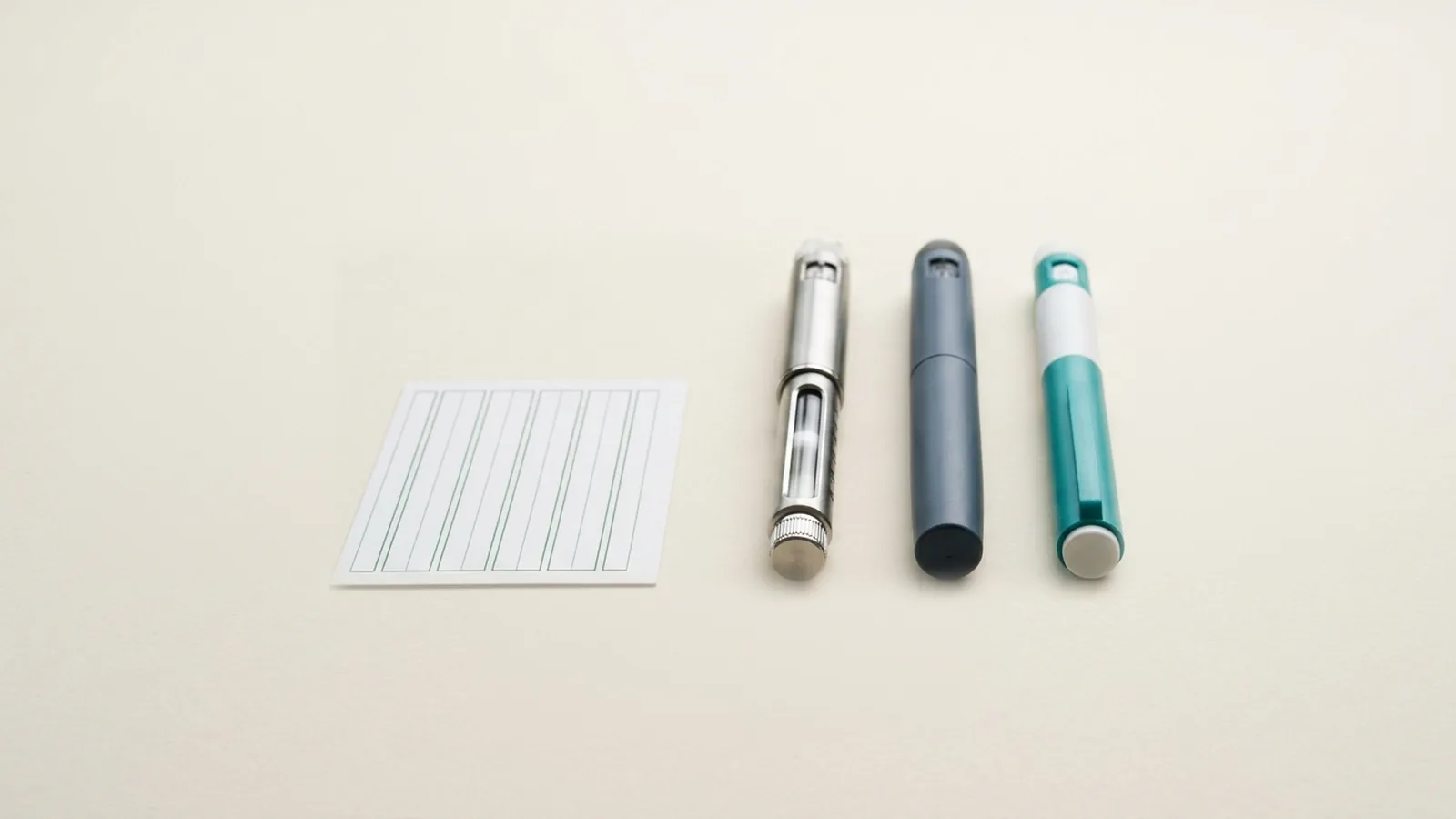
Scenario: Replacing a Stocked 31G 5 mm Pen Needle
The question: Our hospital system wants to replace the stocked 31G 5 mm pen needle with a lower-cost brand that just cleared FDA in 2026, across wards using Sanofi SoloStar, Lilly KwikPen, and Novo Nordisk FlexTouch insulin pens plus Ozempic pens. What exactly must we verify before the switch?
Short answer: a 2026 510(k) clearance and an ISO 11608-2 claim tell you the needle may be marketed in the US and is designed to the double-ended pen needle standard. Neither tells you that it has been tested on each of your four pen families. In the US, pen needles are Class II devices cleared under 21 CFR 880.5570 with FDA product code FMI. The fit question is answered by documents: the needle maker's declared, tested pen list at a stated revision, matched against each pen maker's labeling for your market.
Before signing a contract or swapping stock bins, clear four checks for every pen family on the floor:
Declared compatibility. Ask the 2026 entrant for its current, revision-controlled compatibility list and its cleared instructions for use. The list should name SoloStar, KwikPen, FlexTouch and the Ozempic pen individually. A pen that is not on the list is an unverified pairing, whatever the sales literature says.
Pen-side labeling. Check what each pen's own labeling says about needles. For Ozempic, the US labeling allows NovoFine Plus, NovoFine or other compatible needles up to 8 mm, so a 5 mm needle is inside the stated length range but still has to be shown to be compatible. For the insulin pens, a trade chart revised 12/2024 lists specific needle brands per pen family; confirm those entries against each pen maker's current instructions.
Standard versus safety type. Confirm that the incumbent and the replacement use the same cover design. A standard pen needle has an outer cover and a removable inner needle cover; a safety pen needle has a fixed inner shield that is not removed. FDA's 2018 letter is the reason a type change needs retraining and an instructions-for-use review before it reaches the ward.
Revision on file. Record the needle maker's compatibility document number, revision and date, in the way embecta cites its own summary as Document Number 149OTH-0004-20 Rev Y, dated 2025-11-18. If a cell on the match sheet cannot be filled from a current primary document, hold the substitution until the supplier provides the evidence.
What a Pen Needle Is, Regulatorily
FDA's product classification database lists product code FMI as "needle, hypodermic, single lumen" under 21 CFR 880.5570: Class II, 510(k) required and not GMP-exempt. FDA's September 26, 2018 labeling change request to manufacturers states that pen needles used with pen injectors are regulated under that same regulation and product code. The pen injector is a separate device: FDA's recognition record for ISO 11608-2:2022 lists "Injector, Pen" as product code NSC under 21 CFR 880.5860. Keep the two classifications apart on purchasing records, because the needle and the pen are cleared, labeled and changed independently.
Pen needles also sit next to two product lines that hospitals stock in the same aisle but specify differently:
Separately supplied hypodermic needles. FDA's recognition record notes that hypodermic needles provided separately are covered by ISO 7864, not ISO 11608-2. These attach to syringes with a Luer connection, as described in our guide to hypodermic needle gauge and length specifications, and they are not a substitute for a pen needle.
Insulin syringes. Vial-and-syringe insulin delivery is specified to ISO 8537, covered in our insulin syringe ISO 8537 specification guide. Those products are graduated syringes, not needles that thread onto a pen.
A pen needle is double-ended. One cannula faces the pen and pierces the drug cartridge when the hub is attached; the other is the patient end. Lengths vary within a single brand: embecta, for example, lists its Ultra-Fine pen needles in 4 mm, 5 mm, 6 mm, 8 mm and 12.7 mm lengths. That spread matters because, as the labeling section below shows, at least one current pen label limits needle length.
The Interface: What ISO 11608-2 Requires and What It Does Not Promise
The current standard is ISO 11608-2:2022, "Needle-based injection systems for medical use — Requirements and test methods — Part 2: Double-ended pen needles" (Edition 3, published April 2022). It replaced the 2012 edition. According to the scope reproduced in FDA's recognition record, it covers single-use, double-ended, sterile needles intended for needle-based injection systems that use a non-integrated double-ended needle according to ISO 11608-1. It excludes hypodermic needles, pre-attached syringe needles and dental needles.
FDA recognizes ISO 11608-2:2022 as a complete standard under recognition number 6-476 (Recognition List 058, entered May 30, 2022). Recognition means FDA will accept a declaration of conformity to the standard in a premarket submission. It is not a legal requirement to use the standard, and it does not certify that any particular needle fits any particular pen.
The common procurement assumption is that any needle claiming ISO 11608-2 conformity will fit any ISO 11608-1 pen. The standard's approach, as described in the published literature, points the other way. A peer-reviewed compatibility study (Nicolucci and Leonardi, Medical Devices: Evidence and Research, 2022) describes the 2012 edition as requiring the needle's legal manufacturer to declare on the packaging the list of pens with which the needle is compatible, and to physically verify each declared pairing by test. The full 2022 text is sold by ISO, so ask suppliers to show where their current labeling and test reports meet the edition they claim.
The study describes two parts to that compatibility test, with the acceptance values it applied:
Mechanical fit and hub removal. Needles were attached at an assembly torque of 0.07 ± 0.01 Nm, and a removal torque of 0.100 Nm or less was treated as adequate. A needle that needs more force than that to unscrew is harder to remove from the pen after use.
Delivered dose. For each pen, 60 needles were tested at a low dose volume (Vlow) and 60 at a high one (Vhigh). Doses up to 0.20 mL had to fall within ±0.01 mL of the target and larger doses within ±5%, applied as a statistical acceptance limit rather than a simple average. The delivered liquid was weighed on a laboratory balance.
Using the PiC Insupen G33 x 4 mm needle as the representative product, the study tested 50 pens used for insulin, GLP-1 receptor agonists and an amylin analog. Most passed. The exceptions were pen-specific:
Dose accuracy: the Berlipen Precision pen did not meet the acceptance criteria at its high dose volume.
Removal torque: with the Berlipen 301 and Berlipen 302 pens, removal torque exceeded the 0.100 Nm limit.
Read this study for its method rather than as a verdict on your pens. One of its two authors is an employee of the needle maker, Pikdare; it tested one needle brand, used the now-withdrawn 2012 edition, and reflects the pens on the market when it was done. Its procurement lesson still holds: a hub that threads on is only the first condition. Dose delivery and removal are tested pen by pen, so compatibility is a property of a named pair, not of a needle on its own.
The table below sorts the documents a buyer is likely to see by what each one can and cannot establish.
| Document a supplier offers | What it can establish | What it cannot establish | Example reviewed for this guide |
|---|---|---|---|
| 510(k) clearance under product code FMI | The needle was cleared for US marketing under 21 CFR 880.5570 | Which pens it was tested with; the database record shows clearance metadata only | openFDA records such as K262427 (decision 2026-08-10) |
| Claim of conformity to ISO 11608-2 | The maker says it meets the double-ended pen needle standard, whose 2022 edition FDA recognizes (6-476) | That every pen fits; compatibility rests on a declared, tested pen list | ISO 11608-2:2022 catalog entry; FDA recognition 6-476 |
| Needle maker's compatibility summary with document number, revision and date | Which pens the maker says it has verified, as of that revision | Pens or markets added after the revision date | embecta Document Number 149OTH-0004-20 Rev Y (2025-11-18), cited on its US product page |
| Pen or drug labeling | Which needles, and which lengths, the pen maker's labeling describes | Whether a particular third-party needle has been tested on that pen | Ozempic US labeling (revised 05/2026): NovoFine Plus, NovoFine or other compatible needles up to 8 mm |
| Trade or vendor compatibility chart | A convenient starting list by pen family | Primary evidence; the charts reviewed here describe themselves as partial | EMPR insulin pen chart (Rev. 12/2024); UltiMed chart with a "contact us" note |
| Peer-reviewed compatibility study | That pen-specific failures occur under the standard's tests | The current status of any pen you stock | Nicolucci and Leonardi 2022 (2012 edition; co-authored by a Pikdare employee) |
The Pen Names the Needles: Labeling Versus Marketing
Two tiers of information reach a buyer: the pen and drug labeling, and the needle maker's marketing. When they disagree, the labeling and the needle maker's revision-controlled compatibility document carry more weight than a catalog sentence.
Current US labeling for Ozempic (semaglutide) injection, in the prescribing information revised 05/2026 and its Instructions for Use, is specific about needles:
Supplied needles: "NovoFine Plus 32G 4 mm disposable needles are included with your OZEMPIC pen."
Additional needles: "If you need additional needles, NovoFine Plus, NovoFine or other compatible disposable needles with a length up to 8 mm can be used. For needle compatibility information, talk to your healthcare professional."
What that means for standardization: a 12.7 mm SKU, a length that at least one major brand still offers, falls outside the "up to 8 mm" range in the Ozempic labeling. A plan to standardize every ward on one length therefore needs a separate check for Ozempic pens. The 8 mm figure belongs to this product's labeling and should not be applied to other pens.
Insulin pens show the same pattern in trade references. EMPR's insulin pen devices chart (revised 12/2024), a US drug trade compilation rather than primary labeling, lists needle brands pen family by pen family. For example:
Sanofi SoloStar-family pens: "BD, Ypsomed, or Owen Mumford pen needles."
Lilly KwikPen-family pens: "BD pen needles."
Novo Nordisk FlexPen, FlexTouch and NovoPen Echo 2: NovoTwist, NovoFine or NovoFine Plus needles.
Owen Mumford Autopen: described as compatible with most pen needles.
EMPR notes that its chart is "not an inclusive list of medications and/or official indications." Treat each entry as a pointer to the pen maker's current instructions, record the chart's revision date if you use it, and replace it with the primary document once you have that.
Needle makers' own claims are usually worded with care, and the wording is informative:
embecta Ultra-Fine: embecta (formerly BD Diabetes Care) says its Ultra-Fine pen needles are "compatible with widely used pen injection devices" and footnotes that sentence to a "Pen Needle Compatibility Status Summary with Diabetes Care & Non-Diabetes Drug Delivery Devices," Document Number 149OTH-0004-20 Rev Y, dated 2025-11-18. The summary itself is not posted on the page, so request the document; do not infer its contents from the citation.
UltiMed UltiCare: UltiMed states that UltiCare pen needles "are compatible with most pen injector devices" and publishes a chart of named Lilly KwikPen, Novo Nordisk FlexPen and FlexTouch (including the Ozempic pen) and Sanofi SoloStar pens. The page adds, "If you can't find your pen injector, please contact us," and shows no revision date. The list is partial by design.
Consumer-facing advice: some patient-oriented pages describe pen needles as fitting nearly any pen. That may help an individual shopper, but a hospital substitution needs a documented basis for every pen and needle pair in use.
Standard Versus Safety Pen Needles: Two Ways of Using the Same Code
Standard and safety pen needles are both cleared under product code FMI. One 2026 clearance, K262427, lists both ordinary and safety type configurations in a single submission. They are not interchangeable in use, however. FDA's 2018 letter describes the difference:
Standard pen needles often have an outer cover and a removable inner needle cover, and both are removed before an injection.
Safety pen needles have an outer cover that is removed and a fixed inner needle shield, a sharps injury prevention feature, that is not removed before an injection. Shield designs vary by product, so read each product's instructions. FDA's FMI classification record lists ISO 23908 (second edition, 2024-12) on sharps injury protection among its recognized standards. Ask what sharps-protection evidence supports a safety claim.
In its September 26, 2018 labeling change request, FDA's Center for Devices and Radiological Health said it was aware that the inner needle cover of a standard pen needle is sometimes not removed, so the intended medication is not delivered. FDA reported that it had received some reports of hyperglycemia and diabetic ketoacidosis, including one death, associated with failure to remove the inner needle cover when a standard pen needle was used to inject insulin. The letter also noted that patients could be taught with one type of pen needle and later receive the other, which could cause confusion. FDA cited ISMP, the National Alert Network, Medical Device Reports, FAERS and published literature as the sources that brought the issue to its attention.
FDA reviewed standard pen needle labeling and found that some instructions omitted or confused the two-cover steps. It asked manufacturers marketing pen needles under FMI to review their instructions and training materials, and asked standard pen needle makers to consider adding a warning similar to this one:
Current pen labeling carries the same message in its own words. The Ozempic Instructions for Use state: "The needle is covered by 2 caps. You must remove both caps. If you forget to remove both caps, you will not inject any medicine." The 2018 letter was a request to manufacturers, not a binding rule or a recall. As of this review in October 2026, we found no newer FDA pen needle communication replacing it.
For procurement, a switch between standard and safety pen needles is not a like-for-like substitution. It changes the steps users perform, so nursing education and pharmacy should review it, update the instructions for use and training materials, and agree a cut-over date before the new SKU reaches a ward or a discharge supply.
| Feature | Standard pen needle | Safety pen needle |
|---|---|---|
| Covers, as described by FDA (2018) | Outer cover plus a removable inner needle cover | Outer cover plus a fixed inner needle shield |
| What the user removes before injecting | Both the outer cover and the inner needle cover | The outer cover only; the shield stays in place |
| Failure mode named by FDA | Inner cover left on, so no medication is delivered (reports included one death) | Confusion when a user trained on one type receives the other |
| Evidence to ask the supplier for | ISO 11608-2 conformity and the tested pen list | The same, plus evidence for the sharps-protection claim (for example ISO 23908) |
| Match-sheet entry | Record the two-cover instruction step | Record that the shield is not removed; flag any change of type for retraining |
New Entrants and the Revision Problem
The supply side keeps moving. An openFDA query of 510(k) records under product code FMI, sorted by decision date on October 26, 2026, returned 694 records in total. The code covers single-lumen hypodermic needles generally, so not every record is a pen needle. Among the 12 most recent decisions, at least eight were for products named as pen needles, all decided in 2026. Examples:
K261719, Promisemed X-Safety Pen Needle (Promisemed Hangzhou Meditech Co., Ltd.), decision August 25, 2026.
K262427, Pen Needle (Hh Global Technology, Inc.), decision August 10, 2026, listing 17 ordinary and safety type configurations.
K261829, K260739 and K260855, Profoject Dual-Safety Pen Needles, Profoject Pen Needles and Profoject Safety Pen Needles (CMT Health PTE., Ltd.), decisions between June and July 2026.
K252908, Easydrip pen needle family (Sandstone Medical (Suzhou), Inc.), decision March 25, 2026.
A distributor offering one of these products may lead with two facts: the needle has 510(k) clearance and it meets ISO 11608-2. Both can be true while the buyer's real question is still open: has this SKU been verified on the exact pens used in this health system? The 510(k) database record shows clearance metadata only. Under the standard's declaration approach, the pens a needle is declared compatible with belong in its labeling, so ask the supplier for the cleared labeling and instructions for use.
Compatibility is also a dated statement. embecta's citation of a numbered, lettered and dated compatibility summary shows that at least one major maker manages it as a controlled document that changes over time. Pens and needles keep entering the market, as the 2026 clearances above show, so a compatibility chart saved years ago may no longer reflect the current list. Make it a procurement gate: every prospective pen needle supplier provides its current compatibility document with a document number, revision, date, market and an explicit list of tested pens. A brochure without that metadata is not evidence of compatibility.
The Match Sheet: Fields to Capture Before You Substitute
A match sheet turns the substitution into a document-control task. Before a pen needle SKU is substituted, added to a formulary or moved between departments, complete one row for every pen model in use, with these fields:
Exact pen model. The pen family and the drug presentation, such as a SoloStar, KwikPen, FlexPen, FlexTouch or NovoPen Echo 2 pen, rather than "insulin pen".
Market. The country or regulatory jurisdiction, because pen names, needle brands and compatibility claims can differ between markets.
Needle brand and SKU. Catalog number, brand name and legal manufacturer.
Gauge and length. For example 31G and 5 mm, checked against any length limit in the pen's labeling.
Type. Standard (outer cover plus removable inner cover) or safety (fixed inner shield).
Needle maker's compatibility document. Document number, revision and date of the tested pen list.
Source of record. The primary document behind the row, such as the drug prescribing information and Instructions for Use, the pen user manual, or the needle's cleared labeling. Note a trade chart only as a pointer.
Instructions-for-use change flag. Yes or no: does the substitution change cover removal, needle length or disposal steps, so that staff need re-education?
The table shows the scenario's rows filled only from the public documents reviewed for this guide. The cells those documents cannot fill are left as unknown, and that is the main finding: before the supplier provides its evidence, none of the four pen families can be cleared for the 2026 entrant.
| Pen in use (US) | Pen-side source of record | What the pen-side source says | Candidate: 2026-cleared 31G 5 mm | Needle maker's list and revision | Status |
|---|---|---|---|---|---|
| Sanofi SoloStar family | EMPR chart, Rev. 12/2024 (trade compilation); confirm with Sanofi's current instructions | BD, Ypsomed, or Owen Mumford pen needles | Brand not named by the pen-side source | Unknown: request document number, revision and date | Hold |
| Lilly KwikPen family | EMPR chart, Rev. 12/2024; confirm with Lilly's current instructions | BD pen needles | Brand not named by the pen-side source | Unknown | Hold |
| Novo Nordisk FlexTouch (insulins) | EMPR chart, Rev. 12/2024; confirm with Novo Nordisk's current instructions | NovoTwist, NovoFine or NovoFine Plus needles | Brand not named by the pen-side source | Unknown | Hold |
| Ozempic pen | Ozempic US prescribing information (rev. 05/2026) with Instructions for Use | NovoFine Plus 32G 4 mm included; NovoFine Plus, NovoFine or other compatible needles up to 8 mm | 5 mm is within the 8 mm range; compatibility still needs the needle maker's declaration | Unknown | Hold |
| Every pen (type check) | FDA 2018 letter; incumbent and candidate instructions for use | Standard: remove both covers. Safety: shield stays on | Confirm type from the cleared labeling (K262427, for example, includes both types) | Not applicable | Flag for training if the type differs |
If the incumbent were an embecta Ultra-Fine needle, its needle-side cell would cite 149OTH-0004-20 Rev Y (2025-11-18). Because that summary is not public, the cell is complete only once the document itself is on file and names the pen in that row. An unknown cell should hold the substitution until the supplier provides a written compatibility declaration and test evidence for the named pen.
The Pen Needle Verification Workflow
The flowchart shows the same checks in order, from clearance to match-sheet sign-off:
flowchart TD
    Start["Proposed pen needle SKU substitution"] --> Step1{"1. 510(k) clearance under product code FMI?"}
    Step1 -- "No" --> Reject1["Stop: not cleared for US marketing as a pen needle"]
    Step1 -- "Yes" --> Step2{"2. Same type as incumbent? (standard vs safety)"}
    Step2 -- "No" --> Training["Route to nursing education and pharmacy: update IFU and training before cut-over"]
    Training --> Step3
    Step2 -- "Yes" --> Step3{"3. Revision-controlled compatibility list provided?"}
    Step3 -- "No, only 'fits most pens'" --> Reject2["Hold: marketing claim without a tested pen list"]
    Step3 -- "Yes" --> Step4{"4. Every pen in use named on the list?"}
    Step4 -- "No" --> Request["Hold: request declaration and test evidence for the missing pen"]
    Request --> Step4
    Step4 -- "Yes" --> Step5{"5. Within each pen's labeling? (e.g. Ozempic: up to 8 mm)"}
    Step5 -- "No" --> Reject3["Stop for that pen: outside the pen labeling"]
    Step5 -- "Yes" --> Step6["Complete the match sheet row with document numbers and dates"]
Step6 --> Approve["Approve substitution for the listed pens"]What the Match Sheet Cannot Answer
A match sheet gives traceability for fit, dose-delivery evidence and labeling. It does not replace other parts of formulary and supply-chain governance:
Price and contracts. This guide has no pricing, rebate or supplier ranking data. Group purchasing contracts and net pricing have to be evaluated separately.
Clinical technique. This guide covers consumable specifications and regulatory boundaries only. It gives no advice on injection site, technique or dosing. Those belong to prescribers and institutional clinical guidelines.
Commercial claims. A manufacturer's compatibility statement is the manufacturer's own claim. Ask which standard edition the underlying tests followed, which pens and markets they cover, and the document's revision and date.
The study is illustrative. The Nicolucci and Leonardi results came from the withdrawn 2012 edition, one needle brand, a manufacturer-employee co-author and the pens available at the time. They show that pen-specific failures happen, not how a pen you stock performs today.
Markets differ. Pen names, needle portfolios and compatibility claims vary between markets, so keep match sheets by jurisdiction. Vendor pages reviewed here focus on the US.
Disposal. Used pen needles are sharps whether standard or safety. Container requirements are covered in our sharps container specification guide. Related guides cover filter and blunt-fill needles, safety lancets and ENFit syringes.