
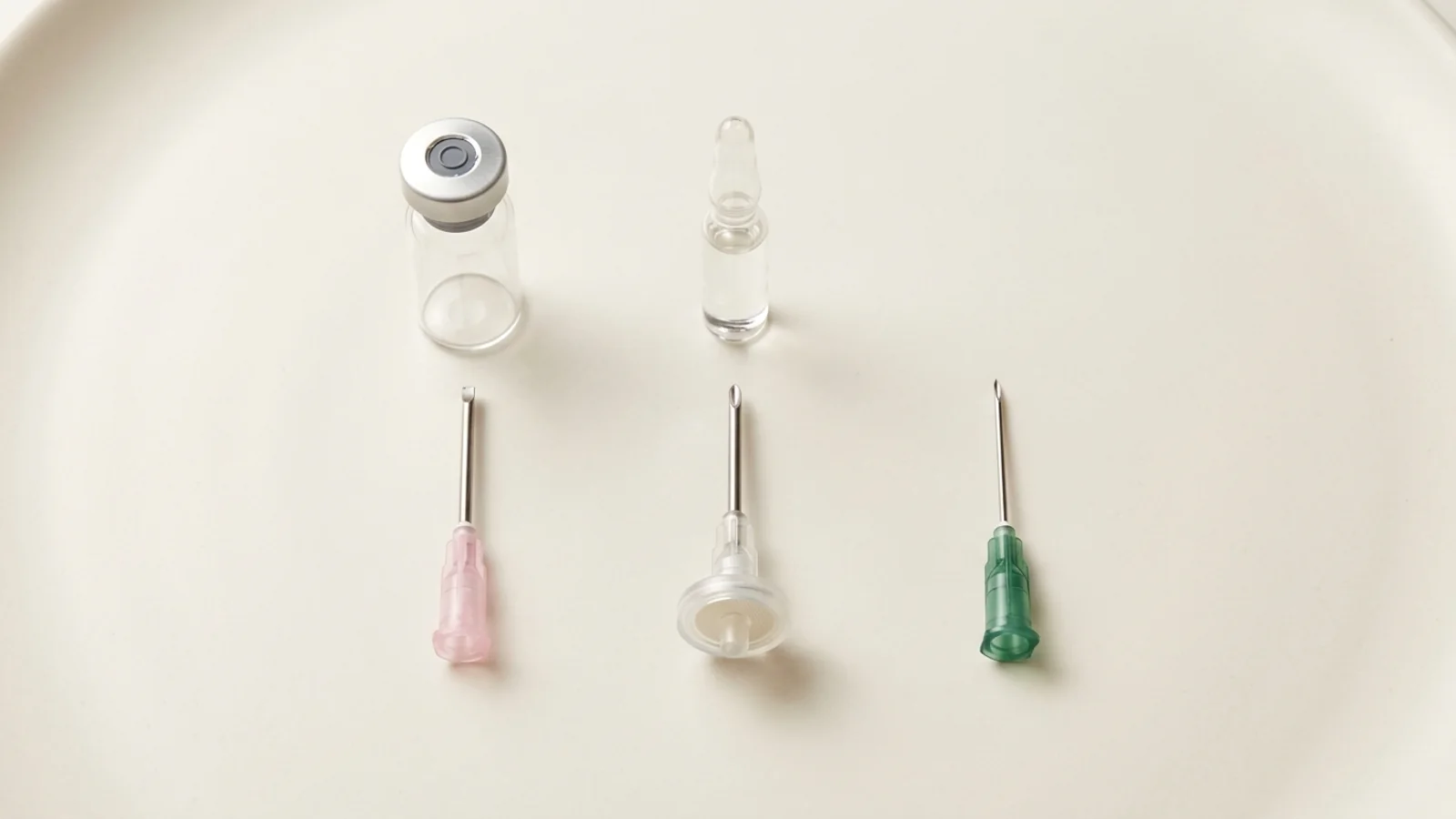
A hospital pharmacy or ward team standardizing medication-preparation supplies usually meets three listings that look almost identical on a price file: an 18 G x 1-1/2 in. blunt fill needle, an 18 G x 1-1/2 in. 5-micron blunt filter needle, and a cheaper bulk SKU of the filter needle. The purchasing question is which labeled product belongs at the vial stopper, which belongs at the glass ampoule, and which fields separate them before a code is loaded into the item master.
The short answer: buy the labeled purpose, not the hub color. BD's usage guidelines direct its blunt fill needle to vial-stopper puncture and its blunt filter needle to glass ampoules. They describe the filter needle as a one-way filter to be removed once fluid is filtered into the syringe, and state that neither product is to be used for skin injections. Cardinal Health describes its Monoject blunt fill needle as attached to a syringe for aspiration from multi-dose medication vials or injection into IV systems, and sells the same line with a 5-micron filter for ampule preparation. Sterility is a property of each order code, not of the product family: BD lists a sterile, single-use filter needle (305211) next to a Bulk Non-Sterile one (305236). Hub colors disagree between brands, so identity has to come from the order code, the product name and the GTIN.
What the labels say: fill needle for the vial, filter needle for the ampoule
BD's one-page usage guide for its blunt fill and blunt filter needles (document BD-1656, dated 05/23) gives the clearest labeled-purpose statement of any source here. It tells users to attach either needle to a standard Luer-Lok or Luer-Slip syringe and to puncture the vial stopper at 90 degrees with the blunt fill needle, adding: “For glass ampoules use the BD Blunt Filter Needle.” Its reminders state that the two products “are not to be used for skin injections” and that the blunt filter needle “is a one-way filter and should be removed once fluid is filtered into the syringe.” The guide also points to the difference in hub color between the two products. For indications, warnings and full instructions, it defers to the product labels and package inserts.
Cardinal Health describes its line differently. The Monoject product page says blunt fill needles “are attached to a syringe for aspiration from multi-dose medication vials or injection into IV systems.” It lists the line as available with and without a 5-micron filter that “effectively filters contaminant particles for safe ampule medication preparation.” So Cardinal's description of the line includes a second use, injection into IV systems, which BD's guide does not mention for its fill needle. When comparing the two brands, copy each manufacturer's labeled use into the item record instead of assuming the two match.
The one-way rule also appears outside manufacturer labeling. The Winnipeg Regional Health Authority's 2018 decision support tool defines a filter needle as a 5-micron device that “can be used either to withdraw or to inject but never for both.” Derbyshire Community Health Services NHS Foundation Trust's May 2025 staff notice tells teams to use one filter needle per drug, because the needles are single use, and not to expel medication through the same filter needle used to draw it up. For purchasing, this means filter-needle use rises with the number of filtered draws. The device used after the filter needle is a separate SKU with its own specification, such as a hypodermic syringe or an IV administration set connection.
SKU-by-SKU specifications: BD and Monoject compared
The fields below come from each manufacturer's live product pages, checked on October 12, 2026. Catalog data can change without notice, so re-check the product record before a contract award.
BD blunt fill and blunt filter needles
305180, BD Blunt Fill Needle 18 G x 1-1/2 in. The product page lists needle tip type Blunt, hub color Red and “Sterile, Single-use,” packed 100 per shelfpack and 1,000 per case. It gives separate GTINs for the unit (00382903051809), the shelfpack (30382903051800) and the case (50382903051804). Its typical-application field says only “General use.”
305211, BD Blunt 5 Micron Filter Needle 18 G x 1-1/2 in. The product page shows the same gauge, length and pack counts, with tip type Blunt Filter, hub color Clear and “Sterile, Single-use.” GTINs: unit 00382903052110, shelfpack 30382903052111, case 50382903052115.
305236, BD Blunt 5 Micron Filter Needle 18 G x 1-1/2 in., Bulk Non-Sterile. The family page lists this SKU next to 305211 under the same product name with “Bulk Non-Sterile” added. That page gives no hub color, pack count or intended use for it. Treat it as a different item, not a cheaper version of 305211.
305201, BD Nokor 5 Micron Filter Needle 18 G x 1-1/2 in. thin wall. BD's 305211 page lists this as an alternative. It has the same clear hub, the same 100 and 1,000 pack counts and the same sterile, single-use status. Its tip-type field reads Filter rather than Blunt Filter. These two clear-hub 5-micron filter needles from one manufacturer differ on the tip field, and the hub color cannot tell them apart.
The family page also lists 305181 (blunt fill needle, 18 G x 1 in.) and 3, 5 and 10 mL BD Luer-Lok syringes with an attached blunt fill needle (305060, 305062 and 305064). Each combination has its own order code. BD's performance claims for the family are manufacturer statements, not independent evidence. BD says the needles are designed to help reduce the risk of needlestick injury during medication preparation “due to higher skin penetration force,” compared with a BD 18 G conventional hypodermic needle. It also says the 5-micron membrane is designed to stop large particles from being drawn into the syringe when preparing medications from ampoules, and it reports no visible coring during medication draw in a bench study of 100 samples.
Cardinal Health Monoject blunt fill needles
11811022, Monoject Blunt Fill Needle 18G x 1-1/2". Pink hub; 100 per box, 1,000 per case.
11811022F, the same needle with a 5-micron filter. Purple hub; 100 per box, 1,000 per case.
Cardinal lists its features for the whole line rather than for each code. They are a standard Luer hub that fits all standard Luer-lock syringes, and a 45-degree bevel that Cardinal says helps reduce needlestick injuries. The line also has a red identification cap “for quick reference as blunt fill needle” and soft-pack packaging. Cardinal describes it as sterile, single-use and individually packaged, and not made with natural rubber latex. The page does not list GTINs, so take them from the package label or the supplier's item file.
Hub and cap colors are brand conventions, not a code
Colors do not carry across brands. BD uses a red hub for its blunt fill needle and a clear hub for its blunt filter needle. Monoject uses a pink hub for the fill needle and a purple hub for the filtered version, and lists a red identification cap for the line. The Derbyshire trust's notice describes its approved filter needles as “purple and red.” It tells staff that all-red needles are blunt needles that should not be used to filter glass ampoules. Under BD's scheme, red marks the unfiltered fill needle. On the filter needle that trust chose, red appears too.
ISO 6009, the color-coding standard for single-use hypodermic needles, assigns hub colors by needle size; our hypodermic needle gauge reference covers it. Neither manufacturer's page links its blunt fill or filter colors to that standard, so a pink, red or clear blunt hub says nothing reliable about function. Identity has to come from the order code, the product name, the tip-type field and the GTIN.
The comparison table: purpose, filter, sterility, hub coding, packaging
The table puts the decision fields side by side. “Not stated” means the field did not appear on the manufacturer page we checked. It does not mean the product lacks that property.
| Item (order code) | Stated container or use | Filter | Sterility claim | Hub / cap color | Packaging and identifiers |
|---|---|---|---|---|---|
| BD Blunt Fill Needle 18 G x 1-1/2 in. (305180) | Vial-stopper puncture (BD guide) | None | Sterile, single-use | Red hub | 100 per shelfpack, 1,000 per case; GTIN at each level |
| BD Blunt 5 Micron Filter Needle 18 G x 1-1/2 in. (305211) | Glass ampoules; one-way filter, removed once fluid is in the syringe (BD guide) | 5 micron; tip type Blunt Filter | Sterile, single-use | Clear hub | 100 per shelfpack, 1,000 per case; GTIN at each level |
| BD Blunt 5 Micron Filter Needle 18 G x 1-1/2 in., Bulk Non-Sterile (305236) | Not stated | 5 micron (per product name) | Bulk Non-Sterile | Not stated | Not stated |
| BD Nokor 5 Micron Filter Needle 18 G x 1-1/2 in. thin wall (305201) | Not stated in the fields reviewed | 5 micron (per product name); tip type Filter | Sterile, single-use | Clear hub | 100 per shelfpack, 1,000 per case |
| Monoject Blunt Fill Needle 18G x 1-1/2" (11811022) | Aspiration from multi-dose vials or injection into IV systems | None | Sterile, single-use, individually packaged (line statement) | Pink hub; red identification cap (line feature) | 100 per box, 1,000 per case; soft pack; GTIN not on page |
| Monoject Blunt Fill Needle with 5 micron filter (11811022F) | Ampule medication preparation (filter feature) | 5 micron | Sterile, single-use, individually packaged (line statement) | Purple hub; red identification cap (line feature) | 100 per box, 1,000 per case; soft pack; GTIN not on page |
| Conventional sharp hypodermic needle (contrast) | Injecting or withdrawing fluids below the skin (21 CFR 880.5570 identification) | None | Verify per SKU | ISO 6009 color by needle size | See the needle gauge reference |
Three findings matter most. Two 18 G x 1-1/2 in. BD filter needles share a product name but not a sterility claim. Two BD clear-hub 5-micron filter needles differ in tip type. And the same color means different things in different brands. None of these differences shows up on a price file that lists only a description and a unit price.
Why the filter exists: glass-particle evidence and its limits
Breaking open a glass ampoule can shed glass particles into the solution, and a series of laboratory studies has counted them. These are particle counts under test conditions, not clinical outcomes. Each study used different ampoules, needles, filters and counting methods, so their numbers cannot be compared across studies.
| Study | Setup | Main finding | Limits |
|---|---|---|---|
| Sabon et al., Anesthesiology 1989 | Four aspiration groups (3 mm tubing control, 18-g 1.5-inch needle, filter needle, in-line filter), then four ampule types | Mean glass particles per ampule: 100.6 ± 16.3 control, 65.6 ± 18.7 with the 18-g needle, 1.3 ± 0.3 with the filter needle, 1.2 ± 0.3 with the in-line filter. Transparent metal-etched ampules yielded 45.9 ± 15.4 particles against 3.1 to 6.0 for the other three types | 1989 devices and ampules; particle counts only |
| Erkoc Hut and Yazici, Journal of Advanced Nursing 2021 | Pilot; three ampoule types; 21 or 22 G needles with and without syringe filters | Glass particles of 0.94 to 90.70 µm in 94% of all samples; filtration had no effect in one group and was up to 85% effective in the other two | Syringe filters, not 18 G blunt filter needles; pilot scale |
| Chiannilkulchai and Kejkornkaew, Int J Qual Health Care 2021 | 56 nurses broke 672 ampoules (2 mL and 10 mL, six breaking methods) in a nursing laboratory | 449 of 672 ampoules contaminated, 2,744 particles in total; 10 mL against 2 mL ampoules, odds ratio 9.53 (95% CI 6.19 to 14.69) | One hospital; artificial setting; compared breaking methods, not filters |
| Joo, Sohng and Park, SpringerPlus 2016 | 180 ampules of 2 mL ascorbic acid, 45 per method, 23 G needles; aspiration not deliberately slow | Filter-needle group 110.47 ± 81.58 particles per ampule against 114.87 ± 89.26 for immediate unfiltered aspiration; not significantly different | One ampule type from one manufacturer |
| Carbone-Traber and Shanks 1986, as summarized in a 2013 review | Ten ampoules per group; 3 mm tubing control | Control 12 ± 5, unfiltered 18 g needle 13 ± 6, 5 µm filter needle 13 ± 7; the authors suggested aspiration force may push particles through the filter | Small sample; secondary summary |
Taken together, the studies show that glass particles are common after an ampoule is opened, and that filtration can remove most of them under some test conditions. The same 2013 review cites Zabir and colleagues (2008): none of 120 samples drawn through a 5 µm filter contained glass, against 9.2% of 120 drawn through an unfiltered 18 g needle. Filtration does not always help, though. Joo and colleagues found no significant difference with filter needles when aspiration was not deliberately slow. They concluded that filter needles may not be as effective as commonly believed unless combined with slow, low-pressure aspiration. The 1986 study found no benefit at all. Chiannilkulchai and Kejkornkaew grouped particle sizes by the inner diameters of 18 to 20 G needles and found far more contamination in 10 mL ampoules than in 2 mL ones.
The evidence of harm is weaker still. The 2021 Thai study cites reports linking injected glass particles to infusion phlebitis, pulmonary emboli, granuloma formation and nodular liver fibrosis. The 2013 review, a student literature review in the Australian Medical Student Journal, found contamination well documented but evidence of resulting clinical harm in humans lacking. It concluded that universal filter-needle use for intravenous ampoule draws could not be justified on that evidence, given the cost. It also cited a Cochrane review that found insufficient evidence to recommend in-line filters in neonates. The Winnipeg tool calls glass-shard harm “a theoretical concern in the literature, the clinical significance of which is not clear.”
For a buyer, the conclusion is narrow. The evidence supports making filter needles available wherever facility policy calls for filtered ampoule draws. It does not establish that every ampoule draw in every setting needs one, and particle counts are not patient outcomes. Where filtration is required is a clinical policy decision. Purchasing's job is to make sure the correct, sterile, clearly identified SKU is there when policy requires it.
US regulatory identity: confirm the product code per SKU
FDA lists devices under product codes tied to classification regulations. The code for conventional hypodermic needles is FMI: “needle, hypodermic, single lumen,” a Class II device regulated under 21 CFR 880.5570, with a 510(k) submission type and review by the General Hospital panel. The regulation's identification describes a device “intended to inject fluids into, or withdraw fluids from, parts of the body below the surface of the skin.” It is a metal tube sharpened at one end, with a hub that connects to a piston syringe or an administration set. That matches the sharp contrast row in the table above. It does not literally describe a blunt device made only for preparation and labeled not for skin injection.
FDA has handled at least one blunt access device under that code. In December 1996 it found the Monoject Blunt I.V. Access Cannula, and a Monoject syringe with that cannula, substantially equivalent under product code FMI (K960982, applicant Sherwood Medical Co.). That record covers one legacy device. It does not give the product code, device class or premarket number for any current BD or Cardinal blunt fill or filter SKU, and an assumption about the whole family is no substitute.
The practical check is per SKU. Ask the supplier for the FDA product code, device class and any premarket submission number for each order code. Then compare them with the GUDID record for the device identifier; our UDI and GUDID guide explains how to read one. If two candidate SKUs carry different product codes, record the difference instead of treating them as interchangeable.
FDA's recognized-standards list for FMI includes ISO 7864 (sterile hypodermic needles for single use) and ISO 9626 (stainless steel needle tubing). It also includes ISO 6009 (color coding), ISO 80369-7 (small-bore connectors for intravascular or hypodermic use) and ISO 23908 (sharps injury protection, both the 2011 edition and the second edition of 2024-12). The list belongs to the product code, not to any one blunt SKU. Use it as a prompt rather than a checklist, and ask which standards the supplier's test reports for that SKU actually cite. The connector standard is a sensible first question, because both manufacturers market their hubs on standard Luer fit.
OSHA and the needlestick-reduction claims
OSHA's bloodborne pathogens standard, 29 CFR 1910.1030, requires engineering and work practice controls to eliminate or minimize employee exposure (paragraph (d)(2)(i)). Its definition of engineering controls gives sharps disposal containers, self-sheathing needles and safer medical devices as examples. Employers must review the exposure control plan at least once a year, and the review must document that appropriate, commercially available, effective safer medical devices were considered and implemented. The standard does not name blunt fill or blunt filter needles.
Manufacturers market these products in that context. BD compares its needles with its own 18 G conventional hypodermic needle, and Cardinal credits its 45-degree bevel with reducing needlestick injuries. Both are company claims, not independent comparative evidence. If your facility cites them in its safer-device review, record them as manufacturer evidence. Used devices still go to a sharps collector. BD's guide says to discard them into an approved sharps collector after single use, so a sharps container that fits them belongs on the supply list for every preparation area.
Practice standards and facility policy: what actually governs the choice
Professional standards push toward filtering ampoule draws. A 2013 letter in the Anesthesia Patient Safety Foundation newsletter says that the American Society of Health-System Pharmacists (ASHP) and the Infusion Nurses Society (INS) base their guidelines on filter-needle use with glass ampoules on USP Chapter <797>. It adds that The Joint Commission considers USP “best” clinical practice. The letter recommends that blunt filter needles or filter straws with a 5-micron filter be available and used every time medication is aspirated from a glass ampoule. Joo and colleagues cite the 2014 ASHP guidelines on compounding sterile preparations, which recommend 5 µm filter straws or filter needles when aspirating ampule contents. BD says its products align to the 2024 INS Standards of Practice, which according to BD recommend a blunt filter needle when preparing medications from glass ampoules.
These are secondhand statements of the standards. The ASHP, INS and USP texts are subscription documents and are not quoted directly here, so confirm the current wording with your pharmacy and infusion-practice leads before you cite them in a tender.
Published policies also limit filter use. The Winnipeg tool recommends “discriminate use” of filter needles. It advises them in specific situations: ampoules larger than 1 mL, intravenous or central-catheter administration, repeated exposure, aspiration needles of wider bore than 21 G (for example, 18 G) and vulnerable patients such as neonates. It does not recommend filter needles for drawing up epinephrine in suspected anaphylaxis or naloxone in suspected opioid overdose, because filtering may delay treatment. Citing the National Advisory Committee on Immunization (NACI), it treats filter needles as not recommended for vaccines and their diluents. It also calls them not indicated for biological products, because a filter could remove adjuvants or other active ingredients. Joo and colleagues note that filter-needle policies vary between institutions and countries, and that filters are often not used because they are expensive and cumbersome. The 2021 Thai study cites cost and time constraints.
What that means for stocking
Purchasing does not decide which draws are filtered, but the item master shapes what is possible on the unit. Three stocking shortcuts deserve scrutiny:
Fill needles only. This means fewer SKUs, but a unit that draws from glass ampoules has no access to the product BD's guide names for ampoules. If policy requires filtration there, this is a supply gap.
Filter needles only. This is not the split BD's guide describes, since the guide names the fill needle for stopper puncture. Because the filter is labeled one-way, a filter needle cannot replace a fill needle in a workflow that both adds and withdraws fluid. Compare costs using your own contract prices; this guide does not publish prices.
Bulk non-sterile filter SKUs. These do not belong in a sterile medication-preparation item master. BD's family page does not state what 305236 is intended for, so ask BD before buying it for any purpose.
Procurement checks before standardizing or switching SKUs
Describe the item by function and code. The item-master line should give the manufacturer, order code, product name (“blunt fill” or “5 micron blunt filter”), gauge and length, sterility claim, and “preparation only, not for skin injection.” Avoid color-only names such as “red prep needle.” The Derbyshire trust found that some teams had ordered blunt fill needles thinking they were filter needles, and asked those teams to remove the all-red blunt needles and stock purple filter needles instead.
Verify sterility for each order code. Read the sterility or single-use field on the product page or label for every code, including distributor substitutes. 305211 and 305236 share a product name, and only one is labeled sterile.
Check the filter rating and tip type. Confirm “5 micron” in the product name or specification, and read the tip-type field: BD uses Blunt, Blunt Filter and Filter as separate values.
Capture GTINs at every packaging level. BD lists different GTINs for the unit, the 100-count shelfpack and the 1,000-count case. Load all three, so a scan at receiving maps to the right unit of measure. For Monoject codes, take GTINs from the package labels. Our UDI and GUDID guide covers what to record.
Confirm regulatory identity for each SKU. Ask for the FDA product code, device class and any premarket number for each order code. Do not carry over a legacy record from a different device.
Record material and disposal fields. Cardinal states that its Monoject line is not made with natural rubber latex. The BD pages reviewed do not state latex status, so ask for it if your facility requires it. Make sure the preparation area has a sharps container that fits the used devices.
Run a brand switch as a change-control event. Changing brands can flip the color logic: red marks BD's fill needle but also appears on the filter needle the Derbyshire trust chose. Remove the old stock, update shelf labels and pick lists, and tell users before the new codes arrive.