
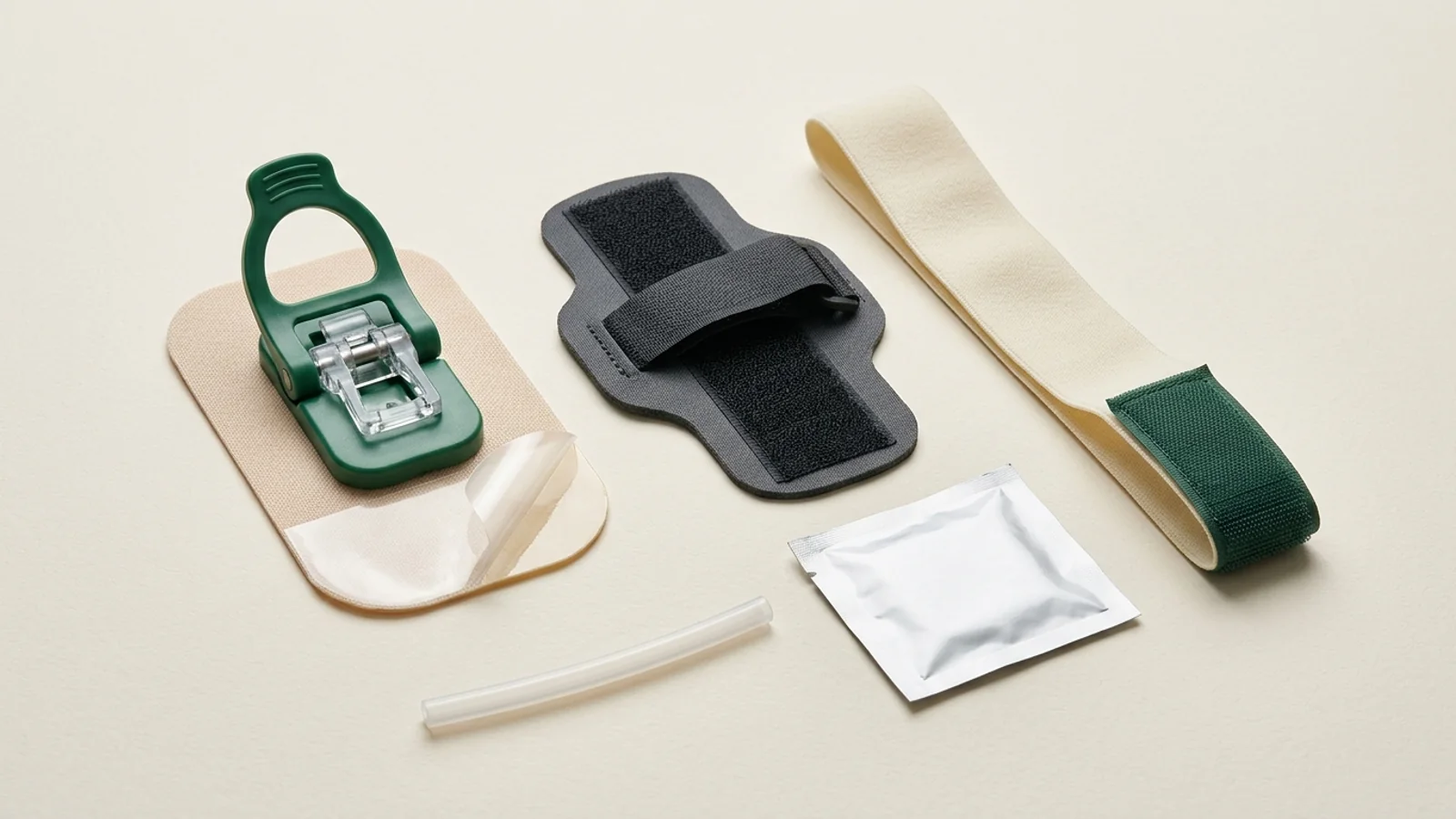
Buy a catheter securement device by matching four verifiable parameters rather than purchasing by general catalog category: the specific catheter type and French size the device is explicitly labeled to hold, the physical anchoring mechanism (adhesive anchor pad, hook-and-loop platform, non-adhesive leg strap, or subcutaneous nitinol anchor), the skin-contact and sterility disclosures on the primary package label, and the resulting regulatory classification and reimbursement billing code. Procurement teams frequently treat catheter securement as an interchangeable commodity, only to experience SKU-level retention failures, uncompensated medical adhesive-related skin injuries (MARSI), or rejected reimbursement claims.
The regulatory status of catheter securement is bifurcated across the U.S. Food and Drug Administration (FDA) device panels. An adhesive-backed anchor pad placed over the hub of an indwelling catheter is identified under 21 CFR 880.5210 (product code KMK) as a Class I, 510(k)-exempt intravascular catheter securement device, while urological catheter holders fall under 21 CFR 876.5130(b)(2) (product code EYJ) as Class I, 510(k)-exempt accessories. 510(k) exemption does not exempt manufacturers from Good Manufacturing Practice (GMP) requirements under 21 CFR 820. Under 21 CFR 880.9, the exemption applies only to devices with existing or reasonably foreseeable characteristics of that generic type; a different intended use or a different fundamental scientific technology requires a 510(k). Antimicrobial coatings and novel mechanical anchors are not named in 880.9 and must be assessed against those conditions rather than assumed to remain exempt. Subcutaneous anchor systems such as SecurAcath are Class II cleared devices under 21 CFR 880.5970 (510(k) K210629), and film-forming liquid securement adhesives with microbial barrier claims such as SecurePortIV Advanced require Class II 510(k) clearance under 21 CFR 878.4370 (product code NZP, 510(k) K223669).
Catheter fit is strictly SKU-dependent. Becton Dickinson's (BD) StatLock Foley stabilization devices explicitly accommodate latex catheters sized 8–22 Fr and silicone catheters sized 8–24 Fr across dedicated 2-way, 3-way, and pediatric SKUs. TIDI's Grip-Lok line relies on sized hook-and-loop platforms engineered to grip silicone and PVC tubing. Conversely, competing devices such as HR HealthCare's TruLock publish 2-way and 3-way clamp configurations but omit exact French size ranges on standard catalog pages. Sourcing teams must record unstated fields as unknown rather than inferring clinical interchangeability. For U.S. outpatient and homecare billing, the Healthcare Common Procedure Coding System (HCPCS) separates devices by mechanism: code A4333 covers adhesive skin attachment devices with release mechanisms, code A4334 covers non-adhesive leg straps, and code A5200 is restricted to percutaneous tubes. One commercial payer example, Aetna Clinical Policy Bulletin 0533, currently lists a usual maximum of three A4333 adhesive anchoring devices per week and three A4334 leg-strap devices per week; other payers publish different quantity limits.
What a Catheter Securement Device Is, and the Mechanisms Buyers Meet
In medical consumable purchasing, a catheter securement device is an external or subcutaneous accessory designed to anchor an indwelling catheter, line, or drainage tube to the patient's body, preventing dislodgement, accidental pull-out, piston-like back-and-forth movement, and traction forces at the insertion site or anatomical junction. The generic category title encompasses five fundamentally different mechanical approaches:
Adhesive Anchor Pad with Mechanical Retainer: A fabric (tricot polyester) or closed-cell foam pad backed with pressure-sensitive medical adhesive that adheres to intact skin. The topside features a rigid plastic housing—a push-to-close clasp or a 360-degree swivel retainer—that mechanically captures the catheter bifurcation, hub, or shaft (BD StatLock Foley lists a push-to-close retainer with swivel; HR HealthCare TruLock lists a 360-degree rotation swivel clamp).
Low-Profile Hook-and-Loop Platform: An adhesive-backed anchor pad topped with a flexible hook-and-loop fabric flap that wraps around the catheter tubing or hub (exemplified by TIDI Grip-Lok). This platform provides a low profile, allowing a secondary transparent film dressing to be applied over vascular hubs, and enables repeated opening for catheter line adjustment.
Non-Adhesive Leg Strap Holder: An elasticized fabric band worn circumferentially around the patient's thigh or calf, secured with hook-and-loop closures, featuring an integrated tubing clip or fabric retention tab. It eliminates adhesive-to-skin contact, which is why CMS distinguishes this mechanism as HCPCS A4334 rather than adhesive-skin code A4333.
Subcutaneous Engineered Anchor: A sterile, single-use Class II device (SecurAcath) featuring two blunt nitinol wire wings deployed through the catheter puncture tract into the subcutaneous tissue directly beneath the dermis, locking to an external clamp. It provides mechanical anchoring for the entire dwell time of central vascular lines without skin adhesives.
Film-Forming Liquid Adhesive / Microbial Sealant: A sterile Class II liquid cyanoacrylate formulation (SecurePortIV Advanced) applied directly to the vascular catheter-skin junction, polymerizing into a flexible film that seals the entry site and bonds the catheter hub to the skin under a transparent dressing.
Because each mechanism family presents distinct clinical risks, regulatory burdens, and reimbursement rules, procurement contracts must never specify generic 'catheter securement' without defining the mechanism subcategory.
Why Catheter Securement Is a Purchasing Category
Catheter securement is a purchasing category because infection-prevention guidelines treat proper catheter securement as a recommended practice, not because a single regulation names a specific device SKU.
For urinary catheters, the U.S. Centers for Disease Control and Prevention (CDC) Healthcare Infection Control Practices Advisory Committee (HICPAC) Guideline for Prevention of Catheter-Associated Urinary Tract Infections establishes Recommendation II.E as a Category IB recommendation: 'Properly secure indwelling catheters after insertion to prevent movement and urethral traction.' That is a Category IB guideline recommendation, not a legal mandate, and it does not specify a brand, mechanism, French range, or HCPCS code.
However, hospital buyers must exercise rigorous critical judgment when evaluating vendor outcome claims. Becton Dickinson's official marketing documentation for the StatLock Foley device cites a clinical study demonstrating a 45% reduction in symptomatic catheter-associated urinary tract infections compared to traditional medical tape. Yet the same manufacturer documentation transparently discloses that the difference did not achieve statistical significance (P = .16). Sourcing committees must distinguish established mechanical stabilization benefits—preventing accidental catheter tension and dislodgement—from unproven marketing claims of guaranteed infection reduction.
Hold performance is mechanism-specific, not category-wide. In a 3M-funded pig-model study of 7 Fr triple-lumen central venous catheters, peak axial pull force was measured only 10 minutes after application. An adhesive StatLock PICC Plus securement device (not a Foley stabilizer) withstood a mean peak force of 36.98 N, compared to 27.56 N for silk sutures and only 17.44 N for a standard transparent securement dressing. Those numbers do not transfer to urinary securement or multi-day wear. A catalog label stating 'catheter securement' still provides no baseline holding-power guarantee.
One Catalog Name, Several FDA Classifications
Procurement specifications frequently err by assuming all catheter securement products are simple Class I exempt medical disposables. In reality, the regulatory path splits according to anatomical contact, invasive depth, and whether chemical or antimicrobial claims are made.
| Mechanism / Device Type | 21 CFR Regulation | Product Code | FDA Class | 510(k) Status | GMP / QMSR Scope |
|---|---|---|---|---|---|
| Intravascular Adhesive Hub Anchor | 21 CFR 880.5210 | KMK | Class I | 510(k) Exempt (subject to 880.9) | Full GMP / 21 CFR 820 applies |
| Urological Catheter Holder / Strap | 21 CFR 876.5130(b)(2) | EYJ | Class I | 510(k) Exempt (subject to 876.9) | Full GMP / 21 CFR 820 applies |
| Subcutaneous Nitinol Anchor | 21 CFR 880.5970 | OKC / KMK | Class II | 510(k) Cleared (K210629) | Full GMP; Premarket review required |
| Microbial Sealant Liquid Adhesive | 21 CFR 878.4370 | NZP | Class II | 510(k) Cleared (K223669) | Full GMP; Premarket review required |
Under 21 CFR 880.5210, the FDA identifies an intravascular catheter securement device as an adhesive-backed device placed over a needle or catheter to keep the hub flat and securely anchored to the skin. While classified as Class I and exempt from 510(k) premarket notification, this exemption is strictly governed by 21 CFR 880.9 (Limitations of exemptions). If the device is intended for a different use than the generic type, or uses a different fundamental scientific technology, 21 CFR 880.9 requires a 510(k). Buyers should not treat antimicrobial, microbial-sealant, or subcutaneous-anchor claims as remaining inside the KMK exemption without a supplier classification statement.
Similarly, urological catheter accessories fall under 21 CFR 876.5130. While indwelling urological catheters themselves are Class II devices, urological catheter holders (product code EYJ) are Class I exempt accessories. Manufacturers of both KMK and EYJ devices remain fully subject to FDA Establishment Registration, Device Listing, Medical Device Reporting (MDR under 21 CFR 803), and Quality System Regulations (QSR / QMSR under 21 CFR 820). Sourcing managers must demand an official 510(k) Exemption Declaration or 510(k) Clearance Summary for every catalog item.
flowchart TD
    A["Catheter Securement Requirement"] --> B{"Intended Anatomical Location & Mechanism"}
    B -->|"Skin Adhesive Anchor / Foley Retainer"| C["21 CFR 876.5130 / Code EYJ<br>Class I (510k-Exempt)"]
    B -->|"Skin Adhesive Anchor / Vascular Hub"| D["21 CFR 880.5210 / Code KMK<br>Class I (510k-Exempt)"]
    B -->|"Circumferential Non-Adhesive Strap"| E["21 CFR 876.5130 / Code EYJ<br>Class I (510k-Exempt)"]
    B -->|"Subcutaneous Nitinol Wire Anchor"| F["21 CFR 880.5970 / OKC and KMK<br>Class II Cleared (K210629)"]
    B -->|"Liquid Cyanoacrylate Microbial Sealant"| G["21 CFR 878.4370 / Code NZP<br>Class II Cleared (K223669)"]

    C --> H["HCPCS Billing: A4333<br>(Adhesive Skin Anchor)"]
    E --> I["HCPCS Billing: A4334<br>(Non-Adhesive Leg Strap)"]
    D --> J["Inpatient / Bundle Facility Cost"]
    F --> J
G --> JMatching the Device to the Catheter It Holds
The most common operational failure in catheter securement sourcing is purchasing a device that physically crimps the catheter lumen or fails to grip the catheter shaft. Catheter tubing materials (latex, silicone, polyurethane, fluorinated ethylene propylene) have vastly different surface energies and outer diameters across French size ranges.
In urology, indwelling Foley catheters feature a drainage lumen and an inflation lumen, with 3-way variants adding an irrigation channel (as detailed in our Foley Catheter Sizes Procurement Guide and companion Urine Drainage Bag Specification Guide). Retention clamps must engage the bifurcation junction without occluding drainage flow:
BD StatLock Foley: Engineered specifically for indwelling urinary lines. BD labels its standard adult devices to accommodate latex Foley catheters sized 8–22 Fr and 100% silicone Foley catheters sized 8–24 Fr. BD lists separate adult, pediatric, and dedicated 3-way SKUs (including FOL0105 for 3-way catheters). The public page does not explain why the latex and silicone French ranges differ, so buyers should treat those labeled ranges as SKU fields rather than inferring clamp calibration.
HR HealthCare TruLock: Features a 360-degree rotating swivel clamp available in dedicated 2-way and 3-way configurations. The swivel clamp allows the catheter to rotate naturally as the patient shifts position in bed, preventing catheter twisting. However, HR HealthCare's public product documentation does not state calibrated French size limits. Sourcing agents must verify the acceptable French range directly from the manufacturer's technical file before standardizing.
TIDI Grip-Lok: Employs a universal hook-and-loop platform rather than a rigid plastic latch. TIDI claims adhesion to silicone, PVC, and other polymer compounds across central venous catheters, peripheral lines, and urinary tubes. While offering flexibility across line types, retention depends entirely on surface shear friction between the hook-and-loop flap and the tubing wall.
Interrad Medical SecurAcath: Manufactured in discrete French-specific sizes: 3F, 4F, 5F, 6F, 7F, 8F, 10F, and 12F. Because the device secures the line via an engineered plastic clamp precisely sized to the outer diameter of vascular catheters (such as PICCs and central lines covered in our Intravascular Catheter Specifications Guide), a 5F clamp is a different SKU from a 4F clamp; K210629 lists discrete sizes rather than a continuous range.
| Device Family | Retention Type | Labeled Catheter Types | Stated French Sizes | Configuration Variants | Unreported / Unknown Fields |
|---|---|---|---|---|---|
| BD StatLock Foley | Push-to-close swivel retainer | Foley catheters (Latex & Silicone) | Latex: 8–22 Fr; Silicone: 8–24 Fr | Adult 2-way, Adult 3-way (FOL0105), Pediatric | Sterility status not declared on web listing |
| HR HealthCare TruLock | 360° swivel clamp | Foley catheters | Unstated on catalog page (UNKNOWN) | 2-way clamp, 3-way clamp | French size range; wipe liquid formulation |
| TIDI Grip-Lok | Hook-and-loop fabric platform | Tubes, lines, Foley, PICC, PVC & Silicone | Not stated as French ranges on cited page (UNKNOWN) | Size-coded lines claimed; no French table on cited page | French table; product code; HCPCS; 4.9× adhesion is data on file |
| Interrad SecurAcath | Subcutaneous nitinol wings + clamp | Percutaneous IV catheters and abscess/general drainage | 3F, 4F, 5F, 6F, 7F, 8F, 10F, 12F | Discrete single-French size SKUs | Latex/DEHP and HCPCS not stated in K210629 |
When a vendor leaves French size ranges or catheter wall compatibility blank, procurement officers must mark the field as unknown. Never assume that a 2-way urological securement clamp will accommodate a 3-way irrigation catheter, or that an IV cannula anchor (see IV Cannula Specifications) will hold a heavy drainage line.
Skin-Contact Claims and What They Are Actually Worth
Catalog listings for adhesive catheter securement devices abound with unregulated marketing terminology, such as 'hypoallergenic,' 'medical-grade adhesive,' and 'gentle on skin.' Sourcing teams must cut through these ambiguous marketing phrases and evaluate verifiable technical disclosures.
TIDI's Grip-Lok marketing page claims a medical-grade, hypoallergenic adhesive, adhesion of up to 4.9 times stronger than commonly used tape as data on file at TIDI Products, and conformance with Infusion Nurses Society guidelines for engineered securement. Those phrases are vendor claims: hypoallergenic and medical-grade are not standardized FDA terms, the 4.9× figure is unpublished internal data, and INS language is the vendor's interpretation of a professional-society standard, not an FDA requirement. Stronger adhesion is not automatically better, given MARSI risk.
Latex and DEHP Disclosures
Because catheter securement devices remain in direct contact with the patient's skin for days, material declarations are critical. BD StatLock Foley devices are labeled 'made without natural rubber latex.' HR HealthCare's TruLock explicitly states that it contains no natural rubber latex and no di(2-ethylhexyl) phthalate (DEHP). TIDI Grip-Lok is labeled made without latex. Sourcing contracts must mandate explicit negative declarations rather than accepting silence as proof of latex-free status.
Anchor Pad Materials, Breathability, and Perspiration
The physical base material determines moisture management beneath the adhesive. BD offers StatLock Foley anchor pads in two distinct constructions: a breathable tricot polyester fabric pad and a closed-cell foam pad equipped with engineered perspiration holes. Tricot polyester allows insensible perspiration to vaporize through the textile weave, reducing moisture accumulation. BD warns about loss of adherence with diaphoretic or nonadherent skin. Foam variants with perspiration holes are a listed SKU difference, not a care protocol.
Skin Preparation Pads and Acrylic Barrier Films
A critical procurement detail is whether the securement SKU includes a dedicated skin-preparation wipe. BD StatLock Foley and BD StatLock IV Ultra include a proprietary skin preparation wipe that applies a polymeric acrylic barrier film to the skin prior to device placement. This barrier serves two technical purposes:
Epidermal Protection: BD describes an acrylic layer that protects the skin; that is a labeled barrier-film function, not evidence that MARSI is eliminated.
Adhesion Enhancement: BD explicitly notes that the acrylic layer creates an optimized surface energy profile; applying the anchor pad to bare skin without the prep pad can result in premature edge lifting and line failure.
HR HealthCare similarly bundles a CliniCare skin preparation wipe inside each TruLock pouch. When evaluating unit pricing across competing bids, buyers must verify whether skin prep wipes are included in the primary blister pouch or must be purchased as an auxiliary line item.
Medical adhesive-related skin injury (MARSI) is defined in consensus nursing and intensive-care literature as any skin integrity alteration—including persistent erythema, epidermal stripping, tension blisters, maceration, or skin tears—that persists for 30 minutes or longer after adhesive removal. A scoping review of adult ICU literature listed catheter fixators among adhesive exposures, alongside electrodes, dressings, and tube attachments.
Preventing MARSI requires matching adhesive wear time to patient skin condition. BD StatLock Foley labeling specifies that adhesive components are validated for continuous wear up to 7 continuous days, requiring daily clinical inspection and replacement at least every 7 days (or sooner if clinically indicated by exudate or soiling). Wear time is a labeled field, not a category default. BD StatLock Foley labeling supports up to 7 continuous days with daily monitoring and replacement at least every 7 days; if a competing listing omits wear time, record it as unknown rather than assuming a 7-day interval.
Biocompatibility and ISO 10993-1 Verification
Skin-contact devices should have a documented biological evaluation. FDA's final guidance on ISO 10993-1 explains a risk-based approach for devices that contact the body, including recommendations for materials that only contact intact skin. The standard was retitled in its 2025 edition as ISO 10993-1:2025. That guidance does not automatically require a fixed battery of cytotoxicity, sensitization, and irritation tests for every adhesive pad. Ask suppliers for a current-edition ISO 10993-1 evaluation or rationale; vendor statements may still cite older editions.
Sterility, Single-Use, and Packaging Statements
Sterility requirements in catheter securement depend strictly on proximity to the insertion site and the care setting.
For vascular access consumables (such as PICCs, central lines, and peripheral cannulas), securement devices reside adjacent to or directly over the bloodstream entry wound. Consequently, devices like BD StatLock IV Ultra and TIDI Grip-Lok are labeled sterile and packaged in individual peel pouches designed for presentation within a sterile procedural field. Interrad's SecurAcath subcutaneous anchor undergoes terminal ethylene oxide (EO) sterilization to achieve a sterility assurance level (SAL) of 10⁻⁶, with sterile barrier integrity validated per ASTM D4169.
For urological catheter securement, packaging practices vary significantly across the industry:
HR HealthCare TruLock is labeled sterile with a do-not-resterilize statement. The cited page does not name ISO 15223-1.
BD StatLock Foley marketing documentation omits an explicit sterility claim on its primary public product page. In clinical practice, Foley securement is placed on the intact upper thigh following catheter placement, outside the sterile insertion field. However, procurement contracts must inspect physical unit packaging to verify whether the product is supplied sterile or non-sterile.
Receiving dock inspection must follow standard sterile barrier verification procedures (as outlined in our guide on Recording Sterile-Pouch Damage at Goods Receipt). Any pouch exhibiting puncture, compromised heat seals, or missing UDI barcodes (see UDI and GUDID for Medical Consumables) must be quarantined immediately.
Coding and Coverage Fields for US Buyers
For U.S. hospital networks operating outpatient infusion clinics, home health agencies, or durable medical equipment (DME) supply businesses, correct HCPCS billing code alignment is essential to avoid reimbursement denials and audit recoupments.
Under the Centers for Medicare & Medicaid Services (CMS) Medicare Policy Article A52521 (Urological Supplies), catheter anchoring accessories are categorized into distinct HCPCS codes based entirely on physical mechanism:
| HCPCS Code | Official Long Descriptor | Mechanical Criteria | CMS / Payer Medical Necessity Scope | Typical Payer Utilization Cap |
|---|---|---|---|---|
A4333 | Urinary catheter anchoring device, adhesive skin attachment, each | Adhesive surface attached to patient skin with release/re-anchor mechanism | Covered for indwelling urethral catheters | Aetna CPB 0533 table: usual maximum 3 per week (payer-specific) |
A4334 | Urinary catheter anchoring device, leg strap, each | Non-adhesive fabric strap encircling leg with release/re-anchor mechanism | Covered for indwelling urethral catheters; non-adhesive alternative | Aetna CPB 0533 table: usual maximum 3 per week (not 1 per month) |
A5200 | Percutaneous catheter/tube anchoring device, adhesive skin attachment | CMS: adhesive dressing over the cutaneous opening, with a hole for the tube (e.g., suprapubic, nephrostomy) | CMS: bill A4333/A4334 for indwelling urethral catheters; A5200 is for percutaneous tubes | Aetna: not medically necessary to anchor an indwelling catheter |
CMS policy establishes that an anchoring device billed under A4333 must possess an adhesive surface that attaches to the patient's skin and a mechanism for releasing and re-anchoring the catheter multiple times without changing the anchoring device. HR HealthCare lists TruLock under A4333. BD's StatLock Foley page does not publish a HCPCS code, so a buyer still needs the supplier's coding assignment rather than inferring coverage from a catalog photo. Circumferential fabric bands with a release/re-anchor mechanism map to A4334.
Billing teams should treat quantity limits as payer-specific. Aetna CPB 0533's HCPCS table currently lists a usual maximum of 3 per week for A4333, A4334, and A5200, and states that A5200 is not medically necessary to anchor an indwelling catheter. That table is one commercial payer's rule, not a national CMS quantity, and it does not use a 1-per-month cap for A4334 (that monthly cap in the same bulletin applies to replacement urinary-leg-bag straps A5113/A5114). CMS Policy Article A52521 separately instructs that adhesive devices used with indwelling urethral catheters are billed as A4333 or A4334, while A5200 is reserved for percutaneous tubes such as suprapubic or nephrostomy tubes.
Cross-Vendor Comparison Table and Purchasing Checklist
To support tender evaluation and distributor contract negotiations, the following matrix compiles verified technical attributes across prominent market families. Unstated attributes are flagged as unknown.
| Specification Field | BD StatLock Foley | BD StatLock IV Ultra | HR HealthCare TruLock | TIDI Grip-Lok | Interrad SecurAcath |
|---|---|---|---|---|---|
| Anchoring Mechanism | Adhesive pad + push-to-close swivel retainer | Adhesive pad + snap retainer | Adhesive pad + 360° swivel clamp | Adhesive pad + hook-and-loop flap | Subcutaneous nitinol wings + clamp |
| Target Catheter Lines | Foley (Latex & Silicone) | Vascular (BD & B. Braun non-winged) | Foley catheters | Tubes, lines, catheters, drains, hubs, and ports (TIDI listing) | Percutaneous IV catheters and abscess/general drainage (K210629) |
| Stated Sizing Range | Latex 8–22 Fr; Silicone 8–24 Fr | Adult & Pediatric catheter sizes | Unreported on web listing (UNKNOWN) | Unreported as French ranges (UNKNOWN) | 3F, 4F, 5F, 6F, 7F, 8F, 10F, 12F |
| Base Material | Tricot polyester or vented foam | Not stated on cited Norway page (UNKNOWN) | Mesh-cloth polyester fiber | Not stated beyond adhesive hook-and-loop platform (UNKNOWN) | Medical polymer + nitinol wire |
| Sterility Declaration | Unreported on web listing (UNKNOWN) | Labeled Sterile | Labeled Sterile (Do Not Resterilize) | Packaged Sterile | Sterile (EO, SAL 10⁻⁶) |
| Latex & DEHP Status | Made without natural rubber latex | Not stated on cited page (UNKNOWN) | Latex-free & DEHP-free | Made without natural rubber latex | Not declared in K210629 (UNKNOWN) |
| Included Skin Prep | Yes (Skin prep pad included) | Yes (Acrylic layer skin prep) | Yes (CliniCare wipe included) | Not stated on cited page (UNKNOWN) | N/A (Subcutaneous placement) |
| Labeled Wear Time | Up to 7 continuous days | Not stated on cited page (UNKNOWN) | Unstated on web listing (UNKNOWN) | Not stated on cited page (UNKNOWN) | Life of the secured catheter unless anchors pull out (K210629) |
| FDA Classification | Usual urological-holder map is 21 CFR 876.5130 / EYJ; request the listing | Typical intravascular map is 21 CFR 880.5210 / KMK; request the listing | Usual urological-holder map is 21 CFR 876.5130 / EYJ; request the listing | Not stated on cited page (UNKNOWN); request the product code | Class II (21 CFR 880.5970 / OKC / KMK / K210629) |
| HCPCS Billing Code | CMS A4333 mechanism map; not stated on BD page | Not a urinary A4333/A4334 device | A4333 (listed by HR HealthCare) | Not stated on cited page (UNKNOWN) | Not a urinary A4333/A4334 device; no HCPCS in K210629 (UNKNOWN) |
Procurement Sourcing and RFQ Checklist
Before issuing a Request for Quotation (RFQ), awarding a supply contract, or executing a brand substitution for catheter securement devices, hospital materials managers must verify the following eight documentary items:
Calibrated French Sizing Documentation: Obtain the official manufacturer IFU stating the exact French size range and catheter material compatibility (latex vs silicone). If the range is omitted, mark the field unknown rather than inferring fit from a catalog photo.
Regulatory Pathway Verification: Require a signed 510(k) Exemption Certification (citing 21 CFR 880.5210 / KMK or 21 CFR 876.5130 / EYJ) or a formal 510(k) Clearance Letter for Class II devices (such as SecurAcath K210629 or SecurePortIV K223669). Ensure compliance with FDA QMSR under 21 CFR 820.
ISO 10993-1 Biocompatibility Certification: Request a biological evaluation or rationale per ISO 10993-1 and FDA's intact-skin guidance. Do not assume the 2025 edition, or a fixed list of cytotoxicity, sensitization, and irritation tests, unless the supplier's file states them.
Auxiliary Skin Prep Inclusion: Confirm whether the primary unit pouch includes a skin-preparation wipe, and whether the wipe's formulation is stated. If excluded, treat barrier wipes as a separate line item rather than assuming any brand is equivalent.
Continuous Wear Validation: Compare the labeled wear time and replacement interval to the facility protocol. Seven continuous days is BD StatLock Foley labeling, not a universal nursing requirement. If wear time is unstated, record it as unknown.
Sterility and Packaging Integrity: Verify whether the SKU is labeled sterile or non-sterile and whether a do-not-resterilize statement is present. Request sterile-barrier evidence when sterility is claimed; ISO 11607 was not verified from the cited sources for this category.
HCPCS Billing Code Authorization: For outpatient or DME distribution, match the labeled mechanism to CMS A4333 or A4334 and confirm the supplier's coding assignment against the applicable payer table. Formal PDAC verification is not documented in the cited sources.
Quality and Change-Notification Agreements: Put adhesive, pad, and clamp changes inside the quality agreement's change-notice terms rather than inventing a 90-day default (see our guidance on Quality Agreements for Consumable Suppliers and Labeled Storage and Transport Controls).
Structuring catheter securement procurement around labeled catheter fit, written skin-contact evidence, and the classification and billing path that follows from the mechanism keeps unknown fields unknown and avoids treating catalog names as interchangeable SKUs.