
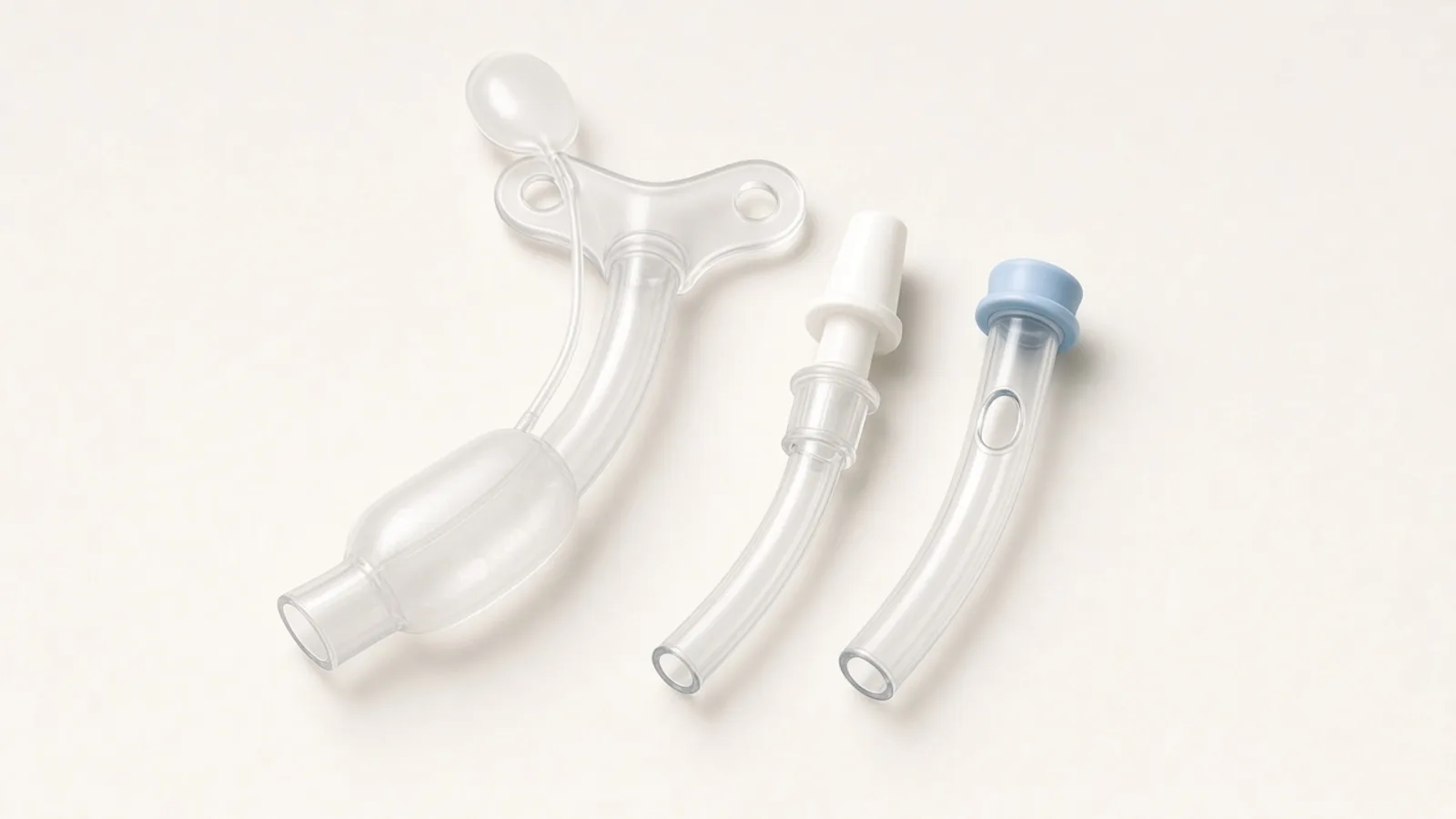
What an Inner Cannula Is in Regulatory Terms
When a replacement inner cannula is back-ordered, or a tube brand is due to change at the next interval, the purchasing question is whether another cannula can go into the tube that is already in stock. Public FDA records and the manufacturer fit tables reviewed for this guide do not establish that basis. An inner cannula is specified with the outer tube it was cleared or catalogued to fit. A matching 15 mm hub, a similar millimeter number, or a similar color is not that specification.
In the United States, the classification is 21 CFR 868.5800, tracheostomy tube and tube cuff, originally published at 51 FR 40389 (November 6, 1986). The identification text covers a device placed into a surgical opening of the trachea to facilitate ventilation. The cuff may be separate or integral. The device is made of stainless steel or plastic. The regulation is Class II. The identification paragraph does not name an inner cannula. Cannula coverage has to be read from the product-code record, the 510(k) device name, and the manufacturer's fit table, not from the CFR sentence alone.
FDA lists two product codes under that regulation, both in the Anesthesiology panel. BTO is "tube, tracheostomy (w/wo connector)." JOH is "tube tracheostomy and tube cuff." On the classification pages reviewed September 22, 2026, both codes are device class 2, submission type 510(k), GMP Exempt? No, implanted? No, and Life-Sustain/Support Device? Yes. A non-exempt listing means the quality-system requirements in 21 CFR Part 820 apply. The pages do not describe inner cannulas. They do list recognized consensus standards, including ISO 5366 first edition 2016-10-01 (recognition number 1-117) and ISO 5356-1 third edition 2004-05-15 (recognition number 1-62).
ISO 5366:2016 is FDA-recognized in full. Recognition list 051, date of entry January 14, 2019, recognition number 1-117, extent of recognition "complete standard." The recognition abstract says the standard specifies requirements for adult and paediatric tracheostomy tubes and connectors, primarily for patients who require anaesthesia, artificial ventilation, or other respiratory support. It also applies to specialized tubes that share those attributes, including tubes without a machine-end connector for spontaneously breathing patients, reinforced or metal tubes, tubes with shoulders, tapering tubes, and tubes with provision for suctioning, monitoring, or delivery of drugs or other gases. Flammability hazards are outside its scope. The recognition is listed against 21 CFR 868.5800 product codes BTO and JOH and against 21 CFR 868.5730 product code BTR (tracheal tube, with or without connector). That BTR listing does not turn a tracheostomy inner cannula into a tracheal-tube accessory.
The tracheal-tube standard is a different document. ISO 5361 excludes tracheostomy tubes from its scope and points them to ISO 5366. The companion guide to endotracheal tube specifications covers the tracheal-tube regulation and ISO 5361. It is not a fit table for tracheostomy inner cannulas.
Premarket clearance is granted to a named family. K251313 was received April 28, 2025, with a decision date of December 29, 2025, and a decision of substantially equivalent. The applicant is Covidien, LLC. The regulation number is 868.5800 and the product code is JOH. The device-name field lists four Shiley Adult Flexible Tracheostomy Tube XLT configurations, each "with Disposable Inner Cannula" (TaperGuard cuff and cuffless, distal and proximal), plus a standalone "Shiley Adult Flexible Disposable Inner Cannula XLT." The replacement cannula is inside that same submission. The record does not clear the cannula for any other brand, and it does not clear it for earlier Shiley lines that use a different lock.
flowchart TD
    A["Airway consumable requisition"] --> B{"Insertion route"}
    B -->|"Translaryngeal"| C["21 CFR 868.5730 tracheal tube\nProduct code BTR, ISO 5361"]
    B -->|"Tracheostomy stoma"| D["21 CFR 868.5800\nProduct codes BTO and JOH\nISO 5366:2016"]
    D --> E["Named outer-tube codes"]
    D --> F["Inner-cannula SKU"]
    E --> G["Match the cleared or catalogued family"]
    F --> G
    G --> H["K251313 covers the named Shiley XLT family only"]
G --> I["A 15 mm hub match is not an inner-cannula fit clearance"]The 15 mm Connector Interface: External Standard vs Internal Fit
Ventilator circuits, manual resuscitators, heat-and-moisture exchangers, and speaking-valve housings are built to meet a 15 mm cone or socket. That shared external fit is why parts from different brands click together at the machine end. It does not mean the cannula shaft inside the outer tube is the same part.
The conical connector standard listed on the BTO and JOH classification pages is ISO 5356-1 third edition 2004-05-15, recognition number 1-62. The JOH classification record checked the same day lists that same entry. ISO's later catalog edition is ISO 5356-1:2015. The edition named for these product codes on the classification pages is the 2004 third edition. The standard covers cones and sockets used to connect anaesthetic and respiratory equipment, including the 15 mm size used in breathing systems. It does not set cannula wall thickness, curvature, insertion length, bevel, or the latch that holds the inner cannula in the outer tube. A declaration of conformity should be read for the edition it actually cites.
Where the 15 mm hub is molded changes what a buyer is actually ordering:
On the inner cannula, snap-lock. Medtronic's Shiley disposable inner cannula (DIC) "has an integral 15 mm snap-lock connector for disposal after a single use." If that cannula is removed, the 15 mm circuit connection goes with it. The University of Iowa Head and Neck Protocols state that this locking mechanism "differs from other Shiley styles, and therefore this inner cannula is not interchangeable with others." A Shiley-to-Shiley swap is not automatic.
On the inner cannula, twist-lock, XLT only. The Shiley XLT extended-length line uses a disposable inner cannula secured by a twist-lock. Replacement cannulas are sold separately as 50XLTIN, 60XLTIN, 70XLTIN, and 80XLTIN. Those item numbers follow the XLT size, not the even-number DIC series. K251313 is the clearance for the current XLT family with its disposable inner cannula. It is not a clearance to put an XLT cannula into a standard DIC tube, or the reverse.
On the outer cannula, or absent. Iowa notes that locking mechanisms vary and that the inner cannula may or may not incorporate a 15 mm adaptor. St George's University Hospitals states that short-term tubes have a 15 mm connector for airway equipment, while some long-term tubes have a low-profile flange that cannot attach to that equipment. A low-profile cannula is a different SKU from a ventilator cannula even when the outer-tube size number matches.
Three cannulas in one Shiley cuffless model. Iowa describes one Shiley cuffless tracheostomy tube, in sizes 4, 6, and 8, that has three inner cannulae: a closed-lumen low-profile cannula intended for decannulation, which the protocol says never to use in a cuffed tube; an open-lumen low-profile cannula not intended for assisted ventilation; and an inner cannula with a 15 mm adaptor. That is a within-brand ordering problem, not a cross-brand one. Iowa is a clinical teaching protocol. Reconfirm the current fit table before a purchase order.
With or without a connector, same brand. The Teleflex Rüsch EMEA catalog says TracheoFix tubes have "size-specific colour-coded inner cannulas (available with or without a 15 mm connector) that correspond to the matching coloured information on the flange." The set contents distinguish a long cannula with a 15 mm connector from a short low-profile cannula. The catalog does not publish a fit to any other manufacturer's outer tube.
| Cannula style | Where the 15 mm hub sits | What removal does to the circuit | Fit boundary in the cited source |
|---|---|---|---|
| Shiley DIC | Integral 15 mm snap-lock on the inner cannula | The circuit connector leaves with the cannula | Not interchangeable with other Shiley lock styles; fenestrated DICFEN is a separate code |
| Shiley XLT inner cannula | Twist-lock disposable cannula, items 50XLTIN-80XLTIN | The XLT circuit connector is on that cannula | Restricted to the XLT family cleared under K251313; not a DIC substitute |
| Portex BLUselect inner cannula | Separate inner-cannula SKU seated in the BLUselect tube | Confirm on the current IFU whether the circuit hub is on the cannula | 101/856, 101/858, and fenestrated 101/851 are BLUselect codes only |
| TRACOE Twist inner cannula | 15 mm connector on the inner cannula; white or blue by fenestration | Connector color tracks fenestration, not a universal size | Cited page covers Twist and Twist Plus only |
| Rüsch TracheoFix | Sold with or without a 15 mm connector | A low-profile version has no circuit hub | Catalogued for TracheoFix; no cross-brand fit is stated |
| Shiley cuffless low-profile cannulas | Closed-lumen decannulation cannula, or open low-profile cannula, or a 15 mm adaptor | Low-profile versions are not ventilator connectors | Iowa: do not use the closed-lumen decannulation cannula in a cuffed tube |
Size Designation Traps: Nominal Tube Sizing vs True Working Lumen
A size printed on a box is not a shared millimeter. In this category the same numeral can mean the outer-tube inside diameter, the inner-cannula inside diameter, or an even size code that is neither. St George's states the point directly: manufacturer sizing "is not standardised between models nor manufacturers," and a size 8 from one manufacturer is likely to differ from a size 8 from another. The trust also says that, with a dual-cannula tube, "the quoted inner diameter on the packaging may or may not reflect" the lumen with the inner cannula in place "and may be much smaller than anticipated."
St George's attributes one labeling limit to the ISO size-designation system, not to an FDA labeling rule: "when the 15mm connector is part of the outer cannula, the manufacturer is not obliged to quote the inner diameter of the inner cannula, of which use is optional." That sentence is one NHS trust's reading of the designation system. It is not a quotation from 21 CFR. Use it as a reason to demand the working lumen on the quote, not as a statement that FDA forbids the number.
Three conventions show up in the sources checked for this guide:
Outer-tube ID, with a smaller inner cannula: Portex BLUselect. On the ICU Medical US ordering page, the inner-cannula ID is published beside the tracheostomy tube ID. The 101/856 series (20 per case) and the 101/858 series (50 per case) pair 6.0 mm with 5.0 mm, 7.0 mm with 6.0 mm, 7.5 mm with 6.5 mm, 8.0 mm with 7.0 mm, 8.5 mm with 7.5 mm, 9.0 mm with 8.0 mm, and 10.0 mm with 8.5 mm. The reduction is 1.0 mm through 9.0 mm and 1.5 mm at 10.0 mm. It is not one fixed offset at every size. On the same page, cuffed tube 101/815/080 lists tube ID 8.0 mm, tube OD 11.9 mm, and length 75.5 mm. The matching inner cannula 101/856/080 lists inner-cannula ID 7.0 mm and the same 75.5 mm length.
Do not copy Portex Blue Line Ultra onto BLUselect. St George's size-8 comparison table lists Portex Blue Line Ultra as 8.0 mm ID without the inner cannula and 6.5 mm with it, outside diameter 11.9 mm, length 75.5 mm. The outside diameter and length match the BLUselect 8.0 mm tube row. The inner-cannula ID does not: BLUselect publishes 7.0 mm, not 6.5 mm. A buyer who "corrects" the ICU Medical table with the NHS Blue Line Ultra row will order the wrong lumen.
Inner-cannula lumen: TRACOE Twist and Twist Plus. Atos states: "The sizing of the Tracoe Twist and Twist Plus tubes always corresponds to the inner diameter of the inner cannula. For example, when it says 08 on the neck flange, the lumen of the inner cannula is 8 mm." The same page does not publish an outer-cannula inside diameter or outside diameter for that size 08. Those fields stay unknown. St George's size-8 table lists a Kapitex Tracheotwist row at 8.0 mm with the inner cannula and an outside diameter of 11.4 mm. That is an NHS illustration of an earlier name, not the current Atos ordering sheet, and it should not be typed into a TRACOE line as if Atos had published it.
ISO size equals inner-cannula ID: Shiley XLT. Medtronic describes XLT sizing as "ISO sizing that matches actual ID of inner cannula." The order table lists four IDs. Size 5.0 mm has OD 9.6 mm and total length 90 mm. Size 6.0 mm has OD 11.0 mm and total length 95 mm. Size 7.0 mm has OD 12.3 mm and total length 100 mm. Size 8.0 mm has OD 13.3 mm and total length 105 mm. Proximal and distal versions share that ID, OD, and total length; the proximal and distal segment lengths differ. For the distal cuffed size 7, item 70XLTCD, the table lists proximal length 12 mm and distal length 49 mm. The replacement cannula 70XLTIN lists ID 7.0 mm and leaves OD and length blank. The OD column is the outside diameter of the tube, not an inside diameter of the outer cannula.
Even sizes 4, 6, 8, and 10: Shiley DIC. Medtronic lists DIC and DICFEN in sizes 4.0, 6.0, 8.0, and 10.0. Iowa describes the Shiley low-pressure cuffed tube with a locking inner cannula in even sizes 4, 6, 8, and 10. On the Medtronic fenestrated-tube order table, the standard DIC rows leave ID, OD, and length blank, so that page does not publish a working lumen for 8DIC. St George's size-8 table, headed as standard-length cuffed non-fenestrated tubes, lists Shiley DCT as ID without inner cannula "n/a," ID with inner cannula 7.6 mm, outside diameter 12.2 mm, and length 79 mm. Use 7.6 mm as that trust's illustration of the lumen with the cannula in place. St George's leaves the without-cannula ID as n/a, and the Medtronic DIC dimension cells reviewed here are blank, so do not invent an outer-tube inside diameter.
The practical buying rule is to write three numbers, each with its source: the labeled size, the inner diameter with the cannula seated, and the outside diameter of the outer tube. If a column is blank on the manufacturer's table, the cell in the purchasing record stays unknown. Nominal size alone does not tell a receiving clerk whether the working lumen is the number on the flange.
| Line and example | What the size number means | Published inner-cannula or working ID | Other published dimension | Do not copy this across |
|---|---|---|---|---|
| Portex BLUselect 8.0, codes 101/856/080 and 101/858/080 | Outer-tube ID | Inner cannula ID 7.0 mm | Cuffed tube 101/815/080: OD 11.9 mm, length 75.5 mm | St George's Blue Line Ultra size 8 lists 6.5 mm with the inner cannula. That is a different Portex line. |
| Portex BLUselect 6.0 and 10.0 | Outer-tube ID | 5.0 mm and 8.5 mm | Reduction is 1.0 mm at 6.0 mm and 1.5 mm at 10.0 mm | The step is not one fixed offset. A 7.0 mm tube pairs with a 6.0 mm inner cannula. |
| TRACOE Twist size 08 | Inner-cannula lumen | 8 mm, as printed on the neck flange | Outer-tube ID and OD are not on the cited Atos page | A size 8 from Shiley or Portex is not an 8 mm TRACOE lumen. |
| Shiley XLT size 7, 70XLTCD and 70XLTIN | ISO size equals inner-cannula ID | 7.0 mm | Tube OD 12.3 mm, total length 100 mm. Cannula OD and length are blank. | Do not invent an outer-cannula ID. The OD column is outside diameter. |
| Shiley DCT on the St George's size-8 table | Even size 8, not an 8.0 mm lumen | 7.6 mm with the inner cannula; without is listed n/a | Outside diameter 12.2 mm, length 79 mm | An NHS illustration. The Medtronic DIC dimension cells reviewed here are blank. |
Fenestration Alignment: Matching the Opening, Not the Size Number
A fenestration is an opening on the tube shaft. Fenestrated outer tubes are sold with a separate inner cannula whose opening is meant to line up with that window, and with a non-fenestrated inner cannula that covers it. Those are different SKUs. Iowa's description of a Shiley fenestrated low-pressure cuffed tube says the longer of the two inner cannulae has a 15 mm adaptor, is not fenestrated, and occludes the fenestration in the outer cannula. The shorter cannula is a decannulation cannula. The procurement fact is the SKU split. This guide does not set cuff, speech, or weaning practice.
Manufacturers keep the split on the order table:
Medtronic DICFEN. The fenestrated disposable inner cannula "features a snap-lock, green color-coded connector." The fit table lists 4DICFEN only with 4DFEN and 4DCFN, 6DICFEN with 6DFEN and 6DCFN, 8DICFEN with 8DFEN and 8DCFN, and 10DICFEN with 10DFEN and 10DCFN. Green is shared across those four sizes, so it marks fenestration, not size. The standard DIC is a different snap-lock code. Iowa says that DIC lock is not interchangeable with other Shiley styles.
Portex BLUselect 101/851. Fenestrated inner cannulas are a separate series, 2 per case: 101/851/060 through 101/851/100 at tube IDs 6.0, 7.0, 8.0, 9.0, and 10.0 mm, with the same inner-cannula IDs as the non-fenestrated series (5.0, 6.0, 7.0, 8.0, and 8.5 mm). The page says solid or checkered markings around the tube indicate whether the tube is fenestrated or unfenestrated, and whether a fenestrated or unfenestrated inner cannula should be used. It does not state, in the text reviewed here, which pattern is the fenestrated one. Read the marking key on the current page or instructions for use rather than assigning solid and checkered from memory.
TRACOE Twist and Twist Plus. Atos uses color for fenestration, not for millimeter size. Green lettering on the neck flange indicates a non-fenestrated outer cannula. Non-fenestrated Twist inner cannulas have white 15 mm connectors. Non-fenestrated Twist Plus inner cannulas have a white locking ring. Blue lettering indicates a fenestrated outer cannula. Fenestrated Twist inner cannulas have blue 15 mm connectors. Fenestrated Twist Plus inner cannulas have a blue locking ring. Twist Plus adds a further opening: besides the fenestration on the outer bend, the page describes two phonation holes on the inner bend. A white connector does not fit the blue-flange ordering rule.
ISO 6009 is a shared color code for hypodermic needle gauge. Nothing reviewed for this guide gives tracheostomy inner cannulas an equivalent shared code. On these four lines, color means size, fenestration, or both, and the same hue does not survive a brand change. A green Shiley connector is not a green TRACOE flange, and neither one is a needle-gauge color.
Rüsch TracheoFix uses color for size, and a circle style for phonation. The catalog says the fixation flange and inner cannula are colour-coded according to size, and that the cannulas correspond to the matching coloured information on the flange. A second mark is not the size: an interrupted coloured circle indicates phonation, and a closed coloured circle indicates no phonation. Letter codes on the flange separate cuff (C), phonation (P), both (CP), and neither. Color-by-size plus circle-by-phonation is a Rüsch convention. The catalog does not publish the color-to-millimeter key in a form that can be copied onto Shiley or TRACOE.
Shiley uses green for a fenestrated disposable cannula. DICFEN is the green snap-lock connector, in every listed size from 4.0 to 10.0. The standard DIC is identified by the snap-lock and the fit table, not by a size color. Green does not mean size 8, and it does not mean an 18-gauge needle.
TRACOE uses white and blue for fenestration, and green or blue flange lettering for the same split. White is non-fenestrated. Blue is fenestrated. Twist Plus repeats that split on the locking ring. Size is the numeral on the flange, which is the inner-cannula lumen, not the color.
Portex BLUselect color-codes tubes and packages by size, and uses shaft markings for fenestration. The product page says tubes and packaging are color-coded by size. The ordering tables reviewed on September 22, 2026, leave the packaging-color column blank, so the color name for each millimeter is unknown until the current catalog or label states it. Fenestration is the separate solid-versus-checkered shaft mark, and the page does not assign which pattern is which in the sentences quoted above.
| Brand | Where the color sits | What the cited page says it means | What it does not mean | Transfer to another brand |
|---|---|---|---|---|
| Rüsch TracheoFix | Flange and inner-cannula collar; coloured circle | Colour tracks size. Interrupted circle means phonation; closed circle means no phonation. | Not a fenestration code shared with Shiley green or TRACOE blue | None |
| Shiley DICFEN | Snap-lock connector | Green marks the fenestrated disposable cannula at sizes 4, 6, 8, and 10 | Not a millimeter size, and not an 18-gauge needle color | None |
| TRACOE Twist, non-fenestrated | Green flange lettering; white 15 mm connector. Twist Plus: white locking ring | Non-fenestrated outer tube and non-fenestrated cannula | Not a size, and not the same as a white Shiley part | None |
| TRACOE Twist, fenestrated | Blue flange lettering; blue 15 mm connector. Twist Plus: blue locking ring | Fenestrated outer tube and fenestrated cannula | Not a size | None |
| Portex BLUselect | Tube and package color by size; solid or checkered shaft mark | Color is for size. Shaft mark indicates fenestrated versus unfenestrated. The color names and the mark key were not printed in the text reviewed. | Do not assign solid or checkered without the current key | None |
Materials, Disclosures, and Single-Use versus Reusable Claims
21 CFR 868.5800 says the tube is made of stainless steel or plastic. It does not name PVC, polyurethane, or a plasticizer. Iowa describes the plain Jackson tube as stainless steel, without a cuff and without a 15 mm adaptor, in sizes 00 through 10. That metal set is outside the polymer fit tables below. Polymer, plasticizer, latex, and reuse have to be copied from the label or the page that actually states them. A blank cell stays unknown.
What the cited pages do state:
Shiley DIC and DICFEN. Medtronic says they are sterile, individually packed, for single use only, and not made with natural rubber latex. Iowa describes the Shiley disposable-inner-cannula low-pressure cuffed tube as polyvinyl chloride and says the cannula is intended for one-time use. The Medtronic feature list reviewed here does not name the cannula resin or the plasticizer. Do not fill DEHP status from a different Shiley brochure unless that brochure is the document in the file.
Shiley XLT. The product page says the line is 100 percent latex-free, with a flexible thermosensitive outer cannula and a disposable twist-lock inner cannula. It does not name the polymer or a phthalate status in the feature list reviewed here. Those two cells stay unknown. K251313 identifies the family; it is not a materials certificate.
Portex BLUselect. ICU Medical states that BLUselect tracheostomy tubes are not manufactured with DEHP plasticizers. The FDA recall page describes the BLUselect tube as polyvinyl chloride. The ordering page reviewed here does not state natural-rubber-latex status. Pack counts are on the page: 101/856 at 20 per case, 101/858 at 50 per case, and fenestrated 101/851 at 2 per case. One inconsistency to confirm before the item master is loaded: in the 50-count block, the size-10 row is printed as 101/856/100 rather than 101/858/100. The other 50-count rows use 101/858. Ask ICU Medical which code is the 50-count size 10. Sterile-barrier wording was not in the ordering text reviewed; take it from the unit label.
TRACOE Twist and Twist Plus. Atos says the tubes are polyurethane and the high-volume, low-pressure cuff is medical-grade PVC, and that all materials are DEHP-free. The page does not state latex status, sterility, or whether a given inner cannula is single-use or reusable. Record those as unknown. Do not infer them from the DEHP sentence.
Rüsch TracheoFix. The EMEA catalog describes the tube as thermosensitive PVC and lists the product as latex-free, sterile, and single patient use. It also says the inner cannula can be removed and cleaned or replaced. That is a single-patient reusable claim in an EMEA catalog, not a US "not made with natural rubber latex" sentence and not a multi-patient reprocessing clearance. Plasticizer status is not stated. Market availability can differ; confirm the label for the country of purchase. This guide does not describe a cleaning method.
Buying a cannula whose label says single-use, for a stock location whose process expects a cleanable cannula, is a specification mismatch. It is not, by itself, a citation of a particular regulation. The reverse mismatch is the same kind of error: a cleanable TracheoFix insert is not a sterile single-use DIC. The label's reuse claim is a required field on the quote.
| Line | Polymer as stated | Plasticizer as stated | Latex as stated | Use and pack claim as stated |
|---|---|---|---|---|
| Shiley DIC / DICFEN | Iowa calls the disposable-cannula tube polyvinyl chloride. Medtronic's feature list reviewed here does not rename the resin. | Unknown on the cited Medtronic feature list | Not made with natural rubber latex | Sterile, individually packed, single use only |
| Shiley XLT | Unknown. Page says thermosensitive. | Unknown on the cited feature list | 100 percent latex-free | Disposable twist-lock cannula; replacements 50XLTIN-80XLTIN, 10 per box on the order table |
| Portex BLUselect | FDA recall text calls the tube polyvinyl chloride | Tubes are not manufactured with DEHP | Unknown on the ordering page reviewed | 101/856 listed at 20 per case; 101/858 at 50 per case; 101/851 at 2 per case. Confirm the printed size-10 50-count code. |
| TRACOE Twist / Twist Plus | Polyurethane tube; medical-grade PVC cuff | All materials DEHP-free | Unknown on the cited page | Sterility and single-use versus reusable: unknown on the cited page |
| Rüsch TracheoFix (EMEA catalog) | Thermosensitive PVC | Unknown | Catalog feature list says latex-free | Sterile, single patient use; cannula may be removed and cleaned or replaced |
Recall Containment, Lot Traceability, and UDI Discipline
Inner-cannula stock is not a bulk bin. The two FDA notices below are examples of how narrow a recall scope can be. Neither notice is a defect report about every inner cannula, and the second one is not a US distribution event. Receiving records have to be able to separate product code, lot, and UDI. The site's guides to UDI and GUDID for medical consumables and mixed-lot consumables recall reconciliation cover the capture and reconciliation steps. The facts below are the scope limits for these two notices.
Smiths Medical BLUselect, June 13, 2024. FDA identifies the action as the most serious type: the device may cause serious injury or death if use continues. The notice covers BLUselect tracheostomy tube kits, BLUselect Suctionaid kits, BLUgriggs percutaneous dilation kits or trays, and BLUperc trays. The reason is a manufacturing defect that may cause the pilot balloon to disconnect from the inflation line. FDA states there have been 12 reported injuries and no reports of death. Affected product is identified by product code and lot number. One listed code is 101/540/080. The defect is the inflation line, not the inner cannula. Kits in the listed codes still have to be quarantined or discarded by those codes and lots, including whatever cannula was packed in the kit. A later inner-cannula replenishment SKU is not in scope unless its own code and lot are on the list.
Medtronic Shiley Adult Flexible tube, February 26, 2025. FDA again identifies the action as the most serious type. The product is the Shiley Adult Flexible Tracheostomy Tube with TaperGuard Cuff Reusable Inner Cannula. Medtronic and its subsidiary Covidien recalled it because the tube may become dislodged if the securement flange disconnects from the device cannula. The notice lists UDIs A8845212054401, 20884521205441, and 10884521205444, lot 202405258X, and SKU/CFN 7CN80R. FDA's page does not label which of those three UDIs is the unit and which is a package. It states that no affected devices were distributed in the United States, and that Medtronic has not reported any serious injuries or deaths related to this issue. A US stock of standard Shiley DIC is not this SKU. Quarantine the listed lot and CFN, not every Shiley cannula that shares the words "inner cannula" in a catalog title.
The useful receiving check is small. Capture the device identifier, the lot or serial production identifier, the catalog or CFN number, and the expiration date on the level of packaging that will be stored. When a notice arrives, match all of those fields. A UDI device-identifier match without the lot is not the scope of either notice above.
Procurement Specification Checklist and Supplier RFQ Requirements
A request for quotation for a replacement inner cannula should ask for the fields that decide fit, and it should refuse a quote that answers with a size number alone. The working rule for this guide is to record unknown when the vendor does not publish a field. Do not fill the gap from a retailer title, a color, or a 15 mm hub.
Standards citations on a catalog page are themselves a field. The Rüsch EMEA catalog heads a dimension legend "Dimensions acc. to ISO 5366-1 & 5366-3." Those are legacy part numbers. The edition on FDA recognition number 1-117 is the consolidated ISO 5366 first edition 2016-10-01. A legacy citation is a reason to request the current declaration of conformity. It is not, by itself, a finding that the product fails the 2016 edition.
Change control belongs in the quality agreement, not in an assumed notice period. Tooling, resin, wall thickness, and lock geometry can change insertion fit. Ask the supplier which changes require prior written notice, and write the number of days into that agreement rather than copying a notice period from a different supplier. The site's guide to quality agreements for consumable suppliers is the place for purchasing-information and change-control structure. Suction-catheter specifications are a separate airway decision, covered in suction catheter specifications, and they do not identify an inner cannula.
The verified set in this guide is Shiley DIC and DICFEN, Shiley XLT, Portex BLUselect, TRACOE Twist and Twist Plus, and Rüsch TracheoFix as described in the cited EMEA catalog. Bivona, Blom, and other metal or adjustable-flange lines are outside that set. Their connector, lumen, fenestration, and reuse fields stay unknown until their own current documents are in the file. Iowa's note on the stainless-steel Jackson tube, which has no cuff and no 15 mm adaptor, is a reminder that a metal set is a different item master, not a polymer-cannula substitute.
| Field to demand | What the quote must state | Acceptable evidence | If the vendor does not state it |
|---|---|---|---|
| Outer-tube match | Manufacturer, family, and the outer-tube catalog numbers the cannula is listed against | Current fit table, plus 510(k) scope when a clearance is claimed | Do not issue the order. No reviewed clearance authorizes a cross-brand substitute. |
| Size convention and working lumen | Labeled size, what that number measures, and the inner diameter with the cannula seated | Manufacturer dimension table. Keep NHS illustrations labeled as illustrations. | Record unknown. Do not treat the box size as the working lumen. |
| 15 mm connector | On the inner cannula, on the outer cannula, optional, or absent | Catalog configuration list or the unit label | Record unknown. Do not assume the circuit stays connected when the cannula is removed. |
| Fenestration | Non-fenestrated, fenestrated, or the Twist Plus phonation-hole configuration, and the outer-tube codes | Fit matrix. For BLUselect, the current solid-versus-checkered key. | Do not issue the order against a fenestrated tube code. |
| Lock | Snap-lock, twist-lock, rotary lock, or another named mechanism, and whether it interchanges inside the brand | Manufacturer mechanical description. For Shiley DIC, the Iowa non-interchange note is a flag to reconfirm, not a substitute for the current table. | Do not issue the order. |
| Material, plasticizer, latex | Polymer, DEHP or phthalate statement, and latex statement, each quoted | The page or label that states that sentence | Record unknown. Do not copy another brand's DEHP or latex line. |
| Sterility and reuse | Sterile or nonsterile; single-use, single-patient cleanable, or another stated claim | Label and instructions for use | Do not assume sterile, and do not assume the cannula may be cleaned. |
| Clearance and standard edition | 510(k) number and product code if a US clearance is claimed; the ISO 5366 edition on the declaration of conformity | FDA 510(k) record and the current declaration | Do not treat a legacy "ISO 5366-1 & 5366-3" legend as evidence of the 2016 edition. |