
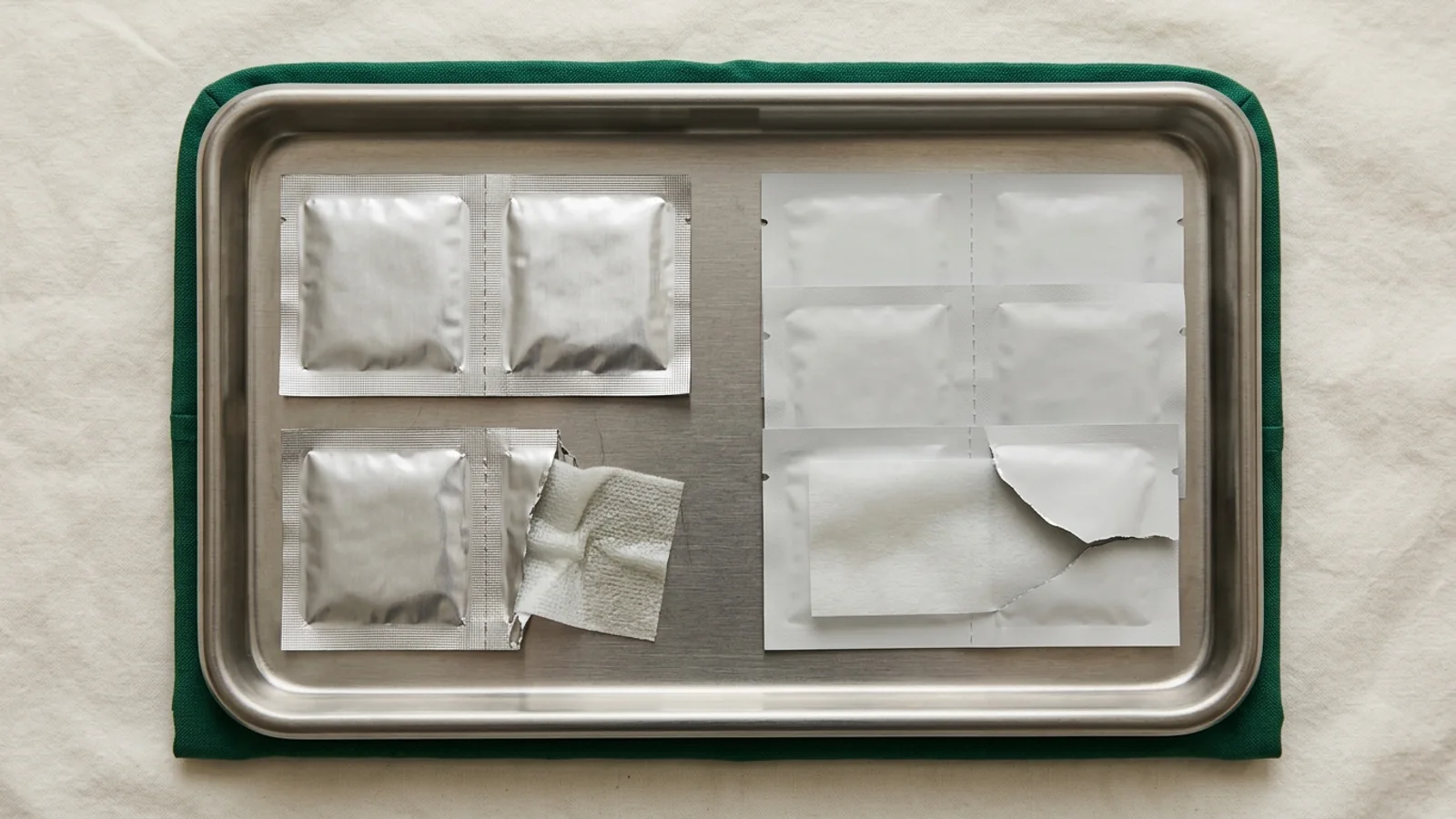
One shelf name, three product classes
When a hospital materials manager, surgical kit assembler, or clinical procurement team orders skin prep wipes, the shelf name does not identify a single product class. Distributor catalogs place barrier films and antiseptic wipes next to each other under that name even though the items belong to different legal regimes and do different jobs. Filing them as one commodity is a purchasing error, not a clinical technique choice.
Consider the classic brand juxtaposition in healthcare procurement: Smith & Nephew distributes both SKIN-PREP Protective Wipes and I.V. PREP Antiseptic Wipes. Both come packaged in sealed single-use sachets, and distributors routinely file both under the generic term 'skin prep.' Their legal classifications and labeled functions are not interchangeable:
Topical skin barrier wipes (such as SKIN-PREP): These are Class I medical devices regulated by the U.S. Food and Drug Administration (FDA) under 21 CFR 880.5090 as liquid bandages. The labeled job is to form a physical protective film on skin. They are not antiseptic drugs: file a device identifier, not a Drug Facts active ingredient or an NDC. Shared ingredients do not close that gap. The 2011 FDA recall record for SKIN-PREP catalog 420400 quotes a pouch listing isopropyl alcohol, butyl ester of PVM/MA copolymer, and acetyl tributyl citrate, and FDA still classified that product as a liquid skin-protectant device.
Antiseptic skin prep wipes (such as I.V. PREP): These are drug products, either over-the-counter drugs or approved new drugs. The cited I.V. PREP label declares isopropyl alcohol 70% v/v as the active antiseptic for preparation of skin prior to injection or venipuncture. A preoperative example, the 2005 Chlorascrub Maxi Swabstick label, lists chlorhexidine gluconate 3.15% and isopropyl alcohol 70%. The evidence to file is a Drug Facts panel and a National Drug Code (NDC), and an NDA number when the product is an approved new drug.
Hard-surface and device-disinfectant alcohol pads: When the label is limited to disinfecting medical devices, rather than preparing patient skin, FDA lists these alcohol pads separately as unclassified pre-amendment medical devices under Product Code LKB, submission type enforcement discretion. That listing is not a patient-skin antiseptic drug and not a polymer skin barrier. A pad whose label claims skin preparation before venipuncture needs drug labeling instead.
What a barrier wipe is labeled to do, and its FDA device record
To understand what a barrier wipe does, sourcing teams must examine the governing regulation. Under 21 CFR 880.5090, the FDA identifies a liquid bandage as a sterile device that is a liquid, semiliquid, or powder-and-liquid combination used to cover an opening in the skin or as a dressing for burns. The device is also used as a topical skin protectant. Film formation after the carrier dries is a product-label fact for the wipes below, not additional text in the regulation.
A crucial nuance lies in the premarket notification status. Under 21 CFR 880.5090, liquid bandages are categorized as Class I devices subject to general controls. However, the regulation establishes that the device is exempt from premarket notification (510(k)) only when used solely as a skin protectant, subject to the general limitations of exemption defined in 21 CFR 880.9. The FDA maintains two distinct product codes under this single regulation to manage this split:
Product Code NEC (Bandage, liquid, skin protectant): Class I devices that are 510(k)-exempt when used only as a skin protectant, subject to the limitations in 21 CFR 880.9. Smith & Nephew SKIN-PREP Wipes are listed under this code.
Product Code KMF (Bandage, liquid): Class I devices whose product-code record lists submission type 510(k). The exemption in 21 CFR 880.5090 applies only when the device is used solely as a skin protectant, so a liquid bandage that is not limited to that use is outside the exempt code. For example, Lodestar Products obtained clearance for its Skin Barrier Film under 510(k) K092712 (decision date February 23, 2010) under product code KMF and regulation 880.5090. That clearance is an example of the 510(k) route for a skin barrier film that is not in the skin-protectant exemption. It is not evidence about any other brand.
In the FDA's Global Unique Device Identification Database (AccessGUDID), the regulatory profile for Smith & Nephew's SKIN-PREP Wipes (Primary DI 00040565112695) lists catalog numbers 420400 and 420471 under product code NEC. The record marks the device single-use and in commercial distribution, indicates lot and expiration date, and does not flag it as a combination product. Premarket exemption is yes. The package is marked sterile, and no sterilization method is listed. Package DI 00040565114521, quantity 50, is identified as carton 420400. Sterility on a database flag still has to match the label on the carton received.
For the related Smith & Nephew film NO-STING SKIN-PREP, the U.S. professional page describes a fast-drying sterile liquid that forms a skin-protectant film on intact skin or on skin damaged by urinary or fecal incontinence, bodily fluids, wound drainage, adhesives, and friction. A product-feature line calls the formula alcohol-free and non-irritating, and another says it provides a waterproof, breathable barrier for up to 96 hours. The 96-hour footnote cites Secura Extra Protective Cream formulation (F-70), not a wipe catalog number, so wear time still has to be confirmed on the wipe label. The alcohol-free line cites a 2010 conference paper. The page says not to apply the product directly to an open wound or in a deep puncture wound, and not to apply it to infected skin. The sterility sentence is limited to the spray: contents of the spray bottle are sterile until first use. The page also says not to use it on patients with a known allergy to any ingredient.
What an antiseptic prep wipe must show: actives, Drug Facts, NDC
When a wipe is labeled to reduce microorganisms on skin before a puncture, FDA regulates that labeled purpose as a drug. Section 201(g)(1) of the Federal Food, Drug, and Cosmetic Act includes articles intended for use in the prevention of disease. That purpose is outside the Class I liquid-bandage exemption for a skin protectant.
The definitive evidence for an antiseptic wipe is its DailyMed drug label listing. The DailyMed label for the Smith & Nephew I.V. PREP Antiseptic Wipe (NDC 69740-212-00; labeler Smith & Nephew, Medical Ltd; manufacturing establishment Span Packaging Solutions; marketing category OTC monograph drug, 505G(a)(3); label text updated March 21, 2024, with the current file published June 5, 2024) shows the fields to file:
Active Ingredient & Purpose: The label explicitly declares Isopropyl Alcohol 70% v/v as the active ingredient, with its stated purpose designated as 'Antiseptic.'
Labeled Intended Use: The statutory indication is strictly 'for preparation of skin prior to injection or venipuncture.'
Drug Facts Panel & Warnings: The Drug Facts warnings say the product is flammable and should be used in a well-ventilated area, away from flames and ignition sources, including electrocautery; that it is sterile and should not be used if the pack is open or damaged; and that it is for external use only and should not be used in or near the eyes. A separate line says to avoid use on children less than 12 years old because it may cause irritation. The contraindication says the product should not be used on full-term or premature babies less than 1 month. Those are label statements for the item master, not application instructions.
Some preoperative preps are approved new drugs rather than monograph wipes. One example is the PDI Chlorascrub Maxi Swabstick, approved under FDA NDA 21-524 (NDC 10819-4075-2 on the 2005 Drugs@FDA label for the Chlorascrub Maxi Swabstick). That label lists chlorhexidine gluconate 3.15% w/v and isopropyl alcohol 70% v/v and calls the product a patient preoperative skin preparation. The same label says the product is flammable, says not to use it with electrocautery, and says not to use it in premature or low-birth-weight infants or on children less than 2 months of age. The PDF says it may not be the latest approved labeling, so concentrations, age limits, and sterility wording should be rechecked on the current label before they are copied into an item master. The example identifies the evidence type—an NDA number, an NDC, and a Drug Facts indication—not a preferred brand.
The operational benchmark for why antiseptic wipes exist is anchored in clinical guidelines. In its Guidelines for the Prevention of Intravascular Catheter-Related Infections, the Centers for Disease Control and Prevention (CDC) provides explicit recommendations for cutaneous antisepsis:
Central venous and arterial catheter insertion: The current CDC summary of the 2011 guideline gives a Category IA recommendation to prepare clean skin with a greater than 0.5% chlorhexidine preparation with alcohol before central venous catheter and peripheral arterial catheter insertion and during dressing changes. If chlorhexidine is contraindicated, tincture of iodine, an iodophor, or 70% alcohol can be used. The same summary leaves the safety and efficacy of chlorhexidine in infants younger than 2 months as an unresolved issue.
Peripheral venous catheter insertion: Prepare clean skin with an antiseptic (70% alcohol, tincture of iodine, or alcoholic chlorhexidine gluconate solution) before peripheral venous catheter insertion. That item is Category IB, a CDC recommendation, not a statute or a product certificate.
Contact and drying time: Antiseptics should be allowed to dry according to the manufacturer's recommendation before the catheter is placed (Category IB). This page does not set a drying time or a scrub technique.
A barrier wipe has no Drug Facts antiseptic active, so it is not the product those recommendations name. Putting it in the antiseptic position of an IV-start kit leaves that position unfilled. Choosing which antiseptic a protocol uses remains a clinical decision, outside this specification.
The overlaps that cause misbuying
Four label overlaps explain the misfiles. Each one is visible on a regulator, registry, or manufacturer record.
Trap 1: Antiseptic wipes that leave a polymer film
A buyer can mistake I.V. PREP for a barrier device because the Drug Facts panel lists a film-forming copolymer among the inactive ingredients. The label does not say that a film remains after the alcohol dries. The Drug Facts inactive ingredients are acetyl tributyl citrate, butyl ester of PVM/MA copolymer, benzalkonium chloride, and water. The label lists butyl ester of PVM/MA copolymer and benzalkonium chloride as inactive. The label does not assign those inactives a separate barrier indication. An inactive copolymer does not move the wipe into 21 CFR 880.5090 or cancel the isopropyl alcohol active and the NDC.
Trap 2: Alcohol content does not equal antiseptic classification
Isopropyl alcohol on an ingredient line does not identify the FDA category. In recall Z-2749-2011, FDA describes SKIN-PREP as an 'alcohol-based liquid film-forming skin preparation.' The pouch text quoted in that record for catalog 420400 lists isopropyl alcohol, butyl ester of PVM/MA copolymer, and acetyl tributyl citrate. That is the same copolymer family listed as inactive on the I.V. PREP drug label. SKIN-PREP remained product code NEC, a skin-protectant device, because the legal category follows the labeled intended use and the drug or device evidence, not the presence of alcohol or a film-former.
The current NO-STING page does call the formula alcohol-free, in a product-feature line footnoted to a 2010 conference paper. That page claim is not the 2011 pouch text, and it is not a specification for catalog 420400, whose recalled pouch lists isopropyl alcohol. The 2011 recall reason also named NO-STING SKIN-PREP Protective Wipes among the affected Smith & Nephew wipes, which is a traceability fact, not a statement of today's formula.
Trap 3: Alcohol pads for device disinfection (Product Code LKB)
Bulk isopropyl alcohol pads are often bought as a general hospital item. FDA lists a separate product code when the labeled use is device disinfection rather than patient skin preparation. Alcohol pads in that device-disinfectant category are unclassified pre-amendment devices under Product Code LKB (Pad, alcohol, device disinfectant). The classification record names the device "pad, alcohol, device disinfectant," shows submission type enforcement discretion, and shows device class unclassified. It does not list vial stoppers, catheter ports, a concentration, a 510(k) number, or an NDC. Those details, when a pouch states them, belong to the pouch. Pads in this code are not patient-skin antiseptic drugs. If the label claims preparation of skin before injection or venipuncture, file it as a drug and look for Drug Facts, not an LKB listing.
Trap 4: Sterility conflicts and monograph barriers
Sterility claims in this space are fraught with documentation discrepancies across databases:
AccessGUDID: The GUDID record for SKIN-PREP Wipes marks 'Packaged as Sterile: Yes', yet lists no sterilization method.
Retail and Distributor Listings: A clinic retail page can disagree with GUDID. The Mayo Clinic Store listing (manufacturer part 420400) describes Skin-Prep skin barrier wipes as non-sterile. The page prints manufacturer part 420400 and UPC 040565114521. That UPC is the 12-digit form of GUDID package DI 00040565114521, the quantity-50 carton record for catalog 420400. The store page and the GUDID sterile flag disagree for the same catalog number. The store ingredient line lists purified water, diglycol, glycerin, sorbitol, octoxynol-9, dimethycone copolyol, diazolidinyl urea, and methyparaben, using the page's spelling. That line does not match the 2011 pouch text for catalog 420400, which lists isopropyl alcohol, butyl ester of PVM/MA copolymer, and acetyl tributyl citrate. Neither the store page nor the 2011 pouch replaces the label on the carton received.
Professional Labeling: Smith & Nephew's healthcare professional product page asserts that NO-STING SKIN-PREP spray contents are 'sterile until first use.'
Buyers must not infer sterility from brand names or marketing bullet points. Sourcing teams must require physical package artwork and lot-specific release documents to verify whether a specific catalog number is validated sterile or non-sterile.
Finally, some topical barriers follow the OTC drug pathway rather than the device route. 21 CFR 347.10 lists skin protectant active ingredients and their concentrations, including dimethicone at 1 to 30 percent, petrolatum at 30 to 100 percent, zinc oxide at 1 to 25 percent, and allantoin at 0.5 to 2 percent. A wipe marketed with one of those actives is a drug, not a 21 CFR 880.5090 device. Since the CARES Act, OTC monograph conditions are also administered through FDA orders, so the CFR list is the starting specification and the current order still has to be checked for the SKU.
Specification fields and evidence to request from suppliers
To eliminate procurement confusion and ensure regulatory traceability, healthcare purchasing teams must establish explicit technical specification fields in their Enterprise Resource Planning (ERP) item masters. The following comparison table maps the four wipe categories against mandatory procurement criteria.
| Specification Field | Barrier Device Wipe | Antiseptic Skin Prep | Preoperative NDA Prep | Device Disinfectant Pad |
|---|---|---|---|---|
| Primary Regulatory Classification | 21 CFR 880.5090 (Class I Device, Code NEC or KMF) | OTC human drug with a DailyMed listing and Drug Facts. Confirm the monograph order that applies | Approved new drug. Cited example: NDA 21-524 | Unclassified Device (Product Code LKB, Enforcement Discretion) |
| Primary Labeled Intended Use | Topical skin protectant when that is the labeled use under 21 CFR 880.5090. Tape, film, and ostomy-site uses have to be on the SKU label | Cutaneous skin preparation prior to injection or venipuncture | Patient preoperative skin preparation before surgical incision | Device disinfection. The LKB record does not list surfaces; read the pouch |
| Active Antimicrobial Ingredients | No Drug Facts active. The 2011 pouch for catalog 420400 lists isopropyl alcohol as an ingredient | Isopropyl alcohol 70% v/v (active antiseptic) | Chlorhexidine gluconate 3.15% w/v and isopropyl alcohol 70% v/v on the 2005 Chlorascrub Maxi Swabstick label (NDC 10819-4075-2) | Isopropyl alcohol 70% v/v (labeled solely for hard-surface/device contact) |
| Identifiers to file | Primary Device Identifier (UDI-DI) in AccessGUDID; 510(k) if KMF | National Drug Code (NDC) and published Drug Facts panel | NDA Number, National Drug Code (NDC), and Drug Facts panel | Device listing under product code LKB when the pad is a listed device |
| Sterility Claims & Documentation | GUDID: packaged sterile, no method listed. Mayo Clinic Store page for the 420400 carton SKU: non-sterile. Use the shipment label | I.V. PREP principal display says sterile solution; do not use if the pack is open or damaged | Confirm sterility on the current NDA label. The 2005 PDF may not be the latest labeling | LKB classification does not establish sterility. Read the pouch |
| CDC Cutaneous Antisepsis Status | Not an antiseptic named in the CDC skin-preparation recommendations | 70% alcohol is on the Category IB list for peripheral venous catheters, and is a Category IA alternative for central venous and peripheral arterial catheters only if chlorhexidine is contraindicated | 3.15% w/v chlorhexidine with 70% v/v alcohol is above the greater-than-0.5% chlorhexidine-with-alcohol threshold in the Category IA recommendation for central venous and peripheral arterial insertion. That is a facility recommendation, not a product certificate | Not labeled for patient skin preparation |
| Film Formation & Polymer Residue | Labeled to form a protective film. The 2011 pouch for catalog 420400 lists butyl ester of PVM/MA copolymer. The NO-STING page states up to 96 hours, but that footnote cites cream formulation F-70, so confirm wear time on the wipe label | I.V. PREP lists butyl ester of PVM/MA copolymer as an inactive ingredient | 2005 packet: prepare skin prior to surgery or injection, and it helps reduce bacteria that can cause skin infection. It does not state stratum-corneum binding | Not labeled as a skin-barrier film |
| Flammability & Storage Controls | The 2011 pouch for catalog 420400 lists isopropyl alcohol and warns against electrocautery. The NO-STING page calls its formula alcohol-free. Confirm flammability on the SKU | Drug Facts: flammable; avoid flames and ignition sources, including electrocautery | 2005 Chlorascrub label: flammable, keep away from fire or flame; do not use with electrocautery | Isopropyl alcohol pads are flammable. Confirm storage on the pouch and the safety data sheet |
To guide clinical engineering, central supply, and procurement teams during item requisition and master file setup, the following decision flowchart illustrates the regulatory pathways:
flowchart TD
    A["Procurement Requisition: 'Skin Prep Wipe'"] --> B{"Evaluate Labeled Intended Use"}
    B -->|"Patient Skin Cleansing / Antisepsis Before Puncture"| C["Drug Product Pathway"]
    C --> C1["Routine Venipuncture: OTC Drug\n(NDC & Drug Facts, e.g. 70% IPA)"]
    C --> C2["Preoperative example: approved NDA\n(3.15% w/v CHG + 70% v/v IPA, NDA 21-524)"]
    C --> C3["Compare the label with the CDC recommendation\n(the recommendation is not a product class)"]

    B -->|"Skin Protection Under Adhesive / Barrier Film"| D["Medical Device Pathway\n(21 CFR 880.5090)"]
    D --> D1["Skin Protectant Only: Product Code NEC\n(Class I, 510(k)-exempt)"]
    D --> D2["Not limited to skin-protectant use: Product Code KMF\n(Class I, submission type 510(k), e.g. K092712)"]
    D --> D3["Verify Device DI in AccessGUDID\n(e.g. DI 00040565112695)"]
    D --> D4["No Drug Facts active; not an antiseptic drug"]

    B -->|"Disinfect a device, not patient skin"| E["Pre-Amendment Device Pathway"]
    E --> E1["Product Code LKB: Alcohol Pad Device Disinfectant"]
E --> E2["Enforcement discretion; not a patient-skin antiseptic drug"]When establishing supply contracts or auditing distributor catalogs, procurement teams should require the following specific documents from manufacturers:
For Barrier Device Wipes: Request the AccessGUDID Primary DI, FDA Device Listing number, 510(k) clearance letter (if KMF), ISO 10993-1 biocompatibility summary (cytotoxicity, irritation, sensitization), wear-time durability validation data, and primary pouch artwork showing clear contraindications.
For Antiseptic Drug Preps: Request the National Drug Code (NDC) registration from DailyMed, full Drug Facts panel proofs, Active Pharmaceutical Ingredient (API) assay certificates, package sterility release validation, and Safety Data Sheets (SDS) identifying flammable liquid transport ratings.
For Device Disinfectants: Request FDA Product Code LKB listing documentation, alcohol concentration verification, and polymer compatibility testing on common medical plastics (e.g. polycarbonate, polyurethane, and silicone).
Recalls and receiving: lot evidence for both families
Both barrier wipe devices and antiseptic drug preps share a vulnerable packaging format: single-use, foil-laminated or polymer-lined sachets. Because these consumables are routinely used in invasive vascular access and surgical wound management, microbiological contamination in manufacturing presents immediate clinical hazard. Historical and recent recall events underscore why rigorous lot traceability at goods receipt is non-negotiable.
The 2011 device recall: Triad Group contamination
Smith & Nephew initiated a Class 2 device recall, FDA number FDA Recall Number Z-2749-2011. FDA lists the firm initiation date as April 4, 2011, the customer letter as April 8, 2011, and termination as July 18, 2011. Quantity in commerce is 691,225 boxes of 50 count, distributed worldwide. The product section names SKIN-PREP catalog 420400 (50 per box), catalog 420471 (a 1,000-count bulk case), catalog 59420425, and PERI-PREP catalog 5132. The manufacturer's reason also names REMOVE Universal Adhesive Remover Wipes, UNI-SOLVE Adhesive Remover Wipes, and NO-STING SKIN-PREP Protective Wipes. The '50 count' quantity field therefore does not describe every code in the event.
FDA's determined cause is material/component contamination. The manufacturer's reason says the wipes were manufactured by H&P Industries, doing business as The Triad Group. The recall record does not name an organism. The pouch text FDA quotes for catalog 420400 lists isopropyl alcohol, butyl ester of PVM/MA copolymer, and acetyl tributyl citrate, and the usage line calls the products alcohol-based liquid film-forming skin preparations for intact skin, including under tapes, films, external catheters, ostomy sites, and adhesive dressings. Buyers should treat the event as evidence that a barrier-wipe device can be recalled for component contamination, and should keep lot-level receiving records. The record does not support a claim about current defect rates.
The March 2026 drug recall: Paenibacillus phoenicis
Cardinal Health announced a voluntary consumer-level recall on March 19, 2026, posted by FDA on March 20, 2026 and updated on April 15, 2026 to clarify lot numbers, for Webcol Large Alcohol Prep Pads (70% Isopropyl Alcohol). FDA's summary lists the product type as drugs and the reason as microbial contamination.
Distribution covered the United States, Puerto Rico, and Japan from September 2025 through February 2026. The organism named in the announcement is Paenibacillus phoenicis. The announcement says there is a reasonable probability that use of the contaminated pads may result in local and systemic infections in at-risk populations. It names patients with an impaired immune response, including patients with cancer receiving chemotherapy or poorly controlled diabetes, who may develop life-threatening infections such as bacteremia or central nervous system infections. The labeled use in the notice is external cleansing. Cardinal Health's March 2, 2026 overnight notice told customers to review inventory for the affected product code, segregate and quarantine affected product, disseminate the notice to departments, clinics, and campuses that handle it, notify customers who received it, and return an acknowledgment. Affected lot numbers are in the table attached to the FDA posting. The consumer note calls the pads a drug product, which matches the FDA summary product type and separates this recall from the 2011 device recall.
What this article does not decide
To maintain strict regulatory, procurement, and clinical boundaries, this guide establishes the following operational scope limits:
No Clinical Antiseptic Selection: This guide does not prescribe which antiseptic agent (alcoholic chlorhexidine, povidone-iodine, or isopropyl alcohol) should be selected for specific patient populations, clinical procedures, or patient age brackets (e.g. premature infants). Such choices must follow hospital infection control committees, CDC guidelines, and clinical nursing protocols.
No Clinical Application Instructions: This guide does not instruct clinicians on skin preparation technique, friction scrub duration, application concentricity, or drying times. Clinicians must follow manufacturer Instructions for Use (IFU) and institutional standards.
No Commercial Brand Equivalence: This analysis does not assert clinical or therapeutic equivalence between brand-name consumables (such as Smith & Nephew SKIN-PREP versus 3M Cavilon No Sting Barrier Film or Coloplast Prep). Sourcing teams must evaluate vendor technical files independently.
Manufacturer Claims Validation: The NO-STING page states an alcohol-free formula, a waterproof breathable barrier for up to 96 hours, and chlorhexidine gluconate compatibility. The 96-hour footnote cites Secura Extra Protective Cream formulation (F-70). The alcohol-free line cites a 2010 conference paper. The compatibility line cites a Microbiotest report, not an FDA clearance. Copy those points into a kit file only when the SKU label or a supplier technical file states them for that catalog number.
For related specifications across vascular access, wound care, and dressing supplies, explore our technical guides on Catheter Securement Devices: Matching the Device and Skin-Contact Claims, Transparent Film Dressings: Barrier Claims and Wear-Time Limits, Specify Wound Dressings by FDA Identification, Not Catalog Name, and IV Cannula Sizes and Color Codes: A Specification Reference for Buyers.
Sources
21 CFR 880.5090 - Bandage, liquid — Electronic Code of Federal Regulations, the continuously updated online edition. It is not the official legal print of the CFR.
FDA Product Classification: Bandage, liquid (KMF) — U.S. Food and Drug Administration, Product Classification Database.
FDA Product Classification: Bandage, liquid, skin protectant (NEC) — U.S. Food and Drug Administration, Product Classification Database.
FDA 510(k) K092712 - SKIN BARRIER FILM — Lodestar Products 510(k) Premarket Notification clearance, U.S. FDA.
AccessGUDID device record - SKIN-PREP Wipes (DI 00040565112695) — U.S. National Library of Medicine Global Unique Device Identification Database.
NO-STING SKIN-PREP Protective Dressing — Smith+Nephew healthcare professional product documentation.
DailyMed label - I.V. PREP ANTISEPTIC WIPE (isopropyl alcohol 70% cloth) — U.S. National Library of Medicine DailyMed Database (NDC 69740-212-00).
Drugs@FDA label - Chlorascrub Swabstick (NDA 21-524) — U.S. Food and Drug Administration approved drug labeling.
CDC Guidelines for the Prevention of Intravascular Catheter-Related Infections — U.S. Centers for Disease Control and Prevention.
FDA Product Classification: Pad, alcohol, device disinfectant (LKB) — U.S. Food and Drug Administration, Product Classification Database.
21 CFR 347.10 - Skin protectant active ingredients — Electronic Code of Federal Regulations, the continuously updated online edition. It is not the official legal print of the CFR.
FDA Class 2 Device Recall - Protective Wipes, Smith & Nephew (Z-2749-2011) — U.S. Food and Drug Administration Medical Device Recall Database.
Cardinal Health Voluntary Nationwide Recall of Webcol Large Alcohol Prep Pads — U.S. Food and Drug Administration Recalls and Safety Alerts.
Skin Prep Wipes Explained: Alcohol, Barrier & Remover Wipes — MohawkPlus Learning Center.
Skin-Prep Skin Barrier Wipe - Mayo Clinic Store listing — Mayo Clinic Store catalog entry.