
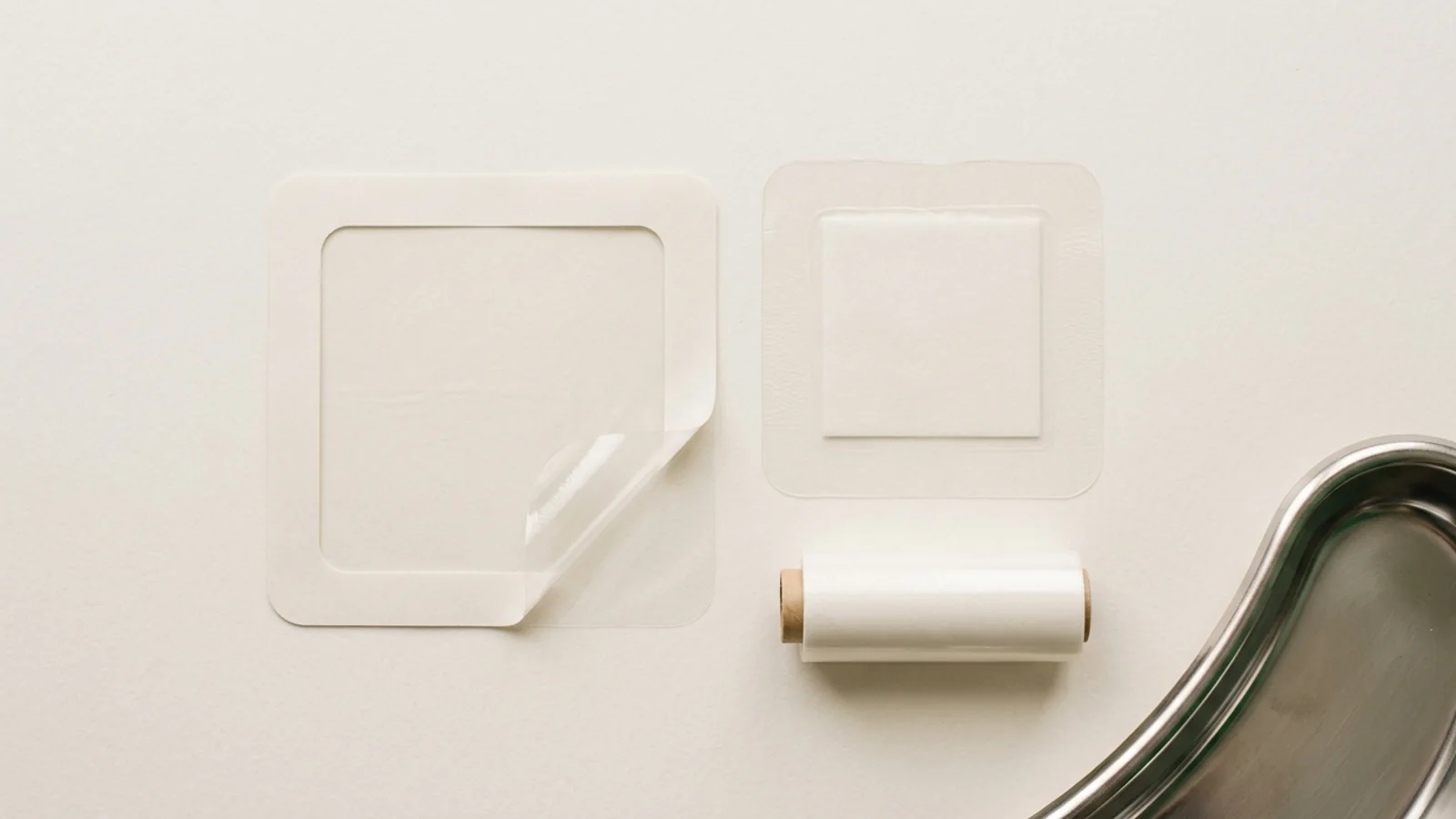
Hospital buyers and distributors evaluating transparent film dressings frequently face catalog presentations that treat brand names as universal specifications. Commercial brochures routinely claim that their thin polyurethane films are waterproof, provide a complete bacterial and viral barrier, offer high breathability, and can remain in place for up to 7 days. When purchasing departments treat these marketing bullet points as interchangeable technical specifications, tenders can award contracts on headlines that the same catalog qualifies in a footnote.
In the United States, a standard transparent film dressing is classified as an occlusive wound dressing under 21 CFR 878.4020 (FDA product code NAD). Under this classification, the device is Class I and exempt from 510(k) premarket notification, subject to the limitations in 21 CFR 878.9 and to general controls. The product-code record is not GMP-exempt, so quality-system requirements still apply. Because FDA does not clear a performance standard for a standard NAD dressing through 510(k), barrier statements and wear-time figures in catalogs are the manufacturer's own labeled claims.
To make defensible purchasing decisions for peripheral intravenous (IV) securement, central vascular access coverage, and low-exudate wound management, procurement teams must divide commercial claims into four verifiable categories:
Liquid Barrier: Separate unqualified "waterproof" or "showerproof" claims from catalog statements that read "may be worn during showering" but carry an explicit footnote recommending an additional waterproof cover over the dressing and catheter site.
Microbial Barrier: Distinguish between bacterial barrier claims (which test specific bacteria such as Staphylococcus aureus and Pseudomonas aeruginosa) and viral barrier claims. On the Solventum catalog reviewed for this article, the viral footnote is an in vitro barrier from viruses 27 nm in diameter or larger, and only while the dressing remains intact without leakage. A named challenge such as HIV-1 or HBV, when a sell sheet lists one, does not extend that claim past the intactness condition.
Moisture Vapor Permeability: While breathability is claimed universally across synthetic polymer films, numerical moisture vapor transmission rates (MVTR) are rarely published in commercial catalogs. Unless a bidder supplies a laboratory report that names the method and edition, procurement matrices should record MVTR as "Unknown" rather than assuming functional equivalence. EN 13726-2:2002, the older moisture-vapour part, has been withdrawn and superseded by EN 13726:2023.
Wear-Time Limits vs. Facility Protocols: A labeled "up to 7 days" claim is a labeled maximum, often conditioned on the dressing staying intact and not leaking. It is not an operational care schedule. Facility protocols take precedence. CDC recommendations for short-term central venous catheter sites say to replace transparent dressings at least every 7 days, with a pediatric exception when changing the dressing could dislodge the catheter, to replace gauze dressings every 2 days, and to replace any dressing immediately when it is damp, loosened, or visibly soiled.
Finally, receiving teams must verify SKU-level identity in the FDA Global Unique Device Identification Database (AccessGUDID) prior to tender award. Because sterility status varies within brand families—ranging from sterile individually pouched dressings to non-sterile bulk rolls—procurement specifications must explicitly record product code NAD, GMDN code 58301, and verified sterility.
What FDA Calls a Transparent Film Dressing
To establish clear tender requirements, buyers must first anchor the consumable to its statutory definition. Under 21 CFR 878.4020, the FDA defines an occlusive wound dressing as a nonresorbable sterile or non-sterile device for external use made of synthetic polymeric material, such as polyurethane, with or without an adhesive backing. The device is intended to cover a wound, support a moist environment, and allow oxygen and water-vapor exchange.
Under FDA regulations, occlusive wound dressings are assigned product code NAD. Devices under this code are categorized as Class I (General Controls) and are exempt from premarket notification under section 510(k) of the Federal Food, Drug, and Cosmetic Act, subject to the limitations of exemptions outlined in 21 CFR 878.9. Exemption does not remove establishment registration or device listing. FDA's product-code record lists NAD as not GMP-exempt. As of February 2, 2026, the quality-system obligation in 21 CFR Part 820 is the Quality Management System Regulation: current good manufacturing practice requirements remain in that part, which incorporates ISO 13485:2016 by reference.
graph TD
    A["Tender Requirement: Transparent Film Dressing"] --> B{"Contains Added Drugs or Antimicrobials?"}
    B -- Yes --> C["Reject from the NAD line: unclassified codes such as FRO or MGP currently need premarket notification; the 2023 proposal is not final"]
    B -- No --> D["Confirm 21 CFR 878.4020 Class I Product Code NAD"]
    D --> E{"Intended Clinical Use"}
    E -- "Vascular Access (IV / CVC)" --> F["Require Labeled Frame/Notch Format & Sterile Single Pouch"]
    E -- "Low-Exudate Wound" --> G["Require Labeled Island or Plain Film Format"]
    E -- "Secondary Securement" --> H["Non-Sterile Roll Permitted if Protocol Allows"]
    F --> I{"Evaluate Manufacturer Barrier Claims"}
    G --> I
    I --> J["Liquid Barrier: Verify Shower Footnote & Coverage Caveats"]
    I --> K["Microbial Barrier: Verify In Vitro Challenge Organisms & Intactness Condition"]
    I --> L["Breathability: Require Standardized MVTR Test or Mark Unknown"]
    J --> M["Cross-Check GUDID: Code NAD, GMDN 58301, Latex & Sterility Status"]
    K --> M
    L --> M
M --> N["Award Contract Based on Documented Specifications"]Four Barrier Claims and What Stands Behind Each
Because standard transparent film dressings do not pass through FDA premarket clearance reviews, the barrier claims in manufacturer literature represent proprietary testing and marketing positions. Commercial catalogs highlight four primary barrier claims: liquid impermeability, bacterial exclusion, viral containment, and moisture-vapor permeability. A disciplined procurement evaluation unpacks each claim.
1. Liquid Barrier and the Showering Footnote Gap
Catalogs often describe transparent film as a shield against external water. The headline and the footnote on the same page are not always the same instruction.
In Solventum's commercial catalog for Tegaderm transparent film dressings, the product description for high-permeability (HP) frame-style dressings states that the film "may be worn during showering." Directly below this statement, however, an asterisked footnote reads: "Recommended use of waterproof cover over dressing and I.V. site when showering." The diamond-pattern film line carries the same cover recommendation. A tender that copies only "may be worn during showering" drops that cover. CDC's catheter-site summary separately says showering should be permitted only if the catheter and connecting device are protected with an impermeable cover. Those are two different documents, and both conditions belong in the specification file.
Smith+Nephew's OPSITE FLEXIGRID consumer page calls the dressing a transparent waterproof and showerproof film. The waterproof and showerproof words carry superscripts whose footnote text was not expanded on that page. The dressing-care text says to change the dressing if leakage occurs and not to wear the same dressing for more than 7 days. Cardinal Health's Kendall transparent film page states that the film is waterproof, impermeable to external liquid and micro-organisms, and a barrier to bacteria and fluid contaminants. That page does not publish a shower-cover footnote, a viral-barrier claim, or a named organism panel. A tender should require the instructions for use and record whether any showering statement is unconditional or contingent on a secondary cover.
2. Bacterial Barrier Testing and Organism Specifics
Bacterial barrier claims are common on transparent film pages. Where a manufacturer names the test, record the organisms and the document. The Tegaderm +Pad sell sheet is one example: it attributes the bacterial claim to in vitro testing and names four organisms. It does not publish the laboratory method, so the tender record should not invent one.
In technical documentation for 3M Tegaderm +Pad film dressings, 3M substantiates its bacterial barrier claim against four specific challenge organisms: Staphylococcus aureus, Enterococcus faecalis, Escherichia coli, and Pseudomonas aeruginosa. These four species represent standard Gram-positive and Gram-negative healthcare-associated pathogens.
Procurement teams must recognize that a bacterial barrier claim validates only the integrity of the continuous synthetic polymer membrane. It does not validate real-world resistance to edge rolling, channel formation caused by patient movement, or adhesive breakdown from sweat. If an edge lifts, bacteria can track beneath the film regardless of the polymer's in vitro barrier properties.
3. Viral Barrier: In Vitro Test Limits and Intactness Conditions
A significant technical distinction between brands is the presence or absence of a viral barrier claim. While standard dressings from several suppliers advertise only bacterial resistance, Solventum and 3M Tegaderm product catalogs prominently advertise both bacterial and viral barrier protection.
The substantiation behind this viral barrier claim contains critical technical caveats that buyers must incorporate into tender records. Solventum's product catalog footnote explicitly states: "In vitro testing shows that the transparent film provides a viral barrier from viruses 27 nm in diameter or larger while the dressing remains intact without leakage." In the Tegaderm +Pad sell sheet, 3M attributes the viral barrier to challenge testing against HIV-1 and hepatitis B virus (HBV) and other potentially infectious body fluids, while the dressing remains intact without leakage. The sheet does not publish virus diameters. The 27 nm figure is the separate in vitro footnote, not a clinical protection radius.
For buyers, two considerations emerge from this footnote:
Size Threshold: The claim is a physical size cutoff stated in the in vitro footnote: viruses 27 nm in diameter or larger. The footnote does not cover smaller particles, and it does not cover a dressing that is no longer intact.
The Intactness Condition: The barrier functions strictly "while the dressing remains intact without leakage." This is not a secondary infection-prevention guarantee; if skin secretions, blood, or external fluids compromise the adhesive seal, the viral barrier ceases instantly. Tenders must never treat viral barrier claims as evidence of superior clinical outcomes in infection prevention.
4. Breathability and Moisture Vapor Transmission Rate (MVTR)
Polyurethane film dressings are engineered to be semipermeable: impermeable to liquid water and environmental bacteria, but permeable to water vapor and atmospheric gases (oxygen and carbon dioxide). This semipermeability allows moisture from normal insensible perspiration to evaporate, preventing skin maceration under the adhesive dressing.
However, a major gap exists in commercial transparent film catalogs: almost no manufacturer publishes quantitative Moisture Vapor Transmission Rate (MVTR) values in standard product guides. While marketing copy describes films as "breathable" or "high-moisture-vapor permeable," or names a film such as Smith+Nephew's REACTIC film that the Post-Op page says lets excess moisture pass through, numerical ratings in grams per square meter per 24 hours (g/m²/24h) are routinely withheld. Ask for the method and edition actually used. EN 13726:2023 is the current European method document for moisture-vapour transmission of permeable film dressings; EN 13726-2:2002 is withdrawn.
Because MVTR varies depending on film thickness, polymer formulation, and adhesive coat weight, procurement officers must avoid assuming that all films breathe equally. In vendor evaluation matrices, unless a bidder submits accredited laboratory test reports documenting MVTR under defined temperature and humidity conditions, the MVTR parameter should be recorded as "Unknown" rather than scored on subjective adjectives.
Cross-Brand Comparison of Labeled Claims and Footnote Conditions
The table below records labeled barrier claims and the footnote or omission attached to each, using public pages checked for this article. FLEXIGRID and Post-Op are separate Smith+Nephew constructions and are not one SKU.
| Manufacturer & Brand | Liquid Barrier Claim | Liquid Claim Footnote / Caveat | Microbial Barrier Claim | Microbial Test Basis & Footnote |
|---|---|---|---|---|
| Solventum / 3M (Tegaderm HP / Frame Style) | Waterproof; "may be worn during showering" | Footnote recommends use of waterproof cover over dressing and IV site when showering | Bacterial and viral barrier | In vitro barrier from viruses >= 27 nm (HIV-1, HBV) while dressing remains intact without leakage; in vitro testing vs S. aureus, E. faecalis, E. coli, P. aeruginosa |
| Cardinal Health (Kendall Transparent Film) | Waterproof, on the Kendall product page; also described as moisture-vapor permeable | No shower-cover footnote found on the Kendall page; the page states the film is impermeable to external liquid | Barrier to bacteria and fluid contaminants; impermeable to micro-organisms | No named challenge organisms and no viral-barrier claim on the Kendall product page |
| Smith+Nephew OPSITE FLEXIGRID (plain film) | Waterproof and showerproof, with superscripts 1 and 2 | Footnote text for superscripts 1 and 2 was not expanded on the captured page. Dressing-care text: change the dressing if leakage occurs; do not wear the same dressing for more than 7 days | Bacterial-barrier testing is cited in page references; the reference text was not expanded | No viral-barrier claim on the FLEXIGRID consumer page. Do not copy the Post-Op REACTIC claim onto this plain-film SKU |
| Smith+Nephew OPSITE Post-Op (island, film plus pad) | Waterproof; labeled to be worn while showering | Stay on up to 7 days only while it still protects the wound and is sticking well | Bacteria-proof REACTIC film on this island dressing | Footnote behind bacteria-proof was not expanded. No viral-barrier claim on the consumer page. This is not the FLEXIGRID plain-film SKU |
Wear-Time Limits Are Labeled Maxima, Not Change Protocols
A frequent point of confusion in hospital procurement is the relationship between a manufacturer's labeled wear time and a hospital's clinical dressing change protocol. Commercial listings frequently state that a film dressing "can be worn up to 7 days" (Tegaderm rolls and Nexcare consumer labeling) or "do not wear for more than 7 days" (OPSITE FLEXIGRID).
Procurement teams must treat "up to 7 days" as a labeled upper physical limit under optimal bench-testing conditions, not as a guaranteed wear duration or a clinical directive. In real-world hospital settings, clinical practice guidelines dictate dressing replacement schedules independently of manufacturer wear claims.
The CDC prevention-strategies page cites one large controlled trial of peripheral catheters, not a CDC-run systematic review that produced these percentages: colonization with transparent dressings was 5.7% and colonization with gauze dressings was 4.6%, with no clinically substantial difference in catheter-site colonization or phlebitis in that study. The same page summarizes a meta-analysis in which catheter-related bloodstream infection risk did not differ between transparent dressings and gauze. Those figures are outcome context for buyers. They are not a specification, and they do not show that a viral-barrier footnote improves infection outcomes. Transparent dressings do let staff see the insertion site without removing the dressing, and the CDC summary says they require less frequent changes than gauze and tape. That operational difference is separate from an infection-reduction claim.
Buyers must ensure that tender evaluation scoring does not award extra points for "infection-reducing properties" on standard Class I NAD transparent films. Such claims exceed the regulatory authorization of product code NAD and misrepresent material properties as clinical guarantees.
Formats, Adhesives, and Sizes That Change the Claim You Need
Transparent film dressings are manufactured in distinct physical formats and adhesive formulations. Selecting the correct SKU configuration ensures that the dressing performs its mechanical function without premature detachment.
Delivery Formats and Structural Construction
Frame-Style Delivery: Polyurethane film used in these dressings is thin enough to curl and stick to itself during handling. Frame-style dressings use a paper or plastic perimeter carrier, including window-in and window-out designs on the Kendall line, that supports the film during positioning and peels away after application.
Bordered and Notched IV Dressings: Bordered IV styles, including Solventum's transparent film dressing with border, are built to secure catheter sites and leave a window over the site. Record the border, notch, tape, and date-label contents from the SKU page. Do not assume every bordered film includes the same accessories.
Island Dressings (Film-Plus-Pad): Tegaderm +Pad and OPSITE Post-Op each combine a transparent film with a central pad. Drainage wording is SKU-specific. The +Pad sell sheet lists light-to-moderately draining chronic wounds among suggested applications. The Post-Op page is written for minor cuts, grazes, and stitches. Do not treat those lines as one shared exudate specification, and do not copy either line onto a plain film SKU.
Film Rolls: Solventum describes the Tegaderm transparent film roll as a way to secure medical devices and primary dressings to the skin for up to seven days. WoundSource identifies a non-sterile version of that roll. Treat sterility as a per-SKU field, and confirm it on the device identifier before accepting a roll as a sterile bedside dressing.
Adhesive Wording and the Exudate Boundary
Record the adhesive description the vendor prints. Cardinal's Kendall page describes a hypoallergenic adhesive and improved wet adhesion. Solventum positions the HP frame-style film for skin with moderate moisture and the diamond-pattern film for hot, humid conditions and diaphoretic patients. Those are catalog positions, not evidence that every brand uses the same adhesive chemistry.
Sterility and Identity: What the SKU Record Shows
A major risk in medical consumable procurement is assuming uniform sterility across a single brand catalog. Receiving teams frequently discover that while a brand name implies a sterile hospital product, individual SKUs within that brand may be non-sterile bulk packaging.
An inspection of official FDA Global Unique Device Identification Database (AccessGUDID) records illustrates this variation. Consider the GUDID device record for 3M Tegaderm Transparent Film Dressing Frame Style SKU 1628NS (Primary DI 50707387818048):
Product Code: NAD (Occlusive wound dressing under 21 CFR 878.4020).
GMDN Preferred Term: Code 58301, "Synthetic polymer semi-permeable film dressing, adhesive."
Sterilization Status: The record officially lists this device as "Not packaged as sterile" and specifies that the device requires sterilization prior to use (ethylene oxide). The same record marks the device single-use.
Production Identifiers: The GUDID record flags lot or batch, expiration date, and manufacturing date as production identifiers on the label.
Latex Disclosure: Labeled as "Not made with natural rubber latex."
If a purchasing department orders a 6 x 8 inch frame-style dressing without the exact catalog number, receiving can accept a bulk record such as 1628NS. That record lists a device count of 500, says the device is not packaged as sterile, and says it requires sterilization before use by ethylene oxide. The same record is marked single-use, so non-sterile does not mean reusable. A sterile, individually pouched clinical SKU has to be confirmed on its own device identifier. Warehouse checks should compare the carton with the sterile-barrier symbols the purchase order expected, using ISO 15223-1 as the symbol reference. For detailed procedures on receiving-dock inspection and verifying sterile-barrier symbols on medical supplies, see our guide on labeled storage and transport for medical consumables, as well as our analysis of separating sterile and non-sterile consumable SKUs.
A Claim-Verification Worksheet for Film Dressing Tenders
To eliminate ambiguity during tender evaluation, hospital procurement departments and supply-chain committees should use a standardized claim-verification worksheet. Bidders must be required to submit specific documentary proof for each specification parameter. Where documentation is missing or relies solely on promotional adjectives, the evaluation committee must record the field as "Unknown" rather than inferring equivalence.
| Evaluation Parameter | Typical Catalog Claim | Required Verification Document | Default if Unsubstantiated | Procurement Acceptance Rule |
|---|---|---|---|---|
| Regulatory Classification | "FDA registered medical dressing" | FDA Device Listing showing Product Code NAD under 21 CFR 878.4020 | Reject SKU | Must be Class I exempt NAD unless 21 CFR 878.9 removes the exemption. If an antimicrobial or other drug is added, the SKU is outside NAD; require the current product code and the 510(k) or PMA evidence that code requires |
| Liquid & Showering Barrier | "Waterproof", "Showerproof", "May be worn in shower" | Full manufacturer Instructions for Use (IFU) and technical data sheet with footnote text | Restrict to dry wear only | If showering requires an additional waterproof cover, document that restriction in clinical requisition guidelines |
| Microbial Barrier | "Bacterial barrier", "Viral barrier" | Summary of in vitro challenge test reports specifying bacterial test species and viral challenge cutoff (nm) | Record as basic membrane only | Require footnote conditions; accept viral barrier only if stated as effective while intact without leakage |
| Moisture Vapor Rate (MVTR) | "High breathability", "Moisture-vapor permeable" | Laboratory report naming the method and edition, such as the moisture-vapour method in EN 13726:2023, and the result in g/m²/24h. EN 13726-2:2002 is withdrawn | Mark as "Unknown" | Do not award tender scoring points for unsubstantiated breathability adjectives |
| Wear-Time Endurance | "Up to 7 days wear", "Can be worn up to a week" | IFU text defining wear-time maximum and replacement criteria | Follow hospital protocol | Treat 7 days as an upper ceiling; do not write 7-day wear into clinical catheter care protocols |
| Packaging & Sterility | "Sterile", "Hospital grade" | AccessGUDID device record confirming sterility, Primary DI, and ISO 15223-1 pouch symbols | Treat as Non-Sterile | Individual sterile peel-pouches required for direct wound contact and vascular access sites |
Core Procurement Rules for Supply Committees
When finalizing tenders for transparent film dressings, procurement officers should enforce four binding rules:
Do Not Conflate Exemption with Standardization: A 510(k)-exempt Class I designation means the FDA has not reviewed manufacturer performance data. Every barrier and wear-time claim must be verified against manufacturer test reports, not assumed to meet a federal performance threshold.
Separate Labeled Maxima from Clinical Policy: A 7-day wear-time label is a labeled maximum. It does not replace facility infection-control protocols that call for a change when the dressing is loosened, damp, or soiled.
Audit GUDID Sterility at the SKU Level: Never assume brand-level sterility. Verify that the exact requisitioned catalog number corresponds to a sterile device identifier in AccessGUDID.
Record Unknowns Transparently: When vendors cannot provide certified MVTR values or test organisms, mark those fields as unknown. Basing purchasing decisions on verified facts rather than marketing adjectives ensures both clinical safety and commercial fairness.
For additional guidance on evaluating regulatory classifications and sterility evidence across hospital wound care lines, review our companion guides on FDA classifications for wound dressings and verifying cleared indications for hemostatic gauze.