
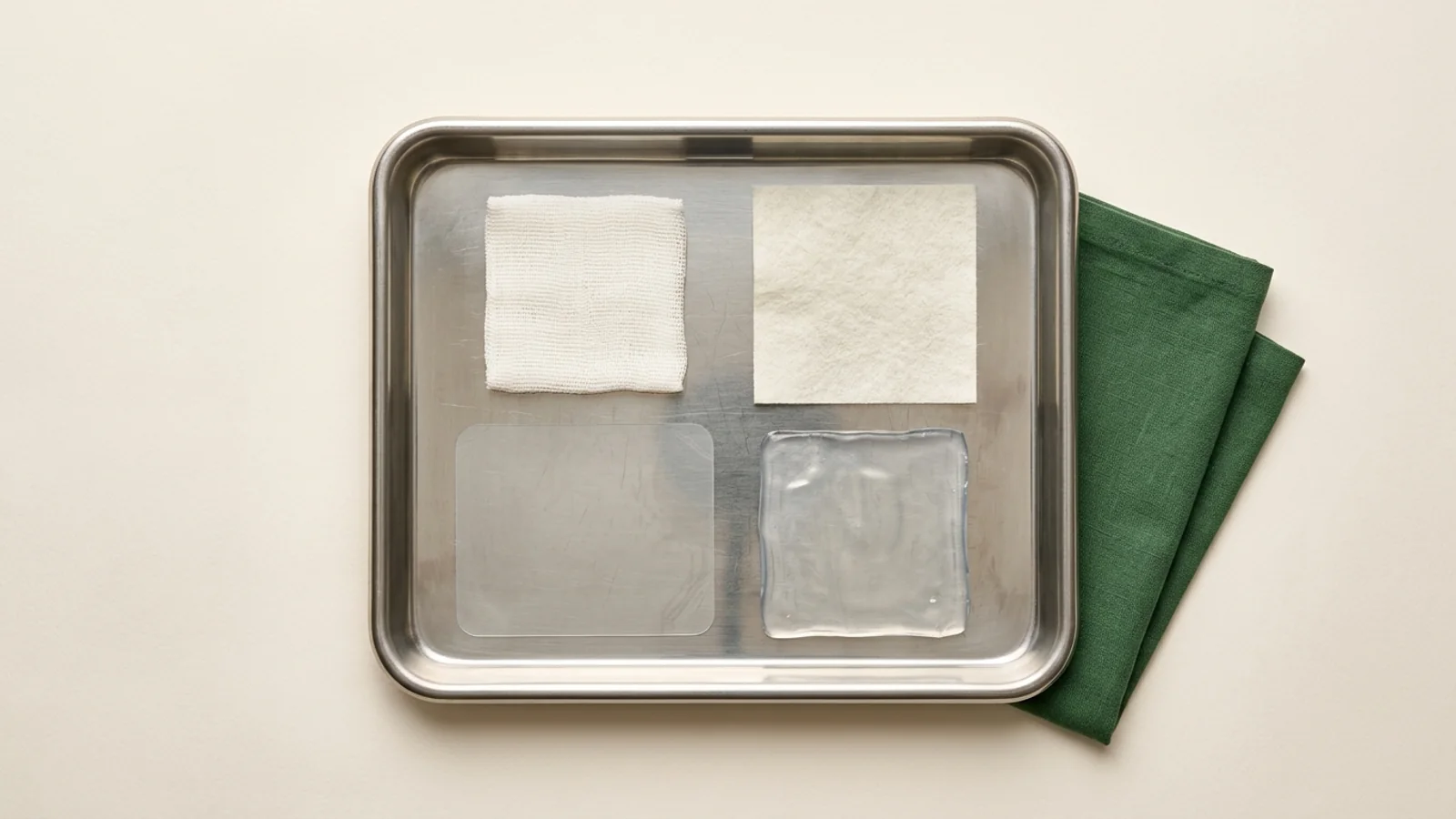
Specify Dressings by FDA Identification, Not Catalog Trade Names
Hospital value-analysis teams, materials managers, and supply-chain distributors cannot specify 'wound dressing' as a single device type. Catalogs and group purchasing contracts often group unlike SKUs under marketing names such as 'advanced wound care,' 'moisture-balancing dressings,' or 'antimicrobial barriers.' Those names are not FDA identifications, product codes, or 510(k) clearances.
Under U.S. Food and Drug Administration (FDA) medical device regulations codified in Title 21 of the Code of Federal Regulations (21 CFR part 878), wound coverings are divided into distinct generic device categories. Four primary families sit as Class I devices that are exempt from premarket notification (510(k)) requirements: nonresorbable gauze/sponge for external use (21 CFR 878.4014, product code NAB), hydrophilic wound dressings (21 CFR 878.4018, product code NAC), occlusive wound dressings (21 CFR 878.4020, product code NAD), and hydrogel wound and burn dressings formulated with at least 50 percent water (21 CFR 878.4022, product code NAE). Each of these four generic identifications explicitly excludes products that contain added pharmaceutical drugs, antimicrobial chemical agents, added biologics such as growth factors, or materials derived from animal sources.
When a manufacturer or distributor adds silver, polyhexamethylene biguanide (PHMB), cadexomer iodine, honey, hydrocortisone, a biologic such as a growth factor, or an animal-derived matrix such as collagen, the SKU generally leaves the four Class I identifications. The matching unclassified or Class II code depends on what was added: FRO for many drug-containing dressings, MGQ for hydrogel with drug or biologic, KGN for animal-derived material without added drug, and NYS only for the pDADMAC devices identified in 21 CFR 878.4015. Unclassified occlusive code MGP is a different 510(k) listing from Class I NAD; a catalog word 'occlusive' does not choose between them. Treating a Class I 510(k)-exempt gauze pad as interchangeable with an unclassified 510(k)-cleared silver foam is a specification error: the identifications, product codes, and submission types are not the same.
This guide establishes a neutral, specification-first auditing framework for procurement teams to verify labeled dressing identities against FDA registration records and 510(k) summaries. It does not provide clinical dressing selection protocols, wound bed staging, or dressing-change frequency guidance. Sourcing teams should integrate these regulatory checks with facility receiving standards for UDI and GUDID receiving capture, binding quality agreements for consumable suppliers, documented labeled storage and transport controls, and related personal protective equipment standards under isolation gown specifications.
flowchart TD
  A["Evaluate wound dressing SKU"] --> B{"Added drug, biologic, or animal-derived material?"}
  B -->|"Yes: added drug or biologic"| C["Unclassified 510(k): FRO, or MGQ if hydrogel with drug or biologic"]
  B -->|"Yes: animal-derived, no added drug"| D["Unclassified 510(k): KGN"]
  B -->|"No"| E{"Labeled identity matches 21 CFR 878.4014, 4018, 4020, or 4022?"}
  E -->|"878.4014 gauze or sponge"| F["Class I 510(k)-exempt NAB"]
  E -->|"878.4018 hydrophilic, including named alginate"| G["Class I 510(k)-exempt NAC"]
  E -->|"878.4020 occlusive polymeric film"| H["Class I 510(k)-exempt NAD"]
  E -->|"878.4022 hydrogel with at least 50 percent water"| I["Class I 510(k)-exempt NAE"]
  E -->|"No, including unclassified occlusive MGP"| J["510(k) required; do not assume NAD"]
  F --> K{"21 CFR 878.9 different intended use or technology?"}
  G --> K
  H --> K
  I --> K
  K -->|"Yes"| L["510(k) still required"]
K -->|"No"| M["Class I exemption may apply; listing and QMS still required"]Four Codified Class I Families: Gauze, Hydrophilic, Occlusive, and Hydrogel
FDA established the modern classification framework for basic wound coverings in a final rule published on 5 October 1999 (64 FR 53927, effective 4 November 1999, Docket No. 78N-2646). Based on recommendations from the General and Plastic Surgery Devices Panel, the agency codified four generic types of dressings under 21 CFR part 878 subpart E, designating them as Class I devices subject to general controls and exempt from premarket notification under section 510(k) of the Federal Food, Drug, and Cosmetic Act.
To qualify for Class I 510(k)-exempt procurement, a consumable SKU must conform precisely to the statutory physical definition, base materials, and intended uses specified in the respective regulation. The table below details the codified scope, matching FDA product codes, and statutory exclusions for each family.
| Regulation & Product Code | Codified Generic Identification | Permitted Substrate Materials | Codified Intended Use | Statutory Exclusions |
|---|---|---|---|---|
| 21 CFR 878.4014 / Product Code NAB | Nonresorbable gauze/sponge for external use | Open woven or nonwoven mesh cotton cellulose or simple chemical derivatives of cellulose | Placed directly on patient wound to absorb exudate (sterile or non-sterile) | Excludes added drugs (antimicrobial agents), added biologics (growth factors), animal-derived materials |
| 21 CFR 878.4018 / Product Code NAC | Hydrophilic wound dressing | Nonresorbable hydrophilic materials; codified examples include cotton, cotton derivatives, alginate, dextran, rayon | Cover a wound and absorb wound exudate (sterile or non-sterile) | Excludes added drugs (antimicrobial agents), added biologics (growth factors), animal-derived materials |
| 21 CFR 878.4020 / Product Code NAD | Occlusive wound dressing | Synthetic polymeric material, such as polyurethane, with or without adhesive backing | Cover wound, support moist wound environment, allow exchange of gases (oxygen and water vapor) | Excludes added drugs (antimicrobial agents), added biologics (growth factors), animal-derived materials |
| 21 CFR 878.4022 / Product Code NAE | Hydrogel wound dressing and burn dressing | Nonresorbable matrix of hydrophilic polymers or other materials with water (at least 50 percent water content) | Cover wound, absorb exudate, control bleeding or fluid loss, protect from abrasion, friction, desiccation | Excludes added drugs (antimicrobial agents), added biologics (growth factors), animal-derived materials |
A rigorous analysis of these four codified identifications reveals critical technical distinctions that purchasing agents must enforce when evaluating product data sheets:
Alginate is named in 21 CFR 878.4018. An alginate sheet, pad, or fiber without added drug, biologic, or animal-derived material can match product code NAC. Collagen is not named in 878.4018; an animal-derived collagen dressing is not an NAC hydrophilic dressing. Sister 878.4018 codes such as KOZ (hydrophilic beads) and MGO (adhesive wound closure) share the regulation and are not substitutes for NAC when the SKU is a sheet, pad, or fiber dressing.
Catalog words 'foam,' 'hydrocolloid,' and 'hydrofiber' are not product codes. 21 CFR 878.4020 names polyurethane as an example of a synthetic polymeric occlusive film, with or without adhesive, that allows gas exchange; that is not a rule that every polyurethane foam sheet is NAD or NAC. Alginate without added drug is named in 878.4018. Do not write a foam-equals-NAC or foam-equals-NAD line into a tender.
Under 21 CFR 878.4022, the hydrogel identification requires a nonresorbable hydrophilic-polymer matrix with water (at least 50 percent) that can absorb exudate. That 50 percent figure is a labeled-composition check, not a hydration protocol. Product code NAE is hydrogel without drug and/or biologic. A marketing name 'hydrogel' is not proof of NAE; hydrogel with drug or biologic is unclassified MGQ and needs a 510(k). Sister 878.4022 codes such as OJJ and PXQ share the regulation and are not automatic substitutes for NAE.
Sister codes under 21 CFR 878.4014 include MAC (decontamination kit), OHO (first-aid kit without drug), OVR (talking first-aid kit), and LZM (skin-graft guard). Those are kit or accessory listings, not a reason to treat every 878.4014 SKU as interchangeable gauze. A bulk gauze line should name NAB and the 878.4014 identification, including sterile versus nonsterile as labeled.
When 510(k) Exemption Does Not Apply: 21 CFR 878.9 and Intended Use
A prevalent misunderstanding in consumable procurement is treating Class I 510(k) exemption as an unconditioned commercial waiver. Under 21 CFR 878.9 ('Limitations of exemptions from section 510(k) of the Federal Food, Drug, and Cosmetic Act'), an exemption applies only to the extent that the specific commercial device possesses the existing or reasonably foreseeable characteristics of commercially distributed devices within that generic type.
According to 21 CFR 878.9, a manufacturer, packager, or private-label distributor must submit a 510(k) premarket notification before marketing a dressing if the device meets either of two statutory limitation criteria:
Different intended use: 21 CFR 878.9(a) still requires a 510(k) when the device is intended for a use different from the intended use of a legally marketed device in that generic type, including a different medical purpose, or lay use where the former intended use was by health care professionals only. A Class I dressing SKU labeled to treat infection, to deliver an antimicrobial drug to the wound, or to serve a purpose outside the 878.4014, 878.4018, 878.4020, or 878.4022 identification is not 510(k)-exempt merely because the catalog still says gauze, foam, film, or hydrogel.
Different fundamental scientific technology: 21 CFR 878.9(b) still requires a 510(k) when the modified device operates using a different fundamental scientific technology than a legally marketed device in that generic type. The regulation's own examples are a surgical instrument that cuts with a laser rather than a metal blade, and an IVD that uses DNA probe technology rather than culture or immunoassay. Those examples are not dressing protocols; they show that a new technology inside a generic type is not covered by the Class I exemption. A fully resorbable matrix is also outside the four identifications, which are limited to nonresorbable devices.
Furthermore, under 21 CFR 801.4 ('Meaning of intended uses'), the legal intended use of a medical device is established by the objective intent of the persons legally responsible for labeling, marketing, and distribution. Objective intent is shown by labeling claims, promotional brochures, advertising matter, and verbal statements. If a private-label distributor purchases an exempt 21 CFR 878.4014 gauze pad (NAB) and repackages it with marketing assertions such as 'broad-spectrum antimicrobial protection' or 'active wound healing accelerator,' the distributor has introduced a new intended use under 21 CFR 801.4. Under 21 CFR 807.81(a)(3), introducing a significant modification in intended use requires the firm to submit and obtain 510(k) premarket clearance before commercial distribution.
Unclassified 510(k) Codes: FRO, MGQ, MGP, KGN, and Class II NYS
When a wound dressing falls outside the four 1999 Class I identifications, buyers should look for the unclassified 510(k) code that actually applies (commonly FRO, MGQ, MGP, or KGN) or for Class II 21 CFR 878.4015 / NYS. Those records show a 510(k) submission type. A 510(k) clearance is a substantial-equivalence determination against a legally marketed predicate, not a PMA approval and not proof that two FRO SKUs are interchangeable.
Product Code FRO: Dressing, Wound, Drug
Product code FRO is FDA's unclassified, pre-amendment listing for 'dressing, wound, drug.' Submission type is 510(k). There is no 21 CFR regulation number on that record. GMP Exempt? No. An antimicrobial marketing claim, a silver or honey ingredient list, or a 'plus' catalog suffix is not a substitute for a matching 510(k) number, product code, and labeled intended use.
FDA's 20-21 September 2016 General and Plastic Surgery Devices Panel executive summary states that unclassified wound dressings containing drugs under FRO have generally been regulated through the 510(k) pathway, with more than 700 510(k) submissions cleared to that date, and that those submissions do not equal 700 distinct products. Appendix 2 of that briefing lists chemically active ingredients that have appeared in unclassified FRO dressings, including bacitracin, chlorhexidine, cadexomer iodine, and hydrocortisone, distinct from base materials such as carboxymethylcellulose, synthetic polymer, or collagen. That appendix is illustrative of submissions, not a closed formulary and not a finding that every listed ingredient always requires FRO. A current public example is K221754, which lists silver foam dressings as unclassified product code FRO.
Beyond FRO, several other distinct product codes govern specialized wound care consumables:
| Product Code | Regulatory Classification | Premarket Submission | Codified or Defined Scope | Key Distinction for Buyers |
|---|---|---|---|---|
| FRO | Unclassified (Pre-amendment) | 510(k) Premarket Notification | Dressing, wound, drug: solid substrates containing antimicrobials or active chemical agents | Unclassified 510(k) code for dressing, wound, drug. Do not infer FRO from a catalog 'antimicrobial' adjective. GMP Exempt: No. |
| MGQ | Unclassified (Pre-amendment) | 510(k) Premarket Notification | Dressing, wound and burn, hydrogel with drug and/or biologic | Requires 510(k); contrast with NAE which covers hydrogels without drugs/biologics. GMP Exempt: No. |
| MGP | Unclassified (Pre-amendment) | 510(k) Premarket Notification | Dressing, wound and burn, occlusive | Unclassified occlusive code requiring 510(k); contrast with Class I exempt polyurethane films under NAD. |
| KGN | Unclassified (Pre-amendment) | 510(k) Premarket Notification | Wound dressing with animal-derived material(s) | Unclassified 510(k) code for animal-derived dressings without added drug or biologic; not NAC or NAE. Species and tissue, if relevant, come from the label and 510(k), not from the code name. GMP Exempt: No. |
| NYS | Class II (Special Controls) | 510(k) Premarket Notification | 21 CFR 878.4015: Wound dressing with poly(diallyl dimethyl ammonium chloride) (pDADMAC) additive | Subject to the 2009 Class II special-controls guidance. Textile substrate with permanently bound pDADMAC; physical barrier; does not act on the wound. |
| Not a 878 wound-dressing code | Class I (510(k) Exempt) | 510(k) Exempt (subject to 880.9) | 21 CFR 880.5240: Medical adhesive tape and adhesive bandage (strip with pad without disinfectant) | Pad must not contain disinfectant. Antibacterial adhesive bandages are cleared under FRO (e.g., K113583). |
Case Study: Dissecting 510(k) Summary K221754 for Silver Foam
To understand what objective evidence a procurement officer must inspect, consider FDA 510(k) summary K221754 (cleared 17 January 2023 for Winner Medical Ag Foam Dressings). The clearance covers non-adhesive, adhesive, and silicone-bordered silver foam dressing configurations. The 510(k) summary provides verifiable parameters that distinguish authentic regulatory clearances from marketing brochures:
Classification Name and Code: The summary explicitly identifies the device classification name as 'Dressing, Wound, Drug,' Device Class as 'Unclassified,' and Product Code as 'FRO.'
OTC versus prescription indications: K221754 splits intended use. OTC indications are to cover and protect, absorb wound exudate, and maintain moisture balance of minor cuts, minor abrasions, minor lacerations, and minor burns. The comparison table also describes prescription indications for management of moderately to highly exuding wounds such as leg and foot ulcers, pressure ulcers, diabetic foot ulcers, and traumatic and surgical wounds. Those statements are this clearance's labeled intended uses, not a treatment protocol and not a finding that other FRO dressings share them. Match the SKU's IFU to the labeled Rx or OTC statement in the 510(k); do not assume an OTC-only IFU covers a different labeled use.
Combination-product flag: FDA's public 510(k) record for K221754 lists Combination Product: No. The 510(k) summary describes a sterile, single-use silver foam that releases silver ions within the dressing in the presence of wound fluid to help reduce bacterial colonization of the dressing. That description is this file's device description, not a general silver-equals-preservative rule and not a clinical claim buyers should copy onto a Class I SKU. K113583 (CURAD Antibacterial Bandage) is also FRO but lists Combination Product: Yes. Do not equate 'contains silver' or 'antibacterial' with that flag; read the 510(k) record.
Sterility and single use: K221754 describes the products as sterile, single-use. The summary states some configurations are sterilized by ethylene oxide under ISO 11135-1:2014 and others by irradiation under ISO 11137-2:2013. Those methods belong to this clearance. They are not a universal dressing specification, and this page does not decode ISO 15223-1 symbols. Record sterile versus non-sterile as labeled; send sterile-barrier and storage evidence to the labeled-storage article.
Formulary Verification Worksheet: Nine Fields Buyers Must Audit
A missing 510(k) number on a true 878.4014, 878.4018, 878.4020, or 878.4022 SKU is expected. A missing listing, a product code that does not match the labeled identification, or a 510(k) number that belongs to a different product code is a specification failure. FDA's product-classification records for NAB, NAC, NAD, and NAE state GMP Exempt? No and remind manufacturers that 510(k)-exempt Class I devices still require establishment registration. 21 CFR 807.20 still covers a specifications developer, a contract sterilizer, and a repackager or relabeler. QMSR (21 CFR part 820), effective 2 February 2026, remains the manufacturing quality regulation; 510(k) exemption does not repeal it. Point UDI capture, labeled storage, and quality-agreement fields to those published pages rather than restating them here.
To eliminate unverified marketing claims during vendor selection and contract negotiations, hospital purchasing committees and supply distributors should execute the following nine-point verification worksheet before adding any dressing SKU to a formulary.
| Verification Field | Class I 510(k)-Exempt (NAB, NAC, NAD, NAE) | Unclassified / Class II 510(k) (FRO, MGQ, MGP, KGN, NYS) | Primary Verifiable Evidence Document |
|---|---|---|---|
| 1. Labeled Device Identity | Must match 878.4014, 878.4018, 878.4020, or 878.4022, including sterile versus non-sterile as labeled | Must match the cleared 510(k) indications-for-use statement and the device name on that record | Device label and IFU; for 510(k) devices, the published 510(k) summary |
| 2. FDA Product Code | Must be listed as NAB, NAC, NAD, or NAE on official FDA listing | Must be listed as FRO, MGQ, MGP, KGN, or NYS on official 510(k) and listing | FDA Establishment Registration and Device Listing record |
| 3. Premarket Authorization | 510(k) exempt per codified regulation; citation of 21 CFR part 878 | Matching 510(k) number (for example K221754) on the public record for that device name | Published CDRH 510(k) summary for that K-number |
| 4. Drug / Chemical Disclosure | Label and composition must show no added drugs such as antimicrobial agents | Take the active ingredient, if any, from the label and the 510(k) summary, not from a catalog adjective | Label ingredient list and, where a 510(k) exists, the 510(k) summary |
| 5. Biological / Animal Origin | Label must show no added biologics such as growth factors and no animal-derived materials | If animal-derived, the listing or 510(k) should be KGN, not NAC or NAE; record species or tissue only as stated on the label or 510(k) | Label and 510(k) summary; do not invent a required certificate-of-origin form on this page |
| 6. Dispensing Status | Rx versus OTC only as labeled; 21 CFR 878.9 still applies if a later packer or distributor introduces a new intended use | Use the cleared Rx versus OTC indications-for-use statement; do not copy another SKU's IFU | Published 510(k) indications-for-use statement and the on-label intended use |
| 7. Establishment Registration | Specification developer, manufacturer, and sterilizer registered under 807.20 | Specification developer, manufacturer, contract sterilizer, and any repackager or relabeler registered under 807.20 | FDA FURLS CDRH Registration and Listing database record check |
| 8. Quality Management System | GMP Exempt? No. 21 CFR part 820 (QMSR) still applies; 510(k) exemption is not a QMS exemption | GMP Exempt? No. Part 820 still applies to the specification developer, manufacturer, and contract sterilizer named on the listing | FDA establishment registration and listing; a registrar ISO 13485 certificate may support a supplier file but is not the classification record |
| 9. 2023 proposed rule status | Do not tender proposed 21 CFR 878.4016, 878.4017, or 878.4019, or PMA duties, as if they were in force | Do not rewrite FRO, MGQ, MGP, or KGN lines as if 88 FR 83774 had classified them | Federal Register document type for 88 FR 83774 as of the tender date (still proposed as of 14 September 2026) |
The 2023 Proposed Rule Status: Why Tenders Must Not Enforce Proposed Classes
On 30 November 2023, FDA published a major proposed rule in the Federal Register (88 FR 83774, Docket No. FDA-2023-N-3392, RIN 0910-AI26) titled 'Medical Devices; General and Plastic Surgery Devices; Classification of Certain Solid Wound Dressings; Wound Dressings Formulated as a Gel, Creams, or Ointment; and Liquid Wound Washes.' The proposal would classify currently unclassified solid dressings, gel, cream, or ointment dressings, and liquid wound washes containing antimicrobials and/or other chemicals, associated in that document with product codes FRO, GER, MGP, MGQ, and EFQ. GER is named in the proposal; it is not used here as a live AccessData listing buyers must query.
In 88 FR 83774, FDA proposed a two-tiered classification based on antimicrobial-resistance concern and on whether the product contains other chemicals as that proposal defines them:
Class III (PMA): FDA proposed to classify dressings and washes containing medically important antimicrobials, as that proposal uses the term, into class III. Table 2 of 88 FR 83774 lists polymyxin B, silver sulfadiazine, and bacitracin in the high AMR-concern column. A companion proposed order published the same day (88 FR 83802) would require a PMA for those devices if they are classified into class III. That PMA filing schedule is a placeholder tied to a final classification that has not published.
Class II (special controls): FDA proposed to classify dressings containing antimicrobials with medium or low AMR concern, and/or other chemicals, into class II with 510(k) and special controls. In Table 2, silver, chlorhexidine, and benzalkonium chloride sit in the medium column; PHMB, iodine, parabens, peroxide, and hypochlorous acid sit in the low column. Honey is grouped in that proposal as an 'other chemical' (Table 3), not as a medically important antimicrobial. Proposed new sections 21 CFR 878.4016, 878.4017, and 878.4019 are not in eCFR. Elemental silver in Table 2 is not the same listing as silver sulfadiazine in the high-concern column.
Because consulting firms, regulatory law blogs, and conference presentations extensively covered 88 FR 83774 throughout 2024 and 2025, some hospital procurement departments and tender writers mistakenly began drafting RFP specifications requiring suppliers to demonstrate 'PMA approval' or 'Class II compliance with 21 CFR 878.4016.' Sourcing professionals must recognize the precise statutory status of this rulemaking:
Rulemaking Remains Proposed: The public comment period for 88 FR 83774 and its companion PMA order closed on 28 February 2024. As of 14 September 2026, the Federal Register and the electronic Code of Federal Regulations (eCFR) confirm that 88 FR 83774 remains an unfinalized proposed rule. FDA has not issued a final classification rule, has not enacted 21 CFR 878.4016, 878.4017, or 878.4019 into law, and has not published an effective final order requiring PMAs for solid wound dressings.
Do not write today's tenders as if those proposed codes or PMA duties were in force. As of 14 September 2026, drug-containing dressings that are currently unclassified continue to be marketed under existing 510(k) records, commonly product code FRO. Disqualifying a bidder for lacking a PMA, a 878.4016 citation, or a proposed class II code is not a current legal specification.
Class I Families Are Expressly Carved Out: FDA's proposed rule explicitly affirms that the four 1999 Class I generic families—21 CFR 878.4014 (NAB), 878.4018 (NAC), 878.4020 (NAD), and 878.4022 (NAE)—are entirely outside the scope of the rulemaking because they were already classified in 1999 and do not contain antimicrobials or added chemicals. Animal-derived dressings without antimicrobials (KGN) likewise remain in their distinct unclassified 510(k) status.
Procurement Checklist for Hospital and Distributor Formulary Committees
Before closing a dressing formulary or distributor catalog line, record the following against the label, the FDA listing, and, where one exists, the 510(k) summary:
1. Name the FDA identification and product code on each formulary line: Class I 510(k)-exempt NAB, NAC, NAD, or NAE only when the labeled identity matches 878.4014, 878.4018, 878.4020, or 878.4022; otherwise the 510(k) code that applies (FRO, MGQ, MGP, KGN, or NYS). Do not issue a line item for 'wound dressing' with no regulation or product code.
2. Read added-drug, biologic, and animal-material flags from the label and, where a 510(k) exists, from the 510(k) summary. A Class I line item cannot carry added antimicrobial agents, added biologics such as growth factors, or animal-derived materials. A catalog adjective is not that evidence.
3. Read the 510(k) summary when the SKU is not Class I exempt: confirm the product code (FRO, MGQ, MGP, KGN, or NYS), the device name, the unclassified or Class II status, the 510(k) number, and the Rx versus OTC indications-for-use statement. Do not treat an antimicrobial marketing claim as that record.
4. Check 21 CFR 807.20 registration and listing for the specification developer, manufacturer, and any contract sterilizer or relabeler. Confirm that the product code on the listing is the same code used in the tender (NAB, NAC, NAD, NAE, FRO, MGQ, MGP, KGN, or NYS).
5. Confirm that 510(k) exemption is not a GMP or listing exemption: NAB, NAC, NAD, NAE, FRO, MGQ, MGP, KGN, and NYS records state GMP Exempt? No. Check 21 CFR 807.20 registration and listing for the specification developer, manufacturer, and contract sterilizer. A registrar ISO 13485 certificate may support a supplier file; it is not a substitute for the listing or the 510(k).
6. Disregard Uncodified Proposed Rules in Tender Criteria: Ensure that tender scoring sheets do not penalize suppliers for lacking PMA documentation or Class II clearance under proposed 21 CFR 878.4016, maintaining adherence to current legal standards in effect as of 14 September 2026.