
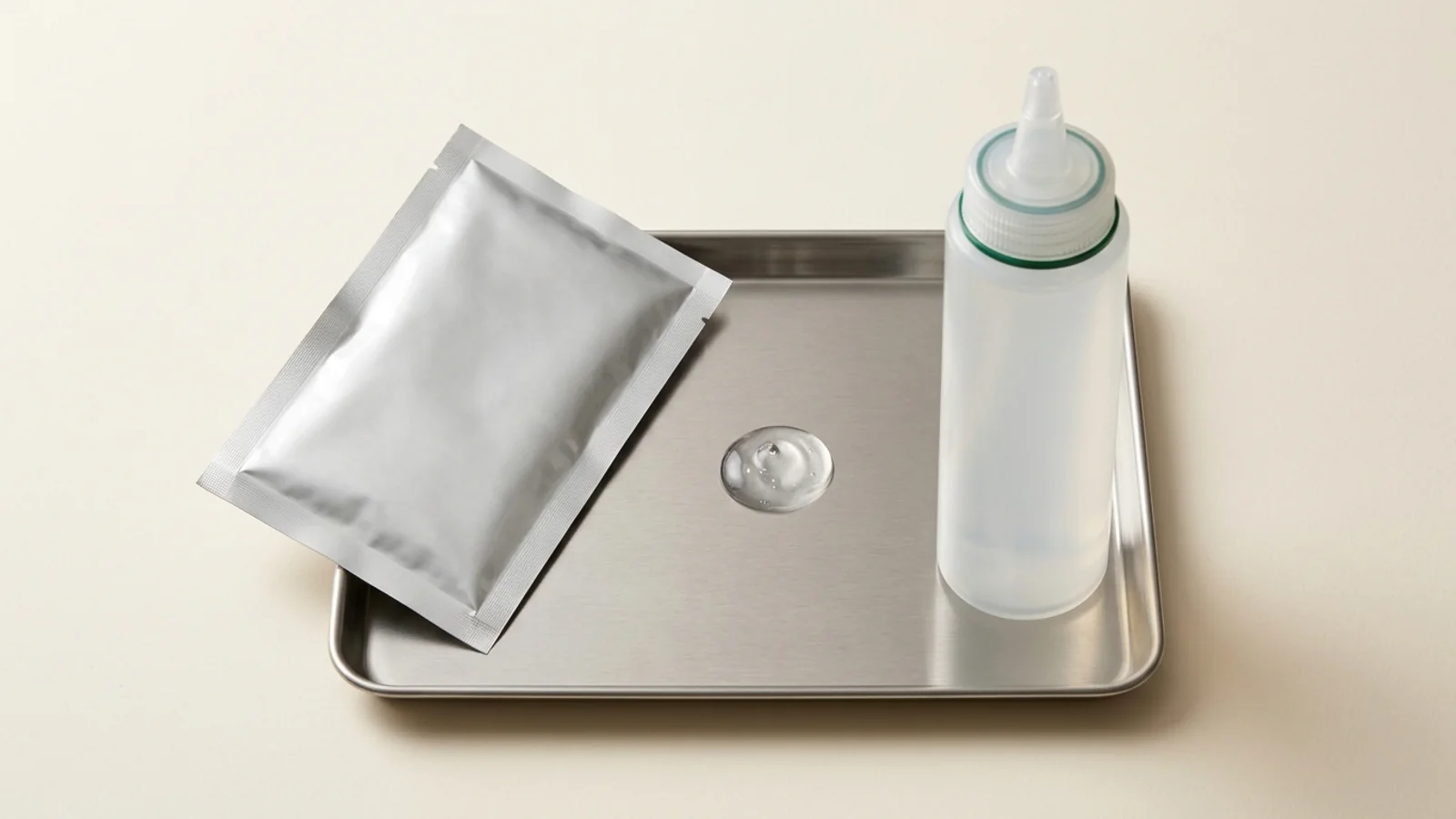
Hospital buyers ordering ultrasound gel often see a single-use packet, a foil pouch, and a squeeze bottle treated as if the package shape were the specification. The same hospital may use gel for intact-skin imaging and for ultrasound tied to intravenous placement, biopsy, or an intraoperative exam. One undifferentiated line does not carry both jobs.
Buy by the labeled sterility claim and the intended procedure, not by the package format. Keep two requisition lines, and do not treat them as interchangeable. Line 1 is gel whose label says sterile, supplied in a single-use container, for the procedure categories below. Line 2 is gel that is not labeled sterile, as a single-use packet or a multi-use bottle, for routine imaging on intact skin, used with the handling rules in the storage section. A sterility assurance level of 10^-6 is a validation result to request for line 1. It is not printed on every pouch, and a small packet does not prove it.
The One-Table Answer: Which Gel for Which Procedure
Three documents are doing different jobs. The CDC safety alert of May 13, 2025 is advice to US healthcare providers, not a device regulation and not a change to a gel's cleared indication. The AIUM guideline, approved July 2, 2025, is a US professional statement. Its sterile-gel wording is "preferable" or "should be considered," depending on the setting. UKHSA guidance applies to England, was updated January 30, 2025, and says sterile single-use gel "should be used" in the settings it lists. A purchasing policy has to name which document it follows where those sentences differ.
The CDC alert's examples of percutaneous procedures are placement of central and peripheral intravenous lines, amniocentesis, paracentesis, tissue biopsy, and surgical procedures. The alert also says percutaneous procedures involve skin or tissue puncture and are not limited to that list. AIUM's examples of invasive procedures that pass a device through tissue include needle aspiration, needle localization, and tissue biopsy.
| Procedure category | Gel to specify | What each document actually says | Requisition line |
|---|---|---|---|
| Percutaneous procedures, including central and peripheral intravenous placement, amniocentesis, paracentesis, tissue biopsy, and surgical procedures | Single-use gel labeled sterile | CDC alert: use only single-use products labeled sterile for ultrasonography in preparation for or during these procedures. AIUM: sterile single-use packets are preferable when a device passes through tissue. UKHSA (England): sterile single-use gel should be used for an ultrasound-guided procedure that passes a device through skin into sterile tissue. | Line 1. Do not accept a packet that says single-use but does not say sterile. |
| Non-intact skin, or a scan near a fresh surgical site | Single-use gel labeled sterile | AIUM: preferable for examinations or procedures on nonintact skin or near a fresh surgical site. UKHSA: should be used for contact with or near non-intact skin. Its examples include a rash, a surgical wound, and the umbilicus in neonates. The CDC alert does not list this as its own category. | Line 1. Do not describe wounds or burns as a CDC rule the alert did not write. |
| Neonatal examinations; intensive care, high-dependency care, and equivalent units | Single-use gel labeled sterile | AIUM: preferable for all neonatal examinations, not only for a NICU stay. UKHSA: should be used in all intensive care, including neonatal intensive care, high-dependency care, and equivalent units. Pediatric intensive care is not a named UKHSA line. | Line 1 for those settings. Treat another unit as "equivalent" only if the facility policy says so. |
| Endocavitary examination on intact mucous membranes, such as esophageal, gastric, rectal, or vaginal contact. UKHSA also names transoesophageal and ophthalmic contact. | Write the chosen standard into the policy before choosing a SKU | UKHSA: where a probe cover is required, use sterile single-use gel inside and outside the cover. AIUM: sterile or bacteriostatic gel should be considered. Those are not the same sentence. AIUM does not say a bacteriostatic claim replaces a probe-cover policy. | Line 1 satisfies both. A bacteriostatic gel that is not labeled sterile does not satisfy the UKHSA sentence. |
| Within 24 hours before a likely or planned invasive procedure at or near the same site, including a viewing scan | Single-use gel labeled sterile if the facility follows UKHSA | UKHSA states this should-use rule. Its rationale is a precaution against transient contamination of skin, including ducts, glands, and follicles. It is not a study result that sterile gel prevents colonization. CDC and AIUM do not state a 24-hour rule. If an unplanned procedure follows non-sterile gel, UKHSA points skin preparation to the facility's infection-control policy. | Line 1 for pre-procedure mapping kits when UKHSA is the adopted standard. |
| Patients assessed as severely immunocompromised | Single-use gel labeled sterile if the facility follows UKHSA | UKHSA says sterile gel should be used. The appendix examples include recent bone-marrow or stem-cell transplant, immunosuppression that significantly raises infection risk, and certain ongoing cancer treatments. It is a patient assessment, not an oncology-ward or transplant-ward rule. AIUM covers the concern only through "when infection is a concern." | Line 1 when infection control classifies the patient that way. |
| Labor when caesarean section or invasive instrumentation is likely; examination near an indwelling invasive device | Single-use gel labeled sterile if the facility follows UKHSA | UKHSA lists both. Device examples include an intravenous catheter and a suprapubic catheter. The CDC alert covers the invasive procedure itself, not a separate labor or near-device line. AIUM does not enumerate these two settings. | Line 1 when UKHSA is the adopted standard for those settings. |
| Routine imaging on intact skin in a low-risk patient, with no mucous-membrane contact, and more than 24 hours before a probable invasive procedure at that site | Non-sterile gel in a single-use packet or a multi-use bottle, with handling controls | UKHSA permits non-sterile gel in that window. AIUM permits single-use packets or multidose containers outside the situations where sterile gel is preferable. The CDC alert does not say to stop non-sterile gel for ordinary intact-skin scans. | Line 2. Bottle or pouch mass is a vendor field. One cleared example is a 250 g non-sterile pouch in K181363. That figure is not a hospital standard. |
Where the three documents agree, stock line 1. Where they do not, the value-analysis record should name the document the hospital follows. Merging them into one unspoken rule hides the difference a buyer has to specify.
graph TD
    A["Ultrasound gel requisition"] --> B{"Which procedure or patient setting?"}
    B -->|"Category the adopted guidance reserves for sterile gel"| C["Line 1: single-use gel labeled sterile"]
    B -->|"Intact-skin imaging outside those categories"| D["Line 2: gel not labeled sterile"]
    C --> E["Request the 510(k) number, sterilization method, SAL evidence, and packaging validation"]
    D --> F{"How quickly is an opened bottle used?"}
    F -->|"High-turnover room"| G["Multi-use bottle: do not refill; date it on opening"]
    F -->|"Low-use area, isolation, or a precaution cart"| H["Single-use non-sterile packet, labeled non-sterile"]
    G --> I["If the policy follows UKHSA: discard when empty, at one month, or at expiry, whichever is first"]
H --> J["Keep the packet visually distinct from the sterile line"]Read the Label, Not the Packet: Sterile vs Single-Use vs Bacteriostatic
Single-use describes the container and the discard rule. It does not describe sterility. A catalog can call a small container a packet, a packette, or a unit dose and still be selling non-sterile gel. The word to find on line 1 is sterile, plus the sterilization method in the technical file.
The December 11, 2025 MMWR report covers May 2023 through April 2025. Investigators identified 42 patients in the United States, Canada, and Israel with Paraburkholderia fungorum in clinical specimens, and 43 isolates from those patients. Whole-genome sequencing placed the clinical isolates and isolates from non-sterile ultrasound gel in one clone, with 0 to 10 single-nucleotide differences. Gel isolates came from six lots of two non-sterile brands, MediChoice and ClearImage, made by NEXT Medical Products Company. The CDC alert of May 13, 2025 names the lots known then: MediChoice 240302 and 240306, and ClearImage 230221, 230256, 240227, and 240230. The MMWR text reports six lots of those two brands and does not reprint that lot list, so the lot numbers belong to the alert.
MMWR says several facilities stocked single-use packets of non-sterile gel. That packaging might have been read as a marker of sterility and could have contributed to use before percutaneous procedures, including peripheral intravenous placement. The report calls this a possible contribution. It does not call the packet format the sole cause. Sixteen of the 42 patients had a documented ultrasound-guided percutaneous procedure before or during specimen collection, and gel use was confirmed for 15 patients. Ultrasound guidance is often missing from the chart, so those figures are not an exposure rate.
A bacteriostatic claim is a third label, separate from sterile and from single-use. The CDC alert says a label claim of "bacteriostatic" or "preservative," without a specific indication of sterility, should be considered non-sterile for clinical purposes. If a bid depends on the preservative, ask the vendor to name it. Do not copy the preservative system from another brand.
Parker Laboratories is a useful catalog example because the sterile and non-sterile lines are separate pages, and both pages use the word bacteriostatic. That is field structure, not a preference for this manufacturer and not evidence that the two gels are the same formula.
Sterile Aquasonic 100, REF 01-01. The product page sells this configuration as sterile and single-use, in individually overwrapped sterilized foil pouches, and recommends it for procedures requiring sterility. That recommendation is the manufacturer's wording. The page does not publish pouch mass, sterilization method, sterility assurance level, acoustic values, or shelf life. Those fields stay unknown unless an instructions-for-use document or a clearance file supplies them. The current instructions for use cited on the page are PM-010-0002F (2023).
Aquasonic 100, REF 01-20 and bottle configurations 01-02, 01-08, 01-34, and 01-50. This is a separate catalog line. The page does not use the word sterile. It does say bacteriostatic, and it says the gel is free from formaldehyde and parabens. Bottle volume, acoustic data, and shelf life are not on the page. Current instructions for use cited there are PM-010-0001H (2026) for the gels and PM-020-0001H (2025) for the single-use packettes. Do not describe the two lines as the same acoustic polymer. The pages do not say that.
Because both lines say bacteriostatic, that word cannot tell line 1 from line 2. Search the label and the instructions for use for sterile, and ask for the sterilization method. Marketing lines such as "acoustically correct" are not a substitute for the velocity, impedance, or attenuation values in a test report.
The Regulatory Identity Buyers Should Verify: MUI and 21 CFR 892.1570
In the United States, acoustic coupling gel is not a separate therapeutic device and not a general hospital commodity with its own product code outside radiology. Under 21 CFR 892.1570, accessories to the diagnostic ultrasonic transducer may include "transmission media for acoustically coupling the transducer to the body surface, such as acoustic gel, paste, or a flexible fluid container." The transducer is Class II. The eCFR text is the current unofficial compilation; the annually published CFR is the official edition.
The FDA product-classification record for product code MUI, "media, coupling, ultrasound," is the identity to match against a vendor's paperwork. The procurement fields on that record are:
Classification. Device class 2, Radiology review panel, regulation 892.1570, submission type 510(k). The record lists the product code as eligible for the 510(k) Third Party Review Program.
Quality system. The record answers "GMP Exempt?" with No, so device quality-system requirements in 21 CFR Part 820 apply to the gel manufacturer. Since February 2, 2026, that part is titled the Quality Management System Regulation. The classification page does not list gel-specific environmental-monitoring or bioburden limits. Do not invent those limits from the word "not exempt."
Recognized standards. The standards on the MUI page are ultrasonic-equipment standards, not gel chemistry or pouch tests: NEMA UD 2-2004 (R2009); IEC 60601-2-37 Edition 2.1 (2015) and Edition 3.0 (2024); and IEC 62359 Edition 2.1 (2017). Recheck the page before a tender. The record changes.
The K181363 summary states that, for acoustic coupling gels, there were no FDA device-specific guidance documents, no special-controls document, and no performance standards promulgated under Section 514, because these gels are accessories to diagnostic ultrasonic devices. That is a statement in a 2018 submission. The clearance letter's boilerplate still notes that a Class II device may be subject to additional controls. A contract should ask for the vendor's own 510(k) number. "FDA compliant" is not a clearance number.
Evidence Fields to Request Before the Purchase Order
K181363, cleared June 13, 2018, is the 510(k) for EcoVue sterile and non-sterile ultrasound gels from HR Pharmaceuticals. Product code MUI, regulation 892.1570, Class II. The configurations in the summary are a 20 g sterile single-use SafeWrap packet (REF 280), a 20 g non-sterile single-use packet (REF 281), and a 250 g non-sterile multi-use FlexPac pouch (REF 285). Use the file as a list of fields a buyer can request. The numbers are that file's reported ranges. Most were generated by the manufacturer's internal methods. Viscosity cites ASTM D445-17a. They are not pass/fail limits for other brands, and they are not a reason to treat two vendors' gels as interchangeable.
Read the indication before using the word sterile as if it widened the clearance. Both the sterile and the non-sterile EcoVue gels were cleared for the same use: intact skin during non-invasive medical ultrasound procedures, to couple sound between the patient and the imaging equipment. Clearance of the sterile SKU in this file is not clearance for percutaneous or other invasive use. The CDC alert is a safety recommendation about which gel to use for percutaneous procedures. It does not rewrite this indication. The summary also compares EcoVue with Sheathing Technologies' Sheathes sterile gel (K130041), sterilized with hot water, and Sheathes non-sterile gel (K112827). Sterilization method and shelf life in that comparison are product-specific.
| Evidence field | What to request | What K181363 actually reports | How to read it |
|---|---|---|---|
| Regulatory clearance | The vendor's 510(k) number and summary, product code MUI, regulation 892.1570 | K181363, cleared June 13, 2018, for EcoVue sterile and non-sterile gels | Confirms that vendor's marketing authorization. It is not a master file for other brands. |
| Cleared indication | The indications-for-use statement, not a catalog sentence about "procedures requiring sterility" | Intact skin, non-invasive ultrasound, for both the sterile and non-sterile gels | Do not treat a sterile label in this file as an invasive-use clearance. |
| Sterilization method and SAL, sterile line only | The method the vendor validated and the sterility assurance level, with the standards cited | Gamma irradiation, minimum 27.5 kGy and maximum 45 kGy, SAL 10^-6, citing ANSI/AAMI/ISO 11137-1/-2/-3 and ISO 11737-1/-2. The sterile predicate, Sheathes K130041, was hot water, not gamma. | Ask for the method this vendor validated. Ethylene oxide under ISO 11135 is a different sterilization family and is not the method in K181363. |
| Sterility evidence | The sterility report or process-validation summary the vendor uses for release | Sterility per USP <71> is listed among the tests | The summary lists USP <71> among the tests. Ask the vendor whether release uses that finished-product test, process validation, or both. The file does not state a 14-day lot-release rule. |
| Microbial limits, non-sterile line | Finished-product microbial test records and the method name | Microbiological growth per USP <61>. USP <62> is not cited. | A microbial-limits test is not a sterility claim. It does not certify absence of Burkholderia or Pseudomonas unless the report says so. |
| Preservative effectiveness | A challenge report if the vendor claims a preservative or bacteriostatic effect | Antimicrobial effectiveness per USP <51> | Shows the test this file cited. It does not turn non-sterile gel into sterile gel. |
| Biocompatibility and contact category | The biological-evaluation summary, including how long the gel contacts tissue and which tissue | Limited contact under 24 hours, intact skin. Cytotoxicity per ISO 10993-5. Irritation and sensitization per ISO 10993-10:2010. The summary says the tests met ISO 10993-1:2009 for those endpoints. | This contact category does not cover breached skin or mucous membrane. A line that says only "ISO 10993 compliant" leaves the category unknown. |
| Acoustic and physical values | A data sheet that names the method, the unit, and, for attenuation, the frequency | Sound velocity 1398-1750 m/s; acoustic impedance 1.40-1.80 Mrayl; attenuation 0.32-0.95 dB/cm at 5 MHz, 0.65-1.10 dB/cm at 7.5 MHz, and 0.85-1.55 dB/cm at 10 MHz; viscosity greater than 35,000 cP by ASTM D445-17a; pH 5.5-7.8; density 0.85-1.15 g/cm3. Velocity, impedance, attenuation, pH, and density are internal methods. | Ask other vendors for their own values. Do not score them against these ranges, and do not drop the frequency off an attenuation number. |
| Sterile-barrier packaging | The packaging-validation report and the seal tests performed | ISO 11607-1, plus ASTM F88/F88M seal strength, ASTM F1886/F1886M visual seal inspection, and ASTM F2096 bubble leak, used to support the sterile-barrier claim for this pouch family | These methods describe the EcoVue package that was tested. They are not a grade for every foil packet on the market. |
| Shelf life | The labeled expiry and the aging method | Accelerated aging per ASTM F1980 supported a one-year shelf life for EcoVue. In the same summary, the Sheathes sterile predicate lists 3 years and the Sheathes non-sterile predicate lists 5 years. | Do not write "1 to 5 years" as the shelf life of ultrasound gel. Shelf life travels with the product file. |
If a sterile pouch arrives with visible damage, use the site's goods-receipt guide on recording sterile-pouch damage. Record the packaging level and the labeled identity. An undamaged-looking pouch is not, by itself, evidence that the gel inside is sterile.
If the vendor does not disclose attenuation and its frequency, the sterilization dose or other process parameters, or the package-aging method, mark the field unknown. Do not fill the blank with K181363's ranges or with another brand's catalog. Unknown means the tender does not yet have the fact.
When a Recall Letter Arrives: Lot Numbers and Brand Aliases
Ultrasound gel is often sold under a distributor's brand. A lot-level recall that names only the factory brand will miss boxes that carry a private label. Receiving has to be able to find the lot under every name the hospital actually bought.
At goods receipt, capture the manufacturer, the brand printed on the box, the lot, the expiry, and the device identifier when the label carries a UDI. The site's guide to what receiving teams should capture for UDI and GUDID is the place for those label fields. For product code MUI, record the device identifier when a UDI is present. The brand "NDC" on the Eco-Med list is the distributor NDC Inc., not a drug-code field.
Quality agreements are where the hospital can require notice of a lot-level recall and a crosswalk from the factory lot to every private-label SKU on its purchase orders. The site's article on quality agreements for consumable suppliers covers purchasing information and change control. It does not create a universal 24-hour notice clause. Put the notice timing the supplier will actually meet into the agreement, and do not cite this recall as if that timing were already the law.
Storage, Opened-Bottle Discipline, and Warmers
Line 2 is reasonable to buy when the units can follow the handling rules the facility adopts. AIUM and UKHSA do not write the same bottle rule, so the formulary note should name which document applies. UKHSA states a one-month opened-bottle limit. AIUM states refill, seal, upright storage, and tip-contact rules, and it does not state a calendar discard date.
| Container | Handling rule, and who states it | What the rule is not | Purchasing note |
|---|---|---|---|
| Multi-use bottle or pouch. The labeled volume is the vendor's. K181363's non-sterile multi-use example was a 250 g pouch. | AIUM: discard and replace multidose containers when empty, and do not refill them; seal them when not in use; store them upright; avoid tip contact with a person or the transducer. Discard the bottle after use on a patient under droplet or contact precautions, or use a single-use packet instead. UKHSA, for England: pre-filled disposable bottles must not be refilled; date the bottle when opened; discard it when empty, after one month, on the expiry date, or sooner if the manufacturer says so, whichever comes first; wipe the bottle, including the tip, before and after each patient; discard it if the tip contacts the patient, the transducer, or other equipment. | UKHSA describes one month as a pragmatic balance of contamination risk, practicality, and waste. It is the interval in the England guidance. AIUM does not give a calendar discard date. The 250 g figure is the EcoVue pouch mass in K181363. | Pick a labeled size the department can finish inside the discard window it adopts. |
| Single-use non-sterile packet | Use it for one examination and discard the remainder. Do not reseal it for another patient. AIUM allows non-sterile single-use packets when cross-contamination is a concern, and otherwise allows them or multidose containers. UKHSA notes that single-use non-sterile sachets can reduce waste in low-use areas. | Not a sterile product. The packet format is the ambiguity MMWR described. | Require the words non-sterile on the line-2 item and on the bin. Use this format for low-volume rooms, isolation, and carts if opened bottles would sit past the discard date. |
| Bulk container used to decant gel or to refill smaller bottles | UKHSA says gel should not be decanted from a larger container into other bottles, and reusable bottles filled from a dispenser are not recommended. AIUM says multidose containers should not be refilled. UKHSA's stated reasons are prolonged storage, exposure to air that can allow bacterial growth, and repeated patient contact. | The CDC background and the Eco-Med notice tie outbreaks to contaminated non-sterile gel. Refilling is a separate handling practice that both AIUM and UKHSA reject. | Keep bulk gel that would be decanted or used to refill smaller bottles off the clinical formulary. Apply that rule to whatever jug size is offered for transfer. |
Warming is optional, and the two documents limit how it is done. AIUM says dry heat should be the only method used to warm gel, and that warmers should be cleaned on the manufacturer's and the facility's schedule. UKHSA says warming is not recommended unless a clinical benefit outweighs room-temperature gel. Where gel is warmed, UKHSA says to use dry heat rather than warm water, and to keep bottles upright. UKHSA notes that water baths have been a contamination route for gel and other supplies.
Store gel under the conditions printed on the label or in the instructions for use. UKHSA says to follow the manufacturer's instructions and to keep gel in a dry area away from sources of contamination. If the label and the instructions for use state no temperature range, leave that field unknown. The site's article on labeled storage and transport is the method for logging the conditions the label actually states.
Purchasing Checklist: Specify Both Lines, Verify Every Claim
Use this list to write the item master and the bid request. It is a specification checklist. It is not a clinical protocol and not a ranking of gel manufacturers.
Two item-master lines. Name them so the word sterile appears on line 1 only, for example "Gel, ultrasound, sterile, single-use" and "Gel, ultrasound, non-sterile." Limit line 1 ordering to the departments that perform the categories in the table, as infection control defines those categories for the hospital.
Ask for the clearance and the method that was validated. Require the 510(k) summary for product code MUI and the indications-for-use statement. For the sterile line, require the sterilization method and the SAL evidence the vendor validated. Gamma irradiation and ISO 11137 are what K181363 used. Hot water is what that file's sterile predicate used. Set the bid condition to the method and the release evidence in that vendor's file.
Ask for contact category, not a bare biocompatibility sentence. Request the ISO 10993 evaluation and the contact duration and tissue. K181363's acceptable results were for limited intact-skin contact. That does not answer mucous-membrane or breached-skin contact.
Keep non-sterile packets from looking like sterile pouches. If the packages are the same size and color, separate the bins and put non-sterile on the line-2 label and the shelf. MMWR says manufacturers and facilities should make sure non-sterile gel, especially single-use packets, is clearly labeled non-sterile.
Do not buy gel for decanting or refilling. Remove bulk-to-bottle refill packs from department templates, at whatever jug size the vendor uses for transfer.
Write the opened-bottle date the adopted policy uses. If the policy is UKHSA, date the bottle on opening and discard it when empty, after one month, or at expiry, whichever comes first, and sooner if the manufacturer says so. If the policy is AIUM only, follow AIUM's refill, seal, upright-storage, and tip-contact rules, and do not pretend AIUM stated one month.
Receive by identity and lot. Check that cartons are intact enough to read the label, and log manufacturer, brand alias, lot, expiry, and any storage conditions the label states. Log a temperature excursion when the label defines the limit that was crossed. For product code MUI, the receiving identity is the device identifier when a UDI is on the label, together with the lot and the brand.
Coupling gel is a transmission medium. It is not a barrier drape and not a treatment. The purchasing decision is which labeled product belongs in which procedure category, which document the hospital is following where the guidance differs, and which evidence fields are still unknown when the purchase order is signed.