
The Short Answer: A Material Claim Is Not a Local Acceptance Decision
A supplier says its sterilization wrap is “#5 recyclable” and points to a manufacturer take-back program. Before that wrap goes into your facility's recycling stream, or into a sustainability report, treat the claim as a question about one specific package in one specific collection system. The resin tells you what the package is made of. It does not tell you whether the hauler or materials recovery facility (MRF) that services your loading dock will take it.
Federal guidance frames recyclability the same way. The FTC's Green Guides say a package should not be marketed as recyclable unless it can be collected, separated, or otherwise recovered from the waste stream through an established recycling program (16 CFR 260.12). EPA's consumer guidance makes the practical point that a resin number does not necessarily mean an item can be collected for recycling in a given community (EPA, How Do I Recycle Common Recyclables).
In practice, a buyer can rely on a recyclable claim only when three links hold:
Material and construction: Which resin or resins, and in what form? A single-material wrap is a different question from a pouch that combines a fiber web with a laminated film.
Clean and non-infectious status: Does the item meet the facility's own waste policy for clean, non-infectious material at the point where it is collected, and who verifies that?
Named local acceptance: Has the hauler, MRF, or recycler that actually services the site accepted this material and form in writing, along with how it must be accumulated and where it goes next?
If any link is missing, the claim is not yet usable. Recyclers expect material that is not contaminated, and HPRC's recycler checklist asks the hospital to describe its collection procedures and QA/QC controls before a program starts (HPRC, Questions to Ask Your Recycler). The rest of this guide covers the federal claim standard, the materials that sit under the label “medical packaging,” the limits of clean-stream estimates, the difference between a manufacturer program and local acceptance, and a checklist you can apply to a single package.
Why Recyclable Is a Collection Claim Under the Green Guides
The FTC's Guides for the Use of Environmental Marketing Claims, known as the Green Guides, are the federal reference point for recyclable claims in U.S. marketing (16 CFR 260.12). They set out how the FTC views deceptive environmental claims; they are not a recycling-facility standard, and they do not decide what a particular hauler accepts. Their core principle is that a product or package should not be marketed as recyclable unless it can be collected, separated, or otherwise recovered from the waste stream through an established recycling program for reuse or use in manufacturing or assembling another item.
The Guides then set a threshold. When recycling facilities are available to a substantial majority of consumers or communities where the item is sold, a marketer can make an unqualified recyclable claim, and “substantial majority” means at least 60 percent. Below that level, the marketer should qualify the claim, and the lower the access, the more strongly the qualification should emphasize limited availability. The FTC's example language ranges from “This product [package] may not be recyclable in your area” to “This product [package] is recyclable only in the few communities that have appropriate recycling facilities.”
Two further provisions matter for medical packaging. First, an item made from recyclable material that is not accepted in recycling programs because of its shape, size, or another attribute should not be marketed as recyclable, and if any component significantly limits recycling, a recyclable claim would be deceptive. Second, the FTC's multi-layer example describes a package of four bonded layers in which only one layer is recyclable and few programs can separate the layers; the FTC calls an unqualified “includes some recyclable material” claim deceptive in that situation. Both points map directly onto sterile-barrier packaging built from more than one material.
The Guides also recognize take-back programs. In one FTC example, a manufacturer whose dealers in a substantial majority of communities collect its single-use cameras can label them “Recyclable through our dealership network,” even though the cameras are not accepted through curbside or drop-off programs. A take-back route can therefore support a qualified claim, but it is a separate pathway from the facility's general recycling contract, a distinction the manufacturer-program section below returns to.
For a hospital buyer, the practical reading is narrow. The Green Guides help you judge the supplier's marketing language; they do not tell you whether your own hauler will accept the package. Public hauler guidance points the same way: WM's Recycling 101 page (WM Recycling 101) says recyclable items vary by location, that the chasing-arrows symbol does not necessarily mean an item is recyclable, and that medical waste never goes in curbside recycling. That is consumer-facing guidance from one national hauler, and a facility's commercial contract can differ, but it shows the gap between a material label and an acceptance decision.
What Counts as Medical Packaging: Blue Wrap, Tyvek, Films, and Trays
“Medical packaging” is not one material. HPRC's guide to common recyclable healthcare plastics (HPRC, Common Recyclable Healthcare Plastics) separates the items a hospital is most likely to see, and the differences change what you need to ask a recycler:
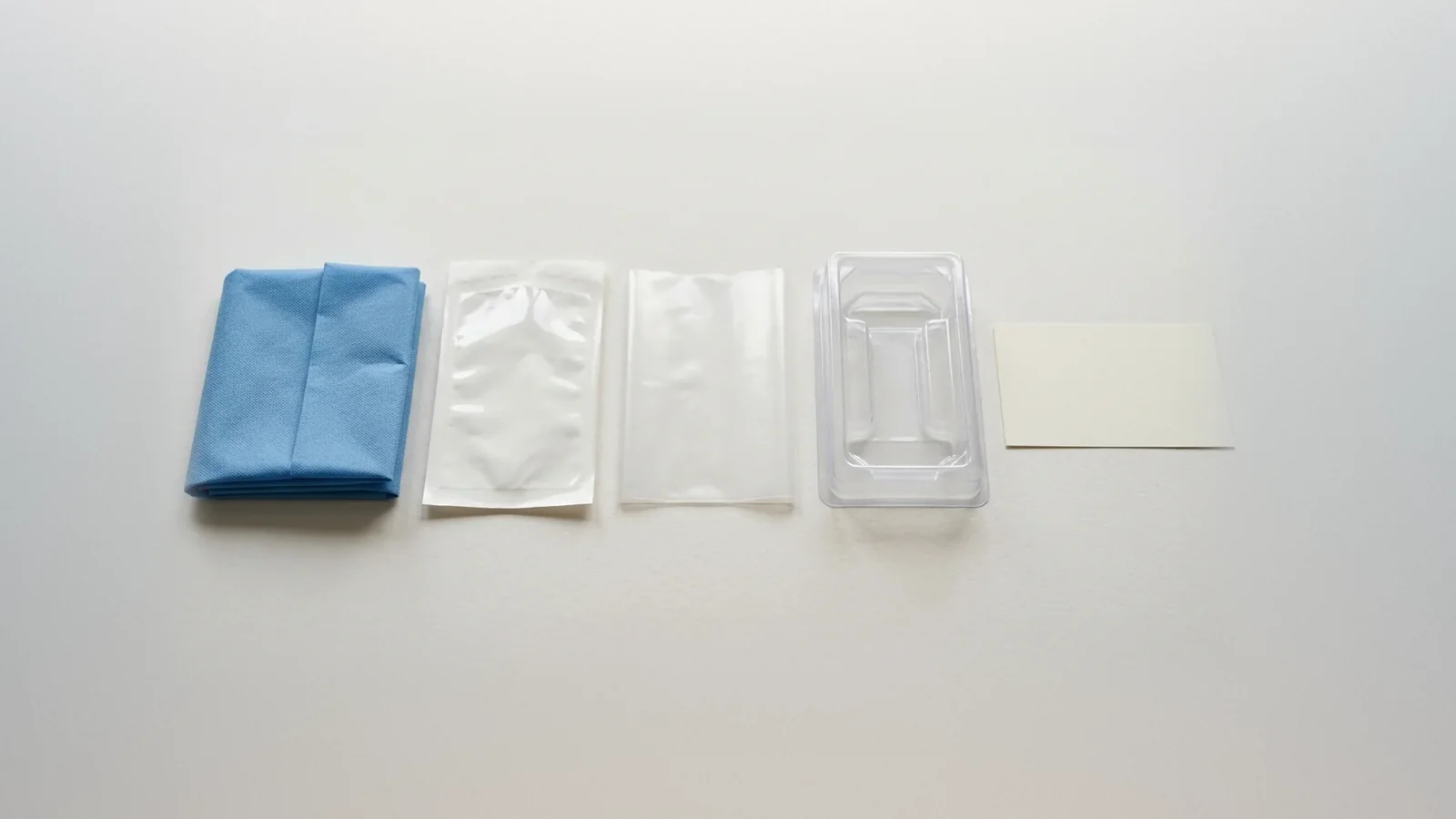
Sterilization wrap (“blue wrap”): HPRC describes it as often made from polypropylene (PP), which may be recycled with other #5 materials or collected and baled separately to increase its value. If collected before surgery, it is clean material. HPRC also cautions that some wrap materials include paper-based materials and advises checking with the manufacturer when the material is uncertain.
Sterile-barrier packaging (pouches, header bags, vented bags, blister packs): HPRC says flexible, semi-rigid, and rigid sterile-barrier packages are often constructed from two different types of materials and/or multi-material film laminations or co-extrusions. It lists Tyvek (high-density polyethylene) and films made from polyester, polyethylene, polyamides, polypropylene, and ionomers as common materials. Tyvek lids removed from rigid trays can be segregated into this stream, but HPRC notes that Tyvek can be hard to tell apart from paper by eye.
Flexible clear packaging: Shrink wrap, stretch film, and plastic bags arrive in large quantities at receiving docks and as secondary and tertiary packaging. HPRC identifies them as polyethylene that may be recycled with #2 materials. That route depends on a recycler that takes film: EPA and WM both say bags, wraps, and films do not belong in household or curbside recycling bins.
Rigid basins, pitchers, and patient-care trays: HPRC describes rigid colored and opaque containers of this kind as typically polypropylene that may be recycled with #5 materials. Clear device trays and blisters that form part of a sterile barrier fall under the previous category, where construction varies by design, so confirm the resin with the manufacturer rather than assuming it.
The table below summarizes what the retained sources say about each format and what a buyer still has to confirm locally. It is not an accepted-materials list; acceptance belongs to the recycler that services the site.
| Packaging format | Material per HPRC | Construction note | General-stream signal in the sources | Confirm with your recycler |
|---|---|---|---|---|
| Sterilization wrap (blue wrap) | Often polypropylene (#5); some wraps include paper-based materials | Clean if collected before surgery; can be baled separately to increase value | HALYARD's program relies on a collector that sorts and bales the wrap rather than ordinary curbside service | Material of the exact product; bags or bales; separate or commingled collection |
| Sterile-barrier pouches and header bags | Tyvek (HDPE) plus films of polyester, polyethylene, polyamides, polypropylene, or ionomers | Often two materials, or multi-material laminations or co-extrusions | WM: flexible multi-material packaging cannot be recycled in curbside programs | Whether this construction is accepted at all, and whether lids must be separated |
| Shrink wrap, stretch film, bags | Polyethylene; may be recycled with #2 materials | Flexible film, concentrated at receiving docks | EPA and WM: bags, wraps, and films do not go in curbside bins; WM says bags tangle equipment | Whether a film-capable recycler collects from the dock, and how film must be accumulated |
| Rigid basins, pitchers, patient-care trays | Typically polypropylene (#5) | Rigid colored or opaque containers | HPRC: the shape of rigid plastics can affect processing equipment | Accepted shapes and resins; contamination limits such as paper labels |
These differences matter when you review supplier claims. For how barrier pouches are specified before sterilization, see our guides to self-seal versus heat-seal sterilization pouches and sterilization pouch sizing. Reusable textiles raise a different set of questions, covered in our guide to reprocessing evidence for reusable surgical drapes.
Clean and Non-Infectious: Necessary, Not Sufficient
Infection prevention is the first gate, but it is not the last. HPRC's hospital waste characterization tool (HPRC, Hospital Waste Characterization) offers sector benchmarks rather than a facility audit:
Scale: By HPRC's estimate, U.S. healthcare facilities generate approximately 14,000 tons of waste per day.
Plastic share: An estimated 20 to 25 percent of that waste is plastic packaging and plastic products.
Non-infectious share: HPRC states that 85 percent of the waste generated is non-infectious.
HPRC turns these benchmarks into a starting equation: total hospital waste in tons per year × 25% × 85% gives an initial estimate of the plastics available for recycling. For a hypothetical facility generating 1,000 tons of waste a year, that is about 212 tons (1,000 × 0.25 × 0.85 = 212.5). HPRC then adds the caveat that matters most: the equation estimates the overall clean healthcare plastic stream, but not all clean healthcare plastics are readily recyclable, and the hospital should contact its recycling partner to evaluate acceptable plastics.
That is the core distinction. Clean, non-infectious status makes an item eligible to be considered. It does not make the item accepted.
Why can clean material still be refused? HPRC's recycler questions point to three variables beyond cleanliness:
Form: Rigid and flexible plastics are handled differently, and HPRC asks hospitals to confirm which forms a recycler accepts. In curbside service, WM says plastic bags are not accepted because they get tangled in equipment and threaten worker safety, and that flexible multi-material packaging cannot be recycled.
Shape and contamination: HPRC lists the shape of rigid plastics (bottles versus other shapes may affect processing equipment) and contamination such as paper labels, mixed plastics, glass, cardboard, and wet materials as acceptance questions. It also warns that mixing and compacting medical plastics with post-consumer recyclables may result in contamination with broken glass.
Final disposition and economics: HPRC tells hospitals to ask where the plastics go after pickup, whether there are further downstream processors, and where the material will ultimately be recycled. It also notes that recycling is driven by economics, so items can become more or less valuable to recyclers over time and acceptance lists can change.
Manufacturer Program Versus Local Hauler Acceptance
Suppliers often answer hauler skepticism by pointing to a manufacturer program. HALYARD's BLUE RENEW page (HALYARD, Hospital Recycling & Sustainability) is a clear example. It describes facilities recycling used, clean HALYARD sterilization wrap made from recyclable #5 polypropylene fabric, and says HALYARD helps facilities connect with local waste haulers and recyclers.
The program is real, and it is relevant evidence for that product. It also shows how many conditions sit behind a single recyclable claim. According to HALYARD's own program description and questions-and-answers section:
Timing: Clean blue-wrap collection is allowed only before surgery, and the bag must be tied off prior to incision.
Scope: HALYARD recommends starting with only blue wrap in the collection bag and adding items such as saline bottles only after the operating room has built a discipline of clean collection. Tape and labels can remain on the wrap, although HALYARD suggests removing any large instruction sheet.
Collector role: The collector picks up at the hospital, sorts, bales, and stores the wrap for recycler pickup; the recycler processes it, and a processor extrudes it into pellets for resin products. HALYARD says it will try to engage a vendor already servicing the facility as a backhaul.
Costs and containers: HALYARD says it does not charge for its assistance, but a collector may charge per pickup or require the facility's contract to be rewritten to show blue-wrap collection, and program revenue goes to the collector. The collector usually supplies bins for the dirty room and loading dock, while the facility supplies bins in the operating room.
Reporting: HALYARD works with the collector to provide quarterly or semi-annual collection numbers back to the facility.
Each of these is effectively a contract term. None of them is the same as your general recycling hauler accepting blue wrap in its ordinary service, and the program covers HALYARD sterilization wrap rather than every wrap or every package that reaches the operating room. HALYARD's participation and diversion figures are manufacturer program data, not an independent audit.
A Buyer Checklist for a Specific Package
Before a recyclable claim enters a value-analysis decision, a contract, or a sustainability report, test it against the single package in question. The workflow below follows the three-link evidence chain and fails closed at every step:
flowchart TD
    A["Supplier recyclable claim for one package"] --> B{"Material and construction confirmed?"}
    B -- "Unknown, or construction not accepted" --> F["Keep out of recycling stream and do not repeat the claim"]
    B -- "Resin and form confirmed" --> C{"Clean and non-infectious under facility policy?"}
    C -- "No or unverified" --> G["Not eligible, follow facility waste policy"]
    C -- "Yes, with a verification step" --> D{"Written acceptance from the named hauler or recycler?"}
    D -- "No" --> F
    D -- "Yes" --> E{"Accumulation, pickup and nonconforming-material terms agreed?"}
    E -- "No" --> F
    E -- "Yes" --> H["Collect under written terms"]
H --> I["Keep disposition and collection reports, recheck when terms change"]Then document the answers. The checklist below is derived from HPRC's recycler questions (HPRC, Questions to Ask Your Recycler) and the operating terms on HALYARD's program page. It describes the evidence to collect; it is not a guarantee that any material will be accepted.
| Step | Question to answer | Evidence to keep | Red flag | Action if missing |
|---|---|---|---|---|
| 1. Material and form | Which resin or resins, rigid or flexible, single material or multi-material? | Manufacturer material statement for the exact product; for wrap, confirmation of whether any paper-based material is present | Resin code only; “medical packaging” treated as one material | Ask the manufacturer; keep the item out until confirmed |
| 2. Contamination status | Is the item clean and non-infectious under facility policy where it is collected, and who checks? | Facility collection procedure and QA/QC step, as described to the recycler | No defined collection point or verification step | Do not start collection until the facility defines and approves its procedure |
| 3. Named acceptance | Does the hauler, MRF, or recycler that services this site accept this material and form? | Written acceptance or contract term naming the material and form | Verbal assurance; a generic list of accepted plastic numbers | Request written terms; make no claim until received |
| 4. Accumulation and pickup | Separate or commingled? Bags, gaylords, or bales? Who supplies containers? What is the dock-out process? | Agreed accumulation method, container responsibility, and pickup frequency | Compacting with post-consumer recyclables without the recycler's agreement | Agree handling in writing; HPRC warns such mixing can bring broken-glass contamination |
| 5. Nonconforming material | What happens if infectious material, sharps, or unaccepted plastic is found? | Recycler's management plan and an agreed root-cause and corrective-action process | No plan; the program can be stopped without a defined response | Agree the process before launch |
| 6. Disposition and reporting | Where does material go after pickup, and what data comes back? | Named downstream processors or end uses; periodic collection reports | No downstream information; no reporting commitment | Ask for the chain and reporting terms; do not report diversion without them |
| 7. Change terms | Can the recycler change accepted items, at what interval, and with what support? | Signed contract covering service deliverables, change terms, and liability | Acceptance can change without notice | Add change terms; rerun this checklist whenever acceptance changes |
If you want packaging-claim evidence written into supplier terms, our guide to quality agreements for consumable suppliers covers purchasing information and change control. Packaging used to ship specimens is a different problem governed by transport rules; see Category B specimen packaging under UN 3373. For storage and distribution conditions on product labels, see labeled storage and transport for medical consumables.
When the Evidence Is Missing, Do Not Repeat the Claim
The defensible default is to fail closed. If material identity, contamination controls, written acceptance, or downstream information is missing, keep the item out of the recycling stream and do not repeat the supplier's recyclable claim, internally or externally.
Three reasons support that default:
Claim accuracy: The Green Guides address marketing claims. When your organization makes its own public statements about recycling or diversion, the same test is a sensible one: does the claim reflect what is actually collected and recovered? The evidence file above is how you substantiate it. This is not legal advice; route public environmental claims through counsel.
Program continuity: HALYARD warns that a collector could stop the program if infectious waste enters the stream, and HPRC notes that recyclers can change acceptable items as economics change. A program that rests on informal assurances is easy to lose.
Staff effort: Clean collection asks clinical and environmental-services staff for extra work. If material collected with that effort has no confirmed destination, the program undermines itself. HPRC's questions about final disposition and reporting exist to close that gap.
Shift the burden of proof back to the supplier with specification-style questions. Which hauler or recycler serving our site accepts this exact product, and in what form? Is the product a single material, or does it include paper-based or laminated layers? If the claim relies on a take-back program, which products and facilities does it cover, who collects, and what reporting comes back? If recycling access is limited, how is the claim qualified under 16 CFR 260.12? A supplier with a working pathway can answer these questions. A resin code alone cannot.
Scope, Limits, and Review Triggers
This guide is a procurement reference for materials management and supplier-quality teams. Its limits are deliberate:
As-of date: It reflects the eCFR text of 16 CFR 260.12, EPA and WM public recycling guidance, HPRC's hospital tools, and HALYARD's BLUE RENEW page as reviewed on November 7, 2026. It does not track state recycling, labeling, or extended-producer-responsibility laws, or later FTC changes.
No independent testing: No laboratory testing, waste audit, or hauler interviews were performed for this guide. HPRC figures are sector-level estimates, and HALYARD's figures describe its own program.
Clinical and legal boundaries: This guide does not provide infection-prevention protocols, waste-classification rules, legal advice on FTC enforcement, or engineering plans for on-site waste handling. Facilities should involve their infection-prevention lead, environmental health and safety director, and legal counsel before changing waste handling procedures.
Contract specificity: Because recycling capabilities, scrap markets, and hauler acceptance lists vary by region and contract, Med Consumables Guide does not publish a universal list of recyclable medical packaging. Every recycling decision has to be verified against the facility's own contracts.
Recheck the packaging recycling decision when any of the following happens:
FTC Green Guides revision: The FTC publishes revised Green Guides or amends 16 CFR 260.12, including the 60 percent substantial-majority threshold or the resin-code example.
HPRC updates: HPRC publishes updated waste characterization data, material lists, or recycler guidance.
Manufacturer program changes: A manufacturer changes the covered products, collection rules, collector arrangements, or reporting terms of its take-back program, such as HALYARD BLUE RENEW.
Hauler or recycler changes: The facility's hauler, MRF, or recycler changes its accepted-materials list, its handling requirements, or its contract terms.
New state or local rules: A state recycling or extended-producer-responsibility law, or a local ordinance, changes what can be collected or how packaging claims must be made.
Packaging changes: A manufacturer changes the resin, construction, coating, or lid material of a packaging format the facility uses.