
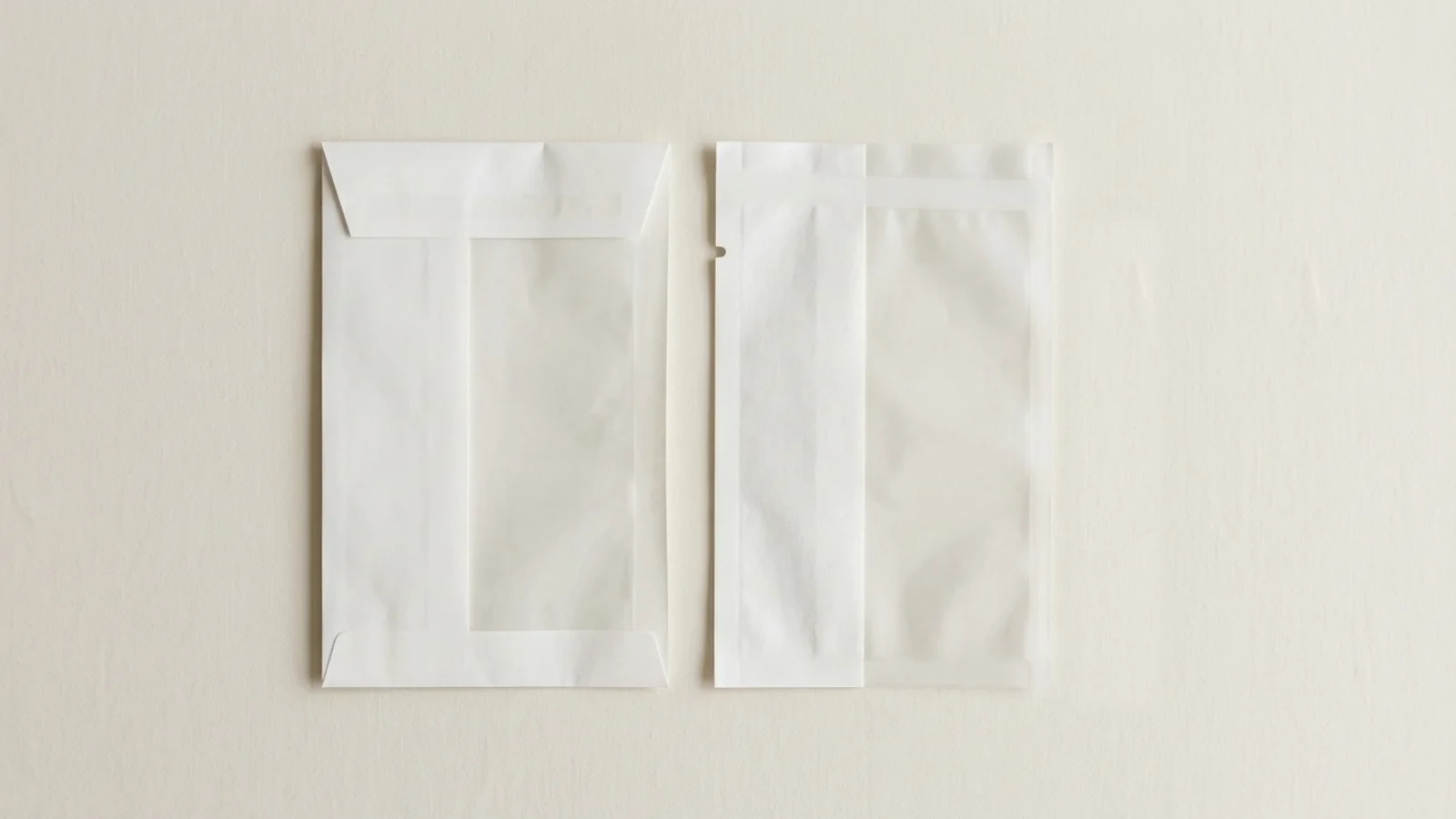
The Decision in One Table: Self-Seal, Heat-Seal, and Roll Stock
When selecting sterilization packaging for medical instruments, procurement teams and central sterile supply department (CSSD) managers frequently face a direct operational choice between self-seal pouches, heat-seal pouches, and continuous heat-seal roll stock (tubing). The direct answer to this purchasing scenario rests on two mandatory filters: first, matching the porous sterile barrier substrate to your installed sterilizer modality (steam, ethylene oxide, or vaporized hydrogen peroxide); and second, matching the closure format to the sealing validation capability of the receiving facility. A material mismatch can fail the cycle no matter how the pouch is closed. A heat sealer that has not been qualified to the pouch instructions leaves the facility without evidence for the seal it forms.
From a regulatory standpoint under United States Food and Drug Administration (FDA) regulations, both self-seal and heat-seal pouches are classified as the exact same medical device: a Class II sterilization wrap under 21 CFR 880.6850 that requires premarket clearance via a 510(k) submission. A self-seal pouch is a factory-preformed sterile barrier system where three edges are heat-sealed during manufacturing and the fourth opening is sealed by clinical staff using a high-temperature-resistant pressure-sensitive adhesive strip protected by a release liner. Because the closure is the factory adhesive strip, a self-seal pouch does not need a heat sealer. That fits ambulatory surgery centers, dental clinics, and other lower-volume sites, as long as staff close the flap the way the pouch instructions describe.
In contrast, preformed heat-seal pouches and continuous roll tubing shift part of the sterile barrier creation process onto the healthcare provider. Closing the package requires a heat sealer. The pouch instructions state the sealing method, and the facility has to qualify the sealer to those instructions under ISO 11607-2:2019+A1:2023. Roll stock can be cut to length for long instruments, but the facility forms both seals. Supplier guidance describing ISO 11607-2 treats that work as a documented program: Installation Qualification (IQ), Operational Qualification (OQ), and Performance Qualification (PQ).
flowchart TD
    Start["Start from the sterilizer on site"] --> Modality{"Which cycle is installed?"}
    Modality -->|"Vaporized hydrogen peroxide"| Vhp["Tyvek and film if the pouch labeling lists that cycle<br/>Paper absorbs peroxide vapor"]
    Modality -->|"Steam"| Steam["Paper and film is the usual steam substrate<br/>Tyvek only if that SKU labeling lists the steam cycle"]
    Modality -->|"Ethylene oxide"| Eo["Paper and film, or Tyvek and film<br/>Use the labeled ethylene oxide cycle"]
    Vhp --> Close{"Is there a heat sealer you can qualify?"}
    Steam --> Close
    Eo --> Close
    Close -->|"No sealer"| Self["Self-seal pouch<br/>Factory adhesive flap<br/>Close it as the instructions describe"]
    Close -->|"Sealer in use"| Heat["Heat-seal pouch or roll stock<br/>Settings from the pouch instructions<br/>Document IQ, OQ, and PQ for the seal the facility forms"]
    Self --> File["Purchase file: 510k number and product code<br/>Labeled cycles and closure instructions<br/>Indicator edition and seal-strength report"]
Heat --> File| Pouch Format | Closure Mechanism | Required Equipment | Sealing Responsibility | ISO 11607-2 Burden | Best Operational Fit |
|---|---|---|---|---|---|
| Self-Seal Preformed Pouch | High-temperature pressure-sensitive adhesive tape with peelable release liner | None (manual finger pressure along pre-scored crease line) | Manufacturer validates adhesive chemistry; user validates manual fold alignment | No heat sealer to qualify. Staff still close the adhesive flap as the pouch instructions describe. That is not an exemption from checking the closure. | Ambulatory surgery centers, dental suites, satellite clinics, outpatient procedure carts |
| Heat-Seal Preformed Pouch | Thermal fusion of plastic polymer layer to porous substrate under heat and pressure | A heat sealer whose settings match the pouch instructions. | Manufacturer validates 3 factory seals; facility validates final top closure seal | The facility forms the final seal, so that sealing step needs a documented IQ/OQ/PQ program matched to the pouch instructions. | Mid-to-high volume hospital sterile processing departments with standardized tray sizes |
| Heat-Seal Roll Stock (Tubing / Reels) | Double thermal fusion: operator cuts roll and heat-seals both bottom and top margins | A heat sealer and a way to cut the reel to length. | Facility assumes full responsibility for forming, cutting, and sealing both ends | The facility forms both seals and chooses the cut length, so both joints belong in the documented sealing validation. | Central sterile processing departments packing rigid scopes, long retractor sets, and custom items |
What You Are Buying: FDA Class II Sterilization Wrap Under 21 CFR 880.6850
A frequent compliance error in medical consumable procurement is treating sterilization pouches as general commercial commodity packaging or Class I 510(k)-exempt items. Under FDA medical device regulations, sterilization pouches and reels are legally categorized as Class II devices governed by 21 CFR 880.6850 (Sterilization Wrap). The regulatory definition explicitly establishes their intended purpose: a device intended to enclose another medical device that is to be sterilized by a healthcare provider, permit sterilant penetration to achieve terminal sterilization, and maintain the sterility of the enclosed device until it is aseptically opened.
In FDA premarket databases, cleared sterilization pouch submissions map primarily to two product classification codes:
Product Code FRG (Sterilization Wrap): The primary classification under 21 CFR 880.6850 for wraps, sheets, and preformed peel pouches used to maintain sterility.
Product Code KCT (Sterilization Wrap Containers, Trays, Cassettes & Other Accessories): Assigned to packaging systems, cassettes, and preformed pouches evaluated under General Hospital panel standards, frequently citing performance consensus standards like ANSI/AAMI ST77 and ISO 17665.
Product Code JOJ (Chemical Sterilization Process Indicator): When a pouch submission includes printed process-indicator ink, FDA has listed a subsequent product code JOJ under 21 CFR 880.2800. K070428 cited ISO 11140-1 (2005 edition) for its external steam and ethylene oxide inks. FDA's current JOJ recognition list includes ISO 11140-1:2014. A printed indicator is not automatically a Type 1 claim unless the submission says so.
Real-world clearance records demonstrate how these codes operate in commercial tenders. For example, 510(k) submission K070428 (A.R. Medicom Self Sealing Sterilization Pouch) was cleared as a Class II device under 21 CFR 880.6850 (product code KCT) with ISO 11140-1 indicator review (JOJ). The 510(k) summary describes medical-grade paper thermally sealed to a laminated film on three sides, with an adhesive strip on the fourth side. It does not name the film layers. The labeled steam cycle is 30 minutes at 121°C. The labeled ethylene oxide cycle is 100 to 120 minutes at 50°C, 60 to 85 percent relative humidity, and 600 mg/L. The summary says the pouch maintains enclosed devices sterile for up to one year after sterilization. That one-year figure is this submission's claim, not a default for every pouch. Similarly, 510(k) submission K183356 cleared both self-seal pouches and continuous heat-seal reel pouches under product code FRG with secondary JOJ indicator clearance. Both closure formats undergo the same premarket scrutiny; choosing self-seal does not relax the requirement for a verified 510(k) clearance number in your tender file.
Match the Porous Material to the Process Before the Closure
Before evaluating whether to purchase self-seal adhesive strips or rotary heat sealers, hospital buyers must verify that the pouch substrate matches the facility's installed sterilizer fleet. A sterilization pouch pairs a transparent film laminate with a porous web. The film construction is whatever the cleared labeling names; do not assume one polymer pair for every pouch. The porous web acts as a selective filter: it must allow rapid passage of air, steam, or sterilant gas molecules while preventing the ingress of bacteria, bacterial spores, and particulate matter.
The industry relies on two primary porous substrates, each dedicated to distinct sterilization physics:
Medical-grade paper and film. STERIS describes paper/plastic pouches for steam or ethylene oxide. It says paper placed in vaporized hydrogen peroxide absorbs the sterilant vapor, which can keep the sterilant from reaching the device, and warns that absorbed peroxide can damage instruments and can possibly catch fire. DuPont makes the same cellulose point for the STERRAD hydrogen peroxide gas-plasma system: cellulosic materials neutralize the sterilizing agent. K070428 is one cleared paper example, labeled for 30 minutes at 121°C and for a defined ethylene oxide cycle. A hotter steam cycle has to be on that SKU's own labeling.
Tyvek and film. DuPont describes Tyvek as spunbonded high-density polyethylene. STERIS describes Tyvek/plastic pouches for vaporized hydrogen peroxide and ethylene oxide, and warns that Tyvek placed in steam will melt at higher temperatures. DuPont's steam statement is narrower: Tyvek has met packaging criteria under controlled conditions of 121°C to 127°C (250°F to 260°F) at 30 psi for 30 minutes. DuPont also states that ethylene oxide does not readily adsorb on Tyvek and is released more rapidly than from medical-grade paper. DuPont says style 4057B is suitable for the STERRAD system and that it does not have test data for every low-temperature oxidative process. None of those material statements clears a pouch. Buy the SKU whose 510(k) labeling names the cycle. DuPont reports biological evaluation of Tyvek packaging styles using ISO 10993 methods; that report is not a substitute for the pouch clearance.
| Sterilization Modality | Medical-Grade Paper / Film | Tyvek (Spunbonded HDPE) / Film | Primary Material Failure Mode |
|---|---|---|---|
| Dynamic-air-removal steam above DuPont's 121–127°C condition | The substrate STERIS describes for steam. Confirm the labeled cycle. K070428's cleared steam cycle is 30 minutes at 121°C, so a hotter cycle has to be on that SKU's labeling. | Not the default. DuPont's published steam condition stops at 127°C. STERIS warns that Tyvek placed in steam will melt at higher temperatures. Use it only when that SKU's cleared labeling lists the cycle. | Using a pouch on a cycle its labeling does not list. A material-maker steam test is not a 510(k) cycle claim. |
| Steam at 121°C, the cycle K070428 lists | Compatible when the pouch labeling lists that cycle. K070428 lists 30 minutes at 121°C. | Only if that SKU's cleared labeling lists 121°C steam. DuPont's controlled-condition test is not clearance of every Tyvek pouch. | Treating a 121°C material test as clearance for every steam cycle in the department. |
| Vaporized Hydrogen Peroxide (VHP / Gas Plasma) | Not for vaporized hydrogen peroxide. STERIS says paper absorbs the vapor and warns of instrument damage and a possible fire risk. DuPont says cellulosic materials neutralize hydrogen peroxide gas plasma. | The substrate STERIS describes for vaporized hydrogen peroxide and ethylene oxide. DuPont specifically names Tyvek 4057B for STERRAD and says it lacks test data for every oxidative process. | Cellulose absorbing or neutralizing hydrogen peroxide, as STERIS and DuPont describe. |
| Ethylene Oxide (EO Gas) | Used for ethylene oxide when the labeling lists the cycle, including concentration, temperature, humidity, time, and aeration. | Also used for ethylene oxide when the labeling lists it. DuPont says ethylene oxide is released from Tyvek more rapidly than from medical-grade paper. | Skipping the aeration or cycle parameters on the pouch or sterilizer labeling. |
Heat-Sealing Moves Part of the Sterile Barrier Onto Your Equipment
When a healthcare facility procures heat-seal pouches or continuous reels, it is not merely buying a consumable: it is purchasing an uncompleted sterile barrier system. Under ISO 11607, packaging for terminally sterilized medical devices is bifurcated into two distinct standards:
ISO 11607-1:2019+A1:2023 (Materials, sterile barrier systems, and packaging systems): Specifies requirements and test methods for materials, preformed sterile barrier systems, sterile barrier systems, and packaging systems that maintain sterility to the point of use. FDA completely recognizes ISO 11607-1:2019 including Amendment 1 (2023) as Rec# 14-594. A declaration of conformity is voluntary premarket evidence, not a separate statute.
ISO 11607-2:2019+A1:2023 (Validation requirements for forming, sealing, and assembly processes): Covers development and validation of forming, sealing, and assembly. FDA completely recognizes ISO 11607-2:2019 including Amendment 1 (2023) as Rec# 14-595, and the recognition record says the scope applies to industry and to health care facilities. Recognition is not itself a rule that an unqualified hospital sealer violates 21 CFR 880.6850.
A critical regulatory consensus notice affects all procurement specifications: FDA has completely recognized both ISO 11607-1:2019+A1:2023 (Recognition No. 14-594) and ISO 11607-2:2019+A1:2023 (Recognition No. 14-595). The FDA recognition records stipulate that a declaration of conformity to superseded Rec# 14-530, for Part 1, is accepted in support of a premarket submission only until December 20, 2026. The same date applies to superseded Rec# 14-531, for Part 2, which Rec# 14-595 replaces. After that date FDA has said it will not accept those older declarations. A tender can ask which recognition number the declaration cites. An older declaration is time-limited premarket evidence, not a reason by itself to reject the pouch.
Steriking, a pouch supplier, states that ISO 11607-2 calls for a documented validation program where devices are packed and sterilized, and it describes that program as installation, operational, and performance qualification. The German Society for Sterile Supply (DGSV) has published a hospital-oriented guideline for packaging-process validation under ISO 11607-2. Those are supplier and professional-society readings of the standard. They are not a US statute.
A major operational consideration highlighted in sterile processing education (such as HSPA CRCST Lesson 171) is the two-temperature rule. The lesson says the pouch instructions state the sealing temperature and method, that steam pouches can require a higher sealing temperature than some low-temperature pouches, and that a department with two temperature requirements should use two sealers. It also says only pouches and tubing designed for sterilization and cleared by FDA should be used, and that sealers need scheduled maintenance. This article does not assign sealing setpoints. Those numbers belong on the instructions for the SKU on the machine.
Seal Evidence: EN 868-5 Minima and the ASTM Test Toolkit
When evaluating supplier quality documentation, hospital buyers must require objective laboratory evidence demonstrating seal integrity and mechanical strength. The particular European standard for sealable pouches and reels, used with the general requirements of EN ISO 11607-1 and EN ISO 11607-2, is EN 868-5:2018 (Packaging for terminally sterilized medical devices - Part 5: Sealable pouches and reels of porous materials and plastic film construction - Requirements and test methods).
A public preview of EN 868-5:2018, clause 4.5.1, states minima for sterilization in healthcare facilities. The same preview says industrial applications can set different values from validation under EN ISO 11607. The healthcare-facility figures are:
Steam Sterilization Processes: Minimum seal strength of 1.5 N per 15 mm of seal width.
Other Sterilization Processes (EO, VHP, Low-Temperature Gas): Minimum seal strength of 1.2 N per 15 mm of seal width.
The published healthcare-facility minimum applies to heat-sealable and self-sealable pouches. It does not rank one closure above the other. HALYARD and Vanderstahl, both sellers, describe heat-sealed seams as flatter or stronger. Those pages do not cite a neutral comparison, so a buyer should not write "heat seal is stronger" into a specification. A mis-folded adhesive flap and a sealer run outside the pouch instructions can each miss the same minimum. Clause 4.5.2 in the same preview says the seal is continuous across the specified width and that opening does not disrupt the porous surface next to the seal. That peel characteristic is separate from the newton value.
To verify these physical properties, testing laboratories and medical device quality departments utilize the standardized ASTM test toolkit recognized by the FDA and the Sterile Barrier Association (SBA):
ASTM F88 / F88M (Seal Strength): Measures the peak tensile force required to separate the flexible seal interface using a motorized tensile testing grip. EN 868-5 Annex D is the preview's stated method for the healthcare-facility minimum. ASTM F88 is the peel-strength method the Sterile Barrier Association lists beside it. F88 measures force and failure mode; the 1.5 N figure comes from the EN 868-5 healthcare-facility clause, not from F88 itself.
ASTM F1929 (Dye Penetration Leak Detection): Standard test method for detecting leaks in porous medical packaging using a colored wetting dye solution. The Sterile Barrier Association describes the method as detecting a channel equal to or greater than one formed by a wire of 50 micrometers (µm). Dye stays in contact for a specified time. The same summary says the porous sheet should hold the dye without discoloring the entire seal for a minimum of 20 seconds. That 20-second note is about dye holdout, not a five-second pass/fail window.
ASTM F2096 (Bubble Emission Gross Leak Testing): Internal pressurization water-submersion test. Used to identify pinholes, punctures, and gross packaging breaches down to 250 micrometers (µm).
ASTM F1886 / F1886M (Visual Inspection of Package Seals): Standardized visual inspection protocol capable of detecting seal channels down to 75 micrometers (µm) with a 60% to 100% probability of visual detection. The method views an unopened seal with at least one transparent side, at 30 to 45 cm. A receiving check can look for channels, but it is not the same as performing this method.
What the Printed Indicator Does and Does Not Tell You
Many pouches carry a printed ink that changes color in the cycle named on the labeling. The color change is product-specific. K070428's external inks are labeled to show that the pouch has undergone either its steam cycle or its ethylene oxide cycle. A purchasing spec should say what that color change is allowed to prove.
ISO 11140-1 uses types. A process indicator whose job is to distinguish processed units from unprocessed units is Type 1. Older text called that category Class 1. K070428 cited ISO 11140-1:2005 for its external inks. A color change shows that the indicator was exposed. CDC says an external chemical indicator shows that the pack went through a sterilization cycle and does not prove that sterilization was achieved.
A Type 1 indicator color change does NOT prove any of the following:
It does not measure microbial kill. CDC says the external indicator does not prove sterilization was achieved, and that chemical indicators do not replace biological indicators.
It does not show that the sterilant reached the inside of a lumen or a closed device. CDC prefers an internal chemical indicator when the question is penetration.
It does not inspect the seal. A channel across the seal can be present while the external ink still changes, because the ink is not a seal test.
CDC's sterilizing-practices chapter says a chemical indicator on the outside of each pack shows that the package has been through a cycle, and that these indicators do not prove sterilization has been achieved. It says a chemical indicator preferably should also be placed inside each pack to verify that the sterilant penetrated. It does not name a Type 4 or Type 5 indicator as the one that belongs in every pouch. The same chapter says peel packs should be placed on edge in perforated or mesh-bottom racks or baskets so the sterilant can circulate. That is a loading recommendation in the guideline, not a purchasing statute.
Tender Fields and Goods-Receipt Checks for Pouch Buyers
To translate regulatory standards into purchasing controls, hospital buyers should incorporate explicit technical parameters into their Request for Proposal (RFP) documentation and goods-receipt inspection procedures. When sourcing sterilization pouches, require suppliers to submit documentation against the following technical checklist:
| Procurement Category | Technical Specification Requirement | Applicable Standard / Regulation | Required Supplier Verification Evidence |
|---|---|---|---|
| Device Classification & 510(k) | Class II medical device cleared as sterilization wrap; product code FRG or KCT | 21 CFR 880.6850 / 21 CFR 807 Subpart E | FDA 510(k) premarket notification clearance letter and publicly searchable 510(k) summary |
| Sterilization Modality IFU | The instructions name the facility's cycle. K070428, for example, names 30 minutes at 121°C and a defined ethylene oxide cycle, not every steam cycle. | FDA 21 CFR 801.5 (Adequate directions for use) | The cleared labeling or instructions for the SKU, including cycle parameters that are actually stated. |
| Sterile Barrier System (SBS) | Materials, preformed sterile barrier system, and packaging system claims for the cleared pouch | ISO 11607-1:2019+A1:2023 (FDA Rec# 14-594) | A declaration of conformity that names Rec# 14-594, plus the material description in the 510(k) or instructions. A Tyvek or paper datasheet does not replace the cleared pouch claim. |
| Pouch Seal Strength | For healthcare-facility use, the EN 868-5:2018 preview states 1.5 N per 15 mm for steam and 1.2 N per 15 mm for other processes. Industrial pouches may use a different validated value. Peel continuity is a separate clause 4.5.2 check. | EN 868-5:2018 clause 4.5.1 and Annex D; ASTM F88 for peel force | The seal-strength report the supplier cites, naming the method. A regulation does not require a tensile result on every incoming lot. |
| Closure Specifications | Self-seal: high-temp adhesive with pre-creased fold line; Heat-seal: defined temperature/pressure window | ISO 11607-2:2019 / EN 868-5 | IFU detailing folding alignment instructions or heat-sealing process parameter envelope |
| Chemical Process Indicators | If ink is printed, the ISO 11140-1 type and edition the 510(k) cites. K070428 cited the 2005 edition for external steam and ethylene oxide inks. | ISO 11140-1:2014 / Product Code JOJ | The indicator claim in the 510(k) or instructions, including the color change that means "processed." |
| Traceability & Packaging | Ask whether 21 CFR 801 Subpart B requires a UDI, then match any carrier to AccessGUDID. Record lot, unused-pouch dating, and any post-sterilization maintenance claim separately. | 21 CFR 801 Subpart B / 21 CFR 830 | The label dates and, when a UDI is required, the AccessGUDID record. K070428's one-year maintenance statement is an example of a post-sterilization claim, not a universal shelf life. |
At receiving, look for channels, wrinkles, delamination, moisture, and crushed cartons. That visual check is not the same procedure as ASTM F1886, which specifies viewing distance and a transparent side. When a pouch or carton is damaged, record it with the facility's method for recording sterile-pouch damage at goods receipt, including the lot, so the supplier review starts from an observation rather than from an assumption about sterility.
After a pouch is processed, CDC's sterilizing-practices chapter treats shelf life as event-related: the pack remains sterile until an event compromises it, such as a tear, wetting, or a broken seal. The same chapter also says not to use an item after a labeled expiration date, or if the sterilized package is wet, torn, or punctured. Event-related storage does not override a date printed on the label.
CDC's storage description for sterile supplies is specific, and it is easy to mis-state. The numbers below are the ones in that chapter.
Temperature and humidity. The sterile storage area should be limited access, with a controlled temperature that may be as high as 75°F. Relative humidity of 30 to 60 percent is stated for work areas other than sterile storage. In sterile storage, relative humidity should not exceed 70 percent. The chapter does not set an 18°C to 24°C band. Distribution and transit evidence are covered in labeled storage and transport for medical consumables.
Placement. Sterile supplies should be stored 8 to 10 inches off the floor, 5 inches from the ceiling unless near a sprinkler head (then 18 inches from the sprinkler head), and 2 inches from outside walls. Do not store them under sinks or anywhere they can become wet. CDC says a wet sterile item is considered contaminated because moisture brings microorganisms with it.
Put the rejection conditions in the purchasing and receiving procedure, not in a bedside instruction. CDC says not to use a sterilized item after the expiration date or when the package is wet, torn, or punctured. The facility's own procedure covers what happens next.
Seal channel or incomplete closure. A gap, wrinkle, or fold that crosses the seal width, or a self-seal flap that is not on the fold line the instructions describe.
Moisture. Water spots, condensation, or a wet pack. CDC treats a wet sterilized package as contaminated.
Tears or punctures. Including damage from the item inside the pouch.
Lifted adhesive. On a self-seal pouch, an edge that is not stuck or a flap that was never folded down.
A labeled date that has passed. That may be the unused pouch's date or a post-sterilization maintenance period stated for that SKU. K070428 states up to one year after sterilization; do not copy that period onto a different clearance. For mixed-lot shipments, use tracing mixed-lot consumables during a recall, the facility's supplier quality agreements, and UDI and GUDID label capture.