
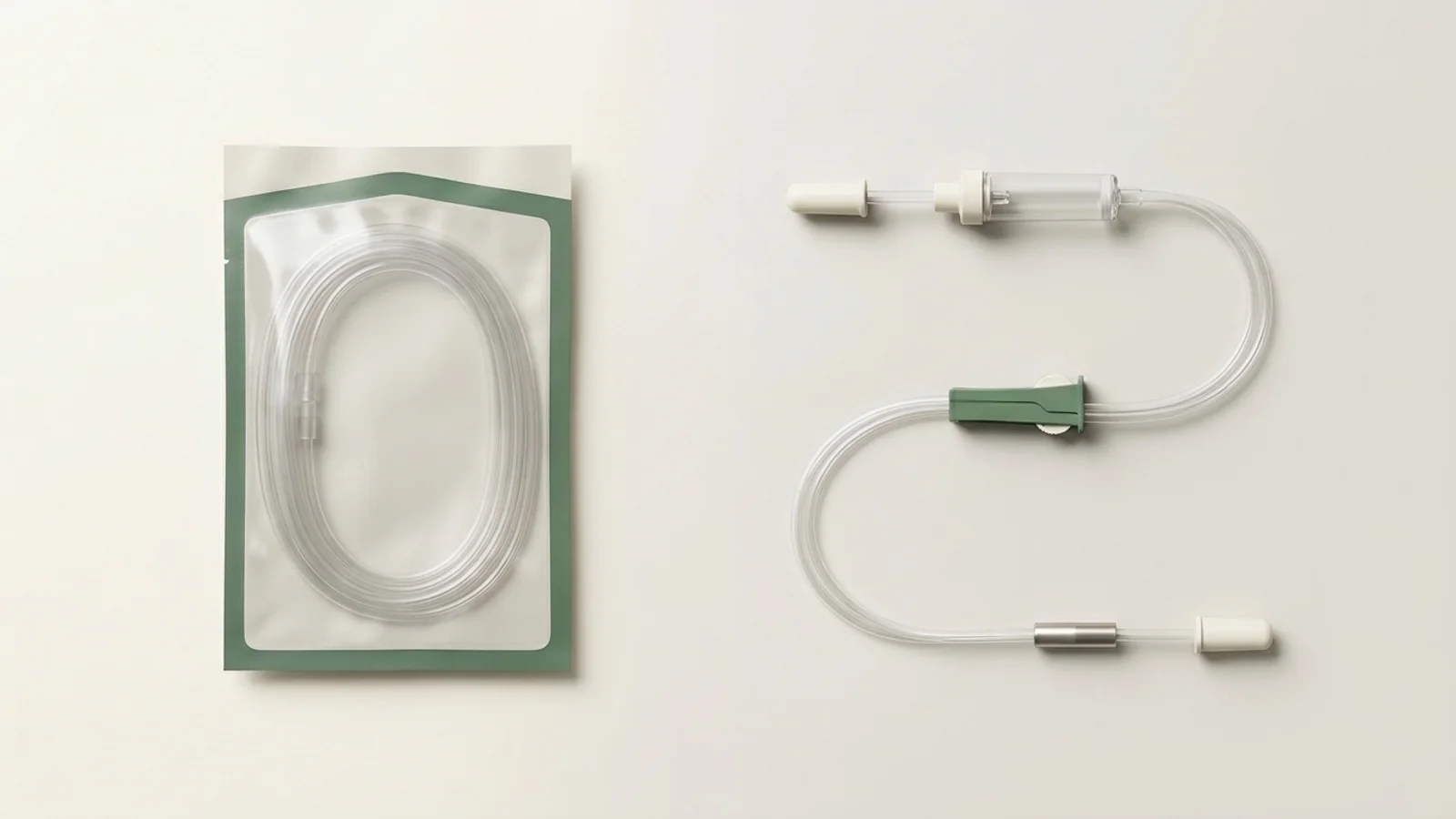
During a hospital or distributor RFQ, a supplier may quote an ethylene oxide (EO)-sterilized single-use consumable alongside a one-line declaration stating that the product family complies with ISO 10993-7. For a US procurement or supplier-quality team, that statement creates an immediate qualification gap: a family-level claim does not prove that the tested specimen, extraction boundary, standard edition, and routine release controls actually cover the exact catalog reference (REF) and lot being purchased.
To close that gap, request a dated EO and ethylene chlorohydrin (ECH) residual test report—or a controlled supplier quality summary—mapped directly to the finished catalog reference on the quote. If the supplier qualified a representative configuration rather than the exact SKU, request the written rationale connecting the tested article to your finished device. Verify the stated contact category, exposure duration, target patient population, the physical portion extracted by the laboratory, the standard edition and units on the report, and the controlled release basis tying that validation to incoming shipments.
What to ask for with the quote
Ethylene oxide sterilization leaves behind two primary chemical residues addressed under the ISO 10993-7 framework: ethylene oxide (EO) itself, which is the sterilant gas, and ethylene chlorohydrin (ECH), a related residue that can form when EO reacts with chloride. Because the materials in tubing, valves, adhesives and packaging can take up and release EO differently, a residual result describes the configuration and processing that were actually evaluated rather than an entire catalog by default.
When evaluating an RFQ packet, buyers should separate four distinct compliance questions that are often conflated into a single "sterile" dossier. In its January 2024 final guidance, Submission and Review of Sterility Information in Premarket Notification (510(k)) Submissions for Devices Labeled as Sterile, the US Food and Drug Administration (FDA) addresses chemical residuals in Section V.A.1.f as a separate review element from sterilization cycle validation, sterility assurance level (SAL), and sterile device packaging. Each element establishes a different technical fact:
Sterilization cycle validation: Demonstrates that the physical EO cycle (conditioning, gas concentration, temperature, humidity, and dwell time) achieves the target microbial lethality across the validated load configuration.
Sterility assurance level (SAL): Expresses the probability of a single viable microorganism surviving on a unit after the validated sterilization process; it provides no information about residual EO or ECH remaining in the polymer.
Sterile barrier packaging: Confirms that the pouch, tray, or wrap permits sterilant ingress and aeration egress while maintaining microbial barrier integrity through shelf life and distribution.
Chemical residual conformity: Establishes the maximum levels of EO and applicable ECH remaining on the finished device after aeration and documents why those levels are acceptable for the device type and expected patient or user contact.
That distinction is reinforced by FDA's general biocompatibility guidance, Use of International Standard ISO 10993-1, Biological Evaluation of Medical Devices — Part 1. Sections III through V tie biological evaluation directly to the final finished device—including sterilization processing and the nature and duration of contact—while Attachment E details the documentation expected for any test record: test article identity, test method and deviations, acceptance criteria, measured results, and conclusions. Although both FDA guidances represent nonbinding recommendations for premarket submissions rather than universal hospital purchasing rules, their traceability logic gives procurement teams a practical template for qualifying supplier claims.
Which ISO 10993-7 edition is on the report?
Before comparing numbers or conclusions, check which edition of ISO 10993-7 appears on the supplier's laboratory report and keep three separate statuses distinct: ISO's publisher catalog status, US FDA consensus-standard recognition, and the edition actually executed in the laboratory test.
In April 2026, the International Organization for Standardization (ISO) published the third edition, ISO 10993-7:2026, and ISO's public catalog lists the earlier edition and its supplements as withdrawn. However, publication by ISO does not automatically change US regulatory recognition. A review of FDA's Recognized Consensus Standards designation search for 10993-7 on November 19, 2026 returned one entry (date of entry July 6, 2020): Recognition Number 2-275 (Supplementary Information Sheet 42651). That FDA entry records complete recognition of the 2008 second edition together with Technical Corrigendum 1 (2009) and Amendment 1 (2019), which addressed allowable limits for neonates and infants.
| Record layer | Observed status (reviewed Nov 19, 2026) | What buyers should record and verify |
|---|---|---|
| ISO publisher catalog | Third edition (ISO 10993-7:2026) published April 2026; earlier edition and supplements marked withdrawn by ISO. | Note whether the supplier or lab references the 2026 third edition or an earlier edition, and recheck ISO status for amendments. |
| US FDA consensus recognition | Recognition 2-275 (Sheet 42651) lists complete recognition of ISO 10993-7:2008 + Corrigendum 1 (2009) + Amendment 1 (2019). | Check market-specific FDA recognition and any transition notice separately; do not assume ISO publication automatically updates FDA recognition. |
| Supplier laboratory report | Varies by test date and submission vintage (for example, the September 2026 US clearance summary discussed below cites ANSI/AAMI/ISO 10993-7:2008). | Record the exact edition, year, and any amendment cited on the report so qualified reviewers can check alignment with current regulatory expectations. |
Both the 2008 amended recognition scope and the 2026 third-edition public abstract confirm that ISO 10993-7 covers EO and ECH residue limits, measurement methods, and conformity for product release within scope. Importantly, ISO's 2026 abstract also states explicit scope exclusions: the standard does not apply to EO-sterilized devices or components that have no direct or indirect contact with the patient's body or user, nor to devices demonstrated not to absorb or retain either EO or ECH—ISO gives devices made exclusively of metal alloys and glass as an example. If a supplier omits ECH testing or claims a component is out of scope, the report or supplier summary should document that technical rationale explicitly.
Note that the normative numerical limits inside ISO 10993-7 sit in the purchased standards text and depend on the exposure category, the patient population (Amendment 1 to the 2008 edition addressed neonates and infants) and other use parameters. Commercial web tools—such as IETQAN's edition-labeled EO and ECH acceptance-limit estimator—show how limits depend on edition and user inputs, but neither a public calculator nor a procurement checklist supplies or validates product-specific acceptance criteria. Leave numerical limit verification to the applicable standard text and your qualified quality or biocompatibility reviewer.
A supplier request map for EO residual evidence
Instead of asking vaguely for "an ISO 10993-7 certificate," use a structured five-row request map that traces the quoted SKU from label identity through extraction and results to routine shipment release. Each row pairs what the buyer must match against the exact supplier record to request and the follow-up action if that link is missing.
| Verification row | What to match | Evidence to request | Action if the link is missing |
|---|---|---|---|
| 1. Product identity | Current US label/IFU, quoted REF, revision, and finished configuration matched against the tested specimen. | Report test-article ID/part number or a written representative-device justification comparing materials, geometry, and processing. | Mark Clarification needed; request a signed SKU-to-test-article mapping and current US label/IFU before qualifying. |
| 2. Contact basis | Intended contact type (direct, indirect, or user), exposure duration category, and target patient population. | Report exposure classification and population assumptions aligned with the cleared US indications for use (including neonate/infant scope if applicable). | Escalate to quality review; a mismatched contact duration or unaddressed neonate/infant use can undermine the comparison until the supplier explains or supplies a matching assessment. |
| 3. Extraction scope | Whether the lab extracted the whole device, selected portion(s), or fluid path only; method approach and specimen handling. | Laboratory extraction scope statement (immersion vs. fluid path, simulated-use vs. exhaustive, single vs. pooled specimens) and rationale. | Mark Unavailable or Clarification needed; request the report's extraction section or a laboratory scope summary. |
| 4. Criteria & results | Report ID, revision, and cited ISO 10993-7 edition tied to EO and applicable ECH measurements. | Dated report or controlled summary showing EO and ECH results (or documented ECH omission rationale), units, stated acceptance criteria, and pass conclusion. | Do not infer pass status from a declaration alone; request a redacted or controlled excerpt with criteria, units, and edition. |
| 5. Release & change trace | Linkage from validated residual profile to the offered SKU, incoming lot, and post-validation changes. | Statement of controlled release basis (e.g., lot testing, aeration parameters, or dissipation curves) plus change assessment covering resin, packaging, or sterilizer updates. | Route to supplier quality under existing quality-agreement change-control terms before accepting recurring lots. |
Several nuances in Rows 1, 3, and 5 warrant closer attention so buyers do not reject valid documentation unnecessarily—or accept incomplete paperwork:
Representative test articles (Row 1): Suppliers do not necessarily run a separate EO residual study on every length or connector permutation in a large consumable catalog. FDA's biocompatibility guidance (Section V.A) recommends testing the device in its final finished form whenever possible; when a representative test article is used instead, it should undergo the same manufacturing and sterilization processes, share the same chemical, physical and surface properties, and keep the same ratio of component materials. Where differences remain, the guidance recommends explaining how they could affect the findings, and Attachment E recommends that the test report identify the specimen and justify any test article that is not the final finished device. A buyer can therefore ask for that written comparison for the quoted REF; judging whether it is adequate stays with the supplier's and your own quality reviewers.
Extraction scope and specimen handling (Row 3): Commercial testing documentation illustrates why buyers must look beyond a bare "pass" line. For instance, Nelson Labs' EO residual testing overview contrasts simulated-use extraction with exhaustive extraction in relation to intended use and distinguishes fluid-path extraction from whole-device immersion. Its historical intake form, FRM0055 Revision 7 (a legacy form referencing the 2008 edition that illustrates typical report intake fields rather than current test rules), similarly tracks whether samples are single devices or multicomponent kits, whole or specified portions, and individual or pooled specimens. The manufacturer and laboratory select and justify the extraction approach; the buyer's check is simply that the extracted portion aligns with how the product contacts the patient or user.
Controlled release basis vs. per-lot testing (Row 5): Buyers should not assume that every qualified sterile consumable receives a fresh chemical residual assay on every commercial lot. Depending on the product and applicable standard edition, routine release may rest on a basis established during validation rather than a new assay for each lot. For example, a historical 2002 FDA-hosted 510(k) summary for the CentriMag Extracorporeal Blood Pump (K020271) explicitly documents the use of EO dissipation curves in routine product release. That older filing reflects a different device type and standards vintage, and its values and settings cannot be transferred—yet it provides a clear counterexample showing why buyers should ask which controlled release basis links the shipment lot to the qualified validation rather than demanding per-lot lab assays by default.
flowchart TD
  A["Quoted REF and current US label/IFU"] --> B{"1. Exact REF tested or written representative link?"}
  B -- "Matched" --> C{"2. Contact type, duration and population match the IFU?"}
  B -- "Clarification needed" --> G["Request signed REF-to-specimen justification and IFU"]
  C -- "Matched" --> D{"3. Extraction scope matches the device or fluid-path contact?"}
  C -- "Mismatch or unclear" --> K["Escalate contact basis to quality review"]
  D -- "Matched" --> E{"4. Report edition, EO/ECH results, units and criteria documented?"}
  D -- "Unavailable" --> H["Request controlled excerpt or summary from the residual report"]
  E -- "Matched" --> F{"5. Controlled release basis and change control linked to the lot?"}
  E -- "Unavailable" --> H
  F -- "Matched" --> I["Evidence file ready for quality sign-off"]
F -- "Missing or changed" --> J["Route to supplier quality under the quality agreement"]What the Ecomed clearance summary answers
Public FDA 510(k) clearance packets show exactly how far public regulatory records take a buyer—and where supplier-held records begin. Consider the September 11, 2026 FDA clearance letter and applicant 510(k) summary for Ecomed Disposable Administration Sets (K254123). Because IV administration sets span multiple tubing lengths, drip chambers, valves, and connector variants—as covered in our IV administration set specification guide—K254123 is a practical real-world test of the five-row request map.
Reading the public K254123 packet carefully yields concrete baseline facts. The FDA clearance letter identifies the cleared US device family, while the applicant's summary describes a portfolio of configurations and states a prolonged indirect blood-path biological evaluation context. The applicant also reports EO sterilization validated under ISO 11135:2014 and separately reports an acceptable EO residual evaluation under ANSI/AAMI/ISO 10993-7:2008. Mapping those disclosures against our five-row worksheet highlights what is already verified versus what remains a buyer follow-up:
| Request map row | Public K254123 summary finding | Evidence status | Remaining buyer action for a quoted SKU |
|---|---|---|---|
| 1. Product identity | Clears a portfolio of disposable administration set configurations; does not map individual catalog REFs to a specific residual test specimen. | Clarification needed | Obtain the current US label and IFU for the exact quoted REF and confirm whether it was tested directly or covered via a representative rationale. |
| 2. Contact basis | Applicant summary reports prolonged indirect blood-path contact in the biological evaluation context and includes FDA's indications-for-use enclosure. | Matched (family summary); verify SKU IFU | Confirm the quoted REF's label/IFU matches the same prolonged indirect blood-path contact and target patient population. |
| 3. Extraction scope | Public summary does not specify whole-set vs. fluid-path extraction, simulated-use vs. exhaustive method, or pooled vs. individual sampling. | Unavailable | Request the extraction scope and rationale from the supplier's underlying residual report or controlled quality summary. |
| 4. Criteria & results | Reports acceptable residual evaluation under ANSI/AAMI/ISO 10993-7:2008; omits report ID/date, measured EO and ECH values, units, and numeric criteria. | Clarification needed | Request the dated report reference, edition/amendment details, EO and applicable ECH results, units, and pass criteria. |
| 5. Release & change trace | Notes EO sterilization validated under ISO 11135:2014, but provides no routine lot-release basis or post-clearance change record. | Unavailable | Ask how routine lot release links each shipment to the validated residual basis and whether any post-clearance changes affect the assessment. |
How to follow up on missing evidence
Suppliers often protect full contract-laboratory reports for confidentiality reasons, but legitimate confidentiality need not prevent them from providing a controlled summary or redacted excerpt with traceable metadata. When an RFQ packet leaves one or more rows of the request map unresolved, send targeted follow-up questions rather than rejecting the quote outright or accepting a generic certificate:
For an unmatched REF or family-level statement: "Please provide the current US label/IFU for quoted REF [number/revision] and either the EO/ECH residual report ID testing this exact configuration or the controlled written justification explaining how the tested representative article covers its materials, geometry, and packaging."
For an unclear standard edition or missing ECH line: "Please confirm the exact ISO 10993-7 edition and amendments applied in the residual report, the intended contact category and patient population evaluated, and the measured EO and ECH results with units and acceptance criteria (or the documented technical rationale if ECH is excluded)."
For missing extraction details: "Please confirm from the laboratory report whether extraction covered the whole device, a specified portion, or the fluid path only, and whether simulated-use or exhaustive extraction was performed."
For unlinked release records or post-validation changes: "Please confirm the controlled lot-release basis connecting incoming shipments of REF [number] to the qualified residual evaluation, and confirm whether any material, sterile barrier packaging, sterilizer site, or aeration-parameter changes have occurred since the report date."
When a supplier cites a material substitution, new sterilizer contract facility, or revised pouch configuration, route the open items through your existing supplier-qualification and change-control workflow. Defining pre-implementation notice triggers and residual-reassessment duties inside consumable supplier quality agreements helps keep the residual evidence linked to future production lots rather than only to initial onboarding.
Finally, treat this request map as an editorial procurement and traceability aid: technical interpretation of test methods, representative equivalency, numerical limits under the applicable standard edition, and final lot disposition remain the responsibility of your organization's qualified quality engineering and regulatory specialists.
Sources
ISO 10993-7:2026 — Biological evaluation of medical devices — Part 7: Ethylene oxide sterilization residuals (International Organization for Standardization)
Recognized Consensus Standards: Medical Devices — ISO 10993-7, Recognition 2-275 (US Food and Drug Administration)
Recognized Consensus Standards: Medical Devices — Designation 10993-7 Search Results (US Food and Drug Administration)
Submission and Review of Sterility Information in Premarket Notification (510(k)) Submissions for Devices Labeled as Sterile (US Food and Drug Administration)
Use of International Standard ISO 10993-1, Biological Evaluation of Medical Devices — Part 1 — FDA Guidance (US Food and Drug Administration)
Ethylene Oxide Residual Testing Extraction Specifics — FRM0055 Revision 7 (Nelson Labs)
Ethylene Oxide (EO) Residual Testing (Nelson Labs)
K254123 — Ecomed Disposable Administration Sets — FDA Clearance Letter and Applicant 510(k) Summary (US Food and Drug Administration and Ecomed Solutions, LLC)
K020271 — CentriMag Extracorporeal Blood Pump — 510(k) Summary (US Food and Drug Administration and applicant)
EO & ECH Acceptance Limits (IETQAN)