
When two vendor quotations both list an 18 G × 10 cm soft-tissue core-biopsy needle, check whether each quote supplies a complete disposable instrument or a needle for a reusable handpiece. A proposed replacement coaxial introducer with a similar gauge and a different catalog suffix needs its own manufacturer pairing evidence. Start with the exact order references and then compare the labeled specifications.
Before updating an item master or approving a substitution, buyers must verify and record six specification layers alongside supply metadata: (1) the named instrument or reusable handpiece model and REF, (2) the disposable device or needle assembly REF, (3) nominal gauge and shaft length, (4) source-stated throw or penetration depth using the manufacturer's exact term, (5) sample-notch length where stated, and (6) the exact named coaxial introducer REF, gauge, and length measurement basis. Buyers also need to preserve kit-versus-separate supply status, target market, unit-of-measure pack count, and the current local label and instructions for use (IFU) version. This guide covers catalog, IFU, and registry specification controls for soft-tissue core-biopsy procurement; clinical device selection and procedural technique remain solely with qualified clinical staff.
Start with the complete order
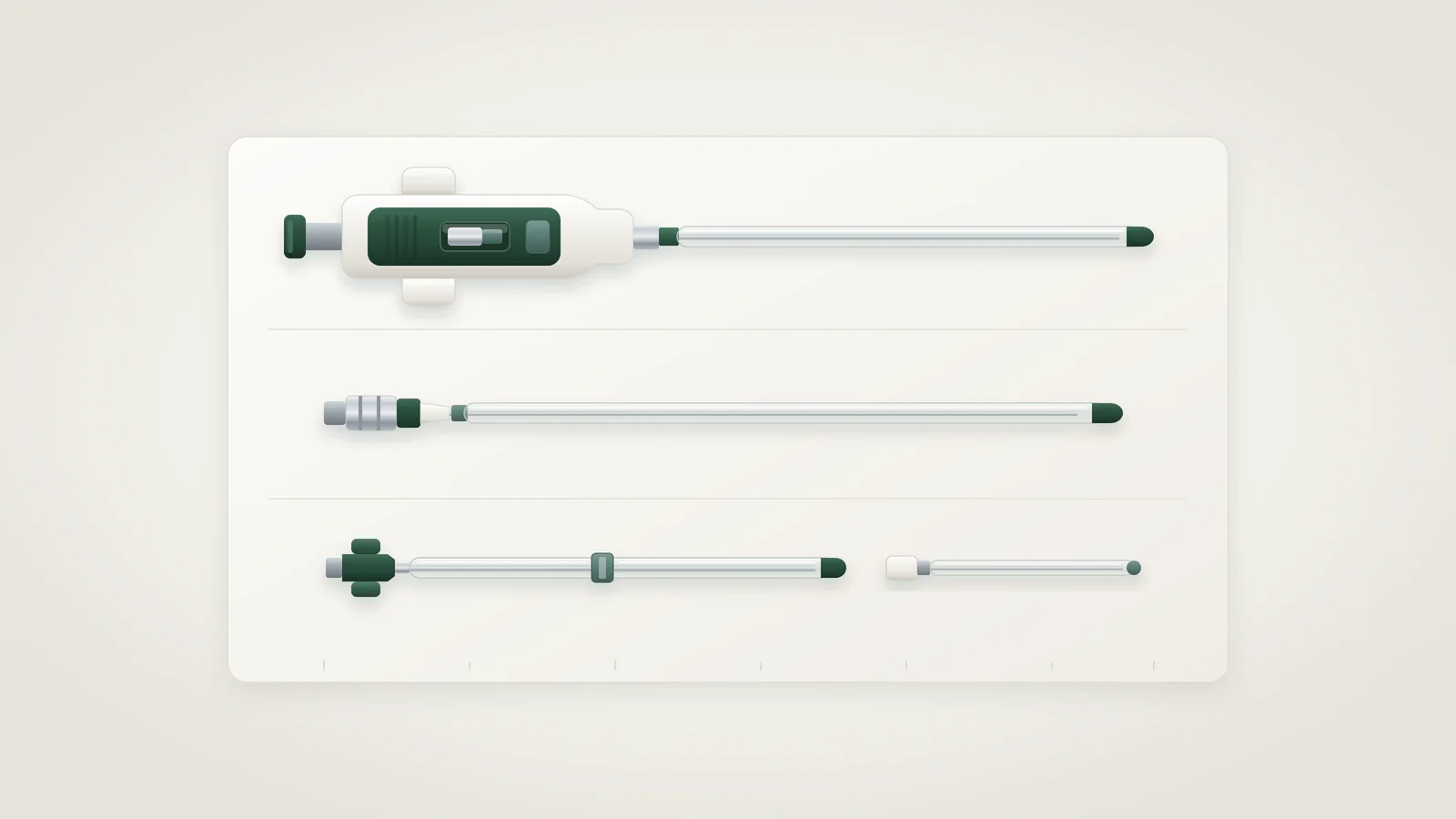
A requisition that captures only gauge and length—for example, "18 G × 10 cm core biopsy"—can leave the physical configuration unclear. Unlike standard injection needles covered in our hypodermic needle specification reference, core-biopsy SKUs span four distinct product configurations in manufacturer catalogs and US device identity records:
Complete disposable core-biopsy instrument: A single-use integrated firing handle and cannula assembly ready to order as one device SKU—such as BD Max-Core
MC1810(corroborated in AccessGUDID for Max-Core MC1810 as a disposable instrument withkit: no), BD Mission1810MSinstrument-only, and Argon Tru-Core II763114100X. INRAD AccuCore has its own device ordering table; confirm the exact device configuration and single-use designation on its current label.Instrument-plus-coaxial kit: A single catalog code that bundles the biopsy instrument with an introducer component. In the 2021 BD Core Biopsy Instruments European brochure (BD-29549, p. 4), Mission
1810MSKis listed as a kit with a17 G × 7.8 cmcoaxial, and AccessGUDID for Mission 1810MSK independently recordskit: yesandsingle-use: yes. However, neither the EU brochure kit row nor the US registry summary specifies the exact standalone REF of the included coaxial needle.Reusable handpiece plus disposable needle: A two-part architecture where the reusable spring-loaded driver is purchased as capital/reusable equipment and the sterile needle is ordered separately. In BD-29549 (p. 6), the reusable Magnum instrument
MG1522pairs with disposable needleMN1810. In the US registry, AccessGUDID for Magnum MN1810 identifiesMN1810as a single-use disposable biopsy needle rather than a reusable handpiece—meaning a quote forMN1810requires confirmation that the department has the matching reusable driver available and maintained.Separate coaxial introducer accessory: An optional or separately packaged guiding cannula and stylet ordered under its own REF—such as BD TruGuide
C1810AandC1810B, ArgonMCXS1410TX, or INRAD601809and601815. Argon's Tru-Core II IFU (X9585333-0221, Rev B, July 31, 2023) explicitly states that the corresponding introducer is packaged and sold separately, and Argon's 2022 catalog listsMCXS1410TXas an optional, separately supplied box of ten.
Comparing a disposable instrument quote directly against a disposable cartridge/needle quote without checking handpiece ownership, or comparing a kit quote against an instrument-only quote without accounting for the separate coaxial line item, distorts both unit-price comparisons and clinical readiness. Just as buyers separate tray contents from standalone needles in spinal needle and tray quote reviews, every core-biopsy quote needs an explicit kit-contents and packaging-level check. For instance, AccessGUDID records MC1810 with primary Device Identifier (DI) 00801741084461 and package DI 10801741084468 containing five units, whereas INRAD's AccuCore ordering page lists ten devices per box and Argon's 2022 catalog lists ten per box for MCXS1410TX. Price the complete approved quote configuration: if the requisition is for a kit, confirm that a separate-instrument proposal includes each required accessory before comparing unit costs. Record any reusable handpiece as a separate purchasing requirement and preserve the quoted package quantity for each REF.
Keep the dimensions separate
Even when two quotes describe the same configuration type, manufacturers do not use uniform labels for needle travel, sampling geometry, or coaxial length. Treating distinct catalog metrics as interchangeable creates hidden mismatches in item masters.
| Specification field | What the catalog or IFU states | Observed variation across cited sources | Procurement rule |
|---|---|---|---|
| Nominal gauge & shaft length | Nominal outer gauge (G) and biopsy needle shaft length (cm). | BD MC1810, MN1810, and 1810MS/1810MSK all state 18 G × 10 cm; Argon 763114100X states 14 G × 10 cm; INRAD 620918 states 18 G × 9 cm. | Never treat identical gauge and shaft length as proof of identical architecture or introducer pairing. |
| Throw or penetration depth | Manufacturer-stated mechanical travel distance in millimeters. | BD Mission lists adjustable throw (10/20 mm); BD Max-Core lists 22 mm penetration depth; Magnum MG1522 offers 15/22 mm penetration depth; Argon Tru-Core II lists 22 mm throw; INRAD AccuCore page states no numeric throw. | Preserve the manufacturer's exact term (throw vs. penetration depth) and record blank if unstated. |
| Sample-notch length | Length of the specimen trough machined into the inner stylet (mm). | Argon Tru-Core II IFU and current product attributes separate 22 mm throw from 19 mm sample notch; INRAD AccuCore lists a 15 mm sample notch; BD-29549 rows omit notch length. | Do not equate notch length with throw or with guaranteed recovered specimen length. |
| Coaxial introducer length basis | How the vendor measures introducer length (total cannula, overall, hub, or working length). | BD TruGuide states total cannula length (7.8 cm for C1810A; 7 cm for C1810B); INRAD separates total length (7 cm / 13 cm), hub length (2.6 cm), and cannula working length (4.4 cm / 10.4 cm); Argon MCXS1410TX lists 5.1 cm without defining the length basis in the ordering table. | Store the stated length basis beside the number; never compare working length directly to total cannula length. |
| Pack count & unit of measure | Labeled quantity per primary package or dispenser box. | AccessGUDID MC1810 package DI lists 5 units; Argon MCXS1410TX 2022 catalog lists box of 10; INRAD AccuCore ordering table lists 10 per box. | Compare price per labeled unit and the complete approved supply configuration; check package-level DI where assigned. |
Two numeric distinctions deserve special attention in item-master governance. First, throw is not sample-notch length, and neither guarantees recovered specimen length. In Argon's Tru-Core II IFU (p. 1) and current Tru-Core II product attributes, the device is documented with a 22 mm throw and a 19 mm sample notch. Conversely, INRAD's AccuCore ordering page specifies a 15 mm sample notch without stating a numeric throw on the inspected page, while the cited BD-29549 sections for Mission, Max-Core and Magnum give penetration depth or adjustable throw without numerical notch lengths. Buyers should never copy a throw value into a sample-notch field or vice versa.
Second, coaxial introducer lengths follow different measurement conventions. In BD-29549 (p. 6), TruGuide coaxial dimensions (7.8 cm for C1810A and 7 cm for C1810B) are defined as total cannula length. By contrast, the INRAD Coaxial Introducer Needles dimensions table gives separate total length, hub length and cannula working length fields: 601809 (17 G) has a 7 cm total length (including the hub), a 2.6 cm hub, and a 4.4 cm cannula working length; 601815 (17 G) has a 13 cm total length (including the hub), a 2.6 cm hub, and a 10.4 cm cannula working length. Because vendors define hub inclusion differently, buyers must store both the value and its measurement basis rather than subtracting numbers to calculate mechanical fit.
A named catalog crosswalk
The crosswalk below compiles worked product rows from the cited manufacturer catalogs, IFUs, product tables, and US AccessGUDID records. Each row preserves the original terminology, market and document version, kit-versus-separate supply status, and missing fields. Unknown stays unknown: this table documents source-linked purchasing records and is not a mechanical fitment calculator, clinical ranking, or present stock guarantee.
| Product family & configuration | Instrument / handpiece REF | Needle or device REF & nominal size | Stated travel & separate notch | Named coaxial introducer & length basis | Supply status & market / source evidence |
|---|---|---|---|---|---|
| BD Mission (instrument-only) | 1810MS (integrated disposable) | 1810MS — 18 G × 10 cm | Adjustable throw: 10 / 20 mm. Notch: unverified in cited EU catalog. | Coaxial excluded from instrument-only quote. The brochure lists the TruGuide family separately; verify the exact accessory REF. | Instrument only; five instruments per case in BD EU 2021 (pp. 4, 6). |
| BD Mission (kit) | 1810MSK (kit) | 1810MSK — 18 G × 10 cm | Adjustable throw: 10 / 20 mm. Notch: unverified in cited sources. | 17 G × 7.8 cm coaxial listed in kit (catalog needle length; measurement basis unspecified on kit row). Exact standalone REF unverified. | Kit includes instrument, coaxial, 10 mm adapter, trocar and blunt-tip stylets, and depth stop; five instruments per case in BD EU 2021 (p. 4). US AccessGUDID 00801741097058 confirms kit and single-use identity. |
| BD Max-Core (disposable) | MC1810 (integrated disposable) | MC1810 — 18 G × 10 cm | Penetration depth: 22 mm. Notch: unverified in cited sources. | TruGuide C1810A — 17 G × 7.8 cm (total cannula length). | Separately supplied (MC1810 pkg DI 10801741084468 = 5 units); BD EU 2021 (pp. 5–6) + US AccessGUDID (MC1810, C1810A). |
| BD Max-Core (unlisted coaxial row) | MC1825 (integrated disposable) | MC1825 — 18 G × 25 cm | Penetration depth: 22 mm (Max-Core family specification). Notch: unverified. | Dash (—) in compatible coaxial column — missing catalog field, not proven incompatibility. | Instrument only; hold the proposed accessory for manufacturer clarification. BD EU 2021 (p. 5). |
| BD Magnum (reusable handpiece + needle) | MG1522 (reusable handpiece) | MN1810 — 18 G × 10 cm (disposable needle) | Penetration-depth options: 15 mm and 22 mm. Notch: unverified in cited sources. | TruGuide C1810B — 17 G × 7 cm (total cannula length). | Handpiece, disposable needle, and coaxial supplied separately; BD EU 2021 (p. 6) + US AccessGUDID (MN1810, C1810B). |
| Argon Tru-Core II (concordant row) | 763114100X (integrated disposable) | 763114100X — 14 G × 10 cm | Throw: 22 mm. Sample notch: 19 mm. | Optional MCXS1410TX — 13 G × 5.1 cm (catalog length; measurement basis unspecified). | Separate introducer, ten per box; code and dimensions agree in the 2022 catalog (printed p. 31) and current ordering table. The 2023 IFU confirms separate supply and family-level throw and notch; verify current local applicability. |
| INRAD AccuCore (9 cm row) | 620918 (device REF) | 620918 — 18 G × 9 cm | Numeric throw not stated on inspected page. Sample notch: 15 mm. | 601809 — 17 G, total length 7 cm, hub length 2.6 cm, cannula working length 4.4 cm. | Device: ten per box. Confirm kit or separate supply and current single-use/sterility label. INRAD AccuCore ordering table and coaxial dimensions table (undated; verify market applicability). |
| INRAD AccuCore (15 cm row) | 621518 (device REF) | 621518 — 18 G × 15 cm | Numeric throw not stated on inspected page. Sample notch: 15 mm. | 601815 — 17 G, total length 13 cm, hub length 2.6 cm, cannula working length 10.4 cm. | Device: ten per box. Confirm kit or separate supply and current single-use/sterility label. INRAD AccuCore ordering table and coaxial dimensions table (undated; verify market applicability). |
Why the same gauge is not enough
Four concrete failure modes in the cited documentation show why matching gauge—or assuming hub color conventions—cannot justify substituting one introducer or needle REF for another.
1. Same nominal gauge, different catalog suffix and length (C1810A vs. C1810B)
Both BD Max-Core MC1810 and BD Magnum MN1810 are listed as 18 G × 10 cm biopsy needles, and both list a 17 G TruGuide coaxial introducer in the 2021 BD EU catalog. Yet the brochure assigns C1810A (17 G × 7.8 cm total cannula length) to Max-Core MC1810 and C1810B (17 G × 7 cm total cannula length) to Magnum MN1810. Separate US AccessGUDID records—DI 00801741085000 for C1810A and DI 00801741085017 for C1810B—corroborate that these are distinct device identities with different clinically relevant lengths, not interchangeable packaging codes. Registry entries corroborate identity and labeled size, not mechanical mating across families.
2. Blank catalog cells are evidence gaps, not physical proof
On p. 5 of BD-29549, the Max-Core MC1825 row displays a dash (—) in the compatible coaxial needle column. Buyers should log that dash as an undocumented catalog field requiring direct manufacturer confirmation—neither guessing an unprinted REF nor assuming universal incompatibility.
3. Manufacturer IFU testing boundaries exclude untested cross-brand claims
Argon's Co-Axial Introducer Needle IFU (X9585765ENG, Rev B, March 22, 2024) states in its English compatibility note that the introducer was tested for compatibility with Argon biopsy products and that other manufacturers' biopsy instruments were not tested. That statement sets a hard evidence boundary: buyers cannot derive a general cross-brand substitution approval from matching nominal gauge, hub color, or third-party claims. Conversely, an absence of third-party testing is a documentation boundary rather than proof that every non-Argon combination physically fails; any off-table pairing remains unverified unless supported by qualified manufacturer documentation.
4. Live web tables can contain conflicting entries
Argon’s 2022 catalog (printed p. 31) and the undated live Tru-Core II product page agree on the 14 G × 10 cm device 763114100X and its listed 13 G × 5.1 cm accessory MCXS1410TX. The web table also shows other introducer descriptions pointing to that same 10 cm device REF. For example, MCXS1416TX has a stated length of 11.1 cm in both sources, but the older PDF names 763114160X in the compatible-device column. The live table names 763114100X in the accessory description while the 16 cm device row identifies MCXS1416TX as its optional coaxial. That internal disagreement is a reason to leave this pairing unresolved. The live device table also gives a different gauge for 763120160X than the dated catalog. Record the exact conflicting entries and request manufacturer clarification. A procurement team should never resolve a listing conflict by guessing which value was intended.
What to request when a quote changes
When a vendor proposes a new catalog number, changes a coaxial introducer suffix, or splits a kit into separate line items, route the quote through a structured pre-approval gate before updating the item master. Establishing pre-implementation change notification terms inside your supplier quality agreements helps prevent unannounced SKU substitutions from reaching receiving docks.
flowchart TD
  A["Quote change or proposed replacement REF"] --> B["Identify complete device, kit, handpiece + needle, or separate accessory"]
  B --> C["Verify REFs, dimensions, travel term, notch, length basis and package count"]
  C --> D{"Current local labeling and named manufacturer pairing evidence sufficient?"}
  D -- "Yes" --> E["Record DI, source version and clinical procurement sign-off"]
  D -- "Missing or conflicting evidence" --> F["Hold proposal and request current labeling and written clarification"]
F --> G["Reassess documented response before approval"]Use this request-for-quotation (RFQ) and item-master verification template whenever a supplier quote introduces a new REF, changes kit bundling, or substitutes an introducer.
| RFQ / Item-master field | What the supplier must provide | Verification check before approval |
|---|---|---|
| Installed device / handpiece REF | Exact reusable driver model and REF (if a two-part system is used), or confirmation of integrated disposable design. | Confirm whether clinical units already hold the matching reusable handpiece. |
| Proposed needle or instrument REF | Exact catalog REF on the quotation and package label. | Match the exact reference against the approved item master, current label and a registry record where available. |
| Labeled dimensions & travel fields | Nominal gauge, shaft length, stated throw or penetration depth (preserving vendor term), and sample-notch length. | Verify throw and notch separately; record "unverified" if vendor documentation omits a value. |
| Accessory REF or kit component list | Named compatible coaxial introducer REF, gauge, and stated length basis—or itemized kit bill of materials. | Check that suffix letters (e.g., A vs. B) and length basis match the paired needle family. |
| Current local label & IFU / compatibility statement | Document ID, revision, effective date, and target-market scope for current IFU and written pairing evidence. | Do not rely solely on dated regional catalogs or untested cross-brand assumptions. |
| Single-use & sterility status | Single-use vs. reusable designation and sterile packaging status where applicable. | Verify the sterile and single-use claims on the exact current package and IFU where applicable. |
| Package count & UDI-DI level | Units per box or case and the device identifiers (DIs) for each applicable packaging level. | Align ERP unit-of-measure conversion and barcode scan level with AccessGUDID or local registry. |
| Unresolved fields & approval owner | Explicit list of missing fields, table discrepancies, or unverified pairings plus named clinical procurement reviewer. | Route discrepancies back to the manufacturer; block clinical release until resolved. |
Close the receiving and change-control loop
Even a clean purchase order can break down at the loading dock if receiving teams match only a generic item description or scan an outer case barcode without verifying the exact REF and unit quantity inside. Integrate core-biopsy receiving checks with the controls outlined in our guide to UDI and GUDID capture at goods receipt:
Verify the REF suffix on the accessible carton and primary-package labels: Confirm that suffix characters—such as
1810MSversus1810MSK, orC1810AversusC1810B—match the approved purchase order line. Keep the sterile barrier intact.Reconcile packaging level, lot, and UDI-DI: Check the scanned Device Identifier against the expected unit level (for example, primary unit vs. five-unit or ten-unit box) and record lot number and expiration status for traceability.
Re-verify upon catalog, IFU, or field-notice updates: Dated European brochures (2021) and older manufacturer catalogs (2022) provide baseline structure, not permanent guarantees. Trigger a procurement review whenever a manufacturer updates a regional catalog, revises an IFU, alters kit contents, modifies a GUDID record, or issues a field safety notice.
By keeping instrument architecture, travel terminology, sample-notch geometry, introducer length basis, and named pairing evidence separated across quoting, item-master setup, and receiving, buyers reduce the risk of undocumented substitutions while leaving clinical device selection firmly with qualified medical staff.
Sources
BD Core Biopsy Instruments (BD-29549, 0521/6149) — BD Switzerland Sarl (2021 European brochure).
AccessGUDID: Mission 1810MSK — FDA/National Library of Medicine; labeler Bard Peripheral Vascular, Inc.
AccessGUDID: Max-Core MC1810 — FDA/National Library of Medicine; labeler Bard Peripheral Vascular, Inc.
AccessGUDID: Magnum MN1810 — FDA/National Library of Medicine; labeler Bard Peripheral Vascular, Inc.
AccessGUDID: TruGuide C1810A — FDA/National Library of Medicine; labeler Bard Peripheral Vascular, Inc.
AccessGUDID: TruGuide C1810B — FDA/National Library of Medicine; labeler Bard Peripheral Vascular, Inc.
Tru-Core II Automatic Biopsy Instrument IFU (X9585333-0221, Rev B, July 31, 2023) — Argon Medical Devices.
Argon Medical Devices Product Catalog 2022: Tru-Core II — Argon Medical Devices.
Tru-Core II Automatic Biopsy Instrument: Product Attributes and Ordering Table — Argon Medical Devices.
Co-Axial Introducer Needle IFU (X9585765ENG, Rev B, March 22, 2024) — Argon Medical Devices.
AccuCore Biopsy Device: Ordering Information — INRAD, Inc.
INRAD Coaxial Introducer Needles: Dimensions Table — INRAD, Inc.