
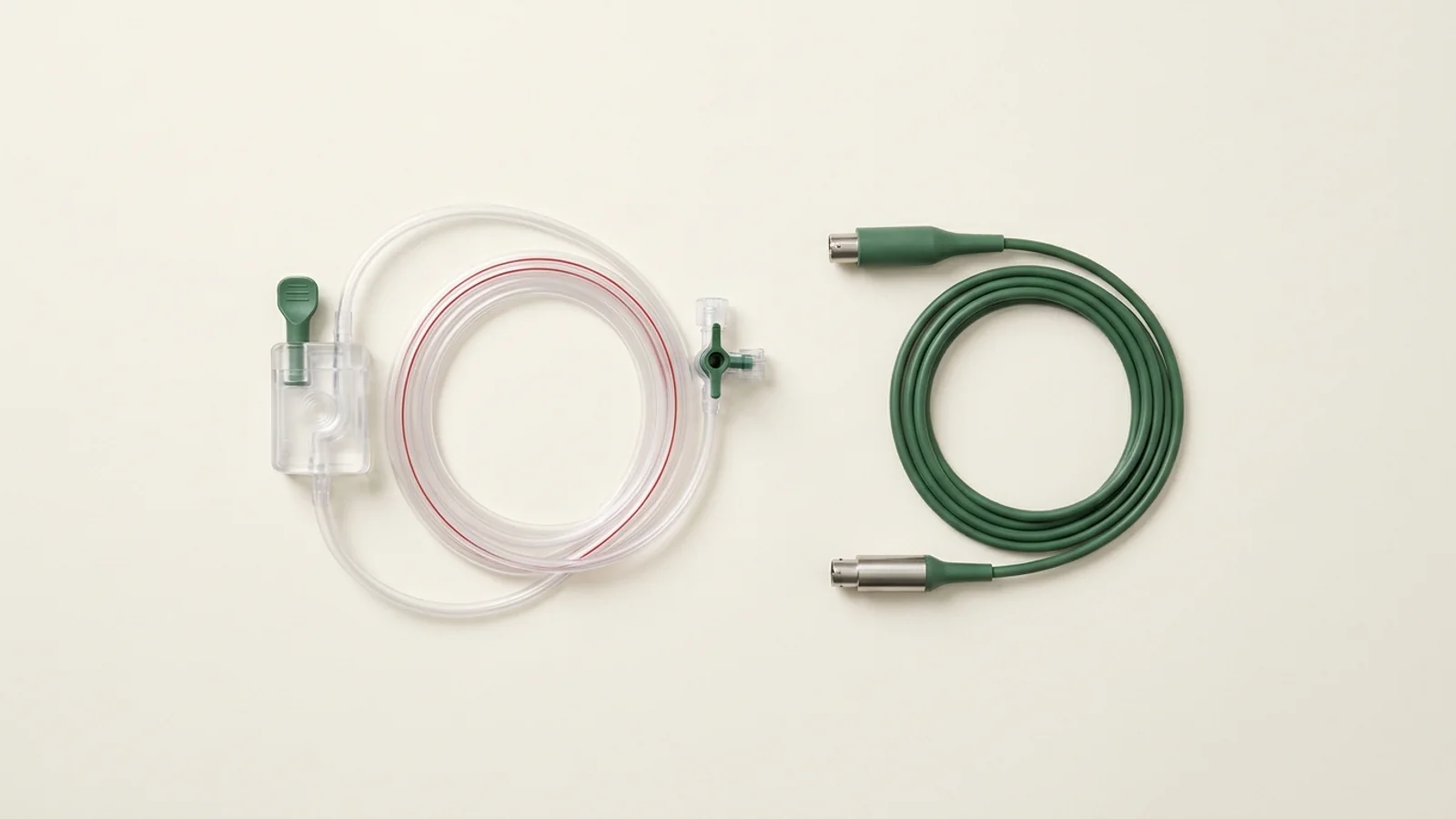
If a supplier offers a replacement arterial pressure monitoring kit, ask them to document the exact kit and how it pairs with the monitors you already own. Start with the catalog reference (REF) on the quote, then request the matching market label, current IFU, itemized kit contents, and written documentation of the reusable monitor interface. Use those records to compare the replacement with the kit you already stock.
A pressure monitoring set carries pressure through a disposable fluid path to a transducer, which converts it to an electrical signal for the monitor. Review the disposable kit and the reusable signal path together. A quote may cover the transducer, tubing, flush device, stopcocks and sampling ports while leaving the cable or contact board as a separate order. The worksheet below shows which of those details a public record can establish and where you need more evidence before making a purchase decision.
Start with the exact kit reference
The CODAN DPT-6000 and DPT-9000/Xtrans IFU (20.1028.00/2022-10) describes a single pressure transducer as the smallest set configuration. The illustrated configurations include different combinations of filling and irrigation hardware, pressure tubing, stopcocks, and blood-sampling components. The same document lists sterile accessories and nonsterile reusable electrical accessories separately (English §§4.1–4.3, pp. 41–44).
Ask the supplier to mark each requested component as included in the sterile pack, ordered separately, or excluded. Record the number of transducers and pressure lines, tubing length for each line, and the number and type of stopcocks, valves, and sampling ports. If a separate accessory needs to be ordered, request its catalog reference and the document that links it to the kit. That lets you compare the cost of the complete documented configuration across quotes that cover different contents.
flowchart TD
  Q["Quoted kit reference and market label"] --> F["Disposable kit contents and fluid-side configuration"]
  Q --> E["Transducer and reusable monitor interface"]
  F --> G["Check labeled use and applicable safety notices"]
  E --> G
  G --> D1["Evidence complete: submit for local approval"]
G --> D2["Evidence missing or conflicting: hold for review"]Compare the flush configuration and tubing on the quote
Keep four fields on the quote comparison: the transducer variant, the flush wording exactly as supplied, any documented flow rate and its reference condition, and the filling configuration identified in the IFU. If a distributor lists only a number, ask for the manufacturer document that explains what the number measures and which kit it describes.
The CODAN Xtrans family overview lists 3 mL/h and 30 mL/h versions with an integrated one-way stopcock. The CODAN IFU links those continuous-flush ratings to specific models. The English component table in §4.1 (p. 43) lists 3 mL/h for DPT-6003 and DPT-9003, and 30 mL/h for DPT-6009 and DPT-9009, both at a 300 mmHg reference condition. Sections 2.6 and 7.2–7.3 limit the bag-and-pressure-cuff arrangement to DPT-6003 and DPT-9003, which can also appear in the labeled syringe-pump arrangement. DPT-6009 and DPT-9009 are labeled for the syringe-pump configuration only. Record the actual filling hardware on the quote even when the model suffix and rate are supplied.
The US AccessGUDID records below show what can change within a kit family. The two Transpac IV SafeSet entries have identical squeeze-flush wording, a reservoir and two needleless valves, but one lists a 60-inch arterial pressure line and the other lists 84 inches. Record the difference against the tubing requirement for the intended location. The separate pediatric arterial kit entry supplies still less detail about its contents.
AccessGUDID gives the ICU Medical flush wording in mL. It leaves the hourly rate and reference conditions for each of these products unresolved. Copy the labeler wording into the worksheet before asking the supplier for the exact kit IFU or specification. The 300 mmHg figure in the CODAN example belongs to the component rating in that IFU. Keep it attached to the source and component shown in the table. For help matching the device identifier to the labeled package, see the UDI and GUDID receiving guide.
| Source and reference | Components stated | Flush or filling detail | Still to verify |
|---|---|---|---|
| CODAN DPT-6003 / DPT-9003 | Transducer variants. Other components depend on the kit REF. | 3 mL/h at 300 mmHg in the component table. Labeled bag-and-cuff and syringe-pump configurations. | Quoted kit contents, actual filling configuration, and current market IFU. |
| CODAN DPT-6009 / DPT-9009 | Transducer variants. Other components depend on the kit REF. | 30 mL/h at 300 mmHg in the component table. Syringe-pump configuration only. | Quoted kit contents and current market IFU. |
| ICU Medical 42644-66 · DI 00887709042599 | Transpac IV SafeSet, 60-inch arterial pressure tubing, reservoir, two needleless valves. | “03 mL” squeeze flush wording. | Hourly rate and conditions, complete contents, and monitor interface. |
| ICU Medical 42646-66 · DI 00887709042605 | Transpac IV SafeSet, 84-inch arterial pressure tubing, reservoir, two needleless valves. | “03 mL” squeeze flush wording. | Hourly rate and conditions, complete contents, and monitor interface. |
| ICU Medical 460650465 · DI 00887709046566 | Pediatric arterial kit with Transpac IT. The description gives few component details. | “30 mL” flush device wording. | Hourly rate and conditions, complete contents, monitor interface, and label-specific population limits. |
Match the transducer to the monitor input
In the CODAN IFU (English §§5.2–5.4, p. 46, and §16.3.3, p. 61), Luer conformity applies to specified external consumables, such as catheters and disposable syringes. The manufacturer separately specifies original CODAN accessories for changes to the set and for signal transmission. It also warns about the effects of third-party electrical accessories. Ask for the document that covers each connection separately. The IV administration set guide covers a related distinction for a different purchasing decision, between fluid connectors and labeled pump compatibility.
Start with the installed monitor model and its pressure input or module, then record the number of signals required and the full transducer family. Find the exact cable, monitor connector, or contact-board REF in the matching row. The Philips (2) table on printed page 56 of CODAN’s Electrical Accessory catalog names the IntelliVue X3 and lists distinct two-signal entries for DPT-6000 and Xtrans.
For the two-signal rows, the Xtrans monitor connector and Contactboard-GO are separate catalog entries. Ask the supplier to identify the complete signal path that applies to the installed input, including every required accessory and any documented adapter. If a quote covers more than one monitor model or input module, record a pairing for each. Have clinical engineering and the suppliers confirm the current references before accepting a dated catalog match for the order.
| Transducer family | Two-signal accessory on the IntelliVue X3 | Check for the live quote |
|---|---|---|
| DPT-6000 | Interface cable REF 75.3251 | Verify the exact monitor input and current cable reference. |
| DPT-9000/Xtrans | Monitor connector REF 75.2237 | Confirm the full accessory combination for the installed input. |
| DPT-9000/Xtrans | Contactboard-GO REF 75.1226 | Confirm whether the documented configuration uses this contact board and which other accessories it requires. |
Record the labeled use and receiving evidence
Record the intended purpose and patient group for the complete configuration. The CODAN IFU (English §§3.1 and 3.5, p. 40) describes continuous invasive pressure monitoring and/or blood withdrawal. Its patient-group section addresses people who are critically ill, on ventilation, or both, and need the stated monitoring or sampling. Within that group, the labeling differs by filling configuration. The DPT-6003 or DPT-9003 configuration with a filling and irrigation system and pressure cuff has a stated starting age of 2 years (12 kg). The cited configuration with a filling line and syringe pump names all four transducer variants and describes use from birth without a weight restriction. Ask the clinical reviewer to check the current market label against the intended application for the quote.
The AccessGUDID record for ICU Medical 460650465 describes that reference as pediatric. Carry that wording into the record for 460650465 and request the IFU for its full use limits. Leave the population fields for 42644-66 and 42646-66 open until you have labeling for those references.
Receiving teams also need a place to record field notices. In the UK, NHS Supply Chain ICN 3546 (November 9, 2026) links CODAN’s October 27 notice FSN_26-09-098 / FSCA_26-09-098, the product list and an IFU supplement. CODAN reported a possible increase in flush rate due to an assembly fault in specified Xtrans or DPT-6000 sets with a 3 mL/h flushing system manufactured from March 2 through August 31, 2026. The linked letter also describes a labeling warning for sets fitted with that flushing system. Record the affected production window and the current supplement as separate fields.
For a local shipment, record the notice identifier, exact product reference, lot number and manufacturing date from the available labeling and receiving records. Check those identifiers against the product scope in the applicable notice and record who owns the disposition. Use updated manufacturer labeling when a supplement applies. The supplier quality agreement guide covers how to document what the supplier must tell you when kit components or labeling change.
Use the worksheet before approving a substitute
Copy the worksheet into the purchase record and add two columns, one for the stocked kit and one for the proposed replacement. For each entry, keep the document title, revision or date, market, and page or table row. Mark the field as confirmed, conflicting, or unresolved. The worked column uses the 42644-66 AccessGUDID record as the first piece of evidence for a hypothetical quote.
| Worksheet field | Evidence to request or record | Worked partial record for 42644-66 |
|---|---|---|
| Stocked and quoted kit identity | Match the exact REF, package-level device identifier if present, and ordering unit to the quote and package label. | Proposed REF 42644-66 and primary DI 00887709042599. Stocked kit and ordering unit still need local entries. |
| Kit contents | Obtain the itemized list for the quoted REF. Include transducer suffix and count, pressure line lengths, stopcocks, valves, ports, and any sampling reservoir. | 60-inch arterial pressure tubing, reservoir and two needleless valves listed. Full contents and exact transducer variant unresolved. |
| Flush wording and rated flow | Capture the label wording, any hourly rate and its unit, and stated reference conditions from the exact product document. | “03 mL” squeeze flush wording confirmed. Hourly rate and reference conditions unresolved. |
| Labeled filling configuration | Record the filling hardware identified by the IFU and whether the required components ship with the quoted REF. | Unresolved. Request the current kit IFU and itemized list. |
| Fluid-side connections | Name the two parts at each interface the quote adds or changes. Record the relevant IFU section or supplier confirmation. | Unresolved. Request the document that covers each proposed component pairing. |
| Reusable monitor interface | Record transducer family, installed monitor and input, signal count, exact cable or board and connector REFs, and documented adapters. | Unresolved. Request the manufacturer’s matching accessory row and have clinical engineering confirm the installed input. |
| Market and labeled use | Record the intended application and population, local label and current IFU revision, including any applicable supplement. | US labeler record identifies an arterial monitoring kit. Current IFU and labeled population limits remain unresolved. |
| Receiving and safety notice status | Check applicable notices and document the search date, affected references, lot or date scope, and disposition as relevant. | Unresolved. Assign the local check before releasing stock. |
| Review and disposition | Record each exception, who will resolve it, the approval owner, and the decision with its date. | Hold. Obtain the missing kit and monitor documents before submitting to clinical engineering and the responsible clinical team. |
Scope, method limits, and when to re-verify
This worksheet draws on selected manufacturer documents, US AccessGUDID records and a dated UK field notice, reviewed November 23, 2026. The examples show how to read those records. Verify orderability and the current label in your market for the reference you plan to buy. A catalog example supplies a place to start the document check, and the local review determines whether the complete configuration meets your purchase specification.
Reopen the worksheet when the supplier changes the kit REF, transducer variant, tubing or filling components, or when the monitor model, input or accessory changes. Review the receiving record again after a relevant label revision, supplement or safety notice update.
Sources
CODAN Invasive Blood Pressure Monitoring | The Intelligent System — CODAN Companies product family overview (Xtrans 3 mL/h and 30 mL/h options and reusable accessories).
IBPM DPT-6000 and DPT-9000/Xtrans Pressure Monitoring Sets: Instructions for Use, 20.1028.00/2022-10 — CODAN pvb Critical Care GmbH (English §§2.6, 3.1, 3.5, 4.1–4.3, 5.2–5.4, 7.2–7.3, and 16.3.3).
CODAN pvb Critical Care Electrical Accessory 2023, printed p. 56 (Philips IntelliVue X3) — Philips (2), two-signal rows.
AccessGUDID Device Record: ICU Medical 42644-66, Primary DI 00887709042599 — AccessGUDID (NLM/FDA), labeler ICU Medical, Inc.
AccessGUDID Device Record: ICU Medical 42646-66, Primary DI 00887709042605 — AccessGUDID (NLM/FDA), labeler ICU Medical, Inc.
AccessGUDID Device Record: Transpac 460650465, Primary DI 00887709046566 — AccessGUDID (NLM/FDA), labeler ICU Medical, Inc.
NHS Supply Chain ICN 3546: CODAN Invasive Pressure Monitoring Sets with Xtrans or DPT-6000 with Flushing System 3 mL/h — NHS Supply Chain (November 9, 2026), linking CODAN manufacturer letter FSN_26-09-098 / FSCA_26-09-098 (October 27, 2026).