
Start with the cover reference, not the dimensions
When a hospital buyer or distributor receives a quote for a nominally matching 14 × 61 cm ultrasound probe cover, matching length and width is not enough to authorize substitution. Specify the exact manufacturer catalog reference (REF) and its applicable label and Instructions for Use (IFU) first, then record intended use, supplied sterile status, single-use marking, declared material and natural-rubber-latex statement scope, geometry, included gel or securing bands, ordering quantity, and documented transducer-model fit as separate fields.
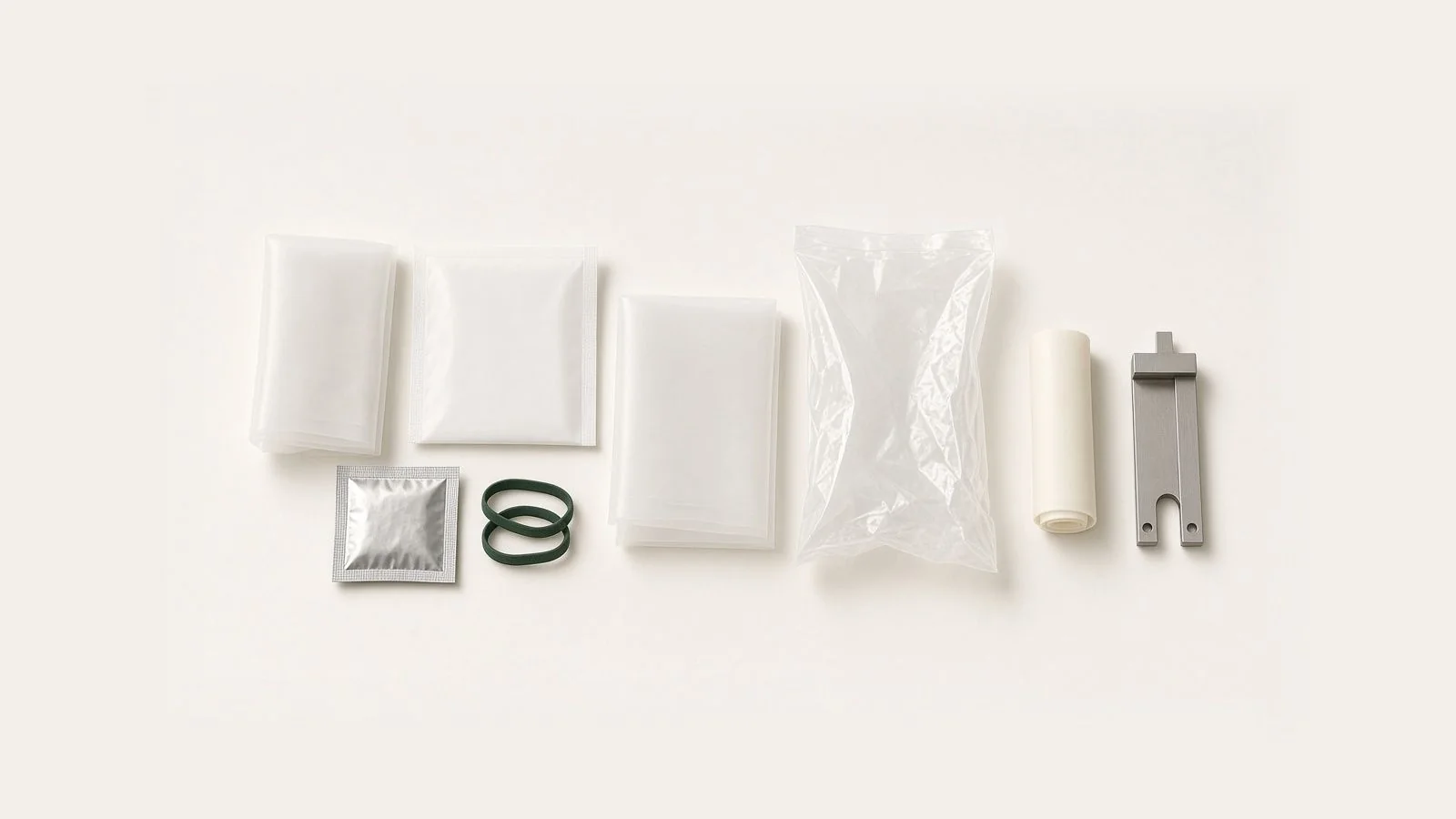
The CIVCO CIV-Flex General Purpose product catalog illustrates why dimension-first purchasing breaks down. Both REF 610-002 and REF 610-362 list identical nominal dimensions of 14 × 61 cm (5.5 × 24 in) in a flat-folded 3D CIV-Flex configuration, and both link to the same shared family guide (IFU 043-313AH). However, REF 610-002 is supplied sterile with a sterile gel packet and elastic bands at a listed catalog quantity of 24, whereas REF 610-362 is a nonsterile bulk cover at a listed quantity of 50 with no gel or bands specified for that bulk listing. Inferring equivalent sterile status, missing accessories, or probe compatibility from the shared 14 × 61 cm dimensions can create receiving errors and supply gaps.
Established supplier catalogs—such as CIVCO and competing lines like Krystal Ultrasound Probe Covers—already publish material families, order references, dimensions, sterile versus nonsterile presentation, gel inclusion, and pack quantities. Where procurement workflows fail is not a lack of catalog tables, but the absence of an auditable buyer record that reconciles catalog configuration against actual SKU labeling, IFU limits, and dated probe-model fit evidence while keeping unverified fields visible.
What the labeled use and clearance actually cover
Regulatory clearances and family IFUs define the outer boundary of what a manufacturer has demonstrated for a specific device submission—they do not create blanket interchangeability across brands, SKUs, or ultrasound transducers. Buyers also need to keep FDA 510(k) clearance distinct from Premarket Approval (PMA): a 510(k) decision is a finding of substantial equivalence to a predicate device, not an approval of universal performance.
FDA 510(k) summary K241615 (July 3, 2024) for Hony Medical Co., Ltd.’s Transducer Probe Cover (Class II, product code ITX under 21 CFR 892.1570) shows how specific regulatory boundaries work in practice. Sections 4 and 5 of that summary describe a disposable polyurethane sleeve supplied with a rubber ring and/or tape strip in various dimensions, individually packaged and sterile for one patient and one procedure. Its cleared diagnostic scope covers body-surface, endocavity, and intraoperative ultrasound.
Sections 6 and 7 of K241615 further clarify what changed relative to predicate K221278: the expanded indication moved beyond external intact skin into endocavity and intraoperative use with no modifications to materials, structure, dimensions, or device performance. Because the device itself was unchanged, the summary states that no new performance bench testing was included and that sterilization and shelf-life evaluations were not required; the only new testing reported is additional biocompatibility evaluation (thrombogenicity and complement activation under ISO 10993-4) for the expanded tissue contact. Yet even that detailed public clearance file does not supply a complete exact-REF dimension table, current commercial SKU labeling, a natural-rubber-latex statement for its rubber ring, or a verified list of compatible ultrasound transducer models—and none of its material or regulatory scope can be transferred to CIVCO or any other manufacturer.
A similar boundary appears inside manufacturer documentation. CIVCO’s shared guide 043-313AH (dated 2026-07-02) spans multiple families—CIV-FLEX, IVAS, NeoGuard, POLY, SURGI, and SURGI-TIP—and differentiates general-purpose, intraoperative, and intracavity covers across sterile and nonsterile single-use configurations. Because one family IFU covers multiple product lines, a shared PDF link confirms family-level warnings and symbol definitions rather than proving that every listed clinical setting or dimension applies to every catalog number. Buyers still must inspect the exact REF listing and physical SKU label before assigning a cover to a clinical area.
Keep material, sterility and reuse marking separate
Three procurement attributes routinely get collapsed into shorthand on purchase orders: polymer identity, natural-rubber-latex status, and sterile versus single-use markings. Treating any one of these as a proxy for the others introduces compliance and supply gaps.
Material trade names and natural-rubber-latex scope
Catalog family names do not equal full chemical disclosures. "CIV-Flex" is a manufacturer product-line name rather than an explicit polymer formula, whereas Krystal catalogs group offerings by stated polymers such as polyurethane, polyethylene, and latex, and K241615 identifies a polyurethane sleeve paired with a rubber ring and/or tape strip. Even when a sleeve polymer is known, a cover kit often includes elastic securing bands, adhesive tape, a gel packet, and primary barrier packaging.
In its December 2, 2014 guidance on Labeling Medical Products Not Made with Natural Rubber Latex, FDA recommends using an explicit manufacturing-material statement such as "Not made with natural rubber latex" rather than absolute "latex-free" claims, because available testing cannot rule out every trace allergen or cross-contamination. Section 4 of that guidance distinguishes an unqualified statement covering the entire product, container, and packaging from a component-specific statement. When evaluating a non-latex quote, confirm whether the supplier’s declaration covers the sleeve alone or also covers the securing bands, gel packet, and primary pouch. CIVCO’s IFU 043-313AH is a useful example of a scoped claim: its symbol legend defines the “not made with natural rubber latex” symbol (ISO 15223-1, 5.4.5 with Annex B) as meaning natural rubber latex was not used in the product, its container, or its packaging. A buyer should still confirm that this symbol actually appears on the label of the SKU being quoted, because a family legend lists every symbol the guide uses, not the markings on each REF.
Where natural rubber latex is present, keep those SKUs strictly segregated in purchasing masters. For example, CIVCO’s Latex General Purpose catalog lists REF 610-043 as a sterile 5 × 30 cm (2 × 11.8 in) narrow rolled latex cover with a sterile gel packet and elastic bands (quantity 24). Its linked Latex IFU 043-312AA (dated 2026-06-24) displays the ISO 15223-1 natural-rubber-latex presence symbol (5.4.5) and explicit allergy warnings. REF 610-043 belongs to a different material, geometry, and size class, so it is not a like-for-like substitute for the CIV-Flex references.
Sterile status, single-use symbols, and separate kit contents
Both CIVCO IFUs separate disposable status from sterilization status in their ISO 15223-1 symbol legends: do-not-reuse / single-use (5.4.2) appears alongside separate markings for sterilized using ethylene oxide (EO, 5.2.3) and nonsterile (5.2.7), plus catalog number, lot, and expiration date. Single-use prohibits reuse or resterilization, but it never implies sterility; IFU warnings explicitly instruct users to check the actual sterile marking on the supplied unit, as EO sterilization applies only where the sterile symbol is present and sterile-field claims apply only to sterile configurations.
Receiving and quality teams should also inspect package integrity and expiration dates at goods receipt rather than assuming pouch appearance establishes sterility. For structured receiving documentation of damaged sterile pouches and UDI label capture, see our guides on recording sterile-pouch damage at goods receipt and UDI and GUDID capture for medical consumables.
Finally, record included accessories separately from the sleeve. REF 610-002 and REF 610-043 list a sterile gel packet and elastic bands, whereas bulk REF 610-362 lists no contents beyond the cover. If a bulk nonsterile cover is substituted without checking accessory rules, the receiving department may create an unbudgeted shortage of single-use sterile gel packets or securing bands. Do not select coupling gel by cover habits—apply our separate specification guide on sterile vs nonsterile ultrasound gel to verify coupling-medium requirements independently.
Worked purchasing comparison: three catalog references
The table below reconciles three verified CIVCO catalog references from current manufacturer listings and linked IFUs. Nominal dimensions are preserved exactly as published rather than recalculated, and unverified fields remain explicitly marked so buyers do not fill gaps by assumption.
| Specification Field | REF 610-002 (CIV-Flex Kit) | REF 610-362 (CIV-Flex Bulk) | REF 610-043 (Latex Kit) |
|---|---|---|---|
| Product family & configuration | CIV-Flex General Purpose 3D flat-folded cover (CIVCO catalog) | CIV-Flex General Purpose 3D flat-folded bulk cover (CIVCO catalog) | Latex General Purpose narrow rolled cover (CIVCO latex catalog) |
| Stated dimensions | 14 × 61 cm (5.5 × 24 in) | 14 × 61 cm (5.5 × 24 in) | 5 × 30 cm (2 × 11.8 in) |
| Supplied sterile status | Sterile; EO applies where actual sterile symbol (5.2.3) is on SKU label (IFU 043-313AH) | Nonsterile (5.2.7); no sterile-field claim applies (IFU 043-313AH) | Sterile; verify sterile symbol (5.2.3) for EO status on actual SKU label (IFU 043-312AA) |
| Single-use marking | Single-use / do not reuse (5.4.2) per linked IFU 043-313AH; verify on actual unit | Single-use / do not reuse (5.4.2) per linked IFU 043-313AH; verify on actual unit | Single-use / do not reuse (5.4.2) per linked IFU 043-312AA; verify on actual unit |
| Material & latex disclosure | CIV-Flex trade name; catalog states not made with natural rubber latex; IFU legend scopes the symbol to product, container, and packaging—confirm it on the SKU label | CIV-Flex trade name; catalog states not made with natural rubber latex; IFU legend scopes the symbol to product, container, and packaging—confirm it on the SKU label | Natural rubber latex; ISO 5.4.5 presence symbol & allergy warning in IFU 043-312AA |
| Included kit contents | Cover, sterile gel packet, elastic bands | None specified beyond cover in bulk listing | Cover, sterile gel packet, elastic bands |
| Listed catalog quantity | 24 (verify full UOM/carton hierarchy on quote) | 50 (verify full UOM/carton hierarchy on quote) | 24 (verify full UOM/carton hierarchy on quote) |
| Linked IFU & revision | 043-313AH (2026-07-02); shared family guide—verify SKU label | 043-313AH (2026-07-02); shared family guide—verify SKU label | 043-312AA (2026-06-24); shared latex guide—verify SKU label |
| Documented installed-probe fit | Not established in catalog or IFU—obtain dated model-level fit confirmation | Not established in catalog or IFU—obtain dated model-level fit confirmation | Catalog notes narrow rolled covers for curved-array probes; exact model fit not established |
Confirm the exact transducer before substituting
Nominal sleeve width and length do not tell a buyer whether a cover’s distal geometry, opening aperture, 3D box-end or tapered fold, and securing bands match an installed ultrasound probe without excess bunching or strain. Catalog pages and regulatory summaries rarely list every ultrasound console and transducer model in a hospital fleet. Before approving any SKU change, run a two-gate reconciliation that separates SKU labeling checks from model-specific transducer fit.
flowchart TD
  A["Receive cover quote or substitution REF"] --> B["Inspect actual SKU label & linked IFU revision"]
  B --> C{"Sterile status, single-use, latex scope & kit contents match?"}
  C -- "No or unverified" --> D["Hold substitution; log gaps for supplier clarification"]
  C -- "Yes" --> E["Compare against installed ultrasound system & probe model"]
  E --> F{"Dated REF-to-probe fit evidence documented?"}
  F -- "No" --> D
F -- "Yes" --> G["Route complete record for clinical/technical buyer review"]Use the reusable purchaser comparison worksheet below to document both incumbent and quoted REFs side by side. This worksheet is an editorial procurement control method—not a regulatory requirement or a pre-validated fit list—and any unconfirmed field should stay explicitly open until the supplier provides dated documentation.
| Worksheet Field | Data to Record | Required Primary Evidence | Substitution Gate |
|---|---|---|---|
| 1. Incumbent & quoted REF | Exact catalog numbers, manufacturer, and target regulatory market | Quote line item, supplier spec sheet, and physical package label | Reject generic descriptions lacking an exact manufacturer REF |
| 2. Label & IFU revision | IFU document ID, effective date, and applicable section scope | Current manufacturer IFU and actual unit/box label | Do not rely on outdated PDFs or shared family summaries alone |
| 3. Intended use & limits | Labeled diagnostic contact scope (external, endocavity, intraoperative) | SKU label, IFU indications, and 510(k) clearance summary where cited | Hold if quoted REF narrows labeled contact scope vs. incumbent |
| 4. Sterile status & method | Sterile vs. nonsterile designation and verified sterilization method (e.g., EO) | ISO 15223-1 sterile (5.2.3) or nonsterile (5.2.7) symbol on actual SKU | Block nonsterile bulk SKUs from replacing sterile-kit SKUs |
| 5. Single-use marking | Presence of do-not-reuse symbol and resterilization prohibition | ISO 15223-1 5.4.2 symbol and IFU warning text | Never infer sterile status from single-use marking |
| 6. Material & latex scope | Stated polymer/material and scope of natural-rubber-latex wording | Manufacturer disclosure covering sleeve, bands/rings, gel pack, packaging | Flag component-only claims or a latex-presence symbol (ISO 15223-1, 5.4.5) |
| 7. Geometry & dimensions | Labeled width, length, distal shape, opening profile, and fold format | Manufacturer technical specification sheet or SKU label | Record exact published units without assuming opening tolerance |
| 8. Contents & UOM hierarchy | Included gel packet, bands/rings/tape, and eaches per box/case | Supplier quote UOM confirmation and package label count | Reconcile missing accessories and pack-size shifts before PO release |
| 9. Installed probe inventory | Exact ultrasound system manufacturer, probe model, and array type | Facility clinical engineering / imaging asset register | Match every target department probe before issuing trial or PO |
| 10. Dated probe-fit evidence | Supplier or technical confirmation linking exact REF to exact probe model | Dated supplier compatibility letter or technical evaluation record | Hold substitution until dated REF-to-model fit is documented |
| 11. Missing/conflicting facts & sign-off | Explicit list of unresolved fields plus clinical and technical reviewer sign-off | Completed buyer worksheet and institutional approval record | Require pre-implementation change notice under supplier quality terms |
To prevent unannounced SKU swaps or packaging changes mid-contract, tie these worksheet fields to formal change-notification clauses in your quality agreements for consumable suppliers.
A cover does not replace probe reprocessing
Procurement specifications must preserve the boundary between barrier consumables and transducer reprocessing. Under CDC/HICPAC Recommendations for Disinfection and Sterilization in Healthcare Facilities (Recommendation 10.a and 10.b, corroborated in the full 2008 Guideline updated June 2024, pp. 91–92), cleaning and high-level disinfection remain required for semicritical probes such as rectal and vaginal probes even when a probe cover has been used. Recommendation 10.b specifically advises against reducing the disinfection category because covers can fail in service.
Manufacturer instructions reinforce that separation: both CIVCO IFU 043-313AH and IFU 043-312AA direct users to the ultrasound system manufacturer’s guide for transducer cleaning and disinfection rather than treating the cover as a reprocessing substitute. For purchasing teams, that means a sterile cover’s labeled sterile-field claim never justifies lowering reprocessing standards or eliminating disinfection consumables from department budgets.
Close the purchase-order record
Before releasing a purchase order or activating an alternate ultrasound probe cover SKU in hospital inventory, settle and archive these seven verification items:
Actual SKU label and IFU match: Confirm the quoted REF matches the physical unit/box label and current manufacturer IFU revision (such as 043-313AH or 043-312AA for the CIVCO examples above).
Applicable intended use, sterile, and single-use symbols: Verify labeled clinical scope (external, endocavity, or intraoperative), sterile versus nonsterile symbol, EO method where sterile, and do-not-reuse marking independently.
Material and latex disclosure scope: Document whether the supplier’s natural-rubber-latex manufacturing statement covers the entire kit and packaging or only the polymer sleeve, and segregate any SKU carrying a latex warning.
Dimensions, geometry, accessories, and UOM: Record exact stated dimensions, fold/distal shape, gel packet and securing-band inclusion, and verified eaches-per-box and case hierarchy.
Dated transducer-fit confirmation: Attach written manufacturer or technical confirmation linking the exact REF to each installed ultrasound transducer model rather than relying on equal nominal dimensions.
Goods-receipt package, lot, and expiry checks: Require receiving staff to verify intact sterile barriers, lot numbers, UDI, and remaining shelf life upon delivery.
Unresolved issues logged for institutional review: Flag missing current IFUs, unverified bulk carton UOMs, or pending probe-fit tests explicitly so infection-prevention and clinical engineering teams review them before clinical deployment.
Sources
CIVCO — CIV-Flex General Purpose Ultrasound Probe Covers (product options)
CIVCO — Transducer Covers IFU and reference guide 043-313AH (2026-07-02)
CIVCO — Latex General Purpose Ultrasound Probe Covers (product options)
CIVCO — Latex Transducer Covers IFU and reference guide 043-312AA (2026-06-24)
EDM Imaging / Krystal — Krystal Ultrasound Probe Covers manufacturer product specifications