
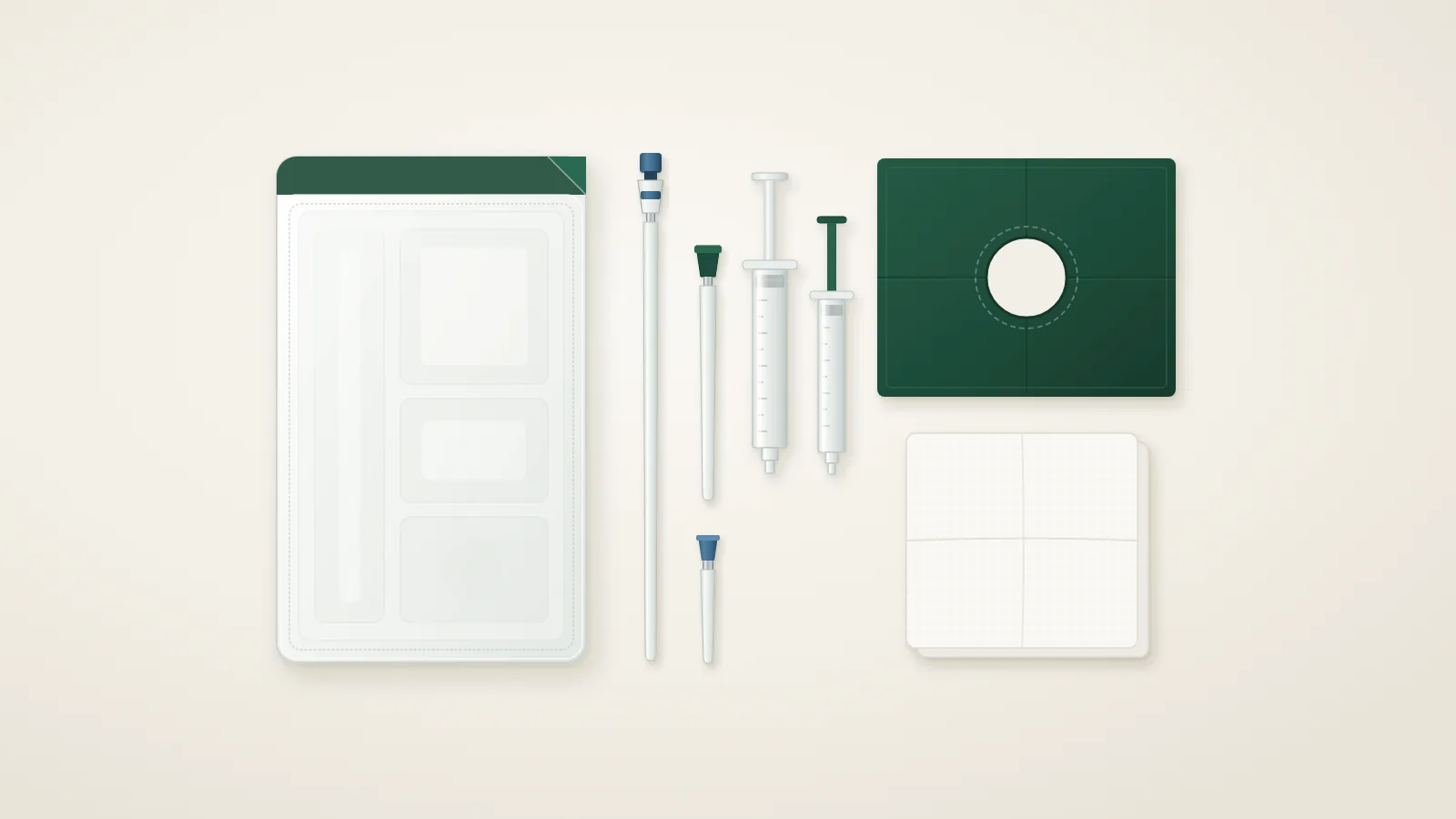
For each quote, get the current US label and component list for the exact catalog reference (REF). Check whether the tray includes a spinal needle. If it does, compare the labeled point, gauge, stated length, stylet, and hub. Then check the introducer, connectors, and other contents against the approved configuration. Even two quotes that both say 24 G × 3½ in. can describe different kits.
Confirm the procedure needle on the quote
ICU Medical lists NEPI-NLD-15548-20 as a Portex prep tray with a 20 G × 1½ in. introducer, other needles, skin prep, and medication. The catalog explicitly excludes the spinal needle. If the purchase line calls for a tray with the procedure needle, record this REF as prep-only and ask the supplier for the correct quote. ICU Medical Portex Spinal Trays
Record the manufacturer REF, the target market, and the packaging level on each quote. Where assigned, capture the device identifier (DI) for that level and record the case quantity. FDA describes the DI as the fixed part of the unique device identifier (UDI) that identifies the labeler and specific version or model. Production identifiers (PIs), such as actual lot and expiry, come from the package label when applicable. FDA UDI Basics · UDI and GUDID receiving guide
flowchart TD
    A["Record exact REF, US label, and package level"] --> B{"Does the tray include the spinal needle?"}
    B -- "No" --> C["Record needle absent and hold a complete-tray substitution"]
    B -- "Unverified" --> I["Hold substitution and request exact-REF documentation"]
    B -- "Yes" --> D["Record labeled tip, gauge, stated length, stylet, and hub"]
    D --> E["Check introducer presence, attachment, gauge, and length"]
    E --> F["Verify each connector and the full component list"]
    F --> H{"Does the documented configuration meet the approved specification?"}
    H -- "Gap or mismatch" --> I
H -- "Verified" --> J["Route for substitution approval and verify the package label at receipt"]Record tip, gauge and stated length
Keep the manufacturer’s point name, stylet design, and hub in separate specification fields. A generic “pencil point” description can group designs that still have different labeled names. General hypodermic needle specifications provide background on size and materials. The named spinal-needle design belongs in the purchase record.
Quincke. PAJUNK describes its Quincke Lumbar as a back-cut bevel. B. Braun identifies Spinocan as a Quincke-bevel design. The European BD brochure illustrates a beveled Quincke point and describes its stylet and hub keying. PAJUNK Quincke Lumbar · B. Braun Q2 2026 catalog, p. 4 · BD European brochure, p. 5
Whitacre and Pencan. The European BD brochure illustrates the Whitacre point with an opening on the side near the tip. B. Braun lists Pencan as a pencil-point design. Preserve the named design on the quote. BD European brochure, p. 5 · B. Braun Q2 2026 catalog, p. 4
Sprotte. Teleflex describes its Sprotte as pencil point. PAJUNK’s 2021 English Luer instructions describe a rounded lateral opening on an ogive-shaped point and include a stylet. Use that document for design terminology and obtain the current US instructions for use (IFU) for the quoted REF. Teleflex SureBlock ordering page · PAJUNK Sprotte instructions, 2021
Lancet Point. ICU Medical uses this name on Portex diagnostic and NRFit tray listings. Carry the manufacturer’s name through to the specification so the supplier can check the exact needle. Portex Diagnostic Procedure Trays · Portex NRFit Trays
BD’s K210978 summary lists Quincke in 18, 20, 22, 23, 25, 26, and 27 G across 1.5–7 in. and Whitacre in 22, 24, 25, and 27 G across 3.5–5 in. These are family-level filing ranges. Use current US ordering and labeling evidence to confirm a particular gauge-and-length combination. BD’s European brochure, for example, lists 401995 (Whitacre) and 405256 (Quincke) at the same stated 22 G × 90 mm (3½ in.) in that market. BD 510(k) K210978 · BD European brochure, p. 5
Preserve each manufacturer’s stated inch and metric entries. Teleflex ASA-24103-SB and B. Braun 333867 (P24BKDP) both list 24 G × 4 in. Teleflex states 103 mm and B. Braun states 100 mm. These are catalog entries. Ask the supplier to confirm the labeled length when the quoted and approved entries differ, and keep any metric field the source leaves blank open for confirmation. Teleflex SureBlock ordering page · B. Braun Pencan ordering page
ISO 7864 covers sterile single-use hypodermic needles, ISO 9626 covers rigid stainless-steel needle tubing, and ISO 6009 covers gauge color coding for single-use hypodermic needles within its scope. A spinal needle submission may cite individual test methods from such standards. For example, BD’s NRFit filing cites ISO 7864 for cannula pull force. Check the printed gauge, point name, and REF to establish the identity of the needle or tray. FDA scope for ISO 7864 · FDA scope for ISO 9626 · FDA scope for ISO 6009 · BD 510(k) K193131
Check the introducer and each connector
An introducer is a separate type of needle that guides the spinal needle. List it on its own line, with presence, gauge, length, and whether the supplier provides it attached. B. Braun Spinal Introducer · BD 510(k) K210978
ICU Medical lists four Portex trays with a 24 G × 3½ in. pencil-point spinal needle and three introducer gauges. NEPI-49661-24 lists 18 G × 1¼ in., 15739-21 lists 19 G × 1½ in., and NEPI-NLD-15848-20 lists 20 G × 1½ in. The fourth, 15858-21, explicitly says its 19 G × 1½ in. introducer is attached. The 25 G × 3½ in. trays NEPI-NLD-15545C-21 and NEPI-49661-25 also list different introducers, at 19 G × 1½ in. and 20 G × 1¼ in., respectively. Teleflex’s standalone Sprotte list shows same-size options with and without an introducer. Its four SureBlock tray entries list introducer presence and leave its dimensions unstated. Ask for the introducer dimensions and attachment status where the catalog leaves either field open. ICU Medical Portex Spinal Trays · Teleflex Sprotte and SureBlock ordering page
Record connectors per component. BD’s US filings describe a Luer spinal-needle family in K210978 and a separate ISO 80369-6 NRFit family in K193131. Smiths Medical’s K172823 epidural-needle summary explains that its NRFit connector was designed to be incompatible with standard Luer to reduce misconnections. In a separate product example, ICU Medical’s Portex NRFit pencil-point tray list includes a 5 mL NRFit lock syringe, a 3 mL Luer lock syringe, and explicitly labeled NRFit filter items. Ask which labeled connector belongs to each quoted part and record the supplier’s evidence for the intended combination. BD 510(k) K210978 · BD 510(k) K193131 · Portex epidural-needle 510(k) K172823 · Portex NRFit Trays
FDA recognition 5-146 for ISO 80369-6:2025 supersedes 5-108 for the 2016 edition. FDA accepts declarations to the 2016 edition in support of premarket submissions until December 17, 2028. Use the current device label and supplier documentation for the purchasing decision. FDA Recognition List No. 065 · FDA recognition 5-146 and transition period
Compare tray components by order code
B. Braun’s Q2 2026 matrix lists the same 24 G × 4 in. (100 mm) Pencan needle, 20 G × 1⅜ in. introducer, lidocaine, and 5 mL Luer slip syringe for both 333881 (P24SK) and 333867 (P24BKDP). Both also list a 3 mL Luer lock syringe preattached to an 18 G × 1½ in. needle. The 333881 column marks povidone-iodine and prep sponges. The 333867 column marks bupivacaine and DuraPrep. The 333881 title on the family page omits drug names, so the component matrix is where the buyer finds lidocaine listed for that REF. B. Braun Q2 2026 catalog, p. 5 · B. Braun Pencan ordering page
PAJUNK’s TBL401 and TBL402 both list a 22 G × 3.5 in. (90 mm) spinal needle with a Luer hub. TBL401 lists a Quincke with detached wings. TBL402 lists a Sprotte with wings and an introducer whose dimensions are unstated. Their shared accessory list includes a 34 cm manometer, a 20 cm manometer extension, a detached three-way stopcock, a 5 mL Luer lock syringe, and two hypodermic needles. PAJUNK US procedure tray catalog
In the Portex catalog, 4825-20 and 4825PL-20 list the same 22 G × 3½ in. Lancet Point specification, plus a manometer, four-way stopcock, and four numbered specimen vials. The standard tray lists a blunt filter needle. The safety tray lists a filter straw and sharps-protection items. The separate infant listing, 4963-20, specifies a 22 G × 1½ in. Lancet Point needle and three vials. Its component list omits a manometer entry. ICU Medical Portex Diagnostic Procedure Trays · Filter and blunt-fill needle specification guide
Read across the row for the exact REF. The examples below compare selected US catalog and registry fields. The August 2013 Cardinal Health rows describe historical configurations. Catalog dimensions are manufacturer-stated values, and an unstated field stays open until the supplier confirms it. Use the current US unit label and component list to resolve discrepancies and verify the configuration before ordering.
| Source / Market | Exact REF | Format | Spinal Needle | Tip | Gauge | Stated Length | Introducer | Connector by Role | Key Component Notes |
|---|---|---|---|---|---|---|---|---|---|
| B. Braun US, AccessGUDID · Q2 2026, p. 4 | 333355 | Standalone needle | Yes | Quincke bevel (Spinocan) | 22 G | 5 in. (130 mm) | Unstated in registry | Unstated in GUDID row (verify label) | Primary DI 04046964179785. Packaged sterile and single-use. Registry flags lot and expiry and leaves the method unstated. |
| ICU Medical US, Portex Spinal | NEPI-NLD-15548-20 | Prep tray | No (explicitly excluded) | N/A | N/A | N/A | 20 G × 1½ in. included | 3 mL and 5 mL syringes: Luer slip. Confirm other hubs. | Includes prep and medication components; explicitly omits spinal needle. |
| ICU Medical US, Portex Spinal | NEPI-49661-24 | Spinal tray | Yes | Pencil point | 24 G | 3½ in. | 18 G × 1¼ in. | 3 mL and 5 mL syringes: Luer slip. Needle hub unstated. | Catalog also lists a 19 G × 1½ in. filter needle. |
| ICU Medical US, Portex Spinal | 15858-21 | Spinal tray | Yes | Pencil point | 24 G | 3½ in. | 19 G × 1½ in. (attached) | 3 mL and 5 mL syringes: Luer slip. Needle hub unstated. | Catalog also lists a blunt fill needle with a filter. |
| ICU Medical US, Portex NRFit | 24-2246-01 | NRFit spinal tray | Yes | Pencil point | 25 G | 3½ in. | 18 G × 1⅓ in. | Spinal needle, 5 mL lock syringe, specified filter needle and straw: NRFit. 3 mL syringe: Luer lock. | Common list includes lidocaine. Bupivacaine cell blank. |
| ICU Medical US, Portex NRFit | 24-2248-01 | NRFit spinal tray | Yes | Pencil point | 25 G | 3½ in. | 18 G × 1⅓ in. | Spinal needle, 5 mL lock syringe, specified filter needle and straw: NRFit. 3 mL syringe: Luer lock. | Bupivacaine marked. Common list includes lidocaine. |
| PAJUNK US, Procedure Trays | TBL401 | Diagnostic tray | Yes | Quincke (detached wings) | 22 G | 3.5 in. (90 mm) | Unstated in catalog row | Spinal needle: Luer. 5 mL syringe: Luer lock. | Shared list: 34 cm manometer, 20 cm extension, detached 3-way stopcock, 5 mL Luer lock syringe, 2 hypodermic needles. |
| PAJUNK US, Procedure Trays | TBL402 | Diagnostic tray | Yes | Sprotte (with wings) | 22 G | 3.5 in. (90 mm) | Included (gauge/length unstated in row) | Spinal needle: Luer. 5 mL syringe: Luer lock. | Shares the diagnostic accessory list for TBL401. |
| ICU Medical US, Portex Diagnostic | 4825-20 | Standard diagnostic tray | Yes | Lancet point | 22 G | 3½ in. | Unstated in table (verify label) | 3 mL and 5 mL syringes: Luer lock. Needle hub unstated. | Standard table lists blunt filter needle, manometer, 4-way stopcock, 4 numbered specimen vials. |
| ICU Medical US, Portex Diagnostic | 4825PL-20 | Safety diagnostic tray | Yes | Lancet point | 22 G | 3½ in. | Unstated in table (verify label) | 3 mL and 5 mL syringes: Luer lock. Needle hub unstated. | Safety table lists filter straw and sharps-protection items, manometer, 4-way stopcock, 4 vials. |
| ICU Medical US, Portex Diagnostic | 4963-20 | Infant diagnostic tray | Yes | Lancet point | 22 G | 1½ in. | Unstated in table (verify label) | 3 mL and 5 mL syringes: Luer lock. Needle hub unstated. | Standard infant table lists 3 specimen vials; no manometer shown. |
| Teleflex US, Arrow SureBlock | ASA-24103-SB | Spinal tray | Yes | Sprotte (pencil-point) | 24 G | 4 in. (103 mm) | Yes (size unstated in table) | Unstated on ordering page (verify label) | Catalog lists bupivacaine and lidocaine. Ask for the full component list. |
| Teleflex US, Arrow SureBlock | ASA-25090-SB | Spinal tray | Yes | Sprotte (pencil-point) | 25 G | 3½ in. (90 mm) | Yes (size unstated in table) | Unstated on ordering page (verify label) | Medication column lists bupivacaine and lidocaine. |
| Teleflex US, Arrow SureBlock | ASA-25090-S | Spinal tray | Yes | Sprotte (pencil-point) | 25 G | 3½ in. (90 mm) | Yes (size unstated in table) | Unstated on ordering page (verify label) | Medication column explicitly states "No". |
| B. Braun US, Q2 2026, p. 5 | 333881 (P24SK) | Spinal tray | Yes | Pencan (pencil-point) | 24 G | 4 in. (100 mm) | 20 G × 1⅜ in. | 5 mL Luer slip & 3 mL Luer lock syringes (verify needle hub) | Lidocaine, povidone-iodine, and prep sponges marked. The 3 mL syringe has a preattached 18 G × 1½ in. needle. |
| B. Braun US, Q2 2026, p. 5 | 333867 (P24BKDP) | Spinal tray | Yes | Pencan (pencil-point) | 24 G | 4 in. (100 mm) | 20 G × 1⅜ in. | 5 mL Luer slip & 3 mL Luer lock syringes (verify needle hub) | Lidocaine, bupivacaine, and DuraPrep marked. The 3 mL syringe has a preattached 18 G × 1½ in. needle. |
| Cardinal Health, August 2013 | 26-LP3CO | Diagnostic tray (historical) | Yes | BD Quincke | 22 G | 3½ in. | Unstated in brochure excerpt | Unstated in brochure excerpt | August 2013 list includes a two-piece manometer. |
| Cardinal Health, August 2013 · AccessGUDID | 26-LP4CO | Diagnostic tray (historical specs / live DI) | Yes, in 2013 brochure | BD Whitacre, 2013 brochure | 22 G (historical) | 3½ in. (historical) | Unstated in cited excerpt | Unstated in cited excerpt | 2013: two-piece manometer. Registry: primary DI 10885425209927, case DI 50885425209925 (10 units), FDA code OJG. |
| Cardinal Health, August 2013 | 26-LP5CO | Diagnostic tray (historical) | Yes | BD Quincke | 20 G | 3½ in. | Unstated in brochure excerpt | Unstated in brochure excerpt | August 2013 list identifies this as the no-manometer configuration. |
Cardinal Health’s August 2013 Presource brochure shows how 26-LP3CO, 26-LP4CO, and 26-LP5CO differed in tip, gauge, and manometer inclusion at the time. The AccessGUDID entry for 26-LP4CO identifies a sterile atraumatic lumbar puncture tray with primary DI 10885425209927 and a 10-unit case DI 50885425209925. For a new order, use the registry to verify those identifiers and ask the supplier for the current component list. Cardinal Health Presource brochure, August 2013 · AccessGUDID 26-LP4CO
Match the label and supplier documentation
Ask the supplier to identify the regulatory basis for the exact US REF and supply the record that applies. Compare that record with the current label and component list before approving a substitution.
Needle classification and clearance. 21 CFR 868.5150 classifies anesthesia conduction needles as Class II. FDA’s BSP classification lists 510(k) as the submission type. BD’s K210978 summary illustrates what a specific clearance adds by identifying named spinal needles and indications, including fluid withdrawal for diagnostic lumbar puncture or myelography. 21 CFR 868.5150 · FDA classification BSP · BD 510(k) K210978
Tray classification. 21 CFR 868.5140 classifies anesthesia conduction kits as Class II. The FDA CAZ record lists 510(k) and describes enforcement discretion for kits that meet the convenience-kit criteria. AccessGUDID reports OJG for Cardinal Health 26-LP4CO. FDA classifies OJG as a neurological tray under 21 CFR 882.4525 and also describes conditional enforcement discretion. Verify the regulatory basis for the quoted kit itself. 21 CFR 868.5140 · FDA classification CAZ · AccessGUDID 26-LP4CO · FDA classification OJG
Convenience-kit guidance. FDA’s May 1997 guidance describes discretion for the 510(k) requirement when the kit meets the intended-use, component, and processing conditions. Its list includes spinal anesthesia kits and lumbar puncture trays. The guidance calls for legally marketed finished device components and an assessment of whether any further processing significantly affects component safety or effectiveness. Other applicable device controls and drug requirements still apply. FDA Convenience Kits Interim Regulatory Guidance
Registry and receiving. The AccessGUDID entry for Spinocan 333355 lists the primary DI, product code BSP, size, sterile packaging, and single-use status. It flags lot and expiration date as production identifier fields and leaves the sterilization method unstated. Record the shipment’s actual lot and expiry from its label. AccessGUDID Spinocan 333355 · FDA UDI Basics
Use the same fields on the request for quotation (RFQ) and in the receiving record so staff can match what arrived to what was approved. Keep the supplier’s change-notification commitment in the supplier quality agreement.
| Verification Field | Required Record for RFQ / Receiving | Authoritative Evidence Source | Mismatch / Substitution Guardrail |
|---|---|---|---|
| Current US label & IFU revision | Revision code/date and US market scope | Supplier-provided current US label and IFU | Reject EU-only or historical PDFs (e.g., 2013 brochures) as sole proof of current kit contents. |
| Exact REF & accepted tray list | Manufacturer catalog REF and tray family confirmation | Quote line matched to label REF | Check whether the approved line requires the spinal needle. Hold prep-only substitutions on complete-tray lines. |
| Procedure needle specification | Labeled tip name, gauge, inch + mm length, stylet, hub | Unit label and current IFU | Resolve differences between quoted and approved lengths, including differences in stated metric values. |
| Introducer specification | Included vs. excluded, attached vs. separate, gauge, length | Unit label / IFU component table | Do not infer introducer size from spinal needle size or summary "Yes" flags. |
| Component-level connectors | Connector standard (NRFit vs. Luer) for needle, each syringe, filter, and accessory | Unit label and component list | Check both syringes if the component list includes NRFit and Luer. |
| Full bill of materials & drugs | Drug name, concentration and container volume as labeled. Skin prep, filter item, diagnostic accessories and quantities. | Signed component list / current label | Distinguish explicit "No" from blank cells or omitted title words. |
| Packaging level, DI, lot & expiry | Unit and case DIs where assigned, case quantity, and actual lot and expiry as labeled. | Package barcode/label + AccessGUDID DI check | Record actual lot and expiry from the physical package; GUDID only flags PI applicability. |
| Storage & supplier change notice | Labeled temperature/storage limits and pre-change notification commitment | Package label + signed quality agreement | Require advance notice for any needle, drug, prep, connector, or sterilization change. |
If the quote, current unit label, and supplier component list disagree, record the conflicting field and hold the substitution. For example, if a distributor cites the 24 G × 4 in. match but omits the introducer and connector, request the current REF-specific list showing those fields. Confirm that it identifies the same market and package as the quote. Send the documented differences to the team responsible for approving substitutions and link its decision to the purchasing record.
Sources
21 CFR 868.5150 — Anesthesia conduction needle (2025 annual edition) (U.S. Government Publishing Office, accessed 2026-11-13)
Product Classification: BSP - Needle, conduction, anesthetic (w/wo introducer) (U.S. Food and Drug Administration, accessed 2026-11-13)
21 CFR 868.5140 — Anesthesia conduction kit (2025 annual edition) (U.S. Government Publishing Office, accessed 2026-11-13)
Product Classification: CAZ - Anesthesia conduction kit (U.S. Food and Drug Administration, accessed 2026-11-13)
Convenience Kits Interim Regulatory Guidance (May 20, 1997) (U.S. Food and Drug Administration, accessed 2026-11-13)
Portex Spinal Trays (ICU Medical, accessed 2026-11-13)
Spinals - Arrow SureBlock Spinal Trays (Teleflex, accessed 2026-11-13)
Pencan Spinal Anesthesia Trays (B. Braun Medical, accessed 2026-11-13)
Spinal Introducer (B. Braun, accessed 2026-11-13)
FDA Recognized Consensus Standards: ISO 80369-6:2025 (5-146) (U.S. Food and Drug Administration, accessed 2026-11-13)
AccessGUDID - Spinocan (04046964179785) (U.S. National Library of Medicine / FDA GUDID, accessed 2026-11-13)
FDA Recognized Consensus Standards: ISO 7864:2016 (6-379) (U.S. Food and Drug Administration, accessed 2026-11-13)
FDA Recognized Consensus Standards: ISO 9626:2016 (6-380) (U.S. Food and Drug Administration, accessed 2026-11-13)
Recognized Consensus Standards: ISO 6009:2016 (Rec# 6-381) (U.S. Food and Drug Administration, accessed 2026-11-13)
K210978: BD Quincke Spinal Needle, BD Whitacre Spinal Needle and BD Spinal Introducer Needle (Becton, Dickinson and Company / FDA, accessed 2026-11-13)
BD Regional Anaesthesia — spinal needles, kits and sets (Becton, Dickinson and Company, accessed 2026-11-13)
K193131: BD Quincke, Whitacre and Introducer Needles with NRFit connectors (Becton, Dickinson and Company / FDA, accessed 2026-11-13)
FDA Modifications to the List of Recognized Standards, Recognition List No. 065 (U.S. Food and Drug Administration / Federal Register, accessed 2026-11-13)
Portex Diagnostic Procedure Trays — Lumbar Puncture Standard and Safety Trays (ICU Medical, accessed 2026-11-13)
Portex NRFit Trays — Spinal Trays, Pencil Point and Lancet Point (ICU Medical, accessed 2026-11-13)
K172823: Portex NRFit Epidural Needles (Smiths Medical / FDA, accessed 2026-11-13)
B. Braun Regional Anesthesia and Pain Management Product Catalog (effective Q2 2026) (B. Braun Medical, accessed 2026-11-13)
PAJUNK US Procedure Trays — Lumbar Puncture (PAJUNK Medical Systems, accessed 2026-11-13)
PAJUNK US Quincke Lumbar — lumbar puncture needles (PAJUNK Medical Systems, accessed 2026-11-13)
SPROTTE English Instructions for Use, XS190000AA, November 25, 2021 (PAJUNK GmbH Medizintechnologie, accessed 2026-11-13)
Presource Products and Services: Diagnostic Procedure Trays, 2PRE12177 (August 2013) (Cardinal Health, accessed 2026-11-13)
AccessGUDID: Cardinal Health 26-LP4CO (10885425209927) (U.S. National Library of Medicine / FDA GUDID, accessed 2026-11-13)
FDA Product Classification: OJG — Neurological tray (U.S. Food and Drug Administration, accessed 2026-11-13)
UDI Basics (U.S. Food and Drug Administration, accessed 2026-11-13)