
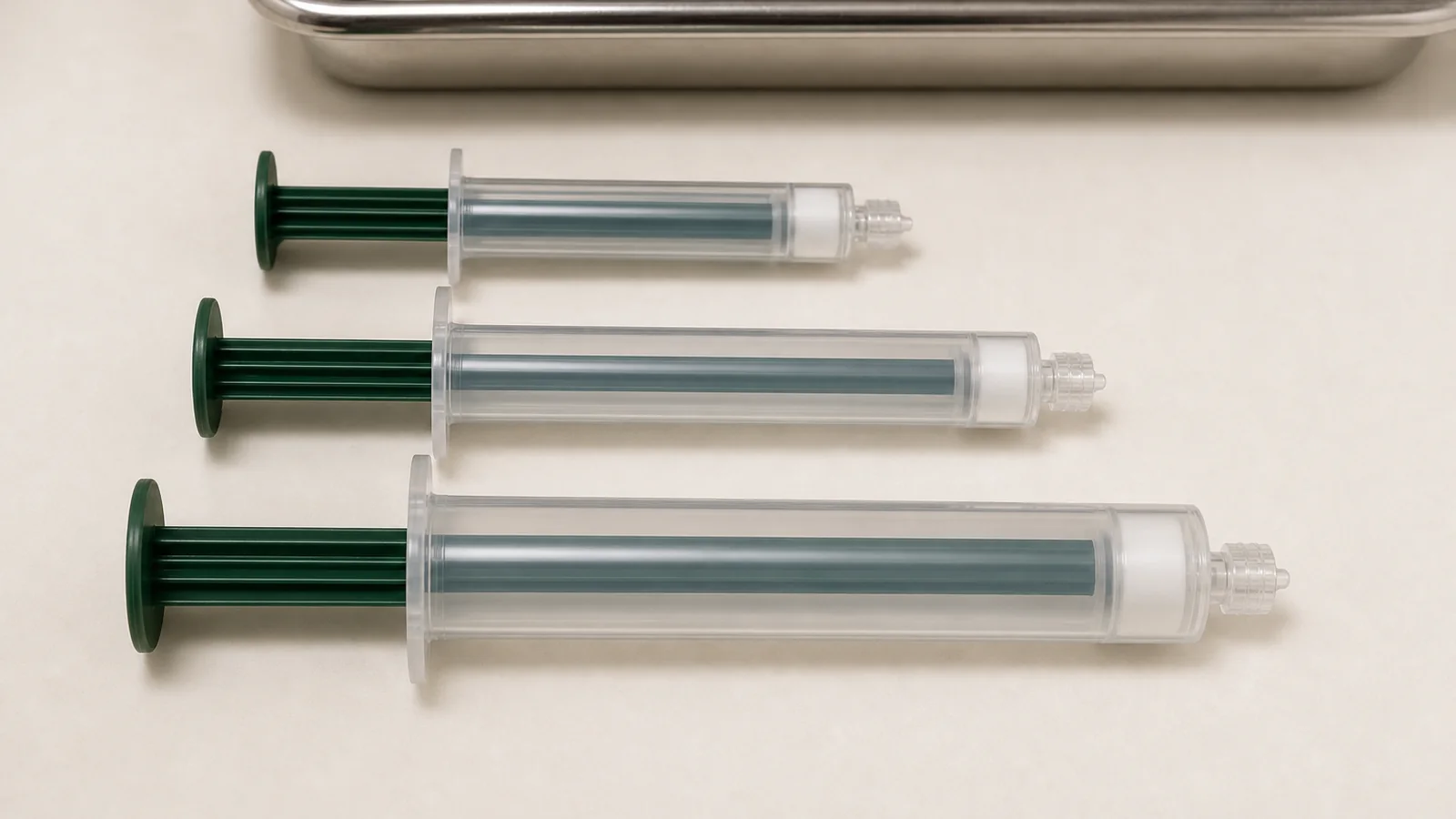
Sterile hypodermic syringes represent one of the most ubiquitous and critical consumable categories across hospital wards, surgical suites, ambulatory clinics, and compounding facilities. However, tender specifications and hospital purchasing files frequently suffer from specification ambiguity: confusing general manual syringes with specialized insulin or pump syringes, failing to distinguish auto-disable reuse prevention from needlestick safety shields, or relying on promotional vendor rankings rather than verifiable technical consensus standards.
Hospital buyers must specify empty sterile manual piston syringes by regulation, ISO edition, labeled volume and connector, and optional safety or reuse-prevention feature—without ranking factories and without converting volume SKUs into dosing advice.
Identify the empty sterile manual piston syringe
In the United States, disposable manual syringes are governed by Title 21 of the Code of Federal Regulations, 21 CFR 880.5860 (Piston syringe). The regulation defines the device as a Class II (performance standards) instrument consisting of a calibrated hollow barrel and a movable plunger with a male nozzle at the distal end, designed to mate with the female hub of a hypodermic single-lumen needle or intravascular connector.
FDA classification divides piston syringes into two primary product codes based on safety architecture:
Product Code FMF (Piston Syringe): Standard, conventional single-use manual piston syringes without dedicated sharps-injury prevention mechanisms.
Product Code MEG (Syringe, Antistick): Piston syringes engineered with integral or add-on sharps-injury prevention mechanisms (such as active locking shields, sheaths, or needle-retraction assemblies) under 21 CFR 880.5860.
When evaluating combined offerings (e.g., a syringe pre-packaged with a detachable needle), public 510(k) clearances (such as K241821) bundle the piston syringe (FMF/MEG) with the hypodermic needle regulation (21 CFR 880.5570, Product Code FMI). Procurement specifications should clearly indicate whether the line item requires an unattached syringe barrel or a matched syringe-needle combination.
graph TD
  A["Syringe Procurement Need"] --> B{"Required Safety Feature"}
  B -->|"Standard Manual Aspiration/Injection"| C["Conventional Piston Syringe<br/>21 CFR 880.5860 (FMF)<br/>ISO 7886-1:2017 Standard Core"]
  B -->|"Sharps Needlestick Prevention"| D["Antistick Safety Syringe<br/>21 CFR 880.5860 (MEG)<br/>ISO 23908:2024 Shielding / Retraction"]
  B -->|"Single-Use Immunization / Anti-Reuse"| E["Auto-Disable Syringe<br/>ISO 7886-4:2018 Mechanism<br/>Plunger Lock / Breakable Stem"]
B -->|"Specialized / Motorized Devices"| F["Excluded from ISO 7886-1 Core<br/>Insulin (ISO 8537) / Pump (ISO 7886-2)"]Bound the ISO 7886-1 core: what this page is not
The global foundational standard for manual hypodermic syringes is ISO 7886-1:2017 (Sterile hypodermic syringes for single use — Part 1: Syringes for manual use), which is recognized in full by the FDA (Recognition Number 6-404).
ISO 7886-1:2017 specifies requirements and test methods for verifying the design of empty sterile single-use hypodermic syringes, with or without needle, intended for aspiration and injection of fluids after filling by the end user. The public catalog states that the standard does not provide lot-release requirements and is intended for use immediately after filling, not for containing medicament for extended periods.
Public scope — design verification, not lot release: ISO 7886-1 is a design-verification standard. Do not reprint paywalled leakage, dead-space, or glide-force numeric limits from the clause text or from test-lab marketing pages.
Immediate use after filling: The syringe is intended to be filled by the end user and used immediately. It is not a prefilled or stored-after-filling device.
Needles, if supplied separately: Syringes without a needle are intended for use with hypodermic needles specified in ISO 7864. Do not turn this page into a combined needle-SKU chart.
Edition must be dated: ISO 7886-1:2017 remains the published edition FDA recognizes (6-404). ISO/FDIS 7886-1 is in approval and will replace the 2017 edition; do not write as if 2017 were already withdrawn.
Furthermore, ISO 7886-1 explicitly notes that syringes supplied without a needle are designed to mate with hypodermic needles conforming to ISO 7864 (see our companion guide on hypodermic needle gauge and length specifications).
Specify volume, graduation, and connector as labeled fields
A complete purchase specification must establish precise parameters for the syringe barrel, volumetric scale, and distal nozzle connector:
| Specification Parameter | Technical Standard / Requirement | Procurement Guidance & Criteria |
|---|---|---|
| Nominal Capacity (Volume) | ISO 7886-1 Designated Volumes | Specify the labeled graduated capacity. Catalog availability of common millilitre sizes is not an ISO requirement and is not a clinical recommendation. |
| Scale & Graduation Markings | Labeled calibrated barrel | Specify that the barrel is calibrated and that graduation marks are labeled. Do not reconstruct paywalled increment tables or treat a volume SKU as a dose. |
| Barrel Transparency | Labeled barrel construction | Barrel transparency sufficient to inspect contents is a labeled/design attribute. Do not specify polypropylene, or any other polymer, as if ISO 7886-1 required it. |
| Plunger & Piston Seal | Labeled plunger construction | Specify two-piece or three-piece construction as labeled. Latex status of the stopper is a labeling field, not an ISO 7886-1 latex-free mandate. |
| Dead Space Volume | Labeled dead-space claim | Specify standard versus low-dead-space as a labeled configuration. Do not convert dead space into a per-injection savings figure or a dosing instruction. |
| Distal Connector Nozzle | ISO 80369-7:2021 | Specify Male Luer Lock (threaded collar for secure positive locking) or Male Luer Slip (friction taper). Center vs eccentric tip for larger capacities. |
Low-dead-space geometry, if claimed, is a labeled configuration of the empty syringe. It is not a clinical dosing recommendation, a vaccine-program mandate, or a cost-savings benchmark.
Separate reuse-prevention from sharps-injury protection
Significant confusion persists between syringes engineered to prevent illicit re-use and syringes designed to protect healthcare personnel from contaminated sharps injuries. These represent two distinct engineering and clinical objectives:
| Attribute | Reuse-Prevention Syringes (ISO 7886-4) | Sharps-Injury Protection Syringes (ISO 23908) |
|---|---|---|
| Primary Objective | Prevent subsequent reuse of the syringe after delivering a single dose. | Prevent accidental needlestick punctures to healthcare workers post-injection. |
| Governing Standard | ISO 7886-4:2018 | ISO 23908:2024 (replacing ISO 23908:2011) |
| FDA Product Code | Typically categorized under FMF (or special auto-disable codes) | FDA Product Code MEG (Antistick Syringe) |
| Typical Mechanism | Internal locking clips that break the plunger rod or lock the piston upon complete discharge. | Hinged needle shields, sliding barrier sheaths, or spring-loaded needle retraction into the barrel. |
| Standard Scope Note | ISO 7886-4 explicitly states that anti-needlestick properties are NOT in themselves addressed in Part 4. | ISO 23908 specifies requirements and test methods for sharps-injury protection mechanisms on single-use sharps after intended use. Name the edition on the label. |
Buyers must specify whether the line item is an ordinary piston syringe (FMF), an antistick syringe (MEG / ISO 23908), a reuse-prevention syringe (ISO 7886-4), or a combination. Those are different claims. ISO 7886-4's public note states that anti-needlestick properties are not in themselves addressed in that part.
Name the ISO edition and the 510(k), not the factory rank
When issuing tenders, purchasing directors should avoid citing undated standards or relying on subjective supplier claims. Sourcing specifications should incorporate the following rigorous verification criteria:
Standard Edition Dating: Specify ISO 7886-1:2017 explicitly. Buyers should note that ISO/FDIS 7886-1 is currently in development in the final approval phase. Once the third edition is officially published, procurement templates should be updated accordingly.
510(k) Premarket Clearance: Require suppliers to submit the official FDA 510(k) clearance letter and summary for Product Code FMF or MEG under 21 CFR 880.5860.
Sterility Assurance and Biocompatibility: Mandate labeled sterile single-use packaging and the 510(k) identity. Do not invent a numeric sterility-assurance value or cite unsourced sterilization-standard clauses as if they were ISO 7886-1.
Material Safety Disclosures: Require labeled plasticizer and latex status where those claims are made. Do not treat DEHP-free or latex-free marketing language as a substitute for 21 CFR 880.5860 identity and the dated ISO 7886-1 edition.
Reject Factory Rankings: Tender specifications must evaluate documented compliance with ISO 7886-1, ISO 80369-7, and 21 CFR 880.5860 rather than subjective manufacturer awards or unverified marketing claims.
For related fluid delivery and vascular access consumables, consult our guides on hypodermic needle gauge and length specifications and IV administration sets.