
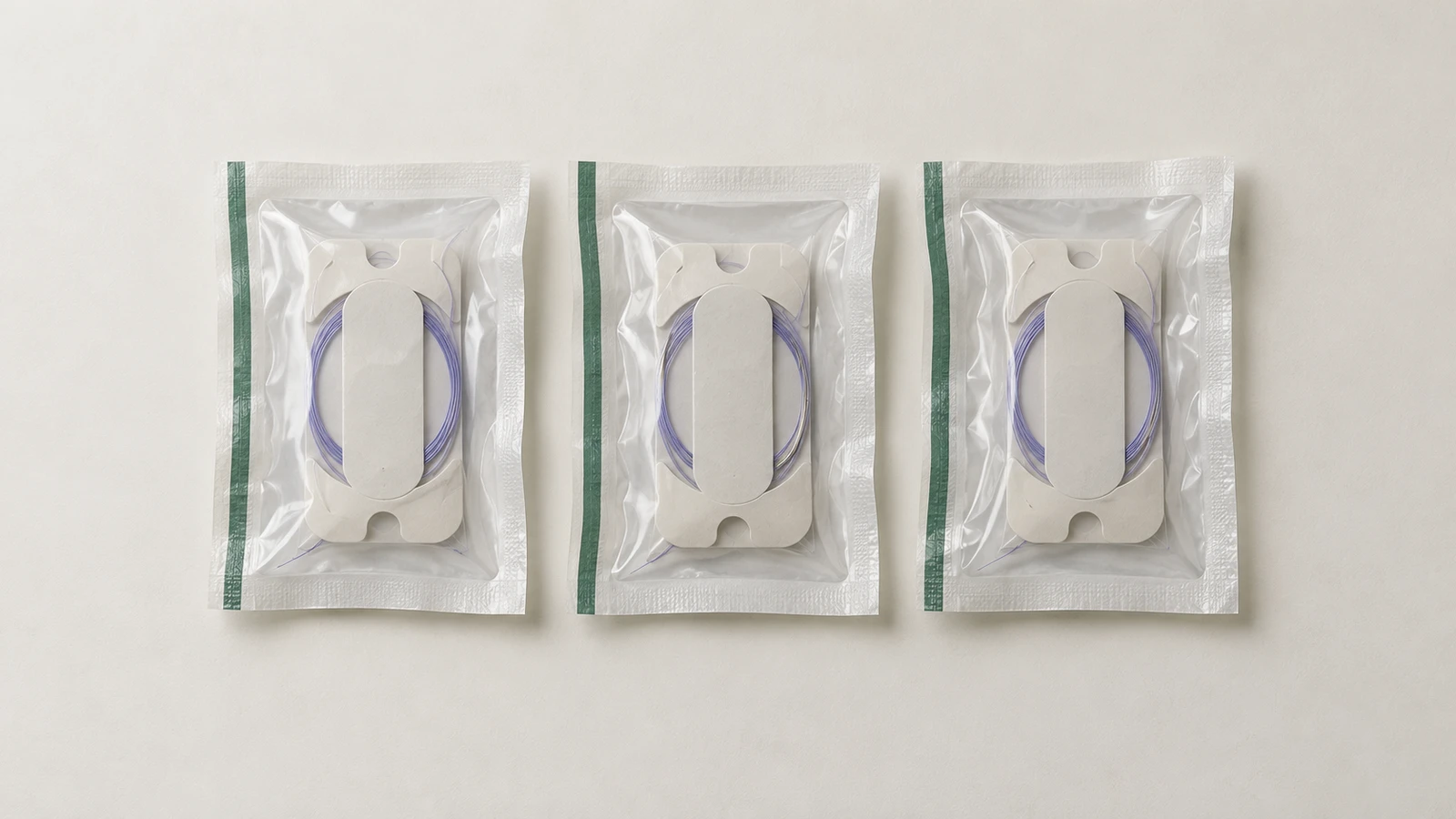
Before treating a quoted suture pack as a substitute, record the strand material, labeled size and length separately from the needle point, curvature and length. Add the exact manufacturer order code and box quantity. A description such as “absorbable 3-0, PS-2-type needle, 12 per box” leaves too much unresolved: “absorbable” does not identify the polymer, and a familiar needle name does not document the geometry. Keep missing fields marked unknown and ask for evidence tied to the proposed SKU.
Start with the strand material and regulatory record
Material is an important classification starting point, rather than a complete regulatory determination. FDA’s GAM record identifies an absorbable synthetic polyglycolic acid suture under 21 CFR 878.4493; its NEW record identifies a polydioxanone suture under 21 CFR 878.4840. Both list Class II and 510(k). Ask the supplier to connect its actual device and labeling to the relevant record. A shared product code alone cannot establish a SKU match.
The text of 21 CFR 878.4493 describes a sterile flexible strand that meets the USP absorbable-suture monograph and can be supplied with or without a standard attached needle. This supports recording strand and needle specifications separately. It does not mean that the needle is unregulated or that strand material alone settles every classification question.
These two classification examples are directly documented in the FDA records linked above. They are starting points for checking a supplier’s claim, rather than a complete material-to-code map:
| Verified classification example | 21 CFR section | Product code |
|---|---|---|
| Absorbable synthetic polyglycolic acid | 878.4493 | GAM |
| Absorbable polydioxanone | 878.4840 | NEW |
FDA’s April 2022 performance-criteria guidance describes an optional pathway and contains nonbinding recommendations. Its exclusions include gut, recombinant PHB, chordae-repair ePTFE, drug-containing sutures, atypical designs such as barbs or anchors, and novel sterilization methods. Do not extend its table to an unlisted material or design. A change in design calls for a separate assessment; it does not by itself prove that the intended use has changed.
Keep USP size, metric size and strand length separate
USP size describes the strand, rather than the needle. The FDA classification records above list USP <861> Sutures – Diameter and <881> Tensile Strength among recognized standards. In a comparison worksheet, write the size designation exactly as labeled, then record the metric designation in a separate cell when supplied. A missing metric value is an open question, even when another product with the same USP designation provides one.
Dolphin’s sizing guide explains metric sizing in tenths of a millimetre and shows different collagen and synthetic columns at the same USP designation. It is a manufacturer’s explanatory chart. This guide does not reproduce its numerical diameter limits as current USP acceptance criteria: the applicable compendial edition and material table need confirmation before those limits become part of a purchase specification.
Treat a supplier’s metric entry as a documented label claim, rather than a value calculated from the USP name. Ask which material table and edition support the declaration. The same worksheet should distinguish a size that is absent from a search result from a size that is genuinely absent from the product’s labeling. Those are different evidence gaps, and only the supplier’s current documentation can close the latter.
Record strand length independently, with its unit. Do not silently convert an unexplained catalog number into centimetres or inches. A shorter strand and a different box count change the commercial comparison, but those changes do not prove a clinical advantage or disadvantage. Confirm the required product configuration first; then compare the acquisition price using a consistent purchasing unit.
Specify the needle geometry before comparing its code
Corza’s needle terminology guide distinguishes point, body, wire diameter, swage and included angle. The swage is the connection between needle and strand. Capture these three geometry fields before relying on a cross-reference:
Point type: copy the manufacturer’s description, such as reverse cutting, conventional cutting or taper point. Preserve distinctions such as “precision” or “premium” rather than assuming that similarly named variants have identical construction.
Curvature: record the stated circle fraction or special shape. A 3/8-circle designation describes an included angle of 135 degrees; 1/2 circle describes 180 degrees. Keep any separately stated angle with the record.
Needle length: record millimetres measured along the needle circumference from point to swage. This is a different measurement from the straight-line distance between those endpoints.
The Medtronic technical sheet, © 2025 lists reverse-cutting 3/8-circle needles C-1 at 12 mm, C-13 at 19 mm and C-14 at 24 mm. Its needle-alloy information is another reminder that point, curvature and length are not a complete mechanical performance specification. Use current product documentation for any additional required properties.
One limited cross-reference illustrates why the manufacturer name belongs beside the code:
| Source and code | Point type | Curvature | Listed length |
|---|---|---|---|
| Corza chart: Ethicon FS-2 | Reverse cutting | 3/8 circle | 19 mm |
| Medtronic technical sheet: Covidien C-13 | Reverse cutting | 3/8 circle | 19 mm |
These entries agree on the listed geometry. The Corza conversion page helps a buyer locate a candidate, but the mapping does not establish matching wire diameter, alloy, coating, attachment performance or complete-pack identity. Request documentation for the actual proposed order code. The Ethicon needle diagram, © 2015 illustrates needle families; its age makes it unsuitable as the sole evidence for a current SKU.
Check the connection between strand and needle
Needle attachment is a separate evidence field. The GAM and NEW classification pages list USP <871> Sutures – Needle Attachment among recognized standards. A quote that describes both components still needs evidence for the connection between them. Ask which attachment design is supplied, which standard edition is claimed and how the supplier documents conformity for that product.
For supplier qualification, agree whether a conformity statement, a test summary or lot-linked release documentation will satisfy your purchasing controls. Put the required record and its traceability in the quality agreement. Do not describe a batch certificate as a universal FDA purchasing requirement, and do not assume that a certificate covers an order code merely because it carries the same brand name.
Use a quote sheet that keeps unknowns visible
Use the following nine columns as the starting worksheet. Keep the needle name alongside the manufacturer order code so that the two identifiers cannot be confused. Add a reference to the dated catalog or supplier document behind every completed field. An internal item number can help reconciliation, but it should not replace the manufacturer’s identity.
These are observations from the Ethicon EMEA MONOCRYL catalog page, checked for this review on October 17, 2026. “Unknown” means the observed listing does not state the value. The page gives strand-length numbers without an explicit unit in these rows, so the worksheet preserves that limitation. Regional catalog availability also needs confirmation for the intended market.
| Order code / needle name | Strand polymer | USP size | Metric size | Strand length as displayed | Needle point | Curvature | Needle length | Quantity / box |
|---|---|---|---|---|---|---|---|---|
| Ethicon T4230H / needle name unknown | Poliglecaprone 25 | 1 | Unknown | 90; unit unstated | Taper point | 1/2 circle | 36 mm | 36 |
| Ethicon C390 / C-3 | Poliglecaprone 25 | Unknown | Unknown | 70; unit unstated | Unknown | Unknown | Unknown | 36 |
| Ethicon W3215 / P-3 | Poliglecaprone 25 | Unknown | Unknown | 45; unit unstated | Unknown | Unknown | Unknown | 12 |
The useful result is the gap list. C390 and W3215 cannot be compared on strand size or complete needle geometry from this page alone. T4230H has more populated fields, yet its metric size and the strand-length unit still need confirmation. A needle code shown in a neighboring row or another manufacturer’s chart does not fill those cells.
Apply the same rule to the opening quotation. Ask for the exact polymer and order code, current label or technical sheet, metric size if claimed, strand length with units, needle point, curvature and length, and box quantity. Keep the quote pending while a required field remains unknown. Once supplied, record the source and date rather than overwriting the gap without a trace.
For a hypothetical geometry comparison, suppose two supplier sheets document the same strand polymer, USP size, metric size, strand length, point type and box quantity. Sheet A lists a 3/8-circle needle; Sheet B lists a 1/2-circle needle. The completed worksheet identifies a geometry difference even if the marketing descriptions call both products the same “type.” Refer that difference for the institution’s substitution decision instead of treating it as an exact match.
Only after the required configuration is established should price enter the comparison. In a fictional example, a $360 box containing 36 individually packed sutures costs $10 per packet. A $156 box containing 12 costs $13 per packet: the lower box price is a 30% higher packet price. That arithmetic describes the purchase unit; it provides no evidence of product equivalence or procedural value.
Request evidence tied to the proposed pack
Use a short evidence request that names the unresolved fields, the exact proposed order code and the decision you need to make. Asking for a generic compliance folder can produce a large file without resolving the quotation. The following sequence keeps the request specific:
Identity and configuration: obtain the current label or technical sheet, manufacturer order code, strand fields, needle fields and pack quantity. Reconcile any disagreement with the quotation before transferring values into the item master.
Regulatory connection: ask the supplier to identify the relevant clearance and explain how the proposed configuration is covered. Compare its intended use and device description with the offered product, rather than treating a classification record as a product-specific clearance.
Conformity evidence: identify the applicable diameter, tensile-strength and needle-attachment standards, their editions, and the records supporting the supplier’s claims. Agree which release documents will accompany orders and how they link to the supplied product.
Sterility and shelf life: request the labeled sterilization method, sterile-barrier description and shelf-life evidence covering that configuration. Confirm that the evidence concerns both the packaging and the device properties needed over the labeled life.
Change control: agree which changes require notification and which documents must be updated. Choose a notice period in the purchasing or quality agreement that supports your review process; do not assume a universal 90-day requirement.
For a concrete example of regulatory documentation, FDA K171039 describes FilBloc Permanent polypropylene sutures in various thread sizes, with or without barbs and with or without various needle shapes and sizes. It illustrates how a device description records configurations. The barbed versions fall outside the 2022 performance-criteria guidance’s scope; this clearance neither validates an unrelated supplier’s SKU nor establishes eligibility for that pathway.
Read an aging claim carefully. The 2022 FDA guidance names ISO 11607-1/-2 for packaging and ASTM F1980 for accelerated aging, and recommends real-time confirmation for polymeric sutures. An accelerated-aging reference alone does not establish every device property. Ask which aged-product results support the stated shelf life, rather than accepting the standard number as the entire conclusion.
Our guide to supplier quality agreements addresses the separate purchasing decision of allocating evidence and change-notification responsibilities. Use the completed suture worksheet to make those responsibilities specific to the product being purchased.
Keep the comparison within its evidence
This sheet organizes procurement evidence. It does not choose a needle for a tissue, prescribe a technique or predict handling from catalog dimensions. A fully populated row is a documented candidate for the institution’s evaluation, rather than an automatic substitution authorization. Record differences as well as matches, and keep the responsible evaluation decision with the evidence.
Manufacturer pages are snapshots and may omit fields that appear elsewhere on a current label. USP numerical tables are edition-dependent; a manufacturer’s educational chart is not a substitute for confirming the applicable compendial criteria. Special designs and materials outside the FDA guidance’s scope need their own assessment. These limits leave the worksheet useful: it shows exactly what the available evidence establishes and what the supplier still needs to resolve.
Related buying decisions have their own specifications: hypodermic needle gauges, filter and blunt-fill needles, scalpel fitment and sharps containers. Keep those device families separate from suture-pack comparisons.