
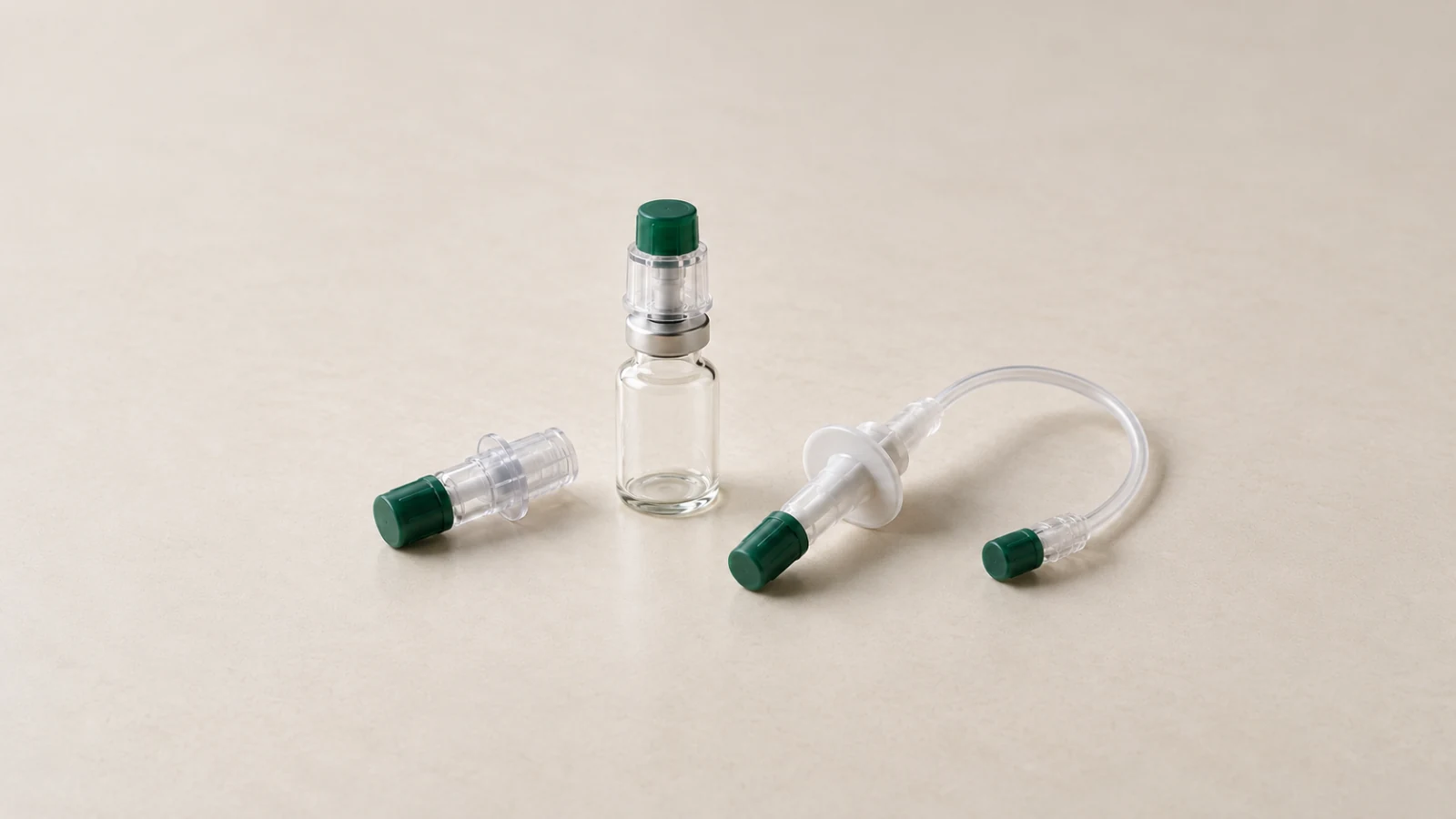
A backorder can leave pharmacy with one closed-system drug-transfer device (CSTD) platform and nursing with adapters from another. Before accepting a replacement, identify the two components that will meet at each transfer connection. Keep those connections within the manufacturer-documented system and generation; verify the drug formulation separately. Standard syringe and IV-set interfaces do not establish that two CSTD transfer ports form a validated closed connection.
This guide helps hospital buyers, distributors and supplier-quality teams review that substitution. Its crosswalk identifies component families and selected catalog names, then turns the evidence into an order-review worksheet. It is a starting point for confirming the exact configuration with the supplier, rather than a list of universally compatible pairs.
Map the vial, syringe and bag components before ordering
The manufacturer pages below were checked on October 16, 2026. Read each row as a separate product listing. Names and connection descriptions identify the portfolio; they do not establish comparative containment performance or authorize every possible combination of its parts.
| Product listing and source | Vial access | Syringe-side transfer | Bag or administration-line components | Documented connection description |
|---|---|---|---|---|
| BD PhaSeal Optima — BD | Protector P13-O, P20-O, P28-O | Injector N35-O, N40-O | Infusion Adapter C100-O; Infusion Connector C35-O; Spike Set C180-O; Connecting Set C83-O | Straight-push connection; collet-style fitting in K181221. Confirm the specified mate for each component. |
| ChemoLock — ICU Medical | ChemoLock vial spikes; universal vial-spike option | ChemoLock Injector | Bag Spikes CL-10/CL-14; ChemoLock Port CL2100; bonded administration sets | Membrane-to-membrane technology; audible connection click. Injector guides distinguish syringe and administration-set attachment. |
| EQUASHIELD — spike-adaptor page | Vial Adaptors family; exact SKU to confirm | Syringe Units family; exact SKU to confirm | Spike Adaptors SA-EZ, SA-EZ/D, SA-180, SA-EZ/W | Page describes a sliding connection to other EQUASHIELD components. Its EZ tubing lock addresses tubing retention. |
| Chemfort — Simplivia | Chemfort Vial Adaptor | Syringe Adaptor (SA); Syringe Adaptor Lock (SAL) | Luer Lock Adaptor; Bag Adaptor CP; Closed Adaptor SP; Closed Y Inline Set; Closed Secondary IV Set | SA/SAL click to Chemfort components; self-sealing elastomers provide the described dry disconnection. |
| OnGuard 2 — B. Braun | OnGuard 2 Vial Adaptor | Syringe Adaptor; Syringe Adaptor Lock | Bag Adaptor Spike Port; Luer Lock Adaptor | Page describes a click connection to other OnGuard 2 components and a membrane-to-membrane dry disconnect. |
Use the table to find gaps in a quotation. A syringe adapter alone does not answer which vial adapter, bag connection or line-side port the facility must stock. Some suppliers offer bonded sets, while others list individual components. Record the actual configuration and packaging unit instead of treating every row as a three-piece kit. The listed bag and line products may serve different configurations; they are not all required together.
There are deliberate limits to the detail here. The EQUASHIELD page names the Vial Adaptors and Syringe Units families in its product navigation, but the detailed specifications on that page concern spike adaptors. Exact vial and syringe models therefore need supplier confirmation. Its SA-1J bottle variant is marked unavailable in the US and is excluded from this US-focused comparison. Similar component names across Chemfort and OnGuard 2 do not establish cross-catalog pairing permission or five independent connector technologies.
Record the product generation as well as the brand
The FDA-hosted K181221 summary provides a concrete generation comparison. Both BD systems include Protector, Injector, Connector and Infusion Adapter devices, but the summary documents a change in how their internal mating interfaces connect.
| BD system in K181221 | Connection action | In-system fitting |
|---|---|---|
| Earlier PhaSeal predicate, K123213 | Push-turn-push | Bayonet fitting with elastomeric double membranes |
| PhaSeal Optima subject device | Push on–pull off | Collet-style fitting with elastomeric double membranes |
The summary also lists luer-lock syringe interfaces and luer-lock or spike-port patient-line interfaces. Familiar boundary connections coexist with different in-system fittings. Record the generation and mating part; this comparison does not test mixed-generation pairs or establish that every attempted mixed connection leaks.
BD’s current portfolio page also names compatible mating components for its Spike Set and Connecting Set. That is more useful than a broad statement that an item “fits standard IV equipment.” Ask the supplier to identify both ends of the proposed replacement: the standard equipment interface and the in-system CSTD mate. If the answer only addresses the first, the pairing question remains open.
Older Oncology Nursing News practice guidance cautions against interchanging parts from different systems. For a current order, use that caution as a prompt to obtain the applicable manufacturer documentation, rather than treating an older educational article as a product-specific compatibility certificate. A common distributor, similar color or audible click does not supply the missing evidence.
Separate USP requirements from purchasing assumptions
USP’s January 21, 2026 FAQ distinguishes the CSTD recommendation for compounding from the requirement for administering NIOSH Table 1 antineoplastic hazardous drugs when the dosage form allows. FAQs 44–45 also require attention to physical and chemical compatibility.
| Activity or condition | USP CSTD position |
|---|---|
| Compounding hazardous drugs | Recommended when the dosage form allows; not required by the CSTD provision. |
| Administering NIOSH Table 1 antineoplastic hazardous drugs | Required when the dosage form allows. |
| Known physical or chemical incompatibility with the specific hazardous drug | The incompatible CSTD must not be used for that drug. |
Section 5.4 of the official 2019 revision bulletin states that a CSTD cannot replace a containment primary engineering control (C-PEC) during compounding. It also calls for careful evaluation of performance claims using independent peer-reviewed studies and demonstrated contamination reduction while a universal containment standard is unavailable. Buying the device does not replace the facility’s broader containment program.
The FAQ dates compendial applicability to November 1, 2023, to the extent <795> and <797> apply. It supplies informational support, not an official interpretation or proof of compliance. The 2019 bulletin is historical text.
Read clearance and containment evidence at the right scope
FDA’s ONB classification record identifies a Class II closed antineoplastic and hazardous drug reconstitution and transfer system, with 510(k) submission type under 21 CFR 880.5440. “Cleared” is the appropriate term here. Sharing this product code does not establish that two systems’ components are interchangeable. The classification entry does not provide a universal containment threshold.
Clearance should not be dismissed as an absence of testing. K181221 reports airtightness and leakproofness tests, among other performance evidence supporting substantial equivalence. Those results concern the submitted system. They do not validate an assembly made by substituting unrelated components or demonstrate compatibility with every commercial drug formulation.
The NIOSH Docket 288 archive describes a draft vapor-containment protocol using isopropyl alcohol and physical-barrier devices. It explicitly says the protocol was not intended for air-cleaning technologies and that NIOSH did not propose a specific pass/fail threshold. The archive is dated March 2016; it is not a current product endorsement.
USP’s January 2026 FAQ reports that neither the initial barrier-type protocol nor the subsequent universal protocol had been finalized. A supplier’s claim to have passed a draft protocol therefore needs the test version, conditions and acceptance criterion. Do not translate it into a claim of federal certification or use it alone to rank competing systems.
Check the commercial drug formulation separately
FDA’s 2015 Treanda safety communication concerns Treanda Injection solution containing N,N-dimethylacetamide (DMA), which is incompatible with polycarbonate and ABS. It distinguishes that solution from the lyophilized formulation. The original notice reports 40 complaints received by Teva, involving leaks, breakage, operational failures or cloudiness/particles in IV bags. These are complaint reports, not an incidence rate or 40 confirmed adverse events.
The September 2015 update lists manufacturer-tested components including the earlier PhaSeal Protector P14, Injector N35 and Infusion Adapter C100. It also distinguishes concentrated transfer from the diluted infusion stage. Do not carry those historical results over to Optima part numbers, other formulations or revised materials. FDA specifically advises checking with manufacturers for material changes. For a purchasing file, the useful lesson is to retain the formulation, component identity and conditions behind a compatibility statement.
A 2021 PLOS ONE study by Chiang and colleagues tested the Needleless DualGuard system with ten antineoplastic drugs under simulated clinical conditions. It reported DINP migration from administration adaptors with paclitaxel and concentrated etoposide, cracks with melphalan, and white particles with busulfan. These findings concern that system and the tested formulations, not every CSTD brand. The authors emphasize testing commercial formulations rather than bulk active ingredients alone.
Translate that evidence into a specific supplier question: “Does this report cover our commercial formulation, the proposed component materials, concentration and contact conditions?” A drug name alone leaves important variables unspecified. A statement about one part also leaves the other fluid-contact components unaddressed. Pharmacy and supplier quality should identify these gaps before a substitution is released; the buyer should not invent an exposure limit or choose a replacement therapy from this article.
Build a reviewable substitution record
The worksheet below is a procurement recommendation derived from the pairing and formulation evidence. It is not an additional USP requirement. Use it to make a supplier response reviewable by the people responsible for the facility’s drug-handling pathway. A proposed order should identify what changes, what mates with it and what evidence supports that exact configuration.
| Field to record | Evidence or answer to request | Reason to keep the proposed substitution pending |
|---|---|---|
| System, generation and catalog identity | Manufacturer, product family, exact REF/SKU and intended market for the old and proposed item | Only a generic “CSTD adapter” description is supplied. |
| Two mating components at each transfer junction | Applicable instructions or a written manufacturer pairing statement identifying both parts | Evidence covers a luer boundary but not the in-system transfer connection. |
| Vial and container interfaces | Labeled vial-closure and bag/line configuration for the ordered variant | A family name is supplied without the relevant size or port configuration. |
| Drug-formulation scope | Compatibility statement identifying formulation, components and tested contact conditions | Evidence covers another formulation, generation or material. |
| Inventory and implementation | List of affected pharmacy and nursing stock, bonded sets, packaging quantities and transition owner | The new syringe-side item arrives without the matching downstream parts. |
Keep the evidence beside the item-master record, rather than only in a sales email. Record the document revision or date, the component pair it supports and who reviewed the proposed change. If the supplier supplies a broad family brochure, ask which part of it applies to the quoted catalog number. When the evidence is incomplete, record the exact gap so the next reviewer does not mistake an unanswered question for approval.
Stock planning should follow the facility’s documented configuration and usage. There is no universal 1:1 purchasing ratio between vial adapters, syringe adapters and bag adapters in these sources. Multi-vial preparations, bonded sets and different administration configurations change the quantities needed. Have pharmacy and nursing reconcile the component demand and packaging units before setting reorder levels. A complete pathway matters more than equal carton counts.
During a transition, identify where each generation remains in use and how the matching parts will be distinguished. Plan pharmacy and nursing availability together. Segregate unsupported substitutions from routine replenishment and have the facility’s responsible team review them. An instruction to discard all earlier stock immediately is not justified by a connector design comparison alone; the transition plan needs to account for the matched configurations still supported.
For contract wording and change notification, the site’s supplier quality agreement guide covers the wider purchasing process. Its IV administration-set guide and non-PVC IV tubing guide address adjacent set and material specifications. Those decisions complement the CSTD review without establishing CSTD interchangeability.
Keep the conclusion within the evidence
The decision is whether the proposed component belongs to a documented mating configuration and has formulation-specific support. This crosswalk supplies names and evidence boundaries for that review; it provides no cross-brand approval, containment ranking, price comparison or clinical administration technique. Manufacturer pages establish their own portfolio descriptions. Historical safety notices and a single-system laboratory study explain why a general category claim is insufficient. Re-check the applicable instructions and evidence whenever the component, generation, formulation or supplier proposal changes.