
The Direct Answer: Match the Filter to the System You Already Own
When an operating-room fleet mixes a Medtronic RapidVac console, Stryker Neptune 3 rovers and a CONMED smoke evacuator, finance and value-analysis teams often ask whether smoke-evacuation filters can be consolidated under one generic "ULPA smoke filter" contract line. The procurement answer is no. Each evacuator family is sold with its own replacement filter, listed under its own order code, with a manufacturer-defined filter life and its own connection points for tubing and fluid traps. Personal respiratory protection, covered in our buyer comparison of ASTM F2100 surgical masks versus NIOSH N95 respirators, is a wearer-side decision. Evacuator filters are machine-side consumables that must physically and functionally match the console they go into.
Across the US documentation checked for this guide (accessed October 15, 2026), the OEM pairings are:
Medtronic (Covidien) RapidVac (`SE3690`, 110 V): the Medtronic US RapidVac page lists the
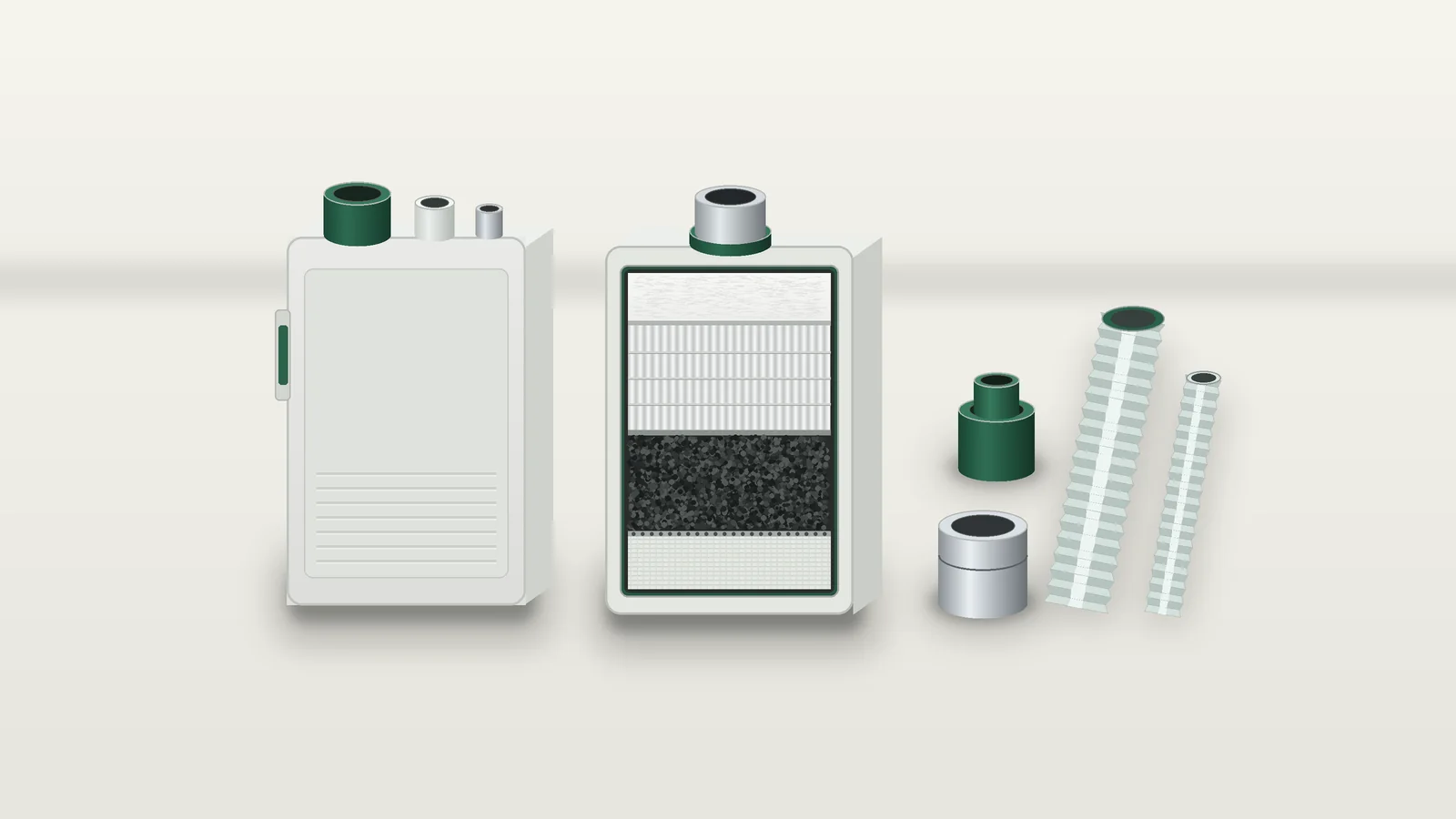
SEA3700RapidVac ULPA filter (2 per box) and describes it as a four-stage filter with no pre-filter needed. FDA 510(k) K142335 cleared theSE3690system with a four-stage filter (prefilter, ULPA-grade filter, virgin activated carbon, woven fiberglass) and a stated 25-hour filter life. Medtronic sells 1/4-inch, 3/8-inch and 7/8-inch smoke tubing that it describes as connecting to the ULPA filter, and states that theRVFT10fluid trap connects to the filter's 7/8-inch port.Stryker Neptune 3 Waste Management System (rover `0703-001-000`): the integrated smoke evacuator uses smoke evacuator ULPA filter
0702-040-000(4 per pack) in both the 2015 Rev C Neptune 3 instructions for use and Stryker's 2021 Neptune family part number brochure. FDA 510(k) K153407 and the Stryker Neptune 3 page both state an 80-hour ULPA filter life. Stryker's standalone SafeAir Compact evacuator (0703-045-000) is a separate system with its own ULPA filter (0703-040-000) and fluid trap (0703-040-001).CONMED (Buffalo Filter) VisiClear (`VC120`), ViroVac (`VV120`) and PlumeSafe X5 (`PX5-120`): the CONMED smoke evacuators and filters catalog lists ViroSafe
VS135as the VisiClear filter;VS353,VS35302andVS35304as ViroVac filters (ViroVac is marketed with "variable filter life up to 35 hours" and a three-port filter); andPX5-135-22(single) andPX5-1354-22(four) as PlumeSafe X5 filters carrying a 22 mm designation. The same table lists extra-long-life ViroSafe filters (VSXLL02,VSXLL04and theVSXLLT02twin-port filter) without naming a host system on the page, so confirm fitment before treating them as alternates.
A distributor or group purchasing contract can bundle several OEM filter SKUs, but consolidating onto one filter manufacturer requires that manufacturer to list filters for other makers' consoles. Among the primary sources reviewed here, CONMED is the one manufacturer that does: it lists VSNEP04 for Stryker Neptune 2 and Neptune 3, VSSV301/VSSV304 for StrykeVac 3, BTLDXS04 for Berchtold Phoenix XS/X3 and VSTR0804 for TRUMPF EasyVac. Before approving any SKU addition or substitution, close three gates: (1) the exact REF matches the current console instructions for use (IFU) or the supplier's written fitment list; (2) the rated filter life and the way the console tracks it are understood; and (3) the filter's connection points match the tubing, wands and traps already in stock, and its efficiency claim states a test basis.
What You Are Buying, Regulatorily: Class II FYD Systems and Class I Accessories
A smoke-evacuation consumables tender usually spans more than one FDA category. The bill of materials can include Class II evacuator systems and their replacement filters, Class II electrosurgical pencils with built-in smoke capture, and accessory items of the kind FDA classifies as Class I. Separating these layers keeps item-master records, UDI capture and complaint routing accurate.
21 CFR 878.5070 identifies an "air-handling apparatus for a surgical operating room" as a device that produces a directed, nonturbulent flow of filtered air, and places it in Class II (special controls). The only premarket-notification exemption in the current text covers air-handling bench, room and enclosure apparatus. Smoke evacuators are not named in the regulation's wording; their placement under it comes from FDA clearance records, which assign product code FYD:
Stand-alone smoke evacuator (`K142335`): 510(k) No. K142335, with a decision letter dated January 14, 2015, cleared Covidien's RapidVac Smoke Evacuator System (
SE3690) under 21 CFR 878.5070, Class II, product codeFYD, to remove and filter smoke and aerosols produced during electrosurgical and laser procedures. Its predicates were the Buffalo Filter VisiClear (K131402) and the Valleylab OptiMumm (K980915). The summary describes the four-stage filter and filter-life verification testing; theSEA3700order code comes from Medtronic's catalog, not from the 510(k).Combined fluid-waste and smoke system (`K153407`): 510(k) No. K153407 covers Stryker's Neptune 3 rover (
0703-001-000) under 21 CFR 878.4780 and 21 CFR 878.5070, product codesJCXandFYD. The summary lists the smoke-evacuation ULPA filter as its own component, product codeFYD, cleared in the Neptune 2 rover 510(k)K132671, that filters evacuated smoke and "also provides an interface to connect smoke evacuation accessories (1/4 inch, 3/8 inch, or 7/8 inch)."Smoke capture at the pencil (`K230547`): when capture is built into an electrosurgical pencil or pencil adapter, the device sits under 21 CFR 878.4400 (product code
GEI, electrosurgical cutting and coagulation device and accessories) withFYDas a subsequent product code. 510(k) No. K230547, decided April 27, 2023, covers CONMED's PlumePen Elite, PlumePen Pro and PlumePen Ultra smoke-evacuation pencils plus the PenAdapt and SnapEvac pencil adapters. Stryker's Neptune family brochure lists SafeAir integrated smoke-evacuation pencils (0703-046-xxxand0703-047-xxx), electrodes and suction sleeves in the same ordering document as its evacuator filters. For generator-side pad and cable compatibility on the same electrosurgical carts, see our guide to electrosurgical return electrodes.Air-handling accessories (21 CFR 878.5080): 21 CFR 878.5080 defines an air-handling apparatus accessory as a supplementary device, used with the apparatus, that provides an interface between components or switches electrical power, and it names fittings, adapters, couplers, remote switches and footswitches. The type is Class I and exempt from premarket notification, subject to the limitations in 21 CFR 878.9. Items such as Medtronic's
SEA3741remote switch activator andSEA3745footswitch, or Stryker's0700-528-001tubing adapter, match those generic descriptions, but confirm each item's actual product code from its labeling or FDA listing before coding it as Class I in the item master.
Demand for these consumables comes from occupational-exposure programs, not from patient-treatment protocols. A 2020 NIOSH Science Bulletin post on surgical smoke inhalation, written by an AORN perioperative practice specialist, notes that NIOSH recommended controlling surgical smoke in 1996 and that AORN has recommended evacuating all surgical smoke since the 1990s, yet operating-room nurses still inhale it daily. The post cites a 2016 NIOSH survey in which respondents working within five feet of the source reported smoke evacuation during only 14% of electrosurgery and 47% of laser surgery, lists constituents including benzene, formaldehyde and hydrogen cyanide, and records Rhode Island and Colorado as the first US states to require smoke-evacuation policies by law. That context explains why hospital systems are standardizing evacuation supply chains. It does not certify the real-world performance of any filter SKU.
The System x Filter x Port x Service-Life Matrix
Manufacturer catalogs list their own consoles and filters in isolation, and distributor listings often repeat filter-life hours without port geometry or regulatory lineage. Table 1 cross-reads the FDA 510(k) summaries against current OEM catalog documents (US market, accessed October 15, 2026). Where a primary source is silent, the cell says so instead of filling the gap.
| Host system | OEM replacement filter (REF, pack) | Stated filter construction | Rated filter life | Connection interface | Evidence |
|---|---|---|---|---|---|
Medtronic (Covidien) RapidVac (SE3690, 110 V) | SEA3700 RapidVac ULPA filter, 2 per box | Four stages: prefilter, ULPA-grade filter, virgin activated carbon, woven fiberglass (510(k)); Medtronic adds "no pre-filter needed" | 25 hours (K142335) | Medtronic 1/4-in., 3/8-in. and 7/8-in. tubing connects to the filter; RVFT10 fluid trap connects to its 7/8-in. port | 510(k) K142335; Medtronic RapidVac page |
Stryker Neptune 3 rover (0703-001-000) | 0702-040-000 smoke evacuator ULPA filter, 4 per pack (2015 IFU and 2021 brochure) | ULPA filter cleared as an FYD component in K132671; the rover also uses a separate fluid-suction HEPA filter (0702-034-000) | 80 hours (K153407; Stryker page; the IFU filter screen counts down from 80) | The ULPA filter provides the 1/4-in., 3/8-in. and 7/8-in. accessory interface (K153407) | 510(k) K153407; Neptune 3 IFU; Neptune brochure |
Stryker SafeAir Compact (0703-045-000) | 0703-040-000 ULPA filter; 0703-040-001 fluid trap | Not stated in the brochure | Not stated in the brochure or product page; confirm in the IFU | Not stated; Stryker says the unit provides suction for SafeAir smoke-evacuation pencils, standard or telescopic | Stryker Neptune 3 page; Neptune brochure |
CONMED ViroVac (VV120) | ViroSafe VS353, VS35302, VS35304 | CONMED's general statement for its filters: pre-filter, activated-carbon blend, ULPA filter, post-filter | Up to 35 hours, described as variable | Patented three-port filter that accommodates a variety of tubing sizes; sizes not listed on the page | CONMED catalog |
CONMED VisiClear (VC120) | ViroSafe VS135 | Same general four-stage statement | Not stated on the catalog page. K142335 lists 35 hours for its VisiClear predicate under catalog numbers VV120 and VV220, while CONMED's current catalog lists VV120 as ViroVac, so confirm in the current IFU | Not stated on the catalog page | CONMED catalog; K142335 predicate table |
CONMED PlumeSafe X5 (PX5-120) | PX5-135-22 (1), PX5-1354-22 (4) | Five-stage filter (CONMED claim, marked data on file) | Not stated on the catalog page | SKU names carry a 22 mm designation; confirm in the IFU what it refers to | CONMED catalog |
Two patterns stand out. First, rated life is a manufacturer-defined figure for a specific console and filter pairing, not a portable property of "a ULPA filter." Second, in at least two of the documented systems the disposable filter is where tubing and traps connect, so a filter decision is also a tubing and trap decision.
For vendor consolidation across a mixed fleet, the only manufacturer-published cross-brand filter list in the sources reviewed comes from CONMED. Its catalog says CONMED "also offers filters for non-CONMED evacuators." Table 2 lists those SKUs with the checks buyers should enforce.
| Target host system | CONMED cross-listed SKU (catalog name) | OEM reference to compare against | Compatibility basis and procurement boundary |
|---|---|---|---|
| Stryker Neptune 2 and Neptune 3 | VSNEP04 (Neptune replacement filter) | 0702-040-000 (Neptune 3 IFU and Stryker brochure) | CONMED's listing is a manufacturer compatibility statement, not an FDA equivalence determination. Verify that the rover accepts the filter, that the filter-life countdown and "No Smoke Filter" logic behave as the rover IFU describes, and how the switch affects Stryker service or warranty terms. |
| Stryker StrykeVac 3 | VSSV301, VSSV304 (StrykeVac III replacement filter) | Current StrykeVac 3 IFU (OEM filter REF not in the sources reviewed) | Confirm the pack quantity behind each code, seal fit and filter-life tracking against the host unit's current IFU. |
| Berchtold Phoenix XS / X3 | BTLDXS04 | Current Phoenix IFU (OEM filter REF not in the sources reviewed) | Require written supplier fitment confirmation and incoming inspection of first lots before fleet deployment. |
| TRUMPF EasyVac | VSTR0804 (TRUMPF ViroSafe replacement filter) | Current EasyVac IFU (OEM filter REF not in the sources reviewed) | Confirm the console hardware revision covered by the fitment claim and the port geometry before ordering. |
Reading ULPA and HEPA Claims Before Comparing SKUs
Almost every surgical smoke filter is sold as "ULPA," yet the documents behind these products quote different particle sizes (0.1–0.2 micron, 0.12 micron, 0.01–0.2 micron) and different percentages (99.999%, 99.9997%). Two filters cannot be ranked by decimal places unless both suppliers state the test method and conditions behind the number.
In general air filtration, high-efficiency filters are classified under ISO 29463-1 and the European EN 1822-1. ISO's catalog page states that ISO 29463-1 classifies filters by performance determined under ISO 29463-3, -4 and -5; the 2017 edition cited here has since been withdrawn and replaced by ISO 29463-1:2024, so ask suppliers which edition a certificate references. As EMW Filtertechnik's comparison of ISO 29463 and EN 1822 explains, both systems evaluate efficiency at the most penetrating particle size (MPPS), the size at which a given filter performs worst, rather than at a fixed diameter. EN 1822 class U15 (ISO 55 U) requires at least 99.9995% overall efficiency at MPPS, and ISO 50 U requires at least 99.999%. The same page notes that US test procedures, including IEST-RP-CC001 and IEST-RP-CC007, evaluate efficiency at specified particle sizes such as 0.3 µm, 0.1–0.2 µm or 0.2–0.3 µm.
US smoke-evacuator documents either state performance in that point-value style or give no number at all, and the wording differs even within one FDA summary:
RapidVac and its predicates (K142335): the comparison table in FDA 510(k) No. K142335 states "The ULPA filter is 99.999% efficiency at .1 to .2 micron particle size" for RapidVac and its VisiClear predicate, and "99.999% efficiency at .12 micron particle size minimum" for the Valleylab OptiMumm predicate. The Medtronic US RapidVac page describes the
SEA3700as a four-stage ULPA filter without publishing a percentage. Neither document publishes the underlying test report, so ask Medtronic which test method and challenge aerosol support the efficiency statement for the currentSEA3700.IEST-RP-CC007 on Neptune (K153407): in the performance-data section of FDA 510(k) No. K153407, Stryker reports that its evaluation of the Neptune 3 rover's compatibility with the Neptune 2 ULPA filter included an evaluation of the ULPA rating in accordance with IEST-RP-CC007 under worst-case flow and vacuum conditions. The summary publishes no percentage. That is a statement about the filter operating in the rover at worst-case conditions, not an ISO 29463 or EN 1822 class label.
CONMED "data on file" claims: the CONMED catalog states that CONMED and Buffalo Filter filters contain four stages "ensuring 99.999% efficiency, down to 0.1 - 0.2 micron," and that the PlumeSafe X5 five-stage filter captures "99.9997% of 0.01-0.2 microns" and filters "10X smaller particles than competitors." Each claim is asterisked "Data on file," meaning the evidence is held by the manufacturer rather than published on the page.
NIOSH's filter recommendation: NIOSH's engineering-control guidance on laser and electrosurgical smoke recommends a High Efficiency Particulate Air (HEPA) filter "or equivalent" for trapping particulates and notes that separate filtering and cleaning processes exist for gases and vapors. It sets an engineering-control principle; it does not certify any vendor's ULPA percentage or rank a 99.999% claim against a 99.9997% claim.
| Source or standard | Stated efficiency wording | Test basis and verification status | What procurement should request |
|---|---|---|---|
| ISO 29463-1 / EN 1822-1 classes (EMW comparison) | U15 / ISO 55 U: at least 99.9995% overall efficiency at MPPS; ISO 50 U: at least 99.999% | Classification by overall and local efficiency at MPPS, with defined leak-test methods | Whether the filter media or finished filter holds an ISO 29463 or EN 1822 class certificate, and which edition |
| K142335 (RapidVac) | 99.999% at 0.1–0.2 micron (RapidVac); 99.999% at 0.12 micron minimum (OptiMumm predicate) | Point values in an FDA-reviewed 510(k) summary; test report not public | The test method and aerosol behind the current SEA3700 statement, plus the current IFU specification |
| K153407 (Neptune 3) | ULPA rating; no percentage in the summary | Evaluated per IEST-RP-CC007 under worst-case flow and vacuum | The rating and test conditions for 0702-040-000 from the current IFU or the manufacturer |
| CONMED catalog | 99.999% down to 0.1–0.2 micron (four-stage filters); 99.9997% of 0.01–0.2 microns (PlumeSafe X5) | Manufacturer claim marked "Data on file" | A test-protocol summary and the regulatory clearance covering the filter, during formal RFQ review |
Tubing, Ports and Adapters: The Hose Is Part of the Specification
A frequent sourcing mistake is treating the replacement filter and the single-use evacuation tubing as independent commodities. In the documented Stryker and Medtronic systems, the disposable filter is where the tubing connects (and, on RapidVac, the fluid trap), so a change on one side of that joint has to be checked against the other.
FDA 510(k) No. K153407 describes the Neptune ULPA filter as providing "an interface to connect smoke evacuation accessories (1/4 inch, 3/8 inch, or 7/8 inch)," and the Neptune 3 instructions for use lists compatible, commercially available "medical grade smoke evacuator tubing with a 1/4 inch, 3/8 inch, or 7/8 inch connector." The same three sizes recur in the Medtronic and Stryker catalogs:
Small- and medium-bore lines (1/4-inch and 3/8-inch): the Medtronic RapidVac page lists
SEA3705smoke tubing, 1/4" × 10', andSEA3710, 3/8" × 10' (10 per box), plusSEA3720lap tubing with valve, 1/4" × 10' (12 per box). Stryker's Neptune family brochure lists0702-045-0233/8" smoke evacuation tubing (10 per pack) and two tubing adapters,0700-528-001(6 mm × 22 mm) and0700-528-020(10 mm × 22 mm), whose listed dimensions indicate a step from small-bore tubing to a 22 mm connection.Large-bore lines, wands and traps (7/8-inch): Medtronic lists
SEA3715sponge-guard tubing, 7/8" × 10' (12 per box), theSEA3725smoke wand, 7/8" × 8' (5 per box), and theRVFT10fluid trap, which keeps inadvertently suctioned fluid from reaching the filter and "connects to the 7/8" port on the RapidVac ULPA filter." Stryker lists 7/8" × 10' tubing (0700-025-000) and the same tubing with wand (0700-026-000), 10 per pack. On the CONMED side, the catalog says ViroVac's three-port filter accommodates a variety of tubing sizes and lists the PlumeSafe X5 filters with a 22 mm designation, without a port-by-port table on the page.Activation accessories: synchronization accessories decide when the evacuator runs, which affects how fast rated filter hours are used. Medtronic's
SEA3730interlink cable synchronizes RapidVac with Medtronic generators (the page names the ForceTriad energy platform and the Force FX-C and Force EZ-C generators), theSEA3741remote switch activator synchronizes by recognizing the cut and coag current being emitted, and theSEA3745footswitch activates the unit. CONMED says its EZlink automatic activation lets users "remotely turn your smoke evacuator on/off to save filter life."
flowchart LR
  P1["Smoke-evacuation pencil (GEI with FYD)"] -->|"1/4 or 3/8 in. tubing"| F1
  P1 -->|"small-bore tubing"| A1["Tubing adapter, e.g. 6 mm x 22 mm"]
  A1 -->|"22 mm end"| F1
  P2["Smoke wand or open-field tubing, 7/8 in."] --> A2["Fluid trap, e.g. RVFT10"]
  A2 -->|"seats on 7/8 in. filter port"| F1
F1["Replacement filter: FYD component that carries the connections"] --> C1["Host console: blower and filter-life count"]This is why substituting a filter or a tubing set in isolation can stop a room. If a facility moves a console to a filter with a different port layout without stocking matching adapters, or orders a fluid trap that only seats on another maker's 7/8-inch port, the tubing already on the shelf may not connect. Validate the full chain (capture device, tubing, adapter, trap, filter) in a trial before changing the contract line.
Filter Life, Tracking and End-of-Life Evidence
Rated life varies by more than a factor of three across the documented systems: 25 hours for RapidVac (K142335), up to 35 hours for ViroVac (CONMED catalog) and 80 hours for Neptune 3 (K153407; Stryker Neptune 3 page). Do not divide a filter's unit price by its rated hours and treat the result as a comparable cost metric. Each figure is defined by its own manufacturer, console logic and operating conditions, and, as the disposal guidance below shows, a facility's change-out policy may retire filters well before the hours run out.
What the documents say about how consoles track filter state:
Neptune 3 (2015 Rev C IFU): the Neptune 3 instructions for use shows a filter screen with smoke evacuation ULPA filter time remaining "out of 80" hours and tells users to always reset the hours of use after installing a new smoke evacuator ULPA filter. It lists a "No Smoke Filter" notification with the action "Install new ULPA smoke evacuator filter," and an expired-filter message telling users to replace the smoke ULPA filter and reset the filter life counter. AUTO mode, which raises evacuation within five seconds of detecting smoke and drops to 10% power within 30 seconds after smoke stops, "is not available unless a smoke evacuator ULPA filter is installed correctly." Because this IFU has users reset the hour count by hand, any trial of a non-OEM filter such as
VSNEP04should have biomedical engineering confirm that filter detection, the countdown and the expiry message behave as the current IFU describes.ViroVac: CONMED states that ViroVac's "filter tracking technology automatically tracks and records filter life" and markets "variable filter life up to 35 hours."
RapidVac: the 510(k) summary reports filter-life verification testing at the maximum flow rate for the 25-hour life. Neither the summary nor the Medtronic page describes how the console displays remaining life, so get that from the current operator's manual before setting reorder points.
Room suction is a different product line: NIOSH's engineering-control guidance says general room ventilation alone is not sufficient, and that room suction systems pull at a much lower rate and were designed mainly to capture liquids. If room suction is used for smoke, users must install appropriate filters in the line, keep the line cleared and dispose of the filters properly. NIOSH considers smoke evacuators generally more effective than room suction for non-endoscopic procedures, so price in-line suction filters as a separate line rather than as an evacuator-filter alternative.
The same NIOSH guidance draws the disposal boundary. Smoke-evacuator filters and absorbers "require monitoring and replacement on a regular basis and are considered a possible biohazard," and at the completion of a procedure "all tubing, filters, and absorbers must be considered infectious waste." It also says new filters and tubing should be installed for each procedure. That guidance draws on NIOSH evaluations from the late 1980s and 1990s and does not match the 25-to-80-hour filter lives in current OEM documents. Procurement cannot settle that difference alone: ask infection prevention and biomedical engineering for a written filter change-out rule that follows each console's current IFU, forecast filter volume from that rule rather than from rated hours, and budget for disposing of tubing, wands and spent filters as infectious waste under the facility's waste policy.
Substitution Checklist: REF, IFU, Fitment List, Change Notification
Before consolidating smoke-evacuation consumables onto a new contract, or approving a cross-listed filter, hospital buyers, distributors and supplier-quality teams should complete four document checks:
Match the orderable REF to the current IFU: do not rely on listings that say a filter "fits Neptune" or "replaces RapidVac" without a stated basis. For each console model in the fleet, pull the current IFU and confirm the orderable filter:
SEA3700(RapidVac),0702-040-000(Neptune 3),0703-040-000(SafeAir Compact),VS353/VS35302/VS35304(ViroVac),VS135(VisiClear) orPX5-135-22/PX5-1354-22(PlumeSafe X5). Check pack quantity too: Medtronic listsSEA3700at 2 per box and Stryker lists0702-040-000at 4 per pack. Keep document numbers, such as Stryker's-700IFU references, out of the orderable-item list.Get a written fitment statement for cross-brand filters: if you evaluate
VSNEP04,VSSV301/VSSV304,BTLDXS04orVSTR0804, archive the current CONMED catalog listing and ask for written confirmation covering your exact console model and revision. A published fitment list is a compatibility statement, not an independent filtration-equivalence trial.Separate regulatory classes in the item master and capture UDI: record
FYDevacuator filters andGEI/FYDsmoke-evacuation pencils separately from accessory items such as adapters and footswitches, using each item's labeled product code. At receipt, capture the device identifier (UDI-DI) and whatever production identifiers the label carries, such as lot number or expiration date, following our guide to UDI and GUDID capture for medical consumables.Put filter REFs under change notification: an unannounced change to a filter's housing, port geometry, media stack or detection by the console can stop OR turnovers. List every contracted smoke-evacuation filter REF in the change-control schedule of the supplier agreement, using the structure in quality agreements for consumable suppliers.