
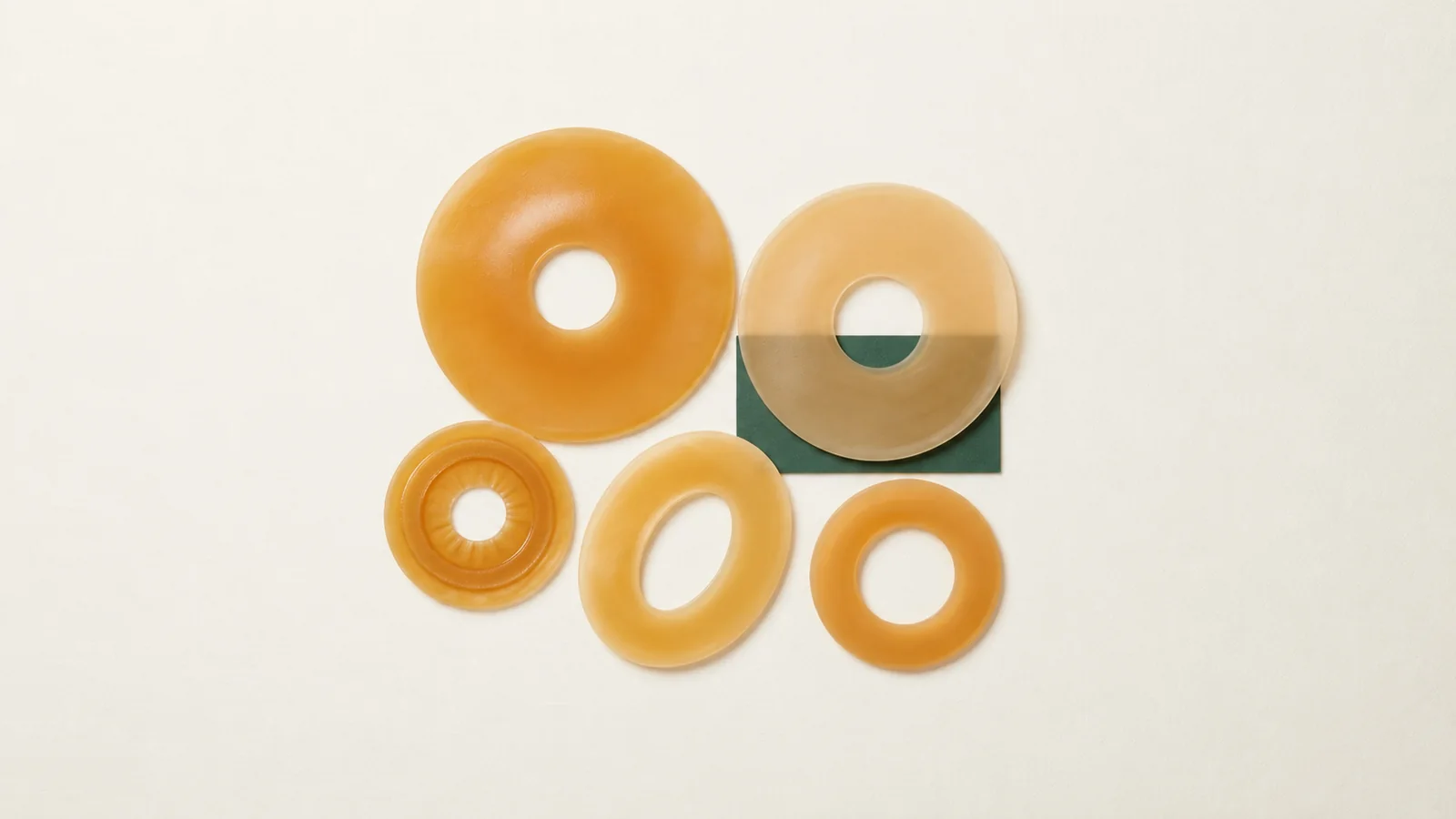
An ostomy barrier ring is a moldable seal used with a pouching system to fill uneven contours around the stoma. For a buyer facing a backorder or supplier change, compare the exact product code, dimensional labels, thickness, opening format, material statements, and packaging before considering a replacement. A shared nominal size or a similar product name does not establish interchangeability. Hollister’s Adapt page describes the ring’s contour-filling purpose; Coloplast’s Brava page confirms that even one ring family offers different thicknesses.
Build the purchasing record around five groups of fields: size, profile thickness, opening and shape, material disclosures, and product identity statements. The last group includes sterility, single-use labeling, cautions, pack count, and the supplier’s proposed billing code. Record missing information as unknown and request it for the exact SKU and destination market. The comparisons below identify questions for procurement and supplier quality; the clinical team must assess suitability for the intended pouching setup.
What the FDA classification establishes
The FDA classification record for EXE identifies “protector, ostomy” under 21 CFR 876.5900 as Class I, with a 510(k)-exempt submission type and no GMP exemption. Section 876.5900 covers ostomy pouches and accessories and makes the premarket-notification exemption subject to the limitations in section 876.9. This is a generic device classification, rather than a clearance comparison of named ring brands.
For a product that falls within the exemption, a 510(k) clearance summary is not the routine purchasing evidence to request. Ask the supplier to identify the device and provide applicable labeling, its instructions for use (IFU), and specifications. The classification entry alone does not establish a ring’s composition, sterility, wear time, or compatibility with another manufacturer’s appliance. Keep regulatory identity and product-specific evidence as separate checks, and investigate inconsistencies before treating a catalog description as sufficient.
Read the dimension label before comparing the number
A “2-inch ring” description leaves several questions unanswered. It may describe the product’s overall footprint, while another listing emphasizes an opening or a range of stoma sizes. Thickness describes a different dimension again. A seal-width measurement is not an outer diameter. Keep the source’s field name beside its value; otherwise a spreadsheet can make unlike measurements look directly comparable.
The following selected examples were checked on October 9, 2026. Hollister/Hartmann is an en-ZA source, ConvaTec is en-CA, and the eakin page is UK-facing. The Coloplast US guide is effective September 2024; its age matters even though the live Brava page still confirms the Moldable Ring thickness options. These are published document values, with gaps visible, rather than a statement that every SKU is currently available in the United States.
| Product / code | Published size or opening | Profile field | Units per box | Evidence / market |
|---|---|---|---|---|
| Hollister table: 7805 | Listed size: 2 in (48 mm) | Published “Width_metric”: 4.5 mm | 10 | Hollister/Hartmann, en-ZA |
| Hollister table: 7806 | Listed size: 4 in (102 mm) | Published “Width_metric”: 2.3 mm | 10 | Hollister/Hartmann, en-ZA |
| Brava Moldable Ring: 120307 / 120427 | Diameter and starter opening not stated in these catalog rows | Thickness: 2.0 / 4.2 mm, respectively | 10 | Coloplast US guide, printed p. 14 |
| Brava Protective Seal: 12035 / 12045 | 18 mm opening; 15 mm seal width | Thickness: 2.5 / 4.2 mm, respectively | 10 | Coloplast US guide, printed p. 12 |
| Brava Protective Seal: 12032 | 18 mm opening; 29 mm seal width | Thickness: 2.5 mm | 10 | Coloplast US guide, printed p. 12 |
| Brava Protective Seal: 12037 / 12047 | 27 mm opening; 15 mm seal width | Thickness: 2.5 / 4.2 mm, respectively | 10 | Coloplast US guide, printed p. 12 |
| eakin Cohesive Small: 839002 | ConvaTec size: 5 cm (2 in); eakin starter hole: 18 mm | Thickness: 4.2 mm on eakin page | 20 on ConvaTec; 30 on eakin | ConvaTec, en-CA; eakin, UK-facing |
| eakin Cohesive Large: 839001 | Listed size: 10 cm (4 in) | Thickness not stated in the cited page | 10 | ConvaTec, en-CA |
| eakin Cohesive SLIMS: 839005 | Listed size: 5 cm (2 in) | Thickness not stated in the cited page | 10 | ConvaTec, en-CA |
| eakin freeseal air: 839007 / 839008 | Listed size ranges: 18–48 / 30–60 mm | Thickness not stated in the cited page | 10 | ConvaTec, en-CA |
| eakin freeseal versa: 839027 / 839028 | Listed size ranges: 18–48 / 30–60 mm | Thickness not stated in the cited page | 10 | ConvaTec, en-CA |
| MPM Medical: Ostomy Barrier Ring (2 in) | Listed size: 50 mm (2 in) | Published dimensions: 3 mm × 50 mm | 10 | MPM Medical product page |
Two limitations are especially useful when converting this table into an item record. First, the Hollister/Hartmann table calls its profile column “Width_metric”; confirm the meaning with the supplier before entering it as engineering thickness. Second, ConvaTec’s freeseal ranges are not labeled outer diameters. They belong in a size-range field until the manufacturer clarifies the dimension. Do not calculate an outer diameter from another field and present it as a labeled measurement.
The Brava Protective Seal examples also show why opening format and moldability are separate attributes. The Coloplast guide describes these seals as moldable even though it supplies starter openings. An 18 mm starter hole does not mean the product has an immutable 18 mm aperture, and a moldable ring should not automatically be recorded as having no starter hole. Copy both the labeled opening and the handling capability.
Resolve source conflicts before creating a substitute record
The Hollister US Adapt page describes features and links to product resources, but the reviewed page text does not itself supply a dimension table. The en-ZA table supplies values, yet a regional page should not silently become the definitive specification for an order in another market. Request the current manufacturer specification for the proposed SKU, including an explanation of any ambiguous column.
There is also a concrete disagreement for 7806: Parthenon’s retailer category page lists 98 mm OD, while the Hollister/Hartmann table lists 4 in (102 mm) as size. This establishes a discrepancy between the sources, not proof of which number describes a current supplied item or why they differ. Keep both observations with their source and review date, then obtain a written resolution. Averaging them or choosing the more convenient value would conceal the uncertainty.
The regional table also includes 8815, 89520, and 89530 under the Adapt page. Its row labels do not establish every sub-family or explain all dimensional meanings. Those rows are therefore excluded from the comparison rather than assigned an inferred flat, convex, or oval geometry. This is a practical stopping rule: when identity or measurement meaning is unresolved, retain the question instead of constructing a more complete-looking specification.
Material names are disclosures, not equivalence evidence
Hollister identifies the Adapt formulation as Flextend M and states that the product is not made with natural rubber latex and is phthalate-free. Those statements can be recorded as manufacturer declarations. They do not supply a full ingredient list, establish a cross-linked chemical structure, or demonstrate that another ring has the same properties. Preserve the actual wording instead of shortening it to a broader allergy or safety promise. Source: Hollister US product features.
Coloplast describes the Protective Seal as having a polymer formulation, but that description does not establish that it is free of hydrocolloid ingredients or chemically equivalent to another supplier’s seal. Likewise, eakin’s vegan-friendly statement for Cohesive Small does not disclose its polymer composition. The useful record is the named formulation or published declaration, with composition marked unstated where the cited document provides no details. Source: Coloplast guide, printed p. 12; eakin Cohesive Small.
If a material requirement matters to the purchase, ask the supplier to address it explicitly for the proposed SKU. A brand-family statement should not be copied to every ring in that family without checking scope. Neither catalog adjectives nor these dimensional tables establish comparative absorbency, erosion resistance, biocompatibility, or wear time. The comparison is a way to identify evidence gaps, rather than a performance ranking.
Keep sterility and patient cautions specific to the product
Coloplast’s guide explicitly identifies the Brava Moldable Ring as non-sterile and cautions about increased infection risk for premature babies or infants receiving incubator care. Its pediatric caution table lists the Protective Seal without that caution. This is a product-specific distinction to carry into the purchasing review; an absent caution is not a sterile claim, a comparative safety finding, or an instruction to select one product for an infant. Source: Coloplast guide, printed p. 103.
The reviewed Hollister Adapt and eakin Cohesive Small product-page text does not state sterility or single-use status. Record those fields as unknown in this comparison and request the current label or IFU. Do not turn silence into “non-sterile single use,” and do not infer sterility from an individual tray. Similarly, use the exact product’s storage instructions rather than imposing a category-wide temperature or humidity threshold.
For a proposed substitution, send the relevant labeling and cautions to the responsible clinical and quality teams. Thickness alone does not establish which ring is suitable beneath a flat or convex barrier. Hollister’s education distinguishes flat and convex ring types and refers fit decisions to an ostomy nurse; it does not support a procurement rule that all thick rings must be restricted to flat appliances. Source: The Versatile Barrier Ring.
Reconcile pack count and billing as separate fields
For 839002, the eakin page publishes a box of 30, while ConvaTec’s Canadian page publishes quantity 20. Both are official product-family sources, but they serve different markets. The disagreement should trigger a question about the orderable pack rather than a claim that one source contains an error. Obtain the exact code, destination market, units per box, and case configuration on the quote; compare that confirmation with the delivered packaging.
Normalize quotations to the confirmed number of individual rings before comparing prices. As a purchasing example, a box price divided by 20 gives a different unit price from the same price divided by 30. Preserve the supplier’s sales unit and the individual-unit calculation separately so receiving and finance can reconcile them. A catalog count from another region is insufficient to settle the purchase order’s unit of measure.
HCPCS is another field that a generic product name cannot settle. A4404 is described as “Ostomy ring, each” in AAPC’s coding reference and in the Coloplast guide’s code reference. Yet the same Coloplast guide assigns A4385 to its Moldable Ring and the Protective Seal examples above. This is documented catalog coding, not proof that all other rings use A4404. Source: Coloplast guide, printed pp. 12, 14, and 118.
Ask the supplier to state its proposed code for the exact SKU, and have the billing team check the applicable payer requirements. Do not infer coverage, payment, quantity limits, or a code change from a similar ring’s name. Coloplast’s reimbursement note itself says coverage and payment vary and are not guaranteed. Keep the billed code and supporting confirmation separate from the dimensional comparison; neither field validates the other.
A purchasing record that keeps unknowns visible
Use this checklist to prepare a supplier request and to review the reply. It is a procurement workflow, not a universal clinical acceptance standard. A record is useful only if it shows what was verified, which document supplied the answer, and what remains unresolved for the proposed product.
| Field | Capture from the exact product | If the answer is missing or conflicting |
|---|---|---|
| Identity and market | Manufacturer, complete SKU, destination market, current label and IFU | Request the orderable identity and applicable documentation; do not merge similarly named families. |
| Dimensions | Outer size, starter opening, seal width, thickness, and any size range in separate fields | Retain the original field label and units; ask the supplier to clarify meaning and tolerances. |
| Shape and system context | Labeled flat or convex design and any stated pouching-system compatibility | Refer unresolved suitability to clinical and quality reviewers; do not assign use from thickness alone. |
| Material statements | Named formulation and product-specific latex or phthalate declarations | Record composition as unstated; request the disclosure needed for the purchasing requirement. |
| Sterility, use limits, cautions | Exact label or IFU statements and relevant patient cautions | Mark unknown; do not infer from packaging appearance or another product’s catalog entry. |
| Packaging and price | Individual units per sales pack, case configuration, confirmed unit of measure | Reconcile quote and delivered pack before comparing unit prices or closing a discrepancy. |
| Coding | Supplier-proposed HCPCS code and billing-team verification | Check the exact product and payer; do not transfer another brand’s catalog mapping. |
For example, replacing Brava 120307 with 120427 preserves the family name and the guide’s box count, but changes the published thickness from 2.0 to 4.2 mm. That is enough to flag a specification change; it is not enough to approve or reject the clinical substitution. Similarly, an eakin 839002 offer with a different pack count needs a packaging reconciliation even when the product code matches. These are two different review questions, so keep separate resolutions.
Attach the reviewed document’s date or version to each resolved field and revisit the record when the supplier changes the SKU, label, formulation, pack configuration, or IFU. Keep a visible pending status for unanswered requirements. For related receiving work, the site’s UDI and GUDID guide addresses device identity capture, while the wound-dressing classification guide illustrates why regulatory identity should be separated from a catalog trade name.