
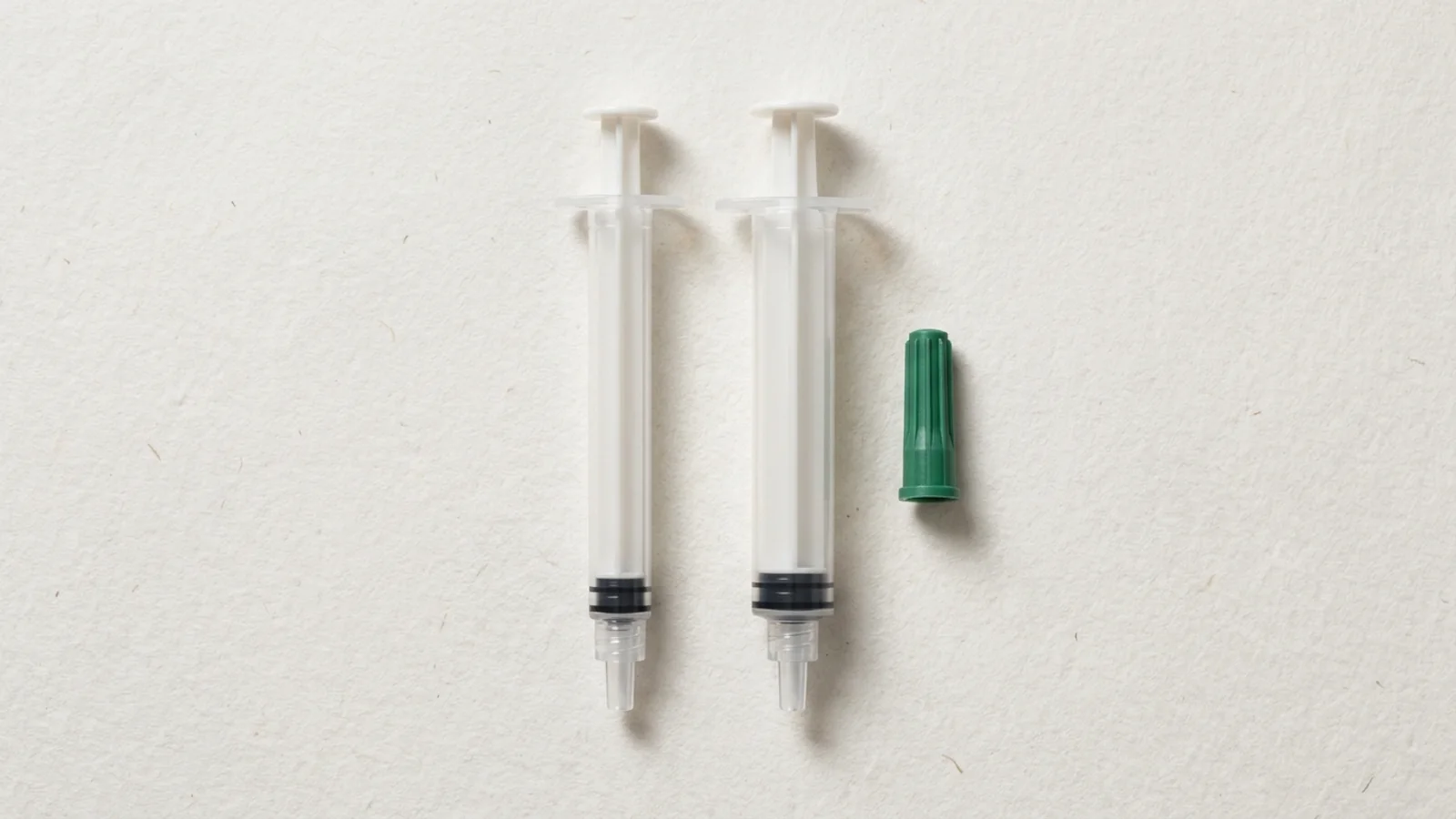
A hospital standardization team comparing preheparinized arterial blood-gas syringe quotes usually sees three heparin descriptions side by side: dry lithium heparin, dry electrolyte-balanced heparin and calcium-balanced lithium heparin, in roughly 1 mL and 3 mL formats, for analyzers that report ionized calcium and lactate. The procurement question is which labeled fields must be documented and matched before switching SKUs, and which fields must stay recorded as unknown until the supplier produces the instructions for use (IFU).
The short answer: treat a blood-gas syringe as a regulated in vitro diagnostic specimen collection device, not as a generic syringe. FDA has cleared standalone arterial blood collection syringes under 21 CFR 862.1675 (blood specimen collection device, Class II, product code JKA, 510(k) required). BD Preset and BD A-Line were cleared under K202446 in September 2020 and, most recently, under Special 510(k) K260128, decided April 15, 2026, for material changes to the syringe resin, tip cap, stopper and packaging. Prepackaged arterial blood sampling kits are a separate Class I category (21 CFR 868.1100, product code CBT): the regulation text calls them 510(k)-exempt subject to 868.9, while the FDA product-code record places them under convenience-kit enforcement discretion. Before switching SKUs, document four labeled fields: (1) heparin form and chemistry, (2) stated heparin amount in IU/mL, (3) labeled fill guidance and volumes, and (4) the labeled analyte scope matched to the installed analyzer menu.
What a blood-gas syringe is, and how FDA classifies it
In tenders, arterial blood collection syringes are easily confused with standard hypodermic piston syringes or with packaged procedural kits. They are different purchases. BD's 2020 510(k) summary describes its Preset and A-Line syringes as sterile, single-use devices intended for the collection of whole blood specimens for in vitro diagnostic testing, used by trained healthcare professionals. That intended use, not the barrel and plunger, is what puts the product in a diagnostic regulation.
FDA records split the device identity into two categories depending on whether the item is a standalone syringe or a kit:
Standalone arterial collection syringes (21 CFR 862.1675, product code JKA): The JKA product-code record lists Device Class 2, submission type 510(k), the Clinical Chemistry panel and “GMP exempt: No.” The identification text in 21 CFR 862.1675 lists blood collection tubes, vials, systems, serum separators, trays and vacuum sample tubes; it does not name syringes. Placement of arterial syringes in this regulation is shown by clearances, such as BD's K202446 (September 25, 2020; predicate K022426) and Special 510(k) K260128 (received January 16, 2026; decided April 15, 2026), and by the product codes in AccessGUDID records.
Arterial blood sampling kits (21 CFR 868.1100, product code CBT): 21 CFR 868.1100 defines the kit as a device in kit form used to obtain arterial blood samples for blood gas determinations, which may include a syringe, needle, cork and heparin. It is Class I and exempt from premarket notification subject to the limitations in 868.9. The CBT product-code record frames the same category differently: submission type “Enforcement Discretion,” established under FDA's May 20, 1997 Convenience Kits Interim Regulatory Guidance, so a kit that meets all criteria in that guidance does not require a 510(k). Whether a specific kit meets those criteria has to be confirmed per product.
For a buyer, the practical consequence is that the regulatory field in a tender has to say which pathway the offered item uses: a 510(k) number and the JKA product code for a standalone syringe, or the CBT product code and the supplier's written basis for kit status. The two descriptions should not be swapped on a quote. Arterial syringes also need to be kept distinct from venous evacuated blood collection tubes and skin-puncture capillary blood collection tubes. All three families share regulation 862.1675, but the questions a buyer must answer about anticoagulant, fill and analyte scope are different for each.
Heparin form, chemistry and stated IU
The preloaded anticoagulant is the field that most often differs between quotes. A review of preanalytical variables in Biochemia Medica, Baird (2013), explains why vendors talk about “balanced” heparin: heparin is a polyanion that can bind cation electrolytes, so blood-gas syringes are usually preloaded with lyophilized heparin that has been pre-titrated with cations such as calcium to reduce errors from cation exchange. The public documents reviewed for this guide do not disclose any vendor's titration recipe, so “balanced” should be recorded as the manufacturer's description, not as evidence that two products behave the same way.
Across the vendor documents reviewed, four distinct heparin descriptions appear:
Calcium-balanced lithium heparin (BD Preset and BD A-Line): The K202446 510(k) summary records calcium-balanced lithium heparin for both the subject device and its predicate. It does not state the physical form or an IU figure, and the AccessGUDID records for catalogs 364390 and 364416 carry only the generic GMDN term “Blood gas syringe IVD, lithium heparin.”
Dry electrolyte-balanced heparin (Radiometer safePICO Aspirator): Radiometer's safePICO Aspirator page describes a dry, electrolyte-balanced heparin “brick” that the manufacturer says reduces the risk of clots, together with an integrated mixing ball. No IU figure is given on the page.
Dry lithium heparin with a stated amount (ICU Medical): ICU Medical's arterial blood sampling page states that Pro-Vent Plus 1 mL and 3 mL syringes use dry lithium heparin at approximately 23.5 IU per mL, with low-heparin versions at approximately 7 IU per mL, and that Pulsator Plus 3 mL syringes use approximately 23.5 IU per mL. LineDraw Plus aspirating syringes are described as coming in a variety of dry lithium heparin concentrations.
Electrolyte-balanced liquid sodium heparin (“anaerobic” line-draw syringes): A Fisher Scientific distributor listing for Smiths Medical/Portex LineDraw Plus kits states that “anaerobic” syringes contain 23.5 IU/mL of electrolyte-balanced liquid sodium heparin, alongside dry lithium heparin arterial syringes at 23.5 IU/mL and low-heparin versions at 7 IU/mL. Distributor copy can lag the manufacturer catalog and mixes brand generations, so the current SKU numbering should be reverified with the supplier.
Peer-reviewed comparisons explain why the dry-versus-liquid distinction matters for acceptance criteria. In a paired-sample study of 35 pediatric intensive care patients published in the Indian Journal of Critical Care Medicine, Chhapola, Kumar and Goyal (2014) compared a commercial electrolyte-balanced dry heparin syringe (Radiometer PICO50, 40 IU/mL) with self-prepared liquid heparin syringes. Agreement was poor for pCO2, pO2, HCO3−, Na+, K+ and Cl−: 40% of pCO2 results, 23% of HCO3− results, 77% of Na+ results, 34% of K+ results and 54% of Cl− results with liquid heparin fell outside total allowable error. pH and lactate showed statistically different means, but a negligible share of results fell outside allowable error, so the bias is analyte-specific rather than uniform.
An earlier study by the same group, Chhapola et al. (2013), filled 1 mL samples into syringes holding minimal, 60 IU or 120 IU of liquid heparin and found pCO2, HCO3− and Na+ fell as the heparin amount increased; observed bias exceeded desirable specifications for pCO2, HCO3−, hemoglobin, Na+, K+ and Cl−. Baird adds that excess liquid heparin can dilute bicarbonate and pCO2 and can affect pO2 because the solution itself carries atmospheric pO2 (about 150 mmHg). In an emergency department study, Sandler and Goldstein (2018) found that for both liquid heparin cohorts, more than 20% of pCO2, potassium, sodium, ionized calcium and hemoglobin results fell beyond total allowable error, and that heparin vacutainer use produced unacceptable variation in respiratory analytes.
The stated amount of heparin is the cell most often left blank. ICU Medical publishes approximate IU/mL figures; Radiometer's product page and BD's 510(k) summary and GUDID records state the chemistry but no IU figure. BD's summary does record “heparin activity” among its bench tests, which tells a buyer such data exist without giving the number. Where the figure is not public, request the package insert or IFU and keep the cell marked unknown until it arrives; assuming the same heparin amount across vendors is exactly the kind of unsupported equivalence a specification should prevent.
Fill marks, preset volumes and short draws
Fill guidance is a labeled field, and the documents reviewed describe it in different ways. BD's K202446 summary says the Preset syringe is designed to preset a desired volume while still permitting aspiration, and that a venting system expels residual air through a self-venting membrane as blood fills the syringe; the A-Line syringe is designed for aspiration from arterial lines. Radiometer's safePICO Aspirator is, per its GUDID description, an aspirator with a vented tip cap. ICU Medical describes LineDraw Plus as aspirating syringes for sampling directly from an arterial line. These are design descriptions to capture, not instructions for use.
Nominal capacity and labeled fill guidance should be recorded as separate fields:
Radiometer safePICO Aspirator: The GUDID record describes catalog 956-622 as an aspirator with vented tip cap, 1.5 mL. Radiometer's product page gives a recommended fill volume of 1.0 mL and says the 1.0 mL label shows the amount of blood needed to measure all parameters on Radiometer blood gas analyzers. That statement is tied to Radiometer's own analyzers; it is not a claim about other platforms.
BD Preset: The GUDID record for catalog 364416 lists a total volume of 1 milliliter. The GUDID record for catalog 364390 gives the device description “SYR ABG PRESET 3(1.6) LL 22X1 ECLIPSE CE” but does not define what “3(1.6)” means. Because the Preset design lets the user preset a desired volume, the string should be copied into the specification as written and interpreted only against the IFU.
Short samples matter most with liquid heparin. Baird notes that liquid heparin is not preferred because short sample collections can lead to an improper mix of anticoagulant and blood, and the 2013 study shows the dilution effect growing as the heparin-to-sample ratio rises. With dry heparin, a short sample also raises the heparin-to-blood ratio; whether that matters for a particular SKU is a question for the manufacturer's IFU and the laboratory, not something a buyer can infer from the catalog.
In practice, a tender should capture three volume fields: (1) nominal barrel capacity, (2) the labeled fill mark or preset guidance, and (3) any minimum sample volume the IFU states for the full analyte panel. If a quote does not define the third field, record it as unknown until it is confirmed against the IFU.
A blood-gas syringe should not be treated as universally interchangeable across analyzers. Each cleared syringe carries an intended-use statement, and that statement is the first place to check analyte scope. BD's K202446 intended use covers in vitro diagnostic testing that “may include: pH, blood gases, electrolytes (including ionized calcium), metabolites, co-oximetry.” By comparison, the Fisher Scientific listing for LineDraw Plus kits names pH, pCO2, pO2, Ca2+, Mg2+, Na+, K+, Cl−, CO-oximetry, glucose and lactate; that is distributor-reproduced marketing text, not a regulatory statement.
Compare those lists with the installed point-of-care and central laboratory analyzer menus. If an analyzer reports an analyte the label does not name explicitly (BD's intended-use wording names ionized calcium but not magnesium, for example), ask the supplier where the labeled scope covers it. If the answer is not in the labeling, record the cell as unknown and route the question to the laboratory's own verification process.
Several vendor features also affect fit with a hospital's workflow. Each one should be recorded as the manufacturer's description:
Heparin dissolution and mixing: Radiometer's educational page on clots states that if the anticoagulant is not completely dissolved, clots may form, a clotted sample should be considered unsuitable, and clots can block the analyzer pathway, biasing results or causing downtime. Radiometer markets its heparin brick and integrated mixing ball as mitigations. These are vendor statements, not independent comparative evidence.
Air removal and venting: Radiometer describes its vented safeTIPCAP as designed to remove air bubbles with minimized risk of blood exposure. BD's Preset uses a different mechanism, a self-venting membrane that expels residual air as the syringe fills (K202446). Record which mechanism each SKU uses rather than treating them as equivalent.
Pre-barcoding: Radiometer states that the safePICO Aspirator is pre-barcoded to help match patient and sample when used with a Radiometer analyzer and its data-management software. That benefit depends on the analyzer ecosystem.
Safety needle option: K202446 states that the Preset syringe is offered with and without a pre-attached Eclipse safety needle, with needle gauges of 22–25G. The GUDID description for catalog 364390 includes “ECLIPSE.” Whether a needle-bearing configuration is required is a decision for the facility's own sharps-safety program.
A syringe that is marketed for one analyzer family should not be assumed to perform identically on another without supplier evidence or local laboratory verification.
The procurement matrix: fields to capture, fields to leave unknown
The matrix below brings together what public FDA records, AccessGUDID entries, manufacturer pages and one distributor listing showed when reviewed in October 2026. Cells that the sources do not state are marked unknown instead of being filled from assumptions. No laboratory testing was performed, and BD's own product web pages were not available for review, so BD heparin amounts, fill marks and marketed analyte lists stay unknown pending the IFU.
| SKU family | Heparin chemistry (as described) | Stated IU/mL | Volume and fill guidance | Venting / needle | Labeled analyte scope | FDA code and premarket number | Storage text |
|---|---|---|---|---|---|---|---|
| BD Preset Eclipse, cat. 364390 | Calcium-balanced lithium heparin (K202446); GUDID GMDN term “lithium heparin” | Unknown pending IFU | GUDID description “3(1.6)”, not defined in record | Self-venting membrane; “ECLIPSE” in description | pH, blood gases, electrolytes incl. ionized calcium, metabolites, co-oximetry (K202446) | JKA; K202446 (GUDID) | “Room Temperature” (GUDID) |
| BD Preset, cat. 364416 | Calcium-balanced lithium heparin (K202446 family); GUDID GMDN term “lithium heparin” | Unknown pending IFU | Total volume 1 mL (GUDID) | Self-venting membrane (Preset design); needle not stated | Same intended use; unchanged per K260128 | JKA; K260128 (GUDID) | Text only: away from sunlight, dry, fragile, this way up; no temperature range |
| BD A-Line | Calcium-balanced lithium heparin (K202446) | Unknown pending IFU | Not itemized in sources reviewed; unknown | Designed for aspiration from arterial lines | Same intended use (K202446) | JKA; K202446 and K260128 | No GUDID record reviewed; unknown |
| Radiometer safePICO Aspirator, cat. 956-622 | Dry electrolyte-balanced heparin brick (manufacturer); GUDID GMDN term “sodium heparin” | Not stated on product page or GUDID; unknown | 1.5 mL (GUDID); 1.0 mL mark tied to Radiometer analyzers | Vented safeTIPCAP; mixing ball; needle not stated | “All parameters” on Radiometer analyzers (manufacturer); other platforms unknown | JKA and MEG; premarket number not released (GUDID) | 2–32 °C (GUDID) |
| ICU Medical Pro-Vent Plus; Pulsator Plus | Dry lithium heparin (manufacturer) | ~23.5; low-heparin Pro-Vent Plus ~7 | Pro-Vent Plus 1 mL and 3 mL; Pulsator Plus 3 mL | Not stated on family page; unknown | Not stated on family page; unknown | Not stated in sources reviewed; unknown | Unknown |
| LineDraw Plus “anaerobic” syringes (distributor listing) | Electrolyte-balanced liquid sodium heparin | 23.5 (distributor listing) | Listing offers 1 mL luer slip and 3 mL luer lock or slip; not mapped to heparin variant | Aspirating line-draw design (ICU Medical) | Distributor text names pH, gases, Ca2+, Mg2+, Na+, K+, Cl−, CO-oximetry, glucose, lactate | Not stated; do not assume JKA or CBT | Unknown |
When issuing a request for quotation or evaluating an alternative supplier, ask for the following documents:
Regulatory identity: the 510(k) number and product code for a standalone syringe, or, for an item offered as a kit, the CBT product code and the supplier's written basis for kit status. Check the number against FDA's 510(k) database.
Full instructions for use: the package insert, to fill in the heparin amount in IU/mL, fill guidance, any minimum sample volume, labeled analytes and shelf life. BD's 2020 summary, for example, records a 2-year shelf life and gamma sterilization to SAL 10−6 for that configuration.
AccessGUDID entry: the primary device identifier (DI), checked for product codes, GMDN term, premarket submission number, sterile-packaging flag and storage text. The records reviewed listed “No Sterilization Methods Found,” so sterilization evidence still comes from the supplier.
Heparin and performance evidence: a description of the heparin-activity bench testing behind the clearance and any supplier data on the analyzer models installed. Where none exists, record unknown and route the question to the laboratory.
Receiving, storage and change control
Procurement's job does not end when the purchase order is issued. When arterial blood collection syringes arrive, receiving should confirm that the delivered DI, product code and labeling match the contracted item.
AccessGUDID is a useful receiving check, as covered in our guide to UDI and GUDID verification for medical consumables. The records reviewed for blood-gas syringes are not uniform, and quality teams should reconcile the differences:
Nomenclature and coding: The safePICO Aspirator record (DI 05700699566225) lists product codes JKA and MEG (syringe, antistick), assigns GMDN 45267 “Blood gas syringe IVD, sodium heparin” even though Radiometer markets an electrolyte-balanced heparin, and shows the premarket submission number as not available/not released. The BD Preset 364390 record (DI 50382903643900) assigns GMDN 57894 “Blood gas syringe IVD, lithium heparin,” cites K202446 and is filed by Becton, Dickinson U.K. Limited with a “CE” description. The GMDN definition shown there describes a syringe “without a pre-attached needle,” while the device description includes “ECLIPSE.” GMDN terms are generic classes and should not be read as the product's actual formulation or configuration.
Storage conditions: The safePICO record gives a storage temperature range of 2 to 32 °C. BD Preset 364390 gives only the text “Room Temperature,” and BD Preset 364416 (DI 50382903644167) gives only handling text (keep away from sunlight, keep dry, fragile, this way up) with no numeric range. Where a record gives no numeric range, ask the supplier for the labeled range and apply labeled storage and transport controls to the warehouse and point-of-use locations.
Quality surveillance should continue after go-live. Radiometer states that clotted samples can block analyzer pathways and bias results; if users report clot-related analyzer events after a syringe change, capture the syringe lot and DI with the complaint so the evidence can support a supplier review. Record such events as complaints for investigation, not as proof of a product defect.
Change control belongs in the supplier contract, as covered in our analysis of quality agreements for medical consumable suppliers. The public record shows that syringe materials can change while the trade name and indications stay the same.
Anchoring blood-gas syringe selection in the FDA pathway, the labeled heparin chemistry and amount, the labeled fill guidance, the labeled analyte scope and written change control gives materials management a specification it can verify, with unknown cells kept visible until the supplier closes them.