
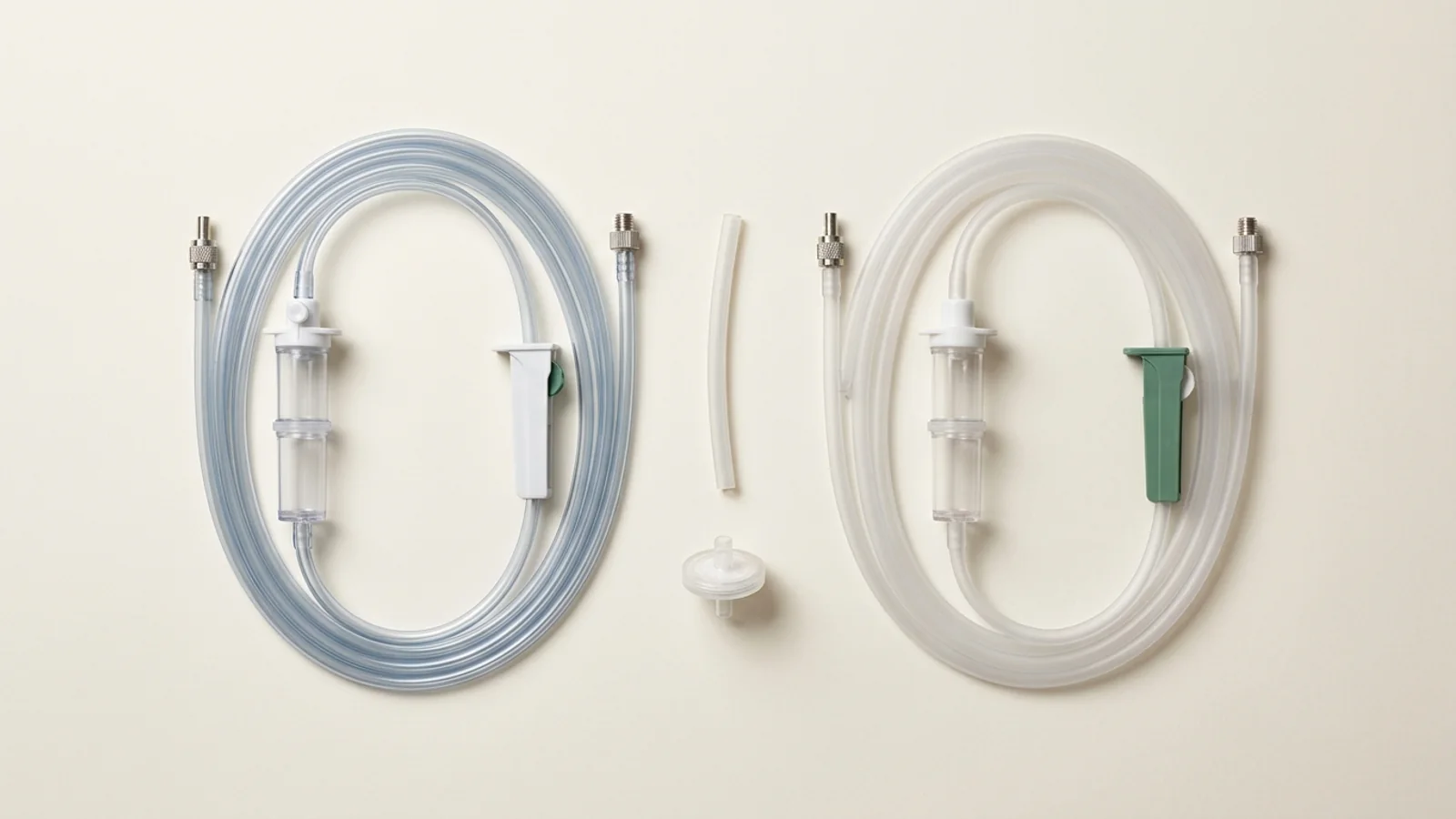
When Non-PVC Tubing Is the Right Specification
When hospital procurement teams or supply managers receive requisitions for "non-PVC IV tubing," the request is often treated either as a routine catalog variation or as a hospital-wide safety upgrade. Neither assumption holds. Non-PVC intravenous administration tubing replaces plasticized polyvinyl chloride (PVC) in the fluid path with other polymers—polyethylene (PE), polypropylene (PP), polyurethane (PUR), thermoplastic polyolefins (TPO), or styrenic thermoplastic elastomers such as SEBS—or lines a PVC tube with a polyethylene contact layer. Each route changes leachables, drug sorption, and pump behavior differently, so the specification has to say which route you are buying.
Base the decision on three priorities, in order: first, what the drug labels on your formulary say about container and tubing materials; second, substance rules in the markets you supply (such as European Union Medical Device Regulation limits on phthalate plasticizers); and third, organizational purchasing commitments such as PVC and DEHP reduction goals. Buying non-PVC sets as a blanket substitute without that alignment carries risk in both directions. The amiodarone label states that all clinical experience has been with PVC tubing and that its labeled concentrations and infusion rates reflect dosing in those studies. The paclitaxel label, by contrast, does not recommend plasticized PVC containers and administration sets because DEHP levels rise with time and concentration, and the nitroglycerin label reports that only 20–60% of the drug content was delivered in published studies using PVC tubing.
Under United States Food and Drug Administration (FDA) rules, non-PVC infusion lines remain intravascular administration sets under 21 CFR 880.5440, a Class II (special controls) device type. Swapping the tubing material does not change the set architecture covered in our guide to IV Administration Set Specifications. It changes the chemistry of the fluid path: what can leach out of the tube wall, and how much drug can be lost into it.
Decoding the Claims: PVC-Free vs. DEHP-Free vs. Non-DEHP PVC
Supplier catalogs and tenders routinely blur "DEHP-free," "non-DEHP PVC," and "PVC-free." The first two usually describe the same thing—PVC made flexible with a different plasticizer—while the third describes a different polymer. Separate them during technical evaluation so you do not buy the wrong material for a labeled requirement, or pay for a claim you do not need.
Unplasticized PVC is rigid. To make flexible, kink-resistant medical tubing, plasticizers are compounded into the resin; a peer-reviewed review of DEHP alternatives in neonatal care notes that DEHP can make up 20% to 40% of the final polymer weight. DEHP is not covalently bound to the PVC matrix, so it can leach into solution. Drug labels flag this for specific products: the paclitaxel label warns that DEHP may be leached from PVC infusion bags or sets, and the amiodarone label notes that its polysorbate 80 component leaches DEHP from PVC.
The same review describes two substitution routes, and infusion-set suppliers also sell a third, hybrid construction:
Route A — Alternative-plasticized PVC (DEHP-free / non-DEHP PVC): The PVC resin stays and DEHP is replaced by another plasticizer, such as trioctyl trimellitate (TOTM, also written TEHTM), DINCH, di(2-ethylhexyl) terephthalate (DEHT, also called DOTP), di(2-ethylhexyl) adipate (DEHA), or a polymeric adipate. A product labeled "DEHP-free" is usually still a PVC product. Removing DEHP removes DEHP exposure, but the replacement plasticizer can still migrate, and laboratory work shows the tube can still sorb lipophilic drugs such as nitroglycerin.
Route B — PVC-free polymers: PVC is removed from the tube. Options include polyolefins (PE, PP, or TPO), polyurethane (PUR/TPU), and styrenic thermoplastic elastomers such as SEBS. These materials do not behave alike: in one pump study, polyurethane tubing sorbed diazepam much more like PVC than like polyolefin.
Route C — Lined or co-extruded PVC: A PVC outer layer provides drape and kink resistance while a co-extruded inner layer, commonly polyethylene, forms the fluid-contact surface. This is the construction the paclitaxel label gives as its example of a non-PVC containing set ("such as those which are polyethylene-lined"). It is not PVC-free, and one study found plasticizer in the co-extruded SEBS inner layer of a PVC/SEBS tube that had probably migrated from the PVC layer, so ask for test evidence on the liner, not just a cross-section drawing.
The regulatory basis for these claims differs between the United States and the European Union:
United States: Under 21 CFR 801.437, FDA requires caution statements only for devices containing natural rubber that contacts humans. There is no comparable US labeling requirement for DEHP or PVC. In 2002 FDA announced draft guidance, "Medical Devices Made With Polyvinylchloride Using the Plasticizer di-(2-Ethylhexyl)phthalate," suggesting that manufacturers label certain devices with their DEHP content and consider eliminating DEHP in devices that can produce high aggregate exposures in sensitive patient populations. The notice stated that the draft was neither final nor in effect, and draft guidance does not bind manufacturers. In US tenders, "DEHP-free" and "PVC-free" are voluntary material claims that the buyer has to verify.
European Union: Regulation (EU) 2017/745 (MDR), Annex I sections 10.4.1–10.4.5, restricts carcinogenic, mutagenic, or reproductive-toxic substances (CMR Category 1A or 1B) and endocrine-disrupting substances in invasive devices and in devices that administer or transport medicines and body fluids. Such substances may be present above 0.1% weight by weight (w/w) only where justified. When they are, their presence must be labeled on the device and/or its packaging, and where the intended use includes children, pregnant or breastfeeding women, or other vulnerable patient groups, the instructions for use must describe residual risks and precautionary measures. DEHP is a CMR substance, so a DEHP-plasticized set placed on the EU market above that threshold must carry this disclosure.
Voluntary purchasing criteria: Practice Greenhealth and Health Care Without Harm publish Safer Medical Products Criteria (August 2020). The PVC criterion requires that a product contain no PVC or other chlorinated polymers; very small components under 1% PVC by weight are allowed, but PVC tubing is not exempt. The DEHP criterion sets a 1,000 ppm de minimis level in homogeneous materials. The parenteral category includes containers of formulations, tubing, and syringes used to access arteries and veins, and excludes pumps and the catheters used to administer the formulation.
| Catalog Claim | Tube Base Polymer | Plasticizer | What the Claim Tells You | What to Verify |
|---|---|---|---|---|
| Standard PVC (no material claim) | Plasticized PVC | Often DEHP, which can be 20–40% of polymer weight | Nothing about plasticizer identity; in the EU, a CMR plasticizer such as DEHP above 0.1% w/w must be disclosed on the device or packaging | Named plasticizer; whether any formulary drug label restricts PVC sets |
| DEHP-free / non-DEHP PVC | Plasticized PVC | Alternative such as TOTM, DINCH, DEHT, DEHA, or a polymeric adipate | DEHP is absent; the tube is still PVC | Named plasticizer; it does not meet a label that calls for non-PVC containing sets |
| Polyethylene-lined / co-extruded | PVC outer layer with a PE (or other) inner contact layer | Outer layer plasticized; contact layer normally unplasticized | The tube's fluid-contact surface is not PVC | Liner material and continuity; drip chamber, port, and connector materials; plasticizer migration data |
| PVC-free: polyurethane | PUR / TPU | None expected; request a declaration | No PVC in the tube | Drug-specific sorption data, because PUR is not automatically low-sorbing |
| PVC-free: polyolefin or TPO | PE, PP, or TPO | None expected; request a declaration | No PVC in the tube | Whole-fluid-path scope; pump validation for the exact pump model; drug-specific data |
Drug-by-Drug Evidence: Four Labels, Four Different Instructions
Generic purchasing rules fail because drug labels say different things. Four current US labels show the range. These are the specific DailyMed versions cited in this guide; other manufacturers' labels for the same drug can word these statements differently, so check the label for each product you actually stock.
Paclitaxel injection — non-PVC set plus a 0.22-micron filter: Paclitaxel injection is formulated with polyoxyl 35 castor oil and dehydrated alcohol. The label reports that DEHP levels increase with time and concentration when dilutions are prepared in PVC containers and concludes that plasticized PVC containers and administration sets are not recommended. It directs: "Non-PVC containing administration sets, such as those which are polyethylene-lined, should be used," and requires administration "through an in-line filter with a microporous membrane not greater than 0.22 microns." It also notes that filter devices with short PVC-coated inlet and outlet tubing have not resulted in significant DEHP leaching. A DEHP-free PVC set does not meet the "non-PVC containing" wording. Albumin-bound paclitaxel is a different product with its own label, so do not carry this requirement over without checking that label.
Tacrolimus (Prograf injection) — container restriction and conditional tubing rule: Prograf injection contains polyoxyl 60 hydrogenated castor oil. The label states that diluted infusion solution should be stored in glass or polyethylene containers and discarded after 24 hours, and should not be stored in a PVC container "due to decreased stability and the potential for extraction of phthalates." For tubing, the instruction is conditional: "In situations where more dilute solutions are utilized (e.g., pediatric dosing, etc.), PVC-free tubing should likewise be used to minimize the potential for significant drug adsorption onto the tubing." For buyers, that means a non-PVC container requirement in every case and a PVC-free tubing requirement wherever more dilute solutions are prepared.
Nitroglycerin injection — least absorptive tubing, with a dose warning: The label explains that nitroglycerin readily migrates into PVC, that absorption increases with longer tubing, lower flow rates, and higher concentration, and that the delivered fraction has been 20–60% in published studies using PVC tubing, varying during a single infusion with no simple correction factor. It directs that nitroglycerin "should be used with the least absorptive infusion tubing (i.e., non-PVC tubing) available," requires glass bottles for preparing the admixture, and warns that some in-line filters also absorb nitroglycerin and should be avoided. It also warns, in capitals, that doses reported in published studies used general-use PVC sets and will be too high when low-absorbing infusion sets are used. A move to non-PVC lines for nitroglycerin therefore has to be agreed with pharmacy and the owners of the clinical protocol before stock changes; dosing itself stays with clinicians and the label.
Amiodarone hydrochloride — the counter-case: The label states that amiodarone adsorbs to PVC tubing, "but all of the clinical experience has been with PVC tubing and the concentrations and rates of infusion provided in DOSAGE AND ADMINISTRATION reflect dosing in these studies." It requires infusions longer than 2 hours to be given in glass or polyolefin bottles, calls for an in-line filter during administration, and notes that amiodarone and its polysorbate 80 component leach DEHP from PVC tubing, more so at higher concentrations and lower flow rates than labeled. The label does not call for non-PVC tubing. A facility-wide PVC-free mandate would move amiodarone infusions away from the tubing on which its labeled dosing was based—a decision for pharmacy, not purchasing alone.
| Drug (Cited Label) | Container Statement | Tubing Statement | Filter Statement | What Purchasing Must Stock |
|---|---|---|---|---|
| Paclitaxel injection (castor-oil vehicle) | Glass, polypropylene, or polyolefin | Non-PVC containing sets, such as polyethylene-lined | In-line filter with membrane no greater than 0.22 µm | Non-PVC (for example, PE-lined) set with a qualifying in-line filter |
| Tacrolimus (Prograf injection) | Glass or polyethylene; not PVC; discard after 24 hours | PVC-free tubing when more dilute solutions are used (e.g., pediatric dosing) | None stated in the dilution instructions | Non-PVC containers; PVC-free tubing for dilute regimens |
| Nitroglycerin injection | Glass bottles for admixture preparation | Least absorptive (non-PVC) tubing available | Avoid in-line filters that absorb nitroglycerin | Low-absorbing set, introduced only after pharmacy review of the dose warning |
| Amiodarone hydrochloride injection | Glass or polyolefin for infusions longer than 2 hours | Labeled dosing reflects clinical experience with PVC tubing; no non-PVC instruction | Use an in-line filter | Keep PVC sets available unless pharmacy decides otherwise |
What Material Studies Show, and What They Cannot Promise
Vendor claims of "zero sorption" or "universal compatibility" should be tested against the peer-reviewed literature. Three in-vitro studies show how drug-specific the behavior of alternative materials is:
Jin et al. (2016) pumped diluted diazepam (10 mg/100 mL and 20 mg/500 mL in 5% dextrose) through 1 m of administration-set tubing at 1 mL/min and measured delivery by high-performance liquid chromatography (HPLC). PVC- and polyurethane-based tubes both showed higher diazepam sorption than polyolefin-based tubes, and the polyolefin tubes delivered more than 90% of the administered diazepam. The result undercuts the assumption that every non-PVC polymer is low-sorbing: in this test, polyurethane behaved more like PVC than like polyolefin.
Tokhadze et al. (2019) compared a reference plasticized PVC tube with five alternatives—PVC co-extruded with PE, PU, or SEBS, and monolayer SEBS and TPO tubes—using diazepam, insulin, and paracetamol delivered at 1 and 10 mL/h by syringe pump. Diazepam sorption was lower than with PVC for PVC/PE, PVC/SEBS, SEBS, and TPO, but higher for PVC/PU, which was also the only tube to lose paracetamol. Insulin reversed the ranking: plain PVC produced the least insulin loss of all the materials, and the PVC/SEBS and PVC/PE co-extrusions were associated with the highest insulin sorption. The authors also detected a plasticizer, attributed to TOTM, in the SEBS inner layer of the PVC/SEBS tube, probably migrated from the PVC layer, while the co-extruded tubes released less plasticizer overall than PVC alone.
Treleano et al. (2009) pumped nitroglycerin and diazepam through PVC tubes plasticized with DEHP, DEHA, DEHT, TEHTM, DINCH, or a polyadipate, and through alternative materials including EVA, TPE, PUR, silicone, LDPE, and PP. Sorption peaked in the first minutes of delivery: for a DEHP-plasticized PVC tube of Shore hardness 80, only about 57% of the initial nitroglycerin concentration was delivered in those first minutes. PE and PP tubes showed significantly lower sorption than the PVC plasticizer systems. Changing the plasticizer addresses DEHP exposure; it does not by itself solve drug sorption.
flowchart TD
    A["IV tubing material route"] --> B["Plasticized PVC"]
    A --> C["Lined or co-extruded PVC"]
    A --> D["PVC-free polymers"]
    B --> B1["PVC with DEHP"]
    B --> B2["PVC with alternative plasticizer: TOTM, DINCH, DEHT"]
    B1 --> E1["DEHP can leach; high nitroglycerin sorption in lab studies"]
    B2 --> E2["No DEHP; nitroglycerin sorption still reported"]
    C --> E3["PE or other contact layer; verify liner and plasticizer migration"]
    D --> D1["Polyurethane, PUR"]
    D --> D2["Polyolefin or TPO: PE, PP"]
    D --> D3["Styrenic elastomer, SEBS"]
    D1 --> E4["Diazepam sorption similar to PVC in one pump study"]
    D2 --> E5["Lower diazepam and nitroglycerin sorption in cited studies; pump fit must be validated"]
D3 --> E6["Lower diazepam sorption than PVC in one study; insulin results differ"]The Specification Comparison Table
For tender documents and item-master entries, force each claim into its own field. Any field the supplier does not document should be recorded as "Unknown / not reported" rather than assumed compliant. The first table lists the fields and the evidence that closes each one; the second shows how three real catalog pages fill them, and how much they leave open.
| Specification Field | What to Record | Evidence That Closes the Field |
|---|---|---|
| Fluid-path contact material | Polymer of each fluid-contact component: spike, drip chamber, tube, pump segment, ports, filter housing, connector | Component-level materials declaration |
| Plasticizer | Named plasticizer, or "none" for unplasticized polymers; whether any CMR phthalate exceeds 0.1% w/w | Supplier declaration; EU MDR Annex I 10.4.5 labeling where applicable |
| Claim scope | Whether "PVC-free" or "not manufactured with PVC" covers the whole fluid path or only the tube | Written scope statement tied to the catalog number |
| In-line filter | Presence, membrane rating (no greater than 0.22 µm where a label requires it), and housing material | Product specification sheet |
| Connector | Luer lock or luer slip, and conformity to ISO 80369-7:2021 | Declaration of conformity or test summary |
| Pump compatibility | Named pump models the set is validated for, or "gravity only" | Pump manufacturer's validated set list or validation letter |
| Drop factor and length | Drops per mL and total length | Product specification sheet |
| Natural rubber latex | Whether any component contains natural rubber; if so, the 21 CFR 801.437 caution statement | Label and materials declaration |
| Drug-specific data | Recovery or sorption results for the drugs and concentrations you infuse | Test report stating method, concentration, flow rate, tube length, and duration |
| Field | B. Braun Infusomat Space Line (not manufactured with PVC) | Mediplast Infusion Set 180 cm, non-vented, PVC-free | ICU Medical / Grifols Fleboflex non-PVC, non-DEHP container |
|---|---|---|---|
| Published material claim | PUR tubing, "not manufactured with PVC" | PVC-free ("Contains no PVC") | Non-PVC, non-DEHP, non-latex multilayer polypropylene film |
| Product type | IV administration set for gravity and compatible pumps | Gravity infusion set with roller clamp | IV solution container (not a set), 50 mL to 1000 mL |
| Pump fit | Silicone pump segment; dedicated to Infusomat Space, Spaceplus, and fmS pumps | Not stated | Not applicable |
| Filtration | Not stated in the product description | 15 µm liquid filter; separate variant with 0.2 µm filter marketed as suitable for paclitaxel infusions | Not applicable |
| Connector | Not stated in the product description | Rotating luer-lock; ISO 80369-7 conformity not stated | Not applicable |
| Length and drop factor | Various lengths; drop factor not stated | 180 cm; 20 drops = 1 mL | Not applicable |
| Whole-fluid-path scope | Not stated | Not stated | Not stated |
| Drug-specific data | Not stated in the product description | Not stated; the paclitaxel suitability statement is vendor marketing | General hazardous-drug compatibility claim; no named drugs or data on the page |
Two engineering boundaries in these tables deserve separate attention:
Connector conformity is independent of tubing material: ISO 80369-7:2021 (Small-bore connectors for liquids and gases in healthcare applications — Part 7: Connectors for intravascular or hypodermic applications) specifies dimensions and functional performance requirements for luer slip and luer lock connectors; its 2021 second edition replaced the 2016 edition. A non-PVC set whose male luer conforms to the standard should mate with conforming cannulas, catheters, and extension sets, such as those covered in our reviews of IV Cannula Sizes and Color Codes and Intravascular Catheter Specifications. Record connector conformity as its own field rather than inferring it from the tubing claim.
Pump performance depends on the tube: Volumetric infusion pumps act directly on the tubing, so their delivery accuracy depends on the tube's dimensions and elastic behavior. Changing the tubing polymer can therefore change pump performance, which is why dedicated non-PVC pump sets are tied to named pumps. B. Braun describes its Infusomat Space Line as PUR tubing "not manufactured with PVC" with a silicone pump segment, intended for the Infusomat Space, Spaceplus, and fmS pumps. Treat any non-PVC set intended for a pump as unqualified until it appears on that pump manufacturer's validated set list for your exact pump models.
Supplier Evidence to Request Before Switching
Before awarding a tender or approving an item-master change, ask for documents rather than adjectives such as "eco-friendly" or "toxin-free." Five evidence packages cover the decision:
Complete fluid-path materials declaration: A component-by-component disclosure of every polymer and additive that contacts the fluid: tubing, spike, drip chamber, drop former, particulate filter, injection ports or needle-free valves, in-line filter membrane and housing, and male luer. Confirm whether "not manufactured with PVC" or "PVC-free" applies to the entire fluid path or only to the tube.
Plasticizer and phthalate declarations: For EU supply, ask how the manufacturer meets MDR Annex I section 10.4: whether any CMR 1A/1B or endocrine-disrupting substance exceeds 0.1% w/w and, if so, the justification and labeling. For US supply, where no DEHP or PVC labeling rule applies, ask for a written statement naming the plasticizer (for example TOTM, DINCH, or DEHT in non-DEHP PVC) and a natural rubber latex statement; if natural rubber is present, 21 CFR 801.437 requires a caution statement on the label.
Drug-specific recovery or sorption reports: For sets intended for drugs whose labels mention tubing material, ask for reports that state the analytical method (the Jin study used HPLC), drug concentration, flow rate, tube length, and duration. Set acceptance criteria with pharmacy using the concentrations and rates your facility actually uses. No single percentage applies across drugs, and the cited studies show that rankings can reverse between drugs.
Pump validation documentation: If the set will run on an electronic pump, obtain the pump manufacturer's validated set list or validation letter for your exact pump models, showing that the set meets the pump's labeled accuracy. A set validated on one pump family is not validated on another.
Quality agreement and change notification: Write change-control obligations into the supply agreement, as described in our guide to Quality Agreements for Consumable Suppliers. Require advance written notice, for a period you specify, before any change to resin grade, plasticizer, co-extrusion liner, or fluid-path component material, because such a change can alter leachables and sorption without changing the catalog number.