
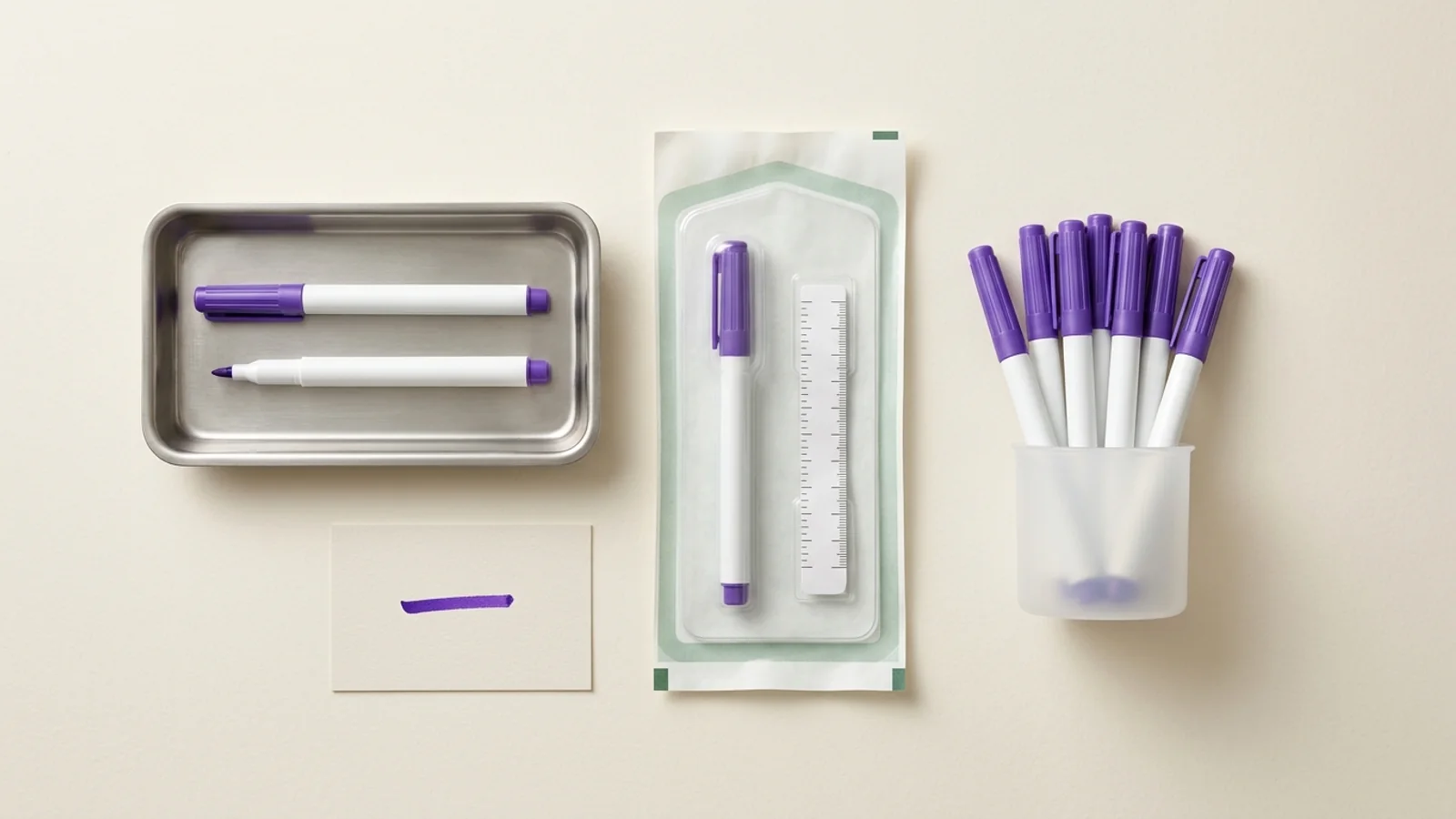
The only specification you get is the label
Picture a common standardization job: one skin-marker contract line for pre-op intake, procedure rooms and the operating room. A distributor offers a non-sterile 100-count dispenser and describes the ink as “FDA approved gentian violet.” Before comparing prices, settle what can actually be verified. The FDA product classification record for product code FZZ lists the skin marker as a Class I device whose submission type is “510(K) Exempt.” Markers that stay within that exemption reach the market without a 510(k) clearance letter or a summary you could compare across suppliers.
What you can compare is printed on the pack and in the IFU. Three documented fields decide whether a given SKU fits where you plan to use it:
Ink identity: whether the IFU says the product contains gentian violet, whether the family is labeled gentian-violet-free, and whether the manufacturer sells it as prep-resistant. The ink also decides whether a California Proposition 65 warning is in play.
Sterility claim: whether the part number is supplied sterile or non-sterile. The manufacturer reviewed here ties sterile supply to marking patients inside the O.R. and positions non-sterile supply for marking before surgery in a non-sterile environment.
Intended surface: the intended purpose and precautions printed in the current IFU: intact skin, external use only, not for newborns and, for one ink family, not for ocular use.
The rest of this guide works through each field with the regulator records, current IFUs and database entries behind it. It ends with a SKU record you can hand to suppliers during a tender or a brand switch. Because one manufacturer’s IFUs were reviewed at part-number depth, treat its part numbers as worked examples, not as a market census.
What the regulation actually says about a skin marker
The classification regulation, 21 CFR 878.4660, identifies a skin marker as “a pen-like device intended to be used to write on the patient’s skin, e.g., to outline surgical incision sites or mark anatomical sites for accurate blood pressure measurement.” It places the device in Class I (general controls) and exempts it from premarket notification “subject to the limitations in § 878.9.” The FDA classification record adds the operational details: review panel General & Plastic Surgery, device class 1 and “GMP Exempt? No.” A 510(k) exemption is not an exemption from FDA’s manufacturing quality requirements, so supplier qualification still has quality-system evidence to ask for.
The exemption also has edges. Under 21 CFR 878.9, it reaches a device only to the extent that it has “existing or reasonably foreseeable characteristics” of devices already in the generic type. A 510(k) is still required when a device is intended for a different use, or when it “operates using a different fundamental scientific technology.” For a buyer, this means a marker marketed for something other than writing on skin is no longer a plain FZZ purchase. In that case, ask the supplier for the regulatory basis of that claim rather than assuming the exemption covers it.
Older paperwork does exist. FDA’s 510(k) database holds K844865, the Securline Surgical Skin Marker 1000 from Precision Dynamics Corp. It was received on December 14, 1984 and found substantially equivalent on January 14, 1985, and the database now files it under product code FZZ. That decision predates the 1988 classification rule that created § 878.4660, and the database shows no summary or statement for it. It is history, not a specification for any SKU on today’s contract.
Intended surface: the first field to check
Before tip size or barrel color, read the intended purpose. The manufacturer’s current traditional-ink IFU (VLIT-45 Ver.2) and gentian-violet-free IFU (VLIT-56 Ver.1), both dated 21 September 2026, print the same intended purpose word for word: “Marking anatomical sites on intact skin prior to surgical procedures.” Both name the intended user as clinicians working on patients. The precautions are where the two families differ:
| Printed precaution | Traditional ink IFU | Gentian-violet-free IFU |
|---|---|---|
| “Marker is for External Use, not internal use.” | Printed | Printed |
| “Not for use on newborns” | Printed | Printed |
| “Not for ocular use” | Not printed | Printed |
| Reuse of a single-use device “could result in infection/contamination and/or device failure” | Printed | Printed |
| Ink disclosure | “Product contains Gentian Violet ink.” | No gentian violet notice |
Record these lines verbatim for each ink family on the contract. Don’t carry a restriction from one family’s IFU to another, and don’t treat its absence on one IFU as permission. The IFU states the restriction but not the reason for it, and this guide does not add one. If a department needs a marker for a use the IFU doesn’t describe, that is a question for the supplier, in writing.
Ink identity: gentian violet, gentian-violet-free and prep-resistant families
The manufacturer’s marker category page sorts its range into five families: gentian violet ink surgical markers, prep-resistant ink skin markers, gentian-violet-free ink skin markers, easily removable ink aesthetic skin markers and permanent ink utility markers. Its IFU index then splits the skin-marking families into four IFUs, each with its own sterile and non-sterile part numbers. The table summarizes what those documents state and what a buyer should record.
| Family | What the manufacturer documents state | What to record or request |
|---|---|---|
| Traditional gentian violet | IFU notice: “Product contains Gentian Violet ink.” The mini marker page positions it for “procedures where less aggressive prep solutions like Betadine® or Iodine are used.” | Gentian violet content, the California warning status and which antiseptics the supplier has tested against |
| Prep-resistant (ViXL) | Its own IFU (Ver.1, 21 September 2026) with separate non-sterile and sterile part numbers | The test evidence behind “prep-resistant,” including which antiseptic and method were used |
| Gentian-violet-free | IFU VLIT-56 adds “Not for ocular use.” Non-sterile 1406 and 1481GVF; sterile 1407, 1437GVFSR, 1437GVFSRL9 and 1481GVFSR | The family’s own precautions; don’t assume they match the traditional family |
| Gentian-violet-free prep-resistant (ViXL red and green) | New IFU, Ver.0, dated 6 October 2026. The 2019 Proposition 65 declaration called the red and green XL markers “very visible after prepping with CHG.” | The IFU revision date and confirmed part numbers at award, because the family is newly documented |
| Easily removable aesthetic | Listed on the category page; no IFU fields reviewed for this guide | The current IFU before any contract line is created |
| Permanent utility | Listed in the same marker category as the skin markers | Confirmation that the item is labeled for skin; keep utility markers off skin-marker lines |
That last row is a real procurement trap. The Pennsylvania Patient Safety Authority’s 2008 advisory on surgical site markers reports that AORN recommends checking the marker label, “because some manufacturers sell markers for use on skin (i.e., surgical site markers) and markers for utility use (e.g., labeling medications).” A catalog that lists both under one heading makes the wrong substitution easy.
Prep-resistance and visibility claims deserve the most caution. The same advisory reviewed three performance studies and found that none “was conclusive in determining the best performance of marks on skin when used with skin prep solutions.” It adds that the studies are not directly comparable because they used different inks and different prep solutions. Two details are still useful for specification work:
In one 2008 study that used permanent ink markers rather than surgical marking pens, a chlorhexidine prep was 21.8 times more likely to erase the mark than an iodine povacrylex and isopropyl alcohol prep. Your antiseptic is part of the question, so name it when you ask a supplier for test data. Antiseptic selection itself is a separate purchasing decision; the skin-prep wipes guide covers that boundary.
An older comparison of 13 commercially available gentian violet pens attributed differences in mark length and clarity to the tips rather than the ink, and one brand produced no discernible mark in any test. Record tip type as its own field instead of treating “gentian violet” as a complete description.
Removal belongs in the record as well. Both IFUs instruct users to “remove ink with vigorous scrubbing using an alcohol swab” after surgery. The advisory frames the target as a mark that is not easily removed by the prep but does not last weeks or months. A family sold as harder to wash off may also be harder to remove, so ask the supplier how its removal instruction differs, if at all.
The gentian violet warning layer: Proposition 65 and Health Canada
California’s OEHHA chemical page shows gentian violet as currently listed under Proposition 65 as causing cancer. The date of listing is 11/23/2018 and the basis is “State’s Qualified Experts.” OEHHA links its hazard identification document, “Evidence on the Carcinogenicity of Gentian Violet,” updated January 17, 2019. The state’s Proposition 65 fact sheet identifies gentian violet with crystal violet and explains that Proposition 65 “requires businesses to determine if they must provide a warning about significant exposure.” Proposition 65 works through warnings; the listing does not ban the chemical or the devices that contain it.
The manufacturer’s Proposition 65 declaration, published January 8, 2019, states that its purple surgical skin markers contain gentian violet (crystal violet, CAS No. 548-62-9) unless otherwise stated. It also says that, to its knowledge, gentian violet is common to all purple surgical skin markers on the market, which is a manufacturer statement rather than a market survey. The company commits to label gentian-violet products shipped to California, points to its red and green XL markers as alternatives, and says it was testing other ink formulae. It also asserts that its diluted ink “is NOT TOXIC” at marking dosage and passed three toxicology tests. That is the manufacturer’s own assessment, not independent comparative evidence. Since then, a gentian-violet-free family with its own IFU has appeared in the same IFU index.
For the SKU record, two practical consequences follow. First, a Proposition 65 warning on a marker box is a statutory notice, not evidence of a defect, but the warning status belongs in the record for any California delivery point. Second, moving to a gentian-violet-free family changes more than the ink color. You inherit that family’s own IFU, including its “Not for ocular use” line, and its own performance claims, so re-run the intended-surface and prep questions instead of treating the switch as a like-for-like swap.
Sterile for the O.R., non-sterile for pre-op, single-patient either way
The manufacturer’s mini traditional marker page lists both “marking patients prior to surgery in a non-sterile environment” and “marking patients within the O.R. (sterile only)” as indications. That pairing of location and sterility claim gives you a clean way to split contract lines: a sterile SKU on the O.R. line and a non-sterile SKU for pre-op marking outside the sterile field. The sterile-versus-nonsterile ultrasound gel guide applies the same buy-for-the-use-location logic to a different consumable.
Sterility is assigned per part number, not per ink family. The same page lists four versions of one marker: 1451-1000 (non-sterile, 1000 ct), 1451-200 (non-sterile, 200 ct), 1451W-100 (non-sterile, proof of use, 100 ct) and 1451SR-100 (sterile, 100 ct). In the IFU index, the traditional-ink IFU alone covers 13 non-sterile and 19 sterile part numbers. The traditional-ink IFU’s own symbol block shows the split. One row carries a “STERILE R” symbol, the symbol for sterilization by irradiation, beside a CE mark with the number 2797. The other row carries a “NON STERILE” symbol and a CE mark without a number. Both rows show the do-not-reuse symbol and a 15 °C to 25 °C temperature range.
Pack descriptions need the same scrutiny. The distributor listing for part 1451-1000 reads “100/Box,” while the manufacturer page lists 1451-1000 as a 1000-count item. The two descriptions may refer to different pack levels, but a purchase order cannot tell which. Your record should therefore store the pack level and count against every part number, and receiving should confirm them. The same listing describes the markers as “single patient use markers” that “provide an economical alternative to opening a sterile package.” That fits the labeled pre-op use, provided non-sterile stock never migrates onto the O.R. line.
Neither format is a multi-patient item. The manufacturer states that “all Viscot Medical Markers are designed for single patient use,” and both IFUs carry the reuse warning quoted above. All five GUDID records reviewed in the next section, including the non-sterile ones, are flagged single-use.
The contamination evidence supports that labeling without overstating it:
The Pennsylvania advisory summarizes three sterility studies of single-use surgical marking pens that found no bacterial growth. Two of them reported 60 and 41 negative cultures.
In a cross-contamination study in the same advisory, MRSA did not survive 15 minutes on permanent marking pens but survived up to three weeks on surgical marking pens. The advisory attributes the difference to ink that used water as its main solvent, and it concludes that facilities “may want to consider using surgical marking pens for single-use only.”
A 2023 Cureus study cultured ten pens that five plastic surgeons had used repeatedly in office settings. Two grew coagulase-negative staphylococci and one grew Pseudomonas aeruginosa, while five sterile control pens grew nothing. After the pens marked mock patients and a povidone-iodine paint prep was applied, two of ten samples still grew coagulase-negative staphylococci.
The Cureus authors call their results insufficient to establish an association between multiply used pens and surgical site infections, or to show that single-use pens reduce them. They also note that the Joint Commission’s Universal Protocol makes no specific recommendation on the type of marking tool, on sterile pens or on using a pen only once. In the sources reviewed here, the single-patient expectation therefore comes from the device labeling, not from that protocol. Buy pack formats that make one pen per patient practical in each location.
Reading GUDID records before you standardize SKUs
The openFDA UDI query for “surgical skin marker” returned 12 records. The five shown below all carry product code FZZ, device class 1, regulation 878.4660 and the GMDN term “Skin marking pen, single-use” (code 61575), and all are flagged single-use. They still disagree on fields that matter at receiving. The UDI and GUDID receiving guide explains the general capture workflow; the table shows what these specific records say.
| Labeler and model | Record description | Sterile | Sterilize before use | Identifiers in record |
|---|---|---|---|---|
| Scanlan PrepMARK 1001-730 | Gentian violet, regular tip, one per sterile package | Yes | No | Primary DI |
| McKesson 19-0751 | Regular tip, sterile | Yes | No | Primary DI plus case-of-50 package DI |
| McKesson 19-0771 | Duotip, sterile | Yes | No | Primary DI plus case-of-50 package DI |
| Sklar 10-1440 | Sklar Surgical Skin Marker 50 | No | Yes, moist heat or steam | Primary DI plus unit-of-use DI |
| Med Saver (MSI) 1436SR-100 | Ultra fine tip, ruler, 100 per box | No | Yes, moist heat or steam | Primary DI |
Three lessons carry over to any standardization project:
Single-use and sterile are separate fields. Two records describe single-use, non-sterile markers with a “sterilize prior to use” instruction by moist heat or steam. Don’t infer sterility from a description, a part-number suffix or the presence of a ruler: the MSI record describes a ruler-equipped 100-per-box marker yet lists it as non-sterile. GUDID entries are submitted by labelers and can lag the printed label, so when a record and the physical pack disagree, ask the labeler which one is current.
Pack-level identity lives in the record. The McKesson records pair a primary DI with a package DI for a case of 50. Map the identifier you will actually scan at receiving to your item master, so a case is never counted as a single marker or the reverse.
Latex statements vary. The McKesson and Sklar records are labeled as not made with natural rubber latex, while the Scanlan and MSI records carry neither latex statement. Record what each record says rather than assuming a default.
Product code FZZ is also broader than pens. It also covers reusable skin marking guides, such as Freeman-style areola markers, that are listed under the GMDN term “Skin marking guide, reusable” with steam sterilization before use. A product-code filter alone can mix these into a pen tender, so filter on the GMDN term as well. Storage and distribution evidence for the chosen SKUs can then follow the approach in the labeled storage and transport guide.
A skin-marker SKU record for tenders and switching
Ask each supplier to complete one record per part number, and check the answers against the physical label at goods receipt. Every field below comes from a document a supplier can produce: the label, the IFU, a regulator database or a written declaration.
| Field | What to record | Where it comes from |
|---|---|---|
| Regulatory identity | 21 CFR 878.4660, product code FZZ, Class I, 510(k)-exempt; GMDN term “Skin marking pen, single-use” | FDA classification record; GUDID record |
| Ink family | Traditional gentian violet, gentian-violet-free, prep-resistant or gentian-violet-free prep-resistant | IFU title and notice line; manufacturer IFU index |
| Colorant disclosure | Gentian violet (crystal violet, CAS 548-62-9) present or absent | IFU notice; supplier declaration; safety data sheet if the supplier provides one |
| California Proposition 65 | Whether a warning is applied to shipments into California | Supplier’s written Proposition 65 position |
| Sterility claim | Sterile with the sterilization symbol shown (for example, STERILE R), or non-sterile; any “sterilize prior to use” instruction | Pack label; IFU symbol row; GUDID sterilization fields |
| Labeled use location | Marking inside the O.R. (sterile only) or before surgery in a non-sterile environment | Manufacturer product documentation |
| Intended surface and precautions | Verbatim: intact skin, external use, not for newborns, not for ocular use where printed | Current IFU revision |
| Single-use statement | Do-not-reuse symbol, reuse warning text, GUDID single-use flag | Label; IFU; GUDID |
| Tip and accessories | Regular, fine or dual tip; ruler or labels if included | Product page; GUDID description |
| Part number, pack level and count | Each, box and case quantities against each part number | Manufacturer page; distributor quote; GUDID package DI |
| Device identifiers | Primary DI, package DI and quantity, unit-of-use DI | GUDID record |
| Storage | Temperature symbol (15 °C to 25 °C on the reviewed IFUs); any orientation instruction, such as horizontal or tip down | IFU symbols; supplier or distributor direction |
| Removal instruction | For example, “remove ink with vigorous scrubbing using an alcohol swab” | IFU |
| IFU revision and market labeling | Document number and date; EU authorized representative and serious-incident wording if sourcing for Europe | IFU; manufacturer IFU index |
Build change control into the supply contract, because this portfolio is visibly moving. The manufacturer’s IFU index shows three skin-marker IFUs revised on 21 September 2026 and a new gentian-violet-free prep-resistant IFU dated 6 October 2026. Your quality agreement should require advance notice of changes to ink formulation, sterility status, part numbers, pack counts or IFU content, delivered with the revised IFU and the updated GUDID entry. A changed ink family should trigger a fresh review of the intended-surface and Proposition 65 fields, not just a price update.
Back to the distributor’s offer. A non-sterile 100-count dispenser can fill the pre-op line if its label shows single-patient use and the manufacturer positions it for marking outside the sterile field, provided a sterile SKU stays on the O.R. line. “FDA approved gentian violet ink” tells you only that the ink is gentian violet. So record its Proposition 65 consequence, decide whether a gentian-violet-free family is needed, and confirm the pack count against the manufacturer’s part number before you sign.