
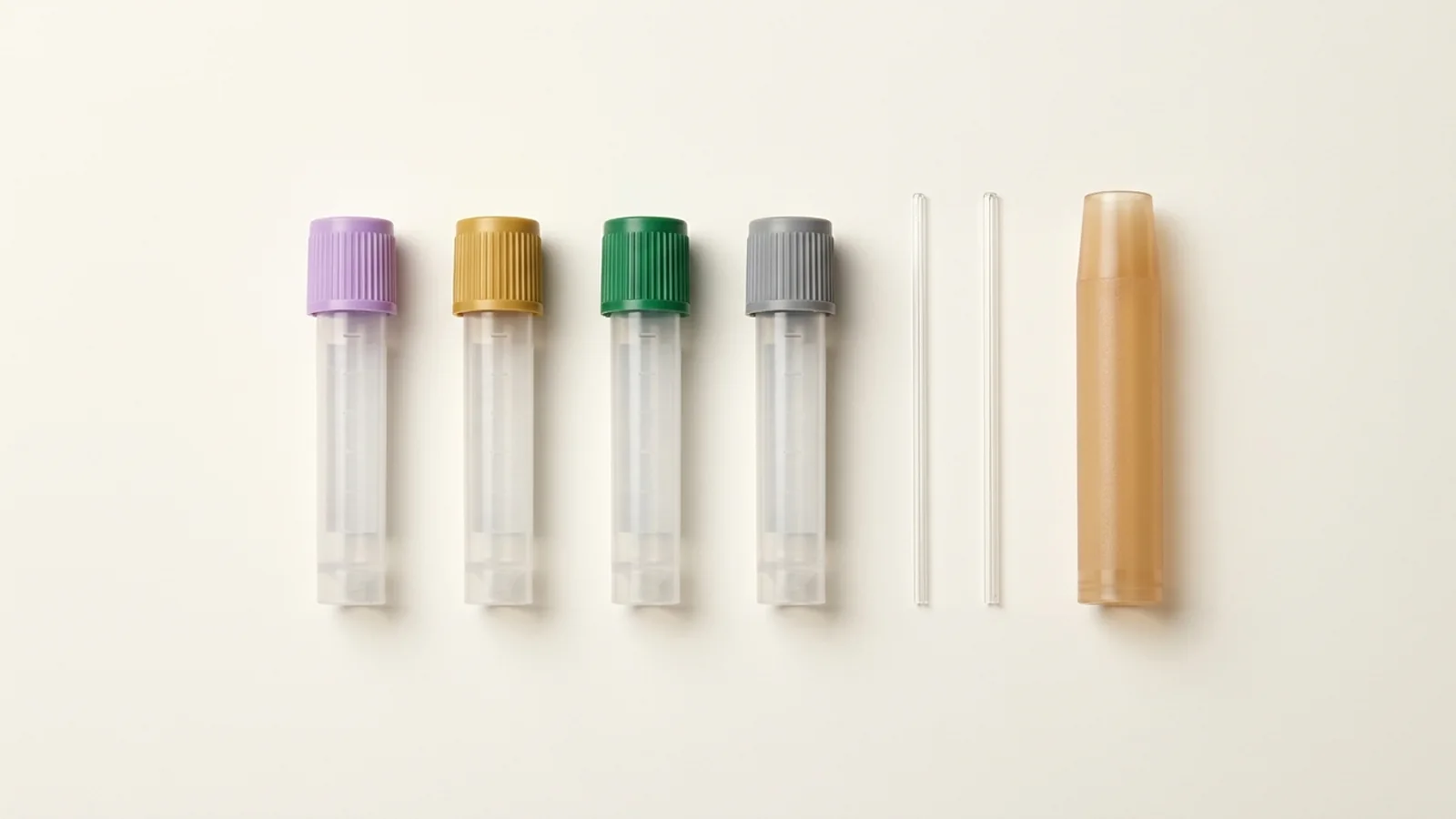
When hospital procurement officers, clinical supply chain managers, or distributor sales representatives restock pediatric and point-of-care specimen consumables, they frequently encounter near-identical lavender-topped micro-tubes across competing catalogs. Sourcing teams often assume these products represent a single interchangeable commodity governed by standard phlebotomy specifications. Capillary blood collection tubes split into two fundamentally different FDA device families governed by separate regulations and premarket pathways. Additive-coated plastic micro-containers (such as BD Microtainer, Greiner MiniCollect, and SARSTEDT Microvette) are classified as Class II blood specimen collection devices under 21 CFR 862.1675 (product code JKA: tubes, vials, systems, serum separators, blood collection). PRJ is a different Class II code for alternative-site capillary collectors. GIM is not the default code for these micro-containers: FDA names GIM "tubes, vacuum sample, with anticoagulant." Class II blood specimen collection devices require 510(k) clearance. A current capillary example is BD's MiniDraw SST system, cleared under K230391 in December 2023. In contrast, plain or heparinized glass capillary tubes are classified as Class I, 510(k)-exempt devices under 21 CFR 864.6150 (FDA product code GIO).
The common assumption that the international phlebotomy standard ISO 6710 governs capillary tube purchasing is incorrect. The published scope of ISO 6710:2017 applies exclusively to evacuated and non-evacuated containers for human venous blood specimen collection, as detailed in our guide to evacuated venous blood collection tubes. For capillary specimen collection, the governing consensus standards recognized by the FDA under product code JKA are published by the Clinical and Laboratory Standards Institute (CLSI), centered on CLSI GP42, 7th Edition (2020) (FDA recognition number 7-301), alongside GP39-A6 and GP34-A, which FDA also lists under product code JKA. Putting ISO 6710 into a capillary-tube tender asks the supplier to certify a venous-container standard.
To avoid purchasing stock that distorts laboratory results or fails incoming warehouse inspection, buyers must evaluate four verifiable technical fields before releasing purchase orders: (1) nominal fill volume and printed graduation marks, because Greiner's US instructions say under-filling can change cell morphology through excess anticoagulant and over-filling can cause clotting; (2) chemical additive and vendor closure coding, recognizing that closure colors are manufacturer conventions rather than universal ISO mandates (for example, SARSTEDT uses brown closures for serum-gel micro-tubes while Globe Scientific codes glass capillary tubes with colored tip bands); (3) tube material and equipment compatibility, contrasting modern polypropylene micro-containers against glass capillary tubes that carry a standing February 1999 joint FDA/NIOSH/OSHA safety advisory on puncture wounds and bloodborne pathogen exposure; and (4) the sterility statement, storage temperature, and prescription line actually printed on the label, verifying printed lot numbers, expiration dates, and labeled storage limits (typically 4–25°C or below 25°C) across all secondary packaging.
Two Device Families, Two FDA Paths
The initial specification checkpoint for hospital buyers is identifying which statutory device classification applies to the quoted line item. In the United States, blood collection tubes are not regulated under a single catch-all medical consumable code. The Food and Drug Administration maintains a clear regulatory division based on tube material, collection mechanism, and incorporated chemical additives.
Under 21 CFR 862.1675 (Clinical Chemistry and Clinical Toxicology Devices), a blood specimen collection device is defined as an apparatus intended to collect and handle blood specimens and separate serum from cellular components prior to in vitro diagnostic examination. Devices falling under this regulation are classified as Class II. Three product codes under this regulation matter to a capillary quote, and they are not interchangeable:
Product Code JKA (Tubes, Vials, Systems, Serum Separators, Blood Collection): Assigned to primary specimen containers, microcollection tubes, and separator systems. Devices registered under JKA require premarket notification through the 510(k) pathway, reviewed by CDRH's Office of In Vitro Diagnostics.
Product Code GIM (Tubes, Vacuum Sample, With Anticoagulant): This is the FDA device name for vacuum sample tubes that contain an anticoagulant. It is the code buyers already use for many evacuated venous anticoagulant tubes. It is not a general label for every capillary micro-container. BD's MiniDraw H&H capillary system was cleared under GIM as K230493 on November 27, 2023, so a capillary tube can carry GIM when its own 510(k) says so. Read the code on that submission. Do not copy it from cap color.
Product Code PRJ (Capillary Blood Collection Device for Alternative Site Collection): FDA defines PRJ as a capillary blood collection device for alternative-site collection, with or without integrated micro-needles, used to collect capillary whole blood for in vitro testing. The product-code record describes the physical state as a sterile blood collection device. PRJ is Class II and requires its own 510(k). The record does not define PRJ as a routine fingerstick micro-tube. Read the 510(k) for the collection site and for whether micro-needles are part of that device.
Demonstrating that this pathway remains actively enforced for modern capillary systems, Becton, Dickinson and Company received 510(k) clearance for the BD MiniDraw Capillary Blood Collection System with SST tube under K230391 on December 1, 2023, under 21 CFR 862.1675 and product code JKA. The predicate named in the 510(k) summary is K991702, the BD Microtainer SST, which is itself a capillary tube. The summary also says fingerstick samples were compared with capillary and venous tubes. That comparison is not the predicate, and the clearance is not a blanket 510(k) for the routine Microtainer catalog. The indications are limited to people 18 years and older and to a stated list of chemistry analytes. The SST tube is not cleared for other analytes. A separate Microtainer example is K002456, the sodium fluoride/EDTA tube with Microgard closure, model 365992, also product code JKA, cleared November 2, 2000.
Conversely, traditional microhematocrit tubes operate under a separate regulation in the Hematology panel. Under 21 CFR 864.6150, a capillary blood collection tube is defined as a plain or heparinized glass tube of very small diameter used to collect blood by capillary action. These devices carry FDA product code GIO (Tube, Collection, Capillary Blood) and are classified as Class I (General Controls). Under the terms of 21 CFR 864.9, GIO devices are exempt from 510(k) premarket notification requirements, provided the manufacturer does not alter the fundamental scientific technology or introduce novel intended uses.
| Device Family | FDA Regulation | Product Code | Device Class | 510(k) Requirement & Scope |
|---|---|---|---|---|
| Plastic Additive Micro-Containers | 21 CFR 862.1675 | JKA unless the 510(k) states GIM | Class II | 510(k) clearance required; evaluated for additive stability and analytical performance |
| Alternative-Site Capillary Collectors | 21 CFR 862.1675 | PRJ | Class II | 510(k) required. FDA describes a sterile alternative-site collector, with or without integrated micro-needles. |
| Plain Glass Capillary Tubes | 21 CFR 864.6150 | GIO | Class I | 510(k) exempt under 21 CFR 864.9; general controls and establishment registration apply |
| Heparinized Microhematocrit Tubes | 21 CFR 864.6150 | GIO | Class I | 510(k) exempt under 21 CFR 864.9; sodium or ammonium heparin coated for packed cell volume |
| Plastic Blood Gas Capillary Tubes | 21 CFR 864.6150 | GIO | Class I | The regulation text identifies a glass tube and exempts it from 510(k) subject to 21 CFR 864.9. FDA coded SAFE-T-FILL plastic blood-gas tubes as GIO. Confirm the listing. Do not treat every plastic capillary tube as GIO. |
A tender has to name the code that belongs to the quoted line. Asking for a 510(k) summary on a soda-lime glass capillary tube under product code GIO fights the Class I exemption. Accepting a plastic micro-container without the 510(k) number for its own product code leaves the qualification file incomplete. K230391 does not fill that blank for a Greiner, SARSTEDT, or routine Microtainer SKU.
Why the Evacuated-Tube Standard Does Not Answer This Purchase
A frequent drafting error in hospital supply tenders is copying technical clauses from venous phlebotomy contracts into capillary consumable requests. Procurement specifications often cite ISO 6710 (Single-use containers for human venous blood specimen collection) as the baseline conformity standard for all blood collection consumables across an institution. This standard cannot be applied to capillary tubes.
ISO 6710:2017 is titled for single-use containers for human venous blood specimen collection. Its scope is evacuated and non-evacuated venous containers. Vacuum draw, closure puncture, and vacuum retention over shelf life are venous-tube questions. They do not describe a capillary tube filled by hand to a printed mark. Capillary tubes are filled by capillary action, gravity, or a scoop into an open, non-evacuated chamber. This guide does not copy numeric tolerances out of the paywalled standard.
For capillary specimen containers under product code JKA, the FDA recognizes an entirely distinct suite of consensus standards developed by the Clinical and Laboratory Standards Institute. The primary standard recognized by CDRH in full extent is:
CLSI GP42, 7th Edition (2020) — Collection of Capillary Blood Specimens: Listed in FDA's Recognized Consensus Standards database under standard identification number 41570 and recognition number 7-301 (FR recognition list 055, date of entry December 21, 2020). FDA recognizes the complete standard. The public recognition abstract says GP42 covers collection of diagnostic capillary blood specimens, including capillary blood gases, and requirements for single-use devices used to collect, process, and transfer those specimens. It is written for health professionals who collect specimens and for manufacturers of puncture devices and microcollection containers. It does not cover capillary-puncture procedures for self-testing, and it does not cover procedures for point-of-care testing. This article uses the recognition record as the capillary-container reference. It does not turn GP42 into a skin-puncture procedure.
CLSI GP39-A6, FDA recognition 7-221: On the JKA product-code page, FDA's current recognition title is Tubes and Additives for Venous Blood Specimen Collection, Approved Standard-Sixth Edition, recognition number 7-221. BD's chemistry instructions and Greiner's US instructions cite the longer title, Tubes and Additives for Venous and Capillary Blood Specimen Collection, Approved Standard, Sixth Edition. Use the recognition number to find the record, and use the quoted instructions for the additive and fill volume. The paywalled concentration tables are not reproduced here.
CLSI GP34-A — Validation and Verification of Tubes for Venous and Capillary Blood Specimen Collection: Defines analytical protocols for evaluating tube interference, analyte stability, and physical container integrity during clinical laboratory testing.
flowchart TD
    A["Blood specimen consumable request"] --> B{"Venous evacuated tube or capillary container?"}
    B -- "Venous evacuated container" --> C["21 CFR 862.1675 and ISO 6710 venous scope\nGIM: vacuum sample tubes with anticoagulant\nJKA: tubes, vials, systems, serum separators"]
    B -- "Capillary container" --> D{"Format on the label and the 510(k)"}
    D -- "Plastic micro-container" --> E["21 CFR 862.1675 Class II\nConfirm the product code\nCited examples are JKA\nCLSI GP42 recognition 7-301"]
    D -- "Alternative-site collector" --> F["21 CFR 862.1675 Class II\nProduct code PRJ\n510(k) required\nFDA physical state: sterile"]
    D -- "Glass capillary or plastic blood-gas capillary" --> G["21 CFR 864.6150 Class I\nProduct code GIO\nIdentification text says glass\nSAFE-T-FILL plastic tubes were coded GIO\n510(k) exempt subject to 864.9"]
    E --> H["Check nominal volume, fill mark, additive name, and IFU limits"]
    F --> H
G --> I["Check tip color, glass versus plastic, and the 1999 breakage advisory for glass"]When configuring tender evaluation criteria, hospital supply chain teams must require vendors to demonstrate conformity with CLSI GP42 rather than ISO 6710. In US instructions 980204US Rev04, Greiner states that additive concentrations, permitted tolerances, and the blood-to-additive ratio follow CLSI requirements and recommendations, and it cites GP42-ED7 for the order of draw. The references also list GP39-A6 and GP34-A. Ask for the records that support the quoted item. Do not treat a citation of GP42 as a completed certificate of numeric tolerances.
Fill-Volume Checks: The Fill Line Is the Specification
In an evacuated venous tube, vacuum draws a predetermined volume. A capillary micro-container is not evacuated. Blood is transferred into it with a scoop, funnel, or capillary. Because the volume is manual, the printed fill mark is the labeled specification that sets the blood-to-additive ratio.
Capillary micro-containers are pre-dosed with a fixed mass of dry spray-coated or liquid additive calibrated precisely to achieve a specific target concentration when blood reaches the nominal fill mark. Deviating from the fill line causes severe pre-analytical specimen errors that can corrupt automated laboratory results:
Under-filling consequences (Excess Anticoagulant Concentration): Greiner's US instructions state the labeled consequence: under-filling can cause morphologic changes in cells because the anticoagulant is then in excess, and over-filling can result in clot formation. BD's chemistry instructions say the fill must stay inside the specified range so the blood-to-additive ratio remains valid, and that over-filling or under-filling may produce incorrect analytic results or poor product performance. On K2EDTA SKU 365974, BD states an average of 1.0 mg of K2EDTA for a 250–500 µL fill. A volume outside that labeled range is a different ratio from the one the tube was built for. This guide does not convert the label into a fold-change, a hematocrit bias, or a red-cell index.
Over-filling consequences (Anticoagulant Depletion & Clotting): Greiner also states that insufficient or delayed mixing in additive tubes may result in platelet clumping, clotting, or incorrect test results. That labeled failure mode is the one to write into receiving notes.
Because fill volume directly impacts analytical accuracy, commercial micro-collection manufacturers publish exact nominal volume bands marked by physical fill lines on the transparent polypropylene container walls:
BD Microtainer Tubes: K2EDTA lavender SKU 365974 is labeled 250–500 µL, with printed fill lines on the tube. In the chemistry-tube instructions, Table A lists serum with no additive at 250–500 µL (red closure), SST with clot activator and gel at 400–600 µL (gold, clear or amber reservoir), lithium heparin at 200–400 µL (green), and a shared 400–600 µL cell for PST gel (light green, clear or amber reservoir) and fluoride (gray, sodium fluoride/disodium EDTA).
Greiner MiniCollect Tubes: The cited US instructions, 980204US Rev04, give one nominal volume per tube type: K2EDTA and K3EDTA 0.5 mL, serum clot activator 1.0 mL, serum gel 0.8 mL, lithium heparin 1.0 mL, and lithium-heparin gel 0.8 mL. The tube is filled to the single fill mark for that nominal volume. Those instructions do not describe dual 0.25 mL and 0.5 mL marks on one EDTA tube. If a shop card shows a different nominal volume, match it to the item number and the current instructions before writing it into the tender.
SARSTEDT Microvette Tubes: The cited US variant list for Microvette 100/200 with capillary states nominal volumes of 100 µL and 200 µL for K3EDTA, serum clot activator, serum gel, lithium heparin, and fluoride/heparin preparations. It does not describe how the capillary is attached, whether a graduation is printed, or how the nominal volume was calibrated. Those fields stay unknown until the supplier's instructions state them.
Mixing counts are brand-specific. Greiner's US instructions say to invert gently without removing the cap, tap the tube so the additive contacts the blood, and not to shake, because vigorous shaking may cause foaming and hemolysis. They do not prescribe a 5-to-10 inversion count. BD's chemistry instructions say to invert SST tubes 5 times and plasma tubes 8 to 10 times immediately after collection. A tender that copies one brand's mix count onto the other is not quoting either label.
Additive and Closure-Color Checks
Selecting capillary consumables requires precise verification of the active chemical formulation. While venous evacuated tubes have largely coalesced around uniform color habits across major North American hospital systems, closure colors in capillary micro-collection remain manufacturer-specific conventions. Sourcing specialists must never order capillary tubes based on cap color alone.
The primary chemical additives utilized in capillary micro-containers comprise four main classes:
Dipotassium vs Tripotassium EDTA: BD's page for K2EDTA SKU 365974 states an average of 1.0 mg of K2EDTA, enough for 250–500 µL, and certifies that tube for lead testing with a background below 1 ng of lead per tube. That lead statement is for this SKU, not for every Microtainer closure. Greiner's US instructions offer both K2EDTA and K3EDTA at 0.5 mL and say the EDTA coats the tube wall. The cited pages do not give a dilution percentage for K3EDTA. Specify the salt and the labeled fill volume, and do not invent a dilution factor.
Lithium Heparin Anticoagulation: Greiner's US instructions say lithium heparin coats the tube wall and activates antithrombins, which block the coagulation cascade and yield whole blood or plasma for clinical chemistry. The same instructions say not to use lithium heparin tubes for lithium determinations.
Clot activators and separator gels: BD's chemistry instructions coat SST tubes with micronized silica and place a separator gel in the bottom of the tube. Greiner's US instructions describe the barrier as an inert acrylic material. Do not copy another brand's gel description onto this tube. Centrifuge settings are also not interchangeable. Greiner recommends 3,000 g, within 1,600–5,000 g, for 10 minutes at 15–24°C. BD recommends 6,000–15,000 g for 90 seconds for gel tubes and a minimum of 2,000 g for 3 minutes for non-gel tubes, and it says alternate conditions need laboratory evaluation. Write the quoted instructions' centrifuge line into the tender.
Glycolytic Inhibitors: Gray-topped capillary tubes combine sodium fluoride with disodium EDTA or potassium oxalate to arrest erythrocyte glucose metabolism, preserving accurate blood glucose concentrations during transport delays.
Furthermore, hospital buyers must respect manufacturer-labeled diagnostic limitations when evaluating line-item substitutions. Greiner Bio-One's official US instructions explicitly state that separator gel tubes are not for therapeutic drug monitoring (TDM), blood banking, and molecular diagnostics. The same instructions apply that limit to MiniCollect plasma tubes in general, not only to gel tubes, and they repeat the lithium-determination limit for lithium heparin. They do not name individual drugs or describe gel absorption. The purchasing control is the labeled limit: do not move a Greiner plasma or gel micro-tube onto a therapeutic-drug, blood-bank, or molecular order because the cap looks familiar.
The cited instructions also limit how far a venous result can stand in for a capillary result, and they do not assign a direction to any analyte. Greiner says skin-puncture and venous chemistry results may differ by a statistically or clinically significant amount, and that the report should state that the blood was collected by skin puncture. BD's chemistry instructions tell the laboratory to judge whether those differences matter before switching specimen types. Order of draw is an instruction-for-use field, and the two labels do not match. Greiner, citing CLSI GP42-ED7, collects the EDTA tube first, then other additive tubes, then serum. BD's chemistry instructions list capillary blood gas, then EDTA, then other additive tubes, then non-additive tubes, then dried-blood-spot filter paper. Write the sequence from the quoted instructions into the tender. Do not paste a venous order of draw, or one brand's capillary sequence, onto the other brand.
Material and Equipment Fit: Plastic Versus Glass
Physical construction and instrumentation fit represent another critical procurement boundary. Historically, capillary phlebotomy was dominated by glass capillary and microhematocrit tubes. Over the past three decades, regulatory safety initiatives and hospital automation requirements have transformed the container landscape.
Material is a labeled field, not a shared plastic grade. BD's K2EDTA page states that those tubes are polypropylene and the caps are HDPE, and that the Microgard closure integrates a collection scoop. Greiner's US instructions call the tubes plastic and fit them with a cross-cut cap that a funnel or capillary can pass through. They do not name the polymer or call the cap silicone or rubber. The cited SARSTEDT variant list is titled Microvette 100/200 with capillary and gives cap color, additive, nominal volume, and outside dimensions. It does not state the polymer, and it does not describe a pre-attached straw. Do not copy one brand's material or collector onto the others. A plastic tube avoids the glass-breakage hazard in the 1999 advisory. It does not remove every handling or centrifugation risk. Confirm the quoted item's material on its own instructions.
External size is a labeled field, not a shared envelope. BD states that Microgard-closure tubes measure 15.35 mm by 46 mm and FloTop-collector tubes measure 9.85 mm by 52.07 mm. Greiner's US instructions give 11.5 mm by 42 mm without the cap and 13 mm by 43.5 mm with the cap. Neither size is a 13 x 75 mm or 13 x 100 mm analyzer tube. The carrier or extender has to be on the quote if the laboratory loads standard racks. Buyers should specify the compatible 13x75 mm carrier tubes and tube extenders:
BD Microtainer Tube Extenders: BD's chemistry instructions list an optional tube extender, catalog 368933. It fits into the bottom of the tube, increases length to about 75 mm, and lets the tube sit in a standard 13 x 75 mm rack. It also adds labeling area.
Greiner carrier tube: Greiner's US instructions describe a 13 x 75 mm carrier tube as the adapter for centrifuge rotors and analyzer racks, and an amber carrier tube for serum and serum-gel tubes when bilirubin is tested. Confirm that the quoted item number is the carrier assembly the laboratory will actually load.
For traditional microhematocrit determination, glass capillary tubes remain widely available, manufactured from soda-lime or borosilicate glass. However, glass tubes carry a documented occupational hazard that procurement teams must factor into their risk assessments. In February 1999, the FDA, NIOSH, and OSHA issued a joint safety advisory titled "Glass Capillary Tubes: Joint Safety Advisory About Potential Risks," dated February 1999 and circulated by OSHA on February 22, 1999. The advisory says breakage during use can cause a penetrating wound and blood inoculation, with risk of HIV, hepatitis B, and hepatitis C. It identifies breakage when tubes are pushed into putty to be sealed and during centrifugation. It does not state a centrifuge speed.
The advisory recommends considering capillary tubes not made of glass, glass tubes wrapped in puncture-resistant film, sealing methods that do not require pushing one end of the tube into putty, and products that measure hematocrit without centrifugation. It is a recommendation, not a ban. Plain and heparinized glass tubes remain Class I devices under 21 CFR 864.6150. Globe Scientific's category page lists 100% plastic microhematocrit tubes with the same blue, red, and green tip colors as its glass tubes. Fit in the existing rotor, and whether a plastic tube seals with the laboratory's wax or caps, is not stated on that page and has to be checked on the item.
Used capillary tubes and lancets must be disposed of immediately in point-of-use sharps disposal containers conforming to OSHA 1910.1030 and FDA Class II requirements under 21 CFR 880.5570, as detailed in our reference guide to sharps container specifications.
Sterility, Storage, and Label Claims
One of the most persistent misconceptions among hospital purchasing agents is the assumption that all single-use clinical consumables must be delivered sterile. Both BD Microtainer and Greiner MiniCollect capillary tubes are explicitly labeled by their manufacturers as non-sterile, single-use in vitro diagnostic medical devices. Specimen collection containers are external sample receptacles intended to transport fluids to analytical instruments; they do not contact internal sterile body cavities or enter the vascular bloodstream.
Greiner's US instructions describe MiniCollect tubes as "plastic, non-evacuated, non-sterile low sample volume tubes." The BD chemistry-tube instructions checked here open with the same non-sterile, single-use IVD statement, and they add that endotoxin is not controlled and that blood collected in the tube is not for infusion. That BD sentence was not repeated on the K2EDTA SKU 365974 product page, so confirm the EDTA instructions for the quoted item. A tender that demands sterility for these routine lines asks for a claim the cited instructions do not make. The same demand is wrong in the other direction for a PRJ device, which FDA describes as sterile.
Storage temperature stability is another critical labeled specification governed by FDA and ISO labeling rules, as examined in our analysis of labeled storage and transport for medical consumables. Micro-collection tubes must be maintained within strictly defined environmental limits to preserve additive potency and gel barrier integrity:
Greiner MiniCollect Labeled Storage: Store unused tubes at 4–25°C (40–77°F), the Fahrenheit range printed in the US instructions, and avoid direct sunlight. Those instructions say that exceeding the maximum recommended storage temperature may impair tube quality, including drying of liquid additives and coloring. Filled tubes may be stored down to −20°C only when the assay instructions allow freezing. The unused-tube range is not a ban on freezing a filled specimen.
BD Microtainer Labeled Storage: The chemistry instructions say to store tubes below 25°C (77°F). They do not state that heat decomposes the additive or changes the specific gravity of the gel.
Greiner's US label prints this sentence: "Caution: U.S. Federal Law restricts this device to sale by or on the order of a physician." The same label block lists the item number, a do-not-reuse mark, lot, temperature limits, manufacturer, and expiry. BD's chemistry instructions say each tube shows fill levels, and the family page says lot numbers, fill lines, and the expiration date are printed on the tube. If the date on the tube is illegible, BD says to use the polybag, case label, or barcode, and to discard the tube if the date still cannot be determined.
A crucial market check for US buyers involves regional system availability. Greiner Bio-One's international catalog highlights a "MiniCollect New Generation" capillary collection platform featuring integrated capillary scoops. However, Greiner's US website explicitly notes that the MiniCollect New Generation system is pending FDA clearance and is not commercially available in the United States. The US offering named on that page is the original cross-cut cap system. A quote for the New Generation line is a quote for a device the manufacturer says is not available in the United States.
When capillary blood specimens are transported from outpatient clinics to regional reference laboratories, secondary packaging must strictly comply with Category B biological substance packaging standards under UN 3373 and 49 CFR 173.199, as detailed in our technical review of Category B specimen packaging UN 3373.
Receiving Checks: What a Live Recall Teaches
The practical necessity of formal goods-receipt verification for capillary consumables is underscored by a significant recent enforcement action. On November 19, 2025, the FDA posted a Class 2 Recall (Z-0562-2026) affecting SAFE-T-FILL Plastic Blood Gas Capillary Tubes (230 µL sodium heparin, FDA product code GIO). The recall was initiated on September 26, 2025, by distributor ASP Global LLC (Anatomy Supply Partners).
The recall notice reveals a critical supply chain failure: the plastic capillary tubes were manufactured under an inadequate quality management system with unvalidated manufacturing processes at a contract manufacturer. The FDA record lists six lots made from July 31, 2023, through February 28, 2025: 23H4156, 23I4015, 24B4198, 24F4187, 24I4313, and 24J4133. Quantity in commerce is 160,250 units. The UDI-DI is 10643351000311. The posted action tells customers to stop use, quarantine remaining stock, and verify critical or abnormal results with repeat or confirmatory testing. It does not say that every prior result from those lots is analytically wrong. An inner-pack GTIN, 30643351000315, is listed separately from the UDI-DI.
This enforcement case demonstrates that capillary consumables require the same rigorous warehouse receiving controls as high-risk implantable devices. Hospital receiving departments must execute a structured three-step verification protocol:
Step 1: Systematic UDI Capture at Inbound Receiving: Receiving clerks must scan and record the complete Unique Device Identifier (UDI)—capturing both the Device Identifier (DI / GTIN) and Production Identifiers (PI: lot number and expiration date)—directly into the enterprise resource planning (ERP) system, in accordance with the procedures outlined in UDI and GUDID capture for medical consumables. Scanning only the purchase order number leaves institutions unable to track specific lots when recalls occur.
Step 2: Rapid Lot-Level Inventory Reconciliation: When a recall notification is received, inventory teams must reconcile on-hand inventory across central supply, clinical carts, and satellite laboratories by exact lot number, avoiding the operational disruption of quarantining unaffected lots, as guided by our protocol for tracing mixed-lot consumables during a recall.
Step 3: Contractual Quality Agreements for Subcontracted Manufacturing: Because medical consumable brand owners frequently outsource injection molding and anticoagulant spray-coating to third-party contract manufacturers, hospital procurement contracts must incorporate formal quality agreements for consumable suppliers. Ask the agreement to require written notice before a change of manufacturing site, resin, or contract manufacturer. The SAFE-T-FILL recall is the reason for that clause. It is a contract term to negotiate, not a statute quoted from the quality-system regulation.
The Procurement Table: Fields to Write into the Tender
To protect clinical pathology operations and ensure full commercial comparability during competitive bidding, hospital procurement teams should assemble a comprehensive technical matrix. The table below consolidates the verified manufacturer specifications, regulatory classifications, and physical dimensions for major commercial product lines across the US market:
| Specification Field | BD Microtainer | Greiner MiniCollect (US) | SARSTEDT Microvette 100/200 | Globe Scientific Tubes |
|---|---|---|---|---|
| FDA Regulation & Class | 21 CFR 862.1675, Class II | 21 CFR 862.1675, Class II | 21 CFR 862.1675, Class II | 21 CFR 864.6150, Class I |
| FDA Product Code | JKA unless the 510(k) states GIM | JKA unless the 510(k) states GIM | JKA unless the 510(k) states GIM | GIO |
| 510(k) Clearance Basis | K230391 clears MiniDraw SST only (JKA, predicate K991702 BD Microtainer SST, ages 18 and older, listed chemistry analytes). It is not the routine Microtainer clearance. K002456 is one Microtainer fluoride/EDTA clearance, also JKA. | Class II, so a 510(k) is required. The cited US shop page does not print a K number. New Generation is pending FDA clearance and is not available in the United States. | Not stated on the cited variant list. Do not copy K230391 or another brand's clearance onto this line. | 510(k) exempt under 21 CFR 864.9 general controls |
| Recognized Standard | Chemistry IFU cites GP42-ED7 and GP39-A6. FDA recognizes GP42 as 7-301, GP39-A6 as 7-221, and GP34-A as 7-225 under product code JKA. | US IFU Rev04 cites GP42, GP39-A6, and GP34-A. FDA recognition numbers under JKA are 7-301, 7-221, and 7-225. | Not stated on the variant list. JKA's FDA recognition list includes GP42, GP39-A6, and GP34-A. That list is not a SARSTEDT certificate. | Not stated in technical listing |
| Available Nominal Volumes | SKU 365974 K2EDTA 250–500 µL. Chemistry IFU Table A: serum 250–500 µL; SST 400–600 µL; lithium heparin 200–400 µL; PST and fluoride share 400–600 µL. | US IFU Rev04: K2EDTA and K3EDTA 0.5 mL; serum 1.0 mL; serum gel 0.8 mL; lithium heparin 1.0 mL; lithium-heparin gel 0.8 mL. | 100 µL and 200 µL nominal volumes on the cited variants. | Not stated on the category page. The page says the tubes are for packed-cell-volume determination. |
| Fill Line Marking | Printed fill lines. Chemistry IFU Table A gives the acceptable range for each additive. | Fill to the fill mark for the nominal volume in US IFU Rev04. | Not stated on the variant list. The catalog gives nominal volume only. | Color-coded tip. A fill line or a length-based volume is not stated on the category page. |
| Available Additives | K2EDTA (1.0 mg avg), SST silica/gel, Lithium Heparin, PST, NaF/EDTA | K2EDTA, K3EDTA, Clot Activator, Serum Gel, Lithium Heparin, LH Gel | K3EDTA, Serum CAT, Serum Gel, Lithium Heparin, Fluoride/Heparin | Plain (untreated), Sodium Heparin, Ammonium Heparin |
| Closure Color Convention | Lavender K2EDTA (SKU 365974); chemistry IFU: red no additive, gold SST, green lithium heparin, light green PST, gray fluoride. | US IFU: lavender K2EDTA and K3EDTA, gold serum gel, green lithium heparin, light green lithium-heparin gel, red serum clot activator. No gray fluoride tube in that table. | Violet K3EDTA, brown serum gel, red serum clot activator, green lithium heparin, grey fluoride/heparin. | Blue tip (Plain), Red tip (Sodium Heparin), Green tip (Ammonium Heparin) |
| Tube Body Material | Polypropylene tube with an HDPE cap, stated on the K2EDTA page. Microgard closure includes a collection scoop. | US IFU: plastic tube with a cross-cut cap. The polymer and cap elastomer are not named. | Not stated on the variant list. The family name includes a capillary. Polymer and a pre-attached straw are not stated. | Soda-lime glass, borosilicate glass, or 100% plastic |
| Labeled Sterility Claim | Non-sterile, single-use IVD on the chemistry-tube IFU. Confirm the EDTA SKU instructions; that sentence is not on the 365974 product page. | Non-sterile, non-evacuated, single-use IVD in US IFU Rev04. | Not stated on product catalog page | Not stated on the category page. |
| Labeled Storage Limits | Store below 25°C (<77°F) | Unused tubes 4–25°C (40–77°F). Avoid direct sunlight. Filled tubes may go to −20°C only if the assay allows. | Not stated on product catalog page | Not stated on the category page. |
| 13x75 mm Analyzer Carrier | Optional extender catalog 368933 lengthens the tube to about 75 mm for a 13 x 75 mm rack. | US IFU: 13 x 75 mm carrier tube. Amber carrier is for bilirubin with serum and serum-gel tubes. | Not stated on the variant list. | Incompatible; requires microhematocrit centrifuge rotor |
| Critical Labeled Limitations | Chemistry IFU: capillary and venous results may differ; fill must stay in range; endotoxin is not controlled and the tube is not for infusion. Lead below 1 ng per tube is stated for K2EDTA SKU 365974 only. A gel/TDM ban is not in that chemistry IFU. | US IFU: do not use plasma tubes, or serum/plasma gel tubes, for TDM, blood banking, or molecular diagnostics. Do not use lithium heparin for lithium determinations. US physician-only caution. Amber carrier for bilirubin. | Not stated on product catalog page | Glass subject to 1999 FDA/NIOSH/OSHA breakage advisory |
By embedding these explicit regulatory, volumetric, and chemical criteria into purchasing schedules, healthcare organizations can eliminate tender ambiguity, prevent pre-analytical testing errors, and secure dependable, fully documented consumables for their clinical laboratories.