
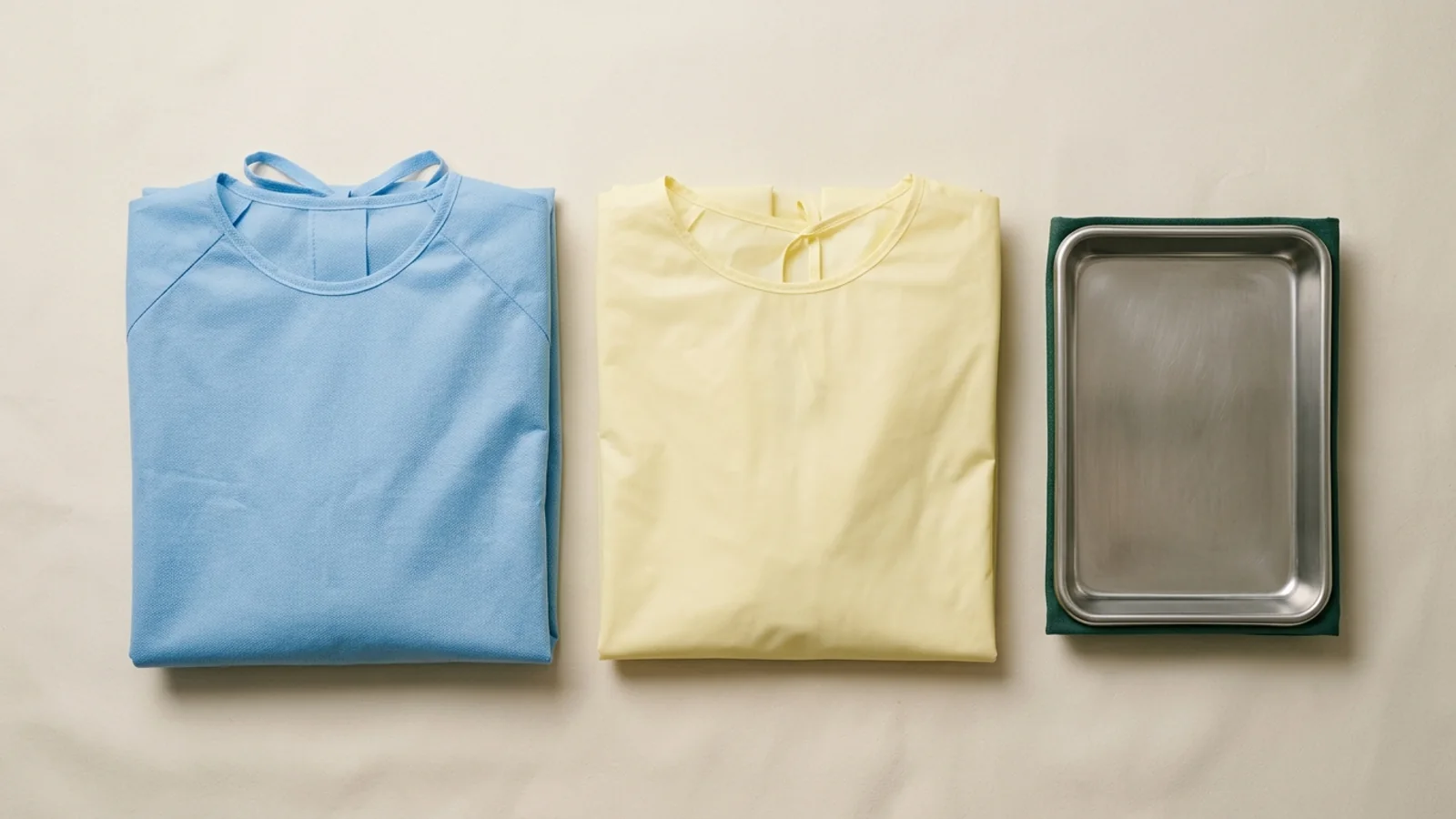
When hospital purchasing committees and medical supply distributors procure protective gowns, confusion frequently arises between non-surgical isolation gowns and sterile surgical gowns. In institutional purchasing, confusing these two apparel types creates serious regulatory and infection-prevention vulnerabilities. Non-surgical isolation gowns are regulated under 21 CFR 878.4040 as surgical apparel, but their regulatory classification and testing rules diverge sharply from surgical operating-room attire. A non-surgical isolation gown remains a Class I medical device exempt from 510(k) premarket notification only when three mandatory conditions are simultaneously met: the device is labeled as a gown other than a surgical gown, its labeling contains no description as a surgical gown, and any barrier performance claims are confined strictly to minimal or low barrier protection (ANSI/AAMI PB70 Level 1 or Level 2). Under FDA classification policy, these Class I exempt garments are categorized under product code OEA.
The moment an isolation gown specification introduces a claim of moderate or high liquid barrier protection—specifically ANSI/AAMI PB70 Level 3 or Level 4—or asserts suitability for surgical isolation or sterile procedures, the gown transitions into a Class II regulated device requiring a formal 510(k) clearance. In commercial practice, non-sterile Level 3 isolation gowns are cleared under product code FYC (gown, isolation, surgical), even when the manufacturer explicitly states on the packaging and indications for use that the device is "not intended for use in the operating room." Furthermore, while sterile surgical gowns have critical zones on the front from the top of the shoulders to the knees and the arms from the wrist cuff to above the elbow, isolation gowns require whole-garment protection: the entire garment—front, back, and all structural seams, excluding only cuffs, hems, and bindings—must meet the claimed barrier rating. Because of this whole-garment requirement, open-backed cover gowns cannot be rated under ANSI/AAMI PB70 as isolation gowns. Purchasing departments must align requests for quotation (RFQs) with ASTM F3352/F3352M-23b, audit accredited seam-barrier test reports, verify device listings under 21 CFR 807.20, and reject obsolete COVID-19 Emergency Use Authorization (EUA) marketing claims.
Isolation Gown is an Intended-Use SKU, Not a Surgical-Gown Substitute
Under the United States Food and Drug Administration regulatory framework, medical apparel is governed by 21 CFR 878.4040. The regulation defines surgical apparel as devices intended to be worn by operating-room personnel during surgical procedures to protect both the surgical patient and operating-room personnel from transfer of microorganisms, body fluids, and particulate material. The generic classification lists surgical caps, hoods, masks, gowns, operating-room shoes and shoe covers, and isolation masks and gowns, while explicitly excluding scrub suits and dresses. Paragraph (b)(1) establishes that surgical gowns and surgical masks are Class II devices subject to special controls. Paragraph (b)(2) establishes that surgical apparel other than surgical gowns and surgical masks is Class I (general controls) and exempt from the premarket notification procedures in 21 CFR part 807 subpart E, subject to the limitations set forth in 21 CFR 878.9.
A fundamental misunderstanding in hospital procurement is the belief that Class I 510(k) exemption frees the manufacturer from quality system requirements. It does not. The FDA product classification database record for product code OEA (non-surgical gown) explicitly states: GMP Exempt? No. Manufacturers and specification developers of Class I non-surgical isolation gowns remain subject to the current Quality Management System Regulation (QMSR) under 21 CFR 820. Exemption from 510(k) premarket notification relieves the manufacturer from submitting a premarket notification packet to CDRH before commercial distribution; it is not a quality-system exemption.
To prevent catalog errors and procurement mismatches, buyers must distinguish between four distinct wearable gown lanes recognized across FDA regulations and classification databases:
Product Code OEA (Non-Surgical Gown, Class I): Regulated under 21 CFR 878.4040(b)(2) as Class I, 510(k) exempt. Defined by FDA as a physical barrier providing minimal or low levels of barrier protection (ANSI/AAMI PB70 Level 1 or Level 2). Intended to protect the wearer from transfer of microorganisms and body fluids in low or minimal risk patient isolation situations. FDA’s Medical Gowns page states that non-surgical gowns are not worn during surgical procedures, invasive procedures, or when there is a medium to high risk of contamination.
Product Code FYC (Gown, Isolation, Surgical, Class II): Regulated under 21 CFR 878.4040(b)(1) as Class II, requiring a cleared 510(k). Intended for use when healthcare personnel face medium to high risk of contamination and require larger critical protection zones than traditional surgical gowns. It also encompasses non-sterile isolation gowns making ANSI/AAMI PB70 Level 3 or Level 4 claims, even if designated "not for operating room use."
Product Code FYA (Gown, Surgical, Class II): Regulated under 21 CFR 878.4040(b)(1) as Class II, requiring a cleared 510(k). Intended to be worn by healthcare personnel during surgical procedures. All surgical gowns under FYA must be provided sterile and labeled specifically as surgical gowns. FDA describes the surgical-gown critical zones as the front of the body from the top of the shoulders to the knees and the arms from the wrist cuff to above the elbow; CDC/NIOSH notes that the back of a traditional surgical gown may be non-protective. (For the sterile FYA barrier table and construction evidence, review the companion guide: Sterile Surgical Gowns Buying Guide).
Product Code QPC (Gown, Non-Sterile, Non-Isolation, Moderate/High Barrier, Class II): Regulated under 21 CFR 878.4040(b)(1) as Class II, requiring a cleared 510(k). Intended to provide moderate or high barrier protection (PB70 Level 3 or 4) to personnel in non-sterile, non-patient-isolation clinical settings. Gowns claiming or containing antimicrobial or antiviral agents are specifically excluded from product code QPC.
In addition to these healthcare personnel protective garments, FDA maintains product code FYB (gown, patient), which is a Class II device requiring 510(k) clearance intended for patient wear during examination and treatment. Patient gowns represent an entirely distinct clinical intended-use family and must never be procured or specified as healthcare worker protective equipment.
| FDA Product Code | Device Classification | Submission Pathway | Barrier Level Claims | Critical Zone Coverage | Supply Condition |
|---|---|---|---|---|---|
| OEA | Class I (General Controls) | 510(k) Exempt (subject to 21 CFR 878.9) | Minimal or Low (AAMI PB70 Level 1 or 2) | Entire garment except bindings, cuffs, and hems (includes seams) | Often supplied non-sterile (not a sterility mandate) |
| FYC | Class II (Special Controls) | 510(k) Premarket Notification Required | Moderate or High (AAMI PB70 Level 3 or 4) | Entire garment except bindings, cuffs, and hems (includes seams) | Typically Non-Sterile (or Sterile) |
| FYA | Class II (Special Controls) | 510(k) Premarket Notification Required | Levels 1, 2, 3, or 4 | Front from top of shoulders to knees and arms from wrist cuff to above elbow | Provided Sterile Only |
| QPC | Class II (Special Controls) | 510(k) Premarket Notification Required | Moderate or High (AAMI PB70 Level 3 or 4) | Not an isolation-gown critical-zone family; intended for non-sterile, non-patient-isolation use (antimicrobial/antiviral claims excluded) | Provided Non-Sterile |
When an ANSI/AAMI PB70 Barrier Level Changes Device Class
In December 2015, the FDA issued its definitive guidance document, Premarket Notification Requirements Concerning Gowns Intended for Use in Health Care Settings. This guidance articulates the clear boundary separating Class I 510(k)-exempt apparel from Class II regulated surgical apparel under 21 CFR 878.4040. Under Section IV of the guidance, a gown is considered a Class I 510(k)-exempt device under 21 CFR 878.4040(b)(2) if and only if all three of the following conditions are satisfied:
The gown is labeled as a gown other than a surgical gown (for example, labeled as an "isolation gown").
The gown is not described in its labeling as a surgical gown.
If the gown makes any statements or claims relating to liquid barrier protection, those statements are strictly for minimal or low barrier protection.
The guidance establishes that the FDA evaluates claims of barrier protection against ANSI/AAMI PB70. Liquid barrier performance is graded from Level 1 to Level 4 based on standardized laboratory test methods. The FDA explicitly interprets ANSI/AAMI PB70 Level 1 and Level 2 barrier claims as representing minimal or low barrier protection. Conversely, the FDA interprets ANSI/AAMI PB70 Level 3 and Level 4 claims as representing moderate or high barrier protection. Under FDA policy, gowns that claim moderate or high barrier protection represent a higher clinical risk profile. Therefore, claiming Level 3 or Level 4 barrier performance is legally considered by the Agency as demonstrating intended use as a surgical gown within the meaning of 21 CFR 878.4040(b)(1).
This policy creates an unavoidable regulatory fork: a Level 3 or Level 4 barrier claim automatically triggers Class II regulatory controls, necessitating premarket clearance through a 510(k) submission. A manufacturer cannot claim ANSI/AAMI PB70 Level 3 barrier performance and simultaneously claim Class I 510(k) exemption under product code OEA.
Crucially, claiming that a Level 3 isolation gown is "not for surgical use" does not return the garment to Class I status. Real-world 510(k) clearance records clearly demonstrate this regulatory reality:
Clearance K223304 (February 2023): Disposable Isolation Gowns cleared under product code FYC (Class II, 21 CFR 878.4040). The indications for use state that the gowns are intended to protect healthcare patients and healthcare personnel from transfer of microorganisms, body fluids, and particulate material, while explicitly adding: "not intended for use in the operating room." The device meets ANSI/AAMI PB70 Level 3 barrier protection for a surgical isolation gown and is supplied non-sterile. Despite being marketed as an isolation gown and prohibited from the operating room, it was legally cleared as a Class II FYC device because of its Level 3 barrier claim.
Clearance K212357 (January 2022): Surgical Isolation Gown cleared under product code FYC (Class II, 21 CFR 878.4040). Indications for use explicitly specify that the single-use, non-sterile gown meets AAMI Level 3 barrier protection for an isolation gown and is "not intended for use in the operating room." Here again, the Level 3 barrier claim required a 510(k) clearance under product code FYC.
flowchart TD
    Start["Gown Procurement Specification"] --> Env{"Intended Clinical Environment?"}
    Env -->|"Sterile Surgical Field / Labeled Surgical Gown"| OR["Sterile Surgical Field"]
    OR --> FYA["Product Code FYA<br/>Class II | 510(k) Required<br/>Must be Provided Sterile<br/>Front & Sleeve Critical Zones"]

    Env -->|"Patient Isolation / Non-Surgical Use"| Claim{"Barrier Protection Claim?"}

    Claim -->|"Minimal or Low Barrier<br/>(AAMI PB70 Level 1 or 2)"| BackOEA{"Back Construction?"}
    BackOEA -->|"Full Back Coverage<br/>Seams Tested to Level"| OEA["Product Code OEA<br/>Class I | 510(k) Exempt<br/>QMSR/GMP Compliant<br/>Whole-Garment Critical Zone"]
    BackOEA -->|"Open Back / Perforated"| CoverGown["Utility Cover Gown<br/>Cannot be PB70 Rated<br/>No Isolation Barrier Claim"]

    Claim -->|"Moderate or High Barrier<br/>(AAMI PB70 Level 3 or 4)"| UseCase{"Patient Isolation Setting?"}
    UseCase -->|"Yes: Patient Isolation"| FYC["Product Code FYC<br/>Class II | 510(k) Required<br/>Usually Non-Sterile<br/>Whole-Garment Critical Zone"]
UseCase -->|"No: Non-Isolation Setting"| QPC["Product Code QPC<br/>Class II | 510(k) Required<br/>Non-Sterile Moderate/High Barrier<br/>No Antimicrobial Claims"]Procurement officers must understand that an ANSI/AAMI PB70 level designation is a performance claim, not a regulatory clearance. A laboratory test certificate demonstrating that a fabric sample achieved Level 3 hydrostatic pressure does not constitute an FDA clearance. When evaluating vendor submissions claiming Level 3 or Level 4 barrier protection, procurement teams must request the manufacturer's specific 510(k) clearance letter and indications for use under product code FYC or QPC. Accepting a Class I establishment listing for a Level 3 gown exposes the healthcare facility to non-compliant, misbranded medical devices.
Critical Zones, Open Backs, and ASTM F3352 Coverage Standards
Beyond regulatory classification, isolation gowns differ from surgical gowns in critical-zone geometry. In a traditional sterile surgical gown (product code FYA), FDA describes the critical zones as the front of the body from the top of the shoulders to the knees and the arms from the wrist cuff to above the elbow. CDC/NIOSH, summarizing ANSI/AAMI PB70, notes that the surgical-gown critical zone comprises at least the front panel and lower sleeves; the back may be non-protective, while the entire front must be at least Level 1.
In contrast, CDC/NIOSH states that for isolation gowns the whole garment is a critical zone because potential contact with blood, body fluids, and other potentially infectious materials is unpredictable. FDA’s Medical Gowns page likewise treats all areas of surgical isolation gowns and non-surgical gowns except bindings, cuffs, and hems as critical zones, and requires seams to have the same liquid barrier protection as the rest of the gown. The entire isolation garment, including back panels and structural seams—excluding only bindings, cuffs, and hems—must achieve the claimed liquid barrier performance.
Structural seams are part of the isolation-gown critical zone. CDC/NIOSH states that the entire isolation gown, including seams but excluding cuffs, hems, and bindings, must achieve the claimed barrier performance, and FDA’s Medical Gowns page requires seams to have the same liquid barrier protection as the rest of the gown. A fabric swatch result does not substitute for finished-garment seam evidence. RFQ specifications should require third-party barrier reports that include major garment seams, such as sleeve attachments and shoulder seams, at the claimed ANSI/AAMI PB70 level.
ASTM F3352 Versus ASTM F2407: The Particular Consensus Standards
While ANSI/AAMI PB70 defines liquid barrier classifications and test methods (such as AATCC 42 impact penetration and AATCC 127 hydrostatic head), it does not address mechanical durability. A gown with excellent liquid barrier properties that tears upon donning or splits at the underarm seam during patient transfer offers zero clinical protection. To ensure physical integrity, the medical device industry relies on particular ASTM specifications.
In hospital tenders, buyers frequently make the mistake of specifying ASTM F2407 for isolation apparel. ASTM F2407 is the Standard Specification for Surgical Gowns Intended for Use in Healthcare Facilities and applies exclusively to surgical gowns under product code FYA. Specifying ASTM F2407 in an isolation gown tender is technically invalid and causes qualified manufacturers to submit non-compliant or unnecessarily expensive surgical tenders.
The correct consensus standard for isolation apparel is ASTM F3352/F3352M-23b, the Standard Specification for Isolation Gowns Intended for Use in Healthcare Facilities. On 22 December 2025, the FDA recognized ASTM F3352/F3352M-23b as Recognized Consensus Standard Number 6-520 (Federal Register Recognition List 065), formally mapping the standard to product codes OEA (Class 1) and FYC (Class 2). Scope Section 1.1 establishes minimum performance and labeling requirements for isolation gowns used by healthcare workers for standard and transmission-based precautions. Scope Section 1.2 explicitly excludes all gowns not meeting the ANSI/AAMI PB70 isolation-gown definition (including cover gowns, procedure gowns, comfort gowns, and open-back gowns), while Scope Section 1.3 excludes surgical gowns and decontamination apparel.
Procurement teams reviewing supplier documentation should note that FDA recognition of ASTM F3352/F3352M-23a (Recognition Number 6-494) will be superseded by the 23b edition. The FDA has established a formal transition window: declarations of conformity to the 23a edition will be accepted in support of premarket submissions until 19 December 2027. After that date, declarations of conformity must reference ASTM F3352/F3352M-23b.
CDC/NIOSH states that ASTM F3352 (isolation gowns) and ASTM F2407 (surgical gowns) add physical-property requirements beyond ANSI/AAMI PB70 barrier testing, including tensile strength, seam strength, and tear resistance, with optional lint generation, evaporative resistance, and vapor-transmission reporting. FDA’s recognition abstract for ASTM F3352/F3352M-23b does not publish those numeric minima. Tenders should request the current recognized edition’s physical-property evidence and third-party reports rather than copying breaking-strength limits from an older edition:
Tensile Breaking Strength: Request tensile-strength evidence for the finished fabric as specified in the claimed ASTM F3352 edition, rather than inventing a grab-test numeric floor.
Tear Resistance: Request tear-resistance evidence for the claimed edition rather than treating a trapezoid or tongue-tear method number as if it were printed in FDA’s recognition abstract.
Seam Breaking Strength: Request seam-strength evidence at structural joins (including sleeve attachments) so seam integrity is documented with the barrier claim, not assumed from a fabric swatch.
Lint Generation & Comfort Metrics: Lint generation, evaporative resistance, and vapor-transmission reporting are optional CDC/NIOSH-noted F3352/F2407 reporting properties. Specify them only if the RFQ needs those fields; do not treat optional comfort metrics as a barrier rating.
Water Resistance Versus Bloodborne Pathogen Impermeability
A critical specification limit emphasized by CDC/NIOSH is the difference between water barrier testing and viral-penetration impermeability. Under ANSI/AAMI PB70, Levels 1, 2, and 3 use water as the challenge fluid. Level 1 evaluates water impact penetration under AATCC 42. Levels 2 and 3 evaluate both AATCC 42 impact penetration and AATCC 127 hydrostatic pressure. CDC/NIOSH notes that water’s surface tension (0.070–0.072 N/m) is much higher than that of synthetic blood used in viral-penetration methods (0.042 ± 0.002 N/m), so blood can penetrate fabrics more readily than water.
Because lower-surface-tension liquids penetrate fibrous non-woven structures much more readily than water, laboratory performance in AATCC 42 and AATCC 127 does not correlate with resistance to blood or bloodborne pathogens. Only ANSI/AAMI PB70 Level 4 gowns are evaluated for viral penetration resistance under ASTM F1671 (using the bacteriophage Phi-X174 challenge; CDC/NIOSH reports that ASTM F1670 and ASTM F1671 are conducted at 13.8 kPa / 2 psi, with no penetration as the criterion). CDC/NIOSH states that Level 1, Level 2, and Level 3 gowns cannot be considered impermeable to viral penetration using that method, and that no correlation can be made between AATCC 42/127 water tests and ASTM F1671. Procurement specifications should not treat a Level 2 or Level 3 water-resistance result as bloodborne-pathogen impermeability. A viral-impermeability claim is a Level 4 / ASTM F1671 claim and, under FDA gown classification policy, a moderate or high barrier statement that takes the SKU out of Class I OEA.
What Class I Exemption, Listing, and Leftover EUA Language Cannot Prove
Navigating supplier documentation requires identifying commercial claims that appear authentic but lack regulatory authority. Three specific compliance areas require strict procurement auditing: limitations of Class I exemption under 21 CFR 878.9, establishment registration under 21 CFR part 807, and obsolete COVID-19 emergency policies.
First, the 510(k) premarket notification exemption granted to Class I surgical apparel under 21 CFR 878.4040(b)(2) is strictly bounded by 21 CFR 878.9 (Limitations of exemptions from section 510(k)). Under 21 CFR 878.9, an exemption applies only to the extent that the commercial device maintains the existing or reasonably foreseeable characteristics of commercially distributed devices within that generic device type. A manufacturer is legally required to submit a 510(k) if the device is intended for a use different from the legally marketed generic type, including a different medical purpose, or if the device introduces a different fundamental scientific technology. Relabeling a Class I isolation gown for surgery, sterile procedures, or moderate or high barrier use is a different intended use under 21 CFR 878.9, not an exempt catalog variant.
Second, buyers must understand the legal boundary between establishment registration and device clearance. Under 21 CFR 807.20, an owner or operator of an establishment engaged in the manufacture, preparation, propagation, compounding, assembly, or processing of a device intended for human use in the United States must register and submit listing information, with a wholesale-distributor exception when the person does not manufacture, repackage, process, or relabel. Obtaining a registration number does not constitute regulatory vetting. In fact, 21 CFR 807.39 explicitly states:
FDA Partial Recognition of ANSI/AAMI PB70:2022
When reviewing consensus standards, buyers must be aware that FDA recognition of ANSI/AAMI PB70:2022 (Recognized Consensus Standard Number 6-487, Federal Register Recognition List 060, effective 29 May 2023) is partial. The FDA specifically refused to recognize three provisions of the revised standard: Section 3's definition of "procedure gown," Section 4.1 labeling provisions, and informative Annex B classification examples.
The FDA's official rationale states that the standard's definition of a "procedure gown" conflicts with 21 CFR 878.4040 and the December 2015 gown guidance. Under Agency policy, any procedure gown that claims moderate or high liquid barrier protection is legally considered a surgical gown requiring 510(k) review. Furthermore, FDA refused to recognize Section 4.1 because Agency guidance mandates that the exact level of liquid barrier protection must be clearly and prominently identified in product labeling. Sourcing specifications must reject supplier quotes that utilize vague "procedure gown" terminology to evade isolation or surgical classification.
Termination of COVID-19 Device EUAs and Enforcement Policies
During the SARS-CoV-2 pandemic, FDA exercised temporary regulatory flexibility, issuing Emergency Use Authorizations (EUAs) and enforcement-policy guidances that permitted the commercial distribution of non-cleared, non-listed gowns. Sourcing managers must recognize that this emergency regulatory framework has concluded.
All COVID-19 device enforcement-policy guidances within the scope of FDA's transition plan are no longer in effect. Furthermore, on 29 June 2026, the Secretary of Health and Human Services formally determined that circumstances no longer exist justifying emergency use of those medical devices (published in the Federal Register at 91 FR 40544). In accordance with Section 564 of the Federal Food, Drug, and Cosmetic Act, the emergency declarations authorizing medical device EUAs terminate effective 26 December 2026. After 26 December 2026, any remaining device EUAs will be entirely defunct. Hospital procurement committees must purge vendor contracts of obsolete language citing "FDA COVID Emergency Guidelines" or temporary umbrella EUAs, insisting upon permanent Class I OEA listing or Class II FYC/QPC 510(k) clearances.
Reusable Versus Single-Use Gown Specifications
While many hospital isolation SKUs are labeled single-use, FDA’s Medical Gowns page states that cloth gowns that will not be used in a sterile field, such as surgery, can be reused if they are laundered in enzymatic detergent or per the hospital’s standard operating procedures. That statement is a labeled single-use versus multiple-use specification field, not a hospital laundry SOP and not a donning protocol.
However, reusability is a labeled technical specification, not an administrative laundry decision. FDA’s December 2015 gown guidance states that if a gown is intended to be reusable, barrier performance testing should also be performed at the end of the labeled use-life (maximum reprocessing cycles). ASTM F3352 is the isolation-gown particular specification for those multiple-use claims. Product code FYC also lists ANSI/AAMI ST65 among recognized consensus standards for processing reusable surgical textiles; that listing is not a substitute isolation-gown specification and is not a hospital laundry instruction. Specify the labeled cycle count and the evidence that the claimed barrier and physical properties still hold after that count.
Procurement Specification Checklist: RFQ Fields for Isolation Gowns
To prevent supply-chain non-compliance, hospital purchasing departments, group purchasing organizations (GPOs), and distributor sourcing specialists should structure isolation gown RFQs around ten standardized technical fields:
Labeled Intended Use Statement: The product labeling, technical data sheet, and carton markings must explicitly declare intended use as a non-surgical isolation gown for low/minimal risk environments, or surgical isolation for medium/high risk environments. Vague designations such as "protective gown" or "procedure gown" must be disqualified.
FDA Product Code & Device Class: The tender must identify the exact 3-letter product code: OEA for Class I 510(k)-exempt non-surgical isolation gowns, FYC for Class II surgical isolation gowns requiring 510(k) clearance, or QPC for Class II non-sterile, non-isolation moderate or high barrier gowns. Do not specify FYB (patient gown) as a personnel isolation code.
510(k) Clearance Verification: For any SKU claiming ANSI/AAMI PB70 Level 3 or Level 4 barrier protection, the supplier must provide an authentic 510(k) clearance summary letter matching the manufacturer and product trade name.
Critical Zone & Circumferential Coverage: Specifications must require full back coverage so the entire garment except bindings, cuffs, and hems can be a critical zone, including seams at the claimed level. Open-back, perforated-back, or neck-loop apron designs cannot be PB70-rated as isolation gowns.
Consensus Standard Edition: The vendor must provide a Declaration of Conformity to ASTM F3352/F3352M-23b (FDA Recognition 6-520), or ASTM F3352-23a (accepted through 19 December 2027). Specifications must never cite surgical gown standard ASTM F2407 for isolation items.
Whole-Garment and Seam Barrier Test Reports: The supplier must submit third-party test reports demonstrating that both the fabric and the structural seams (including sleeve joins and shoulder seams) achieved the stated ANSI/AAMI PB70 level under the water methods that apply to that level (AATCC 42 impact penetration; AATCC 127 hydrostatic pressure for Levels 2 and 3).
Mechanical Property Verification: Third-party physical-property evidence from the claimed ASTM F3352 edition covering tensile strength, tear resistance, and seam strength, without importing numeric minima from a paywalled or superseded edition.
Establishment Listing Audit: Active FDA Device Listing Number and Establishment Registration Number matching the finished device manufacturer. Verify that marketing collateral contains no deceptive "FDA Approved" claims.
Single-Use vs Multiple-Use Lifecycle Data: For single-use disposables, match the labeled sterile versus non-sterile supply condition. For reusable textiles, require barrier evidence after the labeled maximum number of process cycles (2015 gown guidance), not a hospital laundry slogan.
Supplier Quality Agreement & Change Control: Execute a binding quality agreement requiring pre-implementation notification for any changes in non-woven resin composition, fabric supplier, seam construction, or overseas manufacturing site, aligning with QMSR purchasing controls (refer to our procurement guide: Quality Agreements for Consumable Suppliers).
By establishing these rigorous specification gates, healthcare procurement professionals can ensure complete regulatory conformity, optimize apparel expenditure, and deliver verified physical protection to frontline clinical staff. For related personal protective equipment procurement specifications, explore our detailed comparative analyses of Medical Exam and Surgical Gloves and Surgical Masks vs N95 Respirators.