
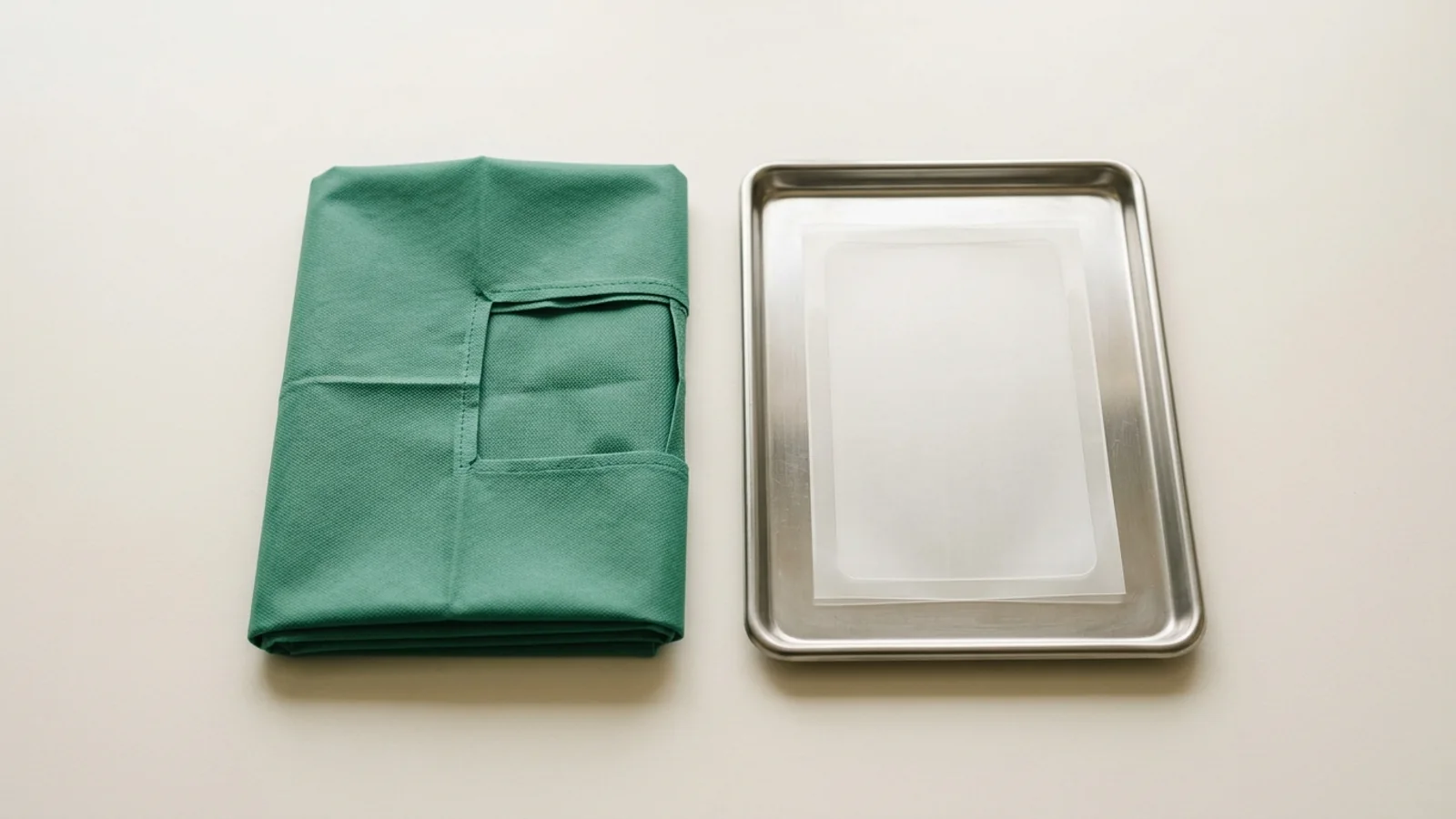
A surgical drape is a patient covering, not a gown SKU
Hospital purchasing teams and distributor sourcing managers frequently make a fundamental classification error during perioperative tender preparation: copying performance clauses, sizing grids, and regulatory references directly from surgical gown solicitations into surgical drape contracts. While both product lines function within the sterile operating theater, they occupy separate regulatory classifications, address divergent clinical exposures, and require fundamentally distinct physical verification criteria.
Under United States law, the Food and Drug Administration defines surgical drapes under 21 CFR 878.4370. The regulation explicitly identifies a surgical drape and drape accessories as a device made of natural or synthetic materials intended to be used as a protective patient covering, such as to isolate a site of surgical incision from microbial and other contamination. The statutory scope specifically encompasses physical patient coverings, plastic wound protectors that adhere to the perimeter of an incision or seat within wound margins, and specialty latex sheet drapes engineered with integrated self-retaining finger cots for transurethral prostatectomy.
This patient-covering mandate stands in direct contrast to 21 CFR 878.4040, which governs surgical apparel. Surgical apparel comprises protective devices intended specifically to be worn by healthcare personnel during surgical procedures to shield both the clinical team and the patient from fluid transfer, particulate shedding, and microbial migration. Hospital buyers who evaluate sterile surgical gowns (regulated under product code FYA with chest and sleeve critical zones) or isolation and non-surgical gowns (regulated under product codes OEA, FYC, and QPC with 360-degree circumferential coverage) are managing wearable protective equipment. Applying apparel standards, donning tolerances, or human ergonomic dimensions to patient coverings distorts procurement criteria and compromises supplier qualification.
Furthermore, commercial buyers must recognize that an ANSI/AAMI PB70 liquid barrier rating assigned to a surgical drape represents a standardized benchtop fluid-resistance metric under defined pressure conditions. It does not constitute a clinical guarantee of surgical-site infection (SSI) reduction. Treating a barrier level as an absolute proxy for clinical outcomes misinterprets the function of protective patient coverings.
When an antimicrobial agent changes the 510(k) path
Every surgical drape falling under 21 CFR 878.4370 is statutory Class II (special controls). However, the premarket clearance mechanism bifurcated significantly following legislative reforms under the 21st Century Cures Act. On 11 July 2017, the FDA published a landmark notice in the Federal Register (82 FR 31976) establishing product code PUI ("drape, surgical, exempt") for Class II surgical drapes that do not include an antimicrobial agent. On 30 December 2019, FDA published a final order at 84 FR 71794 that wrote the exemption into 21 CFR 878.4370(b); the eCFR source note cites that 878.4370 revision at 84 FR 71814.
Under current law, surgical drapes without antimicrobial agents are exempt from 510(k) premarket notification procedures, subject strictly to the generic limitations articulated in 21 CFR 878.9. Those limitations apply only to devices with existing or reasonably foreseeable characteristics of commercially distributed devices of that generic type. A 510(k) is still required if the device is intended for a use different from the intended use of a legally marketed device of that type, including a different medical purpose, or if it operates using a different fundamental scientific technology. Relabeling a PUI fabric drape with an antimicrobial agent is a different intended use, not an exempt catalog variant.
The presence or absence of an antimicrobial agent establishes the primary regulatory dividing line for procurement audits:
Product Code PUI (Drape, Surgical, Exempt): Class II, 510(k)-exempt under 21 CFR 878.4370. The FDA product classification definition restricts PUI to fluid barrier patient coverings that do not contain an antimicrobial agent. Exemption from 510(k) premarket review is not an exemption from Good Manufacturing Practice (GMP). Manufacturers must maintain full Quality Management System Regulation (QMSR / 21 CFR 820) compliance, FDA establishment registration, and active device listings.
Product Code KKX (Drape, Surgical, Antimicrobial): Class II, 510(k) required. Defined as the class II non-exempt counterpart of PUI. The current FDA Physical State field is a fluid barrier film containing an antimicrobial agent. Every current KKX SKU needs a current 510(k). A pre-2017 KKX number on a fabric covering is not proof that the present SKU contains an antimicrobial agent.
Product Code PLY (Antimicrobial Drapes): Class II, 510(k) required. FDA describes a transparent, breathable fluid-barrier film laminated to acrylic pressure-sensitive adhesive containing 2% CHG, on a silicone-coated release liner. PLY is that CHG incise-film type, not a synonym for every KKX SKU and not a substitute for a PUI fabric drape. Some 2% CHG incise films, including K222578, are listed as KKX, so buyers must read the current listing rather than inferring PLY from CHG content.
Procurement professionals auditing legacy product documentation must avoid misinterpreting historical 510(k) summaries. Prior to the July 2017 Cures Act reclassification, product code KKX served as the sole classification code for all surgical drapes, encompassing ordinary nonwoven fabric drapes. For example, 510(k) clearance K130404 (cleared in July 2013 for Cardinal Health Tiburon surgical drapes) cleared single-use disposable fabric drapes under KKX with AAMI PB70 Level 4 barrier performance. This historical clearance does not mean Tiburon drapes contain antimicrobial chemistry. When tender packages present pre-2017 KKX documentation for conventional fabric drapes, buyers must confirm whether the modern listing has transitioned to PUI or whether active antimicrobial claims are actually asserted.
Conversely, modern KKX clearances illustrate the contemporary antimicrobial incise-film profile. In May 2023, FDA issued 510(k) clearance K222578 for the 3M Ioban CHG Chlorhexidine Gluconate Incise Drape (contains 2% w/w CHG) under product code KKX, not PLY. The indications for use are an incise drape with continuous antibacterial activity based on in-vitro time-kill data out to 90 minutes, intended for external use only. In-vitro time-kill data in a 510(k) indication does not constitute an approved clinical claim for surgical-site infection reduction.
Under 21 CFR 807.20, manufacturers, repackagers, and specification developers of both PUI and KKX drapes must complete annual establishment registration and device listing. Crucially, 21 CFR 807.39 explicitly prohibits suppliers from misrepresenting an FDA establishment registration number as an official endorsement or FDA approval. Because true PUI drapes are legally 510(k)-exempt, their absence from the FDA 510(k) premarket database is normal regulatory behavior, not evidence of non-compliance.
flowchart TD
    Start["21 CFR 878.4370 surgical drape evaluation"] --> IsCovering{"Intended use is a patient covering to isolate a surgical incision?"}
    IsCovering -- "No: worn by staff" --> Apparel["21 CFR 878.4040 apparel: gowns FYA / OEA / FYC / QPC"]
    IsCovering -- "Yes" --> CheckAgent{"Contains an added antimicrobial agent?"}
    CheckAgent -- "No" --> SpecialtyCheck{"Named 878.4370(b) specialty type? ENT, ophthalmic, urology, Kelly pad, wound-protector ring"}
    SpecialtyCheck -- "Ordinary covering drape" --> CodePUI["Product code PUI: Class II, 510(k) exempt, QMSR and listing required"]
    SpecialtyCheck -- "Named specialty type" --> SpecialtyCodes["Specialty exempt codes: KGW, ERY, EYX, EYY, HMT, HMW, FNW. Class II, 510(k) exempt"]
    CheckAgent -- "Yes" --> Need510k["Class II, 510(k) required"]
    Need510k --> WhichCode{"Current listing code?"}
    WhichCode -- "PLY 2 percent CHG incise-film type" --> CodePLY["Product code PLY: confirm current 510(k)"]
WhichCode -- "KKX antimicrobial, including some CHG films such as K222578" --> CodeKKX["Product code KKX: confirm current 510(k); do not reuse a pre-2017 fabric-drape KKX number"]| Product Code | Device Classification | 510(k) Status | Physical & Functional Scope | Procurement Audit Verification |
|---|---|---|---|---|
| PUI | Drape, surgical, exempt (21 CFR 878.4370) | 510(k) Exempt | Patient covering sheets without antimicrobial chemistry; nonwoven or film | Active FDA device listing; QMSR compliance; no antimicrobial claims |
| KKX | Drape, surgical, antimicrobial (21 CFR 878.4370) | 510(k) Required | Fluid barrier film containing an antimicrobial agent (current Physical State); confirm the listing is not a stale pre-2017 fabric-drape KKX number | Current 510(k); labeled antimicrobial agent; do not treat in-vitro kill data as SSI reduction |
| PLY | Antimicrobial drapes (21 CFR 878.4370) | 510(k) Required | Transparent breathable incise film with 2% w/w CHG acrylic adhesive | Current 510(k) matching the 2% CHG film type; do not assume every 2% CHG film is PLY |
| KGW | Ring (wound protector), drape retention (21 CFR 878.4370) | 510(k) Exempt | Internal drape retention ring and wound margin covering barrier | Class II 510(k)-exempt listing; not 21 CFR 878.4371 irrigating retractor |
| EYX | Sheet, drape, pure latex, with finger cot (21 CFR 878.4370) | 510(k) Exempt | Latex sheet with integrated finger cot for transurethral prostatectomy | Class II exempt listing; mandatory 21 CFR 801.437 natural rubber latex labeling |
| ERY / EYY | ENT drape / Disposable urological drape (21 CFR 878.4370) | 510(k) Exempt | Anatomically configured specialty ENT or urological patient coverings | Class II 510(k)-exempt listing; labeled fenestration and fluid-collection configuration |
| HMT / HMW | Ophthalmic patient drape / Microscope drape (21 CFR 878.4370) | 510(k) Exempt | Ophthalmic patient covering (HMT) or ophthalmic microscope drape (HMW) | Class II 510(k)-exempt listing; labeled patient versus microscope intended use |
| FNW | Pad, Kelly (21 CFR 878.4370) | 510(k) Exempt | Fluid-channeling basin pad for obstetrical and perineal procedures | Class II 510(k)-exempt listing; labeled fluid-channeling configuration |
| NZP | Sealant, microbial (21 CFR 878.4370) | 510(k) Required | Cyanoacrylate liquid applied to skin drying to flexible barrier film | Current 510(k); liquid microbial sealant, not a fabric covering |
| MMP | Cover, barrier protective (21 CFR 878.4370) | 510(k) Required | Protective covers for operating room equipment and surgical consoles | Current 510(k); equipment cover, not a patient-covering drape. Sterility is a labeled field |
| LRO | General surgery tray (21 CFR 878.4370) | Enforcement Discretion | Pre-packaged convenience surgical kit containing drapes and accessories | Enforcement-discretion kit listing; specify the drape component separately |
FDA’s product-classification index currently lists 15 codes under 21 CFR 878.4370. In addition to the covering, antimicrobial, specialty, sealant, equipment-cover, and kit codes above, the index includes PEM (dental barriers and sleeves, 510(k) required) and OJW (shave prep kit, enforcement discretion). Those codes are adjacent listings, not a reason to specify a fabric covering as a dental barrier or a kit. Absence of a 510(k) is expected for a true PUI drape and is not proof of KKX clearance; conversely, a 510(k) search will not list PUI SKUs the way it lists current KKX or PLY SKUs.
Barrier, fenestration, and Level 4 tests that are not gown tests
Fluid barrier evaluation in North American healthcare facilities relies on ANSI/AAMI PB70:2022 ("Liquid barrier performance and classification of protective apparel and drapes intended for use in health care facilities"), recognized by the FDA under Recognition Number 6-487. However, buyers auditing supplier compliance declarations must note that FDA's recognition is partial. Specifically, the FDA does not recognize PB70 Section 3's definition of "procedure gown", Section 4.1's labeling directives, or the entirety of informative Annex B, which illustrates example barrier-performance classification diagrams for surgical drapes and gowns. Vendor sales collateral that reproduces Annex B drape illustrations cannot claim those diagrams constitute FDA-mandated labeling.
A critical distinction governs Level 4 barrier qualification between surgical drapes and surgical gowns. CDC/NIOSH Table 3, labeled against ANSI/AAMI PB70:2012, is the public assignment of Level 4 tests by product type. FDA currently recognizes ANSI/AAMI PB70:2022 in part (Rec# 6-487). Use the CDC table for the drape-versus-gown test identity, not as the recognized edition and not as a copy of paywalled PB70 numeric pass/fail tables:
Level 4 Surgical Drapes: Evaluated exclusively using ASTM F1670 ("Standard Test Method for Resistance of Materials Used in Protective Clothing to Penetration by Synthetic Blood"). CDC/NIOSH assigns this method to Level 4 surgical drapes, with no penetration at 2 psi (13.8 kPa). It is a material test under continuous liquid contact based on visual detection; it does not by itself address fenestration geometry or garment interfaces.
Level 4 Surgical Gowns: Evaluated using ASTM F1671 ("Standard Test Method for Resistance of Materials Used in Protective Clothing to Penetration by Blood-Borne Pathogens Using Phi-X174 Bacteriophage Penetration as a Test System"). Gowns must demonstrate viral barrier impermeability under identical 2 psi pressure conditions.
A drape RFQ that requires ASTM F1671 viral-penetration testing copies the gown Level 4 method. CDC/NIOSH assigns ASTM F1670 to Level 4 surgical drapes and ASTM F1671 to Level 4 surgical and isolation gowns. Requiring F1671 on a covering drape misstates that split and is not a substitute for the manufacturer-identified critical-zone F1670 report.
Buyers must also note the transition timeline for ASTM F1670. On 22 December 2025, FDA recognized ASTM F1670/F1670M-24a as Consensus Standard Rec# 6-518, mapped on that recognition record to 21 CFR 878.4370, product code KKX. FDA will accept declarations of conformity to the superseded 2017 edition (ASTM F1670/F1670M-17a / Rec# 6-491) in support of premarket submissions until 19 December 2027. After that date, declarations of conformity to Rec# 6-491 will not be accepted. Buyers who need Level 4 drape evidence should request the currently recognized edition rather than treating an older 17a report as an open-ended substitute. PUI drapes commonly use the same barrier method even though that SIS product-code table lists KKX.
For PB70 Levels 1 through 3, CDC/NIOSH describes water challenges: AATCC 42 impact penetration for Level 1, and both AATCC 42 and AATCC 127 hydrostatic pressure for Levels 2 and 3. Because water’s surface tension (about 0.070–0.072 N/m) is much higher than that of the synthetic blood used in ASTM F1670 (0.042 ± 0.002 N/m), CDC states that no correlation can be made between those water-resistance tests and ASTM F1671. Levels 1–3 are water-resistance classes. They are not viral impermeability, and a PB70 level is not clinical suitability for a named procedure.
In surgical drapes, barrier performance is concentrated within the manufacturer-identified critical zone. Typically that zone is the fenestration or incise area and adjacent reinforcement, including seams and attachments in that zone. Ask the manufacturer to identify the zone on the labeled configuration; do not copy gown chest-and-sleeve maps, and do not treat unrecognized PB70 Annex B example figures as FDA-required labeling. Request third-party barrier reports for that identified zone at the claimed PB70 level.
Engineering specifications should also reference physical parameters detailed in FDA's foundational August 1993 Gown and Drape Guidance. The guidance is nonbinding, predates PB70 and the Cures Act exemption, and is not a current 510(k) mandate for PUI SKUs. It still lists specification fields buyers can request: weave or thickness, sizes, resistance to blood and liquid penetration, tear and puncture resistance, lint, toxic ingredients and nonfast dyes, fire protection, tensile/grab/burst strength, and, for reusable devices, the labeled number of process cycles the device can still meet using the labeled sterilization method. When sterility is claimed, request sterility-assurance documentation; the guidance’s one-in-one-million survivor example is illustrative, not a universal numeric mandate for every 878.4370 SKU.
| AAMI PB70 Barrier Level | Surgical Drape Test Standard | Surgical Gown Test Standard | What the level does not prove | Buyer check |
|---|---|---|---|---|
| Level 1 | AATCC 42 water impact | AATCC 42 water impact | Not viral impermeability; not clinical suitability | Water-resistance class only; do not copy paywalled numeric limits into the RFQ |
| Level 2 | AATCC 42 and AATCC 127 water challenges | AATCC 42 and AATCC 127 water challenges | Not synthetic-blood or viral impermeability | Water-resistance class; no correlation with ASTM F1671 |
| Level 3 | AATCC 42 and AATCC 127 water challenges | AATCC 42 and AATCC 127 water challenges | Still a water-resistance class, not F1670 or F1671 | Do not map the level to a named procedure |
| Level 4 | ASTM F1670 / F1670M-24a synthetic blood; no penetration at 2 psi (13.8 kPa) | ASTM F1671 Phi-X174 viral penetration at 2 psi (13.8 kPa) | Drape Level 4 is not gown Level 4 and is not SSI prevention | Request F1670 for the manufacturer-identified critical zone; reject F1671 as a drape substitute |
Accessories, kits, laser claims, and what incise-film evidence cannot prove
A surgical drape RFQ must not conflate distinct peripheral medical devices with the primary patient covering. Several adjacent commodities occupy independent regulatory classifications under Title 21:
21 CFR 878.4380 (Drape Adhesive): Regulated under product code KGT as Class I, 510(k)-exempt (subject to 21 CFR 878.9). This classification applies to standalone liquid or pressure-sensitive adhesives placed directly onto patient skin to anchor drapes. Standalone drape adhesive is not a PUI drape.
21 CFR 878.4371 (Irrigating Wound Retractor Device): A Class II prescription device intended to retract the surgical incision, provide access, protect and irrigate the wound, and serve as a conduit for fluid removal. It is a different regulation from 21 CFR 878.4370 and must not be specified as product code KGW (internal drape-retention wound-protector ring).
Product Code NZP (Microbial Sealant): Class II, 510(k) required under 21 CFR 878.4370. NZP covers liquid cyanoacrylate formulations applied to prepped skin that polymerize into an elastomeric film to immobilize skin flora. Liquid sealants are chemical prep films, not nonwoven fabric drapes.
Product Code MMP (Barrier Protective Cover): Class II, 510(k) required. Designed for draping imaging fluoroscopy c-arms, surgical microscopes, robotic arms, and endoscopic cameras. RFQ line items must segregate equipment drapes from patient coverings.
Product Codes LRO (General Surgery Tray) & OJW (Shave Prep Kit): Class II convenience-kit codes under FDA’s May 1997 convenience-kits interim guidance, with submission type Enforcement Discretion. A tray listing is not a drape specification and does not prove PUI versus KKX status of the covering inside the pack. Specify the drape component’s product code, antimicrobial status, and barrier evidence separately.
When surgical procedures involve electrocautery, radiofrequency ablation, or laser surgery, hospital risk managers frequently demand fire-resistance documentation. However, procurement teams must verify the correct testing standard. ISO 11810:2015 ("Lasers and laser-related equipment — Test method and classification for the laser-resistance of surgical drapes and/or patient-protective covers"), recognized by FDA under Rec# 6-363, evaluates primary ignition, penetration, flame spread, and secondary ignition under direct laser beam exposure. ISO 11810 is not a general hospital fire-safety standard. It applies strictly to drapes that carry explicit labeled claims of laser resistance. Buyers should not demand ISO 11810 certification for standard nonwoven drapes that make no laser claims, nor should they accept generic 16 CFR Part 1610 clothing flammability ratings as proof of laser safety.
For international and European tenders, buyers must evaluate BS EN 13795-1:2025 ("Surgical clothing and drapes — Requirements and test methods — Surgical drapes and gowns"), released 12 May 2025 and superseding the 2019 edition. The public scope covers characteristics, test methods, and performance requirements for single-use and reusable surgical gowns and surgical drapes intended to prevent transmission of infective agents during surgical and other invasive procedures. European performance language is not equivalent to AAMI PB70 Level 4 and is not a U.S. 510(k) or PUI listing. The public scope contains explicit exclusions:
It explicitly does not cover requirements for incision drapes or plastic incise films.
It explicitly does not cover performance requirements for antimicrobial chemical treatments applied to drapes.
It does not assess laser radiation resistance, referencing EN ISO 11810 for any labeled laser claims.
Consequently, an EN 13795-1 declaration cannot validate an antimicrobial incise drape, and European high-performance language cannot be substituted for North American ANSI/AAMI PB70 Level 4 testing.
Perhaps the most critical clinical evidence boundary involves plastic adhesive and antimicrobial incise drapes. Converters frequently market incise films (plain or impregnated with iodine or chlorhexidine) with aggressive marketing language implying substantial surgical-site infection (SSI) reduction. High-level systematic clinical evidence contradicts these claims:
Cochrane Database of Systematic Reviews (CD006353 / Webster & Alghamdi): Evaluating seven randomized controlled trials, the authors found no evidence that plastic adhesive drapes reduce SSI rates. In five trials comprising 3,082 participants comparing plastic adhesive drapes to no drapes, a significantly higher proportion of patients developed surgical site infections in the adhesive drape cohort (Risk Ratio 1.23, 95% Confidence Interval 1.02 to 1.48). In two trials comprising 1,113 participants comparing iodine-impregnated adhesive drapes to no drapes, the drapes showed no statistically significant effect on SSI rates.
World Health Organization (WHO 2018 Global Guidelines on SSI Prevention): Web Appendix 17 evaluated systematic evidence regarding incise drapes. WHO reported very-low-quality evidence indicating neither benefit nor harm for antimicrobial-impregnated incise drapes versus no drapes, and low-quality evidence indicating neither benefit nor harm for non-impregnated adhesive drapes. WHO concluded that given the lack of demonstrated clinical benefit, the additional procurement cost of adhesive incise drapes is not justified. WHO highlighted SHEA/IDSA recommendations advising against routine use of adhesive incise drapes as an SSI prevention strategy.
Hospital procurement committees should purchase incise films when surgeons require mechanical operative field stabilization, anatomical site marking, or continuous fluid collection adherence. However, buyers must reject vendor claims asserting therapeutic superiority or infection reduction based solely on 510(k) clearances or in-vitro antimicrobial kill assays.
Finally, where drape accessories contain natural rubber latex—such as product code EYX prostatectomy drapes with integrated finger cots—suppliers must provide the mandatory caution statement required by 21 CFR 801.437: "Caution: This Product Contains Natural Rubber Latex Which May Cause Allergic Reactions." Material disclosures should be audited against hospital latex-safety policies in alignment with standard medical exam and surgical glove specifications.
RFQ fields for surgical drapes and drape accessories
To establish a legally enforceable, factory-neutral procurement tender, hospital purchasing teams should structure surgical drape RFQ packages across eight core technical fields. This specification architecture eliminates ambiguity, enforces regulatory compliance, and ensures verifiable product quality:
Regulatory classification and product code: Require 21 CFR 878.4370 intended use as a patient covering. Demand the current FDA product code: PUI for covering drapes without an antimicrobial agent; KKX or PLY only when an antimicrobial agent is present and the current listing matches; or a named specialty exempt code (KGW, EYX, ERY, EYY, HMT, HMW, FNW). Require establishment registration and device listing. Registration is not FDA approval.
Antimicrobial chemistry disclosure: Require suppliers to state whether an antimicrobial agent is present. If yes, require the listed product code, the labeled agent, and the current 510(k) number. In-vitro kill data must be identified as laboratory data, not an SSI-reduction claim. Do not infer PLY from 2% CHG content alone.
ANSI/AAMI PB70 barrier classification: Specify the claimed PB70 level for the manufacturer-identified critical zone. For Level 4 drapes, request third-party ASTM F1670/F1670M-24a synthetic-blood reports at 2 psi (13.8 kPa). Note that FDA accepts F1670-17a (Rec# 6-491) declarations of conformity for premarket submissions only until 19 December 2027. Reject ASTM F1671 gown data as a drape Level 4 substitute. A PB70 level is not clinical suitability.
Drape geometry, fenestration, and fluid routing: Specify labeled overall dimensions and the fenestration or incise-film geometry, pouch, and tube-holder configuration as configuration fields. Do not infer those fields from a gown size chart.
Construction and mechanical fields: Request the labeled material construction and the 1993 guidance mechanical fields that apply: tensile, grab, and burst strength; tear and puncture resistance; and lint. Do not invent numeric pass/fail limits. For reusable drapes, require the labeled process-cycle count and the sterilization method used to keep those specifications.
Sterility and supply state: Treat sterile versus non-sterile supply as a labeled intended-use field. Not every 878.4370 SKU is a sterile patient covering. If the SKU is supplied sterile, request the sterilization modality and sterility-assurance documentation for that claim. Do not treat a gown-sterility rule or an equipment-cover SKU as a default for every drape.
Specialty conformity fields: Specify ISO 11810:2015 only when laser resistance is a labeled claim; it is not a general fire-safety specification. For EU covering-drape tenders, require EN 13795-1:2025 performance evidence for the drape, knowing that standard excludes incision drapes or films and does not cover antimicrobial treatments. Require the 21 CFR 801.437 natural-rubber caution if latex is present.
Quality agreement and change control: Require a quality agreement covering outsourced processes, purchasing information, and pre-implementation notice before changes to barrier materials, antimicrobial content, adhesive, sterilization modality, or manufacturing site. Link those controls to standard quality agreements for consumable suppliers.
| Specification Parameter | Required Standard / Regulation | Verification Record to Audit | Critical Rejection Criteria |
|---|---|---|---|
| Regulatory Family & Code | 21 CFR 878.4370; PUI (exempt) or KKX/PLY (510(k)) | FDA Establishment Registration & Device Listing; 510(k) letter | Covering drape claiming current KKX without a current antimicrobial 510(k); missing listing; registration sold as approval |
| Level 4 Fluid Barrier | ANSI/AAMI PB70:2022; ASTM F1670/F1670M-24a | Accredited third-party synthetic blood test report (2 psi / 13.8 kPa) | Failure at 2 psi; substituting ASTM F1671 or water-column AATCC 127 |
| Critical Zone Integrity | Manufacturer-identified critical zone, including seams in that zone | Barrier test data covering fenestration seams and pouch bond lines | Zone inferred from a gown map or from unrecognized PB70 Annex B figures |
| Antimicrobial Status | 21 CFR 878.4370; 510(k) indication review | Current listing/510(k); labeled agent; in-vitro data identified as laboratory-only | Unsubstantiated clinical SSI prevention claims on commercial label |
| Laser Resistance (if claimed) | ISO 11810:2015 (FDA Rec# 6-363) | Laboratory ignition, penetration, and flame spread test records | Generic 16 CFR Part 1610 clothing flammability cited as laser proof |
| Sterility Assurance | Labeled sterile or non-sterile supply; modality if sterile is claimed | Sterility-assurance documentation matching the labeled claim | Sterile claim with no sterility-assurance documentation; gown-sterility rule applied to every 878.4370 SKU |
| Material Cleanliness | Lint and particulate fields from the 1993 gown-and-drape guidance when claimed | Manufacturer lint evidence for the labeled construction | Invented numeric lint limits or paywalled test tables copied into the RFQ |
| Change Control | ISO 13485:2016 Clauses 4.1.5 & 7.4.2; QMSR | Signed quality agreement with pre-implementation change notice | Unilateral resin, adhesive, or sterilization site change without notice |