
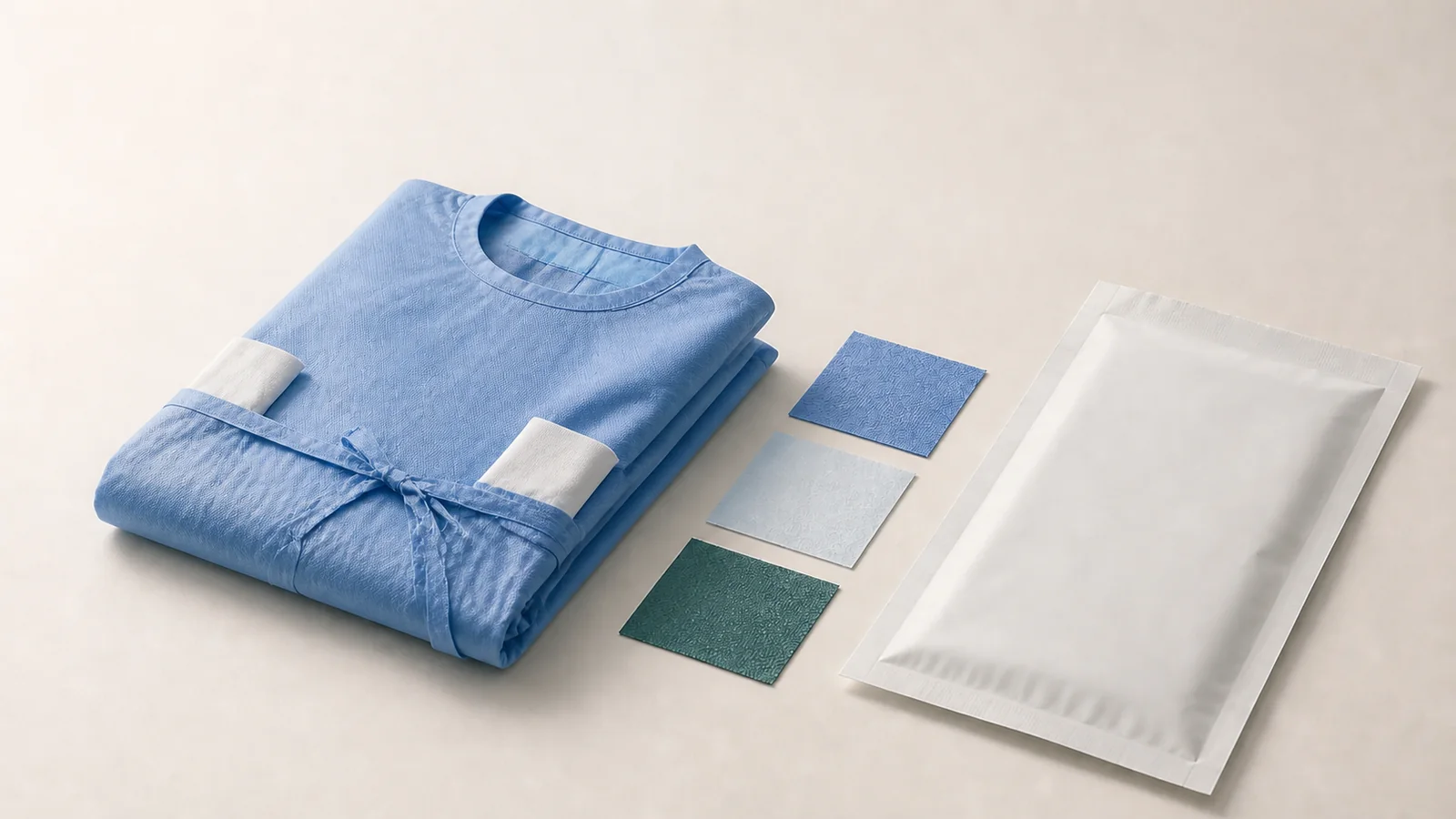
Procuring sterile surgical gowns for hospital operating suites is a cornerstone of perioperative infection prevention and surgical team safety. In high-fluid procedures, surgical gowns serve a dual barrier function: preventing operating room staff from shedding skin flora into the sterile surgical field while shielding surgeons and scrub nurses from bloodborne pathogens (including HIV, HBV, and HCV). However, vague marketing claims such as 'maximum fluid protection' or 'heavy-duty barrier' frequently obscure inadequate seam construction and unverified regulatory clearances.
ANSI/AAMI PB70 Barrier Classification and Testing Standards
The FDA-recognized North American benchmark for medical protective apparel barrier classification is ANSI/AAMI PB70 ('Liquid barrier performance and classification of protective apparel and drapes intended for use in health care facilities'). The standard establishes four discrete barrier performance levels based on objective, standardized laboratory challenge tests.
| AAMI Barrier Level | Mandated Test Method | Challenge Liquid & Pressure | Pass / Fail Performance Threshold | FDA-described risk examples (not a procedure list) |
|---|---|---|---|---|
| Level 1 | AATCC 42 (Water Impact Penetration) | Water spray challenge at low velocity | Water impact penetration <= 4.5 g | Minimal risk: basic care, standard isolation, visitor cover gown, standard medical unit (FDA examples) |
| Level 2 | AATCC 42 (Impact Penetration) + AATCC 127 (Hydrostatic Pressure) | Water spray + rising hydrostatic water column | AATCC 42 <= 1.0 g and AATCC 127 >= 20 cm H2O hydrostatic head | Low risk: blood draw, suturing, ICU, or pathology lab (FDA examples) |
| Level 3 | AATCC 42 (Impact Penetration) + AATCC 127 (Hydrostatic Pressure) | Water spray + elevated hydrostatic water column | AATCC 42 <= 1.0 g and AATCC 127 >= 50 cm H2O hydrostatic head | Moderate risk: arterial blood draw, inserting an IV line, emergency room, or trauma cases (FDA examples) |
| Level 4 | ASTM F1671 (Viral Penetration Test) | Phi-X174 bacteriophage challenge; ASTM F1671 procedures A/B pressurize the penetration cell to 13.8 kPa (2 psig) | Zero viral strikethrough (Pass / Fail biological plaque assay) | High risk: long, fluid-intense procedures, surgery, or when pathogen resistance is needed (FDA examples) |
It is vital to recognize that Level 4 testing under ASTM F1671 is a biological viral challenge, not a water-pressure test. ASTM F1671 uses Phi-X174 as a surrogate for HBV, HCV, and HIV in blood; inferences for other pathogens are case-by-case. The 13.8 kPa (2 psig) step is a discriminator in the method, not a simulation of every intraoperative load. High AATCC 127 hydrostatic results do not create a Level 4 claim without a passing ASTM F1671 result on the claimed critical-zone constructions, including seams.
Surgical gown, surgical isolation gown, and non-surgical isolation gown are different devices
FDA's medical-gown page is the public control for this distinction. A surgical gown (FYA) is Class II, must be provided sterile and labeled as a surgical gown, and may have a non-protective back. A surgical isolation gown (FYC) is also Class II 510(k) and treats nearly the entire garment as a critical zone because exposure is less predictable. A non-surgical isolation gown (OEA) is Class I 510(k) exempt only in low or minimal-risk isolation use; it is not worn for surgery or when medium-to-high contamination risk is expected. Non-sterile, non-isolation gowns that claim moderate or high barrier protection are again Class II.
ANSI/AAMI PB70:2022 remains the FDA-recognized liquid-barrier classification for protective apparel. Levels 1–3 are water tests (AATCC 42 impact penetration; Levels 2–3 also AATCC 127 hydrostatic head). Only Level 4 uses ASTM F1671 viral penetration on gowns. Those laboratory methods classify materials and seams; they are not a permission to write a hospital scoring policy of 30/20/20/15/15 or to mandate ultrasonic welding by name.
FDA also states that an SAL of 10^-6 is required for surgical gowns used during surgical procedures, and that EtO residual limits should follow the recognized consensus standard when ethylene oxide is used. Biocompatibility for these garments is framed as a surface device contacting breached or compromised skin for limited duration, with cytotoxicity, sensitization, and irritation among the expected endpoints. Match the dossier request to that contact category rather than importing vascular-catheter endpoints.
Critical Zones and Seam Construction Integrity
Under ANSI/AAMI PB70, the barrier performance requirements for a surgical gown are determined by specific anatomical zones where fluid exposure and mechanical pressure are concentrated during surgical procedures.
Anatomical Mapping: Critical Zones vs. Non-Critical Back Panels
For surgical gowns, ANSI/AAMI PB70 designates two primary critical zones:
Critical Zone A (Front Body Panel): FDA describes the front critical zone as running from the top of the shoulders to the knees. ANSI/AAMI PB70 further distinguishes barrier areas on the front; the back of a traditional surgical gown may be non-protective.
Critical Zone B (Sleeves & Joining Seams): FDA describes sleeve critical zones from the wrist cuff to above the elbow, including those seams. Isolation gowns are different: the entire gown except bindings, cuffs, and hems is a critical zone.
Non-Critical Zones (Back Panels & Ties): The back of the surgical gown, neckline bindings, and closure ties are classified as non-critical zones. While non-critical zones do not require high liquid barrier ratings, they must provide clean, breathable coverage and satisfy linting and flammability standards.
Seam Engineering: Ultrasonic Welding vs. Needle Stitching
The method used to join gown panels dictates barrier reliability under hydrostatic pressure:
| Seam Technology | Mechanical Construction | Fluid & Viral Resistance | Tender Recommendation |
|---|---|---|---|
| Ultrasonic Welded Seams | High-frequency acoustic energy melts thermoplastic fibers into a continuous, hermetic molecular bond | Eliminates needle holes; can support a seam barrier claim when the finished seam passes the same tests as the fabric | A common Level 3/4 construction when the finished seam meets the claimed PB70 level; not a construction method mandated by PB70 itself |
| Thermally Taped Stitched Seams | Conventional needle stitching reinforced with a hot-melt liquid-proof polyolefin seam tape | Seam tape seals needle perforations, maintaining hydrostatic barrier integrity | Also used for Level 3/4 critical zones when the taped seam passes the claimed tests |
| Conventional Needle-Stitched Seams | Mechanical sewing thread punctures fabric, creating thousands of microscopic needle holes | Needle holes can leak unless sealed; an unsealed stitched seam often cannot support higher hydrostatic or viral-barrier claims | Acceptable only where the finished seam still meets the claimed level. PB70 does not ban stitching by name; it fails any seam that cannot meet the labeled barrier. |
Fabric Technology: SMS Nonwovens vs. Breathable Membrane Laminates
The construction of medical nonwoven fabrics directly determines barrier effectiveness, tensile burst strength, particle generation (linting), and surgical team thermal comfort.
Multi-Layer SMS Nonwovens (Level 2 and Level 3)
Spunbond-Meltblown-Spunbond (SMS, SMMS, and SMMMS) nonwovens represent the standard architecture for Level 2 and Level 3 surgical gowns:
Spunbond Layers (S): Continuous outer polypropylene filaments that provide high tensile strength, abrasion resistance, and tear resistance against surgical instruments.
Meltblown Layers (M): Micro-denier web of randomly oriented microfibers that forms a dense tortuous path, providing liquid barrier resistance and hydrostatic holdout while allowing water vapor permeability.
Breathable Monolithic and Microporous Film Laminates (Level 4)
Level 4 claims require a passing ASTM F1671 result on the labeled constructions. Many Level 4 gowns use a nonwoven laminated to a monolithic or microporous barrier film because SMS alone often cannot pass viral penetration. Breathability, MVTR, and thermal comfort are separate specifications; they are not proven by a 4-to-8 hour procedure slogan.
Regulatory Clearance, Sterility Validation, and Technical Dossier Auditing
Distributors and hospital procurement teams must guard against supplier misrepresentation. In particular, low-cost non-surgical isolation gowns are frequently marketed under ambiguous labels that confuse non-clinical buyers.
Regulatory Classification: Surgical Gowns vs. Isolation Gowns
| Device Classification | US FDA Regulatory Status | European CE MDR Status | Sterility & Cleanliness Mandate |
|---|---|---|---|
| Surgical Gown | Class II Medical Device (21 CFR 878.4040, Product Code FYA); requires formal FDA 510(k) clearance | Follow the manufacturer's declared MDR class (often Class I sterile for many surgical gowns); do not assume Class IIa | If labeled sterile for surgery, FDA expects SAL 10^-6; EN 13795-1 cleanliness/linting applies where that standard is claimed |
| Non-Surgical Isolation Gown | Class I, product code OEA, 510(k) exempt only for non-surgical isolation gowns that remain low/minimal risk; Level 3/4 barrier claims change the pathway | Follow the manufacturer's declared MDR class; do not assume all isolation gowns are Class I | Often supplied non-sterile for ward isolation; sterile status and barrier level must match the labeled intended use |
Sterilization Validation and Biocompatibility
Sterile surgical gown shipments must be accompanied by batch-level quality documentation confirming:
Sterility Assurance Level (SAL 10^-6): Validation per ISO 11135 (Ethylene Oxide) or ISO 11137 (Radiation sterilization), establishing a probability of no more than one non-sterile unit per one million devices.
EtO Residual Limits: For Ethylene Oxide sterilized gowns, residual levels of Ethylene Oxide (EO) and Ethylene Chlorohydrin (ECH) must comply strictly with ISO 10993-7 safety limits to prevent contact dermatitis and chemical burns on operating room personnel.
Particle Release / Low Linting: Where EN 13795-1 is claimed, require the current cleanliness and particle-release (linting) limits for the claimed performance class. Do not copy a single log10 <= 4.0 High Performance figure from a secondary summary without checking the edition's table.
Biocompatibility Assurance: Testing per ISO 10993-1, including ISO 10993-5 (In-vitro cytotoxicity) and ISO 10993-10 (Skin sensitization).
Surgical Gown Procurement Checklist and Tender Evaluation Framework
When evaluating surgical-apparel bids, score qualitative evidence—not invented percentage weights. The matrix below is a checklist, not a universal scoring policy.
| Audit Category | Verification Parameter & Standard | Relative priority | Mandatory Compliance Proof |
|---|---|---|---|
| Liquid Barrier Certification | ANSI/AAMI PB70 certified level (Level 2, 3, or 4) across Critical Zones A and B | Highest | Accredited third-party lab test reports for AATCC 42, AATCC 127, and ASTM F1671 (Level 4) |
| Seam Construction Integrity | Ultrasonic welded or taped critical zone seams meeting base fabric barrier level | High | Seam-specific hydrostatic and viral barrier test certificates |
| Regulatory Clearances | FDA 510(k) Class II clearance letter (21 CFR 878.4040) and ISO 13485 certificate | High | U.S.: 510(k) summary for FYA/FYC as applicable. EU: the manufacturer's declared MDR certificate. Do not require both as if every tender were dual-market. |
| Sterilization Assurance | Terminal sterilization validation (SAL 10^-6 per ISO 11135/11137) and EtO residuals | Supporting | Lot sterilization CoA and ISO 10993-7 residual analysis reports |
| Fabric Comfort & Low Lint | Moisture vapor transmission rate (MVTR), tensile strength, and Gelbo flex linting | Supporting | ISO 9073-10 particle test data and clinical surgical team fit/comfort trial results |