
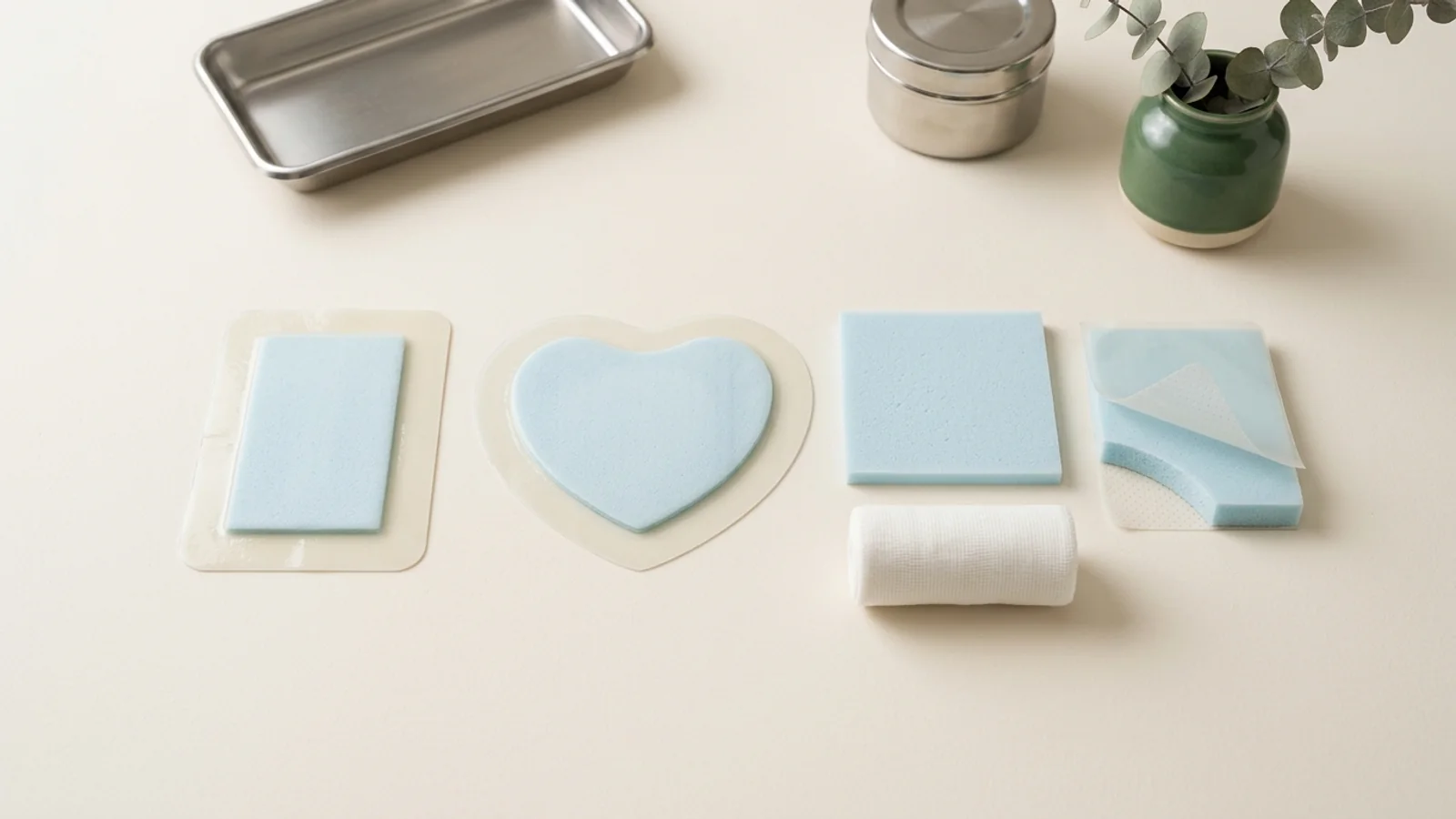
A hospital wound-care formulary update arrives on a procurement desk: the historical baseline item is an unbordered silicone foam pad, but two distributor proposals recommend upgrading to bordered rectangular and sacral-contoured variants. Each proposal quotes an absorbency or fluid-handling figure, but the figures do not share a unit or a test name. Sourcing teams are asked to decide which configuration to standardize, which of those figures can be compared, and what objective technical evidence must be recorded before switching stock-keeping units (SKUs).
The specification answer begins by separating material construction from marketing terminology. Buy a silicone foam dressing by verified layer architecture, standardized test basis, and labeled regulatory limits—never by brand catalog names. In wound-care manufacturing, silicone names the soft adhesive wound-contact layer, not the absorbent core. Exudate is managed by a polyurethane foam pad beneath a polyurethane backing film. Moisture-proof and barrier wording is a claim on a specific label, not a property of every pad. Selecting a bordered configuration is a fixation, perimeter-sealing, and anatomical contour decision; it is not an absorbency upgrade. Absorbency depends on the polymer chemistry, thickness, and micro-pore structure of the internal foam core, which can be identical in non-bordered pads.
Furthermore, vendor absorbency figures cannot be ranked side-by-side unless their test standards, test fluids, reporting units, and laboratory conditions match. Figures generated under free-swell saturation tests per EN 13726 inflate benchtop values relative to clinical performance, whereas Fluid Handling Capacity (FHC) is absorbency plus moisture-vapour loss. Labeled wear times of up to 7 days are manufacturer maxima, qualified by wound and skin condition, not change schedules. A plain silicone foam dressing fits the FDA Class I, 510(k)-exempt hydrophilic wound dressing identification (21 CFR 878.4018, product code NAC) only when it has no added drug. Silver and other added antimicrobials are outside that identification.
What 'Silicone Foam' Names: Layers and the FDA Identity
In clinical product sheets and tender line items, the phrase 'silicone foam dressing' is frequently misunderstood as describing an absorbent foam made entirely of silicone rubber. Material science and device listings contradict this assumption. A silicone foam dressing is a composite multi-layer medical device engineered to balance non-traumatic adhesion, vertical fluid capillary uptake, and moisture evaporation.
The typical commercial construction consists of three primary functional layers, sometimes expanded to four or five layers in specialized bordered variants:
1. Soft Silicone Wound-Contact Layer: A soft silicone contact layer. The 2024 Mölnlycke catalog describes Safetac as not adhering to the moist wound bed but to dry skin only. That is a removal claim. It is not evidence that one foam core heals a wound faster than another.
2. Hydrophilic Polyurethane Foam Core: The absorbent part of the dressing. The 2024 Mölnlycke catalog describes a polyurethane foam pad that absorbs exudate and may be used under compression. Some bordered products add a named spreading layer. Mölnlycke describes one that distributes exudate over a wider area, and it describes Mepilex Border Flex as a five-layer stack. Those extra layers are a named construction, not a result of having a border, and they are not a retention-under-pressure result.
3. Polyurethane Backing Film: A thin, semi-permeable polyurethane membrane bonded to the upper surface. The 2024 Mölnlycke catalog describes the Mepilex film as a breathable, moisture-proof backing and as a bacterial and viral barrier. Treat bacterial, viral, and waterproof claims as statements on that label, and only while the film is intact, not as properties of every silicone foam pad. The film also sets how much absorbed water can leave as vapor.
flowchart TD
  subgraph DressingLayers["Named layers, not every SKU"]
    direction TB
    A["Backing film<br/>Breathable, moisture-proof, or barrier only when that label says so"]
    B["Optional spreading layer<br/>Record it only if the device description names it<br/>Mölnlycke names one that distributes exudate"]
    C["Polyurethane foam pad<br/>Absorbs exudate on the Mepilex label<br/>Not a laboratory result by itself"]
    D["Soft silicone contact layer<br/>Mölnlycke Safetac: dry skin only, not the moist wound bed<br/>A removal claim, not a healing claim"]
  end
A --- B --- C --- DFrom a regulatory perspective, a plain non-medicated silicone foam dressing is identified under the United States Food and Drug Administration (FDA) hydrophilic wound dressing regulation only when it meets that identification. Under 21 CFR 878.4018, the FDA defines a hydrophilic wound dressing as a sterile or non-sterile device intended to cover a wound and absorb exudate, fabricated from non-resorbable materials with hydrophilic properties.
The generic FDA classification carries the three-letter product code NAC ('dressing, wound, hydrophilic'). Devices regulated under 21 CFR 878.4018 are classified as Class I (general controls) and are exempt from premarket notification (510(k)) procedures under part 807 subpart E, subject to the limitations set forth in 21 CFR 878.9. NAC is the generic hydrophilic wound dressing code, not a silicone-foam-only code, so a NAC record does not prove polyurethane foam construction. AccessGUDID lists Mölnlycke Mepilex Border Flex 10 × 10 cm, primary DI 07333350993306, under NAC, exempt from premarket submission, and packaged as sterile. That public record, version dated 4 November 2025, does not populate a sterilization method, so the method still has to be requested. A plain bordered pad and a plain non-bordered pad can share this Class I baseline only when neither contains an added drug, biologic, or animal-derived material, and only subject to the limitations in 21 CFR 878.9. The wider code map is in the guide to specifying wound dressings by FDA identification.
Bordered or Non-Bordered: The Fixation and Shape Decision
One of the most persistent procurement misconceptions is that a bordered silicone foam dressing is intrinsically more absorbent than a non-bordered foam pad. Hospital committees frequently treat bordered dressings as a clinical escalation for heavy exudate, presuming the adhesive perimeter reflects upgraded core capacity. Laboratory characterizations and manufacturer engineering specifications clarify that the border is a fixation, sealing, and anatomical shaping choice, not an absorbency upgrade.
A non-bordered silicone foam dressing consists of the absorbent polyurethane foam core, the silicone wound-contact layer, and the polyurethane film, with edges extending to the perimeter. Because it has no integrated adhesive margin, the line item needs a separate retention product: medical retention tape, elastic tubular netting, stretch gauze, or a cohesive retention sheet. Ask whether the instructions allow cutting. A non-bordered pad is the usual format when the outline has to be irregular, and the quote then needs that retention product. A bordered pad is specified when the perimeter has to stay intact. Smith+Nephew states that cutting Allevyn Gentle Border compromises its bacterial barrier; do not copy that limit onto every bordered brand.
Conversely, a bordered silicone foam dressing adds an adhesive perimeter beyond the central foam island. Record the foam-pad size and the total outer size as separate numbers. The border is what makes the pad self-fixing and is the basis for any labeled water-barrier claim while the border is intact. It does not document a thicker or more absorbent core.
Bordered product families also unlock specialized anatomical shapes. While non-bordered foam is predominantly supplied in standard squares and rectangles (e.g., 5 x 5 cm, 10 x 10 cm, 15 x 15 cm, and 20 x 20 cm), bordered dressings are molded into specialized clinical geometries:
• Sacral Formats: Tri-lobe, heart, or butterfly outlines sold to cover the sacral area. Record the shape, the pad size, and the outer size. The shape is not an absorbency upgrade and is not evidence of a shear or friction outcome.
• Heel and Joint Formats: Multi-wing or cupped geometries (such as 18.2 x 16.9 cm heel designs) designed to wrap smoothly around curved malleolar and calcaneal structures without wrinkling or dog-ear creasing.
• Multisite and Articulating Formats: Flex-cut margins that accommodate dynamic expansion across knees, elbows, and abdominal folds.
| Specification Dimension | Bordered Silicone Foam | Non-Bordered Silicone Foam |
|---|---|---|
| Fixation Mechanism | Self-adhering integral silicone adhesive perimeter | Requires secondary fixation (tape, tubular netting, wraps) |
| Anatomical Configurations | Rectangles, sacral butterfly, heel cups, articulating multisite | Primarily flat squares and rectangles |
| Trimming & Cutting | Do not assume cutting is allowed. Allevyn Gentle Border's label says cutting compromises the bacterial barrier. | Usual format when the outline is irregular. Confirm the cutting instruction rather than assuming every pad may be cut. |
| Fluid Barrier & Showering | Only when the label says the intact border film is waterproof | No integral border seal; any water claim depends on the secondary cover and its label |
| Secondary fixation | Integral border is the fixation. Add a retention product only if the instructions say to. | Specify tape, tubular net, or a retention sheet in the same quote. |
| Absorbency inference | Not evidence of a larger foam core or a higher fluid-handling result. | Not evidence of a smaller core. Compare only matched test reports. |
| Regulatory Status | No-drug pads only: 21 CFR 878.4018, product code NAC, Class I exempt. Confirm the SKU. | No-drug pads only: 21 CFR 878.4018, product code NAC, Class I exempt. Confirm the SKU. |
flowchart TD
  Start["Write the silicone foam line item"] --> Shape{"Does the line require a named shape such as sacral or heel?"}
  Shape -- Yes --> Anat["Bordered anatomical SKU<br/>Record the shape, pad size, and outer size<br/>Do not treat the shape as higher absorbency"]
  Shape -- No --> Cut{"Must the pad be cut to an irregular outline?"}
  Cut -- Yes --> NB["Non-bordered pad<br/>This is the format sold to be cut<br/>Name the separate retention or cover SKU"]
  Cut -- No --> Fix{"Is integral fixation part of the specification?"}
  Fix -- Yes --> BR["Bordered rectangle<br/>Keep the border intact<br/>Allevyn Gentle Border: cutting is labeled as loss of the bacterial barrier"]
Fix -- No --> Ret["Non-bordered pad plus a named retention product<br/>Quote absorbency only on a matched test basis"]How Absorbency Claims Are Produced and Why the Units Differ
Procurement officers and value-analysis committees evaluating vendor tenders are routinely confronted with conflicting performance claims. One sheet may report fluid handling capacity in grams per square centimetre per 24 hours, another may rescale that family of results to grams per 10 cm² or per square metre, and a third may quote grams per dressing with no area and no time. Those are not three measurements of the same thing.
In wound management consumables, the definitive laboratory benchmark is EN 13726 ('Test methods for wound dressings'). The current edition is EN 13726:2023. Its scope is absorption, moisture-vapour transmission, waterproofness, and extensibility. Nygren and Gefen describe the 2023 revision as marginal after two decades and say the data should be read with high caution. The method text is paywalled and is not reproduced here.
To interpret vendor specification sheets, buyers must dissect the two primary methodologies used to quantify liquid management:
1. Free-Swell Absorptive Capacity: Annex B is the normative free-swell method. It saturates the specimen in excess test fluid, including from faces that would not face a wound, and the standard itself notes that fluid trapping can produce artificially high absorbency figures. Nygren and Gefen describe the specified fluid, Solution A, as a non-biological salt solution that lacks the viscosity and wettability of wound exudate. Vendors then print the result as grams per cm², per 10 cm², per 100 cm², or per square metre. The unit is part of the claim.
2. Fluid Handling Capacity (FHC): Annex E is the normative fluid-handling method. Nygren and Gefen describe it as a 24-hour Paddington-cup test using 30 mL of liquid: fluid absorbency plus moisture-vapour loss, reported in grams per cm² per 24 hours. The relationship is:
Fluid handling capacity = fluid absorbency + moisture-vapour loss, in grams per cm² per 24 hours.
A 2024 letter in the International Wound Journal ('Little news is good news? What is missing in the recently published EN 13726:2023 test standard for wound dressings') argues against buying on the raw laboratory number. Erik Nygren is affiliated with Mölnlycke Health Care, and the letter discloses that Amit Gefen is a paid consultant to Mölnlycke, so read it as a methods critique rather than a neutral brand ranking. The letter's main cautions are these. Free-swell saturation can inflate the absorbency figure relative to how a dressing is used. Solution A lacks the viscosity and wettability of exudate. Annexes C and D are informative rather than normative because inter-laboratory experiments showed unexplained variation, and Annex C tests dressings at full saturation under compression. The letter does not publish those annex procedures. A figure from an informative annex is not interchangeable with a figure from Annex B or Annex E.
Nygren and Gefen captured the procurement fallacy with a trenchant engineering analogy: purchasing wound dressings on the sole basis of higher fluid handling capacity or free-swell grams is analogous to purchasing high-speed cars in a world governed by strict speed limits. A higher laboratory total is not, by itself, a reason to pay more.
Gefen and colleagues, in a 2024 engineering review in the same journal, argue that absorbency and retention vary with materials and construction, and that grouping polyurethane foams under one foam-dressing name and assuming similar performance is flawed. Evaporation through the backing is a separate share of fluid handling. Two dressings can report similar totals while holding different shares of that total in the foam versus losing it as vapor. If a secondary wrap blocks the film, the evaporative share is not available in use. The review is theoretical and industry-affiliated, not a clinical trial, and it does not supply a universal retained-versus-evaporated split.
Wear Time: Labeled Maxima and Their Qualifiers
Manufacturer product catalogs prominently display extended wear-time ratings—most commonly 'up to 7 days'. Sourcing analysts frequently calculate institutional cost models by dividing unit acquisition price by 7 days to derive a theoretical 'cost-per-day' figure. This calculation is a widespread financial pitfall.
On the product label, an 'up to 7 days' statement is a labeled maximum, not a guaranteed interval in use. It is the longest wear the label states, qualified by wound condition, exudate, and surrounding skin. It is not a biocompatibility certificate, and it is not a change schedule.
A closer examination of official manufacturer documentation reveals vital technical qualifiers that differ across product families:
• Mölnlycke Mepilex Border Flex: Labeled for wear up to 7 days, explicitly qualified by wound status, exudate level, and surrounding skin condition. Non-bordered Mepilex carries a more conservative catalog statement: it may be left in place for several days depending on the condition of the wound and surrounding skin. The same catalog adds 'or as indicated by accepted clinical practice,' which is not a wear-time number a buyer can put in an item master.
• Smith+Nephew Allevyn Gentle Border: Standard rectangular configurations carry a labeled wear time of up to 7 days. However, the manufacturer's official labeling for the sacral variant limits wear time to 5 days. A separate Smith+Nephew treatment page reports an average wear time of 3.6 days and says dressing changes were minimized to about twice a week. Those figures are manufacturer-reported from company-cited evaluations, not an independent multi-center finding, and they are not a sacral-only result.
• Coloplast Biatain Silicone Fit: The Biatain Silicone range is labeled for up to 7 days depending on exudate, dressing condition, and wound type. Confirm that maximum on the Fit SKU's own instructions. The US professional page documents the Fit shapes, including a heel size of 18.2 × 16.9 cm.
| Brand & Manufacturer | Format & Border | Core & Adhesive Chemistry | Labeled Wear-Time Maximum | FDA Classification & Code |
|---|---|---|---|---|
| Mepilex Border Flex (Mölnlycke) | 5-layer bordered (Rectangles, Sacrum, Heel) | Polyurethane foam + Safetac soft silicone | Up to 7 days (conditioned on exudate & skin) | No-drug category: NAC, Class I exempt. Confirm the SKU in GUDID. |
| Mepilex Standard (Mölnlycke) | Non-bordered pad (Flat sheets, roll) | Polyurethane foam + Safetac soft silicone | Several days (conditioned on exudate & skin) | No-drug category: NAC, Class I exempt. Confirm the SKU in GUDID. |
| Allevyn Gentle Border (Smith+Nephew) | Multi-layer bordered (Rectangles, Multisite) | Hydrocellular polyurethane + perforated silicone | Up to 7 days (standard shapes) | No-drug category: NAC, Class I exempt. Confirm the SKU in GUDID. |
| Allevyn Gentle Border Sacrum | Contoured bordered sacral pad | Hydrocellular polyurethane + perforated silicone | Up to 5 days (sacral specific) | No-drug category: NAC, Class I exempt. Confirm the SKU in GUDID. |
| Biatain Silicone Fit (Coloplast) | 5-layer bordered (Rectangles, Sacrum, Heel) | Polyurethane foam + soft silicone adhesive | Up to 7 days (conditioned on exudate & skin) | No-drug category: NAC, Class I exempt. Confirm the SKU in GUDID. |
For tender evaluation and cost-in-use modeling, do not divide the unit price by 7 as if every pad remains in place for the labeled maximum. Use that maximum as a ceiling. Use a manufacturer-reported average only when the page names it, as Smith+Nephew does with the 3.6-day figure. That figure is not a hospital-wide change interval and not a sacral-only result.
Where Silicone Foam Leaves the Class I Lane
A critical compliance risk in medical supply distribution and hospital purchasing is the conflation of plain silicone foam dressings with medicated or antimicrobial variants. A buyer ordering 'silicone foam with silver' might assume it is merely another SKU within the same commodity line item. Under medical device regulations, adding an antimicrobial agent fundamentally changes the legal status, evidentiary burden, and classification of the consumable.
The plain silicone foam regulation, 21 CFR 878.4018, contains an explicit exclusion. The classification does not include a hydrophilic wound dressing that contains added drugs such as antimicrobial agents, added biologics such as growth factors, or is composed of materials derived from animal sources.
An added antimicrobial takes the dressing outside that identification. The proposal's examples do not all sit in one future class: ionic silver, zinc, copper, chlorhexidine, and benzalkonium chloride are listed as medium-level antimicrobial-resistance concern; polyhexamethylene biguanide is listed as low-level; silver sulfadiazine is listed with the medically important, high-level agents. Honey is discussed as an other chemical, not as a medium-level antimicrobial.
Historically, these combination products occupied an unclassified, preamendments regulatory status, cleared through the 510(k) process under specialized product codes including FRO (dressing, wound, drug), GER, MGP, MGQ, and EFQ.
To resolve this legacy ambiguity, the FDA published a major proposed rule on November 30, 2023 (88 FR 83774). Under rulemaking docket RIN 0910-AI26, the agency proposed establishing a new formal regulation, 21 CFR 878.4016 ('Solid wound dressings containing antimicrobials and/or other chemicals'). Under the proposed risk stratification: Solid wound dressings that contain a medium- or low-level antimicrobial acting as a protectant, and dressings that contain other chemicals, are proposed for Class II (special controls). A 510(k) would still be required. This class is proposed, not in force. The proposal's high-level examples for solid dressings include polymyxin B, silver sulfadiazine, and bacitracin, and those protectant products are proposed for Class III, requiring rigorous Premarket Approval (PMA) applications.
What the Clinical Evidence Does Not Support
Marketing literature for advanced silicone foam dressings often implies that superior fluid handling metrics, proprietary foam geometries, or patented silicone adhesive formulations accelerate wound healing rates. Evidence-based procurement mandates that hospital committees distinguish between physical dressing attributes and substantiated clinical outcomes.
Extensive systematic reviews conducted by the Cochrane Collaboration demonstrate that there is no high-certainty clinical evidence proving foam dressings heal wounds faster or more effectively than other standard dressing categories:
• Pressure Ulcer Healing (Cochrane CD011332): The Cochrane review of foam dressings for pressure ulcers, searched to February 2017, states that there is no clear evidence that foam dressings are more effective at healing pressure ulcers, or more cost-effective, than other dressing types. One trial compared a silicone foam dressing with a hydropolymer foam dressing in 38 participants and was graded very low certainty evidence for both complete healing and adverse events.
• Venous Leg Ulcer Healing (Cochrane CD009907): The Cochrane review of foam dressings for venous leg ulcers, searched in October 2012 and published in 2013, found no evidence that polyurethane foam dressings are significantly better or worse than hydrocellular foam dressings, or than the other primary dressings in the included trials, when used beneath compression. Six of twelve trials were at high risk of bias and six were unclear. That is not proof that the dressings are equivalent.
• NICE Evidence Summary (ESMPB2): NICE evidence summary ESMPB2, whose content was up to date in March 2016, reports that the foam-dressing trials in the venous-leg-ulcer Cochrane review were at high or unclear risk of bias and that the evidence was generally low or very low quality. NICE says that if a specific dressing cannot be adequately justified on clinical grounds, the least costly dressing of the type that meets the required characteristics is the reasonable choice. The summary does not rank silicone foam brands, and it is not a dressing-change instruction.
For a formulary decision, the supported conclusion is narrower: absorbency is a physical benchtop property, not a clinical superiority guarantee. A higher absorbency figure is a laboratory result on a stated test. It is not a demonstrated healing benefit, and it is not a reason to treat two silicone foam SKUs as interchangeable.
The Specification Fields to Put in an RFQ or Item Master
To avoid vendor disputes and keep a substitute inside the specified construction, procurement teams must translate these engineering and regulatory limits into clear item master descriptions and tender specifications. Generic descriptions like 'Silicone foam dressing 4x4' must be replaced by structured technical fields. Map any HCPCS foam-cover code to both pad area and border: A6209 through A6211 have no adhesive border, and A6212 through A6214 are the same size bands with a border. Each of those long descriptors also says the cover is sterile. A6215 is the sterile foam wound filler, per gram, and is not a cover code. Those codes are reimbursement categories, not absorbency or equivalence evidence, and a non-sterile pad that still fits 21 CFR 878.4018 is not automatically one of these codes.
| Item Master Field | Required Specification Detail | Verification Source Document | Audit Failure Consequence |
|---|---|---|---|
| Contact Layer Adhesive | Perforated soft silicone wound-contact adhesive; state any non-silicone adhesive | Manufacturer Technical Data Sheet (TDS) | Reject if acrylic or rubber adhesive is substituted |
| Absorbent Core Material | Polyurethane foam pad that the device description says absorbs exudate | Device description or technical data sheet | Reject if non-absorbent polymer is supplied |
| Backing Membrane | Polyurethane film. Record breathable, moisture-proof, or barrier claims only as written on the label. | Technical Data Sheet / Specification | Reject if the supplied film does not match the claim written into the item master |
| Border Configuration | State clearly: 'Bordered (Integral)' or 'Non-Bordered' | Product Catalog / Packaging Artwork | Flag mismatch; non-bordered requires secondary tape |
| Anatomical Geometry | State: Square, Rectangular, Sacral, or Heel shape | Product Catalog / IFU | Reject if standard rectangle sent for sacral line item |
| Dimensional Sizing | Specify Pad Dimensions AND Total Outer Dimensions | Primary Packaging / Catalog Spec | Reject if the pad size or outer size does not match the specified dimensions |
| Absorbency Test Basis | Edition, annex, metric, unit, duration, test fluid, and any compression pressure. Mark unknown if a field is blank. | Third-party or factory lab test report | Mark 'Unknown' if vendor reports unanchored grams |
| Labeled Wear Time | State maximum labeled days AND condition qualifier | Instructions for Use (IFU) / Labeling | Reject if catalog claims 7 days but IFU specifies less |
| Sterility & Method | State sterile or non-sterile. If sterile, name the method. 878.4018 allows either. Do not infer a method when GUDID leaves it blank. | Certificate of Conformance / Sterility Lot | Reject lot if sterile barrier is damaged or unverified |
| Regulatory Listing | FDA 21 CFR 878.4018, Product Code NAC (Class I) | FDA Device Listing / GUDID Database | Reject exempt claim if antimicrobial drugs are present |
| UDI-DI Identification | GS1 GTIN or HIBCC format Primary Device Identifier | GUDID Database / Package Barcode | Quarantine shipment if barcode cannot be scanned |
| Reimbursement Code | Without a border: A6209 (pad 16 sq in or less), A6210 (more than 16 sq in but less than or equal to 48 sq in), A6211 (more than 48 sq in). With a border: A6212, A6213, and A6214 on those size bands. Each long descriptor also says sterile. Reimbursement category only, not absorbency. | Manufacturer Reimbursement Guide | Billing denial if wrong HCPCS code mapped to SKU |
When receiving incoming shipments at the hospital distribution dock, receiving teams must verify packaging integrity, UDI barcode readability, and labeled storage conditions. Detailed protocols for auditing packaging seals and tracking regulatory device identifiers are outlined in our operational guides to UDI and GUDID capture for medical consumables, recording sterile-pouch damage at goods receipt, and labeled storage and transport controls. Check package integrity, the UDI barcode, and the labeled storage conditions against the item master before the lot is released to stock.