
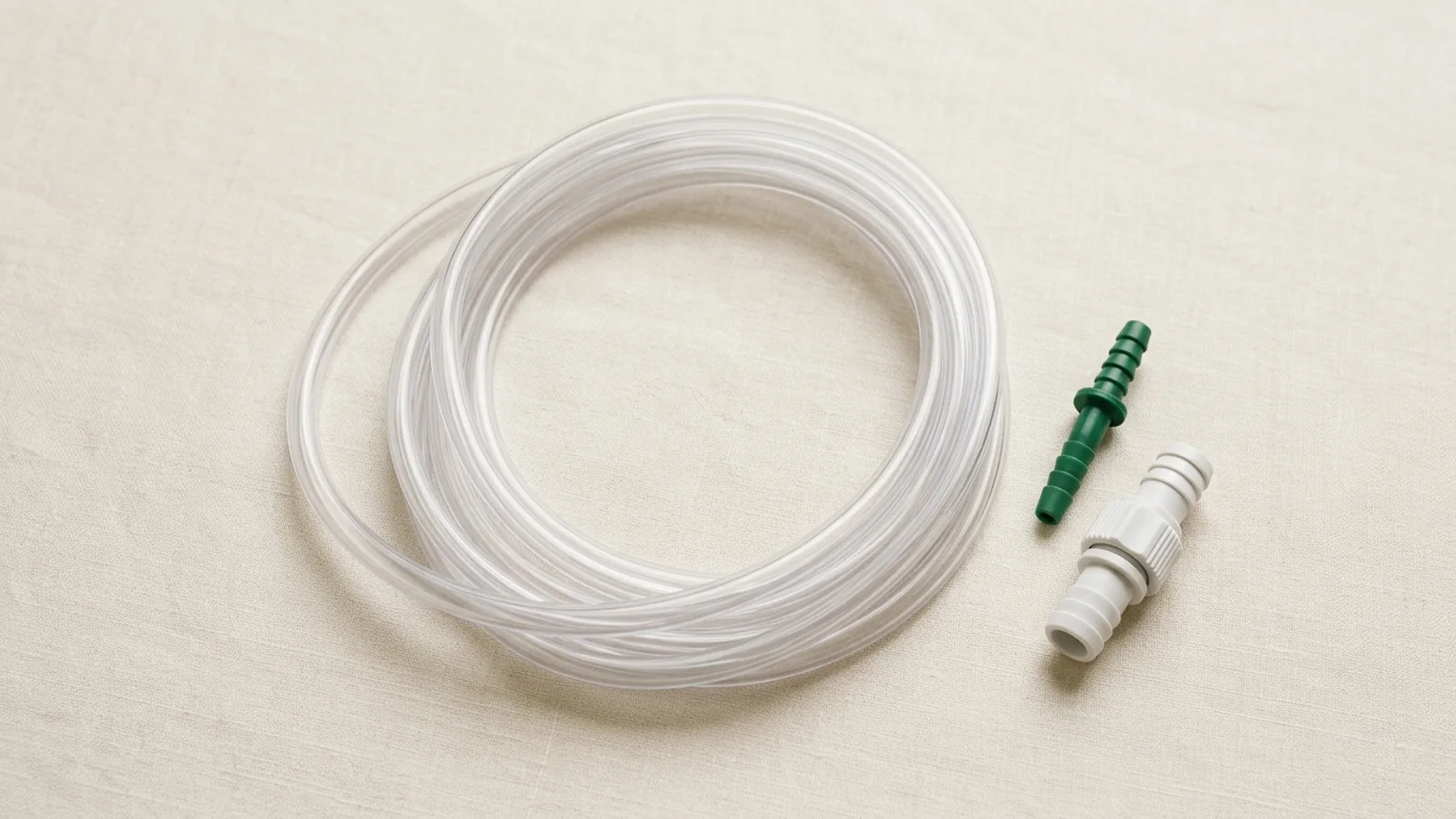
Name the fitting, then the labeled length
Match the oxygen tubing to the outlet already installed, then copy the length limit that belongs to that oxygen source. Open Critical Care describes the patient-side joint as smooth-bore tubing pushed by hand onto a tapered barbed adapter, sometimes called a Christmas-tree connector, and states that there is no universal standard for oxygen connectors. That push-on joint is not locked. The same overview says accidental disconnection is common, especially if the tubing is not pushed on firmly or the pressure is high.
The barbed adapter and the wall fitting are different parts. The adapter may screw onto a flowmeter by hand, and Open Critical Care warns that over-tightening can damage it. Upstream of that barb, an about-50-psi (3.45 bar) outlet needs a gas-specific connection: DISS for oxygen, or the quick-connect family on that wall. Smooth-bore patient tubing is the wrong hose for that pressure. The overview says it cannot maintain integrity on an intermediate-pressure source and that reinforced, gas-specific hose is required.
In the United States, FDA classifies the flexible or rigid tubing used to deliver pressurized medical gases under 21 CFR 868.5860. The product-classification record for that regulation is product code BYX, Class I, 510(k) exempt, and not GMP exempt. Exemption is limited by 21 CFR 868.9. A historical clearance such as Hudson Respiratory Care Model 1115 (K011134) belongs to that device. Two pieces that push together are not evidence that the resins, bonds, or labeled limits match.
Length is a labeled limit for the source in front of the buyer. SunMed user guide UG-10007 says the length of the oxygen tubing plus the nasal cannula should not exceed 57 feet, so there is enough pressure to deliver the set flow. UCSF Health's oxygen-equipment page describes stationary concentrator and liquid-reservoir setups with 50-foot tubing, and it states a 7-foot maximum for portable oxygen concentrators. Those are source-specific instructions. Bench studies of other devices do not replace them.
What FDA calls this tubing
Section 868.5860 identifies pressure tubing and accessories as flexible or rigid devices intended to deliver pressurized medical gases. The sentence stops there. It does not list a connector geometry, a French size, a color, or a maximum length. The BYX classification record maps that identification to regulation 868.5860, device class 1, submission type 510(k) exempt. The same record lists the device as not GMP exempt, so a 510(k) exemption is not an exemption from quality-system duties.
Section 868.9 keeps the exemption only while the device stays within the existing or reasonably foreseeable characteristics of legally marketed devices of that type. A premarket notification is still required when the device is intended for a different use, or when it operates by a different fundamental scientific technology. Buyers should treat a catalog line that adds a new gas service, a new pressure rating, or a new intended environment as a classification question, not as another BYX tubing SKU.
| Product code | Regulation and identification | Class and submission | What the buyer is looking at |
|---|---|---|---|
| BYX | 21 CFR 868.5860. Flexible or rigid devices intended to deliver pressurized medical gases. | Class I. 510(k) exempt under 21 CFR 868.9. Not GMP exempt. | Oxygen supply tubing and the low-pressure tubing connectors FDA has listed under this code. |
| BZA | 21 CFR 868.5810. An airway connector connects a breathing-gas source to a tracheal tube, tracheostomy tube, or mask. | Class I. 510(k) exempt under 21 CFR 868.9. The classification record lists ISO 5356-1. | Airway extension connectors and some oxygen swivel connectors FDA has filed under BZA, outside BYX. |
| CAT | 21 CFR 868.5340. A nasal oxygen cannula is a two-pronged device used to administer oxygen through both nostrils. | Class I. 510(k) exempt under 21 CFR 868.9. Not GMP exempt. | The nasal interface on one end of the supply tubing. |
| BYG | 21 CFR 868.5580. An oxygen mask is placed over the nose, mouth, or tracheostomy to administer oxygen or aerosols. | Class I. 510(k) exempt under 21 CFR 868.9. Not GMP exempt. | The mask interface. The ConvaTec elongated-mask recall below is filed under BYG. |
FDA's 510(k) database records K011134 as OXYGEN SUPPLY TUBING, MODEL 1115, from Hudson Respiratory Care, Inc. The decision is substantially equivalent, dated June 13, 2001, under classification name Tubing, Pressure And Accessories, regulation 868.5860, product code BYX. That letter is evidence that this product name sits in the BYX family. It is not a clearance that other brands can quote.
The FDA medical-device shortages list also shows how FDA sorts current AirLife / SunMed lines. These entries are discontinuances. For the June 16, 2026 BYX rows below, FDA states that the device has not been commercially distributed in the United States for an extended period and that the discontinuation is not anticipated to result in a device shortage.
June 16, 2026, BYX, SunMed Group Holdings, LLC dba AirLife: oxygen tubing with 2 standard connectors, 25 ft (7.6 m), disposable, SKU M4250G-0.
June 16, 2026, BYX: Salter oxygen tubing connector, SKU M128583.
June 16, 2026, BYX: oxygen tubing connector, barbed, TwinMed SKU 100243.
June 16, 2026, BYX: oxygen tubing swivel connector, labeled for low pressure, not to exceed 10 psi, SKU M833710. That 10 psi ceiling is printed on this connector. It is not a pressure rating for every oxygen-tubing SKU.
March 13, 2026, BZA: oxygen swivel connector, SKUs 001841 and 001842. FDA's reason line is strategic product portfolio simplification.
March 13, 2026, BZA: adapters/connectors, SKUs 7-SP5088 and 7-5126.
March 13, 2026, BYX: 21 ft (6.4 m) crush-resistant oxygen tubing, described as vinyl tipped, with a U/Connect-It adapter, SKU 001304U. FDA spells the material word "Vynil" on that row. The reason line says multiple equivalent products are on the market. This is one listed item, not a polymer disclosure for the whole catalog.
A purchase order that names only a legacy SunMed or Salter number can die when that number is discontinued even though FDA does not call the event a shortage. The replacement has to be specified by end name, length, and the fields the label actually states.
Which connector is on the outlet
Open Critical Care organizes the hardware by the joint a technician can see. Low-pressure patient tubing pushes onto a barb. Intermediate-pressure hose, about 50 psi, is reinforced and gas-specific. Cylinder valves are a third interface. The CGA standard FDA recognizes for DISS uses the words "low pressure" for a different boundary: connections at 200 psi (1380 kPa) or less. A buyer who copies the word "low pressure" from a DISS data sheet onto a vinyl supply tube has mixed those two meanings.
| Joint the buyer can see | What the cited source says | What to write on the order | Limit to keep with the line |
|---|---|---|---|
| Barbed patient tubing | OCC: smooth-bore tubing is pushed onto a tapered barb. The joint is not secured. Plastic or metal Christmas-tree adapters screw on by hand and can be damaged by over-tightening. | End name from the tubing catalog, plus the barb already on the flowmeter or concentrator. | Do not place this tubing on an about-50-psi outlet. OCC says smooth-bore tubing cannot hold that pressure. |
| DISS oxygen | CGA V-5:2019 is FDA-recognized consensus standard 1-167, recognition list 062, entered May 29, 2024. It covers noninterchangeable removable connections at 200 psi (1380 kPa) or less. Bay Corporation states that oxygen, DISS 1240, uses the 9/16-inch-18 thread in place of the diameter indexing used for other DISS gas families. | DISS 1240, oxygen, 9/16-inch-18, when that is the fitting on the regulator or wall. | DISS indexes the gas at that threaded joint. It does not index a green barbed nipple downstream. |
| Quick-connect wall outlet | OCC: new construction in the United States and Canada uses DISS, while multiple quick-connect styles remain in service. Regional hose and wall standards are not cross-compatible. Named examples on that overview include Ohmeda, Chemetron, Oxyequip, Puritan Bennett, BS 5682/Schrader, DIN, AFNOR, JIS, and NIST. | The family installed on that wall plate. | A hose built for one quick-connect family does not substitute for another. |
| 15 mm and 22 mm cones | ISO 5356-1 defines those conical connectors for anaesthetic and respiratory equipment. FDA's BZA record is the airway-connector code under 21 CFR 868.5810 and lists ISO 5356-1 as a recognized consensus standard. | Airway connector, BZA, when the part joins a breathing circuit, tracheal tube, tracheostomy tube, or mask. | This is a separate buy from barbed oxygen supply tubing. The tracheostomy inner-cannula guide shows where a 15 mm connector sits on a tube family. |
| Cylinder valve | OCC identifies pin-index yoke valves as CGA 870. For the United States and Canada it describes CGA 580 as the industrial handwheel standard and CGA 540 and CGA 810 as medical handwheel standards. | The valve standard on the cylinder, handled as a gas-control fitting. | Supply tubing attaches after the gas is regulated, at the barb. It does not replace the cylinder valve. |
The path below is the purchasing sequence. It is not a permission to build a circuit from whichever green part is in the bin.
flowchart TD
  cylinder[Cylinder valve: CGA 870 pin index or CGA 540 or 810 handwheel]
  wall[Wall or regulator outlet, about 50 psi]
  diss[DISS 1240 oxygen: 9/16-inch-18 thread]
  quick[Quick-connect family installed on that wall]
  barb[Barbed adapter on the flowmeter]
  tube[Oxygen supply tubing, push fit]
  patient[Cannula or oxygen mask]
  cylinder --> wall
  wall --> diss
  wall --> quick
  diss --> barb
  quick --> barb
  barb --> tube
tube --> patientOn the AirLife / Salter Labs 3-channel oxygen supply tubing page, the connector column is a purchasing field of its own. The page uses the names Trumpet, Thread Grip, and U/Connect-It. One 7-foot row is described as a male/female connector and still lists Thread Grip in the connector column. The page does not publish the rib shape, barb diameter range, or inner diameter behind those names, so those dimensions stay Unknown. Unlike a named small-bore system such as the ENFit enteral syringe connector, these oxygen ends are catalog labels for a friction fit, not a gas-indexed standard.
Length follows the source label
Put the length limit next to the device that states it. Three public instructions are easy to mix up because the numbers sit near one another.
SunMed UG-10007 covers a tubing connector sold in swivel and non-swivel versions. The connector joins two pieces of oxygen tubing. The guide's length sentence is: "The length of the oxygen tubing plus nasal cannula should not exceed 57 feet to ensure enough pressure to deliver your set oxygen flow rate." The 57 feet includes the cannula. The guide does not say that 57 is the sum of a 50-foot supply line and a 7-foot cannula.
UCSF Health tells patients that a compressed-gas system's stationary component is an oxygen concentrator with 50-foot tubing, that a liquid system uses an oxygen reservoir with 50-foot tubing, and that the maximum tubing length for proper delivery from a portable oxygen concentrator is 7 feet. That page is one health system's patient education. It is not a federal maximum.
510(k) K250671, the CAIRE FreeStyle Comfort summary dated in the 2025 file, says oxygen is delivered through a nasal cannula/tubing assembly from Salter Labs (SunMed, LLC), P/N 1600 (K911740). The user must follow that cannula manufacturer's instructions for length of use, maintenance, and replacement. The same summary lists pulse-dose settings and continuous-flow settings from 0.5 to 3.0 liters per minute. The 7-foot figure from UCSF is not printed in that clearance summary as a FreeStyle Comfort limit.
A cleared stationary concentrator can be just as general. K102245 for the CARE ZY5B3A concentrator says oxygen is delivered by standard oxygen supply tubing and a standard nasal cannula or oxygen mask, with an optional standard bubble humidifier, and that the device is available by prescription. In that summary, "standard" means the customary interface named by the manufacturer. It does not cite a connector standard number.
What the bench studies measured
Two published bench studies measured flow through long tubing on the devices the authors had. They are evidence about those setups. They are not a substitute for the length on a device label.
Cullen and Koss, Chronic Respiratory Disease, 2005, volume 2, issue 4, pages 193-197 (PubMed 16541602). The published summary states that neither the concentrator nor the liquid-oxygen delivery units had flow reductions greater than 13.5% and 4.0%, respectively, at 2 L/min with 200 ft (60.96 m) of tubing. The PubMed record carries the authors' recommendation to consider tubing lengths up to 200 ft (60.96 m) at up to 3 L/min, or 100 ft (30.48 m) at 4 to 5 L/min, for an Invacare 5 and similar concentrators. The paper is about the units tested. The summary used here reports flow and does not include an FiO2 result for those runs.
Aguiar, Davidson, and colleagues, Respiratory Care, 2014 (PubMed 25406341). They measured one cylinder and two oxygen concentrators at 1, 3, and 5 L/min, five times at each flow, for 45 proximal-to-distal comparisons across 98.42 ft (30 m) of tubing. Flows were similar at 1 and 3 L/min. At 5 L/min, distal flow was higher than proximal flow (5.57 versus 5.14 L/min). FiO2 was lower at the distal end, and the mean difference was less than 1%. The authors' conclusion is that 98.42 ft may be used for home oxygen delivery at flows up to 5 L/min because they found no important change in flow or FiO2, and that guideline limits of 19.68 ft (6 m) for concentrators and 49.21 ft (15 m) for cylinders were not based on sufficient evidence. The abstract does not explain the higher distal reading at 5 L/min.
Fields the purchase order should force
The AirLife page for Salter Labs 3-channel oxygen supply tubing is a useful catalog because it separates facts the page states from facts it never states. Page-level labels are: 3-channel design, "maintains an uninterrupted flow of oxygen," lengths from 1 ft to 100 ft, disposable, individual packaging, latex free, and single patient multiple use. The specification table on that page does not show a 100 ft item number, so the 100 ft figure is the range sentence, not a captured SKU. Polymer, DEHP or other plasticizer status, sterility, inner diameter, and a labeled pressure limit are absent. Those cells are Unknown.
The same nominal length is not one connector. The 7-foot rows below are Trumpet in clear, Trumpet in green, Thread Grip, a male/female line whose connector column still says Thread Grip, and a crush-resistant U/Connect-It. Ordering "7-foot oxygen tubing" does not select the end.
| Catalog item | Length | Color | Connector on the row | Crush-resistant on the row | Polymer | DEHP | Sterility | Labeled pressure |
|---|---|---|---|---|---|---|---|---|
| 2001-1-50 | 1 ft | Clear | Trumpet | Not stated on the row | Unknown | Unknown | Unknown | Unknown |
| 2004-4-50 | 4 ft | Clear | Trumpet | Not stated on the row | Unknown | Unknown | Unknown | Unknown |
| 2002-7-50 | 7 ft | Clear | Trumpet | Not stated on the row | Unknown | Unknown | Unknown | Unknown |
| 2002G-7-50 | 7 ft | Green | Trumpet | Not stated on the row | Unknown | Unknown | Unknown | Unknown |
| 2099-7-50 | 7 ft | Clear | Thread Grip | Not stated on the row | Unknown | Unknown | Unknown | Unknown |
| 9999-7-50 | 7 ft | Clear | Thread Grip; description says male/female | Not stated on the row | Unknown | Unknown | Unknown | Unknown |
| 001350 | 7 ft | Clear | U/Connect-It | Yes | Unknown | Unknown | Unknown | Unknown |
| 001303U | 14 ft | Clear | U/Connect-It | Yes | Unknown | Unknown | Unknown | Unknown |
| 2121G-21-25 | 21 ft | Green | Trumpet | Not stated on the row | Unknown | Unknown | Unknown | Unknown |
| 2099-25-25 | 25 ft | Clear | Thread Grip | Not stated on the row | Unknown | Unknown | Unknown | Unknown |
| 2025-25-25 | 25 ft | Clear | Trumpet | Not stated on the row | Unknown | Unknown | Unknown | Unknown |
| 2025G-25-25 | 25 ft | Green | Trumpet | Not stated on the row | Unknown | Unknown | Unknown | Unknown |
| 2035-35-20 | 35 ft | Clear | Trumpet | Not stated on the row | Unknown | Unknown | Unknown | Unknown |
| 2035G-35-20 | 35 ft | Green | Trumpet | Not stated on the row | Unknown | Unknown | Unknown | Unknown |
| 2050-50-20 | 50 ft | Clear | Trumpet | Not stated on the row | Unknown | Unknown | Unknown | Unknown |
| 2050G-50-20 | 50 ft | Green | Trumpet | Not stated on the row | Unknown | Unknown | Unknown | Unknown |
Read the 21-foot green Trumpet row next to FDA's March 13, 2026 discontinuance for SKU 001304U, a 21-foot crush-resistant line described as vinyl tipped with a U/Connect-It adapter. Same nominal length, different end, and a material word that appears on the FDA row only. The shortages-list swivel M833710 is the item labeled "not to exceed 10 psi." Leaving the pressure cell Unknown on the tubing rows is the accurate transcription of the AirLife table.
Oxygen compatibility and the Unknown cell
ISO 15001:2010 specifies requirements for the oxygen compatibility of materials, components, and devices used in anaesthetic and respiratory applications. The AirLife tubing page does not claim conformity to it, and it does not name a resin or a plasticizer. A request for quotation can ask for those documents. Until they arrive, the cell stays Unknown. Asking the question is not the same as receiving a certificate, and a certificate for one SKU does not cover the next item number.
Medicare codes for U.S. home-oxygen suppliers
For U.S. Medicare billing, CMS Policy Article A52514 lists oxygen tubing as A4616 among the accessories included in the allowance for rented oxygen equipment. The same list includes cannulas (A4615), mouthpieces (A4617), a face tent (A4619), masks (A4620 and A7525), and regulators (E1353). Published HCPCS descriptors render A4616 as "Tubing (oxygen), per foot." A52514 itself states the payment rule rather than the unit arithmetic, so the current CMS HCPCS release is the place to confirm how units are counted.
Under A52514, the supplier must provide any accessory the treating practitioner orders for rented oxygen equipment. Accessories used with beneficiary-owned oxygen equipment are denied as non-covered. There is no separate accessory payment described in that article for the rental period. E1353 is the regulator code on that list. A barbed adapter is not billed by borrowing the regulator code.
What joint failures show
The push-on joint and the solvent bond at a mask connector are documented failure points. The records below are specific products and lots. They are not a defect rate for every oxygen tube on the market.
ConvaTec elongated masks
FDA recall Z-2228-2017 covers Oxygen Masks, Elongated (under chin), Adult Med Conc., No Tubing, product code 104-E, classification Mask, oxygen, product code BYG. The recalling firm is ConvaTec, Inc. Quantity in commerce is 816,709. The firm initiated the recall on May 10, 2017, FDA posted it on May 24, 2017, and the record status is terminated on August 27, 2021.
FDA's reason statement says users reported tubing detaching from the masks either before use, in the packaging, or during use, across different batches. The failures were caused by an improper solvent bond between the oxygen tubing and the oxygen mask connector. FDA says the defect affects less than 2 percent of the recalled product and that there is a potential for harm when oxygen supply to the user is disrupted. FDA's determined cause is process control. The recall letters told consignees to stop distribution and quarantine the affected lots. The product name includes "No Tubing," and the failure mode is still the bond at the mask connector.
Southmedic OxyMask lot W73877
FDA's recall database lists a Southmedic OxyMask record at id 187862 (FDA recall record 187862). The Canadian notice is Health Canada's OxyMask Adult recall dated May 20, 2021, posted June 17, 2021, Type II, identification RA-75817. On April 21, 2021, a complaint described disconnection of oxygen tubing. After the complaint samples and inventory were investigated, Health Canada states that potential disconnection may be found throughout lot W73877, model or catalog number OM-1125-14, manufacturer Southmedic Inc.
A green nipple is not a gas index
The Anesthesia Patient Safety Foundation summarizes a case report, attributed to Kruppiah and co-authors, of a patient receiving 100 percent carbon dioxide through an AMBU bag connected directly to a carbon dioxide cylinder. The pin-index system on the cylinder yoke worked. The flowmeter was labeled Carbon Dioxide and carried a green nipple. The green color is the color used for an oxygen source, and commonly used oxygen supply tubing connected to that nipple. APSF's point for this joint is that the standards intended to prevent the wrong gas were not enough at a barbed nipple.
The same article describes DISS as a robust standard for connecting the wall supply to the gas delivery device, such as an anesthesia machine or ventilator, and says it is not possible to misconnect gases when that standard is used for those connections. It also says the Pin Index Safety System, used on high-pressure cylinders, has failed to prevent patient injury numerous times. DISS on the wall joint does not relabel a green barb. Color on the plastic is not the index.
What goods receipt can check
SunMed's connector guide gives a fit check, not a laboratory method: insert, push, and twist the tapered end into the tubing connector, then gently tug to check the fit. No-flow troubleshooting in that guide points to kinked or blocked tubing, a loose or disconnected joint, and a damaged or dirty swivel. A receiving record can use those words. It should not add a timed pull force or a magnification rule the guide does not contain.
Match the connector word on the incoming line to the purchase order: Trumpet, Thread Grip, U/Connect-It, or the male/female description. A 7-foot coil is not identified until that word is present.
Copy any printed pressure ceiling. M833710 is the discontinuance example labeled not to exceed 10 psi. A tubing row with no pressure figure stays Unknown.
Keep the source-device length limit with the line: SunMed's 57-foot tubing-plus-cannula instruction where that connector is in use, the cannula instructions named in a clearance such as K250671, and the device's own labeling for everything else.
If the pack is damaged, record the packaging level and the labeled identity. The catalog's "individual packaging" line is not a sterility claim. The sterile-pouch goods-receipt guide is a method for recording visible package damage. It does not convert this tubing into a sterile-barrier product.
Capture the identifier the label actually carries, using the same habits described in the UDI and GUDID receiving guide. Store the product inside the conditions printed on its own label, as discussed in the labeled storage and transport guide. This tubing page does not state a storage temperature.
In the quality agreement, assign who investigates a separated connector or a failed solvent bond, and what notice is required before a change to the connector, the adhesive, or the resin. The quality-agreements guide is where that split and the notice period are written down. The connector page does not state a notice period.
Handling limits printed on the connector guide
SunMed UG-10007 is a connector instruction for prescribed oxygen in the home, outpatient, extended-care, transport, and hospital settings. The handling limits below are quotations of that guide's subjects, for the file that ships with the SKU. They are not a treatment protocol and they are not a house rule to stretch beyond the text.
Oxygen is a nonflammable gas, but it does support combustion. Follow the oxygen-delivery system's own instructions.
Do not smoke, and do not allow anyone to smoke around the person when oxygen is in use.
Keep oxygen equipment at least 6 feet away from flames or any heat source.
Do not use flammable products such as aerosol sprays or cleaning products near the oxygen.
Do not kink, bend, or tie the oxygen tubing. Keep excess tubing loosely coiled so it is not a trip hazard.
Use oxygen as prescribed. The guide also warns that the equipment is a swallowing hazard if children or pets play with it, and it tells the user to keep a spare swivel connector.
Goods receipt closes the same loop the purchase order opened. The end name matches the outlet. The length matches the source label. Every unstated material and pressure field is still written as Unknown. A green color, a push fit, or a shared catalog word does not finish that record.