
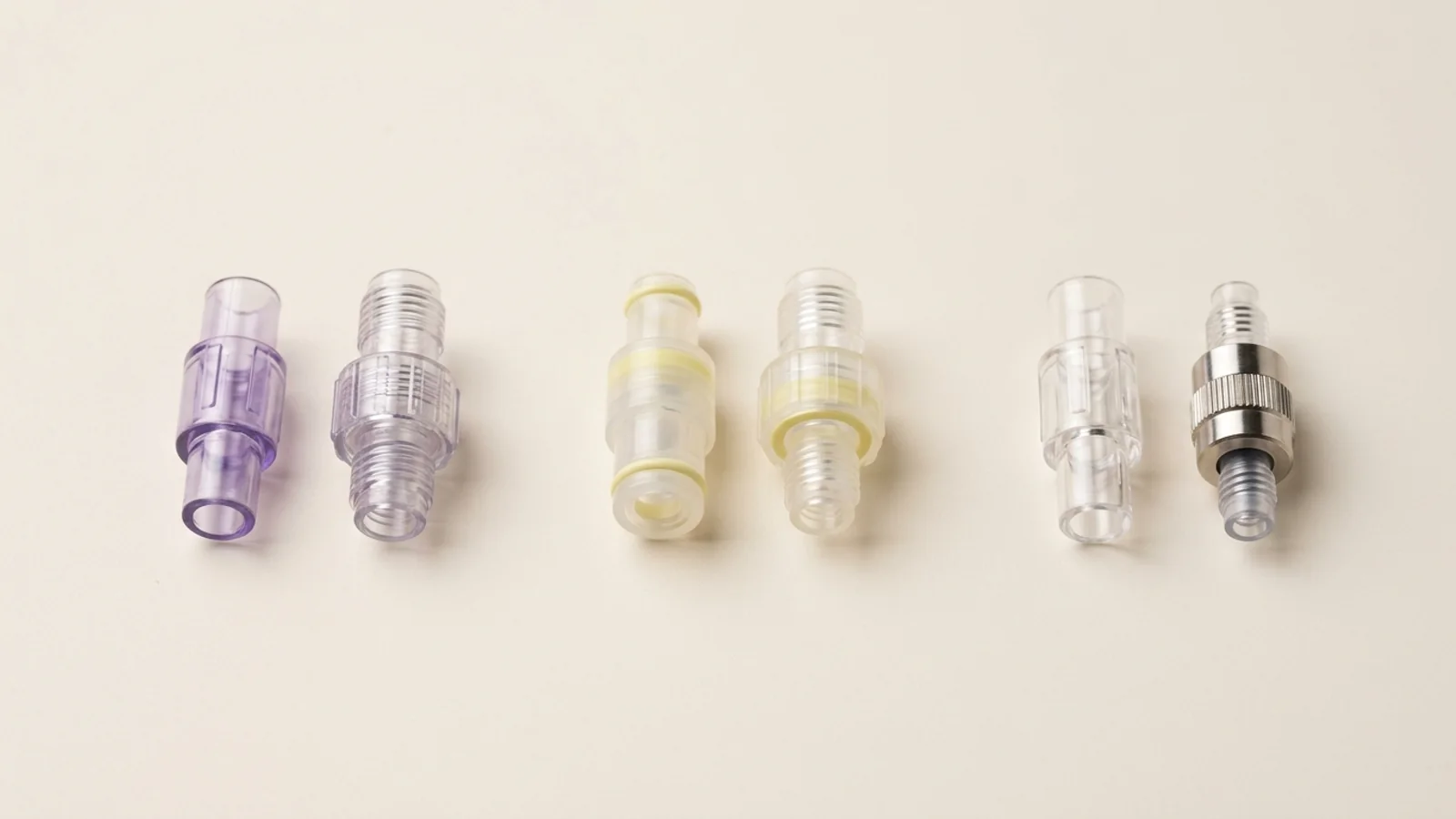
Specify the Connector Family by ISO 80369 Part, Not by a Universal Luer
A small-bore connector is defined across international medical device standards and regulatory frameworks as a fluid- or gas-conveying fitting with an internal lumen opening smaller than 8.5 millimeters. These precision fittings are installed on tubing assemblies, infusion lines, enteral feeding sets, hypodermic syringes, regional anesthesia kits, and respiratory accessories to join medical delivery systems to patient access ports. For decades, the global healthcare supply chain relied almost universally on the traditional 6% taper Luer connector geometry across nearly every clinical delivery discipline. Because identical Luer slip and Luer lock fittings were installed interchangeably on intravenous lines, enteral nutrition bags, epidural catheters, bladder irrigation sets, and tracheostomy cuff inflation lines, clinicians routinely faced severe misconnection hazards.
When physically compatible connectors exist across unrelated delivery routes, wrong-route attachments can cause high-harm events. FDA's published case studies include epidural tubing connected to IV tubing (epidural medicine delivered intravenously; the patient died) and IV tubing connected to a tracheostomy cuff port (IV fluid over-expanded the cuff and entered the lungs; the child died). Those are reported events, not incidence rates. ISO and FDA have advanced the ISO 80369 series of voluntary consensus standards. The series replaces a universal 6% taper Luer with application-specific connector geometries intended to reduce misconnection risk through inherent design. Designed non-interconnectability is not absolute: FDA states that if connectors do not conform to an applicable standard, misconnections can still occur, and adapters, device modifications, and mixed legacy inventory can re-create wrong-route paths.
For hospital procurement committees, value analysis teams, and clinical engineering departments, the primary purchasing rule is unambiguous: ISO 80369-7 (Luer) is strictly the intravascular and hypodermic connector standard. It must never be accepted as a universal or default connector for enteral, neural, or respiratory lines. Procurement specifications must map every fluid-delivery stock keeping unit (SKU) to its dedicated ISO 80369 part:
Enteral Nutrition and Drainage: Specify patient-end fittings to ISO 80369-3:2016 (including Amendment 1:2019), widely recognized in commercial supply channels by the trade designation ENFit.
Neural and Neuraxial Anesthesia: Specify regional block, spinal, and epidural fittings to ISO 80369-6:2025 (or its recognized 2016 predecessor during the active regulatory transition), commercially known as NRFit.
Intravascular and Hypodermic Delivery: Specify traditional Luer slip and Luer lock fittings strictly to ISO 80369-7:2021 on peripheral IV cannulae, sterile hypodermic syringes, hypodermic needles, and intravascular infusion lines.
It is equally critical to separate connector-family selection from broader device architecture. Specifying an ISO 80369-7 Luer connector on an intravascular line does not evaluate the overall performance of IV administration sets governed by 21 CFR 880.5440, nor does it specify ISO 8536-4 closure-piercing container spikes or drip chambers. Similarly, specifying an ISO 80369-3 enteral connector covers only the patient-end terminal and does not replace the comprehensive requirements of ISO 20695 for complete enteral feeding systems.
Color, Labels, and Tags Do Not Close a Misconnection Specification
Before designed non-interconnectability became a purchasing field, hospitals often relied on administrative controls: color-coding (including purple enteral hubs), adhesive tags, imprints such as 'feeding only,' and training. FDA's Medical Device Connectors overview states that color-coding, labels, tags, and training alone have not solved misconnections because they are not consistently applied and do not physically prevent the connections. FDA's September 2018 letter separately records, as reported events rather than incidence, 2 deaths, 24 serious injuries, and 32 device malfunctions related to enteral misconnections since 2011.
FDA's February 11, 2015 document, Safety Considerations to Mitigate the Risks of Misconnections with Small-bore Connectors Intended for Enteral Applications, is guidance for industry and FDA staff and contains nonbinding recommendations. It tells manufacturers submitting 510(k)s or modifying already-cleared enteral connectors that:
Color-coding, labeling, and tagging attached to the device, by themselves, are no longer sufficient to satisfy safety concerns regarding misconnection hazards associated with connectors such as 6% tapered Luer connectors.
The FDA reiterated this position in its Medical Device Connectors overview, noting that color-coding and labeling schemes are inconsistently applied across competing manufacturers, degrade over time, and fundamentally do not provide a physical barrier to attachment. When a clinician or caregiver attempts to mate two incompatible lines under time pressure, a 6% Luer connector will mechanically engage regardless of hub color or printed warnings.
ISO 80369-1: What General Requirements and FDA Recognition Actually Cover
The foundation of the entire small-bore standard portfolio is ISO 80369-1:2025 (Small-bore connectors for liquids and gases in healthcare applications — Part 1: General requirements, Third Edition, published October 2025). Part 1 establishes the overarching interface requirements and the standardized risk assessment methodology used to evaluate whether proposed connector geometries are inherently non-interconnectable with connectors in other functional categories.
ISO 80369-1:2025 identifies applications for which these small-bore connectors are intended to be used, which include, but are not limited to:
Respiratory applications (ISO 80369-2);
Enteral applications (ISO 80369-3);
Limb-cuff inflation (IEC 80369-5);
Neural applications (ISO 80369-6);
Intravascular or hypodermic applications (ISO 80369-7); and
Other clinical use cases utilizing an ISO 80369-7 small-bore connector.
The 2025 third edition's public application list uses 'neural applications' rather than the 2018 second edition's 'neuraxial.' That is an edition and title change. It is not proof that two suppliers' parts are equivalent, and it is not a reason to treat NRFit as interchangeable with Luer.
From a regulatory compliance perspective, the FDA recognized ISO 80369-1:2025 in full under Recognition Number Rec# 5-147 (entry date December 22, 2025). FDA will accept declarations of conformity to ISO 80369-1:2018 (Rec# 5-121) in support of premarket submissions until December 17, 2028. After that transition, declarations of conformity to Rec# 5-121 will not be accepted. The tender should name the edition actually declared; recognition is not a hospital purchasing statute.
Procurement teams must recognize that citing ISO 80369-1 alone on a purchase order is insufficient. Part 1 defines the testing and non-interconnectability framework; hospital line-item tenders must cite the specific particular standard (Part 3, Part 6, or Part 7) that corresponds to the clinical application.
ISO 80369-3 / ENFit: Enteral Patient-End Fields and Public Exclusions
For all enteral clinical applications, the dedicated international standard is ISO 80369-3:2016 (Small-bore connectors for liquids and gases in healthcare applications — Part 3: Connectors for enteral applications, including Amendment 1:2019). The FDA recognized this standard in full under Recognition Number Rec# 5-123. In commercial hospital supply chains and distributor catalogs, this connector geometry is commonly known as ENFit.
ISO 80369-3 specifies dimensions and requirements for the design and functional performance of small-bore connectors on enteral medical devices and accessories. Dimension tables are paywalled and are not reproduced here. Public examples of those devices include:
Enteral feeding sets;
Enteral drainage sets;
Enteral syringes; and
Patient-interface devices, including access ports.
While the ENFit trade name is pervasive, hospital tender documents must require proof of conformity to ISO 80369-3:2016+A1:2019 rather than relying on trademarked marketing terms. Trademark claims do not provide verifiable evidence that two competing suppliers have engineered their connector tooling to compliant dimensional tolerances.
Public Scope Exclusions Under ISO 80369-3
Hospital buyers must avoid over-specifying ENFit across lines where ISO 80369-3 explicitly does not apply. The standard's public scope officially excludes the following device categories:
Oral-Only Dispensing Syringes: An oral-tip syringe intended to administer directly to the patient's mouth and not to connect to another medical device.
Gastric Suction-Only Devices: Gastric suction-only medical devices.
Retention Balloon Inflation Ports: Connectors used only to pressurize or depressurize a retention balloon that holds an invasive enteral device in place.
Rectal Access Devices: Medical devices for rectal drainage, rectal administration of medicines or fluid, and other rectal-access devices.
Gastrointestinal Endoscopy Equipment: Gastrointestinal endoscopy equipment.
Skin-Level Gastrostomy Interfaces: Skin-level gastrostomy medical devices.
FDA product classification PIO (device name: Enteral Specific Transition Connectors, regulated under 21 CFR 876.5980) lists three separate recognized consensus standards on the same record. Connector-family selection is therefore not the same specification as reservoir connectors or the full feeding-system standard:
Patient-End Connectors: Governed by ISO 80369-3:2016+A1:2019 (ENFit geometry).
Reservoir / Bag Delivery Connectors: Governed separately by ISO 18250-3:2018 (reservoir-delivery connectors for enteral application).
Enteral Feeding System Performance: Governed by ISO 20695:2020 (enteral feeding systems — design and testing).
ISO 80369-6 / NRFit: Neural Connectors and the 2016-to-2025 Edition Window
For regional anesthesia, epidural anesthesia, spinal punctures, and peripheral nerve blocks, the applicable standard is ISO 80369-6:2025 (Small bore connectors for liquids and gases in healthcare applications — Part 6: Connectors for neural applications, Second Edition, published May 2025). In commercial clinical distribution, this dedicated connector profile is widely known as NRFit.
The 2025 second edition cancels and replaces ISO 80369-6:2016, updating the title from 'neuraxial applications' to 'neural applications' to reflect broad clinical use across both central neuraxial and peripheral nerve block delivery. The FDA recognized ISO 80369-6:2025 in full under Recognition Number Rec# 5-146 (entered December 22, 2025). Declarations of Conformity citing the 2016 first edition (Rec# 5-108) remain valid for FDA premarket submissions through December 17, 2028.
ISO 80369-6 standardizes two primary mechanical configurations:
NRFit Lock Connectors: Lock connectors, used where a threaded collar is specified.
NRFit Slip Connectors: Slip connectors, used where a friction-fit tip is specified. K201356 includes NRFit slip configurations on a loss-of-resistance syringe family.
FDA 510(k) summary K201356 (plastic loss-of-resistance syringes) lists separate catalog configurations for Luer lock, Luer slip, NRFit lock, and NRFit slip barrels. That summary cites ISO 7886-1 for the syringe and treats ISO 80369-6:2016 and ISO 80369-7:2016 as distinct connector-performance standards. One 510(k) is not a dimensional specification for every NRFit SKU; it shows that lock versus slip and NRFit versus Luer are different connector types.
ISO 80369-6 is intended to be non-interconnectable with other application parts in the series, including ISO 80369-7 Luer and ISO 80369-3 ENFit. That design goal is defeated if cross-application adapters remain on the formulary or if devices are modified. When converting a neural pathway, buyers should plan inventory so lock-versus-slip style and the named ISO 80369-6 edition are consistent across the SKUs that must mate, rather than treating leftover Luers as equivalent fittings.
ISO 80369-7 / Luer: Intravascular and Hypodermic Applications Only
The traditional 6% taper Luer fitting is standardized under ISO 80369-7:2021 (Small-bore connectors for liquids and gases in healthcare applications — Part 7: Connectors for intravascular or hypodermic applications, Second Edition, published May 2021). The FDA recognized this standard in full under Recognition Number Rec# 5-133 (entry date December 21, 2020). ISO 80369-7 is under systematic review (ISO stage 90.20 as of 15 April 2026) within ISO/TC 210.
ISO 80369-7 governs male and female Luer slip and Luer lock fittings installed across standard vascular access and general injection consumables, including:
Sterile Hypodermic Syringes (device geometry is covered on the published syringe page, not this connector map);
Hypodermic Needles (hub color and needle geometry are covered on the published needle page);
Peripheral IV Cannulae (gauge and hub color are covered on the published cannula page); and
IV Administration Sets (set architecture, spikes, and pumps are covered on the published administration-set page, not here).
Public Note 2 in ISO 80369-7 states that the Luer connector was originally designed for use at pressures up to 300 kPa. That historic design note is not a buyer-invented pressure rating for every IV set.
Crucially, ISO 80369-7 contains explicit public exclusions:
Haemodialyser, haemodiafilter, and haemofilter blood-compartment ports, and haemodialysis equipment connectors specified in ISO 8637; and
Infusion-system closure-piercing connectors governed by ISO 8536-4 (the sharpened spikes used to penetrate IV fluid containers).
Procurement specifications must strictly confine ISO 80369-7 Luer fittings to vascular and hypodermic product lines. A supplier proposal offering 'universal Luer fittings' on enteral feeding sets or neuraxial kits must be rejected immediately during technical tender evaluation.
Comprehensive ISO 80369 Connector Family Specification Matrix
The following specification matrix provides a neutral, verified reference mapping clinical delivery routes to their designated ISO 80369 standard parts, FDA consensus recognition numbers, common market designations, and public scope boundaries:
| Clinical Delivery Route | Applicable Standard & Edition | FDA Recognition Number | Common Market Name | Standard Coupling Styles | Public Scope Exclusions |
|---|---|---|---|---|---|
| Enteral Nutrition & Drainage | ISO 80369-3:2016 + Amd 1:2019 | Rec# 5-123 | ENFit | Lock (patient-end); dedicated syringe interface | Oral-only devices, gastric suction-only, retention-balloon inflation, rectal access, GI endoscopy, skin-level gastrostomy |
| Neural & Neuraxial Anesthesia | ISO 80369-6:2025 (or 2016 ed.) | Rec# 5-146 / Rec# 5-108 | NRFit | Threaded lock, friction slip | Specifies connectors, not the needles, catheters, or syringes that use them |
| Intravascular & Hypodermic | ISO 80369-7:2021 | Rec# 5-133 | Luer Slip / Luer Lock | 6% taper slip, threaded lock collar | Enteral feeding lines, neural blocks, hemodialyzer ports, ISO 8536-4 container piercing spikes |
| Breathing Systems & Respiratory | ISO 80369-2:2024 | Rec# 1-195 | R1 / R2 Respiratory | R1 (low pressure), R2 (gas therapy) | Standard 15 mm / 22 mm breathing circuit conical connectors, IV lines, enteral feeding sets |
| Limb-Cuff Blood Pressure | IEC 80369-5:2016 | Rec# 5-107 | Limb-cuff inflation | Specified in IEC 80369-5; not a Luer | Specifies connectors, not the sphygmomanometer or cuff devices that use them |
FDA Recognized Standards Transition Windows and Lifecycle Schedules
When auditing supplier Declarations of Conformity (DoC) and premarket submission packages, procurement and quality assurance teams must verify whether declared standards remain within active FDA recognition transition windows. The table below details the transition schedule across the ISO 80369 family:
| Standard Identifier | Current Recognized Edition | FDA Recognition Number | Superseded Recognized Edition | Transition Sunset Date |
|---|---|---|---|---|
| ISO 80369-1 (General Requirements) | Third Edition (2025-10) | Rec# 5-147 | Second Edition (2018-11, Rec# 5-121) | December 17, 2028 |
| ISO 80369-3 (Enteral Connectors) | First Edition (2016) + Amd 1:2019 | Rec# 5-123 | None (current active baseline) | Active Baseline |
| ISO 80369-6 (Neural Connectors) | Second Edition (2025-05) | Rec# 5-146 | First Edition (2016-03, Rec# 5-108) | December 17, 2028 |
| ISO 80369-7 (Intravascular / Hypodermic) | Second Edition (2021-05) | Rec# 5-133 | First Edition (2016-10, Rec# 5-115) | Superseded (Active: 2021) |
| ISO 80369-20 (Common Test Methods) | Second Edition (2024-11) | Rec# 5-144 | First Edition (2015-05, Rec# 5-97) | July 2, 2028 |
Tender and Receiving Fields: DoC, Lock vs. Slip, Adapters, and Test Methods
To turn this map into purchasing language, healthcare procurement and clinical engineering teams should put the following fields into hospital tender templates, master supply agreements, and incoming receiving inspections:
Mandate Specific ISO 80369 Part and Edition: Line-item descriptions should name the designated part and edition (for example, 'ISO 80369-3:2016+A1:2019 for enteral' or 'ISO 80369-6:2025 for neural'). Vague descriptions such as 'safety connector' or 'ENFit-compatible' should be rejected.
Specify Coupling Mechanism Style (Lock vs. Slip): Requisitions should state lock versus slip as a field. Do not leave coupling style unspecified for SKUs that must mate.
Name the ISO 80369-20 test-method edition: The manufacturer DoC should name ISO 80369-20:2024 (Part 20: Common test methods, FDA Rec# 5-144) or ISO 80369-20:2015 (Rec# 5-97) through July 2, 2028. Require the named edition; do not copy paywalled numeric acceptance criteria into the tender.
Require a manufacturer Declaration of Conformity (DoC): The DoC should identify the exact catalog SKUs and declare conformity to the named ISO 80369 particular part and edition, plus the named ISO 80369-20 edition. A DoC used in a 510(k) is a manufacturer attestation against a recognized standard; it is not a hospital statute and not a laboratory certificate that replaces the named part.
Managing Transition Adapters Under FDA Purchasing Guidance
In a 7 September 2018 letter of recommendations, The FDA Encourages Use of Enteral Device Connectors that Reduce Risk of Misconnection and Patient Injury, FDA recommended that hospital purchasing departments, material managers, and clinical supply distributors:
Purchase enteral devices that comply with ISO 80369-1 or ISO 80369-3;
Check labeling or the manufacturer for ISO-standard identity;
Minimize the use of transition adapters;
Do not use cross-application connectors (including adapters engineered to bridge an enteral line to a vascular Luer); and
Do not modify or adapt devices, because that may defeat the safety system.
Route Isolation Workflow and Verification Architecture
The following engineering workflow illustrates how hospital procurement, value analysis, and receiving inspection verify small-bore connector compliance from initial clinical requisition to clinical release:
flowchart TD
    Req["Clinical Consumable Requisition"] --> Route{"Identify Intended Delivery Route"}
    Route -->|"Enteral Nutrition & Drainage"| Enteral["ISO 80369-3:2016+A1:2019 (ENFit)<br/>FDA Rec# 5-123"]
    Route -->|"Neural / Neuraxial Anesthesia"| Neural["ISO 80369-6:2025 (NRFit)<br/>FDA Rec# 5-146 / Rec# 5-108"]
    Route -->|"Intravascular & Hypodermic"| Vascular["ISO 80369-7:2021 (Luer)<br/>FDA Rec# 5-133"]
    Route -->|"Breathing & Respiratory Lines"| Resp["ISO 80369-2:2024 (R1 / R2)<br/>FDA Rec# 1-195"]
    Enteral --> Verify["Tender & Receiving Verification:<br/>1. Audit Manufacturer Declaration of Conformity (DoC)<br/>2. Verify ISO 80369-20 Test Method Compliance<br/>3. Verify Lock vs. Slip Coupling Style<br/>4. Ensure Absence of Cross-Application Adapters"]
    Neural --> Verify
    Vascular --> Verify
    Resp --> Verify
Verify --> Release["Accepted into Clinical Supply Chain"]Adjacent Families and Scope Boundaries: What This Specification Is Not
To preserve technical clarity in hospital tenders, procurement teams must understand the scope boundaries separating the ISO 80369 small-bore series from adjacent device standards:
Respiratory Connectors (ISO 80369-2:2024): ISO published the first edition in July 2024. FDA recognizes it in full as Rec# 1-195 (the recognition record lists First edition 2024-09; date of entry May 26, 2025). ISO 80369-2 specifies two dedicated small-bore connectors: R1 for lower-pressure breathing gas circuits (up to 15 kPa) and R2 for higher-pressure oxygen therapy tubing (15 kPa to 600 kPa). Those connectors are intended to reduce misconnection with unrelated small-bore families. Large-bore 15 mm and 22 mm conical breathing-circuit connections are outside this small-bore part and must not be specified as ISO 80369-7 Luers.
Urinary and Urethral Connectors (ISO 80369-4): While originally reserved in the ISO 80369 series framework for urethral and urinary drainage applications, ISO 80369-4 currently has no published standard in the ISO catalogue. Foley catheter inflation valves and urinary drainage bags remain outside the active ISO 80369 standardized connector portfolio.
Limb-Cuff Inflation Connectors (IEC 80369-5:2016): Limb-cuff inflation connections, including those between a sphygmomanometer and its cuff, are specified by IEC 80369-5:2016 (FDA Rec# 5-107, complete recognition, including the listed 2017 and 2021 corrigenda). That family is not a Luer and is not interchangeable with ISO 80369-7.
FDA's Examples of Medical Device Misconnections page records high-harm reported cases, including epidural tubing connected to IV tubing and IV tubing connected to a tracheostomy cuff. The same page states that connectors conforming to recognized standards such as ISO 80369 are designed to help reduce misconnection risk, and that misconnections can still occur if connectors do not conform to an applicable standard. Specify the named part; do not treat the series as a guarantee that wrong-route attachment is impossible.
Technical Tender Checklist for Healthcare Purchasing and Clinical Engineering
Clinical engineering, value analysis, and materials management departments should apply the following verification checklist before awarding contracts or accepting delivery of small-bore consumable lots:
| Verification Parameter | Mandatory Tender Requirement | Supplier Submission Evidence | Tender Rejection Trigger |
|---|---|---|---|
| Application Route Alignment | Connector must match labeled anatomical delivery route exactly | Device labeling, IFU, and FDA 510(k) indications statement | Luer connector offered on enteral, neural, or respiratory lines |
| ISO Standard Identity | Explicit citation of applicable ISO 80369 part and edition | Manufacturer Declaration of Conformity naming the ISO 80369 part and edition | Generic claims of 'safety fit', 'compatible', or unverified trade names |
| Performance Testing | Mechanical and leak testing per ISO 80369-20:2024 (or 2015 ed.) | DoC that names the ISO 80369-20 edition used | DoC that omits a named ISO 80369-20 edition |
| Coupling Mechanism | Specification of threaded lock collar versus friction slip tip | Catalog SKU that states lock or slip | Unspecified or ambiguous connection style for continuous lines |
| Adapter Policy | Zero cross-application adapters; transition adapters sunset-controlled | Written statement confirming absence of cross-application bridge fittings | Inclusion of unauthorized Luer-to-ENFit or Luer-to-NRFit bridge adapters |
Write the tender to the ISO 80369 part that matches the labeled intended application, require lock versus slip, and treat color, tags, and ENFit/NRFit market names as secondary identifiers. Require a manufacturer DoC that names the particular part and the ISO 80369-20 edition. Keep transition adapters as documented, time-limited conversion SKUs. ISO 80369 is a recognized voluntary consensus-standard path plus FDA guidance; it is not a U.S. legal mandate to adopt a trademark, and it does not make misconnection impossible if adapters, modifications, or legacy Luers remain in mixed use.